Showing posts with label Max Ernst. Show all posts

Friday, 24 November 2017

Collage:Part two

Frances Stark

Frances Stark is one of several artists that are returning to collage as their art form of choice. However the times have changed and contemporary collage practice seems to be purposely both politically and morally dumb. It has often been said that we get the art we deserve and artists like Stark give us a timely reminder of this. I think this is a good thing, there are times we need reminding of how stupid things are and 'serious art' can just miss the point, Stark's 'Clever' and 'Stupid' signs pointing to the fact that it is sometimes very easy in times like this to become confused and politically directionless. Perhaps today's serious art is tomorrow's poor joke. 


Frances Stark

In the time of post 'Dumb and Dumber' an image such as 'I went through my bin' has that throw away quality that suggests Stark just doesn't care and will just do something, anything to make some art. It might be inane but so what, life's like that. 


Frances Stark

Stark uses old fashioned carbon paper to trace off images that she is interested in and will range across a wide range of both high art and low art sources, often using quotes from literature in order to make her point, which appears to be the impossibility of finding true meaning in what we do and how we look for truths in the work of famous literary figures, but fail to find it. 
There are a lot of collage artists around at the moment and in an age of the throwaway it is probably the medium of choice for artists that want to feel politically true to the zeitgeist of the day. 


Alex Daw

Alex Daw's work suggests the almost suffocating amount of stuff that is thrown away, his work is layered with collaged images, both people and environments becoming clogged up with piles of torn out possibilities. 
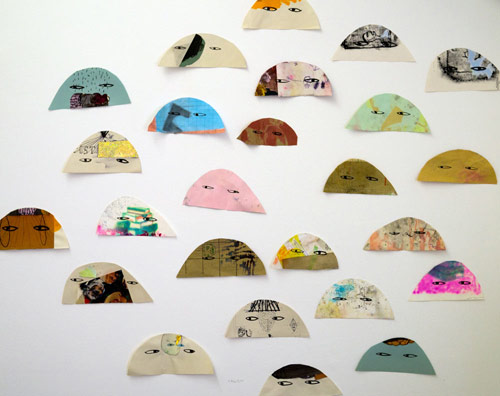
Craig Atkinson's irreverent take on things pitches his scraps of collage against the last vestiges of spiritual meaning, his 'God' a captain Bird's Eye of fish fingers fame, cut out shouting in the void, lost in roughly painted yellow space. In another image tiny half moon snippets of faces suspiciously avoid direct eye contact with us, as if they know something we don't, all part of Atkinson's precarious world of jumbled bits and confused juxtapositions, tales of daft punk associations and irreverent pokes at the authority of art and the old grand narratives. 


Craig Atkinson

Christian Marclay has recently been making small collages from Japanese manga comics and then has them scanned and edited before applying them to large wood panels and getting them cut out and prepared for printing using both traditional wood carving and modern laser cutting techniques. Marclay's 'the Clock' is a classic example of how collage can be used in a video format and if you have not seen it there is a link at the bottom of this post.

Christian Marclay's Screams

Christian Marclay

Marclay has had a long interest in sound and how we represent it and in comic books he found the perfect material from which to make collages. Comics have developed a very sophisticated set of word images to deal with sound and if you want to explore this in more depth see Scott McCloud's 'Understanding Comics'.

From Scott McCloud's 'Understanding Comics'

Marclay's print is based on a transcription made from a collage, that is itself constructed from a variety of comic sources. The interesting issue here is that the collage material is taken back into a print making process that brings all the separate elements together into the same world. Print making and collage have a long intertwined history, so much of the material for collage coming from the rise of print as a production process, a process that is still with us even though we were told that computers would bring in a paperless society. The fact that commercial printing processes are now readily available to everyone and that it is so much easier to scan or make a photographic image of something, has paradoxically led to a further explosion of printed matter.

Alex Rose introduces an almost ritualistic approach to collage, often using aged papers, combined with cheap printing processes to give the effect of images arriving from another time. The combination of different printing processes and the re-photographing or scanning of collaged images and then re-editing in Photoshop, has allowed artists like Rose working in this area to develop a much wider set of sensibilities. College can now be combined with drawing or assemblage, be re-positioned back into the world and photographed again, becoming either part of an on-line culture or operating as collage has always done, as a low technological reminder of the poetry and Surreal potential of the everyday to become magical or simply beautiful. 

Alex Rose

Alex Rose

A personal favourite of mine is Christiane Kowalewsky. She produces an endless stream of images and seems to singlehandedly want to ensure that the old magazines and books of this world are going to live on in her personal world of surreal encounters. 

Christiane Kowalewsky

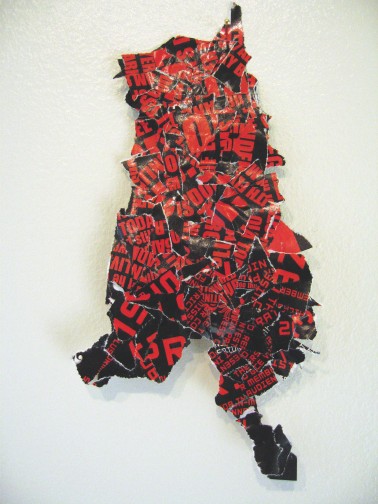
Someone who is concerned to bring back into collage its status as a medium of political and social critique is Tariq Alvi. Tariq Alvi’s work is an interesting combination of intense highly wrought surfaces that are a result of painstaking dissection of printed materials, such as cutting out hundreds of price tags or items of jewellery and the reassembling of these things in such a way that they are re-constructed as a challenge to our notions of both form and format. Again we find collage a useful tool with which to de-contextualise consumerism, and in Alvi’s case he will also at times include references to the sexually charged hidden drivers hidden behind our desire to consume. 


Tariq Alvi

Max Ernst, Kurt Schwitters and Hannah Höch it could be argued set out the three main directions that collage would take. Ernst demonstrated the Surreal potential of composite images, his 'La femme 100 têtes' collage novel set the standard for this type of work both in imagery and in production values. Ernst created his first collages in 1919, using old scientific manuals and illustrated catalogues to make irrational images that tapped into the world of dreams and the subconscious, as well as celebrating the possibilities engendered by an image's chance encounters.

Max Ernst

Max Ernst

Kurt Schwitters saw a different potential on collage, this was the creation of beauty from detritus. He used his formalist understanding of constructivism to create compositions that have all the sophistication of a Classical painting, however he uses the most banal materials, such as used bus tickets and torn envelopes and in doing so makes us aware of how all things in this world have the potential to be beautiful.


Kurt Schwitters

Hannah Höch added a political element into the way that collage was used. From a critique of the financiers and military elite during the depression, to complex discussions around gender and identity in relation to the role of ‘New Woman’ in Weimar Germany, she produced many biting and poignant collages.

Hannah Höch

Hannah Höch

This post is a reminder that collage is an important and powerful drawing tool and in no way is it a summary of what is a huge subject, one that I shall return to several times. Hopefully it will encourage readers to begin to explore the subject much further and to try out for themselves the potential of using collage to reflect upon the society in which we live. 

References

Ades, D. (1986) Photomontage London: Thames & Hudson

Krohn, S (2013) The Age of Collage: Contemporary Collage in Modern Art Berlin: Die Gestalten Verlag


Busch, D. H. (2016) Age of Collage 2 Berlin: Die Gestalten Verlag


Brereton, R and Roberts, C (2014) Cut & Paste: 21st-Century Collage London: Laurence King        

See also

Tuesday, 19 July 2016

Collage: Part one

In a world that produces vast quantities of waste perhaps one of the best ways to deal with the issue is to work in collage. This has several advantages.
The first is that whatever you do it will have a direct relationship with the world. Whether you are going to make figurative narratives from the materials you select or abstract compositions, in either case the materials themselves will carry part of the work's meaning for you.
The second advantage you automatically have when using collage is that the materials begin to suggest ideas as you move them around and into new conjunctions with each other. There will be moments when individual elements 'fit' with each other and the more collages you make the more you become 'attuned' to what fits and what doesn't.
John Stezaker's collages are a case in point. He keeps large image files and when he is working tries out image after image, looking for that perfect fit. When it works his images feel as if they have simply 'arrived', the juxtaposition looks as if the elements were made for each other.  By choosing photographic imagery of faded movie stars he is able to question how the photograph can work as a documentation of truth, holder of memory, and symbol of modern culture, all at the same time. In his Marriage series he uses publicity shots of old film stars, often overlapping them to make hybrids of male and female characters. By using old photographs we are reminded of how photographs are stylised, the further away in time from the present the more their making is revealed as a series of choices and not a simple indexical record.


John Stezaker: From the Marriage series


The 'fit' between male and female movie stars above is very astute, the chins line up and so do the eyes and hair lines, the particular lighting in both is characteristic of studio star photographs, therefore they tonally fit and by having these two characters join to form a horizontal image, we are given a suggestion that they are lying down, in a state of 'revere' or 'daydream', perhaps each character dreaming of the other. Both of course are manufactured by the Hollywood machine, the 'theatre of dreams'. The other issue about the above image is that Stezaker simply cuts one image straight through and places it on top of the other and we can see clearly the misalignment of the two photographs because the white borders show where the images overlap. He clearly wants us to remember this is a collage and that we should not be seduced into it being anything else but that.


Kurt Schwitters


After its early introduction in the Cubist work of Picasso and Braque, two figures dominate the early history of collage and to some extent they also set out the two main directions in which it will become used. Kurt Schwitters used to carry a suitcase around with him so that he could collect street detritus; ticket stubs, discarded papers, scraps of cardboard etc. and with these constructed what he called his 'Merz'. He wanted to both create connections with and celebrate the connections between all the various things in the world. However the underlying principle around which he did this was the formal play of abstract composition. He would bring his various collage elements together using structuralist principles and paved the way for the use of collage as a method of building abstractions. Max Ernst took a much more figurative approach, using collage's potential to release unexpected imagery and as a heightened form of imaginative play.


Max Ernst

Both these artists had an enormous influence on the development of collage as a genre, it could be argued that they stand for the two central planks of modernism, abstraction and Surrealism.
Collage has a simple way of constantly refreshing itself. Because society's waste materials are constantly changing as the relentless march of consumerism produces more and more goods, every generation of artists using collage is faced with materials which reflect the particular moment they live through. A classic example is Rauschenberg, the imagery for his Dante's Inferno prints is located firmly in the 1960s.

Strangely enough, several collage artists have resorted to using already dated imagery in their work. Stezaker in using old movie stills and Ernst himself in using old Victorian illustrations. This is perhaps indicative that many collage artists are also collectors and lovers of memorabilia. There is also an issue of how nostalgia gives renewed meaning to things. An ordinary cigarette package when seen again 20 years later tells a story of the 'design of the times'.

It was Rauschenberg who termed the word 'assemblage', which indicated a point whereby the objects collaged into art pieces were becoming larger and more three dimensional, the line between drawing (collage) and sculpture (assemblage) being somewhat blurred and always seeking definition. For instance Sarah Sze's 3D installations are clearly linked together by linear relationships and they stem from her interest in drawing.


Sarah Sze
Hew Locke is another artist that I would categorise as someone who thinks through drawing, but as an image maker, rather than a formalist.


Hew Locke, Jungle Queen II, 2003


Hew Locke makes his assemblages of the Queen out of thousands of plastic toys, flowers, fruits etc. but the underlying image could be the flat 2D image of a postage stamp. There is an interesting video of him talking about his work here.


The line between sculpture and drawing is very fine and installations often tread right on the border. For instance this collage on sticks (below) by Geoffrey Farmer uses the one sidedness of drawing and flat imagery to his advantage, which also gains presence from the fact that a virtual forest of wooden staves is used to hold the imagery in place.


  Farmer's work also reminds us of the importance of presentation and how when given a certain type of space to exhibit in you sometimes have to be very inventive in how you think about audience engagement. In this case he has used a corridor space really well.

Finally, there are artists such as Mark Lewis that bring together traditional drawing techniques with collage. He makes graphite surfaces and drawn elements that he then cuts up and reassembles. In this way he can have the control over his materials that a traditional artist has and also benefit from the ability of collage working to allow him to 'find' a composition that suits the dynamic he is looking for. The shaped edges of his works are a natural consequence of the working process.  


Mark Lewis: Graphite and paper collage

Collage and its cousin assemblage, are ways of working that didn't exist before the 20th century, so they could be regarded as 'the' modes of expression that are particular to our times of Capitalist mass production. There are always new approaches to working with found materials and as I stated at the beginning of this post by using waste materials to make your work, you begin the process of also commenting on the state of a society that produces so much.

If you want to read more about this a good start is; The Age of Collage: Contemporary Collage in Modern Art  by Krohn, Busch and Hellige

This post on collage also overlaps somewhat with some of the comments made in an earlier post about drawing on top of photographs and the work of Robert Rauschenberg.                               


See also:
Collage part two
Collage part three
Collage part four