Day two of the conference began with parallel sessions.
I attended the four presentations within the Drawing Across session, entitled 'Vulnerable methodologies in art and science'
1. Chloe Masi, Gary Embury, Lucy Ward, and Anouk Mercier: Drawing as a dynamic research tool: Exploring its diverse applications and inclusive perspectives.
I had met Lucy Ward at a previous conference in Bristol, so because I had then occasionally tried to keep up with what she was working on, was to some extent aware of what was happening, especially as I had sent in a possible contribution (not accepted) to the forthcoming Bloomsbury book on drawing. Once the session got started, the first interesting issue for myself was that Gary and Lucy told us that the ideas developed out of a staff development day, and I wondered if my own institution would take such a pragmatic approach to the development of a visual research strand. I was also, in terms of institutional parallels, interested in the take up of life drawing in Bristol, as it seemed that students from university wide disciplines all found it useful. In my own institution a senior manager had banned it and although he has since left, it seems to be only the student union that keeps it going for undergraduate students. It is though not taught and the session I dropped in on, just to see how it was organised, was very poorly constructed, because there was no access to a professional tutor, who could focus the students' attention and give structure to the looking.
The Drawing Research Group at UWE was outlined and we were shown 'Drawing Review' the publication that attempted to bring together findings from projects. (Including a drawing of myself, made when I presented at a pre-covid event) Drawing in relation to reportage and community practices was introduced, including work done with asylum seekers and we were asked to consider drawing as a tool that was particularly appropriate for working in sensitive situations. A particular drawing residency in a hospital looked to have developed some excellent practices, as it included sessions on visual thinking and diagrammatic drawing that would be attended by health care professionals as a way to enhance skills in furthering communication within their profession. For instance if a complex task was required, could a diagram or comic page type set of sequences communicate the stages needed to complete this task? Some of the issues raised were very close to the ones I was working with and I could see considerable overlap, especially in how drawing might be used to communicate type and level of pain. This was linked to the role that drawing might eventually take in the collection of data within the medical profession. Drawing it seems could have multiple roles within a clinical setting and Chelsea and Westminster Hospital, which was the institution they had been working with, looks like an amazing resource for anyone interested in the arts and health. Finally the Bloomsbury Handbook on Drawing was introduced, an ongoing project that will attempt to collate and organise a world wide approach to what is going on within the various drawing professions and interests. A task that seemed to me Sisyphean, but one that was being spread between several people.
2. Lucy O'Donnell: Formless
Lucy was also someone I had also met before as she used to work at York St. John University and I had given presentations there in the past and seen her previous work. She had now moved to Ireland and was making work in response to her experiences of pregnancy. I wrote, 'Little earth bound tales', whether this was a quote from Lucy or whether she was quoting someone else I'm not now sure, but it was a phrase that resonated with me, we all have these stories and they are vital to our understanding of who we are and where we fit into the various communities we find ourselves within. Lucy was using techniques of erasure to find herself through the work she was making. She was cutting the images out from old comics, leaving behind a matrix of empty pages, the various gutters between images, remaining, rather like the steel frameworks and empty window sockets of buildings that have been bombed, an image we are seeing more and more of, as wars proliferate across the world. In some frames bits of images were still left, her sensibility as to whether to cutaway or leave, gradually developing a personal narrative, out of which she had begun to re-construct her own images. She was using collage as a prompt for poetry, a resource out of which the poetic image might arrive as she constructed bodies out of comic bits. Lucy was reflecting upon several issues as she made these collages. One was the nature of being pregnant and its normality. She had been thinking through the notion of 'ableist' societies, or the discrimination and social prejudices that we can have against people with physical or mental disabilities; and how pregnancy can be something whereby it can become a disability, especially if something unexpected occurs. I was reminded of the difficulties faced by my daughter, who nearly died when she was pregnant and of how many women have had either life threatening issues to face or who have died in the past. It was however 'miscarriage' that she was asking us to consider, a pregnancy without birth. It was the relationship between the empty frame and the empty womb we were being asked to see and the need to 'give birth' to something, even if, as it was in this case, what were 'born' were fragmented bodies that were being built from the pictorial elements of the comic book pages. Images, that in turn were made from images that had been cut out of their own frames. The term, 'mother/other' suggested that as a society we do not really want to think about the mother who doesn't give birth; this being seen as abnormal, and Lucy was reminding us that as an artist she had a right to make self portraits that confronted these issues and that she would put her collages in frames chosen to remind us of the honorific values we place on the normative images usually found in this context.
3. Philip Cabau and Maria Manuela Lopes: Mirrored experiences
We were asked to consider, body, space and time. MID Mirror Identity Drawings is a project involving students and professors from eight European universities in the arts, from very different geographical and cultural contexts. It aims to explore the subject of identity as explored through the medium of drawing. The work done so far has exposed the limitations of curriculum, especially as a range of European partners have been constructed. We were given an overview of the symposium held in May, where it seemed many of the project's themes were developed. The work will be going on line and it is hoped that drawing will become a tool for the research and understanding of identity.
4:Veronica Cordova de la Rosa: Drawing across boundaries:Exploring creative art education in a prison setting
Veronica had been using Betty Edwards inspired drawing exercises to help structure drawing workshops held in a London prison. The prison environment was a tough one and it seemed that she had survived it due to her own background of being Mexican, and therefore prisoners who were aware of Mexican American gang subculture, gave her respect. I had worked in similar environments in Yorkshire so understood the context. I wondered if she was aware of the work of Jeremy Deller and the Koestler Award, and whether or not access routes into further education were possible for prisoners? The prison she was working in in London, seemed to be dedicated to high end security, so I suspected not.
Workshop session
This was the session whereby I had to deliver my own workshop.
Under the umbrella title: Hybrid knowing: Spaces between art and science, I delivered a workshop entitled: Drawing the somatic body: Visual problem solving and imagineering.
It seemed to go well, but I was stressed because I only had an hour and we began 15 minutes late because people wanted to have a proper break after having to sit through 4 complex and detailed presentations. After a very rushed presentation, I had people working in pairs, using drawing to visualise a feeling. The session was focused on a constant interrogation of what was being produced, so that the participants could get to grips with the need to always consider the awareness and view point of others and that any difficult concept when being communicated needs to consider and work with the audience it is meant for. Participants hopefully also grasped the idea behind iterative working, i. e. by doing something again and again, and critiquing it between iterations, we can always improve it.
The most important issue to come from the workshop was my realisation that the definition of drawing was having to become more inclusive. We had a sounding session at the end, whereby all the drawings were given a 'sound' related to a synesthesia effect. This sound was another communicative aspect of the drawings made and I felt it was integral. Every pair of participants also spoke earnestly about their conversations as they had tried to 'draw out' from each other what their interoceptual drawings might look like. Their conversations including body language as much as spoken languages. (This was a very multi cultural workshop, with several languages being spoken, even though English was the one in general use) In effect the communication was a multi-modal one and various conversations held during the workshop led me to think about a future re-presentation of the workshop format, in such a way that the concept of 'drawing' could be seen by participants as being much more tied to their understanding of themselves as an animal, inhabiting a body that used drawing as a natural extension of the type of being they were.
After lunch the keynote speech 'Drawing in between worlds: Figuring Contingency' was delivered by Nikolaus Gansterer.
I was really looking forward to listening to this talk because I have for a long time been following his work and he had been generous in the past when I e mailed him to see if he was happy for me to use images of his work in one of my blog posts.
Nikolaus Gansterer's practice is one of situative notation. He explores the fundamental question of how processes of perceiving and thinking can be embodied and translated through drawing. He asks, can drawing operate as an apparatus for navigating, interacting with, and articulating the complexities of the world, particularly in moments of uncertainty and fluidity?Nikolaus introduced us to the idea of working 'in-between worlds' and began with diagramming his thoughts. As his talk was visually stimulating, perhaps its easier to just put in pages from my notebook, to get an idea of how I recording what was being communicated.

1

2

3

4

5

6
Notes taken during Nikolaus Gansterer's presentation
But perhaps I had better try to translate what I understand from my notes. Nikolaus pointed out that he is interested in that space between the known and the unknown. His diagram, reproduced in no.1 notebook page above, showed how interest is split between the two. Because his diagrams were very physical, i. e. big drawings on the floor using chalks etc. the diagrammatic spaces made had traces of their own making. These diagrams, could be extended into 3D frameworks, and these he spoke about as having their own choreography. See page 2.
He went on to state that he was, "diagramming new collective futures" and that his diagrams worked like scores for action. He needed to be able to point at something, to be able to put his finger on something concrete, and as he videoed his diagrams, he became more aware of certain aspects, such as lines of tension that began to exist in a more performative way.
Thinking and drawing could be woven together but also a thought could be simply wiped away. (Page 3) Sometimes withies, (flexible willow stems) were used to extend ideas from 2D to 3D. These made the hand more central to the thinking process and furthered the process of making drawings as a hypothesis and the process led literally to 'figures of thought'.
His study of diagrammatic images led to an index of figures, objects that sat between images and words.
He introduced the idea of drawing as a ping pong game, (or this might have been my translation, as I'm very into table tennis at the moment) drawing being interpreted by others as soon as they are produced. (Which reminded me of my workshop). Drawing can make manifest invisible things as well as observed things. Again something that I was really interested in, and which reflected my decision to scan in and publish both my observational and imaginative sketchbooks as research materials. Sometimes he used transparent paper to develop diagrammatic ideas, as it can be folded and as you do this new relationships can immediately be seen. Like many of us at one time or another Ludwig Wittgenstein and his language games had become a driver for Nikolaus. 'Playing with Ludwig' was a reminder that Wittgenstein's notebooks are full of drawings and these are usually edited out of the text books. Nikolaus had set up drawing games (note 4), whereby computations, scores and instructions could be developed as elements of the language of games. It was interesting to reflect and to rethink how LWs language games had made me think and act in the production of artwork when I was first introduced to them as a student back in 1970. The choreographic figures that were developing in the drawings shown were interesting as they were developing a particular language or sensibility that reminded me of Wittgenstein's interest in families of forms, his metaphor for sets of concepts that overlap and resemble each other. These could be actions, institutions, routines or even the development of culture itself, all of which could be at some point seen as developing languages. Wittgenstein's idea of family resemblance points to the various similarities between members of a family and in this case certain marks and how they were used began to be seen by myself as Nikolaus Gansterer's family of forms.
As the videos progressed it was easy to see that the work was centred around what were termed, "embodied diagrams". These were attempts to depict transitional flow. I was interested to see that in one performance, the fingers had been taped to drawing implements, a reminder of the performance that opened the conference. In note page 5 I noticed I had been interested in what I thought were cotton wool balls that were dotted around the emerging diagram. The surface on which the drawing was developing was black, therefore these moving dots of white, were vital punctuations, or points, that helped pin down a visual awareness of what was unfolding. His research question, was how to attend to the things of the invisible, which interestingly is almost exactly the same as the question that I have been asking myself, in relation to the visualisation of interoception. He saw his work as a movement from meaning to sensation, something that was a qualitative experience. Drawing was at one point compared to an oceanic current, again something I am very interested in in terms of drawings ability to capture energy flow. What he was thinking about was I suggest that drawers are immersed in the world like fish are immersed in the sea and that as they move they both reflect the larger movements of the sea they swim in and at the same time create smaller movements by the actions of their own bodies, both of which are combined in the choreography of life.
As the lecture unfolded I was becoming more and more aware of the various contingent agencies or circumstances that might surround any particular situation and that I wanted to test out the work by re-locating it into a variety of different environments or situations. What if only certain materials were available, materials that only had a very narrow mark making set of possibilities? Drawing, writing, diagramming were all swallowed up as notational forms of mark making, text being as much of a surface texture as lines or marks, his 'touch' being a unifier in the development of images that were not representations but were perhaps more like expositions or illustrations of possibilities for thought.
The issues expounded upon were often so close to my own thinking that at times I felt as if I was swimming in my own thoughts, but Nikolaus is a far better exponent and is much more focused on what he is doing than myself and my own often far too dissipated thoughts as to how drawing can help us understand the world.
After the coffee break there were more parallel sessions. Again I attended the four 'Vulnerable methodologies in art and science' sessions.
1. Ans Nys: Drawing as another way of creatively working through a mourning process and finding new ways of addressing the spectator.
I was particularly interested in what she had to say about this issue, as some of my work has involved making containers for ashes after the body has been cremated. The containers are centred on the development of new rituals to help people in time of grief and mourning. For instance some of the containers I have made take the form of skimming stones, whereby the ashes are put inside a flat stone like ceramic container, and the small hole for ash insertion is then stopped up with a blob of hot sealing wax. The ritual is then centred on a group skimming session, whereby the 'stones' are skimmed off into whichever body of water seems appropriate.
Ans introduced us to the discourses surrounding melancholia and loss of empathy, in particular the discourses surrounding impoverishment and the bankruptcy of the signifier, when people are faced with death. We were reminded of the myth associated with the first drawing, that of Butade's daughter, who drew around the outline of her lover's shadow on a wall, thus preserving his image. The myth reminds us that all is ephemeral and that the drawing may well outlast the experience from which it is taken. Ans then reminded us that Freud would in response to thinking about grief, state that, "the shadow of the object fell on the I". (I hope I got that right) or should it be “The shadow of the object fell upon the ego” a concept taken from Mourning and Melancholia, that describes the experience of a bereaved person, as one who feels as if they are in the shadow of a darkness cast over them, as if they were the moon being darkened by the shadow of the Earth. Andre Breton's poetic figure, 'Nadja' who was in real life, Léona Delcourt, kissed a piece of paper to leave a trace of her presence. "It is me" she states, "c'est moi", her presence haunts the various narratives that thread through Breton's text, the lips' trace, another left behind ghost. I had not quite followed what was being said and the text on the second image of Nadja's lips, "et ca encore", I translated as "To become subject of one's own behaviour", which seemed to fit perfectly, but I am often running with my own narrative in these situations, so bare with me.
To become subject of one's own behaviour
We were introduced to Emma Hauck, a German outsider artist known for her handwritten letters to her husband while she was institutionalised in a mental hospital. The way that writing is compressed in her work, is a form of drawing and I was reminded of the work of Irma Blank and her drawn investigation of the sign that precedes the word. The phrase "Herzenschatzi komm", translates as "Sweetheart come", another projection of loss, and of how we need to deal with what is missing.
Emma Hauck: Herzenschatzi komm
Out of this background Ans Nys had developed a practice that involved both collage and drawing, at times casting her images of hands down onto the floor, a suggestive practice that was both indicative of the broken body as a metaphor for the broken heart and as a symbol of loss. I felt she was still grieving and that the territory she was working in, if I were to enter into it, could become a trap rather than a release, but the presentation was a useful reminder of the width of human experience that drawing could encompass and provide a response to.
2. Teresa Mayr: Worlding Hilma af Klint: An attempt at cartography.
Teresa reminded us that Hilma af Klint's work was really to be seen within a chapel devoted to its presence. Hilma af Klint was interested in developing states of the unconscious whilst drawing, (automatic drawing) and that she had moved in the spiritualist circles of that time. I was interested in the issues surrounding the possibilities of immersing oneself into an image and how the images worked as both signs and as 'temples' or arenas out of which one could emerge transformed. This was image making looking for or searching for a very old feeling or sensibility. Her images can be huge and the scale of the gaze is something we can sometime ignore. In Teresa Mayr's imagination, the "Paintings for the Temple" are pictorial birth canals. Abstract forms bud and change constantly in exchange with the universe, jump back into figuration and oscillate symbolically between macrocosm and microcosm.
We were asked to think of Hilma af Klint's images as clairvoyant views of possible futures, futures that Teresa seeks to expand and extend with her drawings.
The whole edifice of research methodology was questioned as a patriarchal construction, (something that I also see as having problems related to class too), and we were asked to go beyond logical macho-science and embrace embodied processes of thought and imagination,
3, Joana Maria Pereira: Peasants have no skills for drawing: Drawing from the autobiographical narrative and other places.
We were reminded of the importance of grandmothers. One without sight, without reading or writing, was still operating as a significant figure, and how could this be? What is it like to be in that position? Historically we all emerge from the land, some are more aware of this as being more recent, but all of us if we can go far enough back are the products of particular landscapes. All of us are in our various ways, holders of history. How can drawing relate us to our pasts? As the 'underdog of art' it can perhaps escape the charge of elitism, and be a more democratic medium, that therefore can be used to cut through class differences. Simple drawing materials can be used, we can draw on floors or walls, and these materials can be given life by our engagement with them. The gesture and the act are what energises the work, but gestures can too much and perhaps we need to try to say less and to consider inactivity as a critique. Hesitation (again) and inactivity, negation, not making, all of which may be used to state a case. Can drawing be used to address social inequality? Can drawing be used as a mediator between the individual and the world? These were questions that really struck home, as my own work is often used as part of a conversation between myself and others and I have taken up this way of working because I firmly believe that as an artist I can be that conduit that helps others realise their potential.
4. Angélica María Zorrilla and Lila Insúa Lintridis: Scale of gaze: Drawn conversation to knot silences, breaths, pulsions
We were introduced to the work of Angélica María Zorrilla a Colombian artist, and Lila Insúa Lintridis an artist from Madrid, who were now working together.
We were asked to think about how we face the unknown, that there is a 'line of silence', something that made me think of how art could be made on the moon. To consider a culture that was neither East nor West and that was non-binary. We were asked to think of other voices, ones that might be used to trace, to trim or to dilute and to think about 'hesitation' as a way to take up a position. For instance if you have two poetic descriptions of something, do you take them on board one at a time, or both at the same time? What if we use our left hand? The left was seen as taking up a position of 'otherness', I was reminded that in English the word 'sinister' is derived from the Latin for the 'left side'. We were asked to consider diachronic, non linear thinking.
Their work was about an encounter, something in-between the drawn and the written. We were asked to think of the performative aspects of drawing. The kipu or knot form being vital to the meeting of two minds, including traces, marks, ritual inscriptions as well as “the lines of wandering with beautiful delight”, all acting to achieve some form of synchronism between two people.
Although the presentation was about two people working together, it was the work of Angélica María Zorrilla, that chimed with myself, and looking at her work set me off wondering about my own approach to making work and how I had operated when trying to work in collaboration.
I'm afraid I was then off on my own track, thinking about the languages of spiders, going back into animist concerns, how to listen to the ground on which we walk and of how when using drawing as a form of materialist thinking, we can negotiate with the world by developing forms of sympathetic magic. I was also reminded of the vitalist movement and yet again this was another session that had fired me up to want to get straight back to finishing the drawings I have been involved with making recently.
I didn't feel that the round table contributed anything new to the discussion, simply confirming that there was much to chew on and that we had had a very long day, full of exciting material which we hadn't yet had time to digest. The round table was followed in the evening by a conference dinner, which gave everyone a chance to relax and catch up with some of the people we had yet to manage to have conversations with. See also:
Day one
Day three
The embodied diagrams of Nikolaus Gansterer
The diagram as art and spirit guide
Irma Blank
 1
1 2
2 3
3 4
4 5
5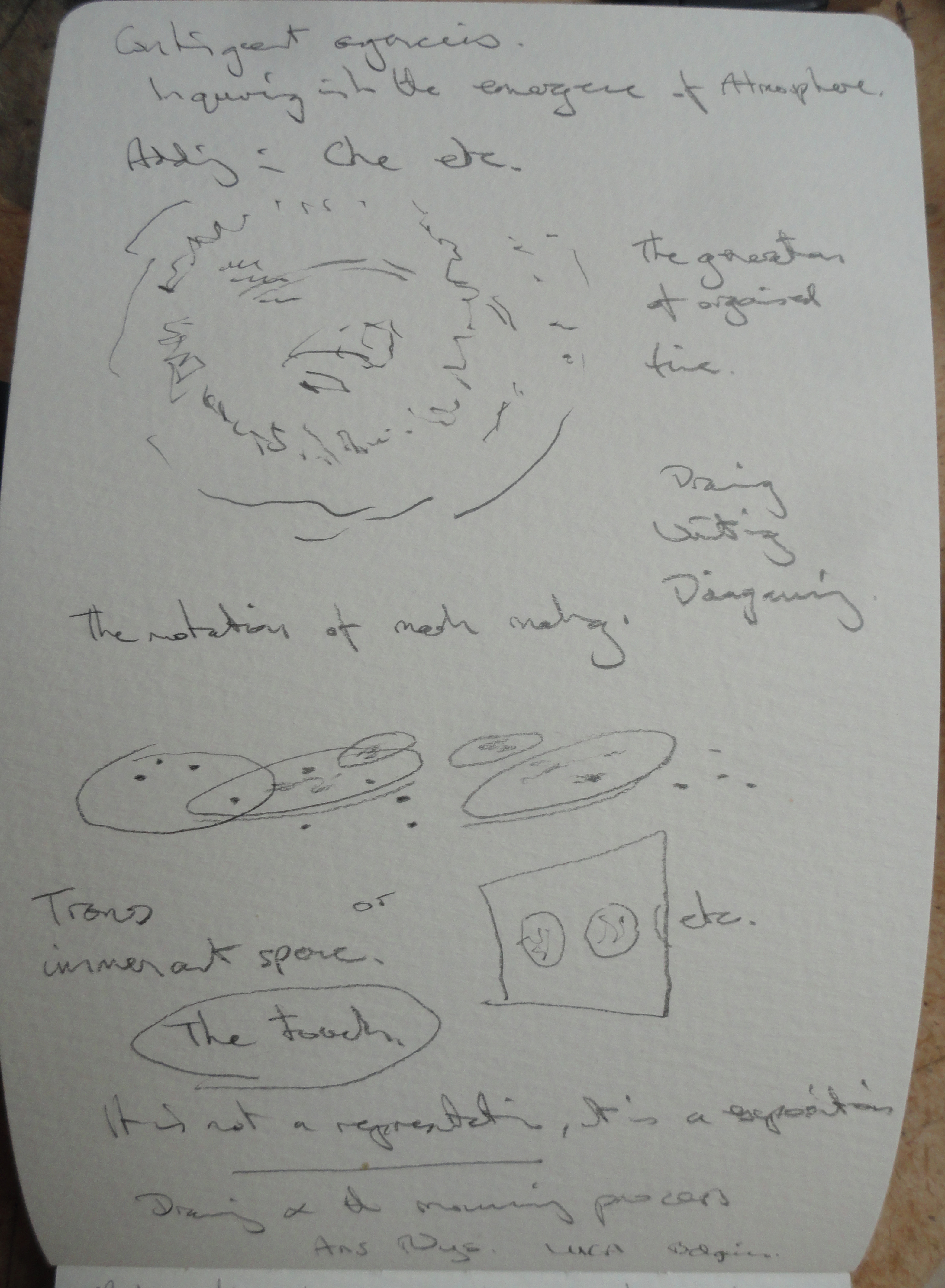 6
6