
The mind in the body in the world (study for stained glass)
Biological systems are autonomous, or self regulating. We tend to think of the things inside a biological system, such as a forest as being lots of separate things, but they are all interdependent, however when each of the elements is looked at it can appear as if it has boundaries. For example an individual tree can be thought of as just that, a tree. But it cant exist as that, its roots tap down deeply into the soil and its leaves are breathing in carbon dioxide. I.e. although for the sake of identification it might be useful for us to be able to nominate a tree as a separate thing, in reality it is an event or aspect of a process. But we can also think of a collection of atoms we call a tree being nested within another set of atoms we call a forest. The boundaries of biological systems, from individual cells to trees (or indeed people) can be thought of as the supporters of free energy, or places where that energy meets other forms of energy and where interactions take place that help to stabilise the entity. If so, something called a Markov blanket can be used to define its boundaries in a statistical sense, i.e. instead of a solid wall you have a series of probabilities whereby something is and isn't at the same time, called in this instance, the active inference scheme. You can infer something is in existence but when you look at it directly it hardens up and becomes a fixed probability. If this sounds like something from quantum mechanics, well it sort of is. For a long time physicists have realised that things are only fixed as they are if you look for them. On a larger scale a collective of Markov blankets can self-assemble into a global system that itself has a Markov blanket that links it to the larger universe; these linked autonomous systems can therefore be understood as having layers of nested and self-sustaining but permeable boundaries. It has been proven mathematically that any living system can be described as a Markov blanketed system and, this is the interesting thing, that the boundaries of such systems need not be co-extensive, or extending over the same area as the biophysical boundaries of a living organism that exists within it. I.e. there is a certain amount of give and take. If you look at the diagram below try to think of the dark spots as a tree, or at least the tree event or fluctuating core of what we tend to think of as a tree. However as part of a Markov blanketed system the edges of 'tree-ness' are not that clear and the tree extends out into the surrounding system, lets say the air or the soil, whereby it is hard to differentiate tree-ness from soil-ness or air-ness. Moving the light grey dots about will eventually disturb the pattern of the dark dots, but on a good day the pattern is pretty predictable statistically and on the whole the dark dots are stable enough for long enough to be at times seen as a tree or whatever else words try to isolate from the situation. Everything is though never static, hence the animated gif version.


Object/space folding into Markov blankets
If you randomly generate a mess of dots, apparently after a time these dots begin to form patterns, i.e. free energy systems eventually appear to become self regulating. As I'm into diagrams at the moment perhaps another diagram might help. If I place a ball on top of a smooth curved hill as in the diagram below, it is unstable and will seek stability by rolling down until it reaches the ground and a state of stable equilibrium.
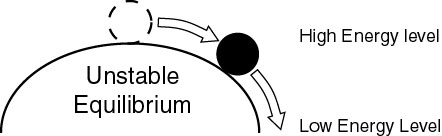
But as a human being you tend to take your ball, (your head) and have it kept in a vertical position. If it was up to physics we would be always be lying flat on the ground (lowest energy level), i.e. we tend to spend most of our lives in a state of unstable equilibrium. This is because we are part of a system. If you look at things as separate entities they work as separate entities. We know a lot about parts but very little in comparison about wholes. But a tree is as we have seen, a part of a system. This situation is called an open systems exchange. Energy, matter and information all enter and leave the system, forms can change, interactions occur and energy can be stored and released. These systems are regulated by feedback loops, which can be either positive or negative. Earth as a whole is warming up and cooling because of these systems, and we have seen this as part of our awareness of how global warming works. If the ice caps are large they form bright, reflective surfaces and they will reflect more of the sun's energy back into space, therefore less heat remains on the Earth's surface; thus cold conditions lead to more cold. However, when air cools, it holds less moisture and relative humidity goes up and condensation will occur. Condensation is water changing from its gas to its liquid state. In a gas there is a lot of energy being used to keep all those atoms flying around at a distance from each other, but as the situation cools down the gas becomes a liquid which needs less energy to maintain its form and the energy has to go somewhere. This energy is known as the latent heat of condensation. The latent heat of condensation then starts to heat up the surrounding air and leads to subsequent temperature increases. Our bodies operate very like this, interconnected feedback loops allow us to regulate our body temperature, blood sugar levels etc.

The diagram immediately above is a different way of representing a Markov blanketed system, but the one made of dots is more like the real situation. The boundary between one thing and another is never a nice sharp line, it is a permeable membrane that is constantly in movement as it adjusts to an ever changing world, so perhaps its better to think of the line of curvature more like the curved line in the image below, something rhythmically punctuated and permeable.

Representation of an outer edge of a Markov blanket
This ability to think about scale changes is helpful because it allows us think about different types of boundaries. For instance at a molecular scale our bodies are composed of elements such as sodium, potassium, calcium, and magnesium, and each has a specific electrical charge. Our cells use these charged elements, called ions, to generate electricity. The contents of a cell are protected from the outside environment by a cell membrane. This cell membrane is made up of lipids that create a barrier that only certain substances can cross to reach the cell interior. (I have looked at lipids before in a post about why ink sticks to paper and I thought then that there were deep metaphors that could be constructed from the way they operate) Not only does the cell membrane function as a barrier to molecules, it also acts as a way for the cell to generate electrical currents. Resting cells are negatively charged on the inside, while the outside environment is more positively charged. This is due to a slight imbalance between positive and negative ions inside and outside the cell. Cells can achieve this charge separation by allowing charged ions to flow in and out through the membrane. The flow of charges across the cell membrane is what generates electrical currents. Cells then control the flow of specific charged elements across the membrane with proteins that sit on the cell surface and create an opening for certain ions to pass through. These proteins are called ion channels. When a cell is stimulated, it allows positive charges to enter the cell through open ion channels. The inside of the cell then becomes more positively charged, which triggers further electrical currents that can turn into electrical pulses, called action potentials. These action potentials are what we think of when we become aware of ourselves doing things. Our bodies use certain patterns of action potentials to initiate movements, thoughts and behaviours. Which is great, but when it goes wrong we have a disruption in our network of electrical currents, which we usually call illness. This is something I'm particularly aware of because I have a heart condition, for my heart to pump, cells must generate electrical currents that allow the heart muscle to contract at the right time. Irregular electrical currents can prevent heart muscles from contracting correctly, and this is why I have an irregular heartbeat.

Memory of a feeling tone
As we become aware of interroception a fusion occurs between the memory of exterior perception and an interior somatic awareness. The image above was constructed as part of a series of responses to remembering how it felt to have a painful bunion. This was then contrasted (below) with an image made when actually in pain.

Image of a pain
Paul Klee suffered from scleroderma an autoimmune condition that happens when the body’s immune system starts to attack itself. Damage by the immune system causes excessive inflammation and increased production of collagen, leading to scarring or fibrosis of the body’s tissues and organs, hence the name, 'scleroderma'. His own artwork you could think of as a way of visualising the internal working and structures of art itself. His 'Pedagogic Sketchbook' being a sort of Gray's Anatomy of the visual world. It was as if he wanted to reveal what lay under the skin of all that Victorian figurative painting.

Klee's world begins with the potential of a dot. More than one dot creates energy, either a balance or an in-balance is created and as these two situations are created and uncreated 'life' begins to emerge from the surface of the paper. As the surface becomes animated moments of more concentrated energy occur, in the case above forms emerge picked out in dark lines, and in the image below shapes become intimated, they drift one into the other and occasionally pop into being, such as the archway or the circle.

I found that by returning to Klee's work after many years, that it seemed as fresh and as inspiring as it did all those years ago when I first encountered it. In the image below we find lines now taking over the image making load, they gradually become signs, but are still also just lines, nothing is fixed but at the same time we can see forms emerging. These images feel very like music, they touch us with their rhythmic pulse, like small creatures, we can feel their heartbeat as we hold them.


See also:
I have been returning to Klee's work as a loadstone or check-in to help me with my next steps in trying to visualise the invisible. How to translate the feeling tones that emerge from the inner body into visual images and it has been a back to basics experience, and has forced me to get rid of a lot of visual baggage.
Klee: Äliup, 1931. Watercolor and pencil on paper on cardboard, 47.9 x 31.4 cm
Klee's world begins with the potential of a dot. More than one dot creates energy, either a balance or an in-balance is created and as these two situations are created and uncreated 'life' begins to emerge from the surface of the paper. As the surface becomes animated moments of more concentrated energy occur, in the case above forms emerge picked out in dark lines, and in the image below shapes become intimated, they drift one into the other and occasionally pop into being, such as the archway or the circle.
Klee: Ad Parnassum 100 x 126 cm
Klee: untitled.
Last week I was able to visit the Pallant House Gallery in Chichester and they had a Paul Klee image on exhibition. Titled 'Clouds' it was stunning. A delicate line image was constantly emerging from the centre of a floating cloud of darkness. The tonality was handled so subtly, that it was hard to see how it was achieved, until you realised that he must have used layer after layer of thin washes to achieve an effect as if the darkness was an integral part of the paper rather than something applied to it. The thin ink lines that drifted in and out of the dark, were like so many of Klee's lines 'going for a walk', lines that were looking for an idea to become, a form to make, always in a moment of becoming rather than an idée fixe. The image was far too delicate to photograph, so you will have to imagine it, and perhaps that's a good thing, we are looking at too many images on line at the moment and we can tend to think that's how they are, but only certain things look good on a screen and it's important that we don't forget that.


From a series of drawings of the body as a self-aware entity
See also:
A growing series of posts that follow the evolution of an idea


