Showing posts with label embodied landscapes. Show all posts

Wednesday, 15 July 2026

Drawing consciousness Part two

Writing my last post on qualia and visualising consciousness reminded me that I had already looked at some of these issues before. The previous time I was thinking about drawing consciousness I finished my post with a reflection on the landscape drawings I had been making in West Wittering. In particular I was thinking about how landscape drawing could inform and build my personal visual dictionary, from which I could draw imagery when I was looking for forms and shapes that I could relate to interoceptual experiences. I have recently returned from another visit to the same coast and whilst I was there I decided to revisit the same locations I drew from last time, to see if I could find in my approach to the drawings better intimations of walking through a cosmic body, whereby the forms I encountered, suggested that  I was passing through a huge entity, in a similar same way to a blood platelet passing through a human body. 

I had in my earlier post on drawing consciousness reflected upon the idea that I was also when drawing somatic feelings, at the same time illustrating something about how consciousness itself might be visualised. My consciousness being part of what Jacob von Uexküll called the unwelten or phenomenal world that is specific to my human nature. My ability to sense my own embodiment, is something I automatically transfer into the way I see landscape as I draw, which is itself an activity unique to my particular human shaped organisational structure. My conscious awareness of self, being a forming principle based on an organisational structure, that itself shapes imagination, perception and interoception.  

I'll use some sketchbook drawings to try to explain. 

I took with me two sketchbooks that I had decided to use for landscape drawing and a third to use when making visual notes visiting cultural sites of interest, such as Chichester cathedral. The sketchbook drawings I'm using to illustrate my point about drawing consciousness are all taken from an A4 size sketchbook that uses Indian rag made watercolour paper. As usual I'm using a dip in pen to draw with, supplemented by diluted inks and in this case the occasional use of liquid graphite.  

The first location I sought out was one where on my previous visit I had drawn from a beach littered with the broken concrete remains of what were I think sea defences. This time I took with me coloured inks, making the drawings directly in red ink and then using dilutions of the ink to reinforce a visual connection to my background awareness of human anatomy, such as ribs emerging from a broken body. I had just before leaving for the coast had to deinstall my work that was on exhibition at Salt's Mill. 'The Cosmic Body' was partly made in response to the Zen Buddhist Japanese idea of Kusôzu, in particular the 5th stage of decay, which was often illustrated using an exposed rotting ribcage. The cosmic body suggested that our idea of the universe itself can only in reality be one that is based on our embodied consciousness and that although science states that it can think outside of this box, the fact that consciousness is embodied, I would argue means we can never escape the fact that all the visualisations we make, have to in one way or another reflect that phenomenal world that is specific to my human nature.

Sketchbook drawing 2026

Sketchbook drawing 2025
The Cosmic Body 2026

The 5th Stage of decay

As I drew the various sea eroded remains of these concrete structures, I imagined that they were the remaining vestiges of a huge under the earth giant, a creature that had at some time in the past inhabited this part of the world. I was thinking of Gog and Magog, who were portrayed as giants in British folklore and Arthurian legend, where they were imagined as the surviving remnants of the people of ancient Albion. A story that had its roots in the Bible, where Gog and Magog represent evil armies that would have to be defeated in a final apocalyptic battle by the armies of Christ.


As I drew these concrete remains, I noticed that there were thin vein like structures that ran through a surface I was looking at. This together with a rusty spike that protruded out of the centre of the structure, triggered another association, that of sliced ham. 

Ham on a meat slicer

I remembered the ham having to be pushed onto a spike, as part of the stabilising process before you could begin the slicing. Once this image was in my head, I carried it with me as I returned to draw yet another broken sea defence. This time the organic concrete form, below, looked as if it was part of a dismembered giant's body, from the moment I began the drawing.

Sketchbook drawing: Concrete form/body part: 2026

As I moved on to draw from another coastal area I was again thinking about Kusôzu images.

A Kusôzu image


Sketchbook drawings 2026

The way that seaweed drapes itself over old wooden posts or fallen tree branches, reminded me of the way that Altdolfer drew trees; somehow he managed to draw them so that you were reminded of Christ's Crown of Thorns and rotting flesh, peeling off a decaying body. 

Altdolfer: Spruce tree: 1550

Sketchbook drawing 2026: Seaweed over tree branches

Altdolfer was very much in my mind when I drew the image above of seaweed hanging from tree branches. 

At one point I was looking at a sea worn island of a remaining bank of soil that had fallen onto the beach after erosion had undercut the coastal walkway. I decided it now protruded from the beach like the head of some sort of dinosaur. As I drew it, I remembered images from Godzilla films, the creature's giant head rising up out of the ocean; popular culture now filtering through, as I re-immersed myself in a landscape that has become an important shaper of my visual language.

Sketchbook drawing: Beach form/dinosaur head: 2026

As I drew a tree, its roots being exposed by erosion, I was reminded of a body being operated upon, an image in my mind of exposed veins and arteries, causing me to use red ink to visually pull the tree and its roots out of the landscape and to insert it mentally into the landscape/body I was looking for. 

Sketchbook drawing: Tree roots/arteries: 2026

During the time I was in west Wittering I filled the sketchbook with coastline images, all of which were in one way or another, attempts to find a syntheses between what I was observing in the external world and what my internal world was telling me . Hopefully the ideas that they conjured up in my mind as I drew them are communicable and that as a reader you can see how when I'm drawing from perception, I'm at the same time drawing from imagination and that observational and imaginative approaches to drawing are fused. 

In my previous post on drawing consciousness I pointed out that like myself, Regis and Brigitte Dutheil agree that the mind creates the sensations we become aware of. In this post hopefully I have been able to give a flavour of how I think this works from an artist's point of view. In doing so I also believe that these drawings operate as images of consciousness and that if this is the case, Altdolfer's drawing of a tree would also have to be read as an image of his consciousness too. It is not like any spruce tree I have ever encountered, but it is like other drawings by Altdolfer I have seen. The sensibility that comes through a handmade image, being like a glimpse into another human's consciousness. 

See also:

Drawing consciousness

Qualia and visualising consciousness

Invisible worlds

Scale

More thoughts on drawing the coast at West Wittering

The geometry of consciousness

Wednesday, 20 April 2022

Drawing and urban acupuncture

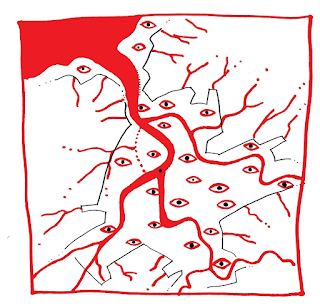
Taipei Organic Acupuncture map by Marco Casagrand

In my last post I pointed to the various energy fields that move between the body and mind, suggesting that they can be thought about and reflected upon as being parallel to the process of image making. I'd now like to fold into that series of interconnections 'environments of existence'. Perhaps a strange term, but I'm looking to develop ways of using language that don't always privilege a human centred world. These environments are usually analysed within disciplines such as urban design or landscape architecture, however it's not just fine art that needs to rethink itself, other visual disciplines such as town planning or architecture need to think about how they operate too. Instead to seeing themselves as disciplines that propose control, perhaps they could be windows through which we could look for how complexity arises and how relationships are built between things. For example in the city of Taipei there are constantly evolving mini events or tiny engagements based around community gardens and urban farms. They pop up like mushrooms into degenerated or neglected areas of the city. They grow into open spaces in the same way that weeds find a home within small cracks in a pavement. Some people have already referred to these interventions as urban composts. The map above that tries to give an idea of their spread, uses eyes to indicate that they could be thought of as observation points from which to look at the city in a new way. Small interventions that look you in the eye and ask questions such as why cant the rest of the city feel like this? They emerge at pressure points that can be used to release the pent up energy of the city mass.
This situation can be looked at using a hybrid lens. Marco Casagrande states that urban Acupuncture is a bio-urban theory that combines sociology and urban design with the traditional Chinese medical theory of acupuncture. As a design methodology, it is focused on tactical, small-scale interventions in the urban fabric, the ripple effects of which lead to the transformation of the larger urban organism within which it operates. As in traditional acupuncture, pressure on a small point can release trapped energies over a much wider surrounding area. Casagrande is part of a new breed of designer / architect who typically mixes architecture with other much older disciplines to create highly aware, ecologically sustainable architectural installations. In his view, ‘there is no other reality than nature’, and architects he believes should operate like design shamans who act to interpret what the bigger shared mind of Nature is transmitting. I'm particularly interested in his idea of energy flows. He views cities as complex energy organisms in which different overlapping layers of energy flow are determining the actions of citizens as well as the shape of the city. By mixing environmentalism and urban design he advocates a sensitive series of ecologically sustainable interventions within a city, this 'Urban Acupuncture' is needed in order to 'heal' insensitive city developments.  His example of using small-scale, but ecologically and socially catalytic developments, is I think very useful. We cant make changes unless we start somewhere, but change becomes daunting if we take on projects that are too big for us to handle. In my own case I begin to look around my own house and its garden and am thinking about what small decisions I could take to make a change for the better. Before making any decisions though one of the main permaculture maxims is to think slowly and to watch carefully, because it will be the way things join together synergistically in plant and animal communities that will become important and you only understand that, by looking closely at what is happening. 

Community gardens in Taipei 

Urban Acupuncture brings together acupuncture with urban planning, urban design, environmental art and anarchy. (If we define the root of anarchy as the impulse to do it yourself: everything else could follow from this) My own attempt to deepen my awareness of how fine art could be approached, (and as I have mentioned before, I think the term fine art needs rethinking) has led me to undertake a permaculture design course, as a way of working towards a set of ethically responsible ways of undertaking a fine art practice. Recent permaculture inspired thoughts about my garden, being a starting point for a more holistic approach to what I have been doing. 

Diagramming a garden's energy flow patterns in relation to human energy needs

I would like to think that eventually fine art could become part of a more sustainable way of living, and that everything I am involved with would be seen as being entangled in some way with everything else. The idea of Organic Acupuncture being yet another signpost along a way that links to a much older tradition, whereby art and other forms of communication and knowledge transfer, are part and parcel of an approach to life that grounds its culture in a sensitivity to the biosphere, or what we now often call Gaia. The name Gaia was revived in 1979 by James Lovelock, when he was advised by William Golding to call his new theory of bio-systems regulation by the name of the old Greek goddess of the Earth, 'Gaia', (the same deity that in Roman times was called Terra). The Gaia hypothesis proposes that living organisms combine with inorganic material to form a dynamic system that is the Earth's biosphere and that this system maintains the Earth as a stable environment for life. The Earth itself is therefore viewed as an organism with self-regulatory functions. Art would in this case be simply part of that self-regulatory process. 


A food pyramid and food web

There are several types of energy flow, the one we are most implicated in is the flow of energy through living things within an ecosystem. All living organisms can be organised into producers and consumers, and those producers and consumers can further be organised into a food chain, and usually humans are right at the top. But once we remember that over 50% of any one human being is actually composed of bacteria, we perhaps begin to see that the idea of one type of species being on top is actually meaningless. We are all interconnected. 


The carbon cycle of a terrestrial ecosystem begins with photosynthesis, water (blue dots) and carbon dioxide (white dots) from the air are taken in with solar energy (yellow dots), and are converted into plant energy (green dots). 

As the sun's energy is trapped and stored, animals who have eaten plants release materials back into the environment, there are in fact no things, only processes of exchange

The chemical process that underlies the formation of the carbohydrate glucose

These processes are central to everything, as the sun's energy needs to be captured before we can use it. The flows of energy begin with star stuff; sunlight and heat radiation is via photosynthesis converted and stored in fats and starches, things that animals can eat and convert back into energy that they use for their own ends. Alongside photosynthesis we also find respiration, a chemical reaction which occurs in all living cells. It could in fact be argued that life is centred on the releasing of energy from glucose. Respiration can be achieved with or without oxygen; aerobic respiration occurs with oxygen and releases larger quantities of energy but slowly; anaerobic respiration occurs without oxygen and releases less energy but more quickly.

Comparison of Respiration and Photosynthesis in a wild strawberry

Respiration converts nutrients from the soil into energy and this is happening all the time, but as photosynthesis needs light it only happens in the daytime. Photosynthesis converts light energy to glucose which can then be used for respiration. This process is an example of an energy flow and also an example of how one type of energy can be stored or transformed into another, in this case it becomes an energy we call food. If there is a break in the chain, such as heavy volcanic activity sending out dust clouds to block the sun's rays, then something will go wrong because you will have an obstructed energy flow. One planet wide example of this was when a large asteroid hit the Earth triggering a chain of volcanic eruptions, the resultant long term darkening of the skies leading directly to the extinction of the dinosaurs. 
Acupuncture is a way of releasing trapped or obstructed energy flows; and there is a close energy flow connection between any body and the landscape it inhabits. 

Human Body Meridians


As well as physical health there is a demonstrable link between body meridians and emotional well being. Meridian acupressure can be used to restore essential equilibrium and promote good health. Meridian lines are the energy network of the body; they are the channels by which our energy flows, transport energy throughout the body. Our life energy, also known in Chinese as Chi or Qi, is distributed by these channels, a process as opposed to a structure, that is studied by Chinese medicine practitioners as intently as a western doctor would have to study the anatomy of the human body. Blockages in this system may be caused by stress, bad diet, drug or alcohol abuse, injury or trauma and can be directly related to health issues. It is strongly believed in Chinese medicine that this energy flow conditions our overall existence; how we think, how we feel and how our body moves. It is further believed that the energy flows that surround us are interlinked with the energy flows that pass through us, something that is easily illustrated by the fact that the sun's energy flow is captured and converted by photosynthesis into substances that store and release energy. We in turn eat green vegetation that has stored that energy and our digestion system releases the energy and distributes it around our bodies. 

Energy flow study

The good thing about drawing is that virtually everything can be both represented as and converted into visual energy using mark making processes. For example in the drawing above, the paper surface was gessoed, this alters the surface structure of the paper, so that scratched marks could be made to hold more ink and a line could be made to look ragged or broken, so that it could be read as a short rhythm of dots as well as a line. A curve sets up a very different type of rhythmic movement to a straight. The movement of the eyes in looking at a drawing adds another energy flow, the time spent contemplating the drawing being yet another flow of energy, this time out of the system, thus ensuring that another energy system is required to re-energise the whole, which may simply be a sweet cup of tea. The tea and sugar however will originate far from myself in Leeds, and this is where the environmental energy flows become so important, the question then asked is how much energy was wasted in transporting the tea and sugar from one side of the world to another? 

The idea of the landscape as a body is another very old one. The traditional relationship of human beings to the land was one of deep reciprocity and continuity, in which it was the human responsibility to reciprocally keep the land 'enchanted' with various ways of communicating an awareness of energy flowing through both land and body, between which there should be a seamless continuum. The mythic link between land and body, might typically be understood within an animist tradition, whereby the relationship between land and body would be renewed and re-sanctified, by ritual and by the basic process of breathing it in over hundreds and thousands of years. It still feels wonderful to stand outside and breathe in and as you do so you feel all the various components of the air enter the body and then as you breathe out you can feel the various gases from the body being released out into the surrounding atmosphere. For the bacteria within you, you are the universe and you yourself are star stuff, a formation that is if only for a brief moment, something that is self aware.

Try to consider the conundrum that the universe can be regarded as a body and yet the body can at the same time be thought of as containing universes. A while ago I put up a post on the macro and the micro. At the time I wrote about making marks as energy fields within a drawing. I stated that "Not only does the mark quality and handling tell a story, but the concept of a mark field being something that comes together as an identifiable entity when you see it from a distance, is itself fascinating." This is the illusion of reality, from certain points of view we see patterns and we fix these patterns with words, but in reality all is always in flux. In the stories we tell ourselves, we steady the illusion of life and build fulcrums for change. However when real life events hit us we need to ensure that they are deeply understood, for instance death can be seen as in integral part of the flux of change and if we can accept this perhaps we can let go of life a little easier. The image immediately below is one of my own attempts to deal with these issues when my mother died. There was a sense of energy leaking away. In contrast the image 'Fluid passages' was a response to the energy exchange between two Phoenix dancers I saw in Leeds, their entwined bodies and contact improvisation techniques eventually dissolving their bodies into each other. 

Slipping away, between states

Fluid passages

The fluid passage between the inside and the outside of the body is something we glimpse in a Frances Bacon painting, 

Frances Bacon

The spaces surrounding Bacon's figures rarely immerse themselves back into the figures which inhabit them. They operate as traps, framing the event, rather than as reciprocal energies. Perhaps his contemporary Frank Auerbach was much more able to represent the integration and flow between the body and its spatial environment. 
 

Frank Auerbach

The sense of flow or change is also I believe related to the importance of 'neuroplasticity', or brain plasticity; the ability of the brain to modify its connections or re-wire itself. (Stiles, 2000, p. 245) Without this ability, any brain, not just the human brain, would be unable to develop from infancy through to adulthood, recover from brain injury or learn new things. Something learnt can I believe also be thought of as a bundle of energy that can be passed on both from a direct experience and from secondary learning, such as reading about something. (Cartlidge, 2010 and Toyabe, Sagawa, Ueda, Muneyuki and Sano, 2010) report on research that is actually about converting information to energy by feedback control, and as an artist I do have an artistic licence to intuitively develop implications from this. 

The brain processes sensory and motor signals in parallel and has many neural pathways that can replicate another’s function so that small errors in development or temporary loss of function through damage can be easily corrected by rerouting signals along a different pathway. The brain’s anatomy however ensures that certain areas of the brain have certain functions. This is something that is predetermined by our genes. For example, there is an area of the brain that is devoted to movement of the right arm. Damage to this part of the brain will impair movement of that arm. But since a different part of the brain processes sensation from the arm, you might be still able to feel the arm but unable to move it. This “modular” arrangement means that a region of the brain unrelated to sensation or motor function is not able to take on a new role. In other words, neuroplasticity is not synonymous with the brain being infinitely malleable, i.e. there are certain channels through which change is hosted but the fact that different regions of the brain do different jobs also helps us get a glimpse of somatic experiences and the relationship between interoception and perception. 

A visualised somatic experience

Merleau-Ponty implies that the body constitutes both the cognitive ground of culture and its existential ontological ground. He argues (1962, p. 303) that we recognise things from the point of view of our bodies. Therefore it could be further argued that perception begins in a body that already knows itself; which is why my current research is focused on interoception and is entangled into the things that the body perceives in relation to itself, as Merleau-Ponty goes on to say, ‘my experience breaks forth into things and transcends itself in them, because it always comes into being within the framework of a certain setting in relation to the world which is the definition of my body’ (Ibid). 

References

Cartlidge, E (2010) Information converted to energy Physics World: Quantum Mechanics Update 19 Nov Available at: https://physicsworld.com/a/information-converted-to-energy/ accessed on 20. 3. 22
Merleau-Ponty, M., & Smith, C. (1962). Phenomenology of perception (Vol. 26). London: Routledge.
Stiles, J. (2000). Neural plasticity and cognitive development. Developmental neuropsychology18(2), 237-272.
Emma McNally Drawings of complex data that include points that could easily begin to operate in a similar way to acupuncture