Showing posts with label empathy. Show all posts

Wednesday, 15 April 2026

Observer-Patch Holography


In OPH, 3+1D de-Sitter space emerges as the conformal group of the S² screen supplies the 3+1D Lorentz symmetry, while modular flow and generalized entropy stationarity project boundary data inward to construct temporal and radial bulk dimensions. Each observer experiences a 3+1D universe.


I've been looking at what is called Observer-Patch Holography. Any reader of this blog will realise that every now and again I dip my toe into what's going on in science, because it can illuminate what I'm trying to think about in refreshing, if often challenging ways. OPH as it is known, is a recent development in the struggle to find a unifying theory, that will explain how everything fits together and works as it does. OPH proposes that gravity, particles and quantum mechanics all emerge from the same idea. That is that no single observer sees everything. Wow, this seems totally counter intuitive but at the same time somehow obvious. I have been hosting workshops whereby I get two people to work together in order to take their individual responses to visualising an interoceptual experience and to see how between them they can push the various visual elements they have invented around and adjust them, so that what they come up with communicates something to both of them. This is a basic process that explores how one person's subjective experience, can when overlapped with another's, gradually become something that can be communicated to someone else. I. e. what was an invisible subjective experience, eventually becomes part of someone else's reality.

Two people developing a cooperative image during a visualising interoception workshop 

OPH proposes that reality is a structure that any consistent set of observers must produce. But no one observer can see everything, therefore reality has to survive agreement across overlaps. I'm no mathematician, so I don't understand the underlying equations, however it seems as if you give each observer a holographic like screen into which is embedded their view of what is happening and as well as this you determine some sort of locality or co-ordinates within which this observer is observing, then you can develop a series of equations summing up that view, from one standpoint's reality. Then imagine other observers' realities also being similarly fixed into being by a set of equations and adding into this the idea that you can overlap all of these realities. This overlapping is what makes one observer's 
subjective reality, into a reality that is everybody's objective reality. This is as if the observer aspect of quantum theory, becomes central to the theory, instead of it being a bit of a problem. This article, Observers are all you need is a useful read if you want to get a proper scientific understanding of the idea. 
Each observer's reality will overlap with another's

What I like about this is that my reality overlaps with yours and that we are all embedded into the unthinkably vast holographic screen S2.

OPH tries to explain several of physics’ deepest open questions as symptoms of the same underlying architecture. For instance; general relativity predicts that spacetime must have a boundary in the past, something we usually call the big bang. Some proposals replace the Big Bang with a “bounce” from a previous contracting phase. Others suggest the universe emerged from quantum fluctuations in “nothing.” None is established. The assumption is that spacetime is fundamental, so asking “what happened at t = 0?” is the fundamental question. However, OPH reframes the question entirely. spacetime is now emergent, it is reconstructed from the consistency of overlapping observer descriptions. So instead of an idea of a single point in time when everything began, we need to think of zooming into a digital photo. At some point you hit pixels. You can’t zoom into the underlying structure any further, not because there’s a “wall,” but because the structure doesn’t support a finer resolution. The image doesn’t have a “beginning” at the pixel level. It just doesn’t have sub-pixel information. The holographic screen has limits, a finite capacity (about 10¹²² states). In OPH, time is relational, defined by how observer patches correlate. At the “earliest” times, 
OPH theorists believe that patches become maximally mixed. There’s no meaningful “before” because there’s no information to distinguish earlier from later.

I have posted before on the hard problem of consciousness and how I think drawing might help us to think about it. There is an OPH answer to this question too. I like so many other people before me I have asked the question 'why is there a something that is the feeling tone that is me?' Subjective experience, is questionable, but I have it, so I believe in it. Physics and science describe matter and forces, but not experience, which is where I always felt art came in.

In physics equations describe objective states of the universe. Observers are incidental. But experience is inherently first-person. You can describe every neuron firing in my brain, map every chemical reaction and still not explain why there’s a “what it’s like” to be me feeling. However, in OPH, the fundamental elements of the universe aren’t objective states, they’re 'observer patches', local, partial, subjective descriptions made by observers. Subjectivity isn’t something that emerges from physics. It’s what physics is built out of. OPH starts with subjects (observers with partial descriptions) and derives the appearance of an objective world from the consistency of their overlapping perspectives. Stuff like atoms and gluons are what my perspective, your perspective and others agree on. Essentially, you get the appearance of matter from the consistency of minds. Observers are therefore the foundation of everything.

I do worry that OPH begins with an idea about screens though. I suspect this is a reaction to their every present nature in our times. But it's an interesting enough idea to follow, so bare with me. OPH uses a holographic screen, that has a topology S^2.  My understanding of the associated expressions with grouping symbols is that S1 is a circle, S2 is a standard sphere, and S3 exists in 4D space. The particular topology is important because it enables someone to use the geometry of motion using variables like displacement, time, velocity and acceleration to analyse position over time, in this case the kinematics of a 3+1 dimensional Lorentzian spacetime. The holographic screen has a finite-capacity that has within it overlapping observer patches. So if the physics we use is derived from this, it explains why the ordinary physics we already use turns out to be the natural thing to see. For instance; in OPH, particles are stable excitation patterns in the overlap and transport of data. If a transport propagates coherently across patches, and can be read consistently by many observers, that’s is exactly the sort of thing we call a particle. OPH equations give us photons, gluons and even gravitons, as well as more detailed mass outputs. 


In OPH, particles are stable transport obstructions across patch overlaps

In OPH, all particle masses are derived from a single constant P ≡ a_cell/ℓ_P², the shared dimensionless “pixel-area” constant that converts the holographic screen’s regulated microphysics into absolute lab units. Once P has been fixed, everything comes from it.

The researchers behind the development of OPH ask us to metaphorically, think of P as a “simulation setting”. The only way of determining this setting is by reverse-engineering its value from certain properties of reality. 


The architecture of OPH is based on a finite octahedral cellulation of the holographic screen. Overlapping patches communicate via a specialised synchronisation API, (mechanisms that enable two software components to communicate with each other using a set of definitions and protocols) which extracts shared readout packets to detect mismatch syndromes. When discrepancies are found, a dedicated repair loop executes local corrections to the registers, ensuring that the disparate observer perspectives remain unified and physically consistent. This again reminds me of my interoception workshops, whereby either myself or another person in the workshop helps with the communication between two other people trying to establish a shared idea of what might constitute for instance, the shape and colour of a particular type of pain. 

The researchers behind OPH have arrived at the strange loop hypothesis, whereby human consciousness is arrived at because the complexity of active symbols in the brain inevitably leads to self-reference. It goes like this, reality is a timeless structure that closes on itself; physical evolution gives rise to complex structure. Complex structure gives rise to minds. Minds give rise to ideas. Among those ideas comes an understanding of the structure of reality itself. This understanding is not external to the universe; it is one of the ways the universe becomes what it is. Physics gives rise to chemistry, chemistry to biology, biology to minds, minds to ideas and ideas are what we create physics from. In an OPH reality, everything is self-referential and the strange loop hypothesis is used to explain its own creation.

Escher visualises the strange loop hypothesis

OPH theorists believe that a consistent reality would be a self-referential, observer-bearing, timelessly consistent reality that closes on itself, eliminating the need for an external creator. Friedrich Nietzsche’s declaration that "God is dead", signified that Christian, metaphysical and absolute moral foundations had become unbelievable due to scientific, rational thought; something he believed would lead to a profound moral disorientation. However when I see images of evangelical nationalists and their tattoos that serve to signify their allegiance to Christian values, I sometimes feel that it is the God fearing that are destroying any moral world order we once had.


When I work as part of the group 'Drawing a life' I have to ask myself a question. "In what way is it different to draw a person speaking about him/herself from drawing somebody I have no idea about?" There is a difference, but there is it seems to me much slippage between the two experiences. The people I have no idea about still have their own phenomenal worlds and they will experience life in terms of species-specific, "self-in-world" subjective reference frames that are sometimes called their 'umwelt'. The structure of their 'umwelt' will though, just as the structure of any other creature's 'umwelt', such as the phenomenal world of the crab or the hedgehog, be one that has a certain commonalty amongst the species. In my case I am just one member of a species that is highly social, bipedal with a large, complex brain, that has a vertical forehead, smaller than average mammalian jaws and a high capacity for self-awareness and the pursuit of meaning. Therefore what I can do is project in my mind an idea that although I don't know someone, I might be able to guess something about what they are thinking; another OPH overlap. 

Again I'm brought back to empathy as being central to any overarching moral view on how we co-exist with the rest of the world. OPH suggests that although we all have subjective viewpoints, we also overlap in our beliefs. It is this area of overlap that allows us to communicate and come to some sort of agreement with others. In my view the overlap also exists in relation to my relationship with the wind, a stone, a kangaroo or a tree, by agreeing that we all have something in common, I am hopefully less likely to abuse these things and spend more time thinking about their needs as well as my own. I can see the attraction of a religion as it helps some of us come to terms with what can be seen as a meaningless life. But life is full of meaning and is a wonderful song of interconnectedness. A blackbird knows this and when I hear its song I know it too. 


Sunday, 23 April 2023

Invisible worlds

From: Jacob Von Uexküll: 'A Stroll through the worlds of animals and men'

Jacob von Uexküll was fixated on the unwelten or phenomenal worlds of other creatures. He was particularly interested in how living beings perceive their worlds, arguing that organisms experience life in terms of species-specific, spatio-temporal, "self-in-world" subjective reference frames that he called 'umwelt'. He believed that every living creature inhabits a world of its own. The structure of this world being determined by the nature of each individual species; by its physiology, its behaviour, and its interactions with its environment. Von Uexküll firmly believed that these worlds disclosed themselves only through individual subjective experience, therefore these worlds were private and unique to each living creature. This of course fascinates me, because I have been worrying about how to move forward in my work on interoception and have at times begun to think about whether or not the internal lives of other creatures could be intuited or thought about in a way that could parallel what I have already been doing in relation to my fellow humans. If the hidden unseen world within us can be explored, as if travelling through some sort of sublime landscapes, then the interior worlds of other creatures can also be imagined as alternative universes, not unlike perhaps, those alternative worlds in Doctor Strange as imagined by Steve Ditko back in the 1960s. I used to love Doctor Strange comics. Waiting eagerly for them to turn up at my local newsagents in Dudley, they opened doors that still remain ajar in my mind even now, those comics showed me how the possibility of otherness could be depicted.


From Doctor Strange: Marvel Comics 1960s Steve Ditko

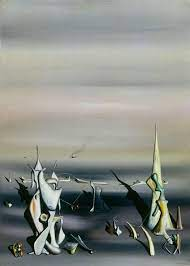
Ditko was able to blend organic forms with geometry, creating hybrid forms that were perfectly suited to the depiction of spaces and places between worlds. These were environments where the normal laws of physics no longer applied and where magic and other mystical forces held sway. These small printed paper panels were gobbled up by myself as a teenager, a spotty youth who was also looking at Surrealism, especially the other worldliness of Tanguy's paintings. Ditko in effect bought Tanguy into my world, via my local paper shop.


Tanguy

Many years later I'm still trying to make images and once more of invisible things, the signals sent to us from inside our bodies, signals that include our embodied minds; that are a product of the strange interface between outside and inside, all of which when I think about the possible worlds of other creatures, become image triggers, but images that can arrive blended with ghostly apparitions from the past.

But again I'm drifting off on another tangent, I only seem to be able to get an idea of what I'm doing after the event. Perhaps this is the right way round, because then you discover the image as if it is fresh minted, if you had worked it out beforehand, it would arrive stale and already used.

Jacob von Uexküll had this to say, 'We are easily deluded into assuming that the relationship between a foreign subject and the objects in his world exists on the same spatial and temporal plane as own relations with the objects in our human world. This fallacy is fed by a belief in the existence of a single world into which all living creatures are pigeonholed. This gives rise to the widespread conviction that there is only one space and one time for all living things.' (Von Uexküll, 1934 in Schiller, 1957, p.14)

The diagram below is from Von Uexküll's 'A Stroll through the worlds of animals and men'. I was interested in his way of relating our external spatial alignment with the world to our internal physiology. Our particular way of orientating ourselves has a lot to do with where our senses are clustered and by them being located around the axis of a bilaterally symmetrical organism and then being 'sided', i.e. eyes are only on one side of the head, and mainly located in the top or raised part of the organism. But hidden beneath all this external sensor location is the fact that inside the head, an extension of our ears has a semicircular canal form. This form is an ancient one and is designed to help an organic form orientate itself when moving.

The semicircular canal system first of all evolved in fish. Fish are jawed vertebrates like humans and like us have inner ears with three semicircular canals, which are what allow fish and humans to sense the position they are in space and stay balanced in the world. If you look at the three canals they are joined together, but orientated to follow the three axes that we associate with the coordinates of Cartesian geometry that are usually labeled x, y, and z.
However a fish is always swimming in a world of water and we tend to only swim occasionally. As Pettibone states, "During human evolution, primates’ quick eyes developed to match the speed of their ability to grab and swing, and the vestibular organs kept pace, resulting in the vestibulo-ocular reflex that allowed the eyes to keep focused while the head is moving side to side (Soden, 2003, p.213). This sophisticated system continued to evolve as orientation demands shifted when apes descended from the forest canopy to walk upright. Side to side movement diminished as man began to stand and run. Consequently, the vertical canals grew and the horizontal canals shrank in the vestibular system of early man (p.217). Vertical orientation for humans was simply more valuable to survival. Soden, Garrett (2003)" 
From: Pettibone, L., The Aesthetics of Gravity.

The semicircular canal system was evolved to cope with a much more complex set of body movements than we have to deal with, and this allows us to move our heads on an extended neck, quickly and without the disorientation that you would expect. Even so our world is very different, but because of the evolutionary links between us, perhaps imagination can offer an insight into what the differences might be.

The worlds of fish are unique to each species, just as the world of an animal is unique to each species. You would not expect a freshwater trout to inhabit the same world as a sea going manta ray, just as you would not expect the world of a human to be the same as a giraffe.
When I was a boy I used to go with some of my dad's friends fishing to a place near Upton upon Severn. I was not very good at it but I do remember catching a few Roach. We would cast a few balls of damp bread out onto the water first and I still remember the wriggling maggots that were then used as bait. As a boy I was mainly restricted to bread bait and was a bit squeamish as well, so was happy to miss out on the maggots. We used to camp over night which was the best thing and there was always a fire and an attempt to cook the fish caught over it. The world of the fish was totally invisible to the world of young boys, fish were simply other things, part of the strange natural world that was outside Dudley. It was only when I began drawing seriously that I also began to get a sense that things like fish might have worlds of their own. I would buy a fish from the market to draw, usually one I knew would be tasty, draw it and then eat it, but in drawing it I had to slow down and really look and as you did you began to slip, if only for a moment into the possibility of a fish's world.


The roach is a member of the carp family, therefore it, like other members of the family, lack teeth set into jaws, instead, they grind up their food with toothed bones set into their throats. It spends a lot of time rooting around in mud at the bottom of ponds and rivers and in order to identify what it is finding in these dark, murky waters it has a highly developed sense of smell. They usually feed by swallowing mud, which they then process in exceptionally long intestines, which can often be 15 times the length of the fish. Their specially adapted mouths can dig up to five centimeters into muddy sediments, their extended top lips, capable of working like shovels. Roach use special holes called “nares” to sniff out tiny bits of chemicals in the water, just as we sense tiny bits of chemicals suspended in air by using our nose. However a fish's nares are just used for smelling, unlike our noses that are also used for breathing. There nares are also far more sensitive than our noses, fish like dogs, relying far more on smell than humans. So what I wonder would be the inner feeling tone of such a creature? Where we look a roach may well smell, where we try not to get dirt mixed up with our food, the roach is designed to sift out its food from mud. Our sense of well being is intimately associated with breathing and as we breath in we also smell the world. However fish breathe in a slightly different way. They take water into their mouth, this then passes over the gills which are situated inside the mouth, just behind its head on each side. The gills' filaments and lamellae (folds) contain blood from which gases are exchanged through the thin walls, the oxygen rich blood then carries the oxygen to other parts of the body. Fish exchange gases by in effect opening their mouths as they swim forward, an action that pumps water over their gills, so that within the gill filaments, capillary blood, flowing in the opposite direction to the water, is subject to a counter-current exchange. As the exchange takes place, carbon dioxide passes from the blood through the thin gill tissue into the water. At the same time, the water's dissolved oxygen is absorbed into the blood. The gills then push the oxygen-poor water out through openings in the sides of the pharynx, or what we would call the throat. As a feeling this must be not too dissimilar to using lungs to breath, except for the fact that water is a much more viscous substance than the air we move through. It would be a similar feeling to running with your mouth open and thick air entering the mouth but then exiting via slits in the throat. This breathing must be central to the roach's inner feeling of 'rightness', watching them gasp as they were lifted out of the water, was always traumatic and my own chest still tightens as I cast my thoughts back to those days of fishing with the boys. Sound would just like ourselves, be very embodied for these fish. Roach have their ear's otoliths hard-wired into their swim bladders by a series of bones that extend from their spines. Otoliths are the inner ear bones located in a fish’s skull. Inside them are tiny hairs called cilia that are stimulated by vibrations in the water. These vibrations are interpreted as a sound by the fish’s brain. Roach have a heightened sense of hearing due to the close proximity of their swim bladder to the otolith and it is connected to the bladder by a system of bones called the Weberian Ossicles.This connection means that their hearing range is considerably different to humans; because sound is created by rapid changes in pressure and the swim bladder works as a sort of very sensitive pressure amplifier. This is why anglers are always quiet, they know that fish can hear them, especially as they walk along the river bank and in particular because water is an excellent conductor of sound vibrations. A human can generally hear between 20 and 20,000 Hertz, (Hertz is a measure of sound frequency, or pitch). The roach can hear between 5 and 2,000 Hertz, so it can tune into lower, deeper sounds than ourselves. Gradually the more information about this fish we have, the more our imaginations can begin to build a picture of what it must be like to be a roach. We now need to add the fact that along both sides roach also have lateral lines, which consist of sensory receptors called neuromasts used to “feel” sounds. A lateral line is made of a series of U-shaped tubes. Every time the water outside the U vibrates, a tiny hair is made to wiggle, which in turn sends a nerve signal to the brain that then translates information coming from the collective of wiggles into information about where the vibrations came from. Information coming from these lateral lines is used to find food, escape predators and to avoid obstacles. So the roach has two overlapping sound vibration sensors. This is probably an evolutionary adaption to the fact that there are about 800 times more particles in a metre cube of water than there are in the same cube filled with air. Sound waves therefore travel much faster in water than they do in air. In freshwater at room temperature, sound travels about 4.3 times faster than it does in air at the same temperature. Therefore fish are operating in a fast sound environment and they have the necessary sensors to cope with sound information travelling so much faster than the sound information we are experiencing. Their bodies are attuned to sound in such a way that it might feel as if their ears extended down the full length of their bodies and were also attached to their lungs. It seems as if they swim through sound as much as they swim through water, i.e. they can 'feel' sounds as if they can be touched.

Taste is another of the senses that fish like ourselves have, but they can taste with their snout, mouth, tongue, and throat. Again they are more fully immersed into the world because water has dissolved into it all the chemicals fish need to respond to. Our tongues need to be wetted by being inside our mouths and then taste can operate. The problems faced by fish as they emerged from the water were as you can imagine considerable. Dryness is in fact a much more sterile condition than wetness and we still carry within us enough wetness to soak our body's insides so that nutrients can be dissolved in our stomachs to enable them to be taken up by the body as food.
Some of the fish's organs are the same as our own, like us they have a stomach, heart, liver and kidneys, but gills are different to lungs and a lateral line operates very differently to ears, and pectoral and pelvic fins operate very differently to arms and legs. But perhaps we can think about movement through the air when flying, as being closer to what it feels like to be a fish? For a plane, like a bird, the air is thick enough to give it support. A bird's wings operating like a fish's fins to power the creature through a fluid environment. I remember taking a helicopter ride over New York before the attack on the Twin Towers and the thrill of being held stationary in the air so that we could look down at certain landmarks and then the feeling of my stomach turning over as we wheeled away to find another spot from which to view the city. Of course swimming itself is something that we also still do, some mammals such as whales and dolphins eventually returning to the sea and re-evolving in order to readapt their bodies to it. These types of experiences, information and thoughts all help to get a feeling for the roach's 'umwelt'. In our imaginations we can begin to sense what it might be like to be another creature, a process that is an important one if we are to develop both empathy and the possibility of using animism as a way of making sense of the world.


Roach Sensations No. 2, 3 and 4

The bottom feeder

References:

Von Uexküll, J (1934) A Stroll through the worlds of animals and men in Schiller, C.H., (1957) Instinctive behaviour; the development of a modern concept. New York: International Univer. Press
Available at: https://monoskop.org/images/1/1d/Uexkuell_Jakob_von_A_Stroll_Through_the_Worlds_of_Animals_and_Men_A_Picture_Book_of_Invisible_Worlds.pdf
Soden, Garrett (2003) Falling: Our Greatest Fear Became Our Biggest Thrill. New York, W.W. Norton & Company
Pettibone, L., The Aesthetics of gravity
Soden, Garrett (2003) Falling: Our Greatest Fear Became Our Biggest Thrill. New York, W.W. Norton & Company

Friday, 13 September 2019

Drawing elephants and other animals

Elephants fighting: 17th Century, Rajput: the Hada Master

If you told me I could own one drawing from all of the drawing collections in the world, I might well chose this one of fighting elephants from 17th century India. It is a wonderful drawing, has such rich content, is embedded in a real moment, uses the page in such an interesting way and above all is drawn so sensitively that the elephants are as alive and responsive now as they were 400 years ago. The dynamic writhing forms in the centre could almost be fighting squids. The straight spears of the soldiers/elephant controllers, stand on the edges of the square and take up the same visual weight as the geometrically drawn architecture. These spiky triangles of spears and architecture visually play off against the human protagonists who desperately try to keep the elephants in the frame. As a counterpoint, one of the drivers is leaping out of harms way while the other sits centrally in the composition as everything whirls around him. There is an economical use of colour too. Most of the paper is left uncoloured, but selected elements are carefully coloured in. Small patches of red and white pick out clothes and tusks and establish a secondary rhythm that riffs with the main one of swirling curves and helps us work our way to the edges of the composition and the straight edged brittle rhythm of the spears and building edges. It feels as if the elephants have knocked the buildings over; the architecture being so very insubstantial in comparison to the dynamic mass of the elephants; the construction lines of towers and walls falling away from each other, as the artist attempts to fit architectural space into the flat dynamic of elephant energy. Fine lines and dots mark out the elephant's texture, their skins are drawn lovingly as if the artist wanted to caress them, their bodies adorned in bands of red and white, as if they were dressed for a dance and not being prodded into mortal combat. The image below is another wonderful drawing from the same elephant series by the Hada master and within the Indian Rajput tradition these drawings have been very influential. 

17th Century, Rajput Drawing: the Hada Master

If you look at this drawing below from the early 18th century you can see how the influence was passed on. 

Elephants running: The Kota Master 1720

Artists like the Hada Master had a major influence on the development of painting in Kota, in both style and content, in particular the concept that that nature in many ways echoes human passion. In the drawing immediately above, the abstract shapes of the architecture are even more abstracted, but this time one elephant goes through a gateway, thus effectively being cut off at the knee. This time the elephant handlers have what appear to be burning torches on the ends of their poles rather than sharp prongs. The rhythm traverses the image from left to right and doesn't revolve around the centre as was the case in the Hada Master's more square image. Even so a life energy runs through the image and there is a sort of exhilaration in our recognition of what an animal of this size must be like when moving at speed.

An elephant combat: Black ink and charcoal with yellow highlights and white chalk on pounced paper 17th century


You can see the artist at work in the drawing above, the chalk drawing is reinforced by the ink drawing. As the image is found, it is sharped up and made ready for the next stage, which would be adding highlights and touches of colour, in a similar way to the images further above, but for whatever reason this never happened. 
Elephants would have been a common sight for Indian Rajput artists but would be a rare animal as far as western European artists were concerned.

While the Hada Master was making his drawings, it is fascinating to think about the fact that Rembrandt encountered elephants for the first time, however for him they must have been much more exotic. In my mind I like to think of these two artists working at exactly the same time, both watching their images arriving out of their hands' movements as much as out of their minds. 


Rembrandt 

The Hada Master knows what elephants look like, and is able to engage much more inventively with action and composition, but Rembrandt is still searching for form. He won't have seen elephants before and he needs to add them to his visual vocabulary. Rembrandt sensitively feels for the elephants' forms by touch. You can feel him tracing each individual elephant's mass as he mentally moves his hands over their various surfaces. These elephants feel as if they have minds of their own, there is something about the way Rembrandt has concentrated on the drawing around the elephants' eyes that makes these creatures almost human in their appeal. 

So what is it about these two different bodies of drawing that is so appealing to me? I think it's about empathy and love. These two qualities unite all these drawings, and whether the animals are part of a common cultural heritage or are new to the artist, they have been responded to with great respect, with a feeling for their 'animalness' and a sense of belonging to the same world as the artist. We feel that both the Hada Master and Rembrandt are also animals, animals that are looking at other animals and in that looking they recognise a similar sentient being. It is in these moments of recognition that philosophies are born and people decide that they are animist in belief. Because these drawings are made by hand on small sheets of paper, they are also gentle reminders of how humans create compacts with inanimate things such as inks and chalks and paper, an empathy with their materials that helps to communicate their feelings to others like myself 400 years into the future.

Joanna Bourke had this to say about the relationship that we have with animals; "In complex and sometimes contradictory ways, the ideas, values and practices used to justify the sovereignty of a particular understanding of ‘the human’ over the rest of sentient life are what create society and social life. Perhaps the very concept of ‘culture’ is an attempt to differentiate ourselves from our ‘creatureliness,’ our fleshly vulnerability". It is perhaps time to remind ourselves that we are animals, and one way of doing this is to spend more time in their company. 

Probably the most ubiquitous drawings of animals are those of cats and dogs. They are so common that we can forget how close the relationship is between ourselves and these domesticated creatures. Below are a couple of drawings by Gericault, a man who was obsessed with the problem of how to animate flesh and how to give to his drawings and paintings a living reality, something he could only accomplish by spending time in the company of animals. 


Gericault a sleeping dog and cat studies

Our observations of animals have become more and more lens based and when thinking about looking at animals we tend to turn to filmed documentary as the medium of choice. This format can however be approached in new ways and with interesting consequences. In 2004 Francis Alÿs made the video 'Nightwatch', which followed the movement of a fox through the National Portrait Gallery. By bringing the static images of dead people together with the live movements of a fox, Alÿs allows us to meditate on our relationship with nature. The fox is so alive and the art on the walls is so 'dead', nature invades culture and as it does it reminds us of how wonderful every creature is. This is perhaps the paradox of all art, in making it we struggle to recreate our experience of life, but as Pygmalion (especially in Edward Burne-Jones' vision below) discovered, art is never quite like life, always at one remove.  


Francis Alÿ: The Nightwatch

Edward Burne-Jones: Pygmalion 

The drawing by Burne-Jones above is a very poor one, it is so lifeless, the artist Pygmalion rests his chisel on a totally inert figure of the sculpture that is to become Galatea, a figure that in this drawing you don't feel could ever come to life no matter how magical the situation or how supportive the Goddess Venus was being and if it did, it could never have wit or humanity. 

See also:

Why draw animals
Indian aesthetics 
Monkey, pig, dog, rabbit and horse

References

Steve Baker (2000) The Postmodern Animal  London: Reaktion Books
Joanna Bourke (2011) What it means to be human London: Counterpoint press