Gerard E Cheshire is a writer I follow avidly. His interests are the deciphering of ancient languages and medieval plant biology. These interests bring together drawings of plants from a time well before both photography or 'scientific' illustration techniques, and a way of writing about nature that doesn't separate out daily human life experience, from nature observation and a need to embed thinking into wider cosmic narratives. There is a wonderful holistic experience to be gained from every one of the pages he studies. Cheshire is also very generous, he sends links out to his work in order to update his followers , such as myself, and every time I look to see what he is doing I am rewarded by fresh insights into how to approach something as apparently simple as drawing a plant.
This juxtaposition below is typical of Cheshire.
A photograph of the root of beaked hawksbeard, compared with its drawing from Manuscript MS408
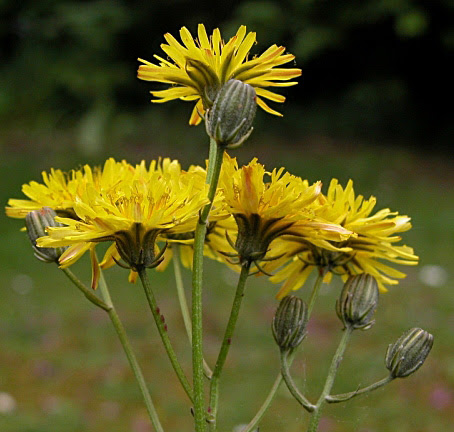
On the left we have the reality of the photographic image, but the drawing takes us into much deeper realms. My first thoughts on seeing a field full of beaked hawksbeards this morning when I went for my walk, was how like suns these flowers were.
Hawksbeard
The flowers like dandelions radiate out from a centre, the evolutionary design for these flowers echoing the sun itself. You cannot escape the connection, as you walk through a field of these flowers and then look up at the sun, they are in many ways one indivisible experience of yellowness and radiance. Hold a flowerhead in your hand and it will turn your skin yellow as it radiates reflective light.
Cheshire then reminds us that the drawing of the root is done in such a way that we are imaginatively intertwined with four braids of Persephone's golden hair and that these represent earth, air, fire and water. Empedocles the philosopher invented the idea of the four elements in his text, 'The Doctrine of the Four Roots'; thus linking in imaginative terms, the base from which everything emerges to plant roots. The world itself, like a plant, grows. What a wonderful idea. Persephone of course had to spend half the year underground, the myth of her abduction and return to the surface representing her functions as the embodiment of spring and the personification of vegetation.
If we then look at the way the flowers have been drawn we see another wonderful complexity visualised.
The sun rising over the flower bud
When you see a beaked hawksbeard, it may or may not be in full flower. Sometimes it will take the form of a seed-head or an as yet unopened bud. A photograph will like the one at the top of this post perhaps be able to show us a couple of states at once. However the artist in this case has drawn a rising sun, emerging from behind the seed pod/flower bud. The flower will be a sun when it has emerged, and like the sun it will disappear during winter, only to emerge again next summer. What a wonderful image.
The full page depicting beaked hawksbeard
In the image above the leaves begin to move across the page as if their form is morphing between plant leaf and insect life and the text that accompanies the drawing is itself of great interest, and the deciphering of texts like this is another of Cheshire's skills.
From this plant can be derived, doses of ichor, the wisest medicine, and it can be beneficial to midwives and child bearing women, the sun's rays as caught in the plants flower, bringing benefits of health and happiness.
The text also operates as a poem, and as a cross between medical information, cosmic connections and everyday need. Please remember, this is also just one page, from one manuscript and Gerard E Cheshire continues to find these old manuscripts and translate them and publish his findings. I think in his quiet academic way, he is offering us something marvellous.
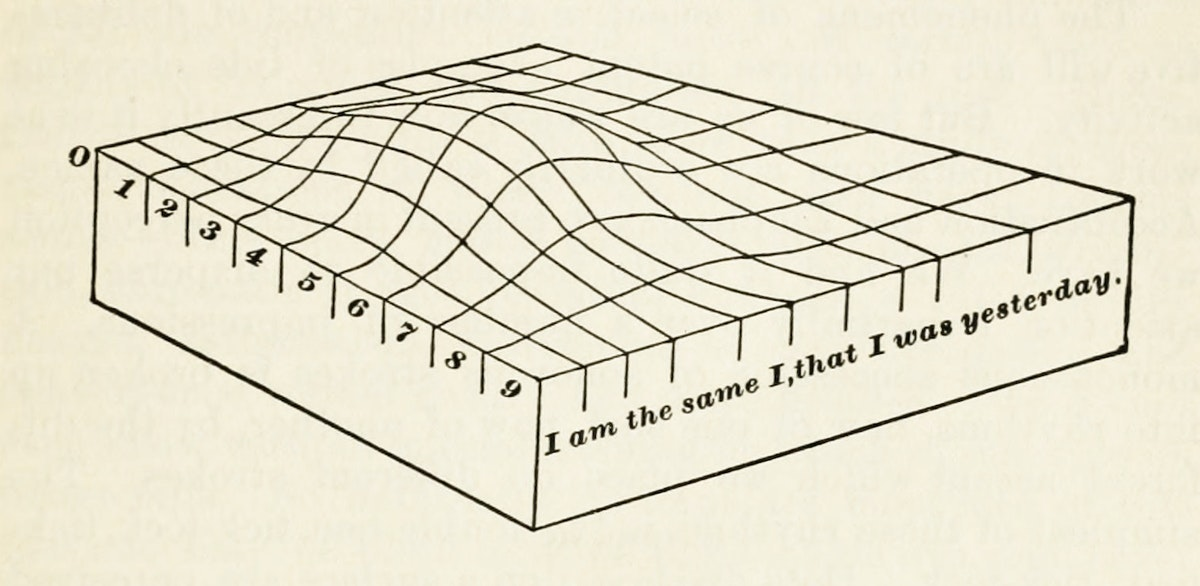
“Annihilate a mind at any instant, cut its thought through whilst yet uncompleted, and examine the object present to the cross-section thus suddenly made; you will find, not the bald word in process of utterance, but that word suffused with the whole idea”. Figure from William James, The Principles of Psychology (1890)
For one reason or another
on Friday an overlapping theme of weaving and grids surfaced. There were several threads to the
conversations that developed (so to speak) and as always due to the short
period of time available for crits and tutorials these were not followed
through in any detail.
The process of weaving
is at its most basic the intersecting of longitudinal threads, the warp,
"that which is thrown across", with transverse threads, the weft,
"that which is woven". It is one of the oldest of crafts and because
of this has a long complicated series of connections with ancient myth.
The two main mythic
traditions that have influenced our own culture are the Anglo-Saxon and the
Classical Greek. Both use weaving myths to explain how our lives are determined
by fate.
Wyrd is the Anglo-Saxon
term. There were three Norns, (Norse Goddesses of Destiny); sisters called Urd, Verdandi, and Skuld; one young,
one middle aged and one old. They weave the fate of both humankind and that of
the Gods. What they weave is the course of the events that form the underlying
structure of life; this pattern if understood, can be used to gain an insight
into how everything that happens in the world is interconnected. Hence we use
terms such as ‘the pattern of our lives’ or the tapestry of life. The Wyrd connects everything, thoughts, emotions
and events on both a cosmic and individual scale, all woven within the threads
of an enormous, invisible tapestry. From the moment you are born you are
connected to all events and things by a sort of invisible thread that weaves
its way around and through all the other threads out there, eventually weaving
a pattern that is your life.
In Greek mythology we have The
Moirae, or the Fates three old women who control destiny. Clotho spins the thread of life, Lachesis decides on
the length of the thread and Atropos cuts the thread on death.
As well as an association
with the tapestry or pattern of life, weaving in Greek myth has other
connotations.
Penelope the wife of
Odysseus weaves a shroud for him by day and unravels it at night, to keep her
suitors at bay during the long years she waits for Odysseus’ return.
The
Goddess Athena, was supposed to have woven the world into existence.
Arachne,
foolishly challenged Athena to a weaving contest and is punished on losing by
being changed into a spider; hence ‘arachnids’ is our collective name for
spiders.
These
myths underpin our understanding of the world, and although we no longer
believe in the Gods and Goddesses of Norse or Greek myth our language is
suffused with metaphors that have been used for so long we have forgotten where
they originated.
“Oh what a tangled web we
weave”. Sir Walter Scott
The World Wide Web of
course is another interwoven network, also called the Internet which of course
brings into this series of associations the net, a type of woven structure that
has been used by hunting and fishing societies from time immemorial. There are
stories in every culture that use the image of the net as a way to either think
about how things are caught or when nets are damaged, how things can escape.
The net being essentially about catching fish or the entrapment of animals, its
metaphors eventually come to be about not just capture, but about containment
and ownership.
When you draw a net you
make a grid. A grid is in effect a two dimensional net.
In her book The Originality of the
Avant-garde and Other Modernist Myths, Rosalind E. Krauss has a whole chapter on the Grid.
She points to the myth of the grid as a dominant factor within Modernist
discourse. Interestingly she points to its use as one that allows artists to
escape narrative associations in their work but she also goes on to point out
how it is almost impossible for artists to avoid its symbolic power. She states
that both Mondrian and Malevich saw the grid as a ‘staircase to the universal’, (1986, p. 10) and that Ad Reinhart must have understood that his Ultimate
Paintings made the shape of a Greek Cross.
The grid of course is a
device that has been used by Renaissance artists to help them take measurements
and apply them into perspective and photorealist artists to allow them to copy photographs; it is used by mapmakers to allow them to measure the world, the longitudinal and transverse threads of the loom now
becoming lines of longitude and latitude. Graphic designers use grids extensively to organise pages, the history of this overlaps with the history of painting composition. See design grid history
As always these blog
posts are to point out directions of interest. You will make your own
connections. For instance archeologists use grids, but of a specific sort, the Museum of London archaeological site manual states,
“It is
common and good practice on excavations to lay out a grid of 5m squares so as
to facilitate planning. This grid is marked out on-site with grid pegs that
form the baselines for tapes and other planning tools to aid the drawing of
plans. It is also common practice that planning is done for each context on a
separate piece of perma-trace that conforms to these 5m grid squares. This is
part of the single context recording system. The site grid should be tied into
a national geomatic database such as the Ordnance survey”. (1994, p. 128)
Geomatics
is the science of spatially referenced information. The wyrd is time and
spatially referenced information but of a complexity beyond current science.
However they both use idea systems derived from weaving. This is a very rich
area to mine and as you uncover different associations you can find new and
alternative directions in which to take work, hopefully this basic introduction
opens a few doors.