Showing posts with label portraits. Show all posts

Friday, 12 June 2026

Drawing a life

For a while now I have been contributing to an on line project called 'Drawing a Life'. We began the project because some of us had been part of an earlier online experiment concerned with drawing the body. Drawing Correspondence ran a six week program, 'THE BODY I AM IN' that lasted from the 19th October to the 23rd November 2021. The participants were from the UK, as well as various parts of Europe. After the sessions were over some of us wanted to continue, so a new group was formed and because of wider interest new people joined, whilst others for a variety of reasons didn't continue.

There was a lot to think about. In particular, what type of knowledge about other people and their bodies, could you communicate through drawing, especially if the information was accessed via the computer screen? This question has sustained us for a while but it has gradually been apparent that simply seeing people on screen and drawing them isn't enough. A few of us had similar questions and we have been undertaking projects designed to test out how we could take some of the ideas further. I think, for myself, it’s about the nature of the hand made portrait in a post selfie world. How can a growing awareness of the narratives surrounding other people's lives be visualised and woven into an image that evolves out of contact with that other person. As we have evolved as a group, we have been changing how we communicate, initially it was simply about spending time looking at each other via the computer screen and making drawings in response to what we saw. But then the more we talked, the narratives that surrounded the images started to become more interesting, the issue now being how could the narratives shape the imagery, without having to resort to simply adding text? We began exchanging things, making things such as puppets, thinking about animal forms that we could inhabit and above all telling stories about ourselves. The image below emerging from a complicated session, whereby I began by working on two joined together large sheets of watercolour paper, an image which I then took into digital print in order to intensify the colour and find more coherence between te image's parts.
C

The image below, was made after a the member of the group gave a theatrical  presentation about their life. As in the image above I worked across two large 5 by 4 feet sheets of watercolour paper, as they presented aspects of their story. Initially working on two separate sheets and then joining them together.


L

We had also begun to exchange things by post. This to establish an actual physical link, to give each other something tangible to hold and to break away from the thin screen presence. Once the sent objects entered the studio, they became the catalyst for more work and new narratives started to emerge.


A new narrative emerges

Working in this way reminded me of why I had decided to join 
'THE BODY I AM IN' project in the first place. It was because I wanted to make myself more aware of that 'body I am in'. I was thinking about what it must be like to make a self-portrait if you had never seen a mirror or any other images of yourself. You would know what others look like and would be aware that you were a human just like them. You would also know that everyone had a different external appearance and that these differences in appearance lay within the bounds of a certain ‘human’ template. No one was over a certain height, noses were nearly always set between two eyes and heads were always within a certain set of proportions in relation to bodies. However, you would also be aware that you had a feeling tone that was you. Your optimism or pessimism index, your sense of bravery, your introvert/extrovert levels and all of those other feelings that make up a sense of yourself, such as whether or not you are in love, in pain or feeling lonely. What Jacob von Uexküll called the 'unwelten' or phenomenological world of any particular creature. This 'unwelten' being dependent upon the body form that perception was housed within. Therefore, a portrait ought to be able to assess these things as part and parcel of the process of depicting a human being. Internal feelings, (interoception) being perhaps even more important than the external appearance of someone. However, there is a powerful paradox in the middle of this and that is that we can never be sure about what another person is thinking or feeling. They may lie, they may have facial expressions that are very inexpressive or not easily linked to internal feelings and many of us are to one extent or another autistic, often high-functioning, therefore not noticed, but nevertheless, something to be aware of.

Interoceptual portrait

The observation of perception considered through drawing, is a research project held under the umbrella of the University of Porto, my role is to use drawing to explore the role of interoception as part of our perceptual experience. Because the world of seeing is like an ever expanding dictionary of what has been seen, things that are not visually seen but which are still being experienced, such as pain or anxiety, are when drawn, usually drawn in such a way that certain aspects of what have been seen are used in those depictions. Metaphor and analogy are important, because meaning is made by making connections with other things. 
A pain might for instance feel very sharp, or be more like a dull throb, in each case we have an implied form, one sharp, bright and pointed, the other lumpy, grey and soft. From such a basic starting point, a language of form can be developed. 

A throbbing pain felt within the body

But feelings can also be associated with more figurative imagery. A memory of a particular soft, cuddly toy might be brought to the fore, every time someone needed a mental cuddle. My felt understanding of ‘leftness’ involves a feeling of pain in my left arm, coupled with an image of a carbuncle that grew in the crook of that arm when I was a small boy. I still see that image whenever I have to think about the difference between left and right. It is part of my internal language and makes no sense to any one outside of my body. 

An image I made when involved with 'The Body I am in'

Sometimes therefore in order to give more information an image of an inner feeling might be located within a simple drawing of the body. In the case below a stomach condition effecting the chest area. 


The longer the ‘
Drawing a life’ group stays together, the more I gather insights into the worlds of the other people in the group. The fact that 'L' has decided to tell the group a story whilst applying layers of clay to her face and painting it, opens new doors, ones that suggest to me that perhaps we ought to have a period of time when we exclude vision and rely entirely on sound to communicate. Then gradually we might bring the senses together again in order to construct portraits that don’t just rely on external appearance. If only we could touch and smell and taste each other too.


L

These two earlier versions of 'L' were made directly from the screen, drawn as 'L' told us about her life. However at that time the portraits made were mainly of heads drawn directly from screen presences, more recently performative presentations have made me reconsider how the normally invisible narratives of our lives, can be transcribed into an image without having to rely on existing illustrative conventions.

When we went to our daughter's final exhibition in Wimbledon, I met Adam Pearson, he had been life modelling for the students there and was also an actor who lives with neurofibromatosis, a genetic condition that causes non-cancerous tumours to grow on nerve tissue, the result of which is that he has severe facial disfigurement. He is also like our daughter and her sister an identical twin, his brother having the same inherited condition, but without the facial disfigurement. (There is a film about their life available at: https://vimeo.com/315774991)

We went for a drink after the opening and we talked about what it was like to be so clearly different to others. Eventually he had to go to get his train and he asked me to walk with him as a form of protection. He had been attacked several times in the past when walking alone, simply because some people just couldn't bear to see him and wanted to literally remove him from the family of forms that make up the possibilities of the human animal.


Adam Pearson

As we talked his features became 'normalised' it was as if the more I saw him as being just another person interested in why people are like they are, the more his external appearance didn't matter, perhaps didn't matter is the wrong term, the less difference it made. I was again reminded of the issues the novel the Picture of Dorien Gray and its various film versions, brought forward, something I wrote about in an earlier post, Adam was I thought, like a first man, bringing forth a whole new series of thoughts about what it is to follow the template of being human. 

Typical image of Dorian Gray's portrait

Meeting Adam had helped me to distrust external appearances. To not take them at face value as we say in English. A phrase that when looked up tells us that we are advised to look beyond the surface, questioning the initial appearance or literal words of a situation, person, or statement to find deeper meaning, hidden motives, or truth. It involves critical thinking and verification rather than blind acceptance. What therefore is an honest face? Again on looking up a definition new problems arise as to how we understand facial appearance. An "honest face" I am told, refers to a facial appearance that instantly signals sincerity, trustworthiness, and innocence, leading others to perceive the person as genuine and free of deceit. This definition is though followed by another statement, 'This subjective impression is often linked to soft features, high symmetry, and "baby-faced" traits rather than hardened or intense features.' After I had left Adam at the station my feeling was that his face was perhaps the most 'honest' I had ever come across.

See also:


Friday, 26 December 2025

Christmas calendars

At Christmas time I put together a calendar, that I use to give to friends as presents. I try to write a small aphorism or quip that can sit in the calendar's date boxes, so that people have something to think about every day. The fact that many people who get them hang them in the toilet, seems to suggest that is where we like to sit and have a little something to think about. Over the last few years I have been contacted by people from outside my family/friend circle, by other's wanting these calendars and interest seems to continue to grow. I usually choose a visual theme from the work I have been doing over the year and write the aphorisms at odd times during that same year. When I was teaching, at one point I was developing a thought for the day that I would put to students first thing in the morning as a sort of wake up call. When Twitter arrived I then used to use that as a way to disseminate the idea. The calendars emerged as a way to record a year's worth of thoughts and were quickly taken up as a more condensed or easy to read, idea a day stimulus. 

I have been involved in a variety of projects this year, some focused on ceramics, one on animation, several on drawing and I have done both collaborative and very solipsistic work. The strand I decided to use as illustrations to this year's calendar, was selected because it represents the impact on us all of the continuing political churn that is emerging from the USA. I have met several people who live in the States over the course of the year at conferences and all of them were talking about their worries for the future of academic freedom and they cited the use of military forces on the streets of usually Democratic voting cities, as the tipping point for them. Like so many of my ideas these images initially emerged as responses to conversations, it seemed that the anonymous forms of semi-military personnel, had wormed their way into people's imaginations and it became my role as an artist to find forms for them. 

I was very aware however that each and every one of the ICE personnel that people were referring to, was underneath whatever covering they wore, an individual, who would have thoughts and feelings no less complex than those who were witnessing these events. An ex student of mine was now living in Chicago and had posted an image of ICE agents dropping into the city by helicopter, who then went on to storm a hostel that held immigrants. She was obviously disturbed by what was going on, frightened by the possibilities it was raising in her head. I could not fail to be affected by these things.

Events such as these are part of a much wider issue, immigration is a hot topic and the media use several rhetoric tropes to stir up people and agitate the situation. The reality is that people are worried about the non integration of large numbers of people coming into the countries of the northern hemisphere. Global warming, war and famine, are together driving thousands of people from their traditional homes, the weather as you go further north is still as yet reasonable and the economic viability of the western world, appears from afar, as creating a haven in comparison to the places where people are coming from. It is no surprise then that people will want to move, but also no surprise that the peoples who already live in the various western countries are resistant to an influx of people that are outsiders. The resultant conflict will I suspect become worse as heat rises. As an artist I have no answers, my practice is focused on listening to people and trying to find images that visualise their fears, anxieties and worries, as well as aspirations, exhilaration and joy. Our world provides us with a complex mix of experiences, some people such as scientists seek some sort of rational understanding of these and others such as artists try to develop more poetic or mythic concepts that help people find an alternative understanding of life's experiences. 

My approach to making visual responses to what I encounter is to set up a situation whereby the materials of image making, be these inks and paints or clay or wood, become another partner in the development of an emerging something. In the case of these recent images, I was looking at TV news footage and first of all scribbling down notes in pencil onto sheets of A3 paper. I then went back through these notes applying ink and watercolour washes, letting the flow of colour and line talk to me. Each image took its own time to emerge out of the materials of its making, I had no idea of where I was going with them and made them on and off over several months, many of them were useless daubs but a few began to chime with something inside me that suggested that they were ok. I didn't want to set these images up as critiques of a situation I had no real understanding of, they were, as are most of the images I make at the moment, more an attempt to capture the psychic feeling tone of people that I have spoken to or an attempt to capture what is in the air. 

These are the pages of this year's calendar.


My calendars are not very Christmassy I'm afraid and they never have been. Last year I decided that prints I made in response to the situation in Gaza would be the main chosen images, but the year before that images of Sooty were chosen.*


I have often in these posts reflected on the various ways that drawings can be presented in exhibitions, but rarely written about other forms of dissemination. In this case by putting images and texts into a calendar, you in effect are sending out a small compact exhibition to individuals. The fact that many of these calendars will find their way onto a toilet wall is for myself a good thing, as it means that people will at least take time to think about what the images might mean to them or ponder on the aphorisms. 


*Thinking of alternative formats for the dissemination of work, at some point in the coming year, Landline Records will be releasing Micko & the Mellotronics latest recording, 'The Trinity'. The singles that have already been released used my images of Sooty as their cover and the gatefold CD package that the new CD will come in will also use Sooty images. I think it's great to have work chosen to accompany Micko's music, which I think is fantastic. Hopefully his sense of how odd our everyday Englishness actually is, will chime with my own take on Sooty as an avatar, an incarnate mystic animal, clothed in the form of a yellow child's puppet; an everyday object that has gone ferrel. 

Sooty is used to cure a painful heel. Stained glass: 2025

This is my last post of 2025, a turbulent year and one that has thrown up many challenges for the human race as a whole. As an artist who tries to make images by making drawings, I feel at times totally useless in the face of world events that I have no control of whatsoever. But I still continue to draw and new images still seem to emerge, so perhaps all is not as bleak as I might at first think it is. Thank you for reading these posts and hopefully you will find an occasional thought that you can use in your own journey. 

Happy New year. xxx

See also:


Tuesday, 27 May 2025

Lynette Yiadom-Boakye at Leeds Art Gallery

It is a wonderful time to go and visit Leeds City Art Gallery at the moment, especially if you are interested in portraits. The new exhibition, 'To Improvise a Mountain: Lynette Yiadom-Boakye Curates', has been developed by the artist in collaboration with Hayward Gallery Touring, and although developed as a touring show, it sets up a series of fascinating associations and connections with work already on display in the gallery. I have seen several exhibitions containing Yiadom-Boakye's paintings of people; her imaginary compositions developed from photographs, life-drawings and found images and was curious to see how she drew as well as painted. She has also curated this exhibition, so it was a chance to see her wider interests in terms of image making, something that we sometimes forget is very important to all artists if they are to continually refresh their eyes and their minds. The focus of this blog is of course on drawing, but sometimes artists who draw and hand make images, also need to look at photography, if only to think about the differences between the two representational systems. Yiadom-Boakye's curation does that well, in particular because of her interest in Sickert, she gives us a reminder of his role in stitching together relationships between the two practices. He at times painted portraits of well-known personalities and when he did, his compositions and images were often derived from press photographs.

Sickert: King Edward the VII

Probably the most well known example of Sickert's relationship with photography is his 
portrait of King Edward the VII, the cropping being probably something he learnt from Degas. As artists began to respond to the photographic image, one of the most interesting issues was how we were reminded of how composed paintings were. One of Yiadom-Boakye's chosen artists, Lisa Brice, is I sense very aware of Sickert, but is now taking the concept of the frame and how it cuts into reality, in another direction, this time using it as a way to reconnect with images of women as framed by men in paintings. She is not like Sickert, casting a photograph into paint, but re-casting the roles of women who inhabit older painting, this time giving them a much greater agency in the image. An agency I personally recognise that can be derived from the act of smoking, the taking up of which at one time, I felt to be an anti-authoritarian snub to my father. It's interesting how easily personal history interweaves itself into the way we find meaning in our experiences. We might love our fathers, but we need to take actions that ensure we don't end up living life under their shadow and I sense that is partly what Brice is saying in these images, she loves painting's history, but needs to re-cast it as something she owns. 

Lisa Brice

Lisa Brice's other painting was I thought just as powerful and in its handling of materials, was an image I could associate with even more closely. I first saw Lisa Brice's work at the Tate and was at the time particularly drawn to this image of another smoking woman.


Lisa Brice: Parting at Dusk (2018) gouache on polyester drafting film 

The blue gouache paint streaks down the drafting film, a surface I have often worked on myself, as you use it in printmaking to hold and transfer gestural qualities when making silkscreen exposures. She translates William Rothenstein's Parting at Morning's material handling into something far more visceral, the paint standing for itself, rather than being a vehicle for representing fragility.  Brice is also making another translation, taking Rothenstein's representation and shifting its meaning, this is no longer an image of a frail white woman left by a man in the morning, it now becomes a woman of unidentifiable race, that will leave before the night, and who stands her ground, smoking defiantly. 

William Rothenstein Parting at Morning (1891, chalk, pastel and bronze paint on paper

Yiadom-Boakye is obviously interested in how painting's past can be revisited and she has chosen to exhibit one of her own responses to this. 

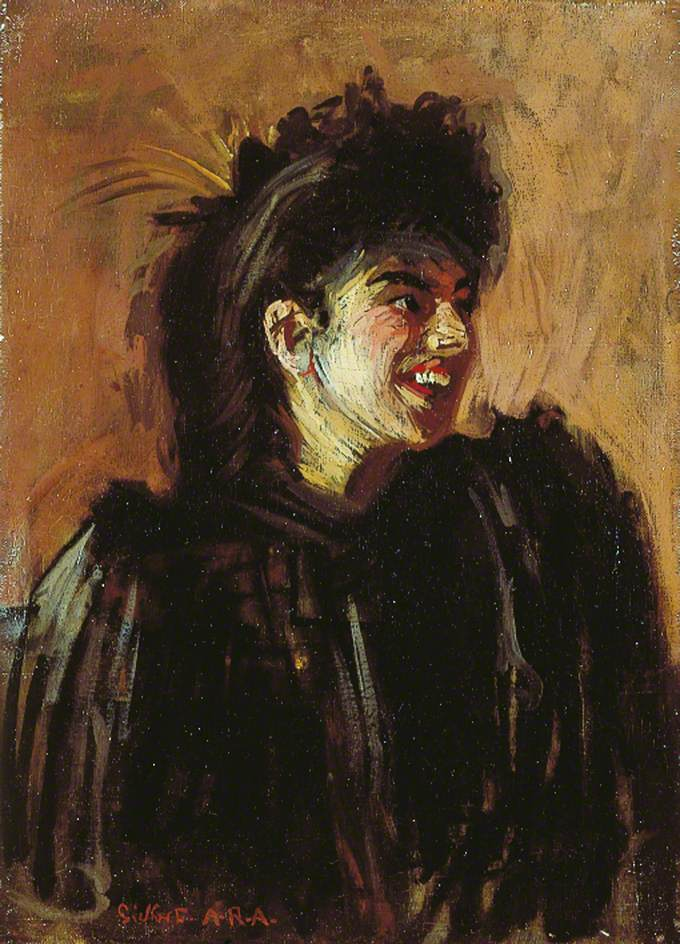
Sickert: The Blackbird of Paradise

Sickert's 'Blackbird of Paradise' painting has long been part of the Leeds Art Gallery collection and it first drew Yiadom-Boakye's attention when she was undertaking some teaching at the Leeds Metropolitan University. During a break she had gone down to the Art Gallery and found a wonderful portrait that is suggestive not only of how humans can be bird like, but how paint itself can inhabit different creatures or materials, sometimes being feathery but at other times slimy like a wet frog or dry like sandstone or an elephant's skin. It was also a study in blackness, of how one colour can be many; blue blacks, green blacks, violet blacks, transparent, impasto, gestural and solid; a reminder of how great painters give life to the paint they use, in order to give life to the subjects they depict. 


Sunbird 2 and 3

Yiadom-Boakye's imaginary portrait drawings, 'Sunbird 2' and 'Sunbird 3' are direct responses to Sickert's painting. At the core of my fascination with her work, is the fact that her portraits are imaginary. She forces us to confront what I think is a central issue in our understanding of portraiture, how much of our understanding of it is due to our obsession with what someone looks like and how much is it a reflection of how we read human beings as types. If, she suggests, an artist is to give life to her subject, she has to first of all 
give life to the materials used to depict that subject and if that is successfully accomplished, this new life, will be read and responded to as any other human being. Sometimes understood as a stereotype, or cliché and at other times as a particular individual that you can have empathy with; the reading is in the power of the beholder. 

Upstairs in the art gallery there are two other exhibitions focused on portraits. One which has been there for quite a while and a new exhibition focused on portraits of women, an exhibition that has to be shown in very low light levels due to the fragility of the various papers on which the works chosen were made. Between the three presentations there are some very interesting comparisons to be made. 

Yiadom-Boakye: Charcoal on paper

Jacob Kramer: Drawing for 'Mother'

Two similar sized drawings, both using charcoal are to be found on exhibition. One by Yiadom-Boakye is downstairs in the exhibition 'To Improvise a Mountain' and one by Jacob Kramer, is in the drawings of women exhibition upstairs. Although both drawings use similar mediums and sizes the handling is very different. It is perhaps easier to see in a detail, especially as it is very hard to photograph images behind glass. 

Yiadom-Boakye

Jacob Kramer

Yiadom-Boakye's hand is a simple solid, the charcoal is blocked in and heavily worked with a rubber. The charcoal is pushed into the paper, using it feels like a good sized block of compressed charcoal, as opposed to a willow charcoal. Kramer's is softer and more delicate. He uses willow charcoal, smoothing out his tonal changes by smudging with his fingers and making highlights with a sharpened rubber. He is feeling for the form of the hand as an extension of the expression of the face, whilst in comparison Yiadom-Boakye's hand is more generic, perhaps even more mechanical, definitely a hand designed to punch more than to express a continuation of the 'read' of the face. Both artists are seeking some sort of authentic communication, trying to express something about what it is to be part of a community that has historically for one reason or another been overlooked. As people from my own family, came as Jews to the UK in the late nineteenth century, I am very aware of the pogroms that Kramer is asking us to remember. His family lived not far from where I live in Chapeltown, which was then home to immigrant families from eastern Europe and Ireland, as it is now for people from the West Indies and other parts of the old British Commonwealth. Kramer wrote that when he was looking at his subject, he saw both its physical appearance and its spiritual manifestation. His struggle, he claimed, was to escape physical appearances and to paint the subject's spiritual form, an idea that was very much of his time, being central to expressionist thinking and deeply influenced by Theosophy. His struggle to find a form of expression that could both elevate the human spirit and remind us of a people's history, give his images a particular authenticity, that can find parallels with Yiadom-Boakye's work. She is also concerned to address a history of a people's representation, or perhaps more accurately their non-representation and in giving form to invented lives, she peoples the walls of the galleries she exhibits in with the portraits that have historically been missing.

As Yiadom-Boakye's portraits are not of any particular person, being constructions made from various source materials, they are anonymous and this opens up their interpretive possibilities.  
Many portraits over time lose their associations with particular human beings and by the time we get to see them, the name of who was depicted has long disappeared. But we are still fascinated by the image of a human being, and perhaps once a portrait is unanchored from the particularities of a name, we can much more easily inhabit the image in our imagination.

An Egyptian 'Feyum' portrait of an unknown man

Perhaps the most powerful example of this effect on myself was when first encountering 'Feyum' portraits. They appeared so lifelike, especially as I knew that they were 2,000 years old, their freshness mainly due to their being painted using wax based encaustic techniques, a reminder of the fact that in comparison most contemporary art materials will fade and deteriorate very quickly. I felt I could 'know' these people, that they were alive to me and I was able to give them life stories in my mind. This aspect of historical distancing also operates with Ottovio Leoni's 'Portrait of a Lady' on display in the upstairs gallery; although drawn in the 17th century, I felt she could have just walked into the room. The drawing very subtly draws you into her gaze, the marks constructing it changing, as we move from the gestural impressions that form the outer edges, towards the much more refined drawing of the face. We are in effect, visually sucked in.  

Ottovio Leoni: 'Portrait of a Lady'

There are so many comparisons and stories that can be made out of this conjunction of exhibitions, that I find myself drawn back into the gallery at least two or three times a week, each time a new set of relationships suggests itself; a proof to myself of how important free access to art galleries is to the wellbeing of cities. In order to 'see' an image, you often need to go back and look again and then after letting it dwell in your mind, you need to go back and look again. It is such a privilege to have somewhere you can do this, without having to pay an entrance fee. This is an issue that does affect us in Yorkshire, I now rarely go to York Art Gallery where the entrance fee is £8.50 or to the Hepworth where it it £13. We should never therefore take our local gallery for granted. 
'To Improvise a Mountain: Lynette Yiadom-Boakye Curates' is on exhibition until 5 October 2025. 

See also: 

Saturday, 5 April 2025

Jonathan Richardson's self-portraits

Self portrait: Foot pain and its emotional effects

I have been making drawings and printed images of people, whereby I listen to them talk to me about their internal perceptions, (interoceptions) of pain, emotion and other inner body feelings. Essentially what I am making are a series of portraits, but images that attempt to reflect the interior world of people, rather than their external appearance. My fellow researcher at the Leeds Arts University, Dawn Woolley is focused on the photographic selfie, so it feels as if we have both interior and exterior awareness covered.
When thinking about a history that might lie behind my approach, I began by looking at expressionist portraiture, but as I dug around the subject, the more I came across the self portraits of Jonathan Richardson. 

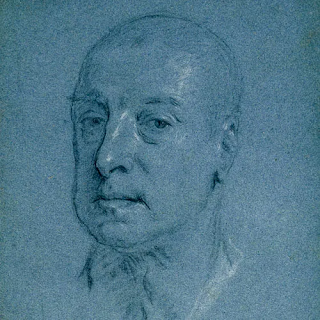
Jonathan Richardson, Self-portrait, c. 1735

Richardson made hundreds of drawn self portraits over a period of several years. This type of serial facial analysis looked at from a present perspective, feels very modern. For instance in relation to expressionist portraits, in three of his more prolific years, Vincent van Gogh, drew and painted himself over 40 times. and as photography has become the main form of facial representation, serial portraits, such as Jo Spence's 'Brave' series, have become central to documentary practices.

Jonathan Richardson, Self-portrait, c. 1738

Richardson even went back to earlier work and made drawn copies of his self-portraits from paintings made many years earlier. Most of his self portraits are however drawn from life, using a variety of materials, including pen and ink, graphite on vellum but mainly black and white chalks on blue paper.

Jonathan Richardson Self-portrait as a poet, c. 1732

Jonathan Richardson, Self-portrait, c. 1728

During his early career as a portrait painter he defined his trade in this way, "a portrait is a sort of General History of the Life of the Person it represents, not only to Him who is acquainted with it, but to Many Others, who upon Occasion of seeing it are frequently told, of what is most Material concerning Them, or their General Character at least." However his later self-portraits, which are nearly all dated, are not a ‘General History’ of his life, they are far too particular. They represent the complexity of an inner emotional life, rather than the status or occupation of the sitter.

Jonathan Richardson Self-portrait at the age of thirty, 1735

Jonathan Richardson Self-portrait, 1736

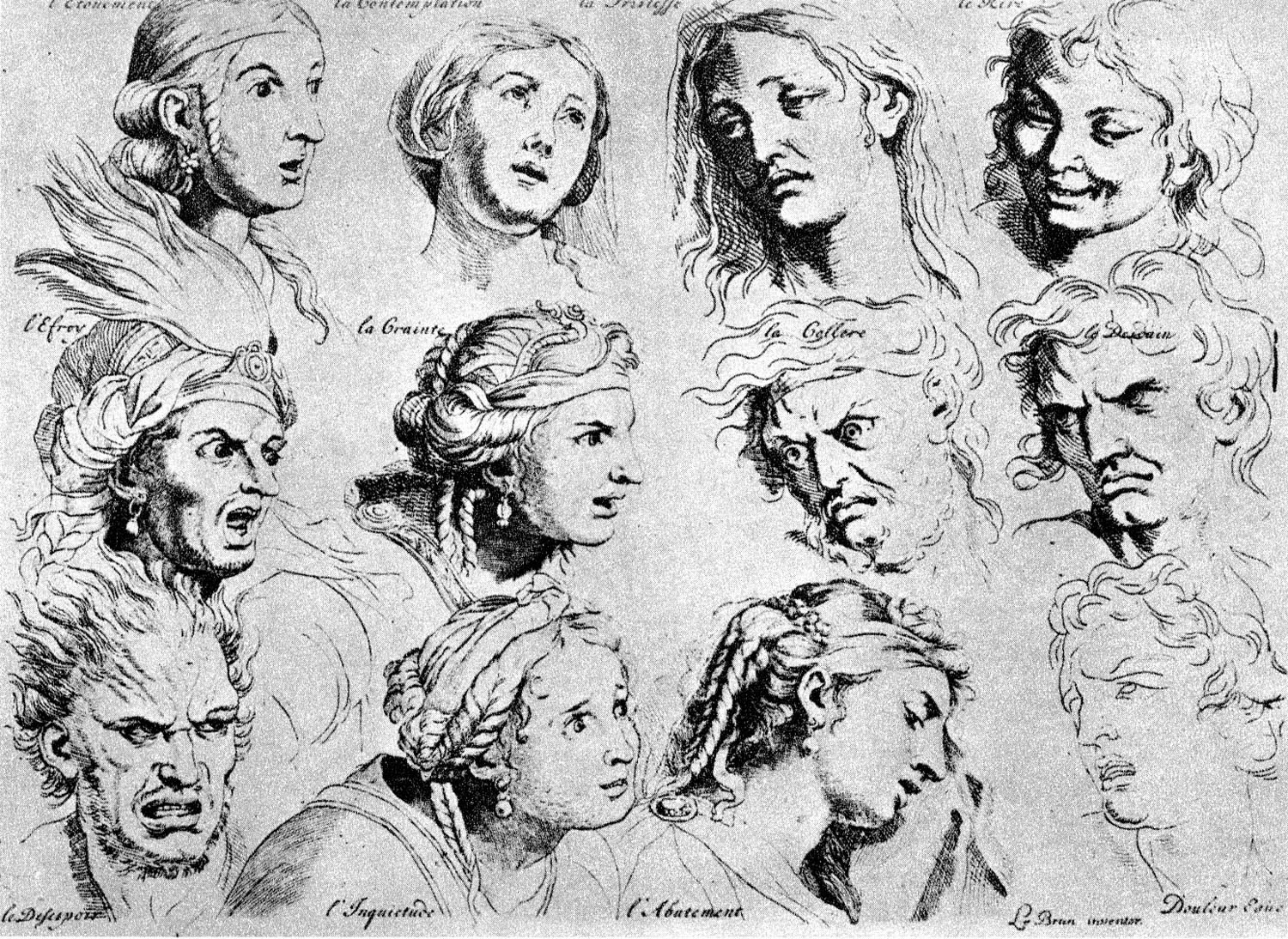
I find his portraits intriguing, especially how with slight differences in the openness of an eye, or width of a face, as well as by changing materials, he can give quite different impressions as to what he is thinking about as he gazes at himself. His images can feel very confident, or fragile, slightly sly or arrogant, quizzical or poetic but they don't feel forced or exaggerated as in Charles le Brun's  work or 
Messerschmitt portraits.

Charles le Brun: The expressions

Messerschmitt: Character Head

I first came across Jonathan Richardson in the chapter 'Searching for the self' in Susan Owens' excellent book, 'The Story of Drawing'. It is a book well worth a read if you are interested in how drawing supports the various ways that artists think about what it is that they do. We might value painting far more, but it is often an artist's drawings that reveal their thoughts and the roots of their sensibilities; the paintings or sculptures done afterwards often covering up the thinking surrounding an idea's gestation.

Richardson's portraits reminded me that you don't need to go 'over the top' when looking for expression and that it is often in small details that a telling communication is made. He also made his self portraits as he neared the end of his career, something I am also doing. It being a time to continue working if you still have the capability but the pressure to earn money or get out there to make your name is less and you can therefore reflect more on what you have done and how perhaps you can do it in a more interesting or personal way. 

See also: