Showing posts with label somatic perception. Show all posts

Tuesday, 11 February 2025

Emotional landscapes

A somatic inner landscape

My research into interoception has led me towards the constructing of what I think of as emotional landscapes. Our thoughts and emotions are held in our bodies, shaped by neurological pathways formed in our brains. Therefore we can think of the body like a landscape or eco-system that has been shaped over the duration of our lives by the rivers, winds, evolutionary forces and seismic shifts of thought and emotion. The problem for myself and many of us is that once the neurological landscape and its eco-systems are formed, rivers flow down now pre-existent valleys, and living creatures within our bodies (we are over 50% bacteria) have evolved in particular ways in order to fit the niches they evolved within and they too are directing our thoughts in channels that may be decades old. Therefore new experiences are usually channelled into old pathways. We are in effect being shaped by our past, re-living it in the present, again and again.

So as an artist making images that are attempts to communicate certain interoceptual experiences, who is also undergoing therapy, I have been reflecting on this and thinking about how these visual reflections might be able to help myself and others to develop a more nuanced and in-the-present somatic self-awareness? Self-awareness perhaps being one way to go back to our inner landscape and begin to cut into it a few new channels, pathways that might help us get past old traumas or not useful habits. As someone who is passionate about the continuing relevance of the long history of drawing, I have been trying to develop an approach to this by going back and looking at art history and thinking about how the idea of a landscape can be both an inner, as well as an external experience. This also reflects a growing awareness that our pasts are also the structures on which we build ourselves, and any new activity will have to be carried by the building blocks of our past. As in most things what is looked for is a synthesis, finding a way to keep the mind and body open to new experiences, whilst keeping both in good repair. 

In her insightful book, 'The Story of Drawing: An Alternative History', Susan Owens introduces us to the work of Guo Xi. When describing the affect of his brush drawing, 'Old Trees: Level Distance', created nearly a thousand years ago in 1080, she states, "It is a drawing that describes an inner state of mind - wistful and nostalgic - every bit as much as the external world." (Owens, 2024) 

Guo Xi: Old Trees: Level Distance

Albrecht Altdorfer: Saint George in the Forest: 1510

Half way in time between the construction of Guo Xi's 'emotional landscape' and now, Albrecht Altdorfer produced his image of 'Saint George in the Forest'. Brad Morosan, had this to say when discussing the painting, "Altdorfer depicts a natural world in which the seen is the garment of the unseen." (Morosan, 2010) That 'unseen' being I would argue, is the inner somatic emotional feeling tone we have when thinking about these ideas. St George is in effect immersed in the belly of an image that is both a dark forest and an internalised psychic landscape.

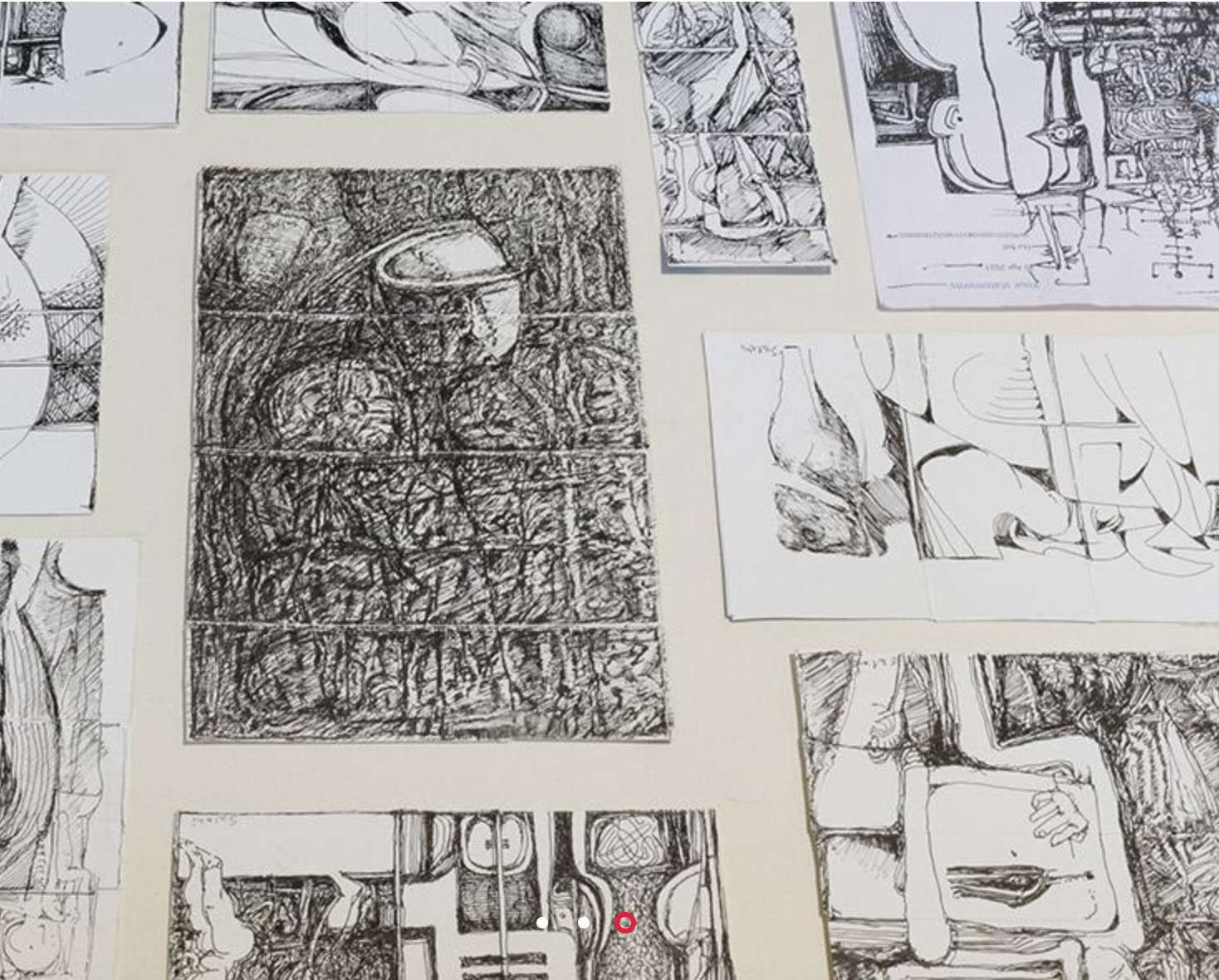
I am though an artist of the 21st century and I have a wider range of drawing tools available to me, including CAD and animation equipment. So I have begun to develop not just single images of feelings made in response to conversations with people, but also animated landscapes within which I can place 'feelings', landscapes designed like those of Guo Xi and Albrecht Altdorfer, as containers of 'inner states of mind'. People I have been talking to recently have told me about their anxieties about the state of the world. In particular, more than one person has been having dreams and nightmares about a city in ruins following a nuclear war, one where Leeds or wherever they see as home, is reduced to rubble and its people totally extinguished. A combination of seeing news footage on a daily basis from Gaza, the drip, drip, drip of Putin's propaganda and the rise of Trump, has gradually eroded traumatic pathways into some people's brains. I have attempted to visualise these thoughts by first of all making drawings and then from the drawings making prints. I see these prints as 'worlds in which the seen is the garment of the unseen'; Morosan's phrase seemed totally right, the distressed marks made by inks and sticks and brushes, further heightened as part of the printmaking process, by imitating the use of the old litho film I used to use when making screen prints. This film was used to turn an image into areas of black and white only, there were absolutely no mid tones. To soften the transitions you could apply a dot screen, but I like to use this type of method to roughen up the image and to make tonal decisions much more dramatic, a sort of printmaker's chiaroscuro. The nearest contemporary application in Photoshop is the stamp filter, which works in a similar way, as you can only have black or white areas, thin ink washes are broken up into black/white textural surfaces, that are suggestive of a dark drama. Grainy watercolour washes can be transformed into more aggressive textural surfaces.

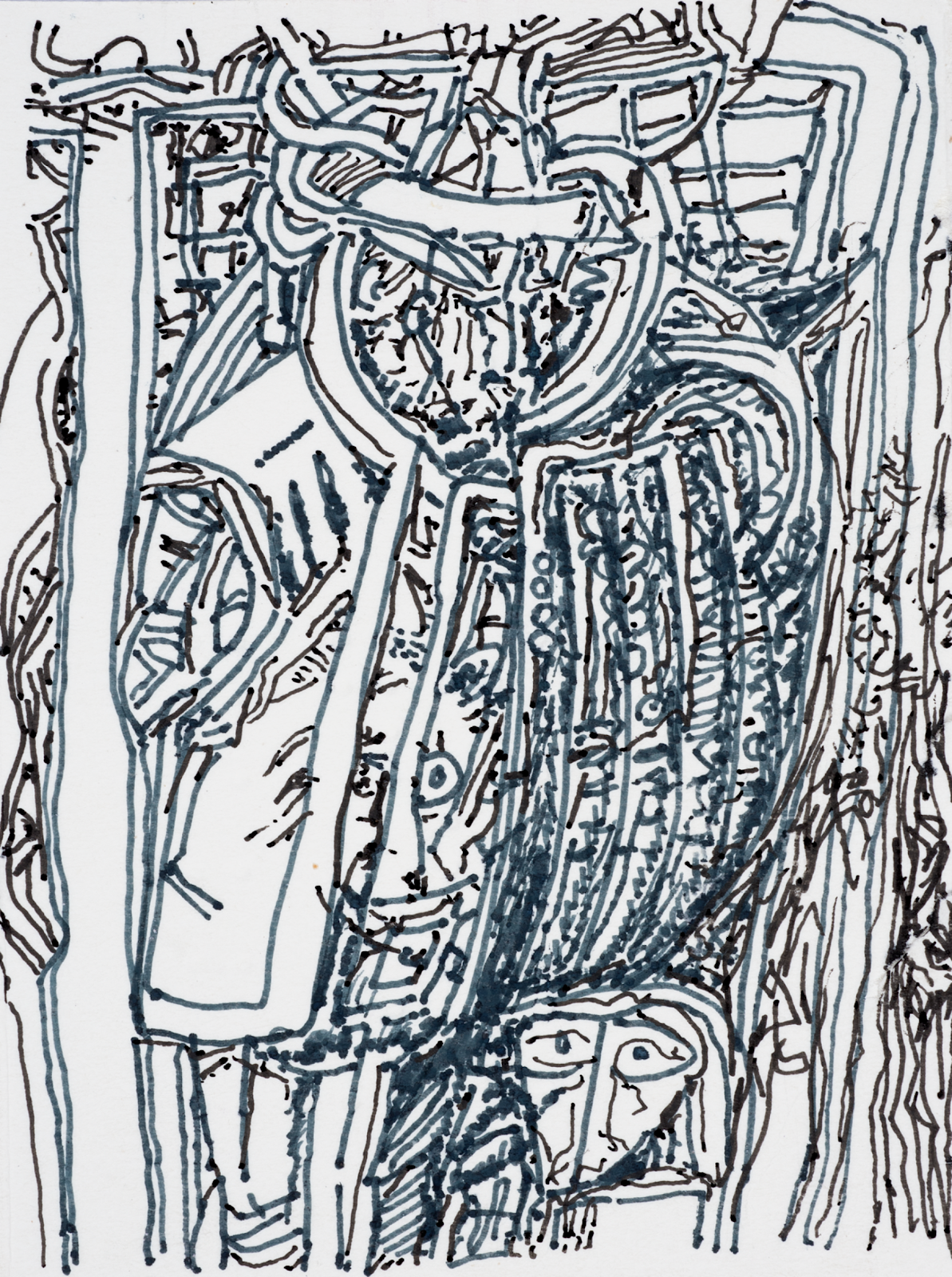
A typical drawing I have done in response to someone's dream


From a series of prints based on dream conversations: 2024

At the same time I am working towards a much more ambitious project whereby I'm developing an animation of an 'emotive landscape', a project I have mentioned already. See: The scrolling of Chinese landscape imagery has in particular influenced my decision to slowly scroll through a landscape/body, which is in itself an idea influenced by the Chinese concept of the Neijing tu. See

Detail of an inner emotional landscape scroll

The images embedded into the landscape/body were developed in response to a series of conversations out of which a book of drawn images were developed that were then used as visual prompts within workshops, designed to help people begin the process of thinking about how to visualise inner feelings. That book has now been scanned and digitally archived: See 

Detail of an animation that uses a landscape scroll as a slowly moving background

Sometimes ideas take a long time to jell. When I read Thomas Hardy's novels, back in the 1960s I realised then that landscape was more than just a setting, it was an active participant and a deep emotional metaphor. In Tess of the d'Urbervilles, it is a cypher for Tess's internal metal state, for instance when she comes home after losing her virginity, she sees the landscape as a reflection of her distress. She begins to understand the external world as having an emotional voice and as she does so, she internalises it; as Hardy put it, “The midnight airs and gusts, moaning amongst the tightly-wrapped buds and bark of the winter twigs, were formulae of bitter reproach”. (2005, p.108) I read the novel as a schoolboy. but it has taken until now to understand how I could use it's ideas in my artwork. The personification of midnight airs and gusts, could I realised go both ways, and my internal winds, could be seen as blowing through and out of a body landscape that sits in a world that I see more and more as belonging to a continuing ancient animist tradition. 

NB

In the world of the designer, emotional landscapes are defined in a different way and there exist tools to help in their visual construction. They are defined as visual representations of the emotions people experience in relation to a product or service. They operate as maps that illustrate the intensity and makeup of those feelings. For instance the X-axis can be used to represent intensity, and the Y-axis to represent desirability. The image below is taken from an emotion centred design website; Medium.

Emotion-Centered Design

Find a 'look book' for emotion centred design here.

The commercial world uses emotional design to get people to engage with products and services and as a former head of theoretical studies at the Art College, I used to have to introduce 'emotional design' in my lecture programme. It can be used in many ways, not just to sell goods to people who might not really need them.

References

Foster, J.A. and Neufeld, K.A.M., (2013) Gut–brain axis: how the microbiome influences anxiety and depression. Trends in neurosciences, 36(5), pp.305-312.

Hardy, T. (2005) Tess of the D’Urbervilles Oxford: Oxford University Press

Morosan, B (2010) 3 Divine Landscapes: The Style of Albrecht Altdorfer University of Western Ontario https://www.uwo.ca/visarts/research/2010-11/bat/images/Web/3,%20Morosan,%203-24.htm (Accessed 11. 12. 24)

Owens, S (2024) The Story of Drawing: An Alternative History of Art: London: Yale University Press

Xue, H., (2022) The Picturesque and the Tragic Vision: Thomas Hardy’s Landscape and Female Images in Tess of the D’UrbervillesFrontiers in Art Research4(3).

See also: 

Collaboration and copying 

Drawing: Analogue and digital processes

Visualising energy flow

Lines as symbols of invisible forces

Thursday, 13 June 2024

The visualisation of embodied thinking

An infection is surrounded by epithelial cells that produce an antimicrobial peptide

Both mental and physical experiences are imprinted into our bodies. This is partly why I have recently posted on the tattoo, which I was thinking about as a sort of analogous process, suggesting that tattooing can be thought of as a metaphor for how the body's internal cells are imprinted by external events. External experiences are held in the body/mind as imprints and memories, and because they are now inside the body, they effect physiological change. 

Our nervous systems are layered, and we have inherited older parts that still work because they were effective during the early part of our evolution as an animal and they helped us to survive.  These primitive reflexes still mobilise our fight-or-flight decisions and they are integral to our inner emotional feeling tone. This feeling tone is an embodied awareness as experiences are encoded in this system non-verbally and non-consciously. This is why I have decided that drawing and other material processes such as making things in clay, are so essential to the awareness raising needed if we are to engage with how our body/minds are working to keep us well. 

I have been looking at my own history and there were times when my experiences of life were traumatic. I feel sometimes as if I still carry these events within myself, even though they are events that took place a long time ago. It is as if these past experiences are somehow still 'fixed' in the body, the problem then being that some of my actions and reactions to new experiences, can be still in some ways, responses to situations that are no longer the case. 

I recently undertook an awareness exercise to help myself identify whether or not my body might be working harder than it needed to when operating automatic self defence mechanisms. After going through the symptoms, it did seem to be the case. I sometimes get cold hands or feet, a common sign of blood being diverted away from the periphery towards the core muscles that help us flee or fight, when we are stressed. I am very sensitive to bright lights and loud noises. I sometimes lose spatial awareness and become dissociated, and I often have that feeling of having my head in the clouds. I have also in the past had panic attacks, but thank goodness I have had none during the last few years.  All of these are signs that my mind/body is over compensating and that it goes into survival mode much too quickly, because it has not been able to 'forget' past experiences that are no longer threats.

Drawing and making things are activities that enable me to feel safe, they are my main health resources, or at least it feels that way to me. Those inner body feelings of an anxious stomach and tight chest, disappear when I am engaged in drawing or making ceramics. I have been for a while now exploring images associated with interoception, perhaps an awareness of how these images came to be, can help others overcome their own embodied anxieties. 

One of the books I have been reading about embodied stress suggests that if you are to move on past your self defence mechanism triggers, an extremely useful skill is to learn to check whether you can inwardly visualise the size, shape and weight of your body. the book suggests that an awareness of the boundary of the skin, helps differentiate who we are; the skin being a transition place between me and not me. The book explains that a layer of our nerve rich skin grew from embryonic ectoderm, which also forms the brain; therefore the skin it is argued, is another outpost of the nervous system, as is the stomach. However, when you try and envisage the body, there can be bits missing. Some people on trying to visualise the body realise that in their body/mind they are missing legs, or limbs are far too small, images of their bodies may be diffuse, abdomens absent, one side of a lung absent, or bones far too soft. In fact it is in the spaces between what feels known and what feels unknown, that some sort of visual understanding is being forged and the unknownness of these elements, is what makes the images made from these feelings so interesting. They are sort of the opposite of photographic realism, they are glimpses of things that are felt and then in order to catch the glimpse, you need to re-invent the form that it is coming in. Even with all this ambiguity and missing elements, there is something about this process that feels much more 'realistic' than copying photographs, because at least I am directly being in touch with myself or others feelings, no matter how tenuously. 

The short condensed text, 'Finding Safety via Embodiment' by Steve Haines (The Body College, 2019), sets out questions that are designed to help you visualise your body...This is the verbatim text...  "Initially it can be useful to go through them as a sequence, using the mnemonic WOSI; Weight, Outline, Skin, Inside. with more experience you can be much more flexible. Often the simple question ‘how does x compare to y’ can open up a realisation of an incomplete mapping of the body. Weight ‘How does the weight of your body feel on the table?’ ‘Do your shoulder blades, hips, knees and ankles feel even on the table?’ Outline ‘Can you feel the outline of your body, the silhouette it makes?’ ‘Does the outline feel the same from the inside with your eyes closed as it would if you were looking at your body or touching it?’ ‘How close or far away are your hands and feet. They are not too big too small or too close or too far away?’ Skin ‘Can you feel your skin as a clear boundary between the inside and the outside?’ ‘Does your skin feel sharply defined and easy to contact or is it a bit blurry or amorphous?’ Inside ‘How does the inside of your body feel?’ ‘Does the inside of your body feel full, flowing, alive or are there bits that feel empty, fixed, numb or hard to contact?’ " (Haines, 2019)

However, I had a few questions myself about the questions asked. Haines presumes that the inner body map in some way resembles the way we see or feel our bodies from the outside. The work I have already done in relation to interoception and how to visualise inner or somatic experiences, has pointed to a wide variety of ways for people to visualise inner body feelings. Drawings that have been done in workshops, as well as images I have made myself, point to a wide range of possible approaches to visualising feelings.


Images made during a workshop

The issue for myself is that by attempting to visualise a somatic experience, the person involved begins to 'own' the experience and to actively engage in building up a relationship with feelings and inner body sensations that they would normally ignore. 

A visualisation of stomach pain

Identification of pains within a crude body map

I have been undergoing pilates sessions, in order to come to a better understanding/awareness of my own body and at the same time attending therapy sessions to get a better grasp of how my mind is working. Hopefully by undertaking the two approaches at the same time, I can gain a better grasp on my own mind/body relationship. I am of course still drawing and having conversations with other people about their own feelings/understandings of these issues. 
Somewhere in the mix, whether it is in the workshops with other people whereby they make interoceptual images, or in my own self reflections, at some point images will hopefully emerge that can help with some sort of communication of what is an eternal conundrum; the fact that we cant see inside anyone else's head.  We do however need to have empathy for others and we need to operate in ways that enable cooperative actions, these things are central to our collective human condition. The making of art, is I feel, something that illuminates our experience of life, that it enriches it and gives it more depth. The mind/body relationship is something humans have had to consider over and over again, each society and time, coming to different conclusions as to how to make sense of consciousness. 

Above all, I'm trying to find answers to the development of a practice that ties together all the various parts of my life experience, a way of working that acknowledges that environments will effect both our bodies and our minds. I also believe that we are inseparable from nature and an integral part of it, which means that you cant step outside of it, a situation that leads me to also believe that everything is interconnected and that this reflects a powerful quantum interconnectedness, which is based on an argument that subatomic particles are in some form of intimate connection with one another, no matter how far apart they may be.

Because these beliefs are not scientifically verifiable and don't fit any one religion, I'm forced to tiptoe around the frayed edges of science and this is why I often post on esoteric ideas such as Mesmerism or Rayonism or am looking to non western traditions, such as a belief in chakra points. I sense that there is some other way to tap into the energies that surround us, and that art can be helpful, as it gives legitimacy to practitioners such as myself, as metaphor inventors and makers. There is a word, 'grok' which means to understand profoundly through intuition or empathy, which was coined by Robert A. Heinlein in his 1961 book 'Stranger in a Strange Land', which is a good word to use in these circumstances, as it suggests a grasp of a something, that you know is there, but you cant put your finger on it. 'Grokking' can be used in a sentence as you would a word like running; to grok being to empathise so deeply with others that you merge or blend with them, even though you might not agree with the way they set out their beliefs. For instance I can empathise deeply with a religious person, even though I don't believe in their religion. 
This deep empathy is often associated with the times when we are in love. In the book, 'Kama Muta: Discovering the Connecting Emotion' Alan Fiske goes into great detail about how we feel when we are moved by feelings of love. He uses phrases such as 'being moved', 'feeling connected', 'feeling warm and fuzzy' and 'being at one with someone else', all of which suggests that we are at our best when our interoceptual feelings chime with those of someone else and that embodied feeling is at its most wonderful and beautiful best, when it is a shared experience. 

References:

Barrett, L. F. (2018) How Emotions are made London: Pan

Biernoff SJohnstone F. (2024) 
What can art history offer medical humanities? 
Available at: https://mh.bmj.com/content/early/2024/05/30/medhum-2023-012763

Briggs, S. (2023) How to change your body London: Synergetic Press

Crawford, D. H. (2009) The Invisible enemy: A natural history of Viruses Oxford: OUP

Fiske, A. (2019) Kama Muta: Discovering the Connecting Emotion London: Routledge

Menzam-Sills, C. (2018) The Breath Of Life: An Introduction to Craniosacral Biodynamics New York: North Atlantic Books

Pert, C. B. (1999) Molecules of Emotion London: Pocket Books

See also:

Drawing and quantum theory

Why do we draw?

Object orientated ontology and drawing

Lines as symbols of invisible forces

Visualising energy flow

Drawings as aesthetic transducers 


Saturday, 1 April 2023

Ibrahim El-Salahi: Pain Relief Drawings

I have been working for a while on how to visualise 'somatic' or inner body experiences. But of course many have been there before me and I have just discovered another artist who has done some very powerful work in this area. The artist Ibrahim El-Salahi, took a closely related but very different approach to the subject and I have found it useful to compare differences. I have been trying to visualise the pain or inner feeling tone of other people as well as myself; usually looking for an area of commonality, between my own perception of feelings such as physical pain or emotional trauma and the way others may visualise them. This has been a very difficult endeavour and has made me very aware of the problems inherent in trying to nail down visual communication between people, mainly because we have no agreed codes or sign systems for these things, which means that everything is open to personal interpretation. 

Ibrahim El-Salahi: Pain relief image: Unique screenprint on linen 

Ibrahim El-Salahi is older than I am, he is now in his 90s. He gets sciatica and chronic back pain, and says that it is only when making images about his pain that he gets any relief from it. This immediately interested me as it suggested once again that the externalisation of a feeling by making an image of it does help to remove it. 

Between 2016-2018 El-Salahi a Sudanese artist who also has a base in Oxford, created a body of work that he had to make whilst confined mainly to an armchair. However this physical restriction in many ways drove, as it often does (think late Matisse), a high level of invention. He has made around 200 tiny drawings in pen and ink, each one drawn on the blank inside of the many medicine packets that he has had to open during the time of his suffering. These 'Pain Relief Drawings' have now been exhibited at the Drawing Centre in New York.

Ibrahim El-Salahi: Pain relief image: Unique screenprint on linen 

The small drawings El-Salahi made were processed by him as silkscreen mono-print images. Silkscreen stencils were made from the initial small drawings by them being scanned and then enlarged for transfer. However he worked with the silkscreen process in a unique way. Once transferred, the initial drawings, because they are so small are in the process of enlargement 'roughened up'. This allows for further textual intervention, if you are used to making silkscreen prints you will be aware that the photo-stencil is a reverse image, the gaps in the image are the areas that allow ink to be squeezed through the mesh. In El-Salahi's case, the transferred image is reconstructed by him pressing ink through the gaps in the gauze by hand (rather than using the traditional squeegee) onto a woven linen canvas. However because this method is so inefficient it has to be done over and over again, until the thick inky texture he wants is achieved. This both amplifies the character of the original marks and gives a renewed physical substance to a process that could have diminished the intensity of the original drawings. The movement between the photographic process of copying and transforming the drawings and the reinsertion of the hand techniques of pushing ink through the silkscreen gauze has particularly interested me, because I also want to work between analogue and digital modes and have worried about losing 'authenticity' or material gravitas in doing so. 

El-Salahi had this to say about his drawings. “I am surrounded by packets of medicine so I said ‘What a waste. Why don’t I use them?’ and I started opening them and chopping them to size and working on them. I had a number of pens with waterproof and fade proof ink, which the material of those kind of packages takes very nicely. It reminds me of the time when I found paper in prison, and did sort of little images as the nucleus. So I pray and bring peace and calm in my mind that I use as imagery, which can be transmitted to other people when they see my work.” He adds, “A small drawing is an artwork by itself, but at the same time when it is enlarged it works very well indeed. It has a great potential of moving from a small size to a large size – the organic growth of a picture, the work is alive. That is the nucleus. The idea of the nucleus, like the seed, if you have water and enough sunlight it can grow into a larger size. It’s the origin, that’s the main thing.”


Ibrahim El-Salahi: Installation of drawings at the 2022 Venice Biennale

I had seen El-Salahi's work at the Venice Biennale and was interested at the time in the way his drawings were displayed in long horizontal vitrines, a method I had been considering of displaying my own work. But most importantly for myself was the fact that his drawings, no matter whether tiny or large scale and printed onto canvas, were attempts to visualise those invisible sensations that we all have but find it very difficult to communicate to others because they remain inside the shell of our internal selves. 


Drawings by Ibrahim El-Salahi

Drawing made on the back of a medicine packet

El-Salahi’s drawings are also deeply connected to postwar European modernism, and yet at the same time they are embedded into a tradition of African and Islamic art history. Because of this he also raises our awareness of how hybrid cultures could be used to help the project of global communication. His work is inspired by Arabic calligraphy, as well as Surrealist figuration and geometric abstraction, a blend of traditions that could never have happened before, but in a post-colonial period, it is expected that artists will emerge from cultures right across the world with fascinating blends and mixes of visual modes and approaches. This is I believe something to be celebrated and it demonstrates the interconnectedness of everything and a move towards a much more non-binary understanding of cultures. They are not fixed things, but are constantly evolving processes. 

It is also useful for myself to have images to compare with my own. So here is what I think of as one of the best of El-Salahi's pain relief image silkscreen monoprints.

Ibrahim El-Salahi: Chronic back pain: Mono-print on linen

Below is one of my first drawings whereby I tried to visualise my own toothache. It is watercolour with pen and ink and was an attempt to fuse the 'socket' feeling of teeth, with the pain feeling that eventually seems to shift to being behind the eye. Looked at from a distance I am not happy about my fusing into the image a pained eye, but even so, it communicates something of discomfort and I was fascinated to see that El-Salahi had also invented a sort of 'internal' eye or eyes, in order I presume to suggest that he was observing his own pain. Even when we cant see something we try to 'see' something. For instance when you grasp what someone is trying to tell you, you often say, "Yes, I see." 

Garry Barker: Toothache: Watercolour on paper

The image immediately below is much more recent and it was initially a watercolour whereby different stains were pooled across unstretched paper. The image was then scanned into Photoshop and the element representing the pain's focus had its colour intensified, whilst a layer of more diagrammatic inserts was used to represent the way the pain both passed out of and was also at the same time held within the body. This was one of my first attempts to visualise what I eventually came to understand as a Markov blanket effect. An unfixed area of significance needed to have broken boundaries, because it allowed for percolation between one thing and another. I.e. it stopped me from thinking that there were always hard edged boundaries between things, only a constant transition between them. Perhaps the key issue here was time. If time was slowed down, as in a drawing, an instant of time frozen between the stages of a process could be captured, but in reality this was always part of a process of constant becoming. 

Garry Barker: Throbbing intermittent stomach pain: PhotoShop processed watercolour image

Ibrahim El-Salahi: Sciatica: Mono-print on linen

I had never seen El-Salahi's work before, but quickly realised I was working a very similar territory and that certain aspects of our visual languages do overlap. I get a sense of compression and the permeability of surfaces from the red image printed onto grey linen above. Perhaps he is trying to represent the way that sciatica pain travels from one place to another and as it does the compression of the lower back or bottom, transfers itself into a pain spreading down a leg. An image of a process rather than a thing. El-Salahi had begun with a small drawing made on the insides of a small cardboard box, it had then been digitally transferred and enlarged, and finally remade using a monoprint process. I had also been moving between analogue and digital ways of working. Did I also now need to revisit my own digital images and look at transferring them back into an analogue process in order to ensure they have the 'right' feeling tone? At the moment I'm making my analogue response in three dimensions, usually using clay and glaze technology, as in the images below but it is always a good idea to keep questioning what you are doing. 

Lung votive

Post cigarette lung

Arthritic fingers

See also:

How to use silkscreen as a graphite monoprinting process El-Salahi uses a similar process, the difference is that he is pushing ink through the mesh and not powdered graphite.