In his book 'The Entanglement' Alva Noë points out that the aesthetic experience is centred around the way that we engage with ourselves and the environments that we find ourselves immersed into. He suggests that the aim of this experience is to move from a position of not seeing to seeing, or from seeing to seeing differently. My recent work looking at how we materialise thought through the use of significant objects forms a parallel visual conversation with his thoughts about how we come to understand things. Evaluating and detecting things, he suggests are inseparable activities. We see the things we love differently to the things we don't care about. He states, 'Values are antecedent to the encounter with the object, because they are embedded in and find expression in the relationship that is the encounter with the object.' p112 He then goes on to say that these values are what makes the object 'present'.
I have been sitting with people and drawing objects that they think are significant to them. In doing so I have tried to learn about how we can together come to some sort of agreement about the mutual imaging of that significance. This work is about how one person's values are gradually transferred to another person by conversation and as this process is visualised hopefully both of us can move on from 'not seeing to seeing differently' and when the work is then seen by others, perhaps it may help them see things differently too.
I begin with making sketchbook drawings of a significant object. These drawings are made whilst making verbal conversation with the object's owner. As we converse significant ideas and thoughts begin to become apparent and they become the gateways through which the next phase of the work will be entered.


The carving of the crawling wooden baby becomes central to our conversation. The memories associated with the sculpture begin to be related and a tale of a Thailand island and jungle wonderment begins to emerge, as the conversation opens out. Flying fish enter the story as a short sea voyage is remembered and a mystery 'shaman' type figure is introduced as a long gone supplier of Chinese heroin, in another conversation a memory of seeing fighting cocks surfaces. The baby is a carved figure from over 40 years ago, it may crawl across a table in northern England, but its dark polished rosewood surface, intimates another life, one from a time when our neighbour was a young man. Initially made as a symbol to help others see the child in all our lives, the baby was a like a narrative magnet and I begin to seek out other stories that it could be crawling into. In Thailand carvings of Baby Buddhas are common or at least were when this one was bought. A story of Buddha's birth may have been taken from a Hindu Rig Veda text, such as the birth of Indra. After Alexander the Great conquered central Asia in 334 BCE, there was a considerable intermingling of Buddhism with Hellenic art and ideas and the last echoes of that time, were now mingling with global tourism. Our neighbour in particular was trying to get off the day to day treadmill of office and factory work and was like the Beatles, looking for spiritual nourishment in the East.

There an alternative origin narrative of the Buddha’s birth being pictorially re-invented after Buddhist traders returned from the Middle East with tales of churches hosting paintings and sculptures celebrating the birth of Jesus. But babies have always been potent symbols of fresh beginnings, new life, innocence and the possibilities of future lives.

Gradually this baby begins to draw around itself more and more stories. The Buddhist view of birth encompasses vast cycles of death, bardo (the state between death and rebirth), and rebirth. The experience of bardo is a result of the life or karma, of the being who enters it. Those who have recently died enter the bardo with a task of searching for the right conditions for their next rebirth, therefore the baby is also in many ways the re-entry into the world of an existing soul, so it is both old and young at the same time. Perhaps an echo of this is seen in the icon above. In Medieval art painters had to reflect the fact that the Church believed that Christ was essentially a perfectly formed and unchanging man during his entire life. I.e. Christ even when a child needed to appear in the form of an adult because he was not supposed to change with age.
After talking to the crawling baby's owner about some of the possibilities for narratives, I take the sketchbook drawings away in order to work from them. Over the next week or so I begin developing them as images that are made to enhance or develop any narratives that were beginning to emerge during our initial conversations.
The idea of the baby in the jungle begins to emerge as a story is written. The point is not to write a novel or a short story, but to see if some sort of narrative coherence can be drawn from the fragments of memory that my neighbour has held in his head for all these many years. This is how the first draft of a story was put down and it was decided that this would be a 'once upon a time' story, as for both of us, the tale seemed very like a fairy story, the jungle being a setting like a 'Just So' story or the forest of 'Little Red Riding Hood'.
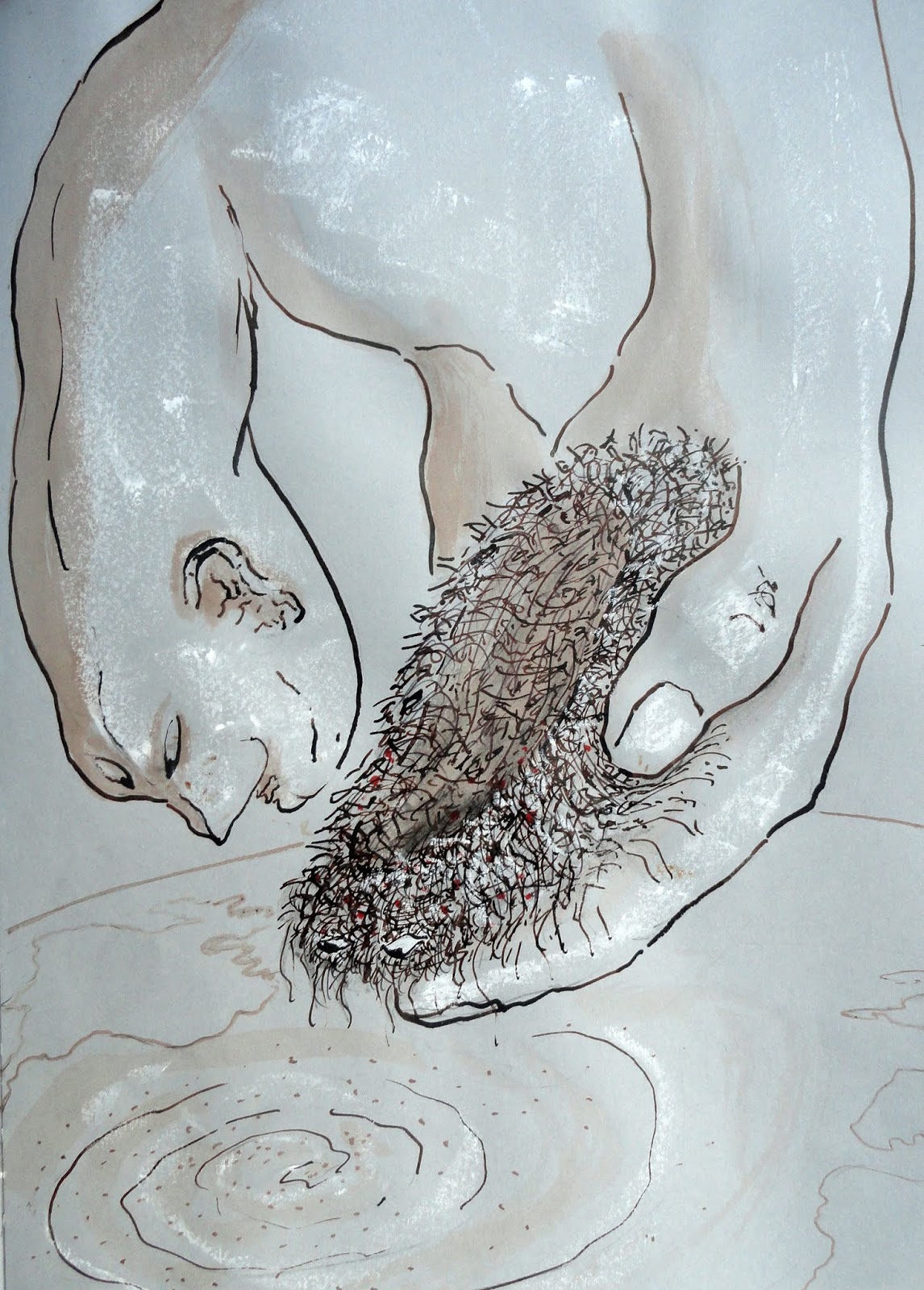
I was told a story whilst I made drawings, by a man who when young had experienced the 'hippy trail' in South East Asia, a story focused on memories that were triggered by a wooden carving of a baby Buddha that sat on a coffee table in the middle of his living room. I was also during this time, on evenings, reading another story, one that was focused on an exotic jungle, Chris Beckett's 'Beneath the World, a Sea'. In my mind the stories became fused, Beckett's vision seemed to me, to be of the unconscious mind becoming a landscape reality, as if the strange jungle described in the book, with its pools of other worldly waters, was a physically manifest unconscious, that was tapping into and revealing the subconscious desires of any character that entered it. Perhaps I thought, the remembered jungles of Thailand were like this too. The prints that then emerged from the drawings, became more and more hallucinatory; the passage of an ever growing old baby through imaginary jungles, becoming a journey into the subconscious.
This was the story that had now emerged:
Once upon a time in Thailand in a small village that sat on the edge of a vast jungle, there was made a baby. It was a beautiful baby, lovingly carved from the wood of one of the jungle's rare rosewood trees. This wonderful baby’s name was Phayung, and he could crawl as soon as he was made. Because he was so beautiful and his heart so pure everyone who lived in the village wanted him to play with them. They felt him calm their fears as he crawled into their homes and he seemed to give the whole village a new life. However the village was a very poor one and life was hard. So one day when a kindly young foreigner who had heard of the magical nature of this wooden child came to the village and offered a large sum of money for him, he was exchanged; the villagers feeling that as the young man was so fresh faced and kindly looking, that he would treat the baby well and that he would at times bring it back on visits.
The baby was much more than a baby, and it could never really be owned by anyone. Within a day, his new owner on picking it up had gently brushed his forehead against that of the wooden baby's and was astonished to hear a voice in his head. He was soon listening carefully to a constant babble of baby thoughts, thoughts that seemed at times very wise and which spoke of vast long ages of wisdom, but which were also silly thoughts, naive ideas about the world and at times totally incomprehensible jibber jabber. The young foreigner soon realised that the baby was someone very special and he was sure that a new life beckoned, especially once he had begun to understand what the baby was trying to tell him.
Because the baby was a wooden boy, he yearned to be with the type of tree from which he had been carved. As well as having all sorts of insights into the new world he was experiencing, he had feeling that came from his past life as a growing tree. Eventually he asked the young man if he could be sent back into the jungles out of which he came. But the young man was from somewhere else and had just been passing through, he didn't know one jungle from the next and of course didn't want to let such a special wooden baby go. But the baby persisted, it now spoke of little else and the man began to become irritated and more importantly very aware that his special find would be of little use if all it could ever do was go on and on about returning to the jungle. Gradually he made up his mind to follow any instructions the baby might give him about returning to the jungle and so began to ask questions about the nature of the place the baby had come from. It was, said the baby a place surrounded by water, his log had been floated down a river and then carried across a salty sea. There had been a tree that had grown from a seed, that had itself been grown from the seed of a tree, that had been grown from the seed of a tree, that had been grown from the seed of a tree under which in its shade the Buddha had once sat, and during that time had achieved his enlightenment. Each of these trees had lived to be many hundreds of years old and every one had held within the possibilities of its heartwood a new life.
The man grew frightened of what he was now hearing. He realised that not only was this baby special, it may have had a deeply spiritual message to transmit, one that he was not in any way worthy of. He looked around and decided that where they were was as good a place as any for the baby to find its family. All these trees looked similar to a man who had grown up in a city far away and it was clear now that the baby had its own mind and that a wooden mind could never in reality be used to help his own fleshy one accomplish anything. After wishing him good luck, the man put the baby onto the ground and watched as it began to crawl off into the thick, dense jungle that surrounded them. As it did a haze began to settle over the man's eyes and he fell asleep. On waking he couldn't quite believe in the baby's existence, but began to trace his way back and to think of all those reasons why he ought to travel back to his former life.
The baby quickly disappeared into the undergrowth. For what seemed like many years he crawled through the dense undergrowth, his lovingly polished dark brown skin glistening in the dampness of early mornings. His tautly curved but very solid back, at odd times emerging like a stone tortoise, pushing itself up and out of the dense leaf compost of the forest floor and when it did other creatures might find the time to gaze in its direction and wonder what it was. Gradually over time the jungle creatures accepted the baby as their companion and after even more time they forgot to even remember he existed.
Then one day the baby found another very like himself. As he crawled into a sheltered jungle glade he came across a seated figure. It was, like the baby, made of rosewood, but it was not crawling. It did move, but only by swaying very slightly, as if surrounded by invisible breezes. It had one hand resting on its right leg, the hand’s fingers pointing downwards, its third finger just touching the ground. The other hand rested on its lap, its palm facing the sky. Its calm eyes were nearly closed, with pupils looking down towards the jungle floor, upon which the baby now crawled to a halt. The rosewood baby gazed back up into the figure’s eyes and as he did he realised that at last he had found what he had been looking for.
The figure he had found seemed familiar, it had a skin of warm polished wood that was exactly the same as the baby’s. It also had a voice, an inner sound, not one like the other creatures of the jungle, not a voice of shriek, or gibber or squawk, this was a voice of singing and of chanting and it called to the baby. It had been calling for a long time, calling the baby to witness; calling it to re-find it's body, to re-vive itself in a new form as an earth-touching element. The wooden carving told the baby a story of its own enlightenment, of how once like the baby it had crawled on wooden hands and knees for many years through the jungle looking for answers, until one day after meditating on its life, it had realised that all was illusion and that all it had to do was to accept this and desire would disappear and he could at last be at one with the rest of the jungle. Therefore he now longer had to crawl, but could sit still and as he did he became a centre around which all things could be entangled, a centre around which spokes could radiate out and connect with all the illusions of reality but not be affected by them.
The baby was a Buddha, the seated statue was a Buddha too; both copies of the innumerable bodies of Buddha. By splitting himself in this way Buddha was able to touch and experience the vast infinity of possibilities that could be. Each of these experiences of Buddha was of cosmic significance, and even though the jungle like all things was an illusion, it was one to be experienced as an episode of wonder and in that wonder a kernel was found around which an idea was formed that helped the Buddha accept the illusion of age.
“We contain multitudes”, chanted the two carvings, harmonising their voices, and vibrating their wooden bodies as a unity. Until one day they finally separated and the crawling baby crawled away back into what it formally believed was reality.
How long the baby stayed had there in the shadowy jungle glade is not known, but when finally he crawled back into the jungle, the baby knew that its time as a jungle baby was coming to an end and he needed to make his way back to the place from where he started.
The jungle he found had however changed, paths previously worn smooth by his passage now gone, familiar trees and streams and stones now strange and even the sounds of what were reassuring animal messages, were now distorted and tuned towards threats. He was lost and he had to find himself again.
After what seemed many years the baby saw a thinning of the trees and shafts of light breaking through in such a way that he knew he had reached the jungle’s edgelands and that soon he would be able to make his way out and back into the place of his making. As he finally crawled out of the jungle, he passed a small still puddle of dark water and looking down into it he saw his reflection for the first time since the start of his journey and staring back was no longer the face of a baby but the face of an old man, and no longer did the jungle surround him, it fell away and as he looked to see where he was, he thought he recognised the form of the young man who had once owned him, but no, it was only an old man sat on a couch, an old man staring past the baby with eyes that were now finding it hard to see the things of this world, but which were beginning to peer gradually into the next.'
The story now became central to how the visual work was evolving.
A new series of drawings and collages were then made, but this time they were designed to be made into prints, so that the ideas emerging could be solidified and firmed up, thus giving the emerging narrative more traction.