In my first few posts of the new year I want to reflect on directions I am trying to establish for my forthcoming work. One of several strands I want to look at, is to explore various ways to miniaturise my ideas and I will try to use a variety of manufacturing techniques both commercial and hand made, to bring ideas to fruition. A while ago I looked at developing designs for tattoos, and I will hopefully be revisiting those ideas as well.
Bracelet with votive images
I have written a chapter for the Palgrave studies in fashion and the body, for the book, 'Wearable Objects and Curative Things: Materialist Approaches to the Intersections of Fashion, Art, Health and Medicine'. My chapter, 'Votives and Charm Bracelets: Materialising Health-Related Experiences Through ‘Sacred’ Objects', academically extends my research interest in votives and how objects help us to externalise our thoughts; the opening abstract hopefully explaining what I'm getting at.
'The concept of a physical artefact acting as an intermediary between the embodied individual and the quasi-divine has historically taken many forms, including charms and tokens worn to ward off evil and ensure good spiritual and physical health. This chapter focuses on the artist Garry Barker’s practice whereby he aims to give material form to people’s psychological relationships with their bodies. Responding to themes that emerge from one-on-one conversations with project participants, Barker has used the making of votives and charms to articulate and materialise people’s health-related narratives. More recently he has been using the charm bracelet as a device for the presentation or exhibition of small sculptures and images that are designed as objects to help mediate between desires to transcend the problems of everyday reality and the need to seek wish fulfilment by channelling more spiritual forces.'
Making charms was an extension of my votive work. But the idea had a particular gestation. During the Covid Crisis I had been party to an argument about whether or not we should have the Covid vaccination. My belief, like that of most health professionals, was that if too many people avoided the vaccination, we would not be able to stop the endless rounds of re-infection. I thought at the time, if people could externally show that they had been inoculated, then more people would probably decide to make the same decision. So I made protective shield designs for necklaces and badges, as well as designs for charms and charm bracelets. The idea being that inoculation was a form of protection and that these items would operate as wearable protective charms, as well as a wordless way of communicating the fact that you had been vaccinated.
Design for an 'I've had my Covid Inoculation' Necklace

Charm bracelet idea
While I was designing ideas for the bracelet, I realised that my other ideas relating to various ways of visualising interoception could also be made into small charms. Pages of drawings in sketchbooks, soon became devoted to possible charms, and all sorts of forms began to emerge, many of them relating to past ideas that I had worked with. It seemed to me at the time that my entire approach to art making could be revised and instead to dreaming of grand gestures, everything could be miniaturised and people could wear these thoughts as tiny objects.
Notebook pages
I had an enamel badge made of the syringe on a blue shield image and it was distributed to various inoculation venues. Recently a local medical professional has donated one of these enamel badges and a collection of associated votive cards, that had used with people at the time of the pandemic, to the Leeds Thackray Medical Museum. The museum has developed a collection of objects that is designed to operate as a reminder of some of the things that were produced and used by the medical profession during the Covid emergency. It was good to hear that the badge had not just been used, but that it was felt it was also worth being archived.

The enamel badge being worn
In my various approaches to making things, I'm always fascinated by how a connection is made between what one makes and possible audiences. Interconnectedness it feels to me, will be more and more important to us all, as we struggle to come to terms with ourselves and the world that surrounds us. One of the greatest fears I have is that the vicissitudes of modern life will result in my isolation from both the world itself and other people. If we are not to make the planet totally inhospitable to our kind of life, we need to commune deeply with it. We need to connect with processes such as how its weather systems work, how soils support vegetation, how water flows, how air is formed and how animals survive and if that means that we have to return to older forms of communication and fuse them together with our more scientific understanding of how the world works, well so be it. We also need to develop a deeper understanding or awareness of ourselves. If we are to have empathy towards others, we need to be tolerant and to seek ways of communicating that don't simply echo the tight channel that we use for communicating with those people who are just like us. As we narrow the band width we become cut off from more and more people, as well as from other things, such as an awareness of why certain plants grow well in some places but not others, and of why some things thrive in certain situations but in others they fail.
I had been trying out alternative ways to visualise ideas. The sensation that everything is connected also I thought, spreads out into how we envisage time. Breaking it down into past, present and future felt wrong; for instance South American pre-Columbian cultures, saw time as a spiralling interconnectedness and not a linear progression.More abstract ideas such as this also need visual forms, and in response to this one, over pages of a small notebook, I found I was drawing spiral forms, over and over again. Forms that reminded me of ones I had looked at many times in the past. Spirals made by Robert Smithson and Louise Bourgeois, or by the people who designed the entrance to the Newgrange monument in Ireland. I had also been looking at badges made for pilgrims to wear.
As a test for how an idea could be visualised and then miniaturised I designed and had made a small enamel spiral badge, using the knowledge developed when designing and getting made the enamel badge for celebrating having being inoculated. These were distributed as gifts to anyone who wanted them. People liked the fact that when wearing one they would be asked, "What is your badge about?" and then they could begin a new conversation about what the idea of spiralling time meant to them. These are still available and I continue to give them out if people want one. The positive reception reinforced the idea that people's bodies could be like small art galleries and the more I looked around, the more I saw people using badge like forms to make statements about who they were and where they had been.
From membership of a political party, via all sorts of other memberships, to tiny images used to elicit memories of visits to various places, badges are active participants in the communication business. Badge symbolising past, present and future, all experienced as one intermingled entity
Our bodies and their coverings can be like materials out of which we construct images of how we wish to be seen by others, We communicate using our eyes and noses just as much as we communicate using sounds. Tattoos, clothes, jewellery, hair, deportment, skin condition, perfumes and the general demeanour or feeling tone of our physical presence, make for direct communication channels with others. The article I wrote is a more 'academic' attempt to try and communicate how these processes might work. It suggests or points towards ways of making artworks that fit into the mainstream of life, rather than them operating outside of our day-to-day activities. It also implies a critique of a 'special' art world, where the value of art is measured in terms of money and status, as well as the prestige of the institution showing the work, rather than in terms of how well artworks can help us to connect with each other.
I would like my work to operate as a doorway into ways of thinking that begin to forge connections between between people and ideas, as well as between ideas and ways of relating with the rest of the world. I have always thought that the more you have empathy for others, the more chance there is of eventually finding those others can become either friends or helpers in the difficult negotiation of life's vicissitudes. But empathy seems in short supply at the moment; if the making of art can do anything, perhaps it might help with the building of empathetic connections. If only the wish of a more altruistic world could come true, simply by wishing it. In the meantime, I will continue to make things that help me to externalise or crystallise my thoughts and hopefully as I do, others might also find these solidified thoughts useful.

Material tests
Charm idea developed from the material tests
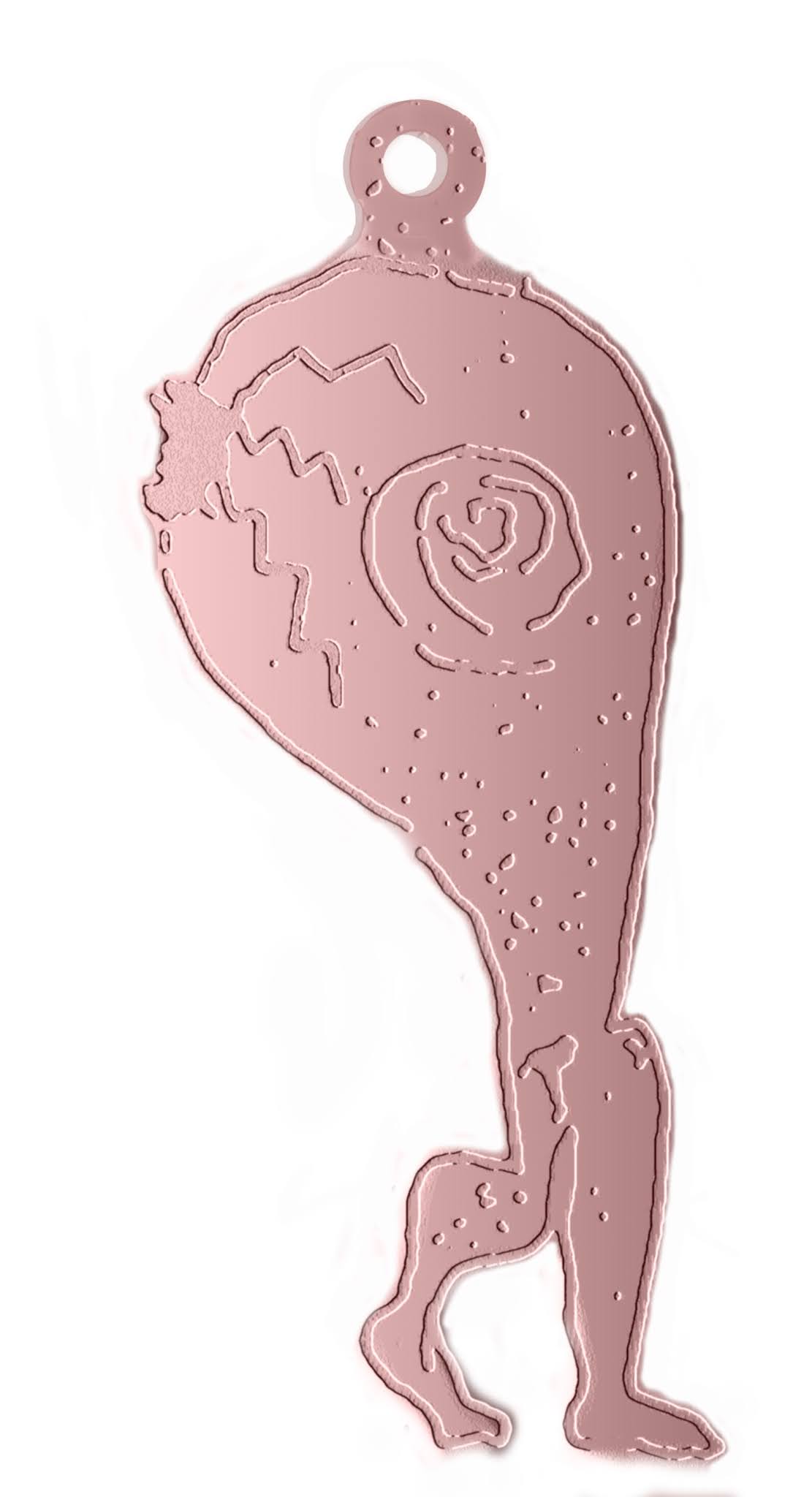
These ideas for bracelet charms were developed using images emerging from an awareness of somatic experiences. I sat with people and developed conversations about their inner feelings. These might be about their psychic state, or their physical condition, but most importantly they were attempts to make visual images of sensations that were normally invisible. Lots of drawings were made as well as small sculptures using clay. Gradually communication developed as images emerged. At the core of each conversation, as a form developed, was the question, "Is it more like this than that?"
The tiny low relief sculptures that were made as additions to charm bracelets, were meant to operate in the same way as my previous votive images. They were objects that had been made from externalised feelings in this case, rather than representations of things such as arms, legs knees or necks. The bracelet that contains images of votives that sits at the top of this post, was the first version to emerge of this idea; it was a way of furthering my older concept of how to work with votives. The later more subjective interpretations were harder to develop and also much more difficult for other people to interpret, but following the experience of the spiral badge, it is hoped that people will wear them, and take pride in opening out their own interpretation of what these tiny objects could signify. More importantly, could they still operate as charms? Could they field off illness or psychic attack? Belief is a strange thing and it is well known that the placebo effect is real.
Whether or not I manage to further these ideas will depend on how they unfold. Best laid plans etc. I have been sidelined by various things recently and have decided that by having a variety of projects on the go, at least some of them may prove fruitful; hence this new year resolution.
See also:
Animism
Drawing and communication theory
Mythic Worlds
'Votives and Charm Bracelets: Materialising Health-Related Experiences Through ‘Sacred’ Objects'
An article on my votive making
The spiral
The tattoo