I was over in Manchester on the weekend and went to see the Barbara Walker exhibition at the Whitworth. Seeing this exhibition so soon after looking at the Curtis Holder exhibition in Leeds was a fascinating experience and the differences are illuminating.


Detail: Self portrait: Leda and the swan
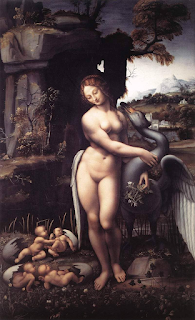
Leonardo: Leda and the Swan
Perhaps best to start with Walker's self-portrait in the guise of Leda and the Swan. This large drawing dominates one end of the gallery space and it sets a tone for the rest of the exhibition. Walker is taking no prisoners, she stands her ground and grinds the feathers of the swan/Zeus into the ground. She is not going to be fooled by some Classical God masquerading as a swan. The charcoal that makes up this and many another of her images is a black, dusty hard working material, one that sits on the surface of a rough/tough paper, asserting its presence as a solid mass maker, rather than as a linear spatial indicator. The marks made work their way over a massive form, and in doing so they give solidity and weight to her figure. Her large wall drawings are also in charcoal, these are not people vibrating into existence, asking questions as to their state in the world; they all take their space, they weigh in, ready to fight their corner and they need to, as society has dealt many of them a poor hand. In comparison with Holder's images I was reminded of Doctor Johnson's "I refute it thus!" James Boswell had this to say about Johnson on Bishop Berkeley,“After we came out of the church, we stood talking for some time together of Bishop Berkeley's ingenious sophistry to prove the non-existence of matter, and that every thing in the universe is merely ideal. I observed, that though we are satisfied his doctrine is not true, it is impossible to refute it. I never shall forget the alacrity with which Johnson answered, striking his foot with mighty force against a large stone, till he rebounded from it, "I refute it thus.” I could I thought hear Walker saying the same about Holder's work.
In another part of the exhibition bits of paper are scanned and blown up to reveal to us their importance. These are the scraps of acknowledgement that people have to show to confirm they are worthy citizens or as proof of the harsh treatment dished out by the authorities, especially when you are seen to be black, young and male. Walker has scaled these papers up and integrated them into her drawing's surfaces, with graphite portraits. In doing this she subverts the texts, giving back a proper humanity to the people who's lives had been effected by the documents enlarged.


Walker's drawings are confrontational and beautiful at the same time. As you look at them, you are drawn into their surfaces. Eyes sit deep into the charcoal of their making, the closer you get, the more these portraits feel as if they are growing out of the ground out of which they were made. The back of a head, Medusa like, activates the space as if it was a live creature. A painting of the back of a young man's head, reveals something vital about identity, it is part of how we hold ourselves and how we shape our profile, as much as it is due to facial features. There is a cultural tilt of the head, just as much as a hair style or choice of hat.


Wall drawing

Detail of a wall drawing
You know that at the end of the exhibition these wall drawings will be painted over, they will be wiped off the wall and in our knowing of this, the pathos of her work reveals itself. She is concerned to give value to often neglected lives. As a white, middle class man, it is hard for me to know or experience the reality of the lives Walker is representing but I get a taste of what it must be like every now and again, because of where I live. Chapeltown was an area of Leeds where up until a few years ago you couldn't get a taxi to drop you off. As a mainly Afro-Caribbean area it was stereotyped as a place of violent disorder. I remember being in a gallery in Leeds 30 years ago and after a conversation whereby it emerged that we lived in Chapeltown, the then curator said that she always told her children to close their eyes when as a family they drove through the area, in case they saw anything horrid. That statement was I thought horrid enough, but it was typical of attitudes at the time.

Embossed paper with graphite drawing
That "don't look and you wont see the black people" attitude, must have been in the back, or maybe the front of Walker's mind when she made her drawings on embossed paper. She had been researching historical images whereby both black and white people appeared together. By taking out the white people, but leaving us with their embossed ghosts, we are able to re-see the images and to reassess the power relationships that are set up between people in the way these images are composed.

Detail
Walker also had a wallpapered room in the exhibition. We forget that wallpapers have both a storytelling ability, as well as a way of signifying status. I remember first seeing Timorous Beasties wallpaper, which at the time was used as a medium to subvert our expectations of the decorative arts. Their wallpaper 'Glasgow Toile' had embedded within it a portrayal of their home city, whereby the Arcadian views of classical wallpaper rolls were replaced by Glaswegian everyday life. A similar thing happens when you see Walker's walls papered in a decorative blue repeating pattern. You are sucked initially into the haze of the repeat pattern, until you begin to look at who is being represented here. This classic pattern is now peopled with those no one wanted, the tables have been turned and that lovely wallpaper is now perhaps threatening for some people, but conversely heartwarming to others, when it is seen who is now included.


Barbara Walker: Detail wallpaper

Timorous Beasties: Detail: Glasgow Toile: 2004
I've used wallpaper myself to communicate similar issues, its intimations of 'domesticity' and expectations as a decorative medium, are powerful signifiers and are ripe for subversion.

Garry Barker: Wallpaper: Detail: Scenes of Hell: 2016
See also:

