During the break I went to see the British Museum exhibition, 'Hokusai: The Great Picture Book of Everything'. For anyone with an interest in drawing the exhibition is revelatory. These are drawings made to be used as templates for woodblocks and would normally be lost as the block cutters would use the drawings as guides for their cutting, cutting the whites away as they copied the images. But for some reason this series of 103 images were never made into prints, so we have a chance to see Hokusai in the raw and what an experience that is!

A bolt of lightning strikes Virūdhaka dead


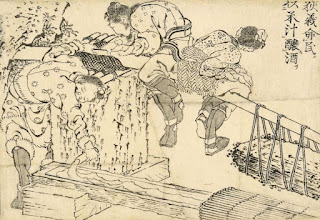
Images from 'Hokusai: The Great Picture Book of Everything'.
The first thing that strikes you is the range of images. From genre scenes of everyday life, via wild life illustrations and mythic stories, to how paper is made. Every subject is handled with a total command of graphic invention, his small brush thickening and thinning its way through the making of lines and the creation of various surface textures. His linear elements are sprung in such a way that his figures have a coiled life, an inner energy that makes everything seem alive. There is action, such as the bolt of lightning that strikes Virūdhaka dead, which could be taken straight out of a present day manga comic, visual poetry as when the moon is reached by climbing up into the night sky using the clouds as a ladder and the everyday of two cats meeting and arching their backs in defiance. In 'how its done' images such as the one above illustrating the stages of paper-making, what could be a boring piece of factual description, is enlivened by inventive body movements and shapes taken up by the workers, workers who are totally embedded into their work environment and as much part of the process as the water and the shredded plants.
I was lucky as it was a quiet day, so I was able to spend over an hour simply gazing in wonder at these amazing images.


Images from 'Hokusai: The Great Picture Book of Everything'.
The exhibition is on until the 30th of January 2022, so if you are in London and were thinking of visiting the British Museum, do go and feast your eyes on drawing after drawing that together demonstrate how inventive a visual mind can be and how skilful hand control can become and how above all the problem, 'I cant think what to draw' can be solved by deciding to draw anything and everything that is seen with your eyes and imagined in your head.
See also:


