Showing posts with label animism. Show all posts

Monday, 2 June 2025

Monkey, pig, dog, rabbit and horse


Ideas for tranculments

Some animals crop up over and over again in my work. They are old friends and they allow me to work with animist ideas, as well as tell stories. They are conceptually embedded into the narrative grounds out of which they grew and each one has a specific set of attributes that are understood by no one else but myself. They often come in the form of ideas for 'tranclements' or 'nic-nacs', ideas I have for objects that I could imagine on shelves in my parents house. This is how I see working class sculpture; our house and the houses of relatives, were full of small ceramic and brass objects, many of which like Staffordshire flat backed ceramic scenes, told mini stories. 

Staffordshire spill vase

Spills were still used to transfer flames and help light fires when I was a boy, and I like to still make 'spill vases' using the Staffordshire form, not that they have any practical use any more, but they remind me of how time moves on and of how outdated forms gradually acquire new meanings. Working in the way I do is also 'old fashioned' but then again anyone over 70 is indeed 'old fashioned', my ideas partly a product of my 1950s upbringing. 


The monkey belongs to grandad Freeman, my mother's father. He used to tell me stories of his time in India, where he was posted during the First World War. His pet monkey was obviously of great comfort to him when posted far away from home, in a very foreign environment. He must have tailored his stories for a young boy, because in my mind grandad's monkey was a sort of simian Black Bob; a clever aid to my grandad, who would get involved in all sorts of adventures, as grandad negotiated Indian life. He never mentioned any fighting, but lots of stories about getting food, whereby his monkey would steal fruit or entertain others while grandad managed to help himself to what he wanted. He told me his monkey was a good listener, who would come into his tent at night and share food, whilst grandad told it all about life in England and it told him all about life in India. His monkey was cheeky and would annoy officers by making rude gestures and stealing things from them, or so grandad said. Back in the 1950s somewhere in Pensnett there used to be a pub that kept monkeys in a cage, I cant place it on a map; but in my memory we walked quite a long way to get there, through rough ground and fields. We only went in summer, grandad and I; we would go out together walking and talking about life, the universe and everything. When we got to the pub we would get a seat at an outside table near to the monkey cage and grandad would retell his monkey stories, pointing out differences between his semi-wild cheeky pet and these locked up, sad specimens. He was obviously not allowed to bring his monkey back home to Pensnett, and it must have been a difficult moment of separation for him, but the monkey lived on in his mind, as a powerful spirit that held on to grandad's wartime experiences. That monkey is still cheeky, still anti-authoritarian and it loves to be included in stories.
Drawing for monkey spill vase

Because my surname is Barker, I've had a long time association with dogs. My nickname at school was 'hylax', the latin for a barking dog, which in turn was derived from the Greek word hylax (ὑλάκτης), meaning "barker" or "watchdog". I liked the idea that as an artist I could operate as a watchdog. But as I'm also prone to be my own worst enemy, and end up going in circles, I was also a dog that bites its own tail.
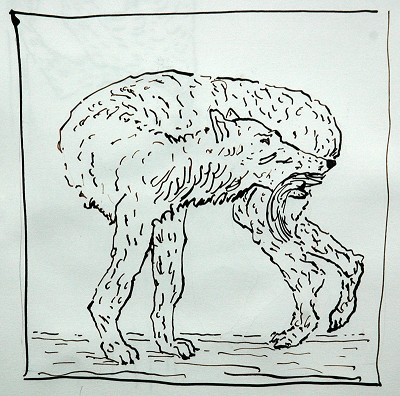
The dog that bites its own tail


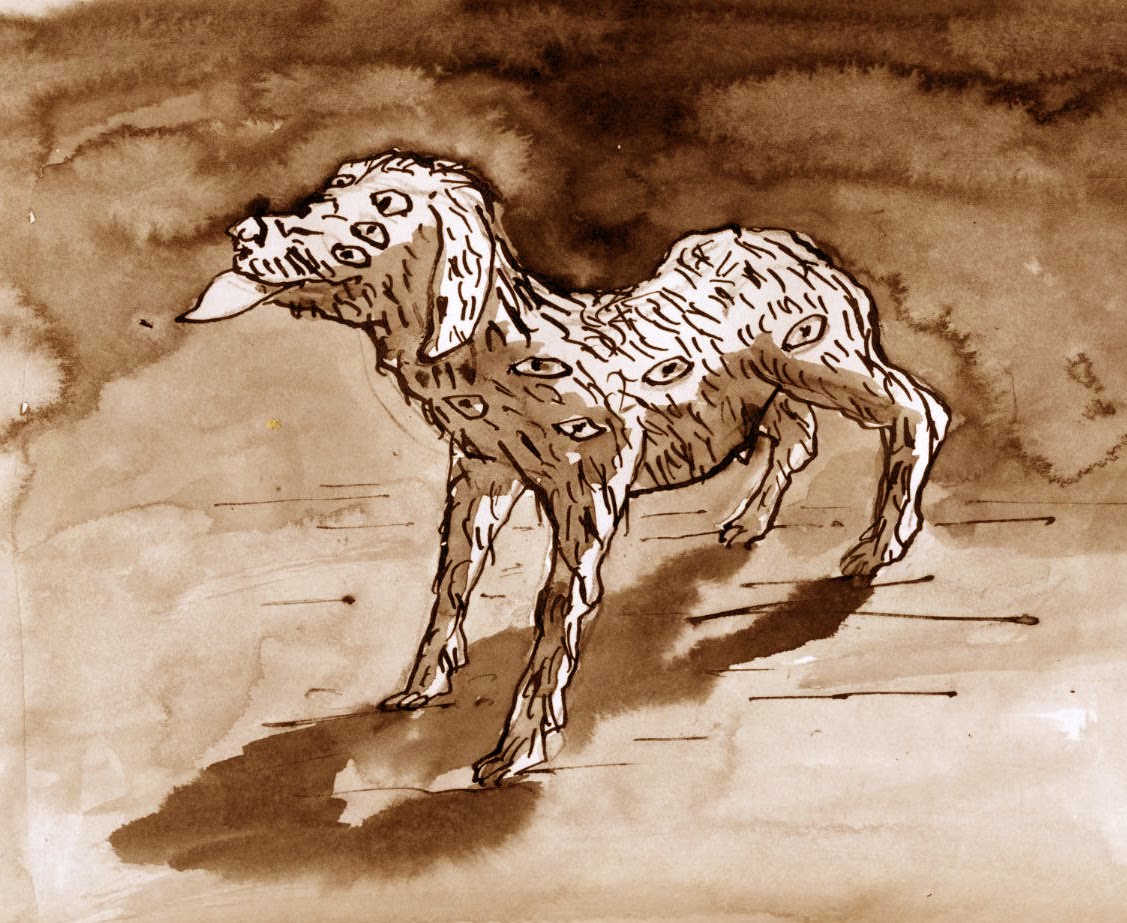

The dog is also a fusion of two real dogs, Scamp and Sam. Scamp was my boyhood dog who went with me as I played within the pitted post-war landscapes of Himley Road in Dudley. From the smoking underground fires of Russell's Hall, via the slag heaps that formed the background landscape to where we lived, Scamp would be with me. Sometimes he would get covered in grey clay as we played in a local stream and I would get a spanking and real telling off for getting him so dirty and at other times he was my saviour, barking at boys who wanted to fight me. Scamp was my Black Bob; we had all sorts of in my mind adventures, as we wondered the scarred landscape of bomb craters and burnt out factories. We were together reliving cowboy and Indian stories, tales of ancient Arthurian England and the New Adventures of Flash Gordon. Sam was the dog we had when the children were young. My daughter was for a while a keen horse rider, and so we would on a weekend walk to the stables, and while she was there I would take Sam out past the ring road, following Meanwood Beck. In such a quiet place I could walk with Sam off the lead, she would paddle in the stream and run around, chasing after any sticks thrown, giddy with excitement. I would be lost in my own world, imagining things, constructing worlds in my mind as we walked, happy in my own company. Sam kept me sane during those years when I would sometimes lose all track of what I was supposed to be doing. 
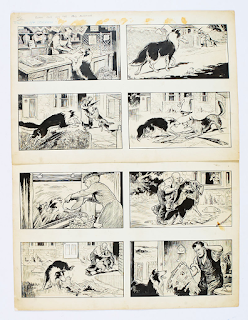
Black Bob

The rabbit belongs to someone outside of the family, and yet it is also Br'er Rabbit, the stories of whom, retold by Enid Blyton, I read to the children many times.


Br'er Rabbit is a trickster, a little like the spider Anansi; originally emerging out of Africa alongside the slave trade and then migrating into the minds of children all over the world as the stories were retold and resold in Westernised versions.


The rabbit was also a creature from a story told to me by a migrant who had crossed the Mediterranean Sea. Whenever danger threatened he would look out into the swell surrounding the boat and if he could spot his rabbit swimming beneath the surface of the water all would be well. The rabbit was a sort of invisible/visible angel that accompanied the man on dangerous journeys, a spirit form that could morph into its surroundings and which took care of the man and protected him from harm. 

Horses are forever associated with my grandmother. She could talk to them. When she was a girl her parents lived above the steelwork's stables, where her father worked as a groom. Before motorised transport horses were the only way to move around heavy materials and metal is very heavy. The horses had to be kept healthy and my gran used to often sleep with them when she was a girl, and would be expected to alert her father to any issues that might be arising, such as if any horse had a fever or cold. She used to take me to visit the local blacksmiths in Pensnett and would talk to a horse while it was being shod, keeping it calm and reassured. Sometimes a horse would be tethered on a scrap of local wasteland and gran would go over and talk to it. She ran her fingers through its ears as she did and scratched its head and neck, I don't know what she said or what the horse replied, but their heads would touch and I knew something special was going on between them, nan sometimes breathing out heavily right up their noses. They were like relatives to her, all part of her mystery, an extension of her tealeaf reading powers and activities as the village healer. Horses are for myself because of my gran's activities, almost human, often morphing between states, they are the warning voice of the animal kingdom, too big to be controlled by us and only allowing us to ride them after a proper negotiation. 


I have one image in my mind of a horse I will never forget; one day my wife Pam and myself were out for a walk with Ruth and William. Of the two children, Ruth always loved to engage with animals, no matter how big or small. We eventually came across a field with horses in it and Ruth wanted to feed one of them with a handful of grass. All seemed fine, until the horse dipped its head over the fence and grabbed hold of the hood of Ruth's coat with its teeth and hauled her up into the air, as if she was a bag of oats. For one horrid moment we thought we had lost her, but I was able to grab her back from whatever fate the horse had decided for her. It was a reminder of how powerful horses are and that if they wanted to, they could easily overpower any human. Nature has a dangerous edge and we forget that, being surrounded by the safety of cities. 

The pig is often cruel or indifferent, able to read books and disengage when life around it is tragic, as in the drawing below. It is also an animal that has suffered greatly in the hands of human beings, an animal that waits its turn in the pecking order, as foreseen by George Orwell.


The pig was an animal that people still kept in back garden stys in the Black Country when I was growing up in the 1950s. At the time they felt like huge, primeval beasts and I was often sent to feed them left-over food scraps, such as potato skin peelings, every time being terrified that they would somehow get out of their enclosures and eat me. There were many tales told to me by adults of their cunning and ferocity, probably to stop me getting too close to them, but you knew as soon as you were next them and they looked at you, how intelligent they were and of how they could totally destroy you if they ever had the chance. 
My primary school entrance was directly opposite to the local abattoir and I knew a boy who's father worked there, so we would often go inside, mainly to use the big floor sinks to play in, as they were places you could sail a boat in and have adventures. Surrounding us were lines of hanging dead pigs. We heard them from the playground when they were driven in for killing, they often squealed as they were dispatched, but we never really thought about what was happening; it was death on our doorstep, but so familiar that the enormity didn't really register until years later, when I began having dreams of standing in those sinks full of blood. 

I have many versions of these animals in my head, some of which exist as puppets and others as characters in drawings or they take part in small ceramic scenes. The puppets are probably closest to how they appear in my head.


Dog, horse, monkey, pig and rabbit puppet designs

It is though the tranculments that it would seem people engage with most easily. When I make a 'tranclement' I hope that someone will put it on their mantlepiece or wherever else in their house they need a little story, my simple contribution to their lives. 

The dog finally catches the rabbit: A tranculment in place in a home

The rabbit captured: Spill vase

Spill vases on a mantlepiece


Tranclements

These animals have allowed me to tell stories, much like the animals in Aesop's Fables, but I never wanted them to teach any moral lessons, they are creatures of my dreams, having material lives of their own, becoming another form for my externalised mind; brothers and sisters of Sooty, the frog, teddy and that stuffed octopus I used to sleep with seventy years ago. 

See also:

Arvak A fable

Thursday, 12 September 2024

What it is to be human?

Lavinia Fontana, “Portrait of Antonietta Gonzalez” (c. 1595), oil on canvas

A hereditary condition known as generalised hypertrichosis terminalis, leads to a covering of fur over most of the body. If a human being has this, it usually triggers a reaction in others that suggests that in some way the person has regressed into being an animal. It is though of no harm to the person that has it and in certain cases, can be a help, as the extra hair still does the job that it was genetically evolved to do in the first place, which is mainly to keep an animal warm and to protect sensitive skin from the sun's rays.

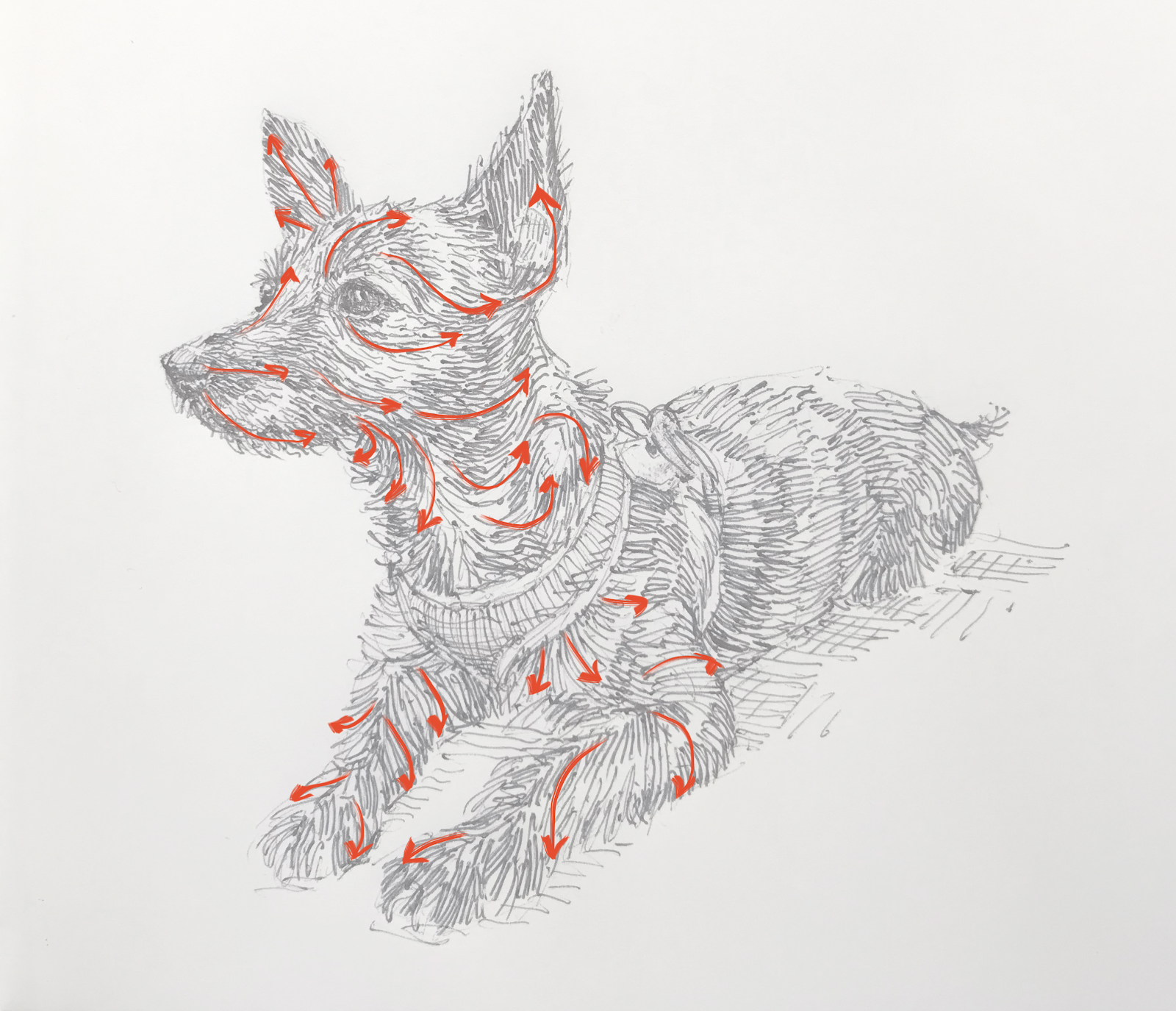
Hair is something most of us have and only in rare cases is someone totally hairless. Like all hairy animals our hair takes certain directions over the body.

Human: Hair direction: Front and back

Dog: Hair direction

The fact that other hairy animals also have directional hair, is something we rarely think of as a common denominator but it is for my drawing self, interesting to think about hair direction as an example of visual energy moving around the body.

The visualisation of imagined interoceptual awareness of fur sensations

Thinking about commonality can also be an entry into animist thinking; for instance you might try to imagine what it would be like to live within a fur clad body. Body hair also provides tactile sensory input by transferring hair movement and vibration via the hair's shaft to sensory nerves within the skin. Therefore we can like other animals, extend our sense of touch beyond the surface of the skin, into the space surrounding us, by using hair to detect air currents, the presence of insects or the close proximity of objects. However the resultant perceptual stimulus and/or interoceptual feelings engendered, are rarely picked out as being important to us. But for many animals this group of senses is vital and being more aware of how they operate, might enable us to have more empathy with other creatures.
The hairs of the skin not only function to prevent heat loss but also have important sensory functions. Recent work has now established that each hair of the skin has one or more of three types of mechanoreceptor ending. Each of these three mechanoreceptor types can detect distinctive information about skin touch, which is relayed to specific brain locations in a somatotopic fashion. (Somatotopy is the precise mapping of body parts to specific areas of the brain.) My interest in interoception, has meant that I have also tried to imaginatively visualise the feeling in the body/brain of a passage of air over hairy skin and how that in itself can become another body part. Feelings, I strongly believe, can be concretised as images. The flowing, twisting sensations in the orange/black image above being my imaginative immersion into what it might feel like to be a sensing hirsute animal. 
Our intellectual history reflects the constructing of an ever widening distance between ourselves and our animal nature, something that we have recently had to question. The more we mentally separated ourselves from nature, the less we were concerned with having any sort of empathy with the natural world. Now that we are more aware of an 'embodied' mind, the recognition that the mind is in fact shaped by the body and is inseparable from it, the more we are also becoming aware that the body is itself shaped by and inseparable from the environment it inhabits. The mental separation of ourselves from nature, has historically led to a using of the world's resources, as if we had no moral responsibility for them. We were able to 'other' not only animals but any humans who did not look like or act like 'us' and as we did so, we also used these other humans as if they were animals or chattel. In the past we set up all sorts of intellectual constructs to help with this, to justify our ability to use anything to further our own ends.

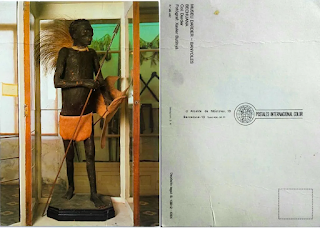
Slave traders were enabled by church leaders who perversely interpreted the Bible in such a way that slavery could be understood as guiding other humans out of the darkness of their mistaken ways and into Christian salvation. The separation was such that other humans were even stuffed and displayed in a similar way to animals. Until recently for 40 pesetas you could still buy a postcard of a stuffed human.

I wonder how the taxidermist thought of the task at hand when asked to work on preserving this 'specimen'? How did those theories of "scientific racism", such as the classification of people according to intellectual inferiority or superiority on the basis of skull measurements, affect the way that the taxidermist approached this task? Or perhaps the task was made easier because the taxidermist was Christian and he believed that his subject was a son of Ham? This idea had persisted for several hundred years, back in the 16th century, Gomes Eanes de Zurara, wrote that Africans were enslaved “because of the curse which, after the Deluge, Noah laid upon [Ham]… that his race should be subject to all the other races of the world”.

The Bible also of course had other things to say about this;

'And God said, Let us make man in our image, after our likeness: and let him have dominion over the fish of the sea, and over the fowl of the air, and over the cattle, and over all the earth, and over every creeping thing that creepeth upon the earth.

And God said, Behold, I have given you every herb bearing seed, which is upon the face of all the earth, and every tree, in the which is the fruit of a tree yielding seed; to you it shall be for meat.

Genesis 26 to 29

So we look like God, but who is the we? We are God faced. But what if God looked more like Fedor Adrianovich Jeftichew? What if the directional pattern of our hair was actually a sign from God? As an atheist my question is why is my hair directional, and what does this tell me about myself? It tells me that evolution is always ongoing and that humans are what they are for a brief period of time, the genetics of life ensuring there is always a better fitted form to the various life niches that are always opening out and that perhaps in the future we will need more hair to protect us from the sun's rays, and if so, future people might be very hairy.

The condition hypertrichosis terminalis is a genetic one and can be therefore passed on. 300 years after the time of Antonietta Gonzalez, Fedor Adrianovich Jeftichew was born with the same condition. Like Antonietta Gonzalez before him, he is nearly always presented in images clothed in the best raiments of the time. No one tries for instance to make him get down on all fours and show his naked body. The clash between smart clothing and an abnormally hairy face, seeming to tell us more about the nature of one of the processes of civilisation. We, the normal people, dress in a certain way, a way that signals we are 'normal'. Outward appearance, grooming, it is suggested, reflecting something about the state of the inner mind.


“Jo-Jo the Dog-Faced Boy”

Perhaps we need a distorted mirror to work out what we really look like, or what we naturally look like. In the late 19th century Fedor Adrianovich Jeftichew toured the sideshows of Europe with his father, the ‘Wild Man from the Kostroma Forest’ and was then at the age of 16 taken to the USA by P. T. Barnum, where he toured under the name of “Jo-Jo the Dog-Faced Boy”. He was told to make dog noises for the various audiences who came to see him, even though he could in fact speak three languages, and was like his father simply a man who had hypertrichosis, but also like his father he would have to live life as an outsider.

From: https://mybillie.com/

Hair is also gendered, men can easily become hirsute but women, when they have hair, are often expected to shave. Billie, a New York-based subscription service sells “razors built for womankind” and they have initiated 'Project Body Hair', which is 'A CELEBRATION OF FEMALE BODY HAIR…WHEREVER IT IS OR ISN’T.' On their website they state, "For the past 100 years, women’s razor brands haven’t acknowledged female body hair. Commercials show women "shaving" perfectly smooth, airbrushed legs. Strange, huh? But everyone has short stubble, long strands, or something in between. What you do with yours is up to you - grow it, get rid of it, or comb it. It's your hair, after all." A clear recognition that cultural norms are yet again shifting. Perhaps its becoming ok for a woman to be hairy. The popularity of werewolf teen movies, suggests that within popular culture the werewolf look is becoming socially acceptable.

Werewolf Girl by Terminotaur

As I looked into what was going on in terms of contemporary culture, I discovered that there was now such a thing as a 'furry artist', defined as 'a person who creates artistic works with the furry fandom in mind as the target audience, or who creates anthropomorphic art of interest to the fandom.' I was not really as aware as I should have been of how culture was changing. It is now totally acceptable to dress up as a dog and go out in public.

A typical image taken from a furry fandom website

A shaman is supposed to have the ability to speak with animals, and some of them have a belief that they can shapeshift into animal forms by using hallucinogens or a combination of dancing, drumming, and singing and I can see a role for a similar figure within contemporary culture. Clare Milledge in her doctorate thesis points out that the role of both the artist and shaman has 'always been to stand between two worlds: that of the visible and the invisible.' and that we 'entrust the artist to go forth into the realm of the invisible and return with a gift: the invisible transformed into the visible'.
As I try to chase down a role for an artist within our present society, there are aspects of shamanism that do seem to ring true, but perhaps acting more like an artist working as a mediator between things rather than as a priest showing the way. Mediation requires high levels of empathy, a thought which takes me back to that portrait of Antonietta Gonzalez.

The fact that Lavinia Fontana was a woman artist at a time when the profession was seen as male only, must have influenced the way that the Portrait of Antonietta Gonzalez was thought about. Both were women outsiders, both could demonstrate abilities equal to the men that surrounded them, but as the men had set out the patriarchal rules of the game, neither of them would ever really be accepted as equals. Antonietta Gonzalez is depicted as someone, who is indeed a someone. There is a recognition of a thinking mind in her direct stare and presentation of a written text that states something important about her. In many ways Lavinia Fontana's image is much more modern than the image of the Werewolf Girl. Antonietta Gonzalez is presented to us as a complex human being, one that like all of us is conflicted and has to survive the fact that other people don't know what is going on in your mind, no matter how hard you try to explain yourself. It is amazing when you realise that someone else has a real empathy with yourself, and I suspect those two women had seen something in each other that really chimed. Looking at a preparatory sketch, helps us to see that the empathy with the subject was not just a one off accident, as there is a similar feeling of total acceptance of Antonietta Gonzalez as a young woman and a clear recognition of the human being behind the hair,

Lavinia Fontana: Preparatory sketch for the Portrait of Antonietta Gonzalez 1594-95 Red and black pencil, brown ink on paper, The Morgan Library and Museum, New York

So how we can build on empathy as a way into being more at one with the world? I have recently been talking to someone about 'modes' of behaviour. Certain people look for particular patterns in life and others see different ones and both act accordingly. Some people realise this and accept the difference, whilst others think that their own mode is the right one and judge other people by how far they fail to operate in a similar mode to themselves. This causes a lot of confusion. Open this out and its easy to see how hard it is to have empathy with a dog or a bat or a tree or a mountain, all entities that we have to coexist alongside, but unless we really work hard, we may well fail to work in harmony with the world that we coexist with.


Trying to visualise my way into this set of thoughts, I made a drawing of myself wearing the white coat of the scientist, (its actually the white coat of the ceramicist, but who's to know?) and then added hair. Over the years I've had to come to terms with going bald, so it was a fascinating reversal. I'm nowhere as skilled as Lavinia Fontana in this sort of image making, but it was an interesting thing to do none the less. Fur is for most mammals not just a heat regulator, it is also a complex mass of sensors that attunes an animal to a constant awareness of its own speed of movement through space, the proximity of other objects that disturb the air around them, as well as changes in the weather. Hair helps attune animals to the world.


Feet and hands are still feet and hands when hairy

The popular press occasionally dips its toes into this area and when it does it often focuses on the cultural myth of the werewolf. Hypertrichosis terminalis is often called the 'werewolf syndrome'. Very quickly interest will turn to Jo-Jo the Dog-Faced Boy, and a historical reminder of his career will be given. I was fascinated to see in one article an illustration of a poster advertising the appearance of Jo-Jo and his father at the Middlesex Music hall in England. They were however identified as Kostroma People from the forests of central Russia, a far more interesting description than P. T. Barnam's redefinition. 'Kostroma People' suggests that in Middlesex at least Fedor Adrianovich Jeftichew and his father were regarded as 'people' and not animals.


Another notorious figure with generalised hypertrichosis terminalis who had to endure the sideshow culture of the 19th century was Julia Pastrana. At the time she was billed as “the ugliest woman in the world,” or “the bear woman.” She was described as the link between mankind and the orangutang and was therefore also known as “the ape woman.”


Julia Pastrana

Victorian 'scientists' claimed that Julia Pastrana was a half-human, half ape hybrid. She was always advertised as half-animal, with many people regarding her as a type of ape. In reality she spoke several languages and by all accounts was an intelligent woman with refined tastes.

Julia Pastrana: The bearded lady, embalmed. Wood engraving

The cruel culture of spectacle was often all those who physically didn’t conform to an arbitrary ideal of beauty could expect. Julia Pastrana is on her death in childbirth, finally mounted and embalmed and put into a display that also included her dead baby, who had inherited the gene that carried generalised hypertrichosis terminalis. Which is why it is so fascinating to find that Lavinia Fontana's “Portrait of Antonietta Gonzalez” is painted without a hint of the sideshow. On the contrary, Antonietta appears inquisitive, happy, self-assured and gazes back, standing her ground, asking us, who are we to question her?

What it is to be human is constantly being redefined, but my personal definition is one that doesn't privilege human beings above other beings, we are just something that is conscious of being and in being so, we are aware of being alive.

References
Agramunt, J., Parke, B., Mena, S., Ubels, V., Jimenez, F., Williams, G., Rhodes, A.D., Limbu, S., Hexter, M., Knight, L. and Hashemi, P., (2023) Mechanical stimulation of human hair follicle outer root sheath cultures activates adjacent sensory neurons. Science Advances, 9(43).

Garland-Thomson, R., 2017. Julia Pastrana, the “extraordinary lady”. Alter, 11(1), pp.35-49.

Milledge, C. (2012) The Artist-Shaman and the" Gift of Sight: Sydney College of the Arts: PhD thesis Accessed from: http://hdl.handle.net/2123/9452

See also:

Why draw animals

Invisible worlds

What is a portrait

Seeing as drawing: Drawing as seeing