Showing posts with label energy fields. Show all posts

Tuesday, 22 August 2023

Maps made by our nervous systems

  
The autonomic nervous system

I have become very interested in how our body's nervous systems are used to create maps of awareness, which enable us to respond to what is going on in both our outer and inner worlds. I'm trying to use my understanding of these 'maps of awareness' as a sort of platform or underlying support for the images I am trying to make as an artist that emerge from a fusion of inner and outer perceptual awareness. My understanding is that animals have for millions of years been attempting to use various nervous systems to map or diagram what seems to be going on, both without and within the various bodies that have evolved over time, so that the complexity of reality can be understood and acted upon. These maps have been made in several ways and it is in the interconnections between them that we make sense of what information is out there and in particular the role of the peripheral nervous system as a controller of 'feeling tone' interests me.  My attempts to visualise the more peripheral aspects of perceptual experience by working with interoceptive information, (see) could perhaps be supported by more thinking about this aspect of neurobiology, especially as mapping is such an important aspect of how I think about drawing as a way to visualise experience. 
So first of all a couple of my own 'maps' drawn to get me to think about how internal and external awareness interconnects. 

The body inhabits various energy fields that we think of as an outside the body world

Energy fields within the body pass through its outer membrane, just as those from outside pass through and into the body

It is the movement between inner and outer awareness that fascinates me and this interpenetration has become a focus for both my intellectual and perceptual engagement with art making. For instance at the moment I'm very aware of various dimensions of pain and the fact that they are located in different parts of my own body map. I have plantar fasciitis in my left foot, this means that as I put my foot down to the floor I have a sharp pain in the heel, a pain that radiates down the tendon that goes underneath the foot. This pain is very intense first thing in the morning but wears off gradually during the day until it is a dull throb. My lower back went into spasm yesterday when I went to pick up the grass cuttings whilst mowing the lawn. By bedtime I was in agony but this morning it is much better, but still delicate and sensitive and I know exactly where the pain lies, in that arch of the lower spine, which in my case is too arched. I have slight toothache in the upper left side of my mouth and this has been there since visiting the dentist last week to have a broken tooth sorted out, this is not a problem, more an awareness and the back of my hand is itching and the red circle marks of insect bites are still there; another gardening memento. I could go on, but you get the idea. At this very moment I would say I'm more aware of these internal body issues than external ones, but all it needs is a ring of the doorbell and the perceptual balance could be changed dramatically. This flow is what makes life as it is experienced so fascinating and it offers a complex, rich subject to an artist. 

But now some more technical detail.

The peripheral nervous system consists of nerves that branch out from your central nervous system into the body's main mass. (Waxenbaum et al. 2019) It relays information from your brain and spinal cord to your organs, arms, legs, fingers and toes and it consists of two distinct and separate evolutionary systems; the more recent somatic nervous system, which guides your voluntary movements and an evolutionary much older system, the autonomic nervous system, which controls many of the activities we do without us having to think consciously about them. The autonomic nervous system regulates certain body processes, such as blood pressure and the rate of breathing and it helps regulate the internal organs, including the blood vessels, stomach, intestine, liver, kidneys, bladder, genitals, lungs, pupils, heart, as well as sweat, salivary, and digestive glands, in response to both internal and external messages about the changing state of the environment. It has two response divisions; the sympathetic and the parasympathetic. When the autonomic nervous system receives new information about the body and/or the external environment, it responds by stimulating body processes, usually through the sympathetic division, or inhibiting them, usually through the parasympathetic division. The communication system involves a nerve pathway whereby one cell is located in a main processing section of the nervous system, the brain stem or spinal cord and another is located in a cluster of nerve cells (called an autonomic ganglion), which are connected with the various internal organs that need controlling. So by either stimulating or inhibiting these organs in doing what they do, the system controls internal body processes such as blood pressure, heart and breathing rates, body temperature, digestion, metabolism, chemical balances, production of body fluids, urination, defecation and sexual responses. I.e. most of what is going on to sustain our daily lives. For example, when the sympathetic division acts on the heart and blood vessels it increases blood pressure, whilst messages from the parasympathetic division decreases it. The two divisions work together to ensure that the body responds appropriately to different situations. Because we don't see how this works, we have to imagine what it might be like. Just as the changing echo sounds of a submarine sonar system might be listened to in order to visualise the shape of a nearby whale, imaginative images based on stories told in order to illicit representations of the feeling tones of someone's body might be used to develop images of what unseen things might look like. 

In 'The Strange Order of Things' by Antonio Domasio, the idea of neural mapping is introduced.

'At some point, long after nervous systems were able to respond to many features of the objects and movements that they sensed, both inside and outside their own organism, there began the ability to map the objects and events being sensed. This meant that rather than merely helping detect stimuli and respond suitably, nervous systems literally began drawing maps of the configurations of objects and events in space, using the activity of nerve cells in a layout of neural circuits. .........imagine the neurons wired in circuits and laid out on a flat board, where every point of the surface corresponds to a neuron. Then imagine that when a neuron in the circuitry becomes active, it lights up, something akin to making a dot on a board using a marker. The ordered, gradual addition of many such dots generates lines that can link up or intersect and create a map'.  (2019, p. 76)

Because we are so good at creating these imaginative maps of what we cant see, we have externalised the skills, so that we can build all sorts of cognitive maps in our minds that relate to external perceived experiences. cognitive map is a type of mental representation that helps us to acquire, store, recall and decode information about the relative locations and attributes of experiences found in both real and/or metaphorical or invented spatial environments. Cognitive mapping then gives us a parallel process whereby we know where we are in space and how that location is related to other locations. Mapping can also add value to these places, such as where the best places to eat are or what areas to avoid because they are dangerous. What the implications of this mean are that before we made that very basic first drawn map, perhaps one that was scratched out using a stick in soft earth, we had developed the capacity to map out those relationships inside our body/minds. Not only that, but we had also developed representations of pain location as well as feeling tone. For instance a tightness in the chest might be due to stress or a lightheadedness due to sexual excitement, but we in some way knew where that tightness was located. These feelings are with us from the moment our nervous systems begin to operate. Therefore not only is the body's map known and used as a model before we begin to map out the environment it inhabits, but as the body grows an awareness of its environment, the map it builds is one based on its initial cognitive mapping of itself, which includes emotional awareness. 

There has been some evidence for the idea that cognitive maps are represented in more than one way.  (Jacobs et al 2003) One is the bearing map, which represents the environment through self-movement cues. These are vector-based cues that create a rough, 2D map of the environment. Another is a sort of sketch map that works using positional cues. The second map integrates specific objects, or landmarks and their relative locations to also create a 2D map of the environment. The integration of these two separate maps with other sources of information, such as memories of touch or awareness of the body, gradually shapes a growing awareness of the environments that people inhabit. Our bodies are very simple in many ways, they are bilaterally symmetrical and we have our main sense organs located at one end, therefore body maps can have a left / right, top / bottom structure and we apply this to the external world as well. What particularly interests myself is that scientists believe that individual place cells within the hippocampus correspond to separate locations in the environment, with the sum of all cells contributing to a single map of an entire environment. The strength of the connections built up between the cells represents the distances between them in the actual environment. In effect our physical structure is amended and reshaped in response to experiences, just as a map on paper you make or draw from personal experience, is composed of a constant re-drawing and editing in order to get a closer and closer account of the information you gather. 

Cognitive mapping allows us to make complex maps of data

Related, but in many ways very different, are the Body Maps that are often used by medical practitioners  to visually pinpoint where on the body a medical condition is affecting a patient. This helps them accurately track the physical progression of an illness so that care can be applied accordingly. A wide selection of conditions can be recorded whereby changes to the surface area of the map over time are important, such as bruises, scalds, infections, skin conditions or swellings as well as being a way to give precision to letting others know where a broken bone or pain may be, or the site of a previous injection.  These maps tend to be outlines of the front and back of a male or female human. You can get them in adult and child size, but all the parts of the figure are related in a 'normalised' position and no accounts are made of the different psychological or or internal maps made by individuals, in these cases 'one shape fits all'. 

Body map. Head (area 1, 2, 23, or 24); neck (area 3 or 25), shoulders (area 4, 5, 26, 27); arms (area 6, 7, 8, 9, 28, 29, 30 or 31); hand (area 10, 11, 32, 33); ribs or chest (area 12 or 13); abdomen (area 14 or 15), back (area 34, 35, 36, 37), buttocks or hips (area 38 or 39); genitalia (area 16), legs (area 17, 18, 19, 20, 40, 41, 42 or 43); feet (area 21, 22, 44 or 45). Adapted from Margolis, Tait, & Krause (1986).


However if we look at diagrams of how we actually sense the world, we find that the body is sensed very differently to the two front and back figure drawings above. 

The body modelled by amount of sensitivity to touch

You will know yourself that when you have toothache for instance, your internal model of the body will be focused directly around the tooth that is causing you the pain. Just as London drags our attention to the south east of the map of the UK, because it is so important, a bad tooth drags the awareness of your internal body map to the mouth. 
This sort of thinking is very common, we are all focused on different things because of self interest. These maps of the USA are hopefully self explanatory. 


From: Jacobs, F. (2022) 

Just as the map of the USA morphs according to interest and from where the viewer is coming from, everyone's internal cognitive map of their own body differs. 

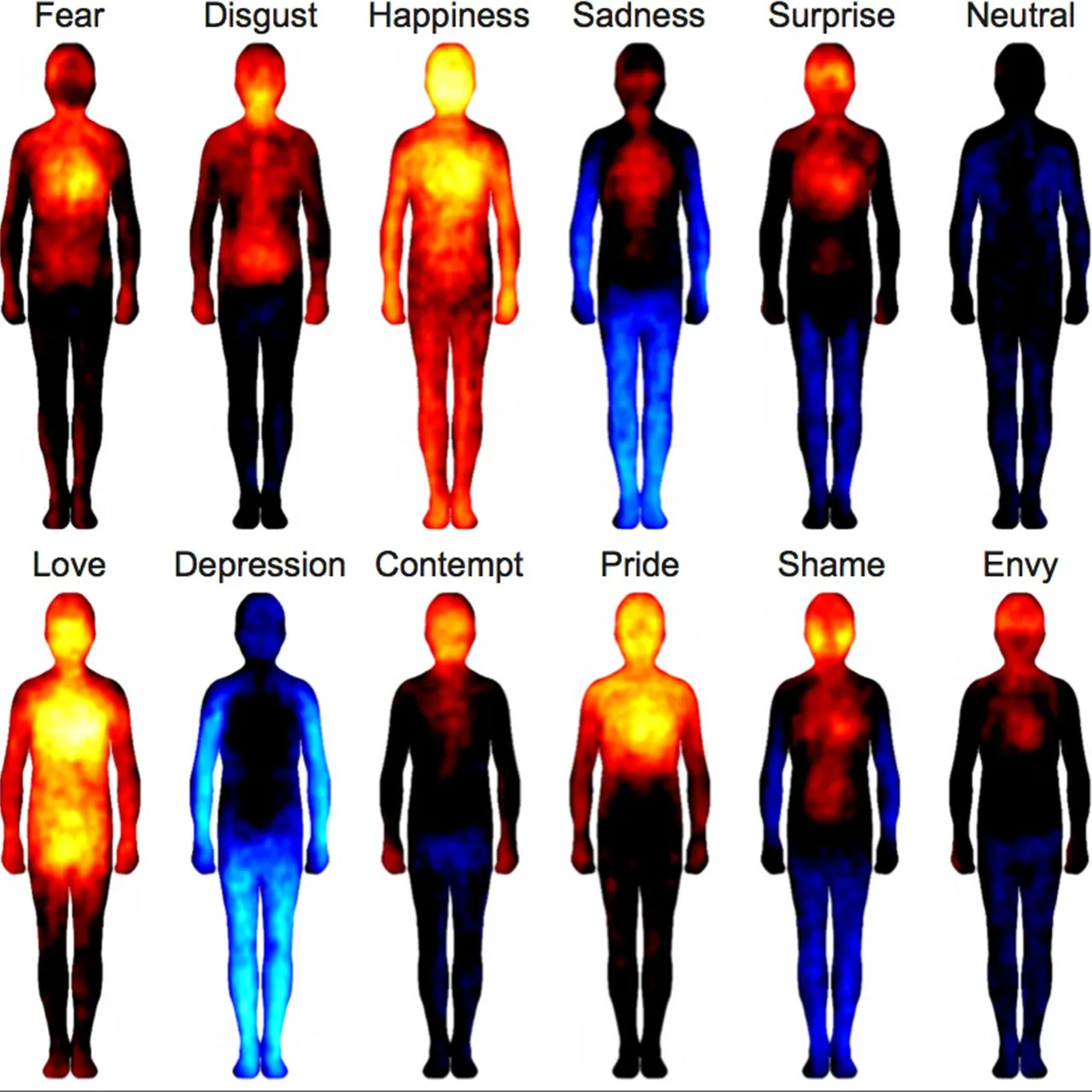
Another aspect that overlaps this area of visual thinking is psychological 'Body mapping', a technique used to identify and position important and relevant emotions such as anger, sadness and love, on a pre-drawn body outline. I was particularly interested in the fact that a study was made using a large sample of people across many cultures and it was found that bodily maps of emotions are culturally universal, (Volynets et al. 2020) especially because I had also read that emotions are not universally pre-programmed, but are culturally conditioned. (Barrett, 2017). This helped me as an artist to feel that it was possible for me to operate in this territory because there was enough scientific doubt to offer spaces in which to be inventive, especially in relation to what Barrett calls 'constructed emotions'. 

Emotional body maps

The standard human shape in the diagram above is for many people acceptable but the colour range feels far too predictable, but I suppose if you are trying to communicate across several cultural barriers, then a certain crudity of emotion / colour correspondence is to be expected. It does though seem to me to be all too neat, it looks like a carefully designed answer, rather than the confused mess of colour, shape and emotion that I have had to deal with when I have spoken to people about visualising their emotional worlds. I'm reminded of 
Vitaly Komar and Alexander Melamid's work whereby they statistically researched what each country's population thought would be a most loved and most hated painting, and then making visible the results. The final body of work was very carefully designed and illustrated the points they wanted to make very well, but once you 'got it', you 'got it' and that seemed a long long way away from the actual experience of encountering either a painting or a landscape. 
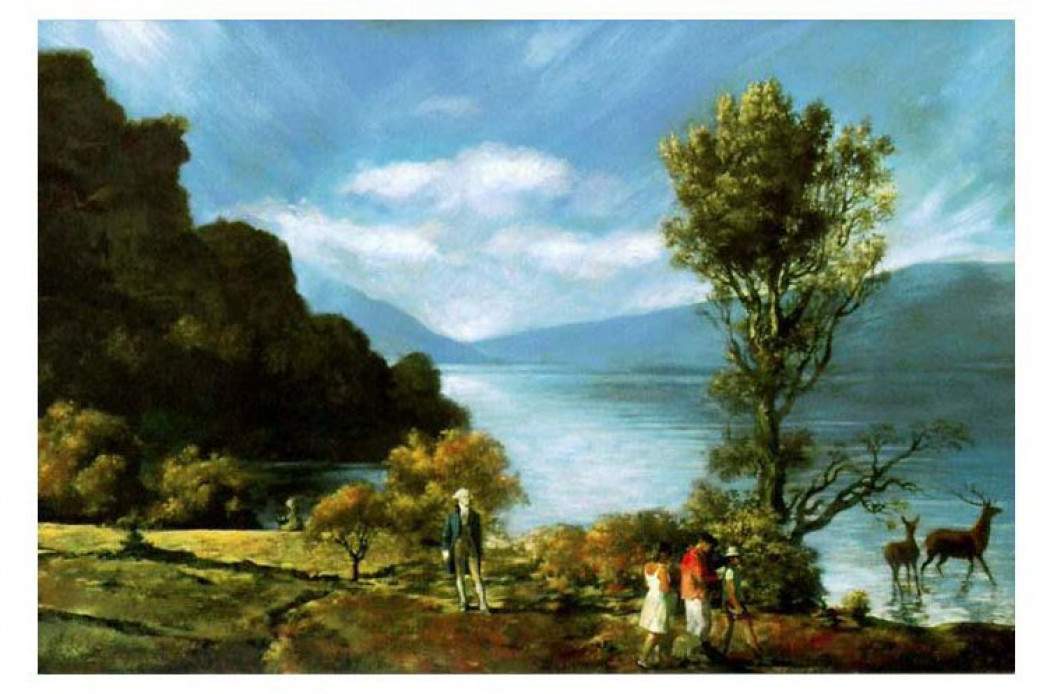
America's most wanted painting

Russia's most wanted painting

Both 
Komar and Melamid's work and the psychological body maps of emotions in relation to colour are based on surveys and according to quantitative research standards they have to be large enough to justify the resulting statistics, a too small number can easily be biased and the readings too subjective. However statistics don't help much in pin pointing those intrinsic qualities of our individual experiences. Science begins by looking at external studies and samples as types of explanations, but subjective experiences are part of what it is to be and this is where I feel art comes into its own. Seeing for example involves various sorts of probing; you are trying to make sense of the spatial chaos that confronts you. As you do you process both what things are and where things are and these recognitions are mixed together to make some sort of awareness. Action and feedback is slightly different in response to these different experiences, but we know our sense of 'where' is being constantly modified by our body movements; eyes change focus and as our body moves into new spaces it encounters constantly changing information that it senses by recording changes in touch, sight, smell etc. But what things are is something that emerges from previous experiences that are mapped against information coming through. You are one thing, constantly changing location amongst other things that are also moving. You are constantly updating the 'whatness' by adding in previous knowledge, such as friend or foe? Perception is therefore not like a passive screen whereby we simply receive qualia, it is more like a form of two way traffic whereby sensing and acting operate in tandem. The whatness of things being in flux, just as much as the 'whereness' of experience; is that stripy thing a tiger or a flickering shadow cast by tall grasses? As I run away I see that it was really a shadow and I slow down, but it was best to run first just in case it was a tiger. The fear was real however and that is an integral part of my feeling tone and as the actual moment fades into my past, the emotional memory embeds itself into my being. As Peter Godfrey-Smith puts it, 'systems... modulate the interpretation of sensory information by the animal's registration of what it is presently doing'; (2021, p. 86) there is a coordination between sensing and acting. When I make a drawing or a ceramic object, as I sense what I'm doing I act in response to what I'm sensing. As I make my images, I would like to think that the process of their making is no different to the process of simply being alive. As animals evolved and were able to coordinate multicellular sensing, parts of their bodies became 'maps or reflections of fragments of their surroundings'. (Ibid, p. 84) Inner and outer worlds therefore were contiguous. 

If we go back to those very first cells and their ability to communicate, we return to the basics of electrical flow. A cell has to manage the chaos of atomic vibrations that become much more real when you are such a tiny thing. One way to bring order is to regulate electrical energy flow, or charge and it uses the control of ions to do this. A cell's membrane keeps some things outside and others inside it, but it needs to communicate through this membrane and let selective things go through. It often uses ion channels for this, which enables cells to adjust their overall charge in relation to the outside world, a sort of tuning, as well as to develop controlled flows of ions, which can function as a basic form of sensing. Godfrey-Smith uses an example of a cell coming into contact with a particular external chemical change, which opens a channel and lets in ions which then as charged particles set new events in the cell into motion. (Ibid, p. 31) 

Perhaps the most important issue arriving for myself as an artist is some sort of confirmation that meaning is tightly bound up in materiality. This means that the old scientific critique of the artist as being too subjective fades away because we are not able to be 'outside' of the world in order to be able to observe it. We are aspects of the physical world, totally integrated into its activities, rhythmically enmeshed into all the other rhythms of vibrating energy fields. Our neurons are not just excitable cells, but are oscillatory devices and rhythmic things have as Huygens put it, 'an odd kind of sympathy between them', (In Godfrey-Smithp. 191) and as an artist seeking a metaphoric understanding I am perhaps just looking for 'that odd kind of sympathy that exists between things'. 

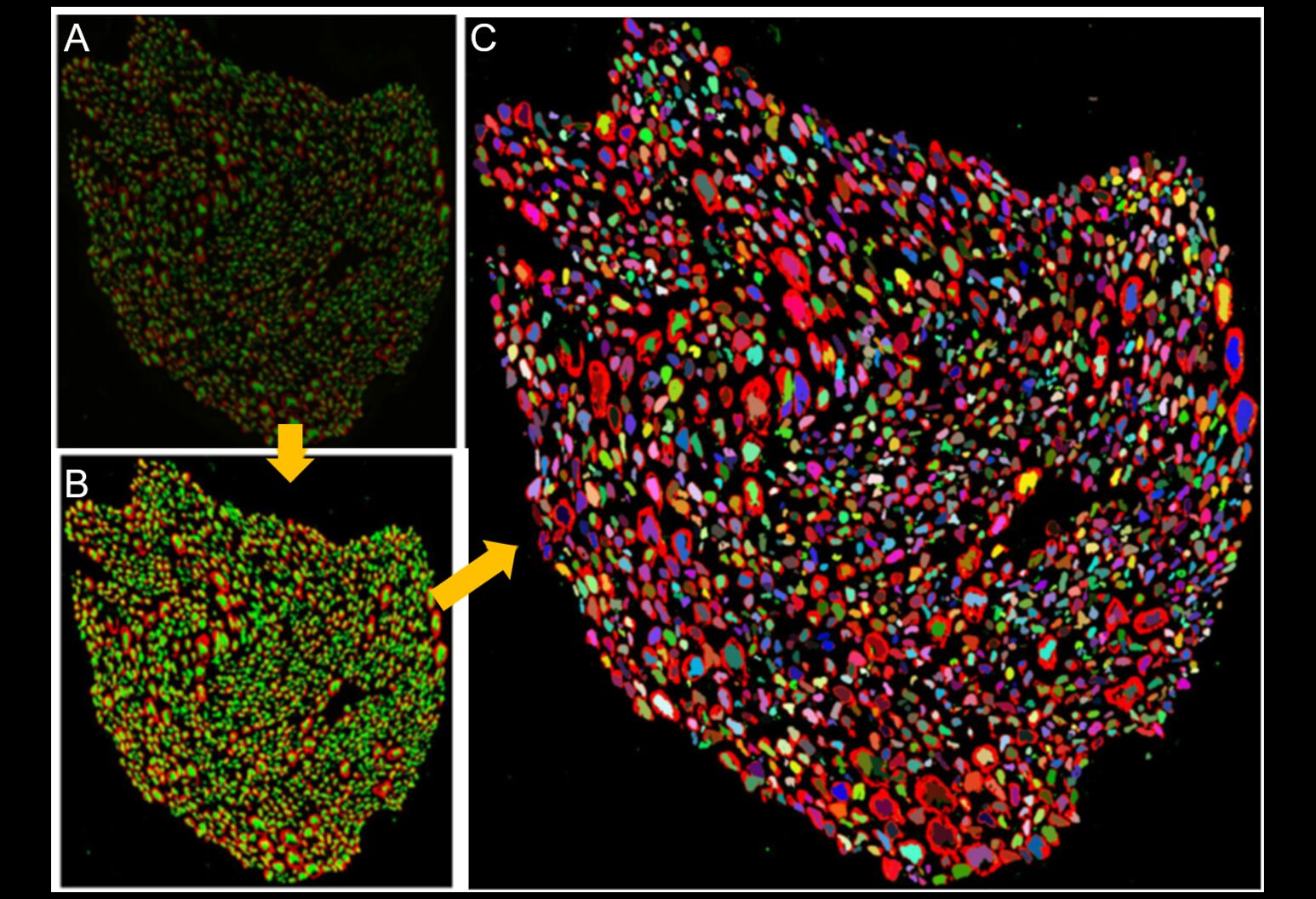
For instance I have just found out that the Feinstein Institutes for Medical Research, have been given an award to support the creation of a detailed map of the anatomy of the human vagus nerve; one of the largest and most critical nerves controlling organ functions like heart rate, breathing, digestion, metabolism and immunological responses. 

One bundle of the human vagus nerve (A), computer enhanced (B) and further analysed at a single fibre level (C).

The map will show the anatomical connectivity of vagus nerve fibres from the brainstem, where the vagus nerve starts, all the way down to organs in the neck, chest and abdomen. At the moment how sensory and motor fibres are arranged inside the vagus nerve and pathways to different organs are essentially unknown. The vagus nerve, which means “wandering” in Latin, runs from the brainstem to most of the body’s major organs. The nerve is not one solid structure but is instead made up of more than 100,000 sensory and motor fibres, grouped together in several bundles, or fascicles, inside the nerve, eventually forming branches that connect to the organs like the heart, lungs, oesophagus, liver and intestines. When functioning properly, the vagus nerve contributes to the maintenance of our body’s homeostasis. However, diseases like Crohn’s disease and rheumatoid arthritis, chronic heart diseases, diabetes and even some cancers are associated with inflammation and abnormal vagus nerve function. This research has already provided images that I could imagine at some point feeding into my own thinking about how the body has developed its own maps. The process of mapping being nested, going from initial maps made in the mind to these new ones that will rely on computer enhancement and the techniques of electron microscopy. The thinking behind this project emerging from minds structured in particular ways that allow them to think of ideas in certain ways, ways that are always responses to information being processed internally and externally; this two way process reflecting the fact that the vagus nerve itself is transmitting information in both directions between the brain and body. 


After all this reflection of what it might be like inside I'm still left with an unknown continent, one that I can only really explore in my imagination, an imagination that is though fed by what I'm thinking and what I'm reading. 

References:

Barrett, L.F., 2017. How emotions are made: The secret life of the brain. London: Pan Macmillan.

Damasio, A., 2019. The strange order of things: Life, feeling, and the making of cultures. London: Vintage.

Downs, R. M. and Stea, D. 1977 Maps in Minds: Reflections on cognitive mapping London: Harper and Row

Godfrey-Smith, P. 2021 Metazoa London: William Collins

Volynets, S., Glerean, E., Hietanen, J. K., Hari, R., & Nummenmaa, L. 2020 Bodily maps of emotions are culturally universal. Emotion, 20(7), 1127–1136. https://doi.org/10.1037/emo0000624

Jacobs, F. 2022 Satirical cartography: a century of American humor in twisted maps Big Think Available at: https://bigthink.com/strange-maps/satirical-cartography-9th-avenue-steinberg/

Jacobs, Lucia F.; Schenk, Françoise (April 2003). Unpacking the cognitive map: the parallel map theory of hippocampal function. Psychological Review. 110 (2): 285–315.


Libassi, M. (2022) Feinstein awarded $6.7M NIH grant to create first human vagus nerve anatomical map Northwell Health: Newsroom, October 25th, Available at: https://www.northwell.edu/news/the-latest/6-7m-nih-grant-creates-first-human-vagus-nerve-anatomical-map

Waxenbaum, J.A., Reddy, V. and Varacallo, M., 2019. Anatomy, autonomic nervous system. National Library of Medicine Available at: https://www.ncbi.nlm.nih.gov/books/NBK539845/#:~:text=The%20autonomic%20nervous%20system%20is,sympathetic%2C%20parasympathetic%2C%20and%20enteric.

Friday, 26 August 2022

Visualising energy flow: Part two

When drawing from life you are in effect visualising energy flow. However the way you approach the task is very important. Every mark you make is a captured moment of energy, the action of looking being a transfer of energy from the world via the eyes into the brain. A growing awareness that there is constant energy transfer within yourself, between yourself and the world, and between the complex of animals, vegetables and minerals that make up any surrounding environment, is central to the concept behind these drawings. Once a drawing has been used to capture various visual and invisible energy flows, it stores the energies recorded like a battery; something that can both store energy and when it is in turn looked at, release energy back out into the world. 

Trees demolish walls

Tyrannosaurus in the woods

An emerging giant

These three drawings above were made, like so many others, from situations encountered on one of my walks through Leeds, all done on the same day and made within 50 yards of each other during a walk over Sugarwell Hill. Walking is a rhythmic exercise and it is also an indication of health. It is very easy to spot someone walking who is not very well, their gait will give them away. I begin with this connection between health and rhythm, because all life has a rhythm, but sometimes it's blocked or the rhythm breaks down. When you are healthy, focused and on top of things, visual scanning and grasp of what you can see is much more insightful and observant than when you are feeling under the weather or not very well. When drawing, you can also have an insight or intuitive sense of the wellbeing or not of the environment you are observing, drawing in this case being a sort of conceptual two way health check. 
I'm particularly interested in how nature removes blocks from the energy flow, how it in effect heals itself and all three of the drawings above touch upon my feelings about that. 

Detail from 'Trees demolish walls'

The drawing 'Trees demolish walls' was made from the edge of the wood, in an area once built upon but now left for nature to reclaim. Some walls have disappeared, others remain jutting out of the ground, broken and uplifted by trees that have pushed their way out into the spaces left by the ruins of buildings broken and ravaged by the weather and ceaseless erosion by organic life. In this section of drawn wall the bricks are still held together by a very strong mortar, its surfaces are though by now severely eroded and moss and tiny plants grow from crevices. It is drawn, like the rest of the image using a dip in pen and ink, first of all the linear marks are made, small curves, made by a slightly quivering hand as the surfaces and the forms are searched for and then the 'pen' is turned around and the brush on the other end comes into play, small patches of diluted ink flicked onto the paper to indicate both a suggestion of moving shadow and surface presence. 

Brush with a nib attached to the other end

The important issue for myself as I draw are the different rhythms set up by visual encounters with the situation, for instance the brick wall itself is still, even after many years of erosion, beating its heart to the regular rhythm of carefully laid bricks and mortar. My job is to both pick this out and to embed it into the other rhythms of moving grasses, broken stones, trees etc. that surround the wall and which are working to gradually dissolve the wall rhythm back into the older rhythms of the woods. The trees are pushing vertically up, powerful forces that surge out of the ground towards the sun, the walls are in contrast now broken at angles, angles that remind myself of broken bodies. As I draw it, a nearby slab of concrete feels to me as if it could have come from a cemetery and it now becomes a tombstone for a dead building. 

Detail from 'Trees demolish walls'

The issue is again one of rhythm. It is in wave forms that rhythm emerges. Seen up close the drawing is simply marks, small lines that are made of tiny curves. However when you pull back from the surface marks coalesce into something recognisable, in this case an old wall, a concrete slab that is breaking down and being over taken by encroaching grasses and trees. These tiny marks are at times indicators of surface texture, or perhaps of a blade of grass, or a sign for the passing of a slight breeze through the surrounding vegetation or they might be a response to the movement of light as it moves from brightness into shadow.
The rhythm of marks is also a vibrational trace of my hand movements. I stand to make the drawings, so movement begins in my feet, rises up my old wobbly legs, is carried up my aching back, down my arms and into my now arthritic fingers. I am ageing just as the building that once stood here has aged. At some point, like the broken wall, I will join it in dissolving back into the world I emerged from. 

The dinosaur drawing is also about energy transfer but with a slightly different emphasis in relation to time. I was trying to get through a very overgrown part of the wood in order to draw something else, but as I broke through some undergrowth, I looked down and lying in grass on the floor was a bright red plastic tyrannosaurus. It was so incongruous that I was initially baffled as to how to deal with it, but as usual drawing sorted the problem for me. 

Detail: Tyrannosaurus in the woods

The issue I found I had with the tyrannosaurus was the power of its image. It was still pristine, its plastic surface unscratched and unsullied by dirt and grime. It felt put there on purpose. I gradually became aware that the tail was missing and that it was in fact broken and therefore probably discarded by its owner, who must have taken it into the woods and left it as some sort of ritual ending to its short toy life. As I drew it, I was able to reconcile its form with the surrounding vegetation, able to dissolve its edges into the more energetic marks that I was using to suggest the life of the flora that surrounded it. It will eventually be covered by fallen leaves and will sink gradually into the ground and become a type of fossil for future diggers to uncover. This drawing of what had been a top predator of its time, began to look as if the dinosaur had just been defeated by something far bigger than itself. It was a fallen giant, now made small; the fast drawn marks made to suggest surrounding grasses, could perhaps be indicators of giant ferns seen from far above, time collapsing in the mind's eye. The image of the dinosaur, something glanced at in a brief moment, also being a window into deep time. The dinosaur's red plastic was once a carbon fossil, then fossil fuel and as a high molecular weight organic polymer, it became morphed into a form alongside cups and saucers, other toys, medical equipment and the myriad of other plastic goods that now threaten oceans and their residues begin to live in our bodies as micro-plastics. The drawing arena is small, not more than a couple of feet to scan, I don't stay long, don't attempt to describe the light change, don't dwell on textural differences, I simply draw mark rhythms. The toy dinosaur's form had been made clear by its designer, stomach ripples looking to me like wave forms, lines of energy that I could play off against marks made to signify the forms of plastic muscles on plastic legs. Legs, that like its arms, are stuck out helplessly, now air running to the rhythms of waving grasses growing nearby. 

The third drawing 'an emerging giant' was made over a longer period of time. The tree at the centre of the image, was in my mind getting ready to take over, ready to reclaim its territory. The tree had grown out of the side of what appeared to be a mixed pile of earth and rubble. Slabs of cut stone, old bricks and other remains of a former time when this was an industrial site, poke out around the tree's base, all of which felt very inconsequential in relation to a dominant tree, that as it was drawn demanded more and more pressure to be exerted on the pen, its rhythms energised the place, so that as it pushed its root system out into and down into the world, it took up the space necessary for a powerful presence. These tree roots were alive with a muscular vitality that visually grabbed the ground and anchored the growing tree to a mound that was now part of itself. The tree's twist into space dominated the rhythmic forms of the area, other vegetation taking a very secondary role. As in a visual opera, tall grasses set up a background rhythm that could support the loud vitality of the tree. As I drew, I felt myself falling over as my feet slipped on the slope I stood on, this became confused with my attempts to depict the slope that surrounded the tree. Disorientated by being off balance, the energy I had to invest in standing upright, was channelled through my drawing hand into the way I was drawing the tree gripping onto the ground. It became more like an octopus stuck onto a rock. 

An emerging giant: Detail

The above approaches to drawing have gradually evolved from a lifetime of drawing that initially used the visual checks and balances of a William Coldstream inspired grid of looking to assess where things are in relation to each other, and which then for many years used the 'giron and fesspoint'* method of spatial drawing as an attempt to capture the flicker and movement of perception. I have spent hours looking at and thinking through the implications of the drawings of Cézanne and have nearly 50 years experience of teaching drawing and a lifetime of making drawings behind me, all of which has only led me to have an uncertain certainty about these issues. I am however still learning, every week something new occurs to me, but I would hope that these recent drawings have enough to them to convince the viewer that they are the product of serious research into how it is still possible to stand in front of the world without a camera and make an interesting drawing of it. 

How to visualise magnetism 

See also:

The oscillations of observation Learning from how to visualise magnetism 

Friday, 1 April 2022

Lines as symbols of invisible forces

A practitioner of Mesmerism using Animal Magnetism

Annunciation: Fra Angelico

In Renaissance times lines emanating from a radiating point were sometimes used as a symbol of invisible religious or occult forces and more recently fanned out, broken or dashed lines have been used as symbols of invisible rays or unseen effects such as magnetism, electricity, x-rays, mesmerism and nuclear radiation. These lines can carry all sorts of ideas, some of which haven't been accepted as scientific concepts but which non-the-less impinge upon our collective imaginations as being necessary to a more esoteric understanding of the world, and the invisible emanations that effect it.  For instance the concept of the 'aura'; a luminous radiation surrounding a living creature or object.

A representation of a body aura

Contemporary 'aura' photographs

In the comic book world superheroes are often depicted as emitting rays of energy, the DC character Captain Atom being typical of an anthropomorphisation of an invisible energy. 

Captain Atom

Grant Morrison in his book 'Supergods' sets out to explain that these comic-book heroes are not simply characters but powerful archetypes that can be traced back into history, art, and various world mythologies. In this case I'm simply pointing out how visual languages are shared across cultures and times, especially when there is a common issue to communicate. 

Many of us have had that feeling that someone is looking at us. As if vision involved an outward-moving influence from the eyes, this is technically called emission or extramission theory and has historically been associated with the evil eye. 

Rays emerge from the eyes in emission theory

Although auras and emission theory have been debunked several times by modern science, ideas of this sort still seem to have a hold on our collective imaginations. For instance the theorist Rupert Sheldrake has argued that the external projection of images or force of seeing is a reality, he imagines perceptual fields that extend out beyond our body receptors, these fields connecting the seeing individual with what is seen. (Sheldrake, 2004) Sheldrake argues that the formation of these fields depends on changes occurring in various regions of the brain as vision takes place. These fluctuations are influenced by inbuilt responses to expectations, intentions and memories. Sheldrake's theories are related to the work of Velmans, (Velmans, 2000) who suggests that image projections take place in a way that is analogous to a field phenomenon, as in a hologram; however Sheldrake takes the idea further, suggesting that the perceptual projection is not just analogous to but actually is a field phenomenon.

Sheldrake is influenced by an awareness of fields in other areas of scientific thinking, magnetic fields in particular have influenced his ideas, and field theory is central to many of the ideas that underlie quantum mechanics. Sheldrake suggests that minds extend beyond brains through fields, negating the idea that our conscious experiences are totally passive. Quantum mechanics suggests that our conscious experiences enter into the dynamics of real world situations in ways not fixed by physically described aspects alone. (Stapp, 2011) Even though Sheldrake's ideas are still regarded as very speculative, what he describes does have a certain intuitive rightness about it. 

Sheldrake states; 'When someone stares at another person from behind, the projection of the starer’s attention means that his field of vision extends out to touch the person he is staring at. His image of that person is projected onto that person through his perceptual field. Meanwhile, the person stared at also has a field all around herself. I suggest that the starer’s field of vision interacts with the field surrounding the person stared at. One field is influenced by another. This field interaction is detected through a change or difference in the field around the body. Just as the field around a magnet is changed when another magnet is placed nearby, this field interaction is directional. The interaction may be weak, and need not be experienced consciously by the person stared at. But, if the interaction is strong enough, the person stared at may respond by turning around, without thinking and without knowing why.'
From: https://psi-encyclopedia.spr.ac.uk/articles/sense-being-stared-theories-vision

Sheldrake goes on to explain how perceptual fields are related to biological fields embedded within the organisation of developing biological organisms and their nervous systems, and that these fields underlie processes of biological morphogenesis. As an artist my attention was immediately raised, as morphogenesis is the coming-into-being of form, and therefore it is a process that lies at the heart of the all creation. These invisible forces seeming to extend out into everything. In my imagination, the lines drawn to illustrate the invisible powers of mesmerism, beginning to intersect with those of the eyes' emissions and other visions of invisible forces. 

Descartes: Vortices

Descartes' idea of materialistic spirits that move through the body and through vision was related to the theories as laid out in his "Cosmogony", in particular, that the entire universe was filled with elements of different sizes which shifted around each other. At the centre was the sun, which was made up of the smallest kind of element and the bigger ones circled around it. This notion of vortices was also used by Descartes to explain forces like magnetism. The idea of the vortices suggested that the fixed stars were actually part of a contigious universe of systems like our own rubbing against each other, in many ways the idea of gravity, as introduced by Newton, replaced Descartes' ideas but once again we have a vision of invisible fields influencing each other and this time tightly curved dashed lines are used to visualise the idea. 

Magnetism

When you place a bar magnet on a smooth surface and add iron filings, the magnetic forces will produce a physical diagram, the iron filings making their own drawing of the invisible forces at work. I have looked at these forms before in the post on Faraday's lines of force, and the more I think around these illustrations of invisible forces, the more it seems to me that they have been central to our understanding of unknown forces for thousands of years. 

Aten, the sun god reaches out with his rays of light

From the rays of the Egyptian sun God Aten, literally reaching reaching out to the earth below, to the rendering of 'God Rays' in contemporary CAD software, the sense of a spiritual other can be made visual by linear effects. 

Maya tutorial: God Rays

Energy emanating from a centre

If the lines of energy are bent, as in gravitational pull, we can visualise energy and its relationship to mass. 

Henry Moore: Shelter drawing

Henry Moore uses this idea in his shelter drawings, the space lines, or rays, are bent as they reveal the mass below. This is I think I very powerful metaphor, as it takes the idea of lines of invisible energy or spirit and relates them to the solid physicality of 'reality'. As we all now know, 'reality' is a sort of illusion and the closer we get to it, the more it disappears and at certain magnifications atoms appear, then the elements that make up atoms and finally the energy fields that underpin everything come into some sort of mathematical appearance, something not actually seen but understood as being there. 


A few images from a sequence whereby inner and outer images of a body are entwined 

In my own drawings I'm looking for a way to connect or entangle both inner and outer body space, an awareness of what goes on inside my body and what goes on outside it, how it is perceived from outside and how it perceives. By thinking about line and then going on to think about other basic visual elements I can gradually build a language that in my mind begins to cope with the various elements of a fluid idea. For instance the dissolving of matter into water so that various solutions are formed is another, for myself, important metaphor for the constantly moving events that are life. As one element combines with another hybrids are formed and as they emerge they can become the building blocks for a private language concerned with visualising the nature of a fluid world, a world where there are no fixed boundaries and where identity is always in a state of flux and reality is never fixed. 

So finally what am I getting at? Bergson used the concept ‘élan vital’ to describe a force inside all living beings that motivated them to continue, what we might call 'the life force'. Bergson was suggesting that life itself was a creative process, something that Prigogine calls a self-organising dissipative structure, driven by non-equilibrium flows of energy. I.e. the active forming process is a self-organising one, one that reflects the possibilities in the organisational structures of life itself. For an animist, (animism perceives all things: animals, plants, rocks, rivers, weather systems, human handiwork, even words; as animated and alive) this ‘élan vital’ it could then be argued is something that runs through everything, not just living things and that all materials have the potential to be formed into others, they just need to be in interaction with whatever they find themselves in contact with. It is as if the entire universe is filled with elements of different sizes which shift around each other and as they do they effect each other and cause changes to occur, as these changes happen, hybrids, combinations and all sorts of alternative forms come into being, a constant process of metamorphosis, a process that is the élan vital’ that runs through everything. It is this situation that in my own work I would eventually hope to visualise; however it will only be through a synchronisation of myself with the voices of others, such as the materials I use, the landscapes I walk through, the plants I observe and the other animals I talk to, that I will be able to succeed.


Charm for a fluid reality

References:

Morrison, G (2012) Supergods: Our world in the age of the superhero London: Vintage

Sheldrake, R. (2004) The Sense Of Being Stared At: And Other Aspects of the Extended Mind London: Arrow

Stapp, H. P. (2011) Mindful Universe: Quantum Mechanics and the Participating Observer London: Springer Press 

Velmans, M. (2000) Understanding Consciousness London: Routledge

See also:

If you want to read a much more scientific description of how interaction works an excellent article is "Scientific Élan Vital: Entropy Deficit or Inhomogeneity as a Unified Concept of Driving Forces of Life in Hierarchical Biosphere Driven by Photosynthesis" by Naoki Sato.  

The key part of this text is for myself this diagram and the explanation below.

From photosynthesis via evolution to culture

Inhomogeneity, a Scientific Equivalent of Élan Vital: Naoki Sato
Bergson has put forward a concept ‘élan vital’ to describe biological force inherent in all living beings that drives all living processes including evolution. This key notion should, therefore, be understood to mean ‘driving force of life’ rather than ‘vital force’ or other words that reminds us of vitalism. Élan vital is sometimes misunderstood as an expression of vitalism, but it is based on numerous scientific results obtained until the beginning of the 20th century, although Bergson was a philosopher but not scientific researcher. Bergson was the first advocate who argued that evolution is a creative process, which was supported later by Monod. Various putative equivalents of élan vital were put forward by various physicists. Schrödinger presented negative entropy as a driving force of life, but there were various confusions regarding negative entropy. Brillouin correctly paraphrased negative entropy as a notion that we call entropy deficit or inhomogeneity in the present article. He also showed the equivalence of negative entropy to information. Prigogine was an eloquent proponent arguing that life is a kind of self-organizing dissipative structure, continuously driven by non-equilibrium flow of energy. The book of Nicolis and Prigogine described in detail their view of self-organization in metabolism, cellular differentiation, evolution and ecosystems with numerical simulations, but they did not consider the entropy of various biological processes. Kaufmann elaborated the concept of self-organization especially in evolution, and he considered that evolution, and therefore, life is not just a mechanism. 


Faraday's lines of force

The virus is looking at you

Diagrams: visualising the invisible

The diagram as art and spirit guide

Quantum entanglement 

Dashed and dotted lines

Hybridity and Permeability