Showing posts with label perception. Show all posts

Wednesday, 1 October 2025

Figure-Ground Relationships

Figure-ground relationships are usually thought of as gestalt principles and one cannot be perceived except in relation to the other. When I used to teach on the visual communications stream of the foundation course, an exploration of figure-ground relationships was one of the basic exercises we set for students and designers in particular use an awareness of these issues as an essential tool. Simon C. Page's posters for the Batman comic series 'Criminal Underworld', being an excellent contemporary example. 

Simon C Page

If the figure ground relationship is one where equal weight is given to either reading, the mind constantly switches between one and the other, thus activating a static image. A trick often used by poster designers or by Cubist artists, as below.

Georges Braque: Woman with two faces

Figure–ground thinking is central to the psychology of perception and is vital to our ability to recognise objects through vision. In Gestalt psychology it is known as a process that helps us to identify a figure and pick it out from the background; an activity that is harder than you might think. The images above rely on an alternation between two mutually exclusive perceptual states, an awareness of which is also referred to as bistable perception. Finding images that sit on this edge can be a very important issue for an artist, especially if what you are trying to do is to keep an image 'alive'. The flicker between one possibility and another, in effect gives life to the image as a whole.
Salvador Dali related this to what he called the paranoiac-critical method. This concept was one derived from Andre Breton's idea that in Surrealism objects could be thought of not as a fixed external things but also as extensions of our subjective selves. When creating an image that illustrates this idea however, an artist needs to use a process that can result in a double or ambiguous image, one that can be read as one thing or another. As an object or as an extension of our inner psyche.

Dali: Apparition of Face and Fruit Dish on a Beach

Dali's 'Apparition of Face and Fruit Dish on a Beach', is an example of his paranoiac-critical method, a process that at its core led to visual ambiguity. The image oscillates between a human face and a fruit dish.
Abstract artists can also use this ambiguity. Victor Vasarely in particular was very fond of these figure / ground illusions.

Keple Gestalt: Victor Vasarely

We are in effect playing with 'border regions' which in visual perception are the transition points between objects and the background in an image. Our ability to identify these borders and assign them to the correct object is a fundamental part of vision, it enables us to 'see' what is out there. This process is also called border ownership, and it's essential for object recognition and understanding the visual scene.

Alaska Geographic logo


Figure-ground illusions, as in the Raven-Bear image above, illustrate how border regions become grouped together with the object that is perceived, even as the figure and ground reverse. This gestalt totality results in heightened neuronal activity as these borders are perceived in conjunction with the overall image that is also being perceived. This requires a rapid global analysis of the entire scene involving the coupling of masses of neurons, which are collectively seeking out clues for both plasticity and meaning. (What it is and what it represents). Thousands of synapses and neurons are simultaneously contributing to the complex cognitive operations required by our minds to try and solve these types of puzzles, and we intuitively feel this in our bodies, as far more energy is involved in dealing with ambiguity than certainty. 
Although not strictly figure ground relationships, images that require a 'Gestalt switch' such as the young/old lady, also for myself fit into this category, as well as seeing faces in everyday objects or face pareidolia as it is properly named.

In my work looking at how to visualise interoceptual experiences, I'm very aware that these experiences are often ambiguous and therefore I have been looking at this area of gestalt psychology as a possible solution to some of the issues I have been facing, especially as to how to maintain the feeling tone that comes from a real life experience in a static image.

A face in the clothes

I think this can be something found out in the world as well as in a drawn image. The 'discovery' of a face within a pile of clothes in an old photograph of mine, shows that Andre Breton's idea that objects could be thought of as extensions of our subjective selves, still has traction. In drawn images about embodied feelings, a certain ambiguity as to figure/ground relationships, can again help heighten visual tension and thus help carry a more accurate sense of a feeling tone. For instance when I was thinking about breathing and how closely our lungs relate to a tree's dendritic structure, it was an obvious move to link the two images and to try and make an image that sat between both.

Lung / tree

This works both ways and when drawing a landscape you can suggest it is alive and breathing by the way you place and shape trees.

Tree lungs within a landscape (detail)

Entrusted with carnival business: Pen and ink wash: 112 x 50 in

In my drawing, 'Entrusted with carnival business', I wanted to show that a local park was in effect the 'lungs' of the area. In the 'Mythic landscape' drawing, there was an attempt to fuse together the concept of our emergence from a female principle, that was both a body and a landscape. 

Mythic landscape: Charcoal on paper: 16 x 23 in

Embodied landscape: Pen and ink, watercolour and ceramic: 72 x 60 in

The embodied landscape drawing above was an attempt to fuse landscape, body and memory together. The landscape that flows from the embodied hills being one reconstructed from memory, as was the ceramic octopus, which was a reconstruction of a child's toy, something that was important to myself when I lived in that landscape when I was growing up. Memories inhabit the body, just places are engraved into old maps and that feeling of inhabiting a body, never leaves us until of course we die.

The flow between an external view of a body and how we see a landscape is something I have tried to depict several times. Some embodied feelings are not so straight forward, but their images can be designed to still use a certain amount of 'bistable perception', just enough to make the observer have to use a little more energy to try to 'see' what is there and as they do perhaps to 'inhabit' the image on their own terms.

Embodied feeling of a failing knee: Felt tip, watercolour and ink: 11 x 16 in

The image of a knee above was made after talking to an old school friend, who like myself is now retired and his knees were going. I made several images of our conversations and he has since had his knees replaced, but the whole experience in effect gave him a mountain to climb. For a while each knee became for him the centre of his perceptual world, the pain blotting out the rest of the landscape. 


A drawing from a series of images about tinnitus 

When I was working with people who had tinnitus, I began making images that were an attempt to visualise an invisible or non-existent force invading the inside of the head, such as the one above. Gradually the drawings of heads became more like landscapes, but not the ones typically produced by European artists, more in my mind like those made by the original inhabitants of Australia.
A working image exploring how to depict an individual experience of tinnitus

Bandak Nym: 1959/60

The 'figure/ground' images made by Aboriginal Australians of "The Dreaming" evolved out of an animist creation narrative and can be understood as belonging to a "timeless time" of formative creation. They are not fixed images, more like maps used to work out where you are both physically and psychically. Their work effortlessly fuses different viewpoints together and I owe a deep debt to a culture I have never witnessed but whose continuing existence reminds me that there have been and always will be many alternative ways of depicting our various realities.

Perhaps the most constant figure-ground or dual image in my work over this time has been that of the body / landscape. We sometimes think of our bodies as small things that inhabit an ever expanding landscape but when we begin to have to focus on our insides, such as during a time of illness, our bodies become the totality of the world we live in. There is of course a flow between the two views, at one moment I stumble and a pain in my foot becomes the centre of my attention and a few moments later, a rumbling sound in the distance takes up all of my perceptual energy, as I try to work out if a storm is coming my way.

Stomach awareness

In the image above I was trying to construct a representation of the feelings that emerge from my stomach. From hunger to nagging indigestion, via rumblings of nervous responses to facing difficult issues, my stomach seems to digest emotional feelings as much as food. It is a complex thing and I never see it, I only feel it, unless of course I have a nasty accident.

Storm clouds with lightening

It is no accident that we think of the adjective 'rumbling' to describe both a stomach or a storm.
I have returned to how to depict this, as well as finding images for my chest and breathing issues many times and if the images are to operate as I want them to, they need to sit on a fence between figure and ground, if not they become too static and cannot breathe or as in the case of the stomach, be able to communicate the movement of peristaltic waves. In Chinese medicine a stomach ache might be described as a malignant wind. 'Feng', the Chinese word for 'wind', has a wider meaning, as an invisible power that works in a way similar to how a howling wind bends a tree. It can 'blow' diseases through the body that result in aches, sickness, tremors, headaches, dizziness or fever and it can operate both internally and externally. An internal imbalance of energy or an external confusion created by a too complex environment may receive similar treatments, in both cases treatments would look to ways to induce calm.

A flow of embodied energies

As always a balance is required, total stillness may be due to death and the flicking/ticking of awareness is a good sign of life. However too sedentary or too active lives become stressful; so take a deep breath and whilst you engage with what's going on, watch how the world flips from one reading to another.

Reference:

Fields, R.D., Araque, A., Johansen-Berg, H., Lim, S.S., Lynch, G., Nave, K.A., Nedergaard, M., Perez, R., Sejnowski, T. and Wake, H., (2014) Glial biology in learning and cognition. The neuroscientist, 20(5), pp.426-431.
See also:


Sunday, 12 March 2023

Drawing Observational Oscillations

Durer

For hundreds of years the image above by Durer has represented an idea of the artist making objective drawings. At the core of the idea is the need to keep your eye steady, in this case by having an adjustable column with a pointed end that is fixed to the drawing table. This fixed point being essential if you are to be able to accurately trace what you can see. In the image above we also have a grid of I presume fine thread, which is stretched across the frame through which the artist looks at the world, a grid that is repeated by the artist drawing another one over the horizontal surface on which the artist draws. The artist then copies what is seen through the vertical grid of threads onto the horizontal gridded drawing surface, using the matching of these two grids as a guide. It is as if the observed image floats towards the grid of threads that crosses the frame and is trapped there, flattened so that the artist can peel it off and lie it flat on the table.

Durer's model reduced to a diagram

I have for many years been dissatisfied with this model and although I'm very aware that since the time of Cezanne, many artists have left this concept behind, it tends to be still influential because of its relationship to the camera.

The inverted image of the candle is captured by the photographic film instead of Durer's grid

In the image above, a camera obscura is converted into a camera by replacing its back wall with a photosensitive surface that will become a photograph after processing. It is the lens, or pinhole that both focuses the image onto this surface and inverts it, a situation that reflects the human eye's ability to focus an image in the same way. The diagram clearly shows that the inverted image still retains a 1 to 1 set of relationships between the object that is projected and the screen it is projected on to. 

The relationship of points of a projected object to its projection using Durer's device

The relationship of points of a projected object to its inverted projection using an imaginary lens placed between the object and the screen

If Durer's apparatus was to be converted into a camera, a box would need to be built in front of the screen like so:

The woman this man is trying to look at is far too close to the tracing screen, so in order to put a camera body in place she has been pushed back to make room. The drawing being made by the man would of course now be upside down.
A camera in effect works by placing a lens that both focuses and inverts the image between the object and the screen it is projected onto. The eye of course works in a similar way. 


The lens' ability to focus an image onto the back of the eye

One thing that is clearly apparent is the fact that the back of the eye is curved, and the image has to be curved to fit. The camera like the eye inverts the image, our brains re-inverting it for everyday use, the observer of a photograph is in effect turning it upside down to see it 'the right way up', but we rarely think of this because we usually only see the image after it has been processed. However going back to Durer's idea, we can see why at the time it seemed like a clear advance. There was little consistency to spatial representation and artists did what they needed to do to show what they wanted to show. In the image below surfaces are tilted in various ways so that we can see what is on them. 

Both tabletops are visualised using what we now call cabinet projections

But Durer was working at a time when perspective was the new toy on the block and in comparison earlier projection ideas, such as cabinet projection, seemed simplistic. When using perspective, a cube much more obviously has a front and a back, its spatial position is clear. 

A cabinet projection and a perspective projection

In the perspective projection the front of the cube remains the same, but the orthogonals  converge toward a vanishing point instead of being parallel, so the back face of the cube appears smaller than the front. The interesting word is of course 'appears'. A cube's sides are always the same size, that is part of its definition. The cabinet projection is not so nailed down as the perspective and visually the front and back often flip between each other. As soon as you move into the world of the cabinet projection things become visually much more active and because of this I have found its ambiguous spaces much more conducive to being able to visualise certain aspects of the scan of looking than traditional perspectives. 


You can of course add secondary information to try to pin one reading rather than another, in the drawings above a dotted line suggests less visual weight, so that the front face of the cube is seen first of all at the bottom left and then in the lower drawing at the top right. 

The eye is usually accompanied by its twin, so every image is duplicated but from a slightly different viewpoint. It is also impossible to keep your head still and your eyes flicker from left to right and up and down constantly as they sweep for constantly changing information. Therefore the idea of a fixed image reflecting how we actually see becomes very suspect. A basic cube, is therefore much more likely to be perceived as a complex of layered bits of information, as represented by the drawing on the right below. 

A Necker Cube (left) and layers of cube information (right)

The Cabinet projection of a cube is known within the discipline of visual psychology as a Necker Cube.* Psychologists are fascinated by the ambiguity of read, the either or situation that the brain projects onto the image. As I look at adding into the situation the shifting viewpoints and doubling of the eyes, this either or situation becomes even more complex and an interwoven space becomes more of a possibly. This is a space that is full of possibilities, points of reference are everywhere and these points are what for myself become a sort of visual battery. Out of the flux of looking will emerge an image, not so much trapped and fixed into place as in perspective, but something that oscillates into view, that vibrates into existence. 
 
A representation of a reconstructed view of Durer's drawing

As you can see in the image above there are two eyes and these eyes are flickering over the scene that is being represented. The drawing below is of a plastic dinosaur observed during a walk through woods. It was drawn in a sketchbook with a dip-in pen. The time taken to make the drawing was about 7 or 8 minutes and I was crouching down to see the situation, so my drawing book's position was rested on a very wobbly supportive knee. 

Pen and ink drawing made from observation
A representation of the tracking of looking made from the observational drawing above

I tried to re-trace the looking that had gone on when making the small drawing of the dinosaur, as I began to do so I realised that the image began to disappear back into the world that it emerged from. This was an interesting conclusion to a process of thinking about looking, what was a diagrammatic representation becoming an active, rather than a passive image, its final appearance perhaps being due to a ghost memory of a Daniel Libeskind drawing, a memory that had long ago lodged itself into my visual memory and which I'm often reminded of when trying to be more technical in my approach to making drawings. 

Daniel Libeskind 

Libeskind's drawings are like layers of architectural memories. They operate as if several transparent sheets of tracings were laid over each other and retraced as one image. By trying to recreate the eyes' activity when making a drawing, I realised I was also laying one memory over another. The tracking diagram in effect freezing recovered lost actions into a drawing space. 

The final image from the observational tracking sequence

Gradually I found myself adding more and more layers to my own drawings, until they began to oscillate with their own energy fields, as in the image directly above.  

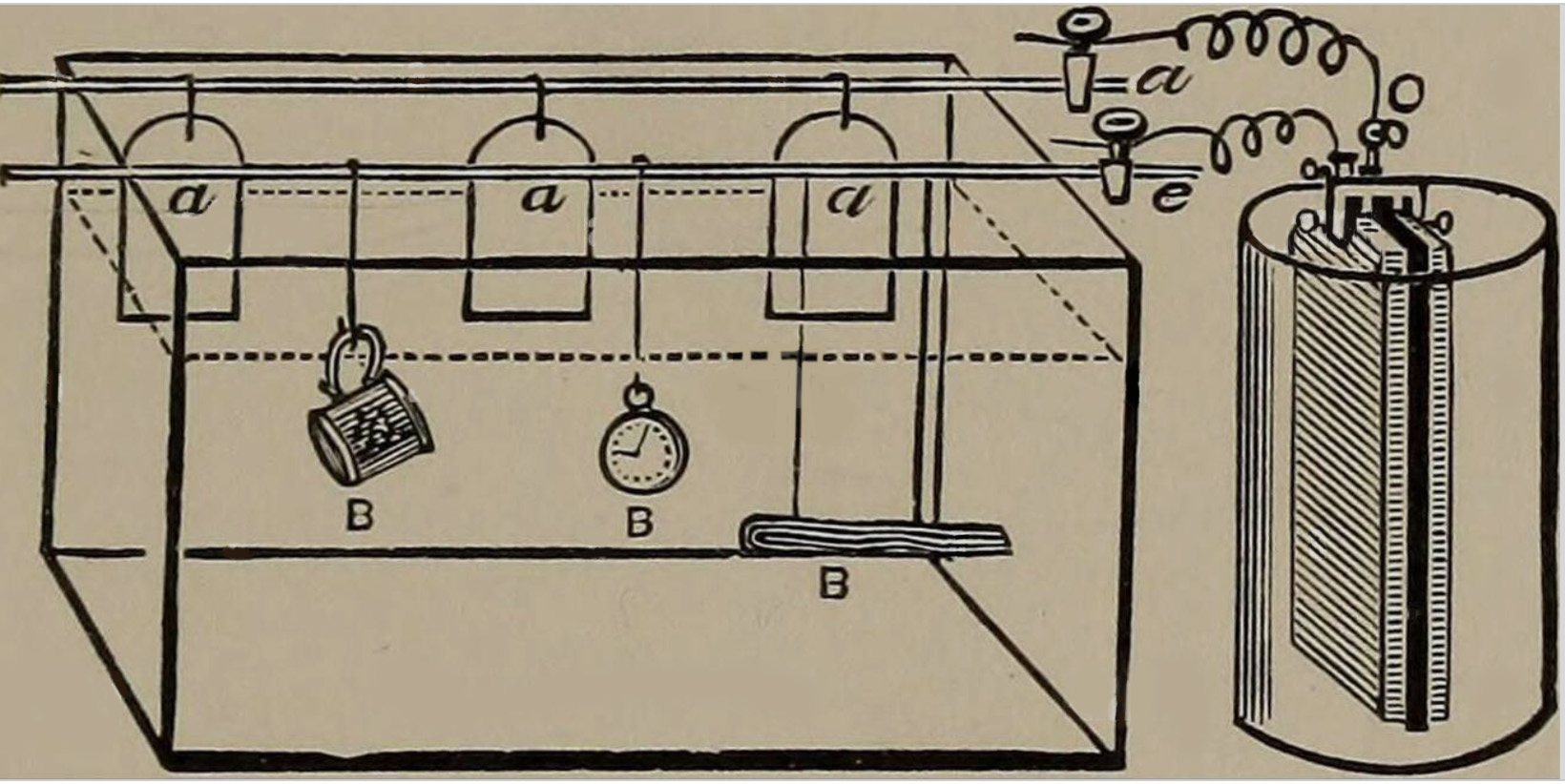
My earlier posts on visualising energy flow are hopefully easier to understand if read in conjunction with this post. I had in one of them referred to the idea that once a drawing had been used to capture various visual and invisible energy flows, that it in effect stored the energies recorded like a battery. These energies could then be released and their charges perhaps harnessed to other uses. Could for instance this way of thinking about drawing be linked to how electroplating works? The diagram below is also a cabinet projection. For copper electroplating for instance, surfaces are hung in a copper ion solution, see. I'm trying to stretch my head around a possible metaphor about energy conversion here and the results will come out more in the objects I'm making. This is not about scientific logic, its some sort of material poetry. 

A basic electro plating system

As I think around the issues connecting energy flow with drawing metaphors, I'm also thinking about the possible development of my more sculptural work into more process orientated directions. I'm also very aware that these approaches to aesthetic 'meaning' are about story telling and that it is the seductive power of the narrative that drives the work as much as the material languages uncovered. If I decide a drawing or any other artwork operates like a battery, then at some point I will begin telling a story designed to convince myself that this is a metaphor that works. This is a form of poetic activity and non of the decisions made are actually verifiable or measurable or academically valid. As a reminder to myself about this fact, not long ago I wrote a proposal for a journal article, entitled, 'Drawings as aesthetic transducers' based on some of the ideas that I have been thinking about in relation to energy flow and batteries.  My feedback, on what was not accepted as a publishable article, was that I must make sure that my paper's claims are presented much more clearly as a hypothesis or as metaphorical expression. I should have clarified for the reader that the hypothesis is only valid as legitimate poetic inspiration for the act of drawing, and that I must not risk looking for any sort of scientific validity for the process." This was a useful reminder that these are just ideas, and as such don't have any academic validity. Even so I would argue that as ideas begin as poetry, and out of poetry new possibilities will often be released, that it was a worthwhile exercise. As an idea it could not stand up to scientific scrutiny but it is an idea nevertheless and one designed to change the way we might think about looking at a drawing. So how does this help you may ask? I suppose I'm suggesting that at times you will need you follow your own logic and that even when other people don't see it as being understandable, that doesn't mean you give it up or discard it. It may well take you somewhere others have never been and that is as far as I'm concerned validation in itself. 

*The Necker cube is used in Robert J. Sawyer's 1998 science fiction novel 'Factoring Humanity'. In the novel the term "Necker" is used as a verb, meaning to switch thinking from one perspective or form of perception to another.

See also:


Sunday, 5 June 2022

Lacan and drawing as an external self

Jockum Nordström: Family Trait: collage on paper, 2006

In my last post on the void I mentioned Dave Edgar's reference to Alain Badiou, who was in turn writing a piece for the magazine 'Lacanian Ink'. While I'm ruminating on perception, I'm afraid I'm going to continue to unpick some ideas about how drawing can sit in that gap between perception and reality, especially because I've been asked to make a series of drawings that communicate what it's like to have tinnitus. 
Tinnitus is a condition whereby we constantly hallucinate sound. These hallucinations interfere with our ability to respond to the real perceived needs of our body and as such can be a real problem for the sufferer. But as these 'sounds' have no grounding in external events, they are very hard to communicate to others who of course cannot hear them. So my problem is, how can drawing help in communicating the issue? The fact that it can externalise an inner feeling or sensation is central to my understanding of drawing's possibility as a conduit between two people, so I'm interested in any ideas that suggest ways that drawing can operate as an extended mind or how our visual imagination can be put to use as a communication tool. 
Lacan helps us to think about how personality could extend beyond the limits of our bodies. In showing how personality is extended and constituted within a social network he indicated how our identities could include elements outside the boundaries of ourselves. For instance I might measure myself against another person and judge myself and my actions in relation to what I thought that person represented to myself, their existence then eventually becomes part of my own. If there is something I find difficult in other people it is lack of self doubt. But in the confidence of others, I find my own identity, one that over the years I have come to accept as riddled with worries, a condition framed in a composition that includes both myself and all those others who I have used to help shape my somewhat damaged ego.
This type of thinking and Lacan's long association with the Surrealist movement, was a catalyst for the development of ideas about how art could itself embody the extended personality of the artist and in turn affect other people.
His argument in relation to the mirror phase is one aspect of this ability to identify with things or images outside of oneself. This type of identification allows us to move on beyond our former selves. A child sees an older child doing something it cant and so it tries to mirror the older child's behaviour and in doing so gradually becomes able to do something it could not do before. Again this idea was taken up by artists and theorists because it helped to explain how an object like an artwork that is external to other humans, could begin to have an affect on others. Indeed Lacan's term the 'imaginary' emphasised the importance of vision and how we achieve mastery over ourselves and our abilities by imaginative appropriation of the skills or abilities of others. We are born incomplete, a baby with no abilities and Lacan argued that the process of acquiring the skills we need to become an adult was what eventually would constitute the ego.
In using the imaginary as a process of growth or realisation, Lacan opens the door to a reading of art-making as being a process that is also to do with self realisation.

Originally appearing in lacanian ink 28, Alain Badiou wrote a piece on drawing, that used a work by Jockum Nordström as an illustration of his ideas. Nordström's works on paper, in particular, read like storyboards, and he has often referred to them as "stills," and I presume his work was chosen as an illustration of Lacanian thought because it can be read as encounters of humans with others, the elements of which float on a paper's white surface, almost like islands, a situation which Badiou regards as a fragile non space. 

Jockum Nordström

Badiou proposed a short definition of Drawing one that drew its inspiration from a Wallace Stevens poem,  “Description without Place.”

He states; 'This is my definition of art : Every work of art, especially every work in contemporary arts, is a description without place.' He asks, ...'what is a Drawing?' and answers himself thus,  'A Drawing is a complex of marks. These marks have no place. Why? Because in a true Drawing, a creative one, the marks, the traces, the lines, are not included or closeted in the background. On the contrary, the marks, the lines—the forms, if you will—create the background as an open space. They create what Mallarmé names, “the empty paper which is protected by its whiteness.” ' It's interesting that Badiou then chooses a collage artist to illustrate the writing, because we then have to read the collage as a complex of marks, the cutting out and placing bits of paper being seen as a process very similar to the marking of paper with a pencil or charcoal. 
Nordström as an artist can easily be read as a maker of marks with paper, as he obviously prepares his paper surfaces carefully before cutting them out and in the cutting always maintains a very particular and apparently simple, formal set of principles.

Badiou goes on to tell us that in a drawing some marks create an inexistent place. (non-existent) and as a result, 'we have a description without place'. ...'There is a Drawing when some trace without place creates as its place an empty surface.'

He then goes on to quote from Wallace Stevens

It is possible that to seem—it is to be,
As the sun is something seeming and it is.

The sun is an example. What it seems
It is and in such seeming all things are.

Badiou takes from these few lines an idea that is about perception and consciousness. 

So the artistic idea of a description without place is in a close relationship with the old philosophical question of being and seeming. Or of being qua being and appearing—to be and to appear—appearing precisely in a place, in a tangible world. The sun is, and it is something seeming, and in Poetry, we must name “sun” neither the fact that the sun is, nor the fact that the sun seems, or appears, but we must name “sun” the equivalence of seeming and being, the inseparability of being and appearing. And finally, the equivalence of to exist and not to exist.

This fascinated me, because I have been looking at perception and interoception and how to visualise things that when you think about them begin to slip away from reality. Anil Seth in his book 'Being You' attempts to explain this situation in another way. He asks, 'What if perception was a controlled hallucination?' (2021, p. 84) Hallucinations are internally generated perceptions, but so are interoceptions. I cant see a pain, but my body feels it and relays sensations about it to the brain. However at the same time a sound idea generated by the brain as in tinnitus, is also relayed as sensations to the brain. Normal perceptions are supposed to be reflections of things that actually exist in the world. However all of these types of perceptions, involve internally generated predictions about the causes of sensory inputs and all use the same set of chemical and electrical mechanisms. Imagine you are in a submarine using an echo sounding device as your perceptual apparatus. You read a series of beeps as changes in the depth of the sea floor or the sudden approach of a whale or another submarine. But what if there is a form of static that causes other bleeps to occur? The beeps are just bleeps but it is your suppositional reading of them that turns them into ideas of a sea bottom shape, or a whale or a shoal of fish. These are all best guesses based on previous experiences, which is very similar to the situation we are in. Our brain receives lots of constantly changing signals and we do our best to imagine what these signals represent. But just as the bleeps picked up by the echo sounding equipment are not the reality of the sea floor, the chemical and electrical signals received by our brains are not the same as the 'real' world. 

Jockum Nordström puts his collaged figures into mobile non space

Badiou has this to say about drawing. 'That is exactly the problem of Drawing. In one sense, the paper exists, as a material support, as a closed totality; and the marks, or the lines, do not exist by themselves: they have to compose something inside the paper. But in an other and more crucial sense, the paper as a background does not exist, because it is created as such, as an open surface, by the marks. It is that sort of movable reciprocity between existence and inexistence which constitutes the very essence of Drawing. The question of Drawing is very different from the question in Hamlet. It is not “to be or not to be,” it is “to be and not to be.” And that is the reason for the fundamental fragility of Drawing: not a clear alternative, to be or not to be, but an obscure and paradoxical conjunction, to be and not to be. Or, as Deleuze would say: a disjunctive synthesis.

This space between things is I think one that is very like Plato's thoughts on the cave of perception, whereby he says that we only see of reality the equivalent to shadows cast on a cave wall by the light of a fire. His shadows are the echo sounding device's bleeps. From them we deduct ideas about what we think the world is like. 

Badiou then goes on to state that, 'The work of art is a description which has no immediate relationship with a real that would be outside the description.' and then later,...'The pure Drawing is the material visibility of invisibility.'

He then sums up;

1. The best definition for a work of art is: description without place.
2. This description is always a link between real being and seeming, or appearing.
3. This link is not purely symbolic. We do not need to go beyond appearances to find the Real. The description is not a sign for something that lays outside its form.
4. This link is not a pure revelation. It is not the coming down of the absolute Idea, or of the infinite, in a beautiful form. Appearing is not like a formal body of being. It is therefore necessary to consider a new link between appearing and being.


From this summery 
Badiou sets out an action plan:

'Our new task is to explain four features of the work of art as a description without place:
1. The description is “artificial thing that exists.” Artificiality. Drawing is something which is composed. It is the question of technology. Today the background can be a screen, and not a piece of paper, and the marks can be the visible projection of immaterial numbers.
2. The description is “in its own seeming.” There is an independent existence in appearances. Drawing must exist without any external explanation. And without external references.
3. But the description is not “too closely the double of our lives.” A true Drawing is not a copy of something. It is a constructive deconstruction of something, and much more real than the initial thing.
4. The description is “intenser than any actual life.” A Drawing is fragile. But it creates a very intense fragility. In short:
—First, being is purely a mathematical abstraction. It is, in any thing, the multiple without any quality or determination. Drawing seizes this definition by reducing any thing to a system of marks.
—Second, when a thing appears as a degree of intensity, we have nothing else than the existence of the thing in a world. A thing exists more or less, and the intensity has no relation with being, but only with the concrete world in which the thing appears. In Drawing, the world is symbolized by the background, pages, screen, or wall.
—Third, there is no question of imitation or of representation. The existence of a multiplicity is directly its appearing in a world, with a new measure of the intensity of this appearing.

Within this framework, we can reconstruct our theory of a work of art as a point where appearing and being are indiscernible.'

Of course we could argue with several of the points he makes but as a way of opening out ways of thinking about drawing and its relationship to how we perceive the world it is very useful. In particular if we remember the context of the initial writing, which was in 'Lacanian Ink', a publication devoted to opening out thinking in relation to the psychological writings of Lacan. My own reading of this is as another example of 
how our thinking could extend beyond the limits of our bodies and of how drawing could be thought of as an external self. In my recent conversations about tinnitus I have discovered that some sufferers 'hear' the imaginary sounds as if they exist outside of the head, sometimes more on one side than another. Sometimes these sounds exist as if they are spaces that the head passes through and for other people it all goes on inside the head. 
An image beginning to be constructed in response to a series of conversations attempting to find an image that would as accurately as possible reflect an individual's felt experience of dealing with tinnitus.

See also:

For an alternative approach to Lacan try:
BRIAN GROSSKURTH, Drawing on Lacan, Oxford Art Journal, Volume 17, Issue 2, 1994, Pages 138–142, 

Tuesday, 9 November 2021

I swear I saw this

'I swear I saw this' is the title of Michael Taussig's book of reflections on the use of fieldwork notebooks. Taussig is an anthropologist and like Tim Ingold, he has much to say about the role of drawing that is just as applicable to an artist, as to an anthropologist. In particular he unpicks that mix of observation and reflection that fills many people's drawing notebooks and gradually as he does so, he dives deeper and deeper into the process of thinking about thinking that many creative people do as they reflect back on experiences and how they effect them. 

A page spread from chapter 1

Chapter one begins with a description of an event that deeply effected Taussig, so much so that the entire book is shaped and driven by his trying to come to terms with this event. This is what he writes about the drawing set into the page spread above:

This is a drawing in my notebook of some people I saw lying down at the entrance to a freeway tunnel in Medellin in July 2006. There were even people lying in the pitch-black tunnel. It was 1.30 in the afternoon.
The sides of the freeway before you enter the tunnel are high there, like a canyon, and there is not much room between the cars and the clifflike walls. "Why do they choose this place?" I asked the driver. "Because it's warm in the tunnel," he replied. Medellin is the city of eternal spring, famous for its annual flower festival and entrepreneurial energy.
I saw a man and a woman. At least I think she was a woman and he was a man. And she was sewing the man into a white nylon bag, the sort of bag peasants use to hold potatoes or corn, tied over the back of a burro making its way doggedly to market. Craning my neck, I saw all this in the three seconds or less it took my taxi to speed past. I made a note in my notebook. Underneath in red pencil I later wrote:
I SWEAR I SAW THIS

Taussig then asks himself a question, 'What is the difference between seeing and believing?'

As he begins to write about the experience he opens out several issues about drawing and perception that intrigued me, in particular he begins to see a notebook as a sort of external mind, something that gives a physical shape to perception and its imaginative unfolding. At times he believes the notebook is like a magic fetish, something that has so much of him invested in it, that he has to be careful that it is not used against him. He sees the potential of the physical embodiment of his mind to be effected by means of shamanistic magic, in a similar way that voodoo magic works by affecting the mind of an individual through items that have been closely associated with them, such as a piece of old clothing or snips of hair or finger nails. 

Of course as I began reading his book, I began to see parallels between the way he thought about his anthropologist's notebooks and my own sketchbooks, things that I would also argue carry within them an externalised mind, or perhaps 'are' externalised physical minds. You could think of a notebook therefore as a type of crystallised or fossilised brain; each image or note within it a frozen memory of a thought. 

Taussig's issue though is how to unpick a moment of experience and how especially experiences that are highly emotionally charged, can be recorded. I think I know what he's getting at, but will have to explain the issues using a drawing of my own. 

Drawing made immediately after seeing an incident on a tube escalator in London

I was rushing to catch a train at Kings Cross and as I was going up one escalator on another one to my right there was an incident. A man began to topple backwards and someone behind him tried to hold him up. However he was too heavy and the person behind was also being pushed over backwards, this was leading to a calamity, as those behind were also now being knocked backwards by the weight of falling bodies. Then just as the whole thing seemed to be about to become a disaster, someone, it might have been my wife, was able to reach an emergency stop button and the escalator stopped and everyone was able to right themselves. In fact the first one up and marching straight on and out towards the station was the older man who had initially toppled backwards. Just as with Taussig, the incident took no more than a few seconds, but time seemed to freeze in the visual mind. There was something about the interrelationship between the man and the people that had tried to save him. Were they his relatives? He never thanked any one when he got to his feet and marched on, not even looking round, it seemed as if he was embarrassed. A suit wearer, he looked as if he was normally in control, but this incident had really fazed him. However I'm sure I heard someone call out 'dad' as he was falling. My mind hearing perhaps a sound I was tuned to hear as opposed to what had actually been shouted. There were three escalators, two side by side going up, which I supposed made sense as people find it hard to carry heavy bags up steps and one going down. That meant that in that brief moment there was a visual confusion, generated as a result of two sets of people going down, one due to the actual downwards momentum of people on the far right escalator and the other people on the central escalator, falling backwards, but at the same time being moved forwards. People on the down escalator were of course concerned with what was happening, but they were unable to do anything, except of course hit the emergency stop. The interaction of the people on my escalator, mirrored the one on the down escalator, we were all cast as spectators, and then all of us were thrown into unsteadiness as all the escalators suddenly stopped and we scrambled on our ways, looking backwards, as the people on the middle escalator also rushed to get back on track and the emergency services began to turn up. No one was I think badly hurt, some must have been bruised but that was not really the point. Taussig asked the question, 'What is the difference between seeing and believing?' The event I have just detailed was one I'm not actually sure I 'saw' as such. It was an event, an event that interlaced with other events, such as my journey to the station, and it sort of had a beginning and an end to it. But what did I see? The event began as I was not far from the bottom of the escalator, I believe I saw something that caught my eye as being an unusual movement ahead of me and to my right. I was of course always moving upwards, as my body was borne along by a rising escalator. But so was the escalator next to mine, so the event would have always been at the same distance from myself. However in my mind I see it getting ever closer, probably because as I 'understood' what was beginning to happen, I was anticipating lots of future events. As my mind ran through probabilities, most of which were centred on, will this effect me, it was also building up ideas of what was happening. Only gradually (and we are thinking seconds here) did my thoughts turn to how can I help? What action can I take? Then of course I, like I think a lot of other people, became aware that the emergency button needed pressing. But not until a few moments had passed, moments that seemed to go past very slowly. It was in that brief time that I decided that what had happened was that the older man, the father I had decided, was leading his family somewhere, somewhere that he was familiar with, and that he had lost concentration and footing as he had turned to his family to point something out. This being why the people behind him were so quickly trying to support him. However they were not used to handing a heavy body like his and were also agitated because they were aware of his fragile condition. (Another conjecture, but one that I'm sure I had at the time, belief being far more powerful in this situation than knowledge). All of this because I thought I heard the word 'dad'. 

However as the man unfurled himself, he acknowledged no one, not even those who had tried to help him, and he strode off, looking red faced and slightly distressed, but with no regard for anyone else. So what had I seen? 

Taussig's point is that even trained observers like him, are always having to contend with beliefs and it is beliefs that the mind uses as triggers for action, especially in relation to events that are fraction of a second encounters. 

His second point is that these beliefs, such as the one he was building up in response to seeing people in such a deeply affecting situation, are much more powerful than we tend to think. In his case the experience was shaping a book full of reflections on the implications. In my own case, I did begin to wonder if something very peculiar had been going on between the older man and those immediately behind him. Why wouldn't he thank them for trying to help him, what was he doing that demanded such as forceful march away from the incident, was his bearing that of a military man and did that have any significance? The mind is always looking for stories, for patterns that make sense of behaviour. 

I am supposed to be getting on with a series of drawings that explore interroception and a somatic understanding of our bodies, but like the perception of outside the body events, stories keep injecting themselves into the situation and I cant seem to avoid them. Perhaps the fact is that without stories my mind cant make sense of things and that everything I encounter can only be processed by my mind as a story of one sort or another. 

I first came across Michael Taussig when I read his 'Mimesis and Alterity', a book that made me for the first time become aware of how strange my own life was. It is only when you see your life reflected in the views of others that you can really understand how peculiar all the things you take for normal really are. This was not the main point of Taussig's text, which was centred on a meditation on mimesis but a feeling of alienation in relation to my own world gradually came over me as I looked through some of the images in the book. In the image below for instance, the tie drawn down the front of the man in the pith helmet, reminded me of my own life and the strange roles ties had played in that life at various times.

Mbari figures 

The Mbari figures above are not from Taussig's book, but as they are very similar, I have used them to illustrate the feeling of alienation I had that emerged from its reading. Our look, our actions and our environments must seem very strange to anyone from a different society; but within our own culture these are our norms and perhaps one of the roles that artists need to take is to be an alien, someone with insect eyes, three noses and five ears, as well as other organs of perception that operate outside 'normal' human sensibilities. Perhaps artists need to develop a way of thinking that reminds us that our everyday is for others a dangerous journey; that our reality is for some people a fantasy world, where things happen as if by magic and what we see as logical behaviour is regarded by others as insanity. 

See also:

Sketchbooks

Tim Ingold

Drawing it all together