Showing posts with label Observational drawing. Show all posts

Sunday, 12 March 2023

Drawing Observational Oscillations

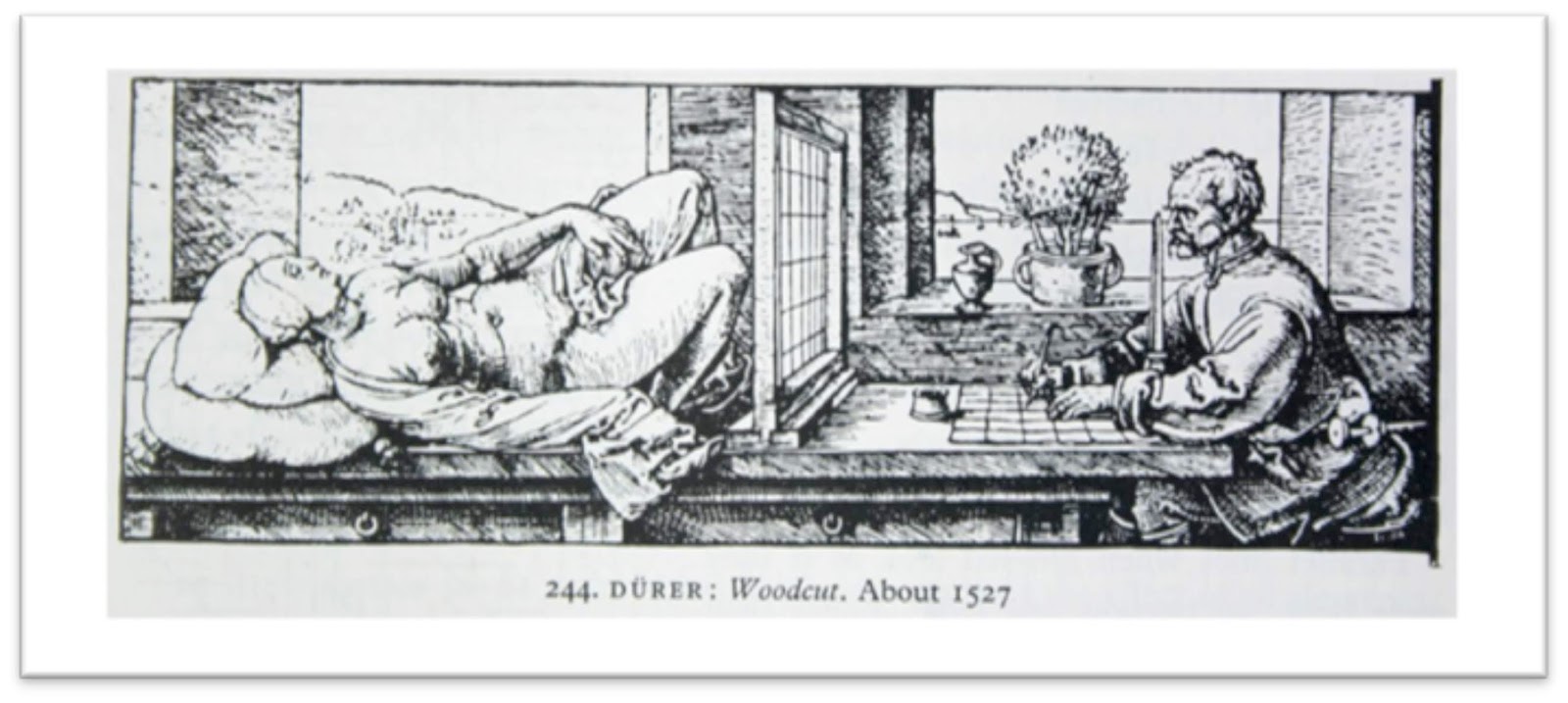
Durer

For hundreds of years the image above by Durer has represented an idea of the artist making objective drawings. At the core of the idea is the need to keep your eye steady, in this case by having an adjustable column with a pointed end that is fixed to the drawing table. This fixed point being essential if you are to be able to accurately trace what you can see. In the image above we also have a grid of I presume fine thread, which is stretched across the frame through which the artist looks at the world, a grid that is repeated by the artist drawing another one over the horizontal surface on which the artist draws. The artist then copies what is seen through the vertical grid of threads onto the horizontal gridded drawing surface, using the matching of these two grids as a guide. It is as if the observed image floats towards the grid of threads that crosses the frame and is trapped there, flattened so that the artist can peel it off and lie it flat on the table.

Durer's model reduced to a diagram

I have for many years been dissatisfied with this model and although I'm very aware that since the time of Cezanne, many artists have left this concept behind, it tends to be still influential because of its relationship to the camera.

The inverted image of the candle is captured by the photographic film instead of Durer's grid

In the image above, a camera obscura is converted into a camera by replacing its back wall with a photosensitive surface that will become a photograph after processing. It is the lens, or pinhole that both focuses the image onto this surface and inverts it, a situation that reflects the human eye's ability to focus an image in the same way. The diagram clearly shows that the inverted image still retains a 1 to 1 set of relationships between the object that is projected and the screen it is projected on to. 

The relationship of points of a projected object to its projection using Durer's device

The relationship of points of a projected object to its inverted projection using an imaginary lens placed between the object and the screen

If Durer's apparatus was to be converted into a camera, a box would need to be built in front of the screen like so:

The woman this man is trying to look at is far too close to the tracing screen, so in order to put a camera body in place she has been pushed back to make room. The drawing being made by the man would of course now be upside down.
A camera in effect works by placing a lens that both focuses and inverts the image between the object and the screen it is projected onto. The eye of course works in a similar way. 


The lens' ability to focus an image onto the back of the eye

One thing that is clearly apparent is the fact that the back of the eye is curved, and the image has to be curved to fit. The camera like the eye inverts the image, our brains re-inverting it for everyday use, the observer of a photograph is in effect turning it upside down to see it 'the right way up', but we rarely think of this because we usually only see the image after it has been processed. However going back to Durer's idea, we can see why at the time it seemed like a clear advance. There was little consistency to spatial representation and artists did what they needed to do to show what they wanted to show. In the image below surfaces are tilted in various ways so that we can see what is on them. 

Both tabletops are visualised using what we now call cabinet projections

But Durer was working at a time when perspective was the new toy on the block and in comparison earlier projection ideas, such as cabinet projection, seemed simplistic. When using perspective, a cube much more obviously has a front and a back, its spatial position is clear. 

A cabinet projection and a perspective projection

In the perspective projection the front of the cube remains the same, but the orthogonals  converge toward a vanishing point instead of being parallel, so the back face of the cube appears smaller than the front. The interesting word is of course 'appears'. A cube's sides are always the same size, that is part of its definition. The cabinet projection is not so nailed down as the perspective and visually the front and back often flip between each other. As soon as you move into the world of the cabinet projection things become visually much more active and because of this I have found its ambiguous spaces much more conducive to being able to visualise certain aspects of the scan of looking than traditional perspectives. 


You can of course add secondary information to try to pin one reading rather than another, in the drawings above a dotted line suggests less visual weight, so that the front face of the cube is seen first of all at the bottom left and then in the lower drawing at the top right. 

The eye is usually accompanied by its twin, so every image is duplicated but from a slightly different viewpoint. It is also impossible to keep your head still and your eyes flicker from left to right and up and down constantly as they sweep for constantly changing information. Therefore the idea of a fixed image reflecting how we actually see becomes very suspect. A basic cube, is therefore much more likely to be perceived as a complex of layered bits of information, as represented by the drawing on the right below. 

A Necker Cube (left) and layers of cube information (right)

The Cabinet projection of a cube is known within the discipline of visual psychology as a Necker Cube.* Psychologists are fascinated by the ambiguity of read, the either or situation that the brain projects onto the image. As I look at adding into the situation the shifting viewpoints and doubling of the eyes, this either or situation becomes even more complex and an interwoven space becomes more of a possibly. This is a space that is full of possibilities, points of reference are everywhere and these points are what for myself become a sort of visual battery. Out of the flux of looking will emerge an image, not so much trapped and fixed into place as in perspective, but something that oscillates into view, that vibrates into existence. 
 
A representation of a reconstructed view of Durer's drawing

As you can see in the image above there are two eyes and these eyes are flickering over the scene that is being represented. The drawing below is of a plastic dinosaur observed during a walk through woods. It was drawn in a sketchbook with a dip-in pen. The time taken to make the drawing was about 7 or 8 minutes and I was crouching down to see the situation, so my drawing book's position was rested on a very wobbly supportive knee. 

Pen and ink drawing made from observation
A representation of the tracking of looking made from the observational drawing above

I tried to re-trace the looking that had gone on when making the small drawing of the dinosaur, as I began to do so I realised that the image began to disappear back into the world that it emerged from. This was an interesting conclusion to a process of thinking about looking, what was a diagrammatic representation becoming an active, rather than a passive image, its final appearance perhaps being due to a ghost memory of a Daniel Libeskind drawing, a memory that had long ago lodged itself into my visual memory and which I'm often reminded of when trying to be more technical in my approach to making drawings. 

Daniel Libeskind 

Libeskind's drawings are like layers of architectural memories. They operate as if several transparent sheets of tracings were laid over each other and retraced as one image. By trying to recreate the eyes' activity when making a drawing, I realised I was also laying one memory over another. The tracking diagram in effect freezing recovered lost actions into a drawing space. 

The final image from the observational tracking sequence

Gradually I found myself adding more and more layers to my own drawings, until they began to oscillate with their own energy fields, as in the image directly above.  

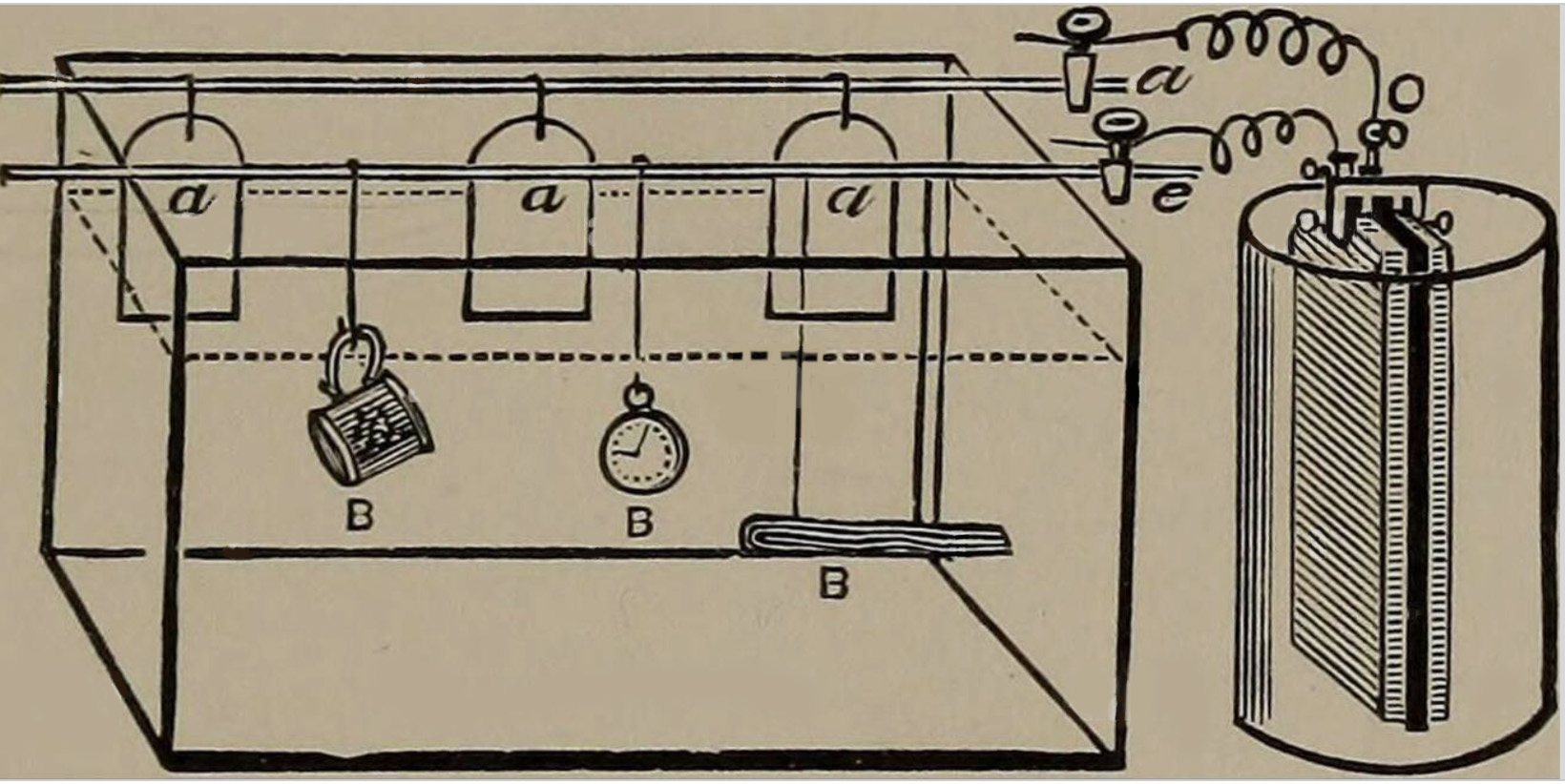
My earlier posts on visualising energy flow are hopefully easier to understand if read in conjunction with this post. I had in one of them referred to the idea that once a drawing had been used to capture various visual and invisible energy flows, that it in effect stored the energies recorded like a battery. These energies could then be released and their charges perhaps harnessed to other uses. Could for instance this way of thinking about drawing be linked to how electroplating works? The diagram below is also a cabinet projection. For copper electroplating for instance, surfaces are hung in a copper ion solution, see. I'm trying to stretch my head around a possible metaphor about energy conversion here and the results will come out more in the objects I'm making. This is not about scientific logic, its some sort of material poetry. 

A basic electro plating system

As I think around the issues connecting energy flow with drawing metaphors, I'm also thinking about the possible development of my more sculptural work into more process orientated directions. I'm also very aware that these approaches to aesthetic 'meaning' are about story telling and that it is the seductive power of the narrative that drives the work as much as the material languages uncovered. If I decide a drawing or any other artwork operates like a battery, then at some point I will begin telling a story designed to convince myself that this is a metaphor that works. This is a form of poetic activity and non of the decisions made are actually verifiable or measurable or academically valid. As a reminder to myself about this fact, not long ago I wrote a proposal for a journal article, entitled, 'Drawings as aesthetic transducers' based on some of the ideas that I have been thinking about in relation to energy flow and batteries.  My feedback, on what was not accepted as a publishable article, was that I must make sure that my paper's claims are presented much more clearly as a hypothesis or as metaphorical expression. I should have clarified for the reader that the hypothesis is only valid as legitimate poetic inspiration for the act of drawing, and that I must not risk looking for any sort of scientific validity for the process." This was a useful reminder that these are just ideas, and as such don't have any academic validity. Even so I would argue that as ideas begin as poetry, and out of poetry new possibilities will often be released, that it was a worthwhile exercise. As an idea it could not stand up to scientific scrutiny but it is an idea nevertheless and one designed to change the way we might think about looking at a drawing. So how does this help you may ask? I suppose I'm suggesting that at times you will need you follow your own logic and that even when other people don't see it as being understandable, that doesn't mean you give it up or discard it. It may well take you somewhere others have never been and that is as far as I'm concerned validation in itself. 

*The Necker cube is used in Robert J. Sawyer's 1998 science fiction novel 'Factoring Humanity'. In the novel the term "Necker" is used as a verb, meaning to switch thinking from one perspective or form of perception to another.

See also:


Sunday, 5 January 2020

Mike Croft: Observation of Perception, Part 2

Observation of Perception, Part 2 

When writing this I’m thinking of drawing as a form of visual thinking. By such thinking, I mean considerations of mind, body and cognition variously channelled through the filter of vision. (Philosophically, this could take one in the direction of Embodiment theory.) What makes drawing as visual thinking particular in the context of art and design is intentionality, and it is the latter of which I try to be specific and that registers in and as the result. This said, a lot happens in drawing concerning the relatively autonomous behaviour of the medium that defies one’s intentions, and intentions are not necessarily always recognisable. However, on this occasion I’m trying to show through and as the drawing, ways in which one might observe perception. For this reason I’ve been recording the drawing process and my spoken thoughts while drawing as videos, specifically through an action camera attached to the front of clear plastic goggles worn over my glasses, Figure 1.


Figure 1: To show goggles, inside and outside, and action camera 
both separate from and attached to the goggles. 


This does also make the methodology more sharable, and anyone interested in it might take up the process and adapt it as needed. 
The action cam, however, appears as a thin blurred black rectangle imploded in front of and perpendicular to my vision, Figure 2.

Figure 2: Screenshots from Observation of Perception: Showing Part 1 of a 2-Part Drawing, video clip 26:52 min, 2019. 


This is therefore both a tool to record the drawing process and one of two objects or motifs to observe. While the action-cam itself picks up sound, I record my speech, what I term a voice-over, into a separate audio device. The second tool, also an object or motif, is the goggles. Both of these may be said to operate as tools because, being very close to my face, they’re almost an extension of my eyes. In this sense I’m observing perception, in other words looking at looking. This point is debatably another example of the medium’s defiance, but what I want is a situation where, as nearly as possible, there is nothing in front of my vision. 
The tools, neither of which you the viewer can see in the videos except in the terms that the drawing presents them, are each responsible for a pair of faculties of visual perception. One of the tools is the action cam, with its wide-angle lens, which records visual content both central and peripheral to my vision, without of course distinguishing between either. I provide such distinction through my speech. The other tool is the goggles that register eye and head movement in coordination with the head. (The camera won’t record eye movements made independently of head movements, of which there are two possibilities; eye movements while the head is still, and less often eye movements in different directions to movement of the head.) Both sets of faculties I register as drawn marks and shapes, which provide the accumulative visual/material interest that gradually makes the drawing, Figure 3.


Figure 3: The two stages of the drawing recorded as the video Observation of Perception: Showing Part 1 of a 2-Part Drawing and Observation… Part 2 of a 2-Part Drawing. Dermatograph pencils, black ink, attached filing cards on white laminated cardboard, 
109 x 79cm. 2019. 


In the first blog entry (link), through reference to the Russian psychologist Alfred L. Yarbus’s non-digital eye-scanning device circa 1960s’, and the Italian Renaissance theorist Leon-Battista Alberti’s net or gridded frame to enable the plotting of observed coordinates, I try to explain that to my mind the mediation between perception and observation falls somewhere between the observer and that which is observed. The eye-scanning device is useful in this respect because it shows how one’s eyes scan across space, and Alberti’s frame because it can represent a material mid-way for consideration of life questions; questions of being. By substituting minimal objects, better conceived as tools of perception, for more tangible three-dimensional objects at obviously more distant positions in front of one, then what gets presented on and in the drawing is the mid-way, the mediator of sources of reference that are before it, as nearly as possible extensions of perception itself.
In circumstances where I’m drawing only, without using the action-cam, I have only my glasses to which to refer. If, as in the following example, I still record my speech, it seems appropriate to write at least some of the observations onto and progressively into the drawing, Figure 4.

Figure 4: Drawing of reading glasses drawing viewed from inside the frames while being worn. Dermatograph pencils, coloured inks on white laminated cardboard, 
109 x 79cm. 2019. 

This might also be a key point in general about the experience of drawing: it’s an activity that starts on a surface and gradually, through its development, opens up the surface as space. My own drawing method however, which is mainly concerned with conveying information about its self-same process, does tend to prioritise the surface. 
Explained another way, I’m setting up an inversion of the circumstances whereby the observed object that’s usually positioned somewhere in the space beyond oneself and the drawing is immediately in front of one, in this case the glasses. There is no source of reference that’s logically in front the drawing, and in fact the drawing, that should be the mediator between perception and what’s observed, is further beyond the object in the positions drawer/agent – glasses – drawing, as suggested in Figure 5.


Figure 5: Drawing of reading glasses viewed from inside the frames while being worn + the actual glasses now suspended in front of the drawing to fit their drawn size 
according to distance when seen from behind. 


What’s now interesting about the circumstances so installed is that the actual space between the object, the glasses, and their mediator between perception and observation, the drawing, can be the space of a narrative, a story of whatever else could be taking place in and as a different criterion of perception, Figure 6.


Figure 6: Showing the photo of Figure 5, above, and a view of the actual space existing between glasses and drawing. 

Artists often use the medium of drawing to rehearse and research narratives, or use drawing as the sole medium for this purpose – to name but one example, the contemporary artist William Kentridge. 
This leads me towards another kind of theory, which is the psychoanalytical theory of Jacques Lacan (1901 - 1981). I’d thought of mentioning Lacan in the first blog entry in the context of the glance, but since I reference the glance specifically in the video, Observation of Perception: Showing Part 2 of a 2-Part Drawing (see Figure 3, above), and hadn’t completed that at the time of writing the first entry, it now seems a better moment for further explanation. Lacan’s theorisation of the glance occurs in his paper, ‘Logical Time and the Assertion of Anticipated Certainty’ (1945). This paper is particularly interesting from the point of view of inter-subjective use of time. While the scenario that provides the context for Lacan’s discussion concerns three human individuals, I’m adapting this to the kind of dialogue that can occur between a drawer/agent and a drawing.
Lacan explains that within the time frame of trying to make a decision or reach a conclusion about something, an initial hypothesis concerning that something is first put to the test of doubt. The period of doubt, which in decision-making need be no more than an instant, but an instant that can be of variable length, is in effect the glance. According to Lacan (2006: 168): ‘The time for comprehending can be reduced to the instant of the glance, but this glance can include in its instant all the time needed for comprehending’. What I like so much about this quote is the suggestion that the glance concerns uncertainty. The engagement with drawing, or more precisely the dis-engagement with other modes of thought during and as drawing, can be an extended time frame of the glance; the holding of decision-making in abeyance as uncertainty. In the following drawing of the action cam and goggles – from which I also made a video – I later superimposed the glasses, seen as before from the narrow space between my face and the glasses lodged on my nose, Figure 7.


Figure 7: Single-layer state of a drawing of an action-cam worn over goggles and the goggles viewed from the inside while being worn, and a second-layer state of the drawing showing the same drawing with orange glasses superimposed, viewed from inside the frames. Dermatograph pencils, black ink and coloured inks, attached filing cards on white laminated cardboard, 109 x 79cm. 2019.

What’s interesting here is that there’s conceptually a space between the two layers of mark making and cursory imagery that I leave alone. The several apparent positions of the glasses do seem to be increasingly in front of the placements of the narrow band of the action cam, but I mean a conceptual space that’s to do with my lack of conscious concern to integrate the two sets of imagery. However, the two sets waver in a kind of relationship that’s, in a sense, up to them.
While the word uncertainty often has a negative connotation, drawing and other forms of creative practice stand a good chance of manifesting uncertainty positively, no matter what one’s disposition. Debatably, if art works, it’s imbued with affirmation, even if its content and the invested feelings are opposite. Insofar as an uncertain disposition would be to hang back, and a decisive one would be to push onwards – hesitancy versus boldness – I personally like the idea of time conducting a kind of backwards rotation as part of its movement forward, where it picks up the past and draws it through. This also seems like drawing; where each decision is consequential on the next, and the next one is in acknowledgement of some previous decision. There are moments in the video-recordings of the drawing as shown in two states in Figure 3, above, however, where such consequential decisions break down, and in the video particularly of the second state I appear to be searching around for something to do next. While this often happens in drawing, I’d much prefer a drawing to roll on as a continuum of action, Figure 8.


Figure 8: Screenshots 40:42min and 41:27min, with 1st voice-over, and interventions of a 2nd voice-over between the timespan of the two screenshots, of the 44:35min video Observation of Perception: Showing Part 2 of a 2-Part Drawing, 2019.

What’s interesting with the strategy of intervening in the first voice-over that’s spoken spontaneously while drawing, is that the intervention is squeezed into available moments of silence where I’m drawing only, which seems like a textual equivalent of re-working and revising the drawing. I show this also, in Figure 8, to indicate how the drawing and the voice-over are mutually both cooperative and distractive.
A second point of Lacanian theory conveniently links the first blog entry’s reference to Alberti’s frame with the idea of a potential narrative space. Lacan adapted the idea of a mid-way in the optical pyramid to his own idea, in the psychical context, of an opaque screen, more like a ‘stain’ or ‘decoy’, that muddies vision, altering and affecting what we assume to be the objectivity of vision. (This is my simple interpretation of very complex theory. For more thorough explanation you might refer for instance to Harari, 2004: 119-40) Suffice it to say that the metaphor of muddied vision may relate to the more subjective aspect of perception: the fact that one often imposes personal interpretation on otherwise objective and sharable visual-material content.
I’m intending to offer this question to a small group of fine art students as a contribution to their seminar class on Embodiment. After a drawing exercise that follows closely in the method of the above-described work, I’ll ask them to define the space that their glasses frame, or the frame of sunglasses, in terms of a narrative of their own choosing. Whether physically in whatever medium in the space as shown in Figure 6, right-hand photo, above, or as further development of the drawing, the only stipulation will be that the drawing should be seen to physically morph into the story. A colleague wrote me a comment on the proposed idea: ‘I see action through big drawing (space), glasses in some way combining a self to a field, which could be expanded space of imagination and place of vision. Physically and symbolically this is interesting, with the use of interpretative words and objects and also the context of subject and thing. I think the content analyses time, space, place, and will involve the students naturally in self related content.’
The idea of framing in one way or another is always important in the more instructive level of creative teaching, and in the above-described project I’ve been doing this for myself. The intention of the drawings is to explore a hypothesis that one can observe perception and visualise it as an observation. As in some instances of drawing – though not all – one hopes that the result conveys a degree of clarity of intentions. However, in the process, things may happen that cause one to become involved in other areas of research. I’ve given some indication of my own interests, and of how things can occur by chance in the course of drawing. If research is an additional direction, then through one’s practice a third and more integral possibility can emerge that alters one’s perspective, but in a sense, because it’s within the work instead of clearly declaring itself, it waits to be discovered. This other integral possibility may shift and challenge one’s determination to achieve clarity.

References 

Harari, R. (2004) Lacan’s Four Fundamental Concepts of Psychoanalysis: An Introduction. New York, NY: Other Press 
Lacan, J. (2006) Écrits: The First Complete Edition in English. (First published 2002) New York, NY; London: W. W. Norton & Company

Thanks to Mike for a fascinating insight into the work he is doing. 

It might be interesting for you to contextualise Mike's post by reading my own thoughts on that 'uncertain certainty' an attitude that lies at the core of most ventures into trying to record perceptual activity. His glasses are another drawing device or apparatus and therefore it might also be useful for you to think about how these devices have become integral parts of other drawing processes. 

Mike has sent a sharable file for those interested in more detail. He has extracted a 'voice' from one of his videos and given an account of how his spoken interjections are woven into the narrative of drawing making. 

Wednesday, 1 January 2020

Mike Croft: The Observation of Perception

Guest drawing blogger: Mike Croft

For the starting post of the new year I'd like to introduce Mike Croft who is the first of my guest drawing bloggers. I first met Mike in the early 1980s when he was making a series of large drawings of cathedrals. These were impressive studies of the types of complex spaces that you find in buildings that have been built on organic principles rather than to an architect’s plan. We were both working on the Foundation Course at what was then the Jacob Kramer College and because of the importance of drawing in the curriculum at that time, we found ourselves constructing situations whereby certain different aspects of observational drawing practices could be explored. Mike left to move to London and then on to S.E. Asia, teaching on various design-based programmes in universities. His most significant pedagogic experience being developing an exploration of the perception of movement with the first year students of a new design programme in South Korea. Movement and the question of time, of which movement is of course an expression, have been abiding interests within Mike’s work for several years and being able to explore this with a group of students who already had strong drawing skills was a cathartic experience. 
Mike has this to say about the changes he has experienced when teaching and making drawings. “Thinking back to the days of Jacob Kramer College, the emphasis seemed much more on the image, and a degree of investment of rigour in drawing to ensure that the image was well founded. What may have changed, and has certainly been my more recent experience of teaching through drawing, is an emphasis on drawing as a research tool that students use while not necessarily being interested in drawing as its own medium, or a medium of fine art”. I would suggest that the change is more one of philosophical positioning here at Leeds. Drawing as process is of course important, but perhaps we are now looking more at drawing as a thinking tool rather than observational record. 
Mike points to his work as having “a certain cursory character compared with what you might imagine as being a ‘well founded’ image” and points to Henri Bergson’s distinction in ‘Matter and Memory’ ([1912] 2004), between what he calls the ‘present image’, as opposed to the ‘represented image’. ‘Representation is always there, but always virtual – being neutralized, at the very moment when it might become actual, by the obligation to continue itself and to lose itself in something else’ (2004: 28). Mike loves this quote, pointing out, “concerning conscious perception, because through it one can acknowledge and build into an image one’s own sense and feelings of movement, and the drift and development of thought and action while drawing. The ‘present image’ may be considered the image in its sense of passing through, and conveys in essence a degree of insubstantiality but in the affirmative sense. Of course, in the sense of difference between say, the sketch and the finished work, this is nothing particularly new”. He points to the recent drawing blog post on ‘clouds’ stating, “what more beautiful instances of ephemeral insubstantiality than clouds!”
When I look at Mike’s drawing research, I’m always impressed with his focus and clarity; recent drawing experiments whereby he explores how to respond to changing perceptions in relation to movement, as always reflect his desire to be accurate, minimalist and systematic in response to the overwhelming amount of experience that sense data provides us with. 
Mike’s blog posts are designed to help you as drawers think more carefully about movement. (He has crafted two, but because there is a lot of information to digest, they will be separated by a few days) As he points out, “working with and through movement in drawing may possibly be a way of attending more to how we see, perception itself, rather than perception’s resulting observations, while attending no less to whatever is the motif, the object of observation”. 
When drawing, going back to hard earned thoughtful and measured looking is always worthwhile and Mike helps us approach the process with fresh insight. 

Bergson, H. (2004) Matter and Memory (first published 1912) New York, NY: Dover
Link to TRACY where Mike has made some of his earlier research publicly available.

The Observation of Perception: Mike Croft

What I’d like to say relates to drawing that concerns observation of the external world, but through the filter of perception. Of course, that there is a relation of the latter to the former is obvious, yet we may tend not to notice, let alone see, perception’s role in the process. Also, conventionally, we mostly select objects for drawing that are still or slow moving enough to enable what we assume will be some degree of representation of them. Notice that I’ve used ‘some sort of’, ‘may tend not to’, ‘mostly select’, and ‘some degree of’, which suggests that nothing I’ve so far said can be really concrete; it’s all open to interpretation.  However, insofar as what I’ve said is relatively true, the facility of observation, in this case primarily visual, is automatically challenged and even sometimes contradicted by aspects of our innate biological and physiological facility of perception. 
Perception may be said to work both for and against objectification of the object of vision, mostly in ways that are either automatic to, or beneath our awareness. How I happen to think this is due to at least two pivotal realisations – points of learning – neither of which happened in art school drawing classes. This is not to say that the classes did not provide the potential for such realisations, just that they were not theoretically articulated at that time. The situation may be somewhat different now. The first realisation was back in the 1970s’ when I was first a student. I happened upon a large-format book on psychology, in which was a photo of a girl’s face and next to it a semi-abstract rendition of it that transformed the face into a continuous kind of line map comprised of tiny flicks and dashes. (The phenomenon of drift and flickyou might, yourself, wish to look up on the Internet in relation to visual perception.) The rendering of the face turned out to be a printout from a non-digital eye-scanning portal, a device invented by the Russian psychologist Alfred L. Yarbus (1914 - 1986) in the 1960s’. The device would record eye movements of a person attached to the device while looking at an image, usually a photograph, for a short period of time. The limitation of this is that the observed material does seem to be photographic, and therefore flattened, but I was quickly extending the visual characteristics of Yarbus’s findings to objects in three-dimensional space.
There are now digital equivalents of eye-scanning portals, but they work very differently. The useful point about Yarbus’s device that relates it to drawing is that it recorded in line, by means of a stylus, which looks similar to and is practically adaptable to drawing. It is however a mechanism, and like any medium imposes its own behaviour to some extent on the user’s intentions. What I learned from it, which caused it to be a pivotal influence, is that in perception we do not incessantly inscribe contours around objects, either on a page or in space, however eloquently we might use the phenomenon of contour in aesthetically inspired drawing. The oval of a human face, for example, does not register in perception except in a fragmentary sense, or even when we are giving it special attention. What is more likely to happen is that we register points and intersections of things in a hierarchy of importance according to whatever are our intentions of looking, Figure 1.

Figure 1. 
Photograph and resulting eye-scanning reading from an eye-scanning portal by 
A. L. Yarbus, and a contrasting portrait drawing by the author. 

In the above trio of photos, I’m comparing the Yarbus photo and printout that I originally noticed with a portrait drawing of mine that is made according to certain drawing conventions, especially that of the closed contour. It’s not necessarily a bad drawing, but to make a bald statement that is therefore open to challenge, it’s not how we look from either the point of view of the observer or the observed! If you compare the Yarbus printout with drawings by the British artist Frank Auerbach, for example, you may feel that Auerbach has arrived at similar knowledge to that provided by the Yarbus, although through the progress of his own experience. At the time of this discovery, especially the examples from Yarbus that concerned the various scanning of an image of figures in a room, this knowledge helped me to understand the kind of scanning across space that is a characteristic of drawings by an artist such as Giacometti, Figure 2.


 Figure 2: A Yarbus eye-scanning experiment where the participant was asked to scan the photo, above left, for a range of specified reasons.  

The eye-scanning’s element of science may help underline the fact that drawing can and often does have an investigative basis. In those early student days, the eye-scanning images enabled me to loosen up line and conceive the depiction of objects more in terms of marks and dashes and, most importantly, sense that space could be traversed through the drift of one’s vision during perception, with or without mapping objects in its course. Currently, I find that the more popular literature of quantum theory on the question of space provides some basis for untethering such marks and dashes almost entirely from the object, so that they start to say something, albeit as a very crude analogy, about the structure of space itself. In this respect, you may be interested in investigating such contemporary research in quantum physics as loop theory(Rovelli, 2017, for a clearly explained introduction). 
            So, to conclude this first point of discovery, the Yarbus findings challenged and in some respects even negated some of the conventions that I was being taught in the context of structuring visual observational experience. 

**********
The second realisation concerns a very recently read comment on the Italian Renaissance theorist Leon Battista Alberti (1404 – 1472) concerning the optical pyramid, which is an attempt to conceptualise how the eye reads three-dimensional objects in space.
Alberti invented a device known as a netor veilto enable the precise depiction of objects through the extraction from them of a structure of coordinates plotted onto a semi-transparent net stretched taut on a plane in front of them. A derivation of this as a gridded frame is shown clearly in use, in a woodcut by the German Renaissance artist Albrecht Durer (1471 – 1528). The artist can be seen plotting such coordinates from the frame relating to a human figure lying in front of him (Gombrich, 1977: 259), Figure 3.

Figure 3: Woodcut by Durer, showing a painter using the device of a gridded frame to aid observation.

The point in relation to what I want to say about this concerns the fact that the gridded frame is positioned midway between the figure being drawn and the drawing plane. According to Dahl (2003: 5), Alberti gave ‘ontological status’ to a non-visible essence somewhere in the middle of the optical pyramid, a kind of plane of being, where Alberti suggests that there’s something more than visual going on in the experience of looking. Coincidentally, and in a sense incongruously, considering that it is such a material device, the net, veil or grid is positioned in just such a middle space between the artist/observer and the human figure or object/s observed. If perception is both the facility that enables observation and something other than observation, then Alberti was suggesting that there could be a sense or realisation of beingcoming through one’s striving to render the appearance of objects in space accurately. 
The Alberti device has since been developed as a more synthetic means that incorporates the slight curvature of the eyes’ lens through the skill that many of us will have learned of holding a pencil or straight-edge at right angles to our outstretched arm, variously perpendicular or horizontal to vision. When used correctly, this system of establishing proportional relationships between objects in three-dimensional space can be very accurate. It’s the scope for the convention’s inaccuracyhowever, while nonetheless striving for accuracy, or through noticing anomalies in the system, that interests me, Figure 4.

Figure 5: The author plotting positions of objects from four slightly differing viewpoints, and the resulting drawing, Dermatograph pencil on white laminated cardboard, 119 x 84cm, 2018. 


The above process of mine concerns making a measured drawing from four very slightly differing colour-coded positions of a single open eye, using a thread held taut between a vanishing point on the drawing set-up and the eye. The resulting reading of the drawing is one aggregate configuration comprised of several mismatched layers. How this relates to Alberti’s idea of the in-between is that – perhaps – the ontological value comes through in the very impossibility of absolute correctness, in which the drawing as a presentationis to be found in a sense of its oscillating somewhere between its referenced objects and its agent, the drawer. It’s paradoxical that the Alberti device is so material, when what it and its derivations presents is an embodiment of less tangible aspects of life.  
Drawing can in this respect be a relationship almost in the manner of a hologram result of an otherwise two-way process of looking and the return to one of what’s being viewed. Since the basis of the hologram is in a certain projected interferenceof the object, this idea of interference is the key – the interference of aspects of perception on observation. To give you an example – although this doesn’t necessarily reflect my current approach to drawing – I relatively recently drew a single figure slowly rotating in a chair through 360°, and shifted the drawing of the figure across to the right at the moment the actual figure crossed a midway diameter demarcated on the floor. While the drawing reads as two separate seated figures, the schematic marks between them are an attempt to conceptualise both moving the figure and keeping it linked to itself. If I speak of an energisedspace between the two apparent figures, this is not so much observed as conceptualised through gestural marks as restless eye movement back and forth, in regard of space itself rather than surrounding infrastructure that one might otherwise reference. Such visualisation of space at least suggeststhat what’s going on is a change in looking at the figure conceived as its back view, to one conceived as its front view at a certain moment when a shift in consciousness of the situation takes place, which is debatably more a question of perception than observation, Figure 5.

Figure 5: Two drawn versions of a single rotating figure, pencil on paper, 84 x 59cm, by the author, 2013.

The idea of an intangible and non-visible in-between plane as a source of interference has been adapted by the psychoanalyst Jacques Lacan (1901 - 1981) where, in the context of discussion of internal psyche, the mid-way of the optical pyramid is a metaphorical ‘stain’ or ‘decoy’ that muddies any assumed clarity of observation (Harari, 2004: 121-31) – but this would have to involve a more extended discussion. In terms of my own albeit limited adaptation, imagine that, when drawing, the drawn object falls somewhere between oneself and whatever is the actual object, and in the process it’s observed basis is as much confounded as enabled by one’s perception. This is the idea that I’d like to introduce in the second blog entry, particularly through links to a couple of video clips that show such a drawing in process and simultaneously explain it through speech. 
There will undoubtedly be plenty of existing artistic work and research on this subject of discussion, but a third and overriding key point is that one tends to engage in and with drawing from wherever one is with one’s own interests at the present time, Drawing as a medium in any case often exerts a degree of autonomy that sets it apart from whatever are one’s expressed intentions.

References

Dahl, T. (2003) The Transformation of Space and the Construction of Engineering Knowledge and Practice—From Renaissance Perspective Thinking to Gaspard Monge’s Descriptive Geometry. Hård, M. et al (ed) Transforming Spaces. The Topological Turn in Technology Studies.(http://www.ifs.tu-darmstadt.de/gradkoll/Publikationen/transformingspaces.html

Gombrich, E. (1977) Art and Illusion. (First published 1960) United Kingdom: Phaidon 
Harari, R. (2004) Lacan’s Four Fundamental Concepts of Psychoanalysis: An Introduction. New York, NY: Other
Rovelli, C. (2017) Reality Is Not What It Seems. (First published in English 2016) United Kingdom: Penguin   
Yarbus, A, L.

Thursday, 21 March 2019

Drawing as testimony

There is an area of drawing that is often underrated and as I have remarked before, also made to feel inferior by being regarded as illustration. This is drawing done directly in front of the world, reportage, or direct responses to life as it is experienced. Historically this thread includes Pieter Bruegel, Goya, Rembrandt, Otto Dix, Daumier, Edgar Degas and many more artists that at their core looked at and experienced the world through drawing, and in doing so derived a deep understanding of what it is to be human.

I try to continue in my own small way this tradition by walking my local streets and drawing. My skills are nowhere as good as they need to be but at least I feel that some of the reality of the streets seeps into the work I do.

This post is about artists who have drawn directly from experience, and like Goya, sometimes these artists find themselves in dangerous and difficult places, and yet also like Goya and Otto Dix, they still managed to get down on paper their feelings and observations. Drawing is not like taking photographs, the split second of the photograph means that you only glance in the direction of what is happening, sometimes not even looking, because you can only point the camera and hope for a good shot. But if you draw you need to look hard and long, thus confronting the situation, taking it in at a much deeper level.


The artist Avigdor Arikha was known for working only in natural light and for producing each of his images in one day. Both of these working methods were due to Arikha’s decision to focus on prioritising the act of observation. He would often give himself limitations within which to work, for instance at one time restricting himself to black and white, a restriction that he imposed upon himself for seven years. 

Working within an imposed set of severe conditions was something Arikha would have had to learn from an early age. He survived his early experiences as a boy in a concentration camp during the second world war, because of drawings he made on scraps of paper of images that were direct impressions of the horrors he was experiencing as a camp inmate. On a visit to the camp, delegates of the Red Cross saw some of his drawings and realising the importance of his revelatory images managed to engineer his own and his sister’s escape. 


Avigdor Arikha: drawings done as a boy in Transnistria concentration camp

Because of his Jewish identity, Arikha was only able to escape the concentration camp by taking on the identity of a boy who had just died. To become a dead person in order to live is one of those experiences that must shape one's view of life forever and in Arikha's case I think it was seminal to what he was to eventually develop as a body of work. His art training in Israel introduced him to European abstraction and this was to have a lasting impression on his compositional choices; selection and simplification of forms being vital to his own process of self-reflection. His perceptions needed to be stripped down as they arrived in all their complexity in order for him to understand what it was he was seeing. The critic Robert Hughes described Arikha's process as one suffused with  an "air of scrupulous anxiety", the act of drawing, being never an easy one, especially when you realise that in some ways you only see through someone else's 'dead' eyes. Arikha's work has a nervous, edgy quality, to it, one that reminds you that no matter how hard one might seek to be objective, a point of view is hard to avoid, because it can seep into the image from the way a pen is held or from the confidence with which a mark is drawn. The artist's 'touch' can at times be just that; a touch that transforms by its very nature. 

Lord Home

I well remember Arikha's portrait of Lord Home the Conservative Prime minister, one of those rare portraits that seemed to capture the nature of what the political animal is actually like. Arikha seemed the perfect choice to make a painting of Home, because he was able to see the death in life of the conservative mind. 

Avigdor Arikha: Samuel Beckett

Avigdor Arikha: Knife and bread

Avigdor Arikha made many drawings and paintings of people and landscapes, but of all his images the ones that I feel make the most impact are those of simple basic objects. His image above of a knife and bread being a wonderful example of that confrontation with the play of light passing over a few moments of the day. He makes these moments as solid as a mountain, this rock of bread will break your teeth if you try to eat it, it is not for eating it is for looking. This image is of a few moments preserved in all their richness, a sight made all the more precious because at one point there was to be no more looking for Arikha and he still can only see out of a dead boy's eyes.


Eric Taylor: Images drawn in Belsen

The images above are by Eric Taylor, a former principal of the art college in Leeds where I still work. When I began my teaching career Eric was still working in the college making ceramics. He was a quiet, inwardly focused man, who at that time used to come into the college every day to work. This was his reward for services rendered, after devoting his life to art education he was given free access to the college studios and facilities and used these until he was in his 90s. He was a beacon of sanity around which the department rotated, he didn't have to talk, he just made things and made them with love and care and an eye that relied on the experiences of life to tell him what to do. One of those experiences was in the services of His Majesty's Government as a war artist at the end of the second world war. He was one of the artists that had to record what had happened in Belsen concentration camp and there is no way that his training as an artist could have prepared him for what he was asked to document. The drawings he did at the time are now kept in the Imperial War Museum and act as reminders to us all of what people do to people when they forget that all people are people. 


Restoring Eric Taylor's mural

Set into the side of the Leeds Arts University's new building, you can see a three part ceramic mosaic mural. It is a joyous celebration of rural life, set into a wall facing a busy city road transport link. This is also the work of Eric Taylor, a far cry from the scenes he was forced to contemplate during his time as a war artist. Now fully restored these colourful murals are passed every day by a new generation of students who have hopefully not had to face what both Avigdor Arikha and Eric Taylor had to experience. However both artists at one time or another had to stare life in the face in order to make their drawings and in that process they learnt both about the world and themselves. 

In many ways the artist Pia Linz's practice is the opposite of these older artists' work. But it is perhaps a much closer reflection on how we as people in what we now call the developed world, experience life today. Because she works from behind a transparent shield, she sees the world through a screen and this, it would seem to me, is the everyday situation for many of us, be this the car windscreen, mobile or a computer screen.
Her 'Box Engravings' have developed from ideas of projection. What is interesting here is that these ideas are in fact rooted in the 15th century and if you go back to very old drawing devices such as Durer's perspective frame, the idea of drawing as a record of what passes in front of a flat screen or grid, can be seen as a constant that has lasted since the invention of perspective.

This is what Durer had to say about how to use his drawing apparatus. “Now draw whatever you wish to paint on the pane of glass. This is very suitable for portraiture-especially for those painters who are not sure of themselves. If you wish to use this method to paint a portrait, let the subject rest his head so that he will not move it until all the needful strokes are completed. ”


You can compare Durer's drawing apparatus with drawing aids used at the beginning of the twentieth century, the following text being taken from an advert for Ablett's glass plane above. "The teacher with the position of his eye fixed by the moveable iron ring, traces with brush and Chinese white the outline of the object, (rod, disk, cube or chair etc), which is placed on a table or the floor on the further side of the glass. The pupils, one by one, look through the ring and see for themselves that the lines traced on the Glass by the teacher, coincide with the outline of the model. Pia Linz develops her three dimensional Box Engravings by always using a fixed standpoint and turning around on her own axis. First, she builds a transparent Perspex box construction that is tailor made in response to her chosen location, for instance it might take the shape of a prominent building that can be seen from the location. Then once it is positioned, she sits inside the transparent Perspex construction and draws with a felt marker onto the inside of the construction what she can see. (Obviously she will have to swivel round as she draws in order to do this). After this activity is completed, she makes the drawing permanent by engraving the lines of the drawing into the Perspex.

In contrast to Durer's perspective frame however, in which the observer places themselves in the same position of the artist, here the observer views the world of the Box Engraving from the outside. The world of Linz's perceptions is always therefore contained within her construction. It is as if Linz's perceptions can never really escape the confines of her own head. The older artists had a confidence that their testimony would be something that was communicable to others, they had no need for complex devices. In Linz's case we feel that she has to provide a framework for her experiences, one that has to conceptually reflect on the research behind her ideas. However her work still operates as a drawn testament to the fact that she too sat out in the street and drew what she saw. It is a document and a form of reportage, but contained in a presentation far more suited to present day exhibition demands, the work sitting clearly within the domain of contemporary fine art practice.


Pia Linz: Box Engravings
See also:

Drawings on exhibition in the Pallant House Gallery (Includes some observations on William Coldstream and related artists)