I was half asleep in bed and I had a sudden remembered image of making marks in the snow with my wee when a boy. I still remembered the yellow tinge the lines made in the snow and how excited I was. I felt again the cold on my bare legs and saw clearly the bits of twig that poked through the light coating of fresh snow. How it had been retrieved and where that memory had been hiding all those years I don't know, but something chemical or electrical must have had its buttons pressed. Perhaps my old man's need to go to the toilet had sent a message from my bladder and a route had been found to my brain. Boys in particular like to make marks with their wee in snow, its a very gendered way of drawing.
Not long ago Helen Chadwick's work was on show at the Hepworth in Wakefield. Her 'Piss Flowers' installation was I thought still a wonderful piece of work. It turns what could be just a gender issue into something transcendent. The exhibition at the Hepworth was entitled 'Life Pleasures' and weeing can be exactly that, a simple basic pleasure. Her Piss Flowers are also a feminist comment on how easy it is for boys to wee in the snow and perhaps because they take it for granted that it is something they can do, she can make her point much more succinctly and with a good dose of humour. It's as if she was saying, "Men never make the most out of what comes too easy."
The installation consists of twelve white-enamelled bronze flower like forms. The shapes had been initially cast in plaster from the negative forms left by the artist and her partner, David Notarius, after urinating into deep snow in Canada. The casts invert the space so that they then resemble flowers. The gender twist was created as they took turns urinating, Chadwick’s wee was the more centralised and was vertical, while her partner's was more scattered, forming what eventually became the outer petals of the flower like forms. For the art theorists who would then write about the work, this inverts gender roles, creating a "phallic" pistil from the female's urine and "petals" from the male's. I am though simply reminded of the joy of weeing in company and see these sculptures as a beautiful evocation of love.
Over time I have slowly begun to realise that the embodied feelings that I have been trying to visualise are tightly woven into the emotions, thoughts and memories that are swilling around us as chemical seas. Everything seems to co-emerge as part of the raw feeling tone that is a conscious human being. These are the echo soundings of the physiological state of our body. If we are to achieve any sort of homeostasis, that state of balance that maintains our internal material, electrical and chemical conditions and reach an optimal state for the best way for us to function, we need to not only register how anxious or calm we are, but we need to reconcile various thought patterns, feelings and instincts, in such a way that we are in harmony with them. These feelings compose the soil out of which our actions will emerge and we need to maintain some type of harmony or balance, if this soil is to support ongoing healthy actions.
The congested chest
If we can visualise the raw feeling states that we have but rarely turn our attention to, we can hopefully be able to get closer to an engagement with the complex meanings that emerge out of the embodied experience we have of our world.
The images and texts that I make from conversations with people about their feelings, are all signs of emerging narratives, ones that as they come out into the open, will help everyone to accept the confusion of existence and to come to terms with that feeling of not being quite ready to face reality, or sense of unease as they come to think about the 'what's next' of daily life. The strangeness of the forms that are worked with, is partly to get past the being 'too familiar with things' stage, as the forms often associated with feelings are too clichéd for us to actually respond to them honestly any more.
A fear of incontinence
I have just made available on line one of my working notebooks, whereby some of my images of embodied feelings are collected together. These drawings were were made after having a series of conversations with others about their feelings. I made notes and then went away and developed a series of more 'worked through' images, whereby my own feelings were conjoined with the images I was trying to work with. I have been using this collection of images to help others and myself in the development of visualisations of inner or somatic feelings. The images can also be used to assess whether or not there is any close similarity with how others visualise their own feelings and if there is, perhaps a visual language of feeling representations could at some point be constructed. This is an old idea, but one that perhaps needs to be revisited. One of my aims is to eventually sit my work alongside that of long debunked theorists such as Benjamin Bett, Dr. Hippolyte Baraduc and Walter Russell and perhaps do this with a nod to Jean Perdrizet's speculative engineering. This is not to disprove or prove any particular theory, but to flag up a common need to find an answer to why we experience the world in the way we do. Now I am older, I really think it is time for me to sort out how my own body/mind is wired up and I have turned to counselling to help myself to understand myself. Hopefully as I undertake the 'getting to become more aware of myself ' sessions, I also get to accept that whatever it is I am experiencing is mostly fascinating and wonderful. My present and past prediction mechanisms always seem to churn my stomach up and race my heart because they are set at a default of 'something terrible is going to happen'. This has caused me to often fail before I begin, or just not experience events as they could be, being overly nervous about what others might think or too worried about what might happen to actually let myself feel and experience what is going on around me. I have learnt over the years that if I am to make anything interesting as an artist, I have to embrace the unknown, I have to enjoy the fact that I don't know what will happen and that the more I am able to do this, the better the work will be. I now actually enjoy the process of being able to do this and it's time for this emotionally safe place to be the one whereby I site the rest of myself.
Inner body, somatic awareness is concerned with sensations like feeling anxious or happy but can also be about feeling pain or its relief; all of these interoceptual experiences are as real as each other and they are entwined together. I have recently had to have a hernia operation, the process made me very aware of my groin and as I meditated on this I made images. Because I was confined to bed for a few days afterwards to allow the wound to heal, I was using my laptop computer to draw on top of and manipulate images that had previously been made using traditional drawing materials such as ink and watercolour. What emerged was a particular form that made use of a much more emotional colour range. Perhaps because I wasn't able to move far I needed to invest my emotional energies in colour thought. This is what emerged.
A visualisation of sensations post hernia operation
As an observer you may or may not 'get it'. There may not be a shape or form that carries meaning in the way I would want it to, but that still doesn't stop me wanting to communicate that invisible something inside me. Perhaps all my work is simply a desire for others to see what is inside me, to be able to transparently communicate my thoughts to others. It is though in the interaction between others that meaning will emerge, just as it must have grown out of conversations around a fire at night in caves 40,000 years ago, a thought emerges into the open, either through spoken words, that may themselves have emerged from a mouthful of air, or from drawings made with a stick in the dust on the cave floor.
Bunion pain
I'm sure many of us feel as if we are trapped inside our own mind and yearn to be able to experience and communicate with the world more directly and fully. To explore whether the visualisation of interoceptual experiences will help do this, is my research objective boiled down to its essence.
I fear this post may stray into foolish territories and open it with a reminder that lines have in the past often been subject to very debatable readings, so do take what I have to say on this topic with the proverbial pinch of salt.
I have written about lines as boundaries, as direction, as diagrammatic form and as metaphors such as life lines and knots in string but it is the emotional line that I'm more interested in at the moment. This is very closely associated with the expressive line, the line that appears to come naturally from an artist's feelings or emotions. However it is slightly different in that it is a type of line engineered to communicate a feeling. This feeling might be someone else's rather than something that is inherently within and part of the artist's way of drawing or making things and it is rooted in synaesthetic experiences. For instance if I say the words "kiki" and "bouba" and then show you two images, such as the ones below, I'm pretty sure you will know which one is which.
But can we go further than this? This area of thinking is one whereby artists such as Klee and Kandinsky were supposed to be the original thinkers and even earlier researchers such as Besant and Leadbeater had written extensively about the relationship between colour, shape and what they called "thought forms". However there is always room for one more attempt to get to grips with something that is endlessly fascinating.
I'm going to start with some examples of 'embodied lines', ones drawn by myself in relation to the way our bodies hold within themselves emotional events and then see where these can be tweaked to vary feeling tone. The first issue anyone familiar with the history of these things is that in the ground initially covered by Klee and Kandinsky, they attempted to strip the language down into its basic elements, point, line, plane etc. For many reasons there is therefore no real reason to go back that far. I'm also by now aware that communication is complex and that in reality we cant experience an isolated line, it will always have colour, texture, direction and all sorts of associations with the interconnected and entangled world around it. I have therefore tended to talk about 'events' rather than 'things'. My attempt to get my head around this is also more to do with poetry than science, each 'line' looked at is part of an experienced event and an attempt to capture that in some way. They are I suppose 'impossible objects', things of the imagination, but in being so, I think they are no more 'real' or 'fictitious' than any of the other things I perceive, whether these be of outer or inner experiences.
A feeling of anxiety coupled with a tinge of the thrill of the unknown
The line image above was made in response to 'feeling tension in the backbone and how it arcs around and out of a clenched stomach', an awareness of which came via a conversation with someone about how their body was involved in their emotional world. A little like a wave, but a thin one that is more like a lightning strike. This could, I then decided, also be a line that responds to the feeling induced by a 'sublime' experience.
But how much of the feeling is due to the wave type associations, how much to the texture, how much to the particular shape and how much to the materials of its making?
The feeling changes slightly as the line/shape morphs.
As the blue drops away the feeling becomes slightly more brittle.
With less texture, but darker, that thrill of the unknown becomes more fairytale
The feeling is shifting again, perhaps more anxious
Each side of the line/shape has a different emotive effect
These all need road testing, but one thing that is very clear is that slight changes in texture and colour, shift the emotional associations through several different registers.
Anxiety turns to jealousy
As an anxiety is triggered it can open the door to other emotions, such as jealousy. A line's colour only begins to make emotional sense when it is embedded within another colour, and in this case, its energy if grounded at both ends, becomes tautened.
Confidence through achievement
The pride of a well muscled body that can stand tall lies at the heart of this line. Its verticality being its most powerful formal component. Bone gives this line its strength, off centred muscles suggest possible resistance to being pushed over. It is though still fragile.
Tired of life
The colour becomes muted and the horizontal of death and things being cut down, replaces the vertical.
Feeling broken, fragile
Now the line is broken, its former 'rightness' about to be snapped.
Becoming sad
Colour is required to get closer to a feeling tone for sadness. This line feels like a fallen branch, or a flower, its stem snapped and ready to be thrown out. The line's position within a frame is also vital, sadness is often associated with an awareness of death, which stripped down to its essentials could be simply _______________________________
Holbein: Dead Christ
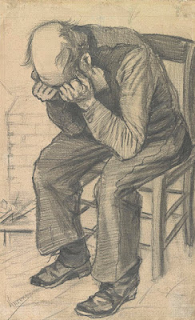
It's interesting to compare this with Van Gogh's attempts to visualise sadness.
Drawing for Worn Out
I read that the direction and form the line takes that follows the person’s back in this Van Gogh drawing is called a 'grief line'. However I can't substantiate this particular usage of the emotional line, but I can isolate it and present it as something to be tested.
The grief line abstracted
The sorrow line abstracted
Floral grief
A line that began within a body and that was thought of as belonging to a series of muscle and bone associations, has gradually been changed to one more associated with plant forms that are beginning to wilt.
Umbrella handle / bowed head
I used this emotive line when I was making a piece of work for Patching. The lily inspired ceramic flower had a bell clapper hanging inside, so that when the wind blew the flower chimed.
Memorial ceramic flower / bell
The line of sadness, is as a formal element, very close to the line of grief. However without colour, variation in associated shapes and textures, it might as well be the handle of an umbrella.
The inverted hemisphere line is another example of an emotive linear form. Not to be mistaken for the smile line, as in an emoticon, this line when used as part of an image's compositional structure can carry another type of emotion similar to sadness, as sort of heartache or sense of things coming to an end.
If you look at Watteau's wonderful painting of a pierrot in the Louvre, it has several inverted hemisphere lines dividing up the image.
Even the creases in the trousers take the form of inverted hemisphere lines
The vertical of the figure feels as if it is dropping down into a pool, colour kept desaturated, makes for an emotional register that feels something like how the world would be experienced if seen from under water.
An energised line falls
A basic children's art exercise is to make different line directions – horizontal, vertical, diagonal, and curved, especially when trying to help them to think about differences in emotions, like sad/happy, excited/bored and calm/worried, in particular when autism is suspected. But as students get older the exercise is rarely returned to as something to work on as a way of developing a more sophisticated basis for visual communication. There is a children's book 'The Way I Feel' by Janan Cain that uses colour and composition very effectively to support a growing awareness of an emotional life and I sometimes feel we need an adult version of this.
From: 'The Way I Feel' by Janan Cain
Cain's book has already been used as a primer to help youngsters think about abstract language and the example above compares a sad line with a silly line. As we get older our emotional lives are though not so easily categorised.
So I have decided that one of my projects will be to return to these basics and to develop a set of cards that can be used to test out whether or not there are any universal visual language forms that can be used effectively, as well as to provide a starting point for new emotional mixes by the simple expedient of shuffling the card deck once it is made.
Trying to regain balance after frenzied activity
In the meantime I'm off to Porto next week to deliver a workshop looking at issues very closely related to the concepts I have been thinking about in this post.
The workshop, 'Drawing the somatic body: Visual problem solving and imagineering' is introducedby the following abstract:
The fact that human experience is subjective and as much an emotional reality as a logical one, is something that drawing takes in its stride. Constable’s cloud studies are as much scientific observation, as they are an understanding of the impact that the weather has on our emotions. Buckminster Fuller’s drawings of geodesic domes illustrate his architectural philosophy, as well as being plans for buildings.
Drawing can be at its most powerful when visualising the invisible. When words fail us, drawings can provide the space for ideas to become externalised and therefore available to communal perusal.
The research objective is to explore how our bodies become measuring sticks when we come to assess responses to perception, and it is based on an understanding that it is our interoceptive network that is used to enable prediction loops to work; a network that therefore is central to our ability to survive.
Our interoceptual network is linked to an invisible but intuitively well understood neurological map of the body, a map that is the ontological bedrock on which we build images; from diagrams of electrical circuits, to maps of war zones, via how to build it illustrations used to construct the latest purchase from a home furnishing store. However, people often regard photography as the only authentic depicter of reality, which is why when trying to convince people of the power of drawing to depict thought, it is useful to focus on things that we cant photograph. Drawings of invisible but clearly felt interoceptual experiences can not only be used to foster cross disciplinary imagination and invention, the emotional range that drawing also encompasses, allows us entry into a visual engagement with the emotive processes that underlie many of our embodied mind’s conceptual models.
This workshop uses a drawing led methodology that has emerged from attempts to visualise interoception; it will ask participants to make their own drawn explorations of somatic feelings; drawings that will then be used as entry points into ways to understand drawing as a cross disciplinary practice. By using gestural mark and image making techniques, diagrams and mapping, this workshop will demonstrate that drawing is one of the most powerful forms of communication and that it can be used to make us more aware of the inner neurological maps of our own bodies. It will highlight how inner body mapping becomes the basis on which we build other drawn visualisations, as well as being the basis on which we build conceptually embodied concepts, such as the visualisation of justice.
Certain aspects of this work have already contributed to the i2ADS Drawing Across Disciplines seed project, ‘The Observation of Perception, considered through Drawing’ and associated workshop practices have been documented and written up as part of the forthcoming publication SKETCHING STEM: A Hands-On Guide on Drawing-to-Learn Approaches, for the Porto University led initiative, Drawing Across University Borders.
When writing this I’m thinking of drawing as a form of visual thinking. By such thinking, I mean considerations of mind, body and cognition variously channelled through the filter of vision. (Philosophically, this could take one in the direction of Embodiment theory.) What makes drawing as visual thinking particular in the context of art and design is intentionality, and it is the latter of which I try to be specific and that registers in and as the result. This said, a lot happens in drawing concerning the relatively autonomous behaviour of the medium that defies one’s intentions, and intentions are not necessarily always recognisable. However, on this occasion I’m trying to show through and as the drawing, ways in which one might observe perception. For this reason I’ve been recording the drawing process and my spoken thoughts while drawing as videos, specifically through an action camera attached to the front of clear plastic goggles worn over my glasses, Figure 1.
Figure 1: To show goggles, inside and outside, and action camera
both separate from and attached to the goggles.
This does also make the methodology more sharable, and anyone interested in it might take up the process and adapt it as needed. The action cam, however, appears as a thin blurred black rectangle imploded in front of and perpendicular to my vision, Figure 2.
Figure 2: Screenshots from Observation of Perception: Showing Part 1 of a 2-Part Drawing, video clip 26:52 min, 2019.
This is therefore both a tool to record the drawing process and one of two objects or motifs to observe. While the action-cam itself picks up sound, I record my speech, what I term a voice-over, into a separate audio device. The second tool, also an object or motif, is the goggles. Both of these may be said to operate as tools because, being very close to my face, they’re almost an extension of my eyes. In this sense I’m observing perception, in other words looking at looking. This point is debatably another example of the medium’s defiance, but what I want is a situation where, as nearly as possible, there is nothing in front of my vision. The tools, neither of which you the viewer can see in the videos except in the terms that the drawing presents them, are each responsible for a pair of faculties of visual perception. One of the tools is the action cam, with its wide-angle lens, which records visual content both central and peripheral to my vision, without of course distinguishing between either. I provide such distinction through my speech. The other tool is the goggles that register eye and head movement in coordination with the head. (The camera won’t record eye movements made independently of head movements, of which there are two possibilities; eye movements while the head is still, and less often eye movements in different directions to movement of the head.) Both sets of faculties I register as drawn marks and shapes, which provide the accumulative visual/material interest that gradually makes the drawing, Figure 3.
Figure 3: The two stages of the drawing recorded as the video Observation of Perception: Showing Part 1 of a 2-Part Drawing and Observation… Part 2 of a 2-Part Drawing. Dermatograph pencils, black ink, attached filing cards on white laminated cardboard,
109 x 79cm. 2019.
In the first blog entry (link), through reference to the Russian psychologist Alfred L. Yarbus’s non-digital eye-scanning device circa 1960s’, and the Italian Renaissance theorist Leon-Battista Alberti’s net or gridded frame to enable the plotting of observed coordinates, I try to explain that to my mind the mediation between perception and observation falls somewhere between the observer and that which is observed. The eye-scanning device is useful in this respect because it shows how one’s eyes scan across space, and Alberti’s frame because it can represent a material mid-way for consideration of life questions; questions of being. By substituting minimal objects, better conceived as tools of perception, for more tangible three-dimensional objects at obviously more distant positions in front of one, then what gets presented on and in the drawing is the mid-way, the mediator of sources of reference that are before it, as nearly as possible extensions of perception itself. In circumstances where I’m drawing only, without using the action-cam, I have only my glasses to which to refer. If, as in the following example, I still record my speech, it seems appropriate to write at least some of the observations onto and progressively into the drawing, Figure 4.
Figure 4: Drawing of reading glasses drawing viewed from inside the frames while being worn. Dermatograph pencils, coloured inks on white laminated cardboard,
109 x 79cm. 2019.
This might also be a key point in general about the experience of drawing: it’s an activity that starts on a surface and gradually, through its development, opens up the surface as space. My own drawing method however, which is mainly concerned with conveying information about its self-same process, does tend to prioritise the surface. Explained another way, I’m setting up an inversion of the circumstances whereby the observed object that’s usually positioned somewhere in the space beyond oneself and the drawing is immediately in front of one, in this case the glasses. There is no source of reference that’s logically in front the drawing, and in fact the drawing, that should be the mediator between perception and what’s observed, is further beyond the object in the positions drawer/agent – glasses – drawing, as suggested in Figure 5.
Figure 5: Drawing of reading glasses viewed from inside the frames while being worn + the actual glasses now suspended in front of the drawing to fit their drawn size
according to distance when seen from behind.
What’s now interesting about the circumstances so installed is that the actual space between the object, the glasses, and their mediator between perception and observation, the drawing, can be the space of a narrative, a story of whatever else could be taking place in and as a different criterion of perception, Figure 6.
Figure 6: Showing the photo of Figure 5, above, and a view of the actual space existing between glasses and drawing.
Artists often use the medium of drawing to rehearse and research narratives, or use drawing as the sole medium for this purpose – to name but one example, the contemporary artist William Kentridge. This leads me towards another kind of theory, which is the psychoanalytical theory of Jacques Lacan (1901 - 1981). I’d thought of mentioning Lacan in the first blog entry in the context of the glance, but since I reference the glance specifically in the video, Observation of Perception: Showing Part 2 of a 2-Part Drawing (see Figure 3, above), and hadn’t completed that at the time of writing the first entry, it now seems a better moment for further explanation. Lacan’s theorisation of the glance occurs in his paper, ‘Logical Time and the Assertion of Anticipated Certainty’ (1945). This paper is particularly interesting from the point of view of inter-subjective use of time. While the scenario that provides the context for Lacan’s discussion concerns three human individuals, I’m adapting this to the kind of dialogue that can occur between a drawer/agent and a drawing. Lacan explains that within the time frame of trying to make a decision or reach a conclusion about something, an initial hypothesis concerning that something is first put to the test of doubt. The period of doubt, which in decision-making need be no more than an instant, but an instant that can be of variable length, is in effect the glance. According to Lacan (2006: 168): ‘The time for comprehending can be reduced to the instant of the glance, but this glance can include in its instant all the time needed for comprehending’. What I like so much about this quote is the suggestion that the glance concerns uncertainty. The engagement with drawing, or more precisely the dis-engagement with other modes of thought during and as drawing, can be an extended time frame of the glance; the holding of decision-making in abeyance as uncertainty. In the following drawing of the action cam and goggles – from which I also made a video – I later superimposed the glasses, seen as before from the narrow space between my face and the glasses lodged on my nose, Figure 7.
Figure 7: Single-layer state of a drawing of an action-cam worn over goggles and the goggles viewed from the inside while being worn, and a second-layer state of the drawing showing the same drawing with orange glasses superimposed, viewed from inside the frames. Dermatograph pencils, black ink and coloured inks, attached filing cards on white laminated cardboard, 109 x 79cm. 2019.
What’s interesting here is that there’s conceptually a space between the two layers of mark making and cursory imagery that I leave alone. The several apparent positions of the glasses do seem to be increasingly in front of the placements of the narrow band of the action cam, but I mean a conceptual space that’s to do with my lack of conscious concern to integrate the two sets of imagery. However, the two sets waver in a kind of relationship that’s, in a sense, up to them. While the word uncertainty often has a negative connotation, drawing and other forms of creative practice stand a good chance of manifesting uncertainty positively, no matter what one’s disposition. Debatably, if art works, it’s imbued with affirmation, even if its content and the invested feelings are opposite. Insofar as an uncertain disposition would be to hang back, and a decisive one would be to push onwards – hesitancy versus boldness – I personally like the idea of time conducting a kind of backwards rotation as part of its movement forward, where it picks up the past and draws it through. This also seems like drawing; where each decision is consequential on the next, and the next one is in acknowledgement of some previous decision. There are moments in the video-recordings of the drawing as shown in two states in Figure 3, above, however, where such consequential decisions break down, and in the video particularly of the second state I appear to be searching around for something to do next. While this often happens in drawing, I’d much prefer a drawing to roll on as a continuum of action, Figure 8.
Figure 8: Screenshots 40:42min and 41:27min, with 1st voice-over, and interventions of a 2nd voice-over between the timespan of the two screenshots, of the 44:35min video Observation of Perception: Showing Part 2 of a 2-Part Drawing, 2019.
What’s interesting with the strategy of intervening in the first voice-over that’s spoken spontaneously while drawing, is that the intervention is squeezed into available moments of silence where I’m drawing only, which seems like a textual equivalent of re-working and revising the drawing. I show this also, in Figure 8, to indicate how the drawing and the voice-over are mutually both cooperative and distractive. A second point of Lacanian theory conveniently links the first blog entry’s reference to Alberti’s frame with the idea of a potential narrative space. Lacan adapted the idea of a mid-way in the optical pyramid to his own idea, in the psychical context, of an opaque screen, more like a ‘stain’ or ‘decoy’, that muddies vision, altering and affecting what we assume to be the objectivity of vision. (This is my simple interpretation of very complex theory. For more thorough explanation you might refer for instance to Harari, 2004: 119-40) Suffice it to say that the metaphor of muddied vision may relate to the more subjective aspect of perception: the fact that one often imposes personal interpretation on otherwise objective and sharable visual-material content. I’m intending to offer this question to a small group of fine art students as a contribution to their seminar class on Embodiment. After a drawing exercise that follows closely in the method of the above-described work, I’ll ask them to define the space that their glasses frame, or the frame of sunglasses, in terms of a narrative of their own choosing. Whether physically in whatever medium in the space as shown in Figure 6, right-hand photo, above, or as further development of the drawing, the only stipulation will be that the drawing should be seen to physically morph into the story. A colleague wrote me a comment on the proposed idea: ‘I see action through big drawing (space), glasses in some way combining a self to a field, which could be expanded space of imagination and place of vision. Physically and symbolically this is interesting, with the use of interpretative words and objects and also the context of subject and thing. I think the content analyses time, space, place, and will involve the students naturally in self related content.’ The idea of framing in one way or another is always important in the more instructive level of creative teaching, and in the above-described project I’ve been doing this for myself. The intention of the drawings is to explore a hypothesis that one can observe perception and visualise it as an observation. As in some instances of drawing – though not all – one hopes that the result conveys a degree of clarity of intentions. However, in the process, things may happen that cause one to become involved in other areas of research. I’ve given some indication of my own interests, and of how things can occur by chance in the course of drawing. If research is an additional direction, then through one’s practice a third and more integral possibility can emerge that alters one’s perspective, but in a sense, because it’s within the work instead of clearly declaring itself, it waits to be discovered. This other integral possibility may shift and challenge one’s determination to achieve clarity.
References
Harari, R. (2004) Lacan’s Four Fundamental Concepts of Psychoanalysis: An Introduction. New York, NY: Other Press Lacan, J. (2006) Écrits: The First Complete Edition in English. (First published 2002) New York, NY; London: W. W. Norton & Company Thanks to Mike for a fascinating insight into the work he is doing. It might be interesting for you to contextualise Mike's post by reading my own thoughts on that 'uncertain certainty' an attitude that lies at the core of most ventures into trying to record perceptual activity. His glasses are another drawing device or apparatus and therefore it might also be useful for you to think about how these devices have become integral parts of other drawing processes. Mike has sent a sharable file for those interested in more detail. He has extracted a 'voice' from one of his videos and given an account of how his spoken interjections are woven into the narrative of drawing making.
Day two of the conference was structured in the same way as day one, two sessions of presentations in the morning followed by workshops in the afternoon. Cindy Yuen-Zhe Chen: Listening and Drawing towards Emplacement
One of Cindy's drawings made of folded paper that was used to touch the surface of the landscape and record the texture/colour of the flowing stream that passed through Golden Gully in Australia
Cindy had been working using interconnected processes of drawing and embodied listening to explore landscapes in both Australia and China. Her practice investigates 'the convergence of aural and optical perception in the experience and representation of place and she thinks of drawing as a gestural act that extends bodily perception through technologically enhanced encounters with the sounds and surfaces of place'. Cindy uses both direct surface rubbings and sound feedback to make recordings of places. Because of her elimination of visual observation techniques, I was reminded of a film made of a blind bike rider who whistles and of another film of a boy who sees without eyes.
The boy who sees without eyes
Cindy didn't make reference to either of these things but it seemed to me that by using echo location technology, she was making use of technology that could be made much more widely available for people that have lost their sight. Her work was a reminder that humans are not using senses to their full capacity and that as an artist, as she begins to use the interrelationship of touch and sound to explore landscape, she is also in effect reminding us that as we eliminate one sense, in this case vision, we heighten our awareness of how other senses are working. (Golden Gully is a very enclosed space, where sound has lots of surfaces to bounce off) As Cindy moved around the gully she was also able to listen for 'sweet spots' where sound had most resonance. Cindy was operating in places that had already been visualised by both eastern and western artists. She was on the one hand using paper surfaces to engage with touch; folding, crumpling, rubbing etc. in order to make direct contact with the landscape and on the other hand she was 'sounding' through touch, because the paper itself made particular sounds as she manipulated it within a landscape setting.
Photograph of crumpled papers that had been used to make surface rubbings of rocks
Photographs of the paper used to make rubbings reminded Cindy of the forms of mountains and rocks in the distance, especially when she was working in China, they were a reminder of the mountainous forms in Chinese landscape brush paintings. Close up video photographs of these paper surfaces were described as membranes of re-enactment.
Cindy spoke of 'sonic fingers' the microphones that were attached to her wrists, enabled her to be in direct recording contact with air, movement and touch.
Another stage in the process was to make her paper into Möbius strips, so that when making rubbings the paper was in one to one contact with the land surface, there no longer being a back and front to her papers. (A Möbius strip has only one side to it) These papers after being used to make rubbings were then brought back into the studio and photographed as if they were models of mountains, which transformed the papers from records of action into pictures of landscapes. Recording that were made of Cindy making rubbings using these papers were described as a sort of "Listening through touch".
Cindy cited Evan Thompson's book, 'Mind in Life' as an important influence on her thinking, his idea that mind is an extension of the life process, allows us to see how what we associate as a specific human attribute, could actually be something possessed by all living things. Of course once you accept that an idea like this could belong to all life forms, what happens as we cross the life/not life divide? Can a landscape be thought of as having a mind?
When Cindy was in China, there was a wonderful moment she had recorded of someone washing clothes in a river. This was an activity very like the artist crushing and moving her paper sheets in the shallow water at the river's edge. Washing and working, drawing and washing, seemed to be a sort of rhythm of the river, a rhythm echoed in the shapes of the mountains seen in the far distance, a rhythm seen in the shapes of the washing/paper as it emerged from the river.
Finally Cindy mentioned that her understanding of drawing as something no longer seen as marks on paper but instead as lines in real space, was supported by remarks made by Catherine De Zeigler in 'On Line: Drawing Through the Twentieth Century'. In particular in this text De Zeigler explores the relationship between drawing and dance. This took my thoughts back full circle to how Cindy thinks of drawing as a gestural act that extends bodily perception through the use of technology. A finger drawing in the sand, becomes a burnt stick extending the body so that it can make marks on the ceiling of a cave, a moving microphone picks up sound vibrations as they rebound from a rock's surface, a transmitter is embedded in depth perception and optical detection glasses for the visually impaired, using ultrasonic sensors and a binaural soundscape environment. All these are linked together under this definition of drawing.
Steve Fossey: An imbricated drawing ontology: Economics of pattern, chaos and scale
This project extends from his initial participation in a project, 'A line made by walking without marking the Earth', and was extracted from his PhD 'Site specific performance and the mechanics of becoming social'. He walks with people and talks with them as they are being tracked by GPS technology.
From his explanation I got the idea that he is interested in talking to people because as they share ideas they also share thoughts about geographical location. For instance because I come from Dudley I have a particular idea of where I come from as being about being a 'Black Country' lad and when I'm in conversation at some point its bound to crop up. However at the same time my mobile phone will be tracking my position on the planet alongside the person's mobile that I'm talking to which is doing the same. So as we exchange geographically located thoughts our relative positions are being bounced off a satellite. Steve's video below provides a much clearer explanation of the concept and extends the idea into an embodied performance.
Walking through the field: Steve Fossey
The most interesting aspect of Steve's presentation for me however was the showing of the video of him lecturing about his project behind himself as he lectured on his project. It reminded me of the old Camp coffee bottle, that had on its label an image of Camp coffee being served, which of course had within that image an image of a bottle of Camp coffee. As a boy I would stare and stare at that image of a bottle to see if I could see another image of the bottle in the image of the bottle.
The lecture as performance is an old interest of mine, one that stems from my time when I met Joseph Beuys who was a consummate performer as lecturer and who in many ways was also performing as Rudolph Steiner lecturing when he was lecturing. The Russian doll effect is with all of us in some ways, as I have given lectures I have at times tried to embody other lecturers giving lectures, echoing others who in their time have echoed others.
Antonino Di Raimo: The Human body as a design apparatus
Le Corbusier
Only the body in movement can draw and Antonino Di Raimo was concerned to develop an understanding of architectural space that reflected the fact that it is a body in movement that inhabits buildings, not frozen human forms. Existing modular systems, such as Le Corbusier's show static humans, and the reality is that we move through and within buildings, so Antonino had decided to see if the body in movement could be visualised as an aid to thinking about designing architectural space.
Antonio began by explaining how he had come to think about the word 'apparatus'. He had looked at Giorgio Agamben's "What is an Apparatus?" who had in turn examined Foucault's use of the term. Agamben then redefines 'apparatus' as on the one hand the network that is established between elements such as discourses, philosophical propositions, institutions, buildings or laws and on the other, the 'apparatus' operates to fulfil a concrete strategic function in a power relationship. This 'apparatus' always appears at the intersection of power and knowledge relations. Antonio also drew our attention to Marco Frascari's thoughts on the human figure in architectural representation, who argued that "in contemporary architectural drawing, the presence of the human figure to give scale, is absolutely indispensable". (Alex Anderson has published a useful article on the subject)
Anderson points out that, "If they are well conceived and rendered, human figures in architectural drawings can help to show how projected buildings might be perceived and inhabited. They can also be used to understand how architecture can be shaped to accommodate human experiences and actions".
If the body is a tool that can be used to measure space, then old modular representations are a failure, as they measure proportion, not space. Dalibor Vesely's work on embodiment and proportion was also cited as vital to Antonio's thinking. (Find here Vesely's classic text, Architecture in the Age of Divided Representation available as a PDF) It is interesting to reflect on how important writers on architecture have been to the development of embodied theories of drawing, where would we be without Pallasmaa's, 'The Thinking Hand'? Antonio agreed with the current critique of ocularcentrism and wanted to explore how computers could use more haptic information when used to incorporate the body into the design process. He was a dancer, and this has deeply effected his idea of what a 'virtual twin' would be like, if a human body was to be designed for virtual testing of architectural spaces. He set about teaching his virtual twin how to dance, realising that what he was doing was creating an avatar that was in effect an anthropomorphic cognitive agent.
This was a radical embodied cognitive approach to thinking about architectural design, not one that used representational models. Antonio pointed out that Anthony Chemero has opened out new ways of thinking in relation to embodiment in his book, 'Radical Embodied Cognitive Science'; in which he argues that cognition should be described in terms of agent-environment dynamics rather than in terms of representation. An idea he traces back to John Dewey. The body as it moves through and in relation to, architectural space is taking part in what Antonio called a 'structural coupling' and as it did so gesture was vital to how a haptic understanding was being developed. In many ways this was like a body on a stage. The final part of Antonio's presentation being about how figures and their representation were also closely linked to space and ritual. As soon as many bodies come together in order to do things, the spaces they do these things in become 'ritual spaces'.
Antonio's computer drawings reminded me of how important coding is as critical tool not just in architecture but in all fields of visual problem solving.
Katarina Andjelkovic: Towards the Embodiment: Drawing's movement, space and temporality.
Katarina was looking at the performance of space. Drawing as an unfolding event. This was the space of performance looked at as a choreographed line that moves through space. Our visual perception provides us with a space of potential, (choice), we have to decide, do we go left or right? She is involved in teaching drawing and wanted to explore the representation of embodied experience in the spatial context of a drawing performance. Students were asked to respond to a performing body, that was responding to a film projected behind and at times on the body, as well as being located in the actual space of the studio. She used Tati's film 'Playtime' as the filmic space and students made several drawings as they began to determine 'boundaries of visuality'. I.e. how to identify filmic, real and performed movement as drawings were made.
Katarina was looking for 'space that recognises its own drama', a kind of dream like space. Participants drew from several positions and were looking to develop an interpenetration between reality, film and performance, that was recorded by drawing. The techniques of dialectic montage and distracted perception were given to the students as their initial guidance and then juxtaposition or the choreography of the city in movement as a secondary concept. (Dialectic montage was Eisenstein's term for an effect in montage in which the juxtaposition of two shots has the potential to make an abstract concept tangible. A focus on distracted perception has resulted from the fact that researchers have found that in between bursts of attention, we are purposely distracted. During those periods of distraction, the brain pauses and scans the environment to see if there is something outside the primary focus of attention that might be more important. If there is not, it will re-focus back to what you were doing. see:
Fiebelkorn, Pinsk, Kastner A
Dynamic Interplay within the Frontoparietal Network Underlies Rhythmic Spatial
Attention
in Neuron
Volume 99, ISSUE 4, P842-853, August 22, 2018)
Because students were drawing within an audio visual event, the filmic experience of editing and how it can be used to encapsulate a filmic idea of time, was seen as something that would deeply effect their approach to the situation. This led to a sort of 'framing' whereby students made several drawings that could be juxtaposed and mixed in order to represent their experience within time. As well as this different levels of abstraction were used to represent different levels of attention. Students were being asked to discover the implications of this world through the act of drawing, by layering past, present and future, with experiences of closeness and distance.
Personally I felt that this would have been a very challenging task for these students but that it did raise several questions as to how drawing could learn from film conventions and how to design multimedia experiences for others to work within.
Nicci Hayes: The unsayable
Nicci performing in a paper 'poem suit'
Nicci presented a series of embodies drawing performances, whereby she blurred the boundaries between disciplines and highlighted the fact that words seem very inadequate as a way to explain what happens in these situations. She had a welcome acceptance of the unknown and saw what she was doing as experiential rather than analytical. Nicci believes that the body remains an invisible component of history. Meaning in language is a gathering web of insinuations, it is a question of conveying one thing in terms of another. (Flann O' Brien) Her reference to Flann O'Brien was a welcome one, as it reminded me that the great comic writer had worked all these things out ages ago, all you have to do is read the Third Policeman and you will realise that all theory is comically vindicated as heroic prose. She at this point also reminded us of Finnegan's Wake and its disintegrating prose, and while doing this she was projecting an image of herself wearing sewn together too large men's trousers, flailing around, with arms in sleeves far too long, but as she said, if you could say it in words why dance it?
Detail from a print
A printmaker, she is vary aware of the gestural impact of marks. She sometimes works with a poet, at one time making a suit to perform/draw with from the poems. At another time she has made a paper suit out of drawings on paper, the marks then working with other drawn marks as she performs.
Nicci Hayes: Mark making suit
Her art work includes video, one of which we were shown which saw her making marks with a representation of a lines drawn on the film, thus bringing together drawing, performance, animation and film making. She is also very interested in the act of writing. Seeing writing as a particular form of drawing, which links to listening, reading, seeing and hearing, all embodied activities. As she stated, 'Human communication is primarily a muscular function'.
Liselotte was dealing with embodied experience and the built environment. Together with Robin Schaeverbeke, Liselotte was working with architectural students trying to get them to open out their visualisation techniques beyond plans, elevations, sections and perspectives. In particular Schaeverbeke and Vroman were very aware that technical drawing processes cannot deal with or capture subjective experiences. The dancer / philosopher Maxine Sheets-Johnson was quoted as stating that movement is pre-linguistic while language is post-kinetic in its nature. Body movement was used as away to explore the communication of embodied experiences and dancers were seen as vital to an understanding of movement in space.
Yvonne Rainier: Sketch for the Trio B choreography
Yvonne Rainier's 'sketch for the Trio B choreography' was shown as a particularly important starting point for this, and the work of Trisha Brown highlighted as an exemplary drawing practice.
Trisha Brown performing and drawing
We were shown an interesting image of a plan that had been drawn large scale between two buildings, that when photographed form the top of one of the buildings operated in that space between the diagram and reality. (Heather Sultz is a dancer that has worked with a lot of architects and she may well be worth checking out if you are interested in this area of thinking). Liselotte pointed out that new frameworks for architectural form were needed. Laban's 'kinesphere' was introduced as a way into thinking about new much more kinaesthetic frameworks.
Annotations using the kinesphere
Liselotte asked the question, "How can movement direct design?" She mentioned 'oblique circulation' which was a project by Benjamin Dillenburger, a project concerned with numerical material, something that I have already looked at in the work of Michael Hansmeyer. But I think I misread the reference, I think she was talking about the architect Claude Parent and the philosopher and urbanist Paul Virilio. Their 'Architecture Principe' was based on a critical approach to the modern plan. Fractured volumes and inclined surfaces were responses to their rejection of Euclidian space and its visualisation within technical drawing. Together they developed the theory of the oblique function, which meant inclining floors to form sloped surfaces. Fluidity of movement was vital as this led to deeper human relationships. By having to make an effort on the ramps, human beings actively participated in the architecture. Joan Jonas's Film "Songdelay", one of her outdoor performances that an audience could only witness from an elevated viewpoint such as a rooftop, was also introduced as a seminal work. It has been argued elsewhere that her filmed performance serves to visualise very particular time-space-conditions and that it also imparts to the viewer a sense of the topology of the space.
From 'Songdelay'
Finally the animated films of Pascal Baes were cited as another very important visual reference for the students when undertaking this elective. I really like Pascal Baes' work it is very urban, witty and plays with time and space.
Pascal Baes
Students were asked to compare random walks with informed walks. Again I began to lose track of the issues. In my head I was thinking about a random walk as a mathematical object that describes a path that consists of a succession of random steps within a mathematical space. Such as the path traced by a molecule as it travels in a liquid or a gas, the search path of a foraging animal or the price of a fluctuating stock. Random walks explain the observed behaviors of many processes. What the students were being asked to do was to compare people walking aimlessly with people walking for a purpose. This was about observation, and as students began to notice differences, they could begin to see the body as a choreographic object. The differences between observed purpose and non purpose gestures could be the starting point for a language of gesture. Students were then set a task in which they were to design a space and make it work to shape movement. This reminded me of a Jim Lambie tape drawing, if you have ever been in a room of his floor drawings, whether you want to or not you will find yourself being directed around the space by his tape lines.
Jim Lambie
The use of mirrors in the spaces constructed by the students also reminded me of work in the Hayward Gallery exhibition 'Space Shifters', in particular the work of Josiah McElheny.
Josiah McElheny's work in 'Space Shifters'
Students had been trained to wear McElheny's mirrors and then to walk the lines set out along the gallery floor. As you encountered these people walking through your space you became quite disorientated, not being sure which was the space you belonged to.
Finally we were reminded of the importance of targeted feedback, the students that undertook the elective fed back in terms of how their understanding of kinetic space had developed. They were also asked whether or not the elective had changed the way that they thought about architecture. I must admit this is something I need to think about much more and I have very little evidence as to how work I have done with various groups has effected their thinking. I will need to do this in future if I am to demonstrate 'impact'.
The afternoon was again devoted to workshops. I chose to do Anthi Kosma's workshop called D(inner)rawing, an activity that was very much about how we visualise touch and feelings. It was the title that made me choose it. As always it was the collaborative happening of a room full of academics and artists that was most interesting to observe, as well as having to make reflections on how I felt about having to express my feelings.
Finally: on the way back home from Loughborough, on getting from the train station to the bus stop I passed an empty shop near the Leeds market hosting an opening of a drawing exhibition. I had a while to wait for my bus, so decided to drop in. John O' Connor's '360 days of drawing Leeds' was on display over two floors of the shop; one drawing of Leeds for every day over the course of a year. He had taken on this task in response to going through a bad time in his life and was at pains to tell me how he had had to work through ice and rain and harsh winds to get these drawings done. The activity seemed to help him regain a certain mental stability, the need to focus on a task being something all of us value when things are not going well. After all the intellectual theorising of the past two days, it was refreshing to meet someone simply 'drawing' and in his encounters with the city many of the drawings had an intensity and energy that went far beyond drawing as therapy, if anything they reminded me of the drawings of Giacometti and I really appreciated that he was exhibiting all these drawings as 'a gift' to the people of Leeds, and that all his encounters with people during the year were valued by John as being worthwhile. Perhaps this was embodied drawing at its clearest and at its most effective, each of John's drawings was like a seismograph, you could stare into each one and relive that day's drawing action, see how he began tentatively, look for where anchor points began to help him stabilise the image and watch how lines massed up to find complex forms. John can draw, and draw well.