
During the first few weeks of a fine art course the one material that is nearly always supplied for people to work on is cartridge paper. The fact that it's called cartridge paper because it used to be used to make cylinders or cones containing both the bullet and its gunpowder is though nearly always forgotten.

A paper cartridge
History and the fact that everything ages are stories that can be woven around all materials and paper is so central to the production of art that it's worthwhile considering some of these narratives in more depth. If you go to the 'see also' list at the bottom of this post you will find links to stories already told about paper in this blog, but there are many more.
There will be times when you need to either repair an old drawing or be in a position whereby someone wants to buy a drawing and wants to be reassured that you have thought about conservation issues. On the other hand it may be that you want to work with papers as building materials and want to make sure that all the materials you use will last and be compatible.
If you need to ensure that your papers are of the highest quality just make sure that you get your paper from a reputable manufacturer or art supplier such as Atlantis, Lawrence, Strathmore, Canson, Arches or Fabriano etc. however you may not want to use expensive acid free papers, you may want to make your own, embed found papers into your work or use the fact that some papers are acidic and easily light damaged as a specific quality that is used as part of your idea. Paper is a material that is easily effected by dampness, acidity, dirt, insects or fungi and can have a very short life span and if you don't have to worry about conservation issues, you can work with a cheap paper's propensity to be easily effected by the changing world and build in an acceptance that your work will change over the years.


Spiritual value can be earned over long periods of use within a religious context or it can be something that only enters into the situation at special heightened moments of ritual and both these situations can be seen to affect the way we might work with a material.

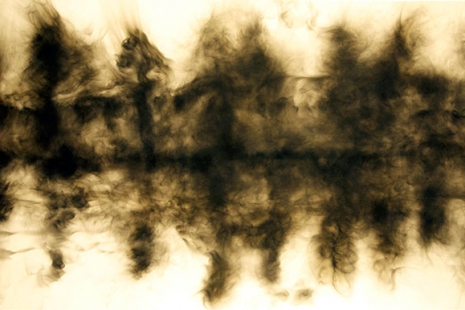
Conservationists use a wide variety of tools, many of which can be put to use by inventive artists. For instance, specialist dry sponges such as 'smoke sponges' made of either vulcanised or natural rubber, will effectively remove soot and smoke damage from papers but can also be used in conjunction with fumage techniques to make very interesting drawings.
Some conservation specialists have ranges of tools that you cannot get elsewhere. For instance the American company Talas supplies a wide range of brass tools designed to work with paper, that you won't find anywhere else. They are though very expensive and you would need items shipping. Even so the idea of exploring the possibilities specialist tools open out for you is a powerful one and it ties in very neatly with media specificity. Every tool that is new to you as an artist opens out the imagination and takes you places you have never been before.


 Jihyun Park


However it could be that you approach paper from a very different angle, that of its position within a performance or action. In an earlier post on the languages of paper I pointed out that in certain prisons paper becomes central to an underground communication process. Within the average 6′ by 8′ cell with its toilet and two bunks, paper is one thing that is thin enough not to take up room and it can be used in a variety of ways. Prisoners have access to books and magazines, writing and drawing paper, legal paperwork, letters and toilet paper. What most prisoners do with all those paper things , besides reading and writing , is make other things. Some of these items, like kites (messages, see earlier post) and crafts, (the prison paper mâchè recipe is toilet paper and water: wetted, moulded, dried and wetted again), are mostly benign, but some, like the paper or cardboard knife are a threat to the safety of the prison. The act of creation is empowering and gives prisoners some measure of control over their strictly monitored lives. Yet even the unaltered paper object can hold power, such as the information and ideas found in books and magazines. All prisoners have access to a library, and there exists another, perhaps busier, underground lending library: books and magazines are passed around and letters shared, porn is bartered, and original pencil drawings are swapped for cigarettes. And so an environment of oppression becomes the mother of invention. With nothing but time on their hands, prisoners find ways to communicate, play, trade and fight each other and the system with altered paper, often in ingenious ways. A New York Times report found that the narcotic Suboxone was getting into prisons using paper. Pills are crushed and then mixed into a paste and then very inventive ways are used to get the Suboxone into or onto papers. For instance in one case it was spread across the page of a child’s colouring book, its yellow stain then coloured over with crayon. Prison social worker Edward Matthews had this to say about the situation, “paper absorbs drugs like a lover’s perfume..." Paper in this case is a central performer in a powerful drama and as an artist this might be a very useful direction to take an idea into, especially if you felt the more traditional methods of working with paper were getting stale. I'm sure many of you have your own stories about paper and stories have a way of making themselves visible.


If you need to ensure that your papers are of the highest quality just make sure that you get your paper from a reputable manufacturer or art supplier such as Atlantis, Lawrence, Strathmore, Canson, Arches or Fabriano etc. however you may not want to use expensive acid free papers, you may want to make your own, embed found papers into your work or use the fact that some papers are acidic and easily light damaged as a specific quality that is used as part of your idea. Paper is a material that is easily effected by dampness, acidity, dirt, insects or fungi and can have a very short life span and if you don't have to worry about conservation issues, you can work with a cheap paper's propensity to be easily effected by the changing world and build in an acceptance that your work will change over the years.

Daniele Del Nero: After Effects
Daniele Del Nero uses the mould that grows on paper to give life to the miniature models he makes out of it. He uses damp paper's susceptibility to mould as a central aspect of his working process.
In many ways we are foolish in thinking that we can hold back time and I strongly believe that artworks are for the moment, Del Nero's work bridges both these aspects, on the one hand he doesn't try to hold back time and yet on the other hand his work suggests the long unfolding of time, in that his models work like a speeded up film of a full sized world. However some think that art is eternal, that old quote 'ars longa, vita brevis' suggests that art is long-lasting and life is brief. Perhaps as usual it is in the dialogue between these two standpoints that interesting things emerge. If you look closely at the image at the top of this post the classical head drawing is surrounded by mould spots, that look like a constellation of fungal stars. These signs of ageing add a second layer of meaning to the drawing's attempt to attach itself to classical values. The age spots verify the age of the paper and therefore enhance the drawing's associations with an ancient culture. The fact it is old gives the drawing a certain gravitas or worth. I'm reminded of the difference between icon paintings as used in Russian orthodox Christian ceremonies and the mud sculptures used in Indian Durga Puja ceremonies. In the case of the icons, they are often encrusted in gold leaf, and have semi-precious stones embedded within them and are treasured as doorways into an eternal religious experience, many of them are hundreds of years old, their value as spiritual guides related to their centuries of use, as well as the fact that their value in terms of materials used in their making, reflects their owners' awareness of a link between spiritual value and material cost. In contrast the Indian Durga Puja ceremonies have short lived statues of the Goddess Durga at their centre. These statues are made each year especially for the ceremony and use local materials, often from examples of earth taken from various local sites and once the ceremony is over the sculptures are put into the river Ganges and they dissolve back into the world they came from. Both objects are central to people's religious experience, but one is valued more and more as time unfolds and the other has a very limited use, the Goddess only 'inhabiting' her statue during the period of the Puja ceremony.
A statue of the Goddess Durga being pushed out into the Ganges
Spiritual value can be earned over long periods of use within a religious context or it can be something that only enters into the situation at special heightened moments of ritual and both these situations can be seen to affect the way we might work with a material.
Whether or not you are using paper at its archival best, or full of acids that will act to destabilise it and make it fall apart after a few years, a deep knowledge of the processes involved can be very useful.
Sometimes you will want to engage with your paper in such a way that you want to ensure its integrity and if this is the case then you might need to think about your work from a paper conservationist's viewpoint. For instance, sometimes I tear or rip my paper and then later I want to repair it. I often use Document repair tape or transparent mending tissue for this. These are readily available from suppliers of paper conservation materials as are glues that are also designed to be used in conservation.


You might not think that glue is very important, but if you are working using various collage materials it will be vital. I have some collages that I made over 50 years ago and they have deteriorated considerably by now.
The big issue with papers is acidity, for instance in an earlier post on Oak Gall ink I pointed out that some drawings and early documents written in this ink are now falling apart, because the ink is acidic, over time it will gradually corrode through a paper's surface.
Sometimes you will need to use paper pulp to repair holes in your paper, this can also be supplied by specialist suppliers for the conservation industry. Once again what is initially used for one purpose can easily be used for another. Try drawing directly with the pulp, first of all to add texture to the paper surface, gradually as you get more used to it, you can dye the pulp different colours and employ it as an image making material in its own right.


Acid free PVA
The big issue with papers is acidity, for instance in an earlier post on Oak Gall ink I pointed out that some drawings and early documents written in this ink are now falling apart, because the ink is acidic, over time it will gradually corrode through a paper's surface.
Sometimes you will need to use paper pulp to repair holes in your paper, this can also be supplied by specialist suppliers for the conservation industry. Once again what is initially used for one purpose can easily be used for another. Try drawing directly with the pulp, first of all to add texture to the paper surface, gradually as you get more used to it, you can dye the pulp different colours and employ it as an image making material in its own right.
David Hockney: Paper pool 6: Coloured and pressed paper pulp
Conservationists use a wide variety of tools, many of which can be put to use by inventive artists. For instance, specialist dry sponges such as 'smoke sponges' made of either vulcanised or natural rubber, will effectively remove soot and smoke damage from papers but can also be used in conjunction with fumage techniques to make very interesting drawings.
Antti Keitilä: Fumage drawing
Some conservation specialists have ranges of tools that you cannot get elsewhere. For instance the American company Talas supplies a wide range of brass tools designed to work with paper, that you won't find anywhere else. They are though very expensive and you would need items shipping. Even so the idea of exploring the possibilities specialist tools open out for you is a powerful one and it ties in very neatly with media specificity. Every tool that is new to you as an artist opens out the imagination and takes you places you have never been before.
A Japanese push drill for cutting round holes in paper
A punch set for punching holes or embossing circular forms
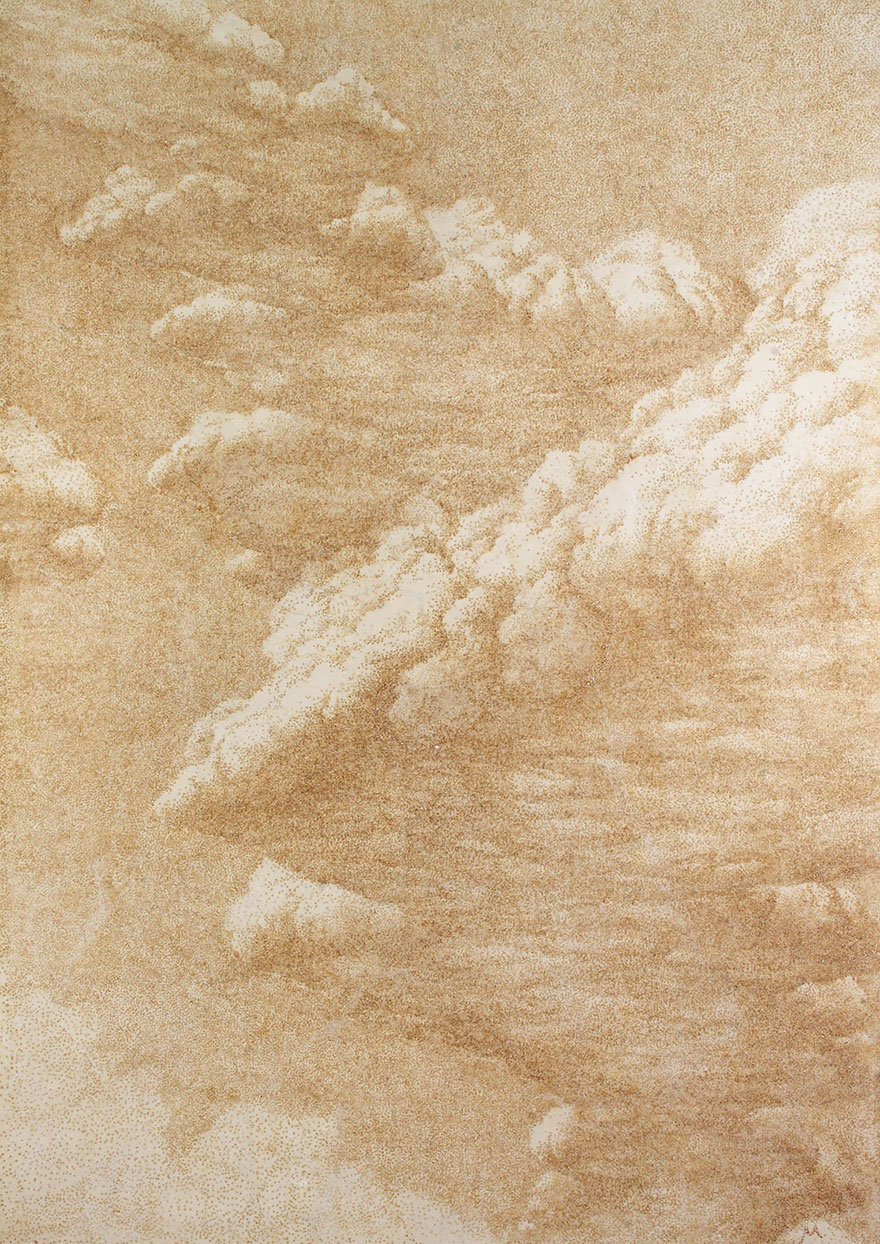
Sometimes tools made to do other jobs, can be repurposed. The process of getting to know paper and what it is capable of is one that could take a lifetime and become a way of earning money as well as a way of making art.
Jihyun Park: Using burning incense sticks to burn holes into rice paper
Just as with an icon, that becomes more powerful the longer it has been operating as a religious artefact, layers of meaning can build up around any object if there is a long term engagement with it. It is as if bits of the human lives that it touches rub off and become integrated into its fabric. Paper conservation also adds layers of meaning into the materials you are working with. The more an old sheet of paper is repaired and holes in it filled, over the years it develops a patina of use that becomes meaningful and the further away from its original use the more it seems to develop another meaning due to a nostalgia for lost uses. The old ledger papers below reflect the rise of computer technology, spreadsheets having replaced ledgers in most parts of the world.
Old hand made papers
Edward Allington used old ledgers to draw on and the combination of a drawing style based around cross hatched pen and ink drawings and the old ledgers made for fascinating images, their subject matter suggesting questions about the status of Classical art within a modern context and the role of history in our lives.
Edward Allington
Like everything else the more you research it the more interesting it gets.
Of course if you are to repair papers you also need to know how they are made. For 500 years European paper makers could only produce Laid papers. This was a process whereby the papermaker would dip a mould into a vat containing diluted pulp of hemp or linen fibres, then lift it out, tilt it to spread the pulp evenly over the sieve and as the water drained out between the wires, shake the mould to lock the fibres together. In the process, the pattern of the wires in the sieve was imparted to the sheet of paper and the wet paper was then 'laid' down on a sheet of thick cloth or felt to dry. Many artist's papers are still made in this way. In 1757 John Baskerville the printer began to use a new kind of paper, called Wove (known in Europe as Vélin). This paper is smoother because the mesh that the paper is strained over was 'woven' thus creating a much finer surface for the paper to sit on; one that could also work with shorter fibres, a fact that allowed for even finer papers to be manufactured. James Whatman's name, the man who invented the process, still survives in the name of the company that produces industrial filter papers. With the establishment of the papermachine (1807), the manufacture of paper on a wove wire base became the norm. Key to this process was the introduction of the Fourdrinier Machine, which uses a moving woven mesh to create a continuous paper web by filtering out the fibres held in a paper stock and producing a continuously moving wet mat of fibre. This is dried in the machine to produce a strong paper web, and today more than 99% of the world's paper is made in this way.
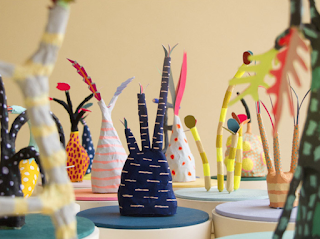
You can however reverse engineer the process. If you tear sheets of paper up, soak the results overnight and put the soft torn fragments in a blender with plenty of water, you can reduce the sheets back into paper pulp and with pulp and paper sheet combinations you can just about shape any forms you like and when dry they can be coloured. Adam Frezza and Terri Chiao are just two of a wide range of artists that have built practices around the possibilities inherent in paper as a construction material. For LAU students if you want to try it out, the ceramics technicians have all the equipment you need as well as sheets of wood pulp that you can add into any paper mix to get a blend that is perfect for your needs. For anyone else there are lots of videos on YouTube about how to make your own paper and you don't need to invest in frames if you just want to start by using paper pulp to make things.


Adam Frezza and Terri Chiao
However it could be that you approach paper from a very different angle, that of its position within a performance or action. In an earlier post on the languages of paper I pointed out that in certain prisons paper becomes central to an underground communication process. Within the average 6′ by 8′ cell with its toilet and two bunks, paper is one thing that is thin enough not to take up room and it can be used in a variety of ways. Prisoners have access to books and magazines, writing and drawing paper, legal paperwork, letters and toilet paper. What most prisoners do with all those paper things , besides reading and writing , is make other things. Some of these items, like kites (messages, see earlier post) and crafts, (the prison paper mâchè recipe is toilet paper and water: wetted, moulded, dried and wetted again), are mostly benign, but some, like the paper or cardboard knife are a threat to the safety of the prison. The act of creation is empowering and gives prisoners some measure of control over their strictly monitored lives. Yet even the unaltered paper object can hold power, such as the information and ideas found in books and magazines. All prisoners have access to a library, and there exists another, perhaps busier, underground lending library: books and magazines are passed around and letters shared, porn is bartered, and original pencil drawings are swapped for cigarettes. And so an environment of oppression becomes the mother of invention. With nothing but time on their hands, prisoners find ways to communicate, play, trade and fight each other and the system with altered paper, often in ingenious ways. A New York Times report found that the narcotic Suboxone was getting into prisons using paper. Pills are crushed and then mixed into a paste and then very inventive ways are used to get the Suboxone into or onto papers. For instance in one case it was spread across the page of a child’s colouring book, its yellow stain then coloured over with crayon. Prison social worker Edward Matthews had this to say about the situation, “paper absorbs drugs like a lover’s perfume..." Paper in this case is a central performer in a powerful drama and as an artist this might be a very useful direction to take an idea into, especially if you felt the more traditional methods of working with paper were getting stale. I'm sure many of you have your own stories about paper and stories have a way of making themselves visible.
Greig Burgoyne has used paper several times in his performances and it is interesting to see how he builds a very personal relationship with his materials as the performances develop.
Greig Burgoyne
As well as making art in a variety of ways with paper, there are of course jobs in this area and it could be that an interest in paper conservation could lead to a career that you had not thought about before. If you are interested in this area, look out for paper and photograph conservation technician traineeships, which are often associated with big national museum collections.
See also:


