I remember first coming across Matthew Barney as a performance artist. He seemed to be pitting his body against the art spaces he found himself in. He was climbing walls, trying to get into inaccessible spaces, jumping, running and variously challenging us in his exhibitions to think about the athleticism of a human body in action, rather than providing static works for the traditional contemplative spaces that art galleries were thought of being. These actions in gallery spaces were titled 'Drawing Restraints' and they followed the implications of something I was writing about recently when thinking about 'curves'. The drawing of a line is when drawn by a hand held implement, a drawing that demonstrates a particular set of restraints. An arm is only so long, a body so flexible, fingers only capable of holding things of a certain size and weight etc. Barney seemed to push at all the boundaries, taking his pervious experience as an athlete who had to test his body to its limits and using this to make us aware that all human made drawings are physical exercises of one sort or another.
Matthew Barney: Drawing Restraints
However he quickly moved on and the next time I came across his work was as a series of films. The Cremaster Cycle was a series of five feature-length films, together with related sculptures, photographs, drawings, and artist's books.
Film stills from 'The Cremaster Cycle'
Cremaster 1
The Cremaster Cycle had materials such as fat or vaseline as a sort of visual glue that was used to hold things into a sort of gooey suspension. As scenes moved from one to another we were reminded of metamorphosis as a very physical transformation. Some of his drawings for the time were embedded in resin, others suggestive of machines becoming organic or people melting into animals as if arriving from ancient myths.
Matthew Barney
Storyboards are central to Barney's practice, however they are not like the ones we normally associate with artists' plans for films. They are images and objects set out in a sequence and then when exhibited they are presented as vitrines filled with specific objects, drawings, books, and photographs. Rather than drawing two-dimensional sequential images of action, he plans his projects via a strategy of building relationships between things. These storyboards are more like collages of visual relationships.
Matthew Barney: Storyboard for a film
Matthew Barney is a very useful artist to explore if you are thinking about how a drawing led practice can unfold into performance, video, sculpture and installation work. Drawings driven by the possibilities of the body, material invention and collage are approaches to practice that in Barney's work morph into each other. Drawing is like life, sometimes we get stuck into the physicality of existence, but at other times we escape from reality into a fantasy world.
Climbing and drawing have a lot in common. Both these activities demand very good eye/hand control and looking has to be acute and coupled with a good knowledge of materials if the activity is to be successful. Drawings of climbing routes are particularly interesting because they show us how any particular interest shapes what we see and forms the essential underlying conceptual structure of a drawing. Think of how complex a mountain is. It might be shrouded in mist and only emerge clearly for brief moments. The mist and an appearance that fades out as clouds collect over its peaks may of course be of interest to someone drawing, but except as potential things to beware of, a climber's drawing would be more focused on potential hand and foot holds.
Xia Gui Detail of Remote view of streams and mountains
Xia Gui's Remote view of streams and mountains, is an image made by an artist with an obvious interest and deep knowledge of mountain scenery, which is why it is so beautifully executed, but the interest is more in the visual texture of the experience and not in how to climb the steep crags. However when you read about how Chinese landscape artists approached their work, you often find that before they made their drawings they would walk through the landscape, hike through hard to get to areas and look at the landscape from a variety of distances, both from afar and close to. Getting to know the landscape was a matter of experiencing it and climbing a mountain is of course an extreme experience. However, according to both Zen and Taoism, the attempted control of nature by man is at once absurd and useless, so there is a line that can be crossed between experiencing a place and conquering it. A sensitive climber being one that is climbing to deepen an experience, and a more selfish climber, being one that sees the climb as proof of their own abilities.
A climber's map
The climber's map above is one that still reveals something of the grandeur of the experience of seeing a mountain but it is also very detailed as to the climbing potential of the various rock faces the mountain is composed of. There are routes such as 'Chinese water torture' or 'Pressure Cooker', each route picked out in a different colour.
As you get in closer to a climber's map, the rest of the mountain disappears. Only one thing is on the climber's mind, how to use foot and hand holds in order to get to the top.
Climber's map of a particular route
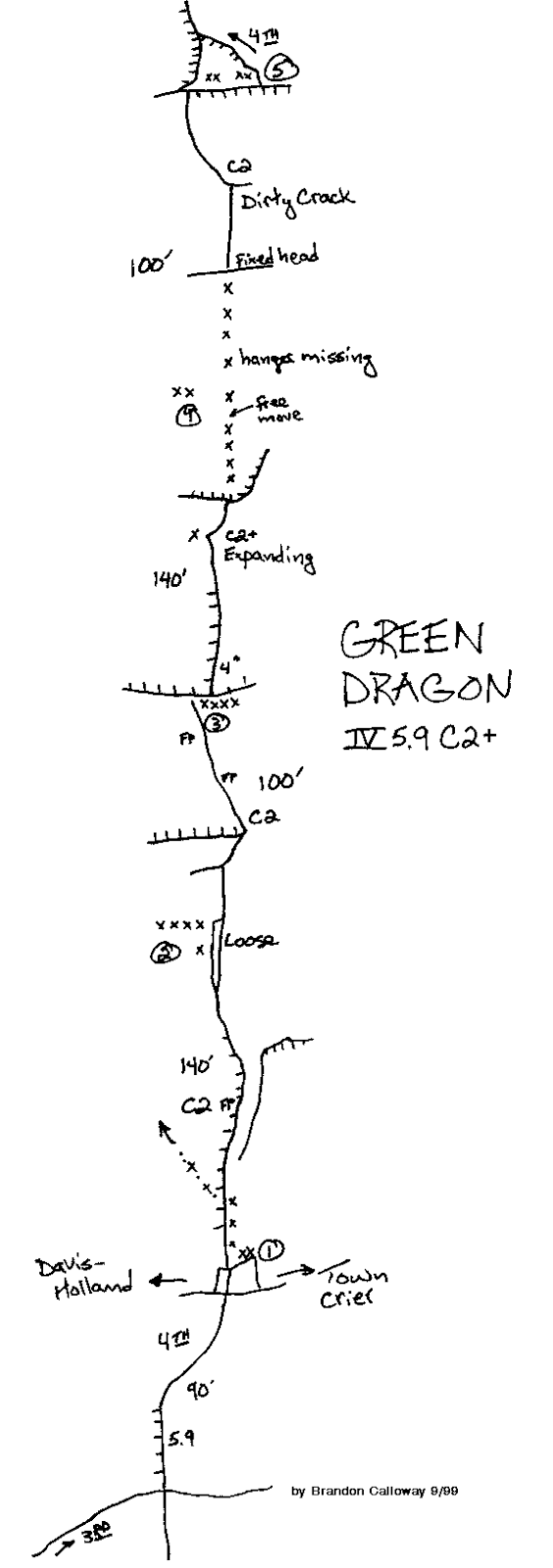
The focus is precise, the pattern of and distance between hand and foot holes are very important, the drawing below containing very detailed information about a particular climb.
Map of climbing route with X and Y coordinates of the holds
Because of their similarities climbing and art often converge. Lucy Gunning's video 'Climbing around a room' 1993 is a classic work of the time.
Lucy Gunning: Climbing around my room
The route Gunning takes around her room effectively drawing the space of the room in real time and real space. I have always enjoyed watching this video of her, partly because it defamiliarises a common taken for granted space but also for the fact that she wears a red dress and not special climbing clothing. Somehow this democratises the idea, this could be anybody climbing through these spaces, you too could do this.
Alex Hartley
Alex Hartley is another artist that climbs, this time over buildings, he often exhibits images of the places he has climbed, with his climbing route mapped out over a photograph or drawing of the building. I first came across his work in Edinburgh at the Fruitmarket Gallery, the image above is of Hartley climbing up the front of the building. in contrast to Gunning I get the feeling that he is putting his mark on the place, in effect conquering it. This more 'male' (or traditionally male associated idea) is certainly an aspect of Matthew Barney's early work.
Alex Hartley: Drawings of climbing routes over buildings
Back in the 1980s Matthew Barney came to our attention with a series of works called 'Drawing Restraints', whereby Barney worked to make drawings within the strictures of self-imposed restraints. In the video Drawing Restraint 2 (1988) Barney is harnessed and pulling against a rope as he attempts to run up a makeshift ramp in order to reach a sheet of drawing paper pinned to a wall. Drawing Restraint 3 (1988) is of Barney in a high-ceilinged exhibition space climbing the wall to reach the ceiling. When he gets there, he makes his drawing and then climbs down. In this case climbing and drawing become combined. However the mountain climbers that make drawings of the climbs they have made also combine the two activities, often making small sketched notes of the hand and foot holes needed in order to attempt the ascent, so that they can develop a detailed map of the climb afterwards. It would be interesting to exhibit the drawings alongside each other. What would they tell us about human beings and their relationship with the rest of the world?
Matthew Barney talks about Drawing Restraint
Matthew Barney: Climbing and Drawing (Drawing Restraint 3)
There are several other connections between drawing and climbing. The use of ropes and pulleys in particular are common to both practices, plumb lines being used to help artists assess verticality, string gridded surfaces used to help with the transfer and scaling of images. Ropes and pulleys are an essential addition to a sculptor's studio and are used to move heavy weights around, they are of course also used by climbers to help them traverse otherwise impossible surfaces. You can see both sets of tools in combination from the photographic records of the carving of the Mount Rushmore monument overseen by the sculptor Gutzon Borglum, who both designed the monument and developed the techniques for its construction.
Details of workers carving Mount Rushmore
I was reminded of this link between drawing and climbing when writing my last post on the work of Hew Locke, his use of vertically hanging beads helped to energise the wall spaces around his bead drawings, but in this case the vertical lines are working to facilitate the creation of the huge sculpture itself. Gutzon Borglum is a fascinating artist, especially in relation to art and politics, so I might devote a further post to him and his work in the future. Drawing as climbing is closely related to what the 'drawing to perform' community of artists do, and if you are interested in this they advertise up and coming events here. Some other posts relating to drawing and dance and other more performative approaches The Planetary Dance of Anna Halprin Dancing and working on the floor Drawing and dance Performance drawing Walking and Drawing