Showing posts with label drawing devices. Show all posts

Thursday, 21 March 2019

Drawing as testimony

There is an area of drawing that is often underrated and as I have remarked before, also made to feel inferior by being regarded as illustration. This is drawing done directly in front of the world, reportage, or direct responses to life as it is experienced. Historically this thread includes Pieter Bruegel, Goya, Rembrandt, Otto Dix, Daumier, Edgar Degas and many more artists that at their core looked at and experienced the world through drawing, and in doing so derived a deep understanding of what it is to be human.

I try to continue in my own small way this tradition by walking my local streets and drawing. My skills are nowhere as good as they need to be but at least I feel that some of the reality of the streets seeps into the work I do.

This post is about artists who have drawn directly from experience, and like Goya, sometimes these artists find themselves in dangerous and difficult places, and yet also like Goya and Otto Dix, they still managed to get down on paper their feelings and observations. Drawing is not like taking photographs, the split second of the photograph means that you only glance in the direction of what is happening, sometimes not even looking, because you can only point the camera and hope for a good shot. But if you draw you need to look hard and long, thus confronting the situation, taking it in at a much deeper level.


The artist Avigdor Arikha was known for working only in natural light and for producing each of his images in one day. Both of these working methods were due to Arikha’s decision to focus on prioritising the act of observation. He would often give himself limitations within which to work, for instance at one time restricting himself to black and white, a restriction that he imposed upon himself for seven years. 

Working within an imposed set of severe conditions was something Arikha would have had to learn from an early age. He survived his early experiences as a boy in a concentration camp during the second world war, because of drawings he made on scraps of paper of images that were direct impressions of the horrors he was experiencing as a camp inmate. On a visit to the camp, delegates of the Red Cross saw some of his drawings and realising the importance of his revelatory images managed to engineer his own and his sister’s escape. 


Avigdor Arikha: drawings done as a boy in Transnistria concentration camp

Because of his Jewish identity, Arikha was only able to escape the concentration camp by taking on the identity of a boy who had just died. To become a dead person in order to live is one of those experiences that must shape one's view of life forever and in Arikha's case I think it was seminal to what he was to eventually develop as a body of work. His art training in Israel introduced him to European abstraction and this was to have a lasting impression on his compositional choices; selection and simplification of forms being vital to his own process of self-reflection. His perceptions needed to be stripped down as they arrived in all their complexity in order for him to understand what it was he was seeing. The critic Robert Hughes described Arikha's process as one suffused with  an "air of scrupulous anxiety", the act of drawing, being never an easy one, especially when you realise that in some ways you only see through someone else's 'dead' eyes. Arikha's work has a nervous, edgy quality, to it, one that reminds you that no matter how hard one might seek to be objective, a point of view is hard to avoid, because it can seep into the image from the way a pen is held or from the confidence with which a mark is drawn. The artist's 'touch' can at times be just that; a touch that transforms by its very nature. 

Lord Home

I well remember Arikha's portrait of Lord Home the Conservative Prime minister, one of those rare portraits that seemed to capture the nature of what the political animal is actually like. Arikha seemed the perfect choice to make a painting of Home, because he was able to see the death in life of the conservative mind. 

Avigdor Arikha: Samuel Beckett

Avigdor Arikha: Knife and bread

Avigdor Arikha made many drawings and paintings of people and landscapes, but of all his images the ones that I feel make the most impact are those of simple basic objects. His image above of a knife and bread being a wonderful example of that confrontation with the play of light passing over a few moments of the day. He makes these moments as solid as a mountain, this rock of bread will break your teeth if you try to eat it, it is not for eating it is for looking. This image is of a few moments preserved in all their richness, a sight made all the more precious because at one point there was to be no more looking for Arikha and he still can only see out of a dead boy's eyes.


Eric Taylor: Images drawn in Belsen

The images above are by Eric Taylor, a former principal of the art college in Leeds where I still work. When I began my teaching career Eric was still working in the college making ceramics. He was a quiet, inwardly focused man, who at that time used to come into the college every day to work. This was his reward for services rendered, after devoting his life to art education he was given free access to the college studios and facilities and used these until he was in his 90s. He was a beacon of sanity around which the department rotated, he didn't have to talk, he just made things and made them with love and care and an eye that relied on the experiences of life to tell him what to do. One of those experiences was in the services of His Majesty's Government as a war artist at the end of the second world war. He was one of the artists that had to record what had happened in Belsen concentration camp and there is no way that his training as an artist could have prepared him for what he was asked to document. The drawings he did at the time are now kept in the Imperial War Museum and act as reminders to us all of what people do to people when they forget that all people are people. 


Restoring Eric Taylor's mural

Set into the side of the Leeds Arts University's new building, you can see a three part ceramic mosaic mural. It is a joyous celebration of rural life, set into a wall facing a busy city road transport link. This is also the work of Eric Taylor, a far cry from the scenes he was forced to contemplate during his time as a war artist. Now fully restored these colourful murals are passed every day by a new generation of students who have hopefully not had to face what both Avigdor Arikha and Eric Taylor had to experience. However both artists at one time or another had to stare life in the face in order to make their drawings and in that process they learnt both about the world and themselves. 

In many ways the artist Pia Linz's practice is the opposite of these older artists' work. But it is perhaps a much closer reflection on how we as people in what we now call the developed world, experience life today. Because she works from behind a transparent shield, she sees the world through a screen and this, it would seem to me, is the everyday situation for many of us, be this the car windscreen, mobile or a computer screen.
Her 'Box Engravings' have developed from ideas of projection. What is interesting here is that these ideas are in fact rooted in the 15th century and if you go back to very old drawing devices such as Durer's perspective frame, the idea of drawing as a record of what passes in front of a flat screen or grid, can be seen as a constant that has lasted since the invention of perspective.

This is what Durer had to say about how to use his drawing apparatus. “Now draw whatever you wish to paint on the pane of glass. This is very suitable for portraiture-especially for those painters who are not sure of themselves. If you wish to use this method to paint a portrait, let the subject rest his head so that he will not move it until all the needful strokes are completed. ”


You can compare Durer's drawing apparatus with drawing aids used at the beginning of the twentieth century, the following text being taken from an advert for Ablett's glass plane above. "The teacher with the position of his eye fixed by the moveable iron ring, traces with brush and Chinese white the outline of the object, (rod, disk, cube or chair etc), which is placed on a table or the floor on the further side of the glass. The pupils, one by one, look through the ring and see for themselves that the lines traced on the Glass by the teacher, coincide with the outline of the model. Pia Linz develops her three dimensional Box Engravings by always using a fixed standpoint and turning around on her own axis. First, she builds a transparent Perspex box construction that is tailor made in response to her chosen location, for instance it might take the shape of a prominent building that can be seen from the location. Then once it is positioned, she sits inside the transparent Perspex construction and draws with a felt marker onto the inside of the construction what she can see. (Obviously she will have to swivel round as she draws in order to do this). After this activity is completed, she makes the drawing permanent by engraving the lines of the drawing into the Perspex.

In contrast to Durer's perspective frame however, in which the observer places themselves in the same position of the artist, here the observer views the world of the Box Engraving from the outside. The world of Linz's perceptions is always therefore contained within her construction. It is as if Linz's perceptions can never really escape the confines of her own head. The older artists had a confidence that their testimony would be something that was communicable to others, they had no need for complex devices. In Linz's case we feel that she has to provide a framework for her experiences, one that has to conceptually reflect on the research behind her ideas. However her work still operates as a drawn testament to the fact that she too sat out in the street and drew what she saw. It is a document and a form of reportage, but contained in a presentation far more suited to present day exhibition demands, the work sitting clearly within the domain of contemporary fine art practice.


Pia Linz: Box Engravings
See also:

Drawings on exhibition in the Pallant House Gallery (Includes some observations on William Coldstream and related artists)


Saturday, 2 April 2016

More drawing devices

I have looked at drawing devices before but have recently come across or remembered others that might be of interest. In particular this area might be of interest to those of you trying to work with ideas that question the 'authenticity' of the hand drawn mark or want to work in that space between photographic representation and drawing from perception. The constrained ball by Giha Woo is a product with lots of design flaws, however as an idea it is fascinating as it suggests that like a ruler you could use this device to draw straight lines. Thinking about it though, it probably wouldn't help that much, but it would be interesting to see what drawings would look like if you made a series of holders like the one illustrated to 'help' you draw. You could convert toy cars or similar objects with small wheels by taping pens, charcoal sticks, pencils etc. to them and seeing how they effected the types of marks you could make. 

The Constrained Ball designed by Giha Woo

David Hockney has used a camera lucida to draw portraits with. If you look at the examples below you can see how the camera lucida changes the way you look. They are actually very hard to use and you need to be already aware of the main issues that face someone trying to do a measured drawing if you are trying to use one. The main problem is keeping a steady and fixed eye point. You need to work looking through one eye and you also need to keep your head very still. The image you will see is also very faint because you are not working in a dark box, but when you get used to using one, you can use it to plot essential points, such as corners of the mouth in relation to width of nose, and in this way you can get a very good likeness. The concentration needed means that you will probably only use it for essential measuring points, therefore other elements of the drawing will probably be sketched in. Look at how the focus on the faces of Hockney's drawings below are much more intense than on the rest of the figure. He would also have had to ask the sitters to keep very still when using the device and they do feel rather 'stiff' in response to the situation. 
David Hockney: Portrait using a camera lucida

David Hockney

You can see how to use a camera lucida in the drawing below. You 'see' the image on the paper and in effect trace around it. Any small change in the head's position would mean however that any accuracy would disappear. 

Camera Lucidas

You can still buy camera lucidas, see but they are quite expensive, however for those of you interested in that grey area between camera made images and drawings they can be fascinating devices to experiment with. 


Artist's proportional measuring dividers

Proportional measuring dividers are another tool used to help measure relationships and once measured they can be used to transfer the measurements to a drawing that is either proportionally smaller or bigger than the original. There are short videos here and here that show you how to use them. Again using a device like this changes the way you draw. The measuring points themselves become part of the drawing and as you take the measurements the choices made as to where to take these from further affect what the drawing will look like. Typically you might begin to break a face down into areas of measurement like the image below. You don't of course have to measure in this way, and finding unusual or unexpected points to begin to measure from can reveal unexpected and novel relationships. For instance you can use these dividers whilst blindfold, feeling for the form and plotting the relationships on paper by pricking holes in the surface. 


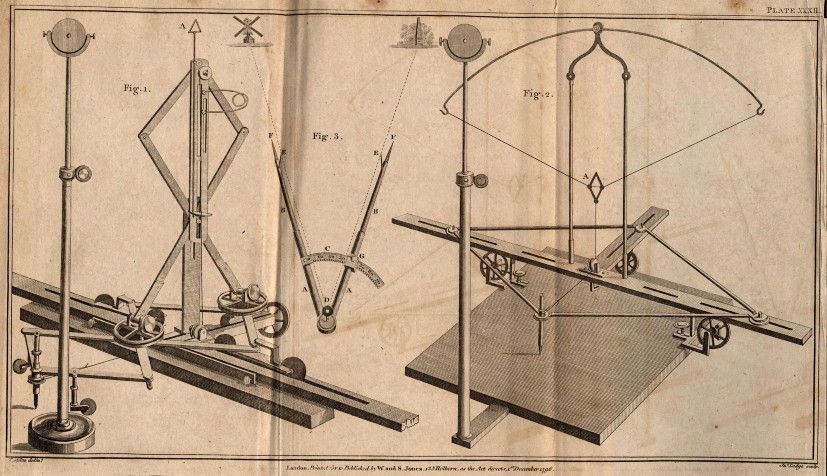
Devices that were built to help artists with complex perspective could be become very complicated. Looking at the drawing below, we have a situation that could be developed as a collaborative performance concept. 

A pair of Perspective Compasses. In: Adams, George: Geometrical and Graphical Essays, Containing a General Description of the Mathematical Instruments Used in Geometry, Civil and Military Surveying, Levelling and Perspective, with many new Practical Problems. London 1803


The image above of a perspective drawing device from 1803 suggests many other possible drawing machine inventions and could become a starting point for any of you wishing to revisit these ideas. Perhaps of most interest though is the fact that the drawings done to illustrate the devices are really good drawings in their own right. 

Finally, I have found a Japanese alternative to the chalk line. To see how it works see

Coda: Drawing with a mechanical plotter March 2023

My old friend Terry has been in Australia and when in Perth came across the work of Robert Andrew. As Terry describes it; "In his work a programmed mechanical plotter was connected by wires and pulleys to various points along the top of two facing walls. Suspended from these points were more pulleys and pieces of burnt wood, ochre and rocks. As the plotter moved (spelling Noongar words) the entire contraption of wood and rocks moved and made marks on the wall - but such tiny movements that you had to stare hard to see them. As your eyes tuned in you could see the whole wall was moving." 

As computer driven motors get more sophisticated in terms of their programming, I suspect more and more work will evolve from that interface between the drawing device, or machine for the  construction of drawings and AI and other computer driven concepts. This work of Robert Andrews is very interesting as it on the one hand still attaches us to the natural world of sticks and bits of rock, whilst at the same time bringing us into the human world of high specification technology. His point I'm sure being that the native aboriginal populations of Australia still exist alongside the new immigrant populations of a post colonial time. The old is always with us, even when we want to forget it. 


Robert Andrew

See also:


Monday, 24 November 2014

Drawing devices

Drawings as a record of action and process often include various drawing devices as part of the experience.
My earlier post on camera-less drawing reminded me of an area of drawing which uses a variety of strange and complex devices that can enable an artist to record information. One of the earliest examples we have of artists using devices to help them record the world is this image by Durer.


A complex arrangement has been set up to draw a lute in perspective. One person uses a pointer with string attached to indicate specific parts of the object and another person holds a marker so that when the door is shut a record can be made of where the point goes. This would have involved some complex moves. For instance before the door can be shut the stringing has to be moved out of the way. The string is kept taut by having a lead plumb attached to the ‘eye point’ which in this case is a hook set into the wall. It would be interesting to recreate this situation. How accurate would a drawing be? Looking at the situation more closely, Durer has made the drawing of the lute a lot larger than it would actually have been. Obviously he is trying to illustrate the process in detail, but if you look at the distance between the frame that holds the drawing and the ‘eye point’ on the wall you can tell that the frame should be a lot closer to the lute, if the drawing was to be the size it appears to be. At some point someone should try and build one of these devices, I'm sure  we would then have a method of making some quite fascinating drawings.

Another strange drawing device is one introduced already, the camera obscura. But what would this be like to work with? How would you make a device like the one in the image below?


The camera obscura above seems to work almost as an extension of the artist’s body. It operates as a sort of performative piece; if you ever encountered an artist actually working like this, you would probably accept the activity as a cutting edge example of contemporary drawing practice. Imagine walking round town making drawings in this way.
Could you create a 'costume' or 'outfit' that worked as a portable camera obscura? The sedan chair camera obscura (below) is another similar device, but you need a couple of willing helpers to get you around. 


These devices can be seen as sculptural objects in their own right, but they have much potential as objects that could be part of a much more environmental or performative approach to drawing practice.
One of the simplest tracing devices is a pantograph.


This too can be extended to make a more performative event. The very ungainliness and difficulty that begins to stand in the way of making a drawing begins to be interesting in its own right.

There are lots of different jointings that pantograph type machines can have, this is called the Watts connection.


There is a long history of these devices, artists have been also drawing them being used and they make for quite fantastic images in their own right.

An artist at work with an assistant.

Pablo Garcia has made twelve drawings of historical drawing machines, by using a computer numerical controlled machine, thus using a drawing machine to make images of drawing machines.


Pablo Garcia's drawings of drawing devices 

These devices can of course be reconfigured to accommodate more modern materials, look at the work of Trevor and Ryan Oakes here

 Trevor and Ryan Oakes: The concave easel

If you are inventive enough anything can become a drawing device.


Tim Knowles

Tim Knowles turns a tree into a drawing machine, the artist John Stell (a former LCA Fine Art student) attached spot lights to his legs and photographed the linear light traces of himself walking at night.

John Stell

Alan Storey: Handle With Care

Storey's shipping crates when folded out are seen to be surfaces for specially prepared pen carriages that translate the movements of the container as it is shipped.

Alan Storey: Handle With Care: Montreal to Vancouver
Trans-Canadian highway

It's interesting to compare Story's work with Walead Beshty's. His Fed-ex pieces are made of glass and sent out by post in carefully packaged containers. However they always break. Beshty is interested in rule governed behaviours, but there are always other associations that creep into a work's meaning, for myself it was the connection with Marcel Duchamp's Large Glass, which was itself broken in transit and then resurrected, with the break preserved.

Walead Beshty: Fed-ex: 2007

Many things can be done to record traces of events. Just leaving things out in the world will usually result in a drawing of some sort or other.


Images of surfaces that have been scratched, simply by heavy contact with the world.

Nikolaus Gansterer is an artist that works in this territory; for example he uses: "a writing tool suspended inside hardware that inscribes on a paper the wave movement of a canal, drawing instruments held on stretched ropes that are pressed onto paper by birds sitting on the ropes, 
papers attached to street cars that brush through the city or even plain papers get buried in the park becoming a test field for microbial activities". See his work here link 

Nikolaus Gansterer: Traces of Spaces

Modern computer technology has of course enabled artists to go much further with these types of ideas. Andrew Kudless has produced some fascinating drawings using programmed robotic machines. Find a link to these here.


 "Untitled #13," from "Scripted Movement Drawing Series 1" (2014) by Andrew Kudless

See also:

More drawing devices