Showing posts with label process. Show all posts

Friday, 3 July 2026

Drawing the processes of life

Gemma Anderson-Tempini: Garden of Forking Paths; Mitosis Score no.2, 2019. Pencil, watercolour and colour pencil on paper, 

When I attended the drawing conference "Drawing Across Along Between University Borders" in Porto in 2024, there was a presentation by Gemma Anderson-Tempini, whereby she outlined her work on what she called 'process biology'. I was fascinated to see how she had been integrated into biological laboratories, scientists obviously really appreciating what she was bringing to their understanding of the complex forms of life's processes. I was very envious of her contacts and thought the work she was doing was exemplary, so on getting home immediately bought a copy of the book she worked on, 'Drawing the processes of life'. The book explores how an artist might visually represent the dynamic processes of molecular level life, using drawing as a way of inquiring into living processes at the cellular scale. Drawing is shown to be a useful pathway to knowledge, rather than it being about the production of static images, something that I was aware I'm hoping to achieve myself, but also aware that I am still very concerned with finding that 'image' that sums an idea up. Her lecture was very useful and it gave me much food for thought. 

I am also interested in what she has to say because she had a complex installation constructed in Leeds in 2023, 'And She Built a Crooked House' whereby she had filled the rooms and garden at Burton Grange, a Victorian house in Far Headingley, Leeds, with elements of a journey through the fourth dimension; an artwork that was part-factual, part-historical and part-autobiographical. In addition to physics, concepts and ideas associated with the higher spatial dimensions were touched upon, such as maths, art, literature, cinema and the spiritual and I thought at the time that she had made a good fist of trying to show how these things could be ambitiously interconnected.

I wonder if I could make a similar or even more poetic set of connections and observations in relation to my own work. For instance is it possible to open out both scientific and sociological associations that begin with drawing the processes of life? Perhaps starting with the hand drawn diagram below of the relationship between RNA and DNA, that can be used to illustrate the fact that DNA stores genetic instructions, while RNA acts as a messenger and worker that translates those instructions into proteins. I like to think of the RNA as an open spiral, ready to connect, whilst the DNA is a closed spiral in love with itself. Reproduction and love being in our human minds often inseparable but also often subject to emotional stress. Our cells get RNA from DNA through a transcription process, which uses the DNA of a gene as a template to build a complementary RNA molecule. This happens inside the cell nucleus. This process is initiated when an enzyme called RNA polymerase binds to a specific starting sequence (the promoter) on the DNA, causing the double helix to unwind and separate. Once this happens a process of elongation begins, the enzyme reads the DNA template strand and builds a single-stranded RNA molecule by matching complementary RNA bases. However this is not a direct copy. For instance, thymine (symbol T or Thy), one of the four nucleotide bases that make up our DNA, alongside adenine, guanine, and cytosine (A, C, and G), is replaced by uracil (U) when RNA is constructed. Hence the three letter "start codon" that initiates the process is AUG. Like all other forms of transcription, during the process of converting data from one format to another, something is nearly always lost and yet at the same time, something is gained, a new read is possible, such as when a written transcription is made from a verbal model, by typing the information out it becomes more formal, it may then have more gravitas or appear to be more factual, it also becomes less personal, the unique sound of an individual's voice being lost and replaced by the chosen font that the printed text is now set within. 

Drawing of the relationship between RNA and DNA

I have looked before at the importance of folding as an underlying principle embedded into the idea of life and reproduction. Folding gives us a way to think about how reproduction is facilitated; for instance the first functions of chromosome folding are perhaps to mediate genome replication, compaction and segregation. RNA molecules play a central role in virtually all cellular processes. However in order to play out their roles, the various RNA molecules have to fold into specific three-dimensional structures. Therefore each and every RNA molecule has to at some point undergo the transition from an unfolded, disordered state to a functional conformity. A broader understanding of this transition has also led to the RNA world hypothesis. This proposes that early life forms relied almost entirely on RNA to store genetic information and catalyse chemical reactions, its ability to both self-replicate and operate as an enzyme being vital to the building of mechanisms that would eventually lead to the origin of life, facilitating both metabolism and reproduction. A RNA molecule is linear, but when folded into three dimensions ribozymes can be formed and they have similar abilities to enzymes which in turn allow for metabolism, the chemical reactions that convert food into energy. Most present day enzymes are now proteins; ribosomal RNA (rRNA) catalyses the formation of peptide bonds, stitching amino acids together to build proteinsribozymes. A ribosomal subunit is one of the two distinct, structural components that make up a complete ribosome. Ribosomes are essential for translating genetic information into proteins and are made up of two subunits: a small subunit and a large subunit. The small subunit binds to messenger (mRNA), which contains the genetic code for the protein. The large subunit adds amino acids to the growing protein chain. They are found in both prokaryotic and eukaryotic cells and are responsible for protein synthesis, which converts genetic information into the proteins which are essential for life, as they are necessary for all cellular functions.Together, these protein-and-RNA complexes act as the cell's molecular machinery, translating genetic information from messenger RNA (mRNA) into functional proteins.

I was pleased to find this illustration of the two subunits, we are built from blobs

Inside myself I know I house all sorts of bacteria, my intestines have a long standing relationship with E coli, which comes in a variety of forms many of which are useful to myself but some are harmful. Like myself though E coli will have a deep 'code' or 'codon' that determines the form that we will finally become, and we share a sequence of three RNA nucleotides (Adenine-Uracil-Guanine) that serve as the universal "start codon". The codon signals the cellular machinery to begin building a protein and dictates the insertion of the amino acid methionine. Methionine acts as the "start codon" (AUG) that initiates the translation of every protein synthesised in the body. The combined small and large subunit of E coli is in the scientific world named the 50S ribosomal subunit and it has been visualised as in the imasge below.
The 50S ribosomal subunit of E. coli 

I like this visualisation as it gives me a feeling that I think I know what sort of thing this is, even though I don't really. It intuitively feels like something I could grasp and if so, I can make something like it out of clay. It consists of three compartments, which are technically described as: the A (aminoacyl) site which binds incoming charged aminoacyl tRNAs. The P (peptidyl) site which binds charged tRNAs carrying amino acids that have formed peptide bonds with the growing polypeptide chain but have not yet dissociated from their corresponding tRNA. The E (exit) site that releases dissociated tRNAs so that they can be recharged with free amino acids. It is acting I think to put in place the first codon after the AUG. 

When I'm talking to people about what they feel their insides are up to, they may describe certain 'fictional' organs, such as a spleen, a something heard of but not very often seen, unless of course you are a medical professional. The drawn image of the 50S ribosomal subunit of E. coli has now begun to inhabit my visual archive and as such it will I'm sure emerge at some point as an image related to how I visualise an interoceptual experience. An image that is initially made to help describe one of the fundamental processes of life, becoming part of an image bank dedicated to visualising how we internally feel. Both the more scientific illustration and my feeling led forms, having a relationship to an idea that organic forms begin as blobs.

The issue for myself as an artist is that the processes of life are as much emotional as scientific. Yes I know that science is opening out amazing possibilities for our future, but I also know that our crazy emotional embodied mess of stuff, is what initiated the riots that happened in Southampton recently. I'm sure a scientist somewhere is at this very moment trying to isolate the various chemicals that were released as rioters achieved states of vitriolic anger, but my present feeling tone is one of anxiety and worry that a tragic death more to do with I suspect police incompetence, is seen by many as a sign of unfair treatment and the dire straits that some people find themselves in, can become situations that feel as if they can be transformed by smashing things up. Rioting can feel as if you are operating in response to righteous anger and some people are very good as triggering this. My body has been constructed using DNA sequencing but my conscious awareness of that is very much on the back burner as I watch the riots unfold, as I go back to drawing the processes of life, I try to acknowledge that both these situations are part of my life story. 

The riot in Southampton: Protestors make Nazi gestures

I'm reminded that science is often brought to a sudden stop by fascism. Emil Starkenstein Czech-Jewish pharmacologist, one of the founders of clinical pharmacology, was arrested by the Gestapo and murdered in the Mauthausen concentration camp in 1942. He would have been very aware of the role chemicals take in the construction of our mind/body complex, but nothing could have saved him from the mindset that took over the people who inhabited that part of the world at that particular time. I have to have faith that we will never return to those dark days, but to ensure that, we will I'm afraid have to have the courage to stand up to bullies and those that encourage them to think that aggressive action is the only catalyst for change. 

I would of course like to think that art can be a catalyst for change. Because it doesn't offer either / or answers and gives us a series of open ended responses as to how we can feel about the world, hopefully it helps celebrate difference and offers opportunities for reflection and speculation that lead to the opening out of imaginative new worlds. 

Sketchbook drawing

I often walk and draw. I look for things that both remind me of the thoughts I have been having and which I think might also become metaphors for them. In the case of the drawing above made in West Wittering last year, I was thinking about the sea as a constant devourer of the land and of how our bodies can be thought of as landscapes. Protruding spiral cut metal rods, emerge from a beach, their concrete base covered by seaweed; this rib-like structure, reminding me of work I had made that was itself a reflection on Japanese  Kusôzu images, those graphic depictions of corpses in the process of decay; images that were used by Buddhists to meditate upon the fragility of life and the reality of death. The processes of life are inseparable from those of death, there being a constant oscillation between the two states. In the acceptance of this we remove our constant internal suffering by coming to an understanding of the true nature of reality. Making a drawing of what you are seeing slows you down, it engages you in a dialogue with the materials of recording and the ability of your own body to shape those materials into a vision of what is seen. In doing this, contemplation begins and your breathing changes, becoming deeper and more in tune with the landscape you are within. I would argue that drawing is itself also therefore a process of life and that it is in many ways a form of meditation. My own image bank has recently been dedicated to visualising how we internally feel and these images are imaginatively conceived in the drawings I make of my external world. The process of drawing is internalising my perceptions of the external world. As these perceptions are recorded, they become as internalised things, not unlike those other internal objects that I think of as my body's organs or the scientific illustrations such as the 50S ribosomal subunit of E. coli that I have also recently been looking at. This personal narrative becomes a story out of which emerges the things I make as art, products of my own life's processes.

See also:

Thursday, 19 September 2024

Body cartography

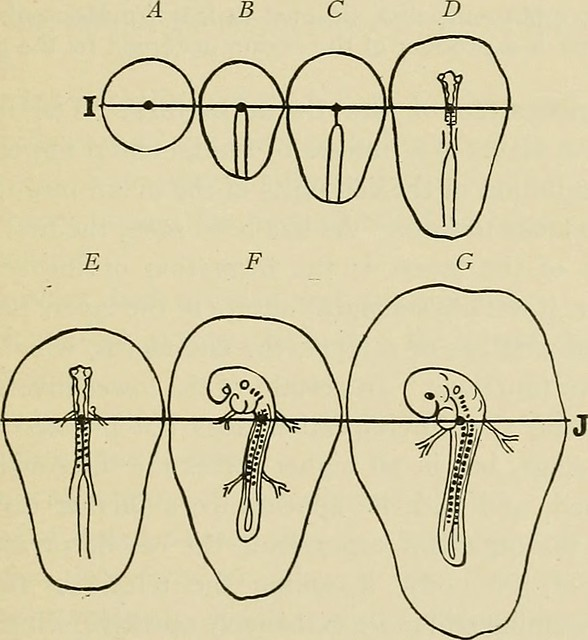
Human embryonic development

I have been looking at the work of the body cartography project. This is something that has been underway for some time but I have only just discovered it. Perhaps this is because I have only recently begun to look more closely at how dancers work, however as artists of the body, they are finely tuned to somatic experiences. Body maps have interested me for a while, and the body cartography project bases its focus on the developing of experiential tools that are derived from somatics, (sensation-based movement practices), dance and choreography. The background scientific research they have done, because they are focused on movement and change rather than static facts, is focused upon embryology; the branch of animal biology that studies the prenatal development of gametes, fertilisation as well as the development of embryos and fetuses. 
Carla Bottiglieri, a project researcher for the body cartography project, has stated;
"With embryology, anatomy ceases being the static, achieved geography of structures – a stillness that is primarily borrowed from the cadaveric inertia of the dissected body – and reveals what moved and still moves our seemingly silent interiors. Learning through embodiment may start from a choreographic-like mind, the one that takes images as maps, maps as diagrams, and everything as scores. In the case of embryology, the term score seems almost to be closer to music than to dance, and in fact lines and directions describing the all too busy movement of the forming embryo, in order to be “correctly” read, need kinematics being paralleled with dynamics: a play of intensities, rhythms, simultaneous events, different speed rates."

This statement immediately drew my attention, because I have for a while been working to develop a way of making images about interoceptual experiences that are not reliant upon static anatomy illustrations from medical textbooks, or some sort of fixed map that tries to pin down where things occur. I have been looking for various ways to open up my own and others awareness of the body's kinetic inner perception of its own sensations, which hopefully might bring about a more nuanced sense of our presence in the world and the experience of being.


Embryology Sections

Tree with root system

The study of embryology also includes an awareness of the evolutionary history of the human body and the bodies and forms of other living creatures. For instance our cranial bones are developed in the mesenchymal tissue surrounding the head end of the notochord; a process that begins in the foetus by the end of the first month of pregnancy. Most of the cranial vault and a portion of the base of the skull arise as membranous bone. However there are two types of evolutionary origins or paths that are operating here and they occur simultaneously and complementary with each other in the formation of the completed cranium. We are a type of primate, and the development of the primate skull consists of neural and visceral (branchial) components. The neural portion consists of the brain case and the capsular enclosure of the special sense organs. The visceral portion is derived from the embryonic counterparts of the branchial arches, which, in fishes and tailed amphibia, support the oral and pharyngeal regions. These visceral components function in respiration and mastication. The formation of the primate palate being an innovation which permits infants to suck and the adult to chew while respiration continues. The neural and visceral components of the branchial arches include Branchial motor neurons that are located in the brainstem and which supply with nerves the muscles formed by the branchial arches. The branchial arches are a series of six paired arches that form in the head and neck of an embryo during the fourth week of gestation. The arches are made up of four tissue components: cartilage, aortic arch artery, nerve, and muscle and they will eventually develop into the face, neck, and oropharynx (soft pallet, tonsils, and part of the tongue).

Fetal skull

So why is this so important? The structure of the primate palate means we can't breathe and eat at the same time, but we can coordinate breathing and swallowing to allow for eating. The pharynx is the shared route for both functions, but it's used differently for each activity. When breathing, the pharynx dilates to keep the airway open, but when swallowing, it constricts to push food down the oesophagus. When at rest, the epiglottis is upright and allows air to pass into the lungs, but when swallowing, the epiglottis folds backward to cover the larynx's entrance, preventing food and liquid from entering the lungs. Swallowing is therefore a complex process that involves coordinating more than 26 muscles and 6 nerves. When swallowing, breathing temporarily stops, and becomes more irregular and this can lead to problems, some of which I have had to face myself at times. As part of my own process of self awareness, I have to make sure I am calm and relaxed when eating, if not I can easily find myself with muscle tension in the throat, which leads to a difficulty in swallowing due to a globus sensation (a persistent but painless feeling of having something stuck in your throat when there is nothing there). that I can experience because of anxiety. The complex interconnection of interoceptual experience, (somatic feelings) and the autonomic nervous system that mediates unconscious activities, is hard for me to understand and yet I have begun to think that it is very important. So for myself, my own body map has one of its focal points around the throat, and since I have had problems with plantar fasciitis, another is the base of my left foot.

Trying to visualise plantar fasciitis

By owning some sort of visualisation of these sensations, I can help myself move on and not be stopped in my tracks by them, as I have literally been in the past. I.e. I can to some extent try to adjust my mental state in order to maintain some sort of 'homeostasis'. (The process of keeping your body in balance by noticing changes and then acting upon them to regulate your systems). There are many ways to track your environment and spot any changes, some are very obvious, such as seeing something dangerous in the distance, or hearing a loud noise coming closer and then you can act appropriately, but an awareness of other more subtle changes can be more intuitive, and they may be 'felt' sensations, or beliefs, which are harder to pin down, but they are still perceived experiences. We have a wide range of equipment that extends our body's perceptual abilities, such as microphones, telescopes, microscopes and radar, all of which can be used to predict external changes, but as yet we have few mechanisms that can measure internal change and it is the complex arena of our inner lives that fascinates me and that I have been trying to visualise.

Anatomical diagram of the throat

Visualisation of interoceptual awareness of swallowing air

However, one of the most complex issues facing embodied awareness is the status of the other creatures that inhabit and make up what I think of as my body. As far back as 1991 Lynn Margulis had introduced the idea of the holobiont, a term used to describe a host organism and the microorganisms that live on or within it, such as bacteria, viruses, and fungi. The holobiont body, is a body, like our own, where over 50% of the cells are microbial symbionts that are integrated into the physiological, anatomical, developmental, and immunological processes of the body. Therefore the actualisation of the body only occurs through the support of teams of species and in consequence an idea like 'immunity' can be thought of as a holobiont function, wherein microbes and zygote-derived cells cooperate for mutual defence. The zygote cell undergoes cleavage, or cell division and when it does, the new cells are called blastomeres, which are smaller cells that form a compact mass called the morula, which is the solid ball of cells that form the early stages of embryonic development in mammals. There is an elliptic visual connection here in that the word "morula" comes from the Latin word morus, which means mulberry, fruits that do indeed look very like the blastomeres and this year our mulberry tree has fruited abundantly for the first time. As Shakespeare knew, you don't pick mulberries as they will break up in your hands, you put sheets down under the tree and shake it, then collect all the fruits that have fallen.

Now humble as the ripest mulberry
That will not hold the handling.
                                        Coriolanus

Mulberry

A: The morula.  B: A cross section of a blastula

If we die, all the creatures that live on and within us die too or have to move elsewhere, just as if and when the Earth dies, all the creatures that live on and within it will die too. In order to maintain some sort of 'homeostasis', an environment of co-habitation needs to be fostered, and this needs to be about mutual intra species processes of symbiosis, something that can be suggested by the processes of the visualisation of feelings, even if it cant be depicted from observation. The flow of movement that suggests the processes at work here is what the body cartography project is most interested in and it points out that the body is in its peak flow mode during the first few weeks of its life. Many of the signals that are sent out by an organising fetal entity are intra-species, a microbial life is being ushered in just as much as a mammalian one. The more we understand this, the less I would hope that we are bothered that some mammals are darker in skin tone than others.

The body cartography project uses dance as a form of embodied learning and communication. I posted recently on Katia Heitmann's work, whereby a dancer will observe others and then attempt to mimic their body movements as a form of archiving. The body cartography project is similar, in that a dancer wants 'to pay attention to and to move with things that are invisible yet also and therefore, invisible in the sense that you’re not seeing the same body structure and also invisible in the sense that things that are very patterned or repeated or are not very apparent sometimes, forgotten, like the sensation of wearing your clothes'...

Taken from a record of a conversation during the Fluid Spaces Event: Teknisk Museum, Oslo in 2022.

It seems to me that the dancer was searching for a way of communicating things that are on the edge of our awareness, in a similar way to how I am searching for a way of making myself and others aware of some sort of interconnected flow of energies, a flow that I could hopefully visualise in either drawing or ceramics.

From a developing animation

This way of thinking is not new, and if you have been reading my posts over the last few years, you will have seen that I am fascinated by the various theories that emerged during the 19th century as ways to explain what was going on in the world. The emergence around 1800 of the science of embryology was at the time a theory based on the epistemology of rhythm. At the time the concept of rhythm was crucial to many fields of knowledge, including the study of life and living processes. This led to an understanding of the living world in terms of rhythmic patterns, rhythmic movement and of course rhythmic representations, and it echoed Schlegel’s statement that, “All art should become science and all science art; poetry and philosophy should be made one.” The Romantic ideal was that the aesthetic approaches of art and literature could reveal patterns and meaning in nature that couldn’t be uncovered through rationalistic philosophy and science alone and this argument is something that I still have a great deal of faith in.

A link to more embryology images here

The illustration that describes the transition of a dot, as in drawing A, its extension and growth through to a recognisable form at point G, is as much poetry as science. At no point is a body ever either as it is represented at B or at G or at any other point, all the images above are figments of the imagination of an artist. 

B and G

Perhaps what I'm really interested in is the idea of 'becoming'. Becoming is a process that eludes observation and is hard to represent, which is why it is interesting to myself as an artist. Things that are directly analysable or measurable can reasonably easily be depicted, but there is a hard cognitive and perceptual struggle to be had, if we are to visualise processes that are continuous and often invisible and felt with senses other than the visual. This it seems to me is a worthwhile task, and it keeps driving me on to make the images I do and to believe that at some point these images might actually become useful.  

References:

Richards, R.J. (2010) The romantic conception of life: Science and philosophy in the age of Goethe. University of Chicago Press.

Wellmann, J. (2017) The form of becoming: embryology and the epistemology of rhythm, 1760–1830. Princeton University Press.

Wellmann, J. (2021). History of Embryology: Visualizations Through Series and Animation. In: McCallum, D. (eds) The Palgrave Handbook of the History of Human Sciences. Palgrave Macmillan, Singapore. https://doi.org/10.1007/978-981-15-4106-3_22-1

See also:

Maps made by our nervous systems

Drawings as aesthetic transducers

Katja Heitmann and embodied learning.

Eco awareness and OOO

Parascientific visions and Rayonism

Dr. Hippolyte Baraduc's theory of iconography,

Sunday, 21 April 2024

Process or substance ontology?

A lump of clay suggested this

I have been over time trying to write about my activities as an artist who draws and makes things under two essential headings, both of which at one time or another have been regarded as a particular nature of being, and it has always been difficult for me to reconcile the two approaches. One has been substance ontology, in which objects are the focus of philosophical interest and the materials of making become central to an understanding of possible metaphors. As a maker, I am very aware of the primacy of materials and how their physical nature shapes and affects possibilities, so I'm particularly attracted to this approach.

Cardboard, tape, a discarded child's bedroom table and a ceramic thought suggested this

The other is as a process ontology, which sees change as more fundamentally real than objects. This way of thinking seems to concur with an awareness of time and the nature of energy fields. At a deep level all is rhythm and a dance of particles and intellectually this is if I think about it probably true. So I am drawn towards any philosophy that argues this case; such as Alfred North Whitehead's as explicated in 'Process and Reality'. He believed that fundamentally, nothing exists in itself, everything is in transformation all the time. Therefore, all that really exists is the relationship between "things", such as mass and energy. This relationship can be either potential or actual. These ideas were based on his particular understanding of quantum theory, which for Whitehead was mathematical. Whitehead sought a holistic, comprehensive view of reality that provided a systematic descriptive theory of the world which could be used for 'the diverse human intuitions gained through ethical, aesthetic, religious, and scientific experiences, and not just the scientific'. A stance which of course led to his work being regarded as of great interest by artists such as myself. Intuition and aesthetics in particular holding a very important place in my own attempts to get to grip with what it is to think through the role of art as a means to come to terms with the world. Whitehead helped me to reconcile my own diverse approaches to visualising life experiences or at least to accept that I didn't have to always be clear or sorted out in my head about these things and that if I was confused, I could live with the confusion.  

Everything is in flux, but our problems seem to remain the same

Back in 1929 Whitehead stated; 'We diverge from Descartes by holding that what he has described as primary attributes of physical bodies, are really the forms of internal relationships between actual occasions. Such a change of thought is the shift from materialism to organic realism, as a basic idea of physical science'.

Whitehead: Process and Reality, 1929, p. 471


Seen that way, the important elements that make up a drawing are not the material things that it is composed of but rather the processes that come together in its becoming and these things are always shifting. However the material reality of the process is fundamental to how that process will operate. 

The peristaltic wave 

Trying to claim either one aspect or another as being fundamental to the make up of a drawing is perhaps a not very useful activity. My attempts to visualise inner body experiences have tended to be done by fixing certain visualised moments within a wider awareness of ongoing processes. Whitehead would though I think if he looked at this work, suggest that I have a problem with constant flux or change. 

The body as a moving inside/outside mass of energy

Perhaps all I'm looking for is a way of visualising moments of stability within the chaos of being and that death is just the dissolving away of one particular process that was stable for a time.

However the ultimate abstract principle of existence for Whitehead is creativity. Existence itself is for Whitehead a process of becoming, and “'becoming' is a creative act. This helps and reinforces my belief that every drawing or made image is also a metaphor for life itself. 

We experience this 'becoming', according to Whitehead as 'occasions' and these he states come in four types or grades. 

The first is a fundamental underlying force, like those interacting with a Higgs field, such as the propagation of an electromagnetic wave or gravitational influence across empty space. The second are occasions of experience that involve inanimate matter, something that I personally read as an opening for an animist reading of Whitehead's ideas. The third being an involvement with living organisms, a hierarchy which reminded me of Raymond Lull's ascending ladders and  the fourth, which was about the experience of presentational immediacy, which means, I think, the qualia of subjective experience. This 'presentational immediacy' Whitehead suggests, occurs  only in more evolved animals, again something I'm not sure about, but I know what he means. However I can only accept this if these things are enfolded into a totality of being, a totality that acknowledges that the qualia of experience are dependent on an interaction with the Higgs force and all living matter is composed of inanimate matter, which is itself composed of fundamental forces.

The mental and the material aspects of experience or becoming can therefore for us humans be seen as verbal or visual abstractions from experience, (interpretations via various languages). The brain is part of the body, and both are abstractions of a kind referred to by Whitehead as 'persistent physical objects', or in my mind 'nouns'; neither being actual entities. All of which points to a type of understanding that again sits within a flux of becoming; a flux which means that at one moment I seem to be able to nail down a thought, but the next sees everything dissolve into the flow of being. But things are still things and as such they seem to have their own reality.


Three responses to material possibilities offered to me by collaboration

These three responses to what others had done, were all made as part of a 'vitrine' project, 'Regenerative Things' and were done in relation to a 'Thing Power' research group. I'm no longer part of this project, but it did help me to come to terms with an acceptance of change and the letting go of ownership, as whatever was done, was quickly pulled apart and dismantled by someone else, but at the same time something of the idea, or material potential would remain, as the work was reinterpreted by whoever followed me and what I was therefore providing was 'potential'; and it is perhaps this idea of 'potential' that is the most intriguing for me. 

Every art work ever made is like a battery that is charged with 'potential'. As someone looks at and considers a drawing, a painting or an object, that potential is released as a thought transfer. The materiality of the work, gives weight and externality to someone's thinking, so that it can be offered forward to another person as a materialised thing. Those that encounter the 'made thing' can then interpret it in whatever way they need to. This potential is for myself so exciting. In my mind, it sits alongside the body's interoceptive ability to predict. The main thing I have taken from my work on visualising interoception is that the body is a focus for the construction of prediction loops, whereby emotions and physical responses to stimuli are entwined together in order to respond to things before they happen. The body hosts a mass of interconnected triggers that make it do stuff in response to best guess scenarios and this system of making best predictions, is central to how we think. By inventing a new thing that is open to interpretation, others are challenged as to how to read a possibility. Some will not see any need to spend energy on this but others will and the fact that something new has been made that adds to another body's awareness of potential is a wonderful idea. 
References:

Barrett, L. F. (2017) How Emotions are Made London: Pan
Pert, C. B. (1999) Molecules of Emotion London: Simon and Schuster

See also:

Why interoception

Friday, 18 June 2021

Natasha Kidd: Painting as Disegno

Natasha Kidd: Overflow

Natasha Kidd makes automated paintings, systems or machines.  Her mechanisms fill paintings from the inside and in making visible the process, action and event of painting itself, I would argue she returns painting back towards a need for grounding itself in disegno. I'll try and explain. Disegno is a Renaissance term describing both the ability to make a drawing and the intellectual capacity to invent a design. It was seen as something all artists, (painters, sculptors or architects) had to do in order to 'design' or visualise their ideas. Disegno was the underpinning framework that a painting was built on. If you wanted therefore to reveal or make visible the processes from out of which a painting emerged, you would show the pentimenti (underlying drawings), cartoons, and the studies, which would again all be drawings. 

It is interesting to compare Kidd's work therefore with more traditional approaches to making visible the process, action and event of painting itself. 

Robert Polhill Bevan: The Feathered Hat: Study for a portrait of the artist's wife 

The black chalk drawing above has been squared and numbered for transfer, by leaving this process visible, Bevan in effect is also making visible one of the processes of painting. 

Natasha Kidd: Flow and return

The underlying grid that so many painters used to transfer their drawn image onto paper, echoes the grid of pipes Kidd produces in order to 'feed' her canvases with paint. 

Jenny Saville: Study from Pentimenti 

Jenny Saville’s Study from Pentimenti is an image that demonstrates how making visible the process still can be achieved in more traditional ways. This time it is the pentimento or adjusted underlying drawing that is revealed by Saville as part of the disegno process. 


Titian: Bacchus and Ariadne 

Beneath the figure on the left in Titian's 'Bacchus and Ariadne' there still exists an adjusted drawing or Pentimento. This normally invisible process can be revealed by x-ray photography and once extracted or separated from the original image, becomes something new again. 

Another meaning emerges if we go back to the original Italian understanding of 'pentimento' which is repentance. This suggests that changing one's mind can also be a type of repentance or regret. 

Jasper Johns: Regrets

The adjusted drawing is also the place where imagery arrives or emerges from the process of making a drawing. In Johns' image 'Regrets', the dark vest like shape and skull image that sits above it, emerged when Johns began drawing from an old torn photograph of Lucien Freud that was found on the floor of Frances Bacon's studio after he had died. The torn out section of the photograph, the missing element, became a positive when the image was mirrored and redrawn, and for Johns the pentimento is now the final image.  This too could be compared with another of Kidd's images. 

Natasha Kidd: Painting that is machine dipped

The paint ripples and lines demarcating levels of dip in Kidd's work, could be compared with Johns' ink washes made within the boundaries of a traced series of shapes taken from the original photograph. The painting as it rises and falls into the vat of paint, creates negative spaces around itself, the rectangular form of the dipping tank, echoing the shape of the canvas. Both Kidd's and Johns' work being self reflective and concerned with the processes of making art itself, in Johns case he recognises other artists and their mythologies as being part of the process, just as much as the physical action of putting paint onto canvas. 

See also:

Drawing machines at the Venice Biennale 

Drawing devices

Drawing from old masters

Process and its documentation

Wednesday, 1 January 2020

Mike Croft: The Observation of Perception

Guest drawing blogger: Mike Croft

For the starting post of the new year I'd like to introduce Mike Croft who is the first of my guest drawing bloggers. I first met Mike in the early 1980s when he was making a series of large drawings of cathedrals. These were impressive studies of the types of complex spaces that you find in buildings that have been built on organic principles rather than to an architect’s plan. We were both working on the Foundation Course at what was then the Jacob Kramer College and because of the importance of drawing in the curriculum at that time, we found ourselves constructing situations whereby certain different aspects of observational drawing practices could be explored. Mike left to move to London and then on to S.E. Asia, teaching on various design-based programmes in universities. His most significant pedagogic experience being developing an exploration of the perception of movement with the first year students of a new design programme in South Korea. Movement and the question of time, of which movement is of course an expression, have been abiding interests within Mike’s work for several years and being able to explore this with a group of students who already had strong drawing skills was a cathartic experience. 
Mike has this to say about the changes he has experienced when teaching and making drawings. “Thinking back to the days of Jacob Kramer College, the emphasis seemed much more on the image, and a degree of investment of rigour in drawing to ensure that the image was well founded. What may have changed, and has certainly been my more recent experience of teaching through drawing, is an emphasis on drawing as a research tool that students use while not necessarily being interested in drawing as its own medium, or a medium of fine art”. I would suggest that the change is more one of philosophical positioning here at Leeds. Drawing as process is of course important, but perhaps we are now looking more at drawing as a thinking tool rather than observational record. 
Mike points to his work as having “a certain cursory character compared with what you might imagine as being a ‘well founded’ image” and points to Henri Bergson’s distinction in ‘Matter and Memory’ ([1912] 2004), between what he calls the ‘present image’, as opposed to the ‘represented image’. ‘Representation is always there, but always virtual – being neutralized, at the very moment when it might become actual, by the obligation to continue itself and to lose itself in something else’ (2004: 28). Mike loves this quote, pointing out, “concerning conscious perception, because through it one can acknowledge and build into an image one’s own sense and feelings of movement, and the drift and development of thought and action while drawing. The ‘present image’ may be considered the image in its sense of passing through, and conveys in essence a degree of insubstantiality but in the affirmative sense. Of course, in the sense of difference between say, the sketch and the finished work, this is nothing particularly new”. He points to the recent drawing blog post on ‘clouds’ stating, “what more beautiful instances of ephemeral insubstantiality than clouds!”
When I look at Mike’s drawing research, I’m always impressed with his focus and clarity; recent drawing experiments whereby he explores how to respond to changing perceptions in relation to movement, as always reflect his desire to be accurate, minimalist and systematic in response to the overwhelming amount of experience that sense data provides us with. 
Mike’s blog posts are designed to help you as drawers think more carefully about movement. (He has crafted two, but because there is a lot of information to digest, they will be separated by a few days) As he points out, “working with and through movement in drawing may possibly be a way of attending more to how we see, perception itself, rather than perception’s resulting observations, while attending no less to whatever is the motif, the object of observation”. 
When drawing, going back to hard earned thoughtful and measured looking is always worthwhile and Mike helps us approach the process with fresh insight. 

Bergson, H. (2004) Matter and Memory (first published 1912) New York, NY: Dover
Link to TRACY where Mike has made some of his earlier research publicly available.

The Observation of Perception: Mike Croft

What I’d like to say relates to drawing that concerns observation of the external world, but through the filter of perception. Of course, that there is a relation of the latter to the former is obvious, yet we may tend not to notice, let alone see, perception’s role in the process. Also, conventionally, we mostly select objects for drawing that are still or slow moving enough to enable what we assume will be some degree of representation of them. Notice that I’ve used ‘some sort of’, ‘may tend not to’, ‘mostly select’, and ‘some degree of’, which suggests that nothing I’ve so far said can be really concrete; it’s all open to interpretation.  However, insofar as what I’ve said is relatively true, the facility of observation, in this case primarily visual, is automatically challenged and even sometimes contradicted by aspects of our innate biological and physiological facility of perception. 
Perception may be said to work both for and against objectification of the object of vision, mostly in ways that are either automatic to, or beneath our awareness. How I happen to think this is due to at least two pivotal realisations – points of learning – neither of which happened in art school drawing classes. This is not to say that the classes did not provide the potential for such realisations, just that they were not theoretically articulated at that time. The situation may be somewhat different now. The first realisation was back in the 1970s’ when I was first a student. I happened upon a large-format book on psychology, in which was a photo of a girl’s face and next to it a semi-abstract rendition of it that transformed the face into a continuous kind of line map comprised of tiny flicks and dashes. (The phenomenon of drift and flickyou might, yourself, wish to look up on the Internet in relation to visual perception.) The rendering of the face turned out to be a printout from a non-digital eye-scanning portal, a device invented by the Russian psychologist Alfred L. Yarbus (1914 - 1986) in the 1960s’. The device would record eye movements of a person attached to the device while looking at an image, usually a photograph, for a short period of time. The limitation of this is that the observed material does seem to be photographic, and therefore flattened, but I was quickly extending the visual characteristics of Yarbus’s findings to objects in three-dimensional space.
There are now digital equivalents of eye-scanning portals, but they work very differently. The useful point about Yarbus’s device that relates it to drawing is that it recorded in line, by means of a stylus, which looks similar to and is practically adaptable to drawing. It is however a mechanism, and like any medium imposes its own behaviour to some extent on the user’s intentions. What I learned from it, which caused it to be a pivotal influence, is that in perception we do not incessantly inscribe contours around objects, either on a page or in space, however eloquently we might use the phenomenon of contour in aesthetically inspired drawing. The oval of a human face, for example, does not register in perception except in a fragmentary sense, or even when we are giving it special attention. What is more likely to happen is that we register points and intersections of things in a hierarchy of importance according to whatever are our intentions of looking, Figure 1.

Figure 1. 
Photograph and resulting eye-scanning reading from an eye-scanning portal by 
A. L. Yarbus, and a contrasting portrait drawing by the author. 

In the above trio of photos, I’m comparing the Yarbus photo and printout that I originally noticed with a portrait drawing of mine that is made according to certain drawing conventions, especially that of the closed contour. It’s not necessarily a bad drawing, but to make a bald statement that is therefore open to challenge, it’s not how we look from either the point of view of the observer or the observed! If you compare the Yarbus printout with drawings by the British artist Frank Auerbach, for example, you may feel that Auerbach has arrived at similar knowledge to that provided by the Yarbus, although through the progress of his own experience. At the time of this discovery, especially the examples from Yarbus that concerned the various scanning of an image of figures in a room, this knowledge helped me to understand the kind of scanning across space that is a characteristic of drawings by an artist such as Giacometti, Figure 2.


 Figure 2: A Yarbus eye-scanning experiment where the participant was asked to scan the photo, above left, for a range of specified reasons.  

The eye-scanning’s element of science may help underline the fact that drawing can and often does have an investigative basis. In those early student days, the eye-scanning images enabled me to loosen up line and conceive the depiction of objects more in terms of marks and dashes and, most importantly, sense that space could be traversed through the drift of one’s vision during perception, with or without mapping objects in its course. Currently, I find that the more popular literature of quantum theory on the question of space provides some basis for untethering such marks and dashes almost entirely from the object, so that they start to say something, albeit as a very crude analogy, about the structure of space itself. In this respect, you may be interested in investigating such contemporary research in quantum physics as loop theory(Rovelli, 2017, for a clearly explained introduction). 
            So, to conclude this first point of discovery, the Yarbus findings challenged and in some respects even negated some of the conventions that I was being taught in the context of structuring visual observational experience. 

**********
The second realisation concerns a very recently read comment on the Italian Renaissance theorist Leon Battista Alberti (1404 – 1472) concerning the optical pyramid, which is an attempt to conceptualise how the eye reads three-dimensional objects in space.
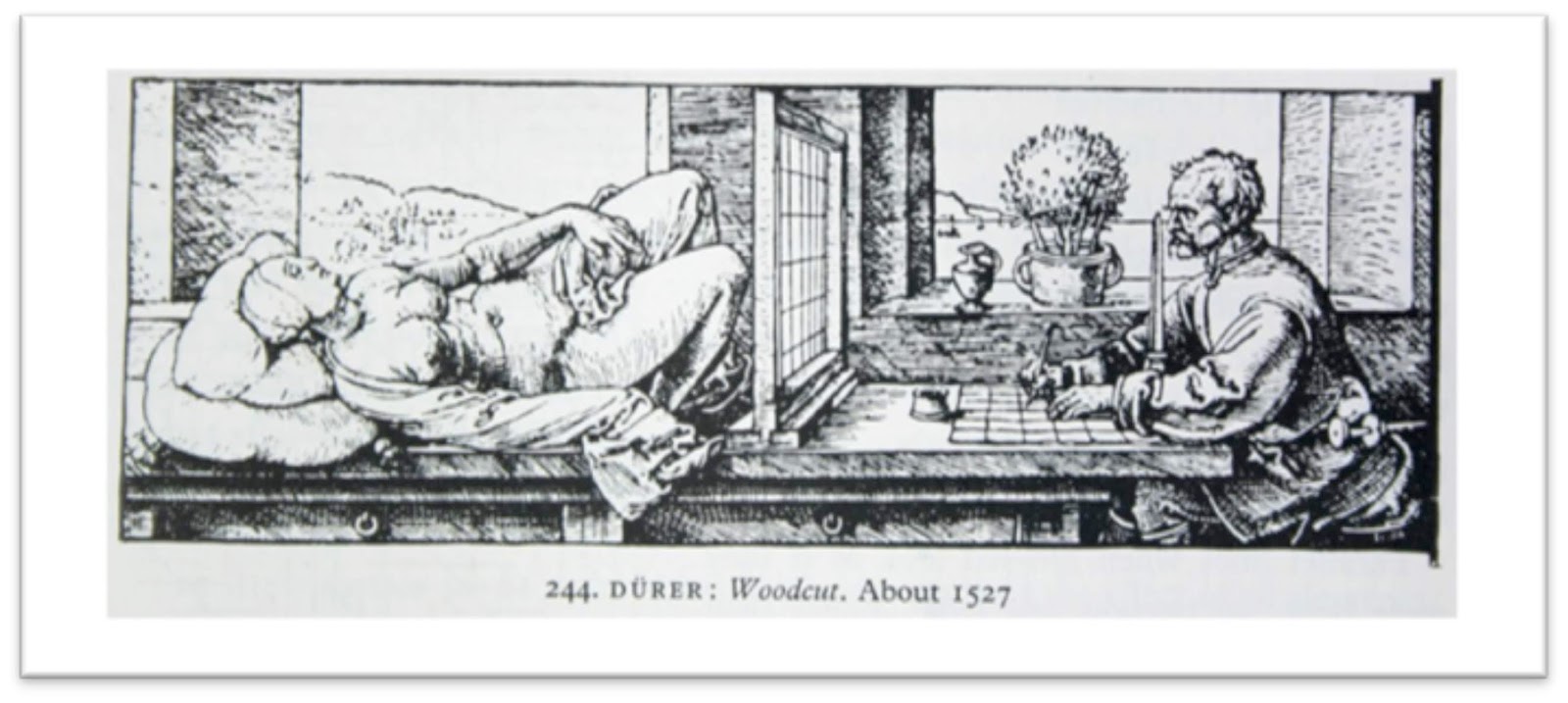
Alberti invented a device known as a netor veilto enable the precise depiction of objects through the extraction from them of a structure of coordinates plotted onto a semi-transparent net stretched taut on a plane in front of them. A derivation of this as a gridded frame is shown clearly in use, in a woodcut by the German Renaissance artist Albrecht Durer (1471 – 1528). The artist can be seen plotting such coordinates from the frame relating to a human figure lying in front of him (Gombrich, 1977: 259), Figure 3.

Figure 3: Woodcut by Durer, showing a painter using the device of a gridded frame to aid observation.

The point in relation to what I want to say about this concerns the fact that the gridded frame is positioned midway between the figure being drawn and the drawing plane. According to Dahl (2003: 5), Alberti gave ‘ontological status’ to a non-visible essence somewhere in the middle of the optical pyramid, a kind of plane of being, where Alberti suggests that there’s something more than visual going on in the experience of looking. Coincidentally, and in a sense incongruously, considering that it is such a material device, the net, veil or grid is positioned in just such a middle space between the artist/observer and the human figure or object/s observed. If perception is both the facility that enables observation and something other than observation, then Alberti was suggesting that there could be a sense or realisation of beingcoming through one’s striving to render the appearance of objects in space accurately. 
The Alberti device has since been developed as a more synthetic means that incorporates the slight curvature of the eyes’ lens through the skill that many of us will have learned of holding a pencil or straight-edge at right angles to our outstretched arm, variously perpendicular or horizontal to vision. When used correctly, this system of establishing proportional relationships between objects in three-dimensional space can be very accurate. It’s the scope for the convention’s inaccuracyhowever, while nonetheless striving for accuracy, or through noticing anomalies in the system, that interests me, Figure 4.

Figure 5: The author plotting positions of objects from four slightly differing viewpoints, and the resulting drawing, Dermatograph pencil on white laminated cardboard, 119 x 84cm, 2018. 


The above process of mine concerns making a measured drawing from four very slightly differing colour-coded positions of a single open eye, using a thread held taut between a vanishing point on the drawing set-up and the eye. The resulting reading of the drawing is one aggregate configuration comprised of several mismatched layers. How this relates to Alberti’s idea of the in-between is that – perhaps – the ontological value comes through in the very impossibility of absolute correctness, in which the drawing as a presentationis to be found in a sense of its oscillating somewhere between its referenced objects and its agent, the drawer. It’s paradoxical that the Alberti device is so material, when what it and its derivations presents is an embodiment of less tangible aspects of life.  
Drawing can in this respect be a relationship almost in the manner of a hologram result of an otherwise two-way process of looking and the return to one of what’s being viewed. Since the basis of the hologram is in a certain projected interferenceof the object, this idea of interference is the key – the interference of aspects of perception on observation. To give you an example – although this doesn’t necessarily reflect my current approach to drawing – I relatively recently drew a single figure slowly rotating in a chair through 360°, and shifted the drawing of the figure across to the right at the moment the actual figure crossed a midway diameter demarcated on the floor. While the drawing reads as two separate seated figures, the schematic marks between them are an attempt to conceptualise both moving the figure and keeping it linked to itself. If I speak of an energisedspace between the two apparent figures, this is not so much observed as conceptualised through gestural marks as restless eye movement back and forth, in regard of space itself rather than surrounding infrastructure that one might otherwise reference. Such visualisation of space at least suggeststhat what’s going on is a change in looking at the figure conceived as its back view, to one conceived as its front view at a certain moment when a shift in consciousness of the situation takes place, which is debatably more a question of perception than observation, Figure 5.

Figure 5: Two drawn versions of a single rotating figure, pencil on paper, 84 x 59cm, by the author, 2013.

The idea of an intangible and non-visible in-between plane as a source of interference has been adapted by the psychoanalyst Jacques Lacan (1901 - 1981) where, in the context of discussion of internal psyche, the mid-way of the optical pyramid is a metaphorical ‘stain’ or ‘decoy’ that muddies any assumed clarity of observation (Harari, 2004: 121-31) – but this would have to involve a more extended discussion. In terms of my own albeit limited adaptation, imagine that, when drawing, the drawn object falls somewhere between oneself and whatever is the actual object, and in the process it’s observed basis is as much confounded as enabled by one’s perception. This is the idea that I’d like to introduce in the second blog entry, particularly through links to a couple of video clips that show such a drawing in process and simultaneously explain it through speech. 
There will undoubtedly be plenty of existing artistic work and research on this subject of discussion, but a third and overriding key point is that one tends to engage in and with drawing from wherever one is with one’s own interests at the present time, Drawing as a medium in any case often exerts a degree of autonomy that sets it apart from whatever are one’s expressed intentions.

References

Dahl, T. (2003) The Transformation of Space and the Construction of Engineering Knowledge and Practice—From Renaissance Perspective Thinking to Gaspard Monge’s Descriptive Geometry. Hård, M. et al (ed) Transforming Spaces. The Topological Turn in Technology Studies.(http://www.ifs.tu-darmstadt.de/gradkoll/Publikationen/transformingspaces.html

Gombrich, E. (1977) Art and Illusion. (First published 1960) United Kingdom: Phaidon 
Harari, R. (2004) Lacan’s Four Fundamental Concepts of Psychoanalysis: An Introduction. New York, NY: Other
Rovelli, C. (2017) Reality Is Not What It Seems. (First published in English 2016) United Kingdom: Penguin   
Yarbus, A, L.