Showing posts with label eye movement. Show all posts

Wednesday, 1 January 2020

Mike Croft: The Observation of Perception

Guest drawing blogger: Mike Croft

For the starting post of the new year I'd like to introduce Mike Croft who is the first of my guest drawing bloggers. I first met Mike in the early 1980s when he was making a series of large drawings of cathedrals. These were impressive studies of the types of complex spaces that you find in buildings that have been built on organic principles rather than to an architect’s plan. We were both working on the Foundation Course at what was then the Jacob Kramer College and because of the importance of drawing in the curriculum at that time, we found ourselves constructing situations whereby certain different aspects of observational drawing practices could be explored. Mike left to move to London and then on to S.E. Asia, teaching on various design-based programmes in universities. His most significant pedagogic experience being developing an exploration of the perception of movement with the first year students of a new design programme in South Korea. Movement and the question of time, of which movement is of course an expression, have been abiding interests within Mike’s work for several years and being able to explore this with a group of students who already had strong drawing skills was a cathartic experience. 
Mike has this to say about the changes he has experienced when teaching and making drawings. “Thinking back to the days of Jacob Kramer College, the emphasis seemed much more on the image, and a degree of investment of rigour in drawing to ensure that the image was well founded. What may have changed, and has certainly been my more recent experience of teaching through drawing, is an emphasis on drawing as a research tool that students use while not necessarily being interested in drawing as its own medium, or a medium of fine art”. I would suggest that the change is more one of philosophical positioning here at Leeds. Drawing as process is of course important, but perhaps we are now looking more at drawing as a thinking tool rather than observational record. 
Mike points to his work as having “a certain cursory character compared with what you might imagine as being a ‘well founded’ image” and points to Henri Bergson’s distinction in ‘Matter and Memory’ ([1912] 2004), between what he calls the ‘present image’, as opposed to the ‘represented image’. ‘Representation is always there, but always virtual – being neutralized, at the very moment when it might become actual, by the obligation to continue itself and to lose itself in something else’ (2004: 28). Mike loves this quote, pointing out, “concerning conscious perception, because through it one can acknowledge and build into an image one’s own sense and feelings of movement, and the drift and development of thought and action while drawing. The ‘present image’ may be considered the image in its sense of passing through, and conveys in essence a degree of insubstantiality but in the affirmative sense. Of course, in the sense of difference between say, the sketch and the finished work, this is nothing particularly new”. He points to the recent drawing blog post on ‘clouds’ stating, “what more beautiful instances of ephemeral insubstantiality than clouds!”
When I look at Mike’s drawing research, I’m always impressed with his focus and clarity; recent drawing experiments whereby he explores how to respond to changing perceptions in relation to movement, as always reflect his desire to be accurate, minimalist and systematic in response to the overwhelming amount of experience that sense data provides us with. 
Mike’s blog posts are designed to help you as drawers think more carefully about movement. (He has crafted two, but because there is a lot of information to digest, they will be separated by a few days) As he points out, “working with and through movement in drawing may possibly be a way of attending more to how we see, perception itself, rather than perception’s resulting observations, while attending no less to whatever is the motif, the object of observation”. 
When drawing, going back to hard earned thoughtful and measured looking is always worthwhile and Mike helps us approach the process with fresh insight. 

Bergson, H. (2004) Matter and Memory (first published 1912) New York, NY: Dover
Link to TRACY where Mike has made some of his earlier research publicly available.

The Observation of Perception: Mike Croft

What I’d like to say relates to drawing that concerns observation of the external world, but through the filter of perception. Of course, that there is a relation of the latter to the former is obvious, yet we may tend not to notice, let alone see, perception’s role in the process. Also, conventionally, we mostly select objects for drawing that are still or slow moving enough to enable what we assume will be some degree of representation of them. Notice that I’ve used ‘some sort of’, ‘may tend not to’, ‘mostly select’, and ‘some degree of’, which suggests that nothing I’ve so far said can be really concrete; it’s all open to interpretation.  However, insofar as what I’ve said is relatively true, the facility of observation, in this case primarily visual, is automatically challenged and even sometimes contradicted by aspects of our innate biological and physiological facility of perception. 
Perception may be said to work both for and against objectification of the object of vision, mostly in ways that are either automatic to, or beneath our awareness. How I happen to think this is due to at least two pivotal realisations – points of learning – neither of which happened in art school drawing classes. This is not to say that the classes did not provide the potential for such realisations, just that they were not theoretically articulated at that time. The situation may be somewhat different now. The first realisation was back in the 1970s’ when I was first a student. I happened upon a large-format book on psychology, in which was a photo of a girl’s face and next to it a semi-abstract rendition of it that transformed the face into a continuous kind of line map comprised of tiny flicks and dashes. (The phenomenon of drift and flickyou might, yourself, wish to look up on the Internet in relation to visual perception.) The rendering of the face turned out to be a printout from a non-digital eye-scanning portal, a device invented by the Russian psychologist Alfred L. Yarbus (1914 - 1986) in the 1960s’. The device would record eye movements of a person attached to the device while looking at an image, usually a photograph, for a short period of time. The limitation of this is that the observed material does seem to be photographic, and therefore flattened, but I was quickly extending the visual characteristics of Yarbus’s findings to objects in three-dimensional space.
There are now digital equivalents of eye-scanning portals, but they work very differently. The useful point about Yarbus’s device that relates it to drawing is that it recorded in line, by means of a stylus, which looks similar to and is practically adaptable to drawing. It is however a mechanism, and like any medium imposes its own behaviour to some extent on the user’s intentions. What I learned from it, which caused it to be a pivotal influence, is that in perception we do not incessantly inscribe contours around objects, either on a page or in space, however eloquently we might use the phenomenon of contour in aesthetically inspired drawing. The oval of a human face, for example, does not register in perception except in a fragmentary sense, or even when we are giving it special attention. What is more likely to happen is that we register points and intersections of things in a hierarchy of importance according to whatever are our intentions of looking, Figure 1.

Figure 1. 
Photograph and resulting eye-scanning reading from an eye-scanning portal by 
A. L. Yarbus, and a contrasting portrait drawing by the author. 

In the above trio of photos, I’m comparing the Yarbus photo and printout that I originally noticed with a portrait drawing of mine that is made according to certain drawing conventions, especially that of the closed contour. It’s not necessarily a bad drawing, but to make a bald statement that is therefore open to challenge, it’s not how we look from either the point of view of the observer or the observed! If you compare the Yarbus printout with drawings by the British artist Frank Auerbach, for example, you may feel that Auerbach has arrived at similar knowledge to that provided by the Yarbus, although through the progress of his own experience. At the time of this discovery, especially the examples from Yarbus that concerned the various scanning of an image of figures in a room, this knowledge helped me to understand the kind of scanning across space that is a characteristic of drawings by an artist such as Giacometti, Figure 2.


 Figure 2: A Yarbus eye-scanning experiment where the participant was asked to scan the photo, above left, for a range of specified reasons.  

The eye-scanning’s element of science may help underline the fact that drawing can and often does have an investigative basis. In those early student days, the eye-scanning images enabled me to loosen up line and conceive the depiction of objects more in terms of marks and dashes and, most importantly, sense that space could be traversed through the drift of one’s vision during perception, with or without mapping objects in its course. Currently, I find that the more popular literature of quantum theory on the question of space provides some basis for untethering such marks and dashes almost entirely from the object, so that they start to say something, albeit as a very crude analogy, about the structure of space itself. In this respect, you may be interested in investigating such contemporary research in quantum physics as loop theory(Rovelli, 2017, for a clearly explained introduction). 
            So, to conclude this first point of discovery, the Yarbus findings challenged and in some respects even negated some of the conventions that I was being taught in the context of structuring visual observational experience. 

**********
The second realisation concerns a very recently read comment on the Italian Renaissance theorist Leon Battista Alberti (1404 – 1472) concerning the optical pyramid, which is an attempt to conceptualise how the eye reads three-dimensional objects in space.
Alberti invented a device known as a netor veilto enable the precise depiction of objects through the extraction from them of a structure of coordinates plotted onto a semi-transparent net stretched taut on a plane in front of them. A derivation of this as a gridded frame is shown clearly in use, in a woodcut by the German Renaissance artist Albrecht Durer (1471 – 1528). The artist can be seen plotting such coordinates from the frame relating to a human figure lying in front of him (Gombrich, 1977: 259), Figure 3.
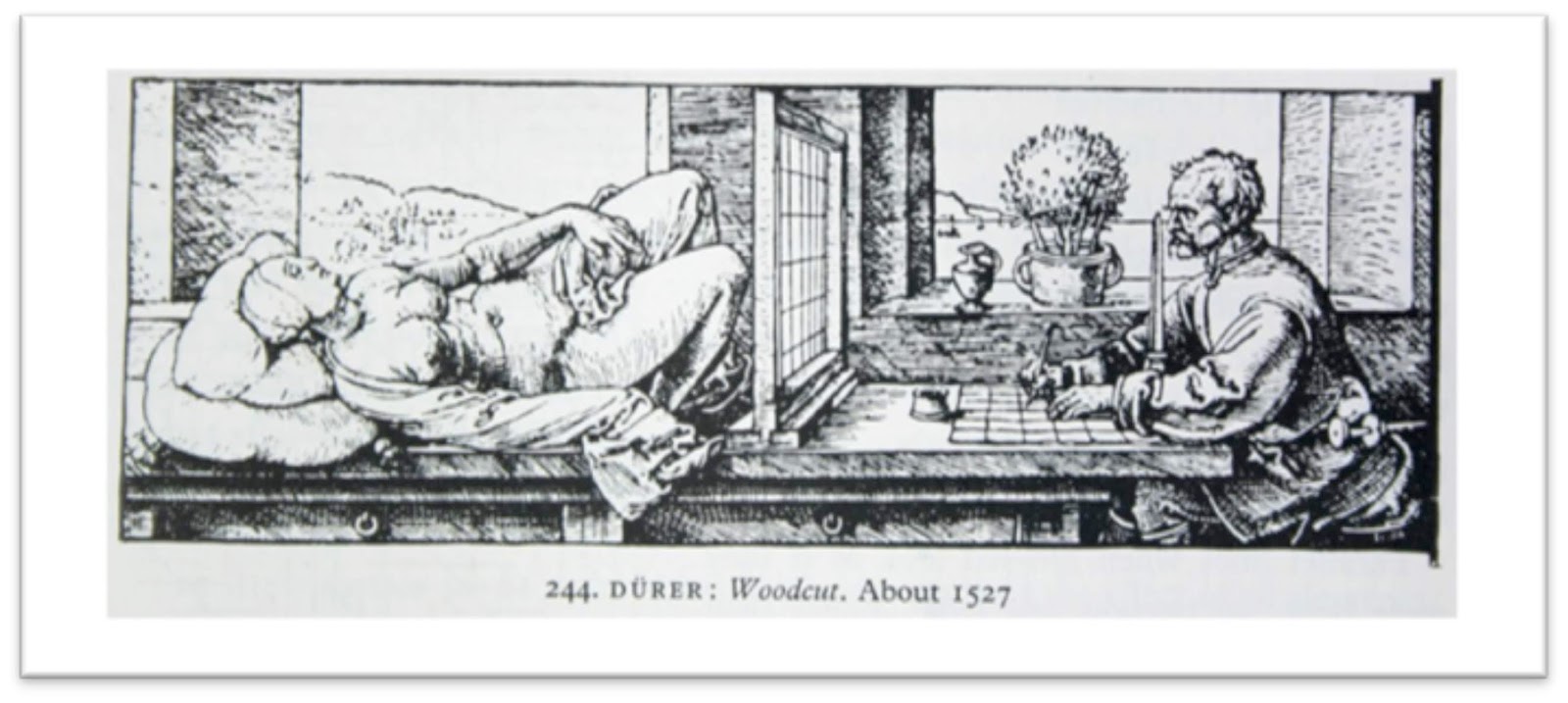
Figure 3: Woodcut by Durer, showing a painter using the device of a gridded frame to aid observation.

The point in relation to what I want to say about this concerns the fact that the gridded frame is positioned midway between the figure being drawn and the drawing plane. According to Dahl (2003: 5), Alberti gave ‘ontological status’ to a non-visible essence somewhere in the middle of the optical pyramid, a kind of plane of being, where Alberti suggests that there’s something more than visual going on in the experience of looking. Coincidentally, and in a sense incongruously, considering that it is such a material device, the net, veil or grid is positioned in just such a middle space between the artist/observer and the human figure or object/s observed. If perception is both the facility that enables observation and something other than observation, then Alberti was suggesting that there could be a sense or realisation of beingcoming through one’s striving to render the appearance of objects in space accurately. 
The Alberti device has since been developed as a more synthetic means that incorporates the slight curvature of the eyes’ lens through the skill that many of us will have learned of holding a pencil or straight-edge at right angles to our outstretched arm, variously perpendicular or horizontal to vision. When used correctly, this system of establishing proportional relationships between objects in three-dimensional space can be very accurate. It’s the scope for the convention’s inaccuracyhowever, while nonetheless striving for accuracy, or through noticing anomalies in the system, that interests me, Figure 4.

Figure 5: The author plotting positions of objects from four slightly differing viewpoints, and the resulting drawing, Dermatograph pencil on white laminated cardboard, 119 x 84cm, 2018. 


The above process of mine concerns making a measured drawing from four very slightly differing colour-coded positions of a single open eye, using a thread held taut between a vanishing point on the drawing set-up and the eye. The resulting reading of the drawing is one aggregate configuration comprised of several mismatched layers. How this relates to Alberti’s idea of the in-between is that – perhaps – the ontological value comes through in the very impossibility of absolute correctness, in which the drawing as a presentationis to be found in a sense of its oscillating somewhere between its referenced objects and its agent, the drawer. It’s paradoxical that the Alberti device is so material, when what it and its derivations presents is an embodiment of less tangible aspects of life.  
Drawing can in this respect be a relationship almost in the manner of a hologram result of an otherwise two-way process of looking and the return to one of what’s being viewed. Since the basis of the hologram is in a certain projected interferenceof the object, this idea of interference is the key – the interference of aspects of perception on observation. To give you an example – although this doesn’t necessarily reflect my current approach to drawing – I relatively recently drew a single figure slowly rotating in a chair through 360°, and shifted the drawing of the figure across to the right at the moment the actual figure crossed a midway diameter demarcated on the floor. While the drawing reads as two separate seated figures, the schematic marks between them are an attempt to conceptualise both moving the figure and keeping it linked to itself. If I speak of an energisedspace between the two apparent figures, this is not so much observed as conceptualised through gestural marks as restless eye movement back and forth, in regard of space itself rather than surrounding infrastructure that one might otherwise reference. Such visualisation of space at least suggeststhat what’s going on is a change in looking at the figure conceived as its back view, to one conceived as its front view at a certain moment when a shift in consciousness of the situation takes place, which is debatably more a question of perception than observation, Figure 5.

Figure 5: Two drawn versions of a single rotating figure, pencil on paper, 84 x 59cm, by the author, 2013.

The idea of an intangible and non-visible in-between plane as a source of interference has been adapted by the psychoanalyst Jacques Lacan (1901 - 1981) where, in the context of discussion of internal psyche, the mid-way of the optical pyramid is a metaphorical ‘stain’ or ‘decoy’ that muddies any assumed clarity of observation (Harari, 2004: 121-31) – but this would have to involve a more extended discussion. In terms of my own albeit limited adaptation, imagine that, when drawing, the drawn object falls somewhere between oneself and whatever is the actual object, and in the process it’s observed basis is as much confounded as enabled by one’s perception. This is the idea that I’d like to introduce in the second blog entry, particularly through links to a couple of video clips that show such a drawing in process and simultaneously explain it through speech. 
There will undoubtedly be plenty of existing artistic work and research on this subject of discussion, but a third and overriding key point is that one tends to engage in and with drawing from wherever one is with one’s own interests at the present time, Drawing as a medium in any case often exerts a degree of autonomy that sets it apart from whatever are one’s expressed intentions.

References

Dahl, T. (2003) The Transformation of Space and the Construction of Engineering Knowledge and Practice—From Renaissance Perspective Thinking to Gaspard Monge’s Descriptive Geometry. Hård, M. et al (ed) Transforming Spaces. The Topological Turn in Technology Studies.(http://www.ifs.tu-darmstadt.de/gradkoll/Publikationen/transformingspaces.html

Gombrich, E. (1977) Art and Illusion. (First published 1960) United Kingdom: Phaidon 
Harari, R. (2004) Lacan’s Four Fundamental Concepts of Psychoanalysis: An Introduction. New York, NY: Other
Rovelli, C. (2017) Reality Is Not What It Seems. (First published in English 2016) United Kingdom: Penguin   
Yarbus, A, L.

Saturday, 2 November 2019

Training the eyes

During the build up to the World Cup rugby final the Guardian sports section had an article on the work of Dr Sherylle Calder. She was reported on as being the most successful coach in the modern rugby era and she works as a 'vision specialist'. She works with the players developing regular eye exercises and tries to get them to avoid too much time on mobile phones and other similar devices because they don't exercise eye muscles and the attention awareness sections of the brain associated with peripheral vision, spatial awareness and rapid and flexible eye movement. Her training methods reminded me of the work we used to do in teaching drawing during the mid 1970s and early 1980s, especially when we were trying to highlight how kinetic awareness was tightly connected to spatial awareness. We would set up drawing situations designed specifically to test spatial awareness and as part of the process throw into the situation balls of crumpled up paper that would be deliberately thrown in from behind the students' backs, therefore entering their fields of vision at random unexpected moments. This on the one hand kept attention high and on the other forced them to be inventive in how they dealt with these spatial 'explosions'. 
Dr Sherylle Calder has an on line eye gym and if you go there you can test out your own ability to see and recognise situations quickly. It is very revealing and makes you aware of how little time we spend exercising our eye/brain responses, particularly when we spend so much of our time handling dangerous machinery such as cars and other mechanical constructs that demand that we stay in a state of controlled awareness for long periods of time. 
The speed of reaction of ball players used to be a constant topic of conversation in those long ago days of teaching drawing. Visual and spatial awareness was at the core of so much of what we did, the making of images being subordinate to the construction of visual fields of engagement. 


Hans Hofmann notes on approaching a drawing

One of the most important influences on teaching drawing at that time was Hans Hofmann. His drawn notes above being typical of what was being discussed in a drawing studio when I began teaching. What were your eyes picking up first, where did attention then move to? In what direction and in what rhythmic form did the eyes move as they sought out both space and formal relationships? Did an awareness of the space begin at the bottom edge of the drawing? If not why not and where did it begin? I would suggest that this type of approach to drawing lasted from the late 1940s until the 1980s and it was central to a whole generation of artist / teachers that had been influenced by abstract expressionism. In England my own awareness of this approach to drawing came via Peter Lanyon, who had taught the artist Patrick Oliver who had been apprenticed to him because of the influence of Patrick's father the art critic W. T. Oliver. When I began teaching drawing on the foundation course at Leeds the staff were very post-Harry Thubron in their understanding of visual language and Patrick Oliver was the most vociferous exponent of both Thubron and Lanyon's teaching methods.  Oliver had worked alongside Lanyon in his studio in the 1950s and Lanyon had when he had time, given Oliver things to think about when making paintings. For instance one day Lanyon put a house brick down on one of Oliver's paintings and said to him, "When I decide to pick that brick up, you need to be able to paint the space it was in". Lanyon encouraged 'fast' seeing and Oliver used to ride motor bikes through the Yorkshire landscape and explore his perceptual memories of this experience in his paintings. Lanyon pushed these experiences even further and took up gliding as a way of heightening his spatial awareness of the Cornish landscape, an approach that would lead to his death in a gliding accident in 1964. 


Hans Hofmann drawing of a landscape view

The drawing above by Hofmann shows how this type of awareness often began to be transcribed into drawings. The placement of forms such as triangles and lines, is composed in such a way that they combine to make rhythmic shapes that keep the eye moving through the drawing. I well remember Oliver looking in students' drawings for 'enclosed' or 'trapped' forms, i. e. these would be shapes that locked the eye movement into them and so held the looking in one spot. These would have to be broken, so that the eye movement could continue to revolve around the image. He was very critical of what he called the centralised image, something I am now very interested in, but which in those days would have been criticised because it did not generate action for the eyes. The central image it was argued, prioritised the verbal language element of thinking, therefore removed the eye/brain from experiencing the space / form of the image as the brain moved into thinking about the semiotics of the image rather than the experience of the moment. 
Looking back to that time I'm now more aware of a political stance that related to this position. Fixed images could be seen as commodities that could then be sold. The flux of experience was much harder to sell. 


Peter Lanyon

In the drawing above by Lanyon you can see lines following the movement of the searching eyes as they look from foreground to background. You are supposed to look through the space, not at the objects you encounter. Patrick Oliver used to say that you need to make drawings in a similar way to how a bird flies through a thick set hedge. If the bird was looking at all the various small branches and twigs as it moved it would very quickly become entangled in the complexity of thinking about the thingness of the various experiences, however if the bird simply flew through the space, the things that could have impeded its way just disappeared. The space was the path that needed to be taken, the objects in this world were simply irrelevancies, only made relevant because we have a verbal language that needs to identify nouns with things and prioritises thingness over action. 


Patrick Oliver Irish Painting


The painting above was made by Oliver in the early 1980s and is typical of his approach. You are meant to re-experience a ride through the Irish landscape, the colour being as much about treading in a cowpat when you dismounted from your motorbike, as looking up at a blue sky or seeing hills in the distance. The totality of the experience was something Oliver believed he could re-create in paint. 

At the time I loved the epic romanticism of the man, his firm belief in the power of painting to re-create experience and to provide an arena for the eyes to exercise themselves within. It was always 'eyes', the old principal of the art college Frank Lisle had lost one eye during the second world war and Patrick would accuse him of no longer being able to paint properly because of this. The spaces in these paintings were designed for bi-focal vision, angle of line and form as well as surface adjustment being designed to trigger mental spaces as the two eyes attempted to focus. Oliver would demonstrate this in the studio by getting students to watch him trying to pull apart two straight edges, such as two lengths of 2 x 1 timber. He would say that they were stuck together by a very sticky invisible substance, but if he pulled hard enough he could separate the edges, but this would leave between them a plane composed of a very taut surface of infinitely thin invisible glue. He would then mime a struggle to separate the two lengths of timber, finally shaking with the effort he would not just separate them but would then twist them in relation to each other. "Now", he would say "how do you see the space between these two timbers?" 

There is still a memory of those times in the back of my head every time I draw. I'm now once again attracted to the issues associated with a word bound experience and how to go beyond them, but am looking at the resolution from a more 'vibrant materialist' perspective. Those times had a very interesting approach to the problem and I think it has reemerged as an aspect of speculative realism and other approaches to materialist thinking. I am also putting up this post as a reminder that old experiences are never 'wrong' just simply other worlds waiting to reemerge as fresh made for another time.


See also:

Eye tracking technology
The hard won image

Other posts about teaching during the 1970s and 80s.

More on pulling space apart in a flat drawing
How to address the paper surface

Tuesday, 14 March 2017

The hard won image

Wollheim suggests that art is a form of life, if so what makes it's heart beat? One sort of drawing is that which seeks to recapture the essence of the contact with another human being. The result of this encounter is one you could argue according to Wollheim, that is another form of life. If so, how do we read this life? How do we separate out those encounters that deaden the experience from those that embody it?
Drawings that record the struggle of the encounter always seem to offer to myself a more rewarding experience. So I thought it worthwhile looking at a few artists that still work in the traditional field of perceptual observation and that use the human figure as their core subject.


Ginny Grayson 'No conclusions drawn: self portrait'

Ginny Grayson states that she slowly feels her way through the forms that she perceives, comparing her approach to a surgical process. She says this reflects the difficulty of pinning down reality or identity, and states that she often finds the ghostly residue or erasure preferable to the actual drawing. Grayson’s method involves numerous corrections using eraser and gesso, and by adding paper to areas worn thin by overworking. The worn and fragile surface of 'No conclusions drawn: self portrait' attests to the difficulties generated by her investigative process. The right panel of the diptych contains photographs showing earlier stages, lost as an inevitable part of her method, while date stamps on the drawing are intended as an ironic comment on the absurdity of trying to draw what one perceives.
See

Grayson sums up the problem of a perceptual encounter as being something virtually impossible, however in trying to record the event the image gradually evolves and as a viewer you can trace back the encounter by reliving the various stages of the drawing. I'm not so sure she needs to also give us the stages of its making by including the photographs but perhaps in this age dominated by the photographic image, new audiences need to be reassured by the photographic record. The grid of her looking is for me the main entry point into this work together with the way the drawing intensifies as it reaches the figure. The way the stomach gets blacker and blacker as she discovers where her weight lies, (I don't mean poundage, just visual focus) draws me to an off centre intensity. It's as if the drawing moves from a first of all 'it's not what it is but where it is' encounter, gradually into a second stage whereby she discovers what it is by looking for where it is. The marks and traces of looking change as she encounters her own image, outside of the figure they assert the underlying geometry of relationships, but once the figure is entrapped it begins to generate a new energy of internal dynamics, but an energy that is loosed into the surrounding space by the way the left arm in particular is broken by the rubber and therefore cut back into the space behind her, whist also being pulled into the growing mass of the body. It is the unravelling of the process that reveals the life of the looking and at this point this is what for me gives the drawing life. Notice how the long straight of the table in the foreground is broken several times. If the line had no interruptions it would flatten the foreground space, but as it is, the broken line allows the eyes to inhabit both the established foreground space and also travel back into the rest of the image's spaces. As you look into the space behind the table a rhythmic play of partly revealed rectangles begins, rectangles that are partly a response to things seen, (edges of boards, canvases etc) and partly a response to the imagined grid of looking. A grid she has either developed from the use of perhaps a plumb-line or a horizontally and vertically held pencil measure, a grid that in the process of the actual drawing has a history in the way she has come to do the looking. As someone who has drawn for a long time I now no longer use my aids to measurement such as plumb-lines and verticals and horizontals, it's as if that grid is locked into my head and I 'see' angles and relationships as if the physical checks were still there and it may well be a similar situation with Grayson when she draws, not that it really matters. What does matter is that in order to try to capture the ephemeral nature of looking, an artist needs something to hang on to. All is chaos until something is brought into the situation to stabilise it.

Ginny Grayson

It's interesting to compare one of Ginny Grayson's head drawings with one of Frank Auerbach's.

Frank Auerbach

Auerbach is looking for something else here. The grid you feel is not there, he is searching for the monumentality of the encounter. Looking I suspect now as much at the drawing as at the image. In comparison with Auerbach's drawing, the 'space lines' that suggest perhaps a collar that Grayson uses to create a space for the bottom half of the drawing to exist in, feel almost mannered. Grayson is still in an intellectual control of the drawing, while Auerbach after a long time of searching for something has just at some point had to stop working, you get the sense that he is always feeling for the image, rather than trying to arrive at a 'look' or preconceived idea of a resolution. The drawing has almost disintegrated under his searching for some sort of reality. Black marks seep into the solid of the body but this time ooze into the space behind rather that slit the space open. Both artists use the frame of the drawing to give their sitters a strong presence, Grayson in particular pushes the mass of the head out into our space, whilst Auerbach's head appears to be wanting to knock its solidity against its frame. These drawings reward close and slow looking, both artists have given us a rewarding experience based on an encounter with another human being. I'm personally more drawn to the Auerback image, in the end because it is more awkward, more difficult, but Grayson's image can be equally rewarding, as it has a strong grasp of how dark light reversal can be used to heighten an awareness of form. The facial modelling is much more subtle than Auerbach's and suggestive of individual character, Auerbach's suggestive of a more universal encounter with a human being, rather than with a particular person.

Ginny Grayson

The two drawings above are also date stamped, the printed dates playing off against the marks that determine the space within which each head sits again coalescing around the areas of perceptual focus. Each drawing begins to set up its own vibration patterns, reminding us that we are all at a microscopic level simply a vibrating mass of atoms and electrons.
The portrait drawings of Ann Gale fit into this same category, but there are subtle differences.

Ann Gale

The frame of looking is established right from the start A drawn rectangle surrounding the image is used to establish almost a weaving frame support. The mass gradually emerges from the space, each horizontal or vertical finding line trying to literally pin down the image. Secondary marks attempt to find their way onto the surface of the figure, bending out of the rigid mesh of woven grid lines. A totally different rhythm is established, even though the perceptual problem is similar. The looking is much more fragile and tentative, the marks less substantial and less energetic than those used by Grayson in the two portraits above.

The framing of space and the finding of that frame are most clearly seen in Gale's most famous artistic predecessor, Giacometti.


Giacometti

Giacometti's drawings often use a space frame to locate the image, but the frame itself is often re-established several times as he seeks to find the space that his figures exist in. The image photographed in its presentation frame, has in particular had several drawn frames established as the drawing has evolved, to the extent that they now operate more like a doorway into the space. Again the figure appears as if it is pinned into the space, this time thin paint is used  to erase the lines of looking rather than erasers. However in both Gale's work and Giacometti's it is the story of the finding that lives on in these images.

All of these artists have an artistic forefather in Cezanne, his attempts to put together his 'petite sensations' were always struggles to grasp what he was seeing rather than attempts to depict a subject and he pioneered a way of drawing and painting that left open to the viewer the various changes and differences that take place when you look at something over time. 

Cezanne
See also:


Wednesday, 18 March 2015

Eye tracking drawing technology

Graham Fink has an exhibition at Riflemaker at the moment that relies on using eye tracking software, in particular he has acquired a Tobii 'eye-tracker'. See: 

The technology works by shining infra-red light directly into the eyes. The reflections are recorded by a camera through multi-algorithms and filters which allow eye movement to immediately be translated to a screen. 


This type of software is becoming more available as developments in aids for people who have lost their limbs or body functions becomes more sophisticated. 


As you can see from looking at the two drawings above the images are very close in appearance to those drawings done in exercises when you are asked to keep drawing whilst looking at the subject and making your hand follow what you are seeing without looking at the paper. If you have not done this, you should try it. It's interesting that the gallery celebrates this as a unique thing, when for many artists working in this way is basic bread and butter stuff. The only thing that has changed is that computer software and a printer have replaced the brain and hand. 

It is interesting to compare these computer drawings to other images. 

Giacometti

As a sculptor Giacometti feels for the face in space. His eye movements being tracked by his pen as he searches for what is there in front of him. 


Claude Heath

 Claude Heath is actually feeling for the form. The white dot on top of the 'head' being the point where his feeling starts from. 

"When you follow the movements of a football across a flat TV screen you sometimes have the sensation that the ball is going in a certain direction when it turns out to have a different arc altogether and ends up at the feet of a different player than you had first thought. Its true movements are hidden by the flatness of the screen until it arrives at some particular part of the pitch. This same kind of sensation sometimes happens while drawing, when you attempt to compress the sight and touch of a solid object onto various parts of a flat surface". 
Claude Heath 

Claude Heath has been fascinated for a long time with how we see and how a drawing can trace a memory or record of the process. 

Thinking about looking has of course been central to drawing practice for hundreds of years from Durer's investigations of drawing technology to Cezanne's preoccupation with trying to record those "petit sensations". As someone who draws every day it has always been a central concern of my own and I often return to this activity in order to refresh my own drawing language with a dose of perceptual reality. 
Durer
Cezanne

See also: