I recently saw the John Craxton exhibition at the Pallant House Gallery in Chichester and after spending some time with his work, moved on and found hosted within their more permanent collection some of Jake Grewal's charcoal drawings, that he had on exhibition alongside a few of his paintings. Craxton was born in 1922 and yet his work feels as if it still has resonance, especially when you put it alongside the work of an artist born in 1994.
Some days I feel more alive: Jake Grewal
Jake Grewal’s drawn landscapes include naked men, figures that you might need to spend time finding, as they are often hard to see clearly, because they are deeply set into the smoky grit of his charcoal marks. He is obviously influenced by British Neo-Romantic artists, such as Caxton and Keith Vaughan and often works outside, which is perhaps why the drawings feel as if they are still in touch with nature.
For myself it was the issue of how we can be in touch with nature that I was most interested in. Both Caxton and Grewal are gay and I had the feeling that they were both drawn to the idea that in a natural state, conventions such as a male/female cultural divide could disappear. In Craxton's case the human presence is amalgamated with and locked into the forms of landscape by his particular use of pen, ink and wash, whilst for Grewal it is the charcoal that allows him to bring his figures into the same world as his landscapes. This is the magic of materials and how they are worked. By placing an idea into a material form, that idea becomes materialised and in that very materialisation it transcends the human and becomes a thing. The human becomes an ink thing or a charcoal thing and in becoming these new forms, is released from the conventions that bind real people.
Craxton: Poet in a landscape
Craxton: Dreamer in landscape
The need to dissolve ourselves in nature is an old one, and it is Albrecht Altdorfer’s ‘Saint George and the Dragon’ that for myself epitomises this need.
Albrecht Altdorfer: ‘Saint George and the Dragon.’ 1510
St George and the rather small dragon are really a pretext for the painting's real subject which is the magic of the wood and wonder of the lush but wild landscape. There is an arcane atmosphere whereby we understand that human deeds, even mythic actions such as Saint George overcoming the Dragon, are all subordinate to the power of nature.
How we find a way of working that reflects a personal understanding of our place in the universe is important, and in this case it helps me to think about how to relativise the human nature divide and how to give nature its proper weight and importance in relation to human endeavours.
One of the most interesting aspects of the Venice Biennale this year was the presence of such a wide range of artists from what we used to call the third world. Another reflection of change, artists from all over the globe now exhibiting their work with no feeling of inferiority, simply showing work alongside artists from other nations on an equal level. Things have come a long way since the Magicians of the Earth exhibition back in the 1980s. I have though decided not to identify where the artists I have to picked out as interesting come from, some it is obvious from the content of their work, but for others it is not so obvious and in this ambiguity I think there is an interesting point to be made about how we tend to associate country of origin with how we read the images. If you want to it is of course easy to Google each artist to find out more. The photographer Gauri Gill had taken wonderful images of Maharashtrian tribesmen wearing papier-mâché masks that she had had made based on certain individual's own sense of themselves as characters. This activity brought together traditional and non traditional notions of how to make images. For me this was three dimensional drawing at its most elemental fused with photography's ability to bring everything within shot into the same world. Perhaps it was the way these images reminded me of shamanistic traditions, but whatever the reason, I found them totally engaging and they fulfilled my personal need to work with images that dissolved the barriers between people and animals or people and objects.
Gauri Gill
This is how Gill's website introduces her work: 'Acts of Appearance' assumed its form within a village of Adivasi paper mache artists from the Kokna tribe in Jawhar district. Further inland from Dahanu, it is one of the most impoverished districts in Maharashtra. In Rajasthan, among her Jogi friends during Holi, Gill had first encountered people wearing store-bought masks to play-act various personas as part of the fun of the festival. In Maharashtra, she learned of the Bahora procession, held once a year in many Adivasi villages, in which the entire community participates in a ritual performance over several nights, to enact a mythological tale. The performers are chosen from among the residents and wear elaborate masks made by artists to represent different gods, demons, and ancillary figures. The Bahora masks take weeks to make, are sacred and consecrated, and constitute a moral and imaginative universe, but also conform to strict rules of creation as they represent powerful archetypes refined over generations of storytelling. In 2014, Gill sought out the acclaimed brothers Subhas and Bhagvan Dharma Kadu, sons of the legendary craftsman Dharma Kadu, with a proposal. She wished to commission them, along with their families and fellow volunteers (more than thirty people in total), to create a new set of masks—not of gods or demons as per local tradition and lore, but rather as representing beings existing in contemporary reality. The interpretive creations were to come from them, with the suggestion that they embody different ages, distinctive individuals, the varied rasas (emotions) like love, sadness, fear or anger, and those experiences common to all humans, such as sickness, relationships, or aging. In the course of dialogue, animals were naturally understood to be a part of this universe. Later, precious objects entered the frame, as they are believed have sentience too. Inhabiting these masks, a cast of ‘actor’ volunteers (including the artists) would later improvise and enact different real scenarios, 'across dreaming and waking states’, in and around the village'.
The idea that other things besides ourselves could have sentience was something I have been thinking a lot about lately, as well as my work on issues to do with aging and how we enact our views of who and what we are; therefore I was particularly fascinated by what Gauri Gill was doing. The idea of everything being 'actants' in universal as well as local sets of events and entangled interconnections appeals to me more and more.
Shakuntala Kulkarni
Cane armour by Shakuntala Kulkarni was another of my favourites, cane as a 3D drawing tool is very expressive and her work highlighted the fact that we wear our clothes as a sort of armour.
Shakuntala Kulkarni
Kulkarni was able to exhibit her work in three ways, as a sculptural presentation, such as in the image directly above, and as constructed photographs, as well as documentation of performances.
Tavares Strachan
A memorial to Robert Henry Lawrence, the first African American astronaut by the Bahamanian artist Tavares Strachan is of a glowing figure momentarily suspended as it falls to Earth, Robert Henry Lawrence becoming a radiant spaceman midway between drawing and sculpture.
A memorial to Robert Henry Lawrence
Tavares Strachan: Encyclopaedia of invisibility
Strachan's other works in the Giardini are a series of images that have emerged from what he calls 'the encyclopaedia of invisibility'; made up of collaged elements taken from an imaginary Encyclopaedia Britannica, one that has excluded certain elements of history, ones that he feels were excluded because of the hidden agendas of the white editing team that put the encyclopaedia together. Just as Robert Henry Lawrence is often forgotten about, there are many aspects of history that are edited out by any dominant culture.
Thinking about the space race and images coming from a dominant culture there was a contemporary version of The Pioneer Plaque made to reflect the plight of refugees in Halil Altindere's installation, "Space Refugee". In this work Altindere explores the life of Muhammed Ahmed Faris, Syria's first and only cosmonaut. Faris travelled to the Mir space station with a Soviet team in 1987 and was treated as a national hero.However when Faris became a supporter of the opposition movement against Assad, he was forced to leave the country and now lives as a refugee in Istanbul.
Halil Altindere "Space Refugee"
Michael Armitage is mainly known for his large paintings, so I was pleasantly surprised to see a collection of his drawings.
Michael Armitage
Informal drawings that were sketchbook like in their size and format, were collected together to make an installation consisting of white framed drawings made in brown ink wash on white paper. Armitage's paintings weave multiple narratives that are drawn from historical and current news media, internet gossip, and his own ongoing recollections of Kenya. The drawings exhibited being his daily jottings whereby he recorded life in Kenya. This very traditional way of using drawing as a documentation or recording device, is in his paintings merged with imagery taken from websites and other places from within the ubiquitous contemporary image stream. Old and new fusing in a similar way to the fact that village culture in Kenya is in many ways interacting with the effects of global transnational events. The old in the new, the traditional living alongside the contemporary, is a growing reality of modern life. Frida Orupabo’s collages of black women are made in such a way that they have a sculptural presence. She creates joints between her cut out sections that are rather like those used in certain sorts of puppet making.
Frida Orupabo
Orupabo's awkward body juxtapositions and use of black and white imagery reminded me of how historically black women had been traded as objects, these 'puppets' are though turned to face you, and like Manet's Olympia transcend their position and take on an agency that gives them gravity and a certain presence.
Kemang Wa Lehulere
Kemang Wa Lehulere’s notion of the collective is key to the artist’s practice. As an activist in Cape Town, he established Gugulective in 2006, an artistic platform for performance and social intervention. Both the installations exhibited in the Arsenale and in the Central Pavilion are made from salvaged wood and metal from school desks and chairs. Each element in these works comes together in a web of associations, references, and stories because for Wa Lehulere, personal biography and collective history are inextricable.
Kemang Wa Lehulere
He also has a drawing practice that although not focused on in Venice is usually an important part of his installations.
Kemang Wa Lehulere
Often drawing in white chalk directly onto black painted walls, the various elements of his private associations become mixed in with images taken directly from encounters with the various South African iconic images of nation. His work was of particular relevance because I find myself working between drawing, making and performance, I also find myself storytelling and I need to embrace various and diverse elements if I am to fully engage with the communication of what I want to say. New technology was also very visible in Venice, I was particularly interested in Ian Cheng's work, because it illustrated how an idea can literally be grown from the implications of computer algorithms.
Ian Cheng
Ian Cheng's work also demonstrated the continuing influence of the comic book on image making. His creation, 'Bob' growing and morphing, living and dying in a computer animation according to rule generated behaviours, as well as having its own comic book story, 'the life of Bob' which was presented as a very large back lit cartoon strip and was also available to buy in comic book form in the biennale shop.
I have just returned from my biannual visit to the Venice Biennale and as always have thoughts as to the role drawing is still playing within contemporary art practice. Perhaps this year drawing feels more something that lies under the surface and is less obvious as an art form, but the more I looked about me, I saw drawing as a framework through which many artists had stepped, even though by now they felt it had been left behind. This year's biennale entitled, 'May you live in interesting times' in particular being a fascinating one, because it asks the question, "what purpose can art play when there are so many environmental and political dangers facing the planet?" The lead curator, Ralph Runoff stated that the real purpose of art is that artworks are never reducible to being messages to decipher or comprehend. Art does not give us conclusions but gives us interesting points of departure. That old question, "What does it mean?" is shown to be meaningless, and the biennale sets out to "celebrate artists that work between customary categories". My own responses are as always driven by my present interests and therefore my reflections are not really a proper review, but are simply thoughts about things I encountered that made me think about what I am up to. The first issue to strike me was that the selected artists in the Arsenale were also shown in the Giardini central pavilion. The issue being that the type of work shown in the one was not necessarily like the work shown in the other venue. For instance, the work of Christian Marclay in the Arsenale was a video projection and in the Giardini large woodcut prints. The old idea of an artist being a painter or sculptor was gradually being let go of and being replaced by an idea of the artist as someone that used whatever was appropriate to get their ideas communicated. Personally I felt this reflected a position that I was very comfortable with and as someone that still uses drawing as a thinking tool, it also helped me to locate my ideas about drawing practice much more clearly. Drawing is something that does not have to be the end result, simply something that is part of a complex process of communication. Sometimes it will have a strong visual presence, but at others it may simply be the way that an artist visualised a future possibility in his or her head.
Christian Marclay's '48 War Movies' was the first work to get me thinking as I walked around the Arsenale. There were several overlapping issues here for someone trying to think about the continuing relevance of drawing. The first thing that you become aware of is the old fashioned power of a single central point perspective. This is what in effect Marclay has made by inserting one movie inside another and then another and another, each time leaving a thin edge that still keeps running its footage, even though we can only see a tiny strip of what is going on.
One point perspective
This reveals the tight connection between the idea of the camera and single point perspective. The compaction of 48 movies running at the same time together with the overlaid sound of them, added up to a pretty powerful effect. (If you google 'how to put one video inside another in Adobe Premiere' you will find out how to do this) I found it fascinating that you could work out all sorts of things about each movie from the small amount of information available to you, our perceptual apparatus is very sophisticated especially when it comes to reading images that we are very used to. As a genre 'War Movies' have much in common, but when seeing 48 at once, together with their overlaid soundtracks you can become disorientated, something that I'm sure Marclay wanted to happen, his projection reflecting on our continuing fascination with war and how it can never capture the reality of war's fragmentation of normality. The tiny images in the centre of the film, read as if they were trapped in the net of all the other films, your vision was drawn down into that tiny central world, a world too small to be clearly recognisable, but big enough to communicate its warlike nature.
Detail
Christian Marclay
In the Giardini central pavilion you could see Marclay's other work, consisting of two large six foot high woodcuts which were images taken from Japanese Manga comics. I presumed the images had been transferred using CNC routing techniques, used to cut out what looked like large plywood sheets. The contrast between the cut out sections that made up the image and the way grain of the wood itself had picked up the printer's ink, was what I found most interesting, as it was the thing that highlighted the specific nature of printing off large plywood sheets. The figures in the prints were screaming but of course silently, this being the nature of the medium. No matter how big you make the prints, no matter how large the printed mouth becomes, it will never make a sound. This was of course the opposite to what was happening with his war movies, the sound in the projection room being at times almost unbearable. Ed Atkins was another artist that in being represented by two totally different sets of work demonstrated that he was more interested in getting an idea across than working towards a certain style or overall 'look'. In the Arsenale his computer animations and video installations were the focus and in the Giardini his drawings were spread out and mixed in with various other artists work.
Ed Atkins: Old Food. 2017 - 2019 Video installation
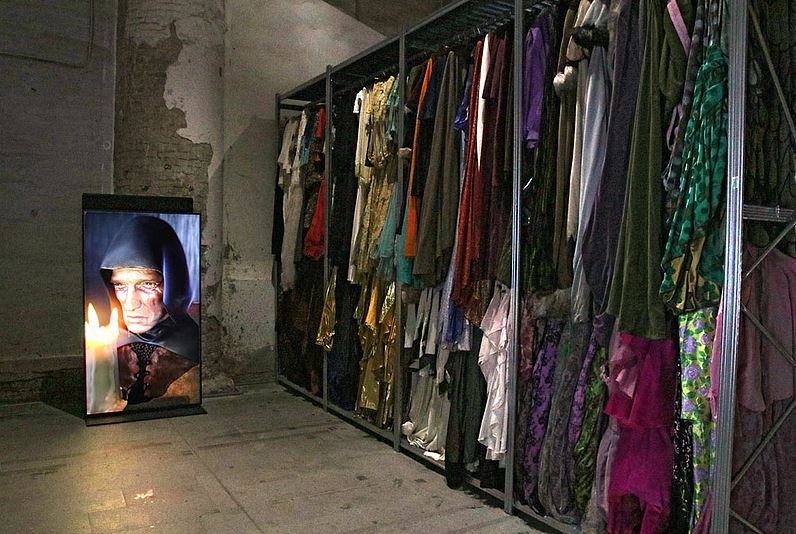
The focus of the various video and installation pieces was I thought very much about role playing. From large scale clothes hangers carrying what appeared to me to be various costumes, some of which looked as if they had been worn in his videos, to the videos themselves and animations that focused sometimes on how we respond in certain cliched ways in times of grief or loss and at others on how the atmosphere of the fairy tale can be used to loop or hold time frozen.
Ed Atkins
His drawing work as shown in the Giardini was much more traditional, each image including a giant cross spider / human, the word BLOOM emblazoned across every drawing as if it was some sort of logo. The style of drawing was very comic book derivative, suffering from a certain thinness of line I felt, but nevertheless powerful enough to hold their own when seen against various other types of work when they were placed around and about the Giardini central pavilion. The images worked as if they were escaped experiments from some film like 'the Fly'. His moving image works operated to some extent like this too. They felt as if they were brief moments cut from a fairy tale or public information animation. One animation in particular consisted of the making of various sandwiches. The images in this case being of humans making up the various sandwich fillings. Collectively I found the work compelling and spent some time sitting looking at the various video pieces and thinking about how they linked with the spaces made by the large clothes racks. Siting these various video pieces in dark spaces made by these racks was an important part of the overall effect and highlighted the importance of this type of control over the presentation of your work.
Suki Seokyeong Kang was using a particular formal approach to 3D drawing, that I have referenced before in the work of Sarah Sze. You link one thing to another by a formal association, such as a line being made of a length of metal at one moment and then it can be extended or linked to another line that may be a decorative element on a surface or a drawing on the floor. However her work also introduced issues related to craft and the blurred line between 'modernism' and design and painting and the found object.
Suki Seokyeong Kang
In the Arsenale installation, (above) Suki Seokyeong Kang was able to link craft based textiles, design components from manufactured objects, and engineered elements into a flowing series of related forms. The only issue I had was with the devices used to keep the audience from getting too close to the work. They were too formally similar to the aesthetic Kang uses and so interfered with the visual read.
Suki Seokyeong Kang
In the Giardini she exhibited objects that were more 'stand alone' highlighting the sculptural elements of her practice. However these objects were still in essence 3D drawings. Lines in space made by objects that were sometimes designed and at other times made as craft. For instance in the piece above that uses two circular elements, the top one is woven from a natural material and the object that it sits on is manufactured. The square sections below are made from metal, but with a square of hand made textile sat in the middle of it. Formal symmetry being the device to lock everything into one and differences in manufacture and use being the secondary rhythm that runs through the piece. Kang's much more gentle formal associations were for myself a welcome visual relief, such a pity that the installations had to have those grey stands with wire between in there as well, they were too much of a visual distraction.
Gabriel Rico
It is interesting to compare Kang's work with the work of Gabriel Rico who's small wall drawings made of found materials and tiny neons were on the one hand very much an extension of Paul Klee's exhortation to take a line for a walk, and on the other a celebration of the textural complexity of the city street meets a rural retreat.
Gabriel Rico
Rico's work was also presented in installation form and in these stripped down situations the connections made between things were as much poetic as they were formal. Cameron Jamie first came to attention with his film Kranky Klaus, following the village ritual of Krampus through small villages high in the Austrian Alps. The film was scored by noise artists Keiji Heino and the Melvins and was centred on what is regarded as a culturally sanctioned ritual of choreographed – though apparently real – violence. His work comments on our very thin veneer of sophistication that is so easily broken through and it reflects on how close we actually can be to a time of violence and the destruction of social norms.
Cameron Jamie
Jamie's installation in the Arsenale could have been something from an anthropological exhibition, its raw approach to image making reflecting both his earlier interest in Austrian Krampus rituals and his continuing interest in American folk rituals, many of which seek to tap into Native American Indian references. In the Giardini he was exhibiting ceramic masks
Cameron Jamie
I was particularly interested in how the masks were both made and presented. By working over an actual face the interior of the masks was refined and represented a ghost of what you could call a 'normal' person, but the exterior of the mask was rough and hardly formed, almost demon like. The use of ceramic was interesting and again the change between refined elements and rough unformed surfaces was particularly fascinating, especially because of the various ways I have been handling clay myself.
You might question what his work has to do with drawing, but the more I have found myself working with found materials in conjunction with clay, the more I feel that ways of drawing, such as collage and frottage, can very easily transposed into making.
All five artists were playful in the way they were using materials. In particular it felt as if we had now moved well beyond media specificity, and artists were now simply using whatever approach or materials they decided were fit for purpose. The old hierarchy between different approaches or artists seeing themselves as painters or sculptors seemed to feel redundant and artists were able to focus on ideas, without too many art axes to grind. As this is a university holiday period and I have several exhibitions of my own to work on, I will be taking my time and making my reflections on this year's Venice Biennale over three or four posts. The Biennale goes on until November, so there is plenty of time to fit a visit in if you have the money and the inclination. Venice Biennale 2019 Part two Venice Biennale 2019 Part three Venice Biennale 2109 Part four Reflections on other Venice Biennales 2015 Part 1 Part 2 Part 3 Part 4 2017 Venice an allegory Part 1 Part 2 Part 3 Part 4