Tim Ingold the anthropologist is also interested in the fold and he uses it to ask us to consider the fact that life is messy and convoluted and to beware of the way academic research tends to smooth it all out. Ingold states, 'in the correspondence of voices we are an intermingling. We are part of an ever forming plenum, which is the world we live in, the cosmos, the universe. (Plenum: an assembly of all members, or a space filled with matter). Research is supposed to clear the ground, but to clear the ground is not to make a space, it simply smooths it out. The kinks, twists and knots of reality, as everything is enfolded into everything else is the true order of the plenum. The convolutions of material folding in on itself as it goes along doing its doing is limitless, because it is a process of always carrying on. The plenum is therefore perhaps time itself. We therefore live in a ‘con-crescent’ world. (Concrescent: in biology, a growing together of initially separate parts or organs). In the plenum nothing is final. The world is therefore a ‘pluriverse’, consisting of endless multiples of kinks and folds and it is this situation that we should be responding to.' Taken from my own notes written when listening to Tim Ingold speaking.
A multiple of kinks and folds which our lives consist of is for myself a good metaphor. It reminds me that I should not always be looking for answers and that answers only provide a temporary simplicity that might feel as if we are in control, but which in the end are mere sticking plasters over the intricate enfolding of real experiences. My feeling is that all we can do is to flow with the complexity and to accept that our desire for control, is in fact a deep fear of a reality that we can never know.
In order to allow us to think about this type of situation, David Bohm introduced the idea of 'explicate' and 'implicate' order, two different frameworks that we could use to help us think about both our everyday perceptual experience of the world and how we use that to come to some sort of understanding about what we think of as reality and possible realities that might lie outside of our limited embodied perceptual framework, these concepts were developed in order to explain the sometimes apparently non-logical behaviours of subatomic particles, for instance some quantum researchers believe that time doesn't flow forward but folds in on itself. In 'Wholeness and the Implicate Order' Bohm described how differing contexts might change the appearance of certain phenomena. The "implicate" (also referred to as the "enfolded") order, is a deep fundamental order of reality. The "explicate" or "unfolded" order includes the abstractions that humans normally construct from perceptions. He stated in relation to this, "In the enfolded [or implicate] order, space and time are no longer the dominant factors determining the relationships of dependence or independence of different elements." Our 'normal' reality being the smoothed out version; again it is the enfolded complex of experience that is regarded as reality beyond our experience of it. As Bob Dylan put it, 'something is happening here but we don't know what it is.'
Perhaps though there is a halfway house, somewhere between the "implicate" and the "explicate" and this could be the gap into which art might insert itself.
In 'The Biology of Belief' by Bruce Lipton, there is a recognition that quantum properties are essential to the production of life itself. The manipulation of quantum properties influencing not just biochemical reactions, (Lipton, 2015, p.99), but the creation of life itself. The first cells when beginning to form clusters needed a mechanism to entangle themselves and this mechanism would need to operate at a quantum level. Gradually as we have evolved, the quantum biology that sits below all the physical stuff that we see, touch and smell, is still in operation and its signalling systems still work to help harmonise the complex bodies we now inhabit. Lipton goes on to explain how the cells that make up our bodies are affected by our thoughts and most importantly for myself, our emotions. (An issue that I may well come back and unpick further in a future post)
Raymond Ruyler in 'The Genesis of Living Forms', wrote extensively on the evolution of early life. He was fascinated by the problem of how life forms could pass on 'memories' of their complex final forms using a single cell. Every cell forms itself out of the 'memory' of the principles adhered to by the sub-atomic forces that control the behaviour of materials. Therefore the form of each creature and its various attributes, (perhaps in the case of humans, even consciousness), are the products of the movement of relationships between atomic forces. How they can move and in what possible variations being dependent on the structural principles inherited from all the previous embodied generations of electrons and protons, neutrons and / or electromagnetic or other forces that underpin everything. These rules then determine the possibilities of events coming together in different arrangements, such as in the form of a human being.
One of the key structural elements of animals with backbones, like ourselves, is the neural tube. In relation to the developing backbone, the neural tube is the embryonic precursor to the central nervous system, which is centred around the brain and the spinal cord. The neural groove gradually deepens as the neural folds become raised and ultimately the folds meet and coalesce at the middle line and convert the groove into the closed neural tube.

The development of the neural tube follows processes similar to those observed in the development of gastrulation itself, the final enfolding that produces the tube, being reminiscent of one of Raymond Ruyler's folding diagrams, that he used to illustrate his ideas about embryogenesis.


Within the microtubule tubulins of orchestrated objective reduction theory, oscillations switch states and they are generated by electromagnetic forces. To understand how both this biological process and a quantum computer works, we also need to understand the properties of an electron and how electrons behave in the presence of electromagnetic fields. So lets imagine for both situations a duality as set out below, where the oscillating electromagnetic energy, is both up and down at the same time.

which is a geometrical representation of the pure state space, the set of all possible pure quantum states, represented mathematically as rays within a Hilbert space of a qubit. (A Hilbert space generalises the notion of Euclidean space to infinite dimensions).


A Bloch sphere
The north and south poles of the Bloch sphere are typically chosen to correspond to the standard basis vectors |0⟩
 and |1⟩
 , respectively, which in turn can be used to correspond to the spin-up and spin-down states of an electron. Any points on the surface of the sphere correspond to the pure states of the system, whereas the interior points correspond to the mixed states.
Physicists use mathematics to represent these things, as in the equations below, but I have to picture them.
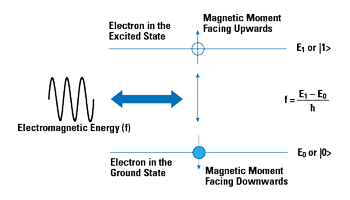
The frequency of applied electromagnetic energy causes electrons to move from one energy state to another.
For physicists to measure what is going on they have to apply certain values to each element and this is how best I can grasp what is going on by cutting and pasting from various web sites and wikipedia.Each atomic orbital, (a 3D region around an atom's nucleus describing where an electron is most likely to be found and also represents its wave-like behaviour rather than a fixed path), is represented by an energy level measured in electron volts, with the lowest orbit called the ground state. As a particle can also be a wave, its energy level has a frequency equal to the energy level in electron volts divided by Planck’s constant (the quantisation constant). Consider the diagram above. If we want the electron to move to a higher energy state, we apply electromagnetic energy at a frequency (f) equal to the desired energy level (E1) minus the current energy level (E0), which is the energy level of the ground state, which is then divided by Planck’s constant (h). The electron will absorb the energy and jump to the next quantum energy level, its excited state. Once the energy is removed, it will fall back to its original level, emitting the energy at the frequency previously absorbed. Therefore, if we can constrain the energy levels to two, we have the fundamental building blocks for manipulating ones and zeros with a single electron.

In order to digest this I have to turn to other forms of thinking and as I have often suspected that ancient ideas of the body's energy levels and chakras are actually deep insights into these things, I reestablished in my mind a connection to the concept of Yin Yang.

The Yin Yang symbol represents opposite forces that interact to form a dynamic whole. The two magnetic moments of up and down-ness could easily be symbolised by this figure. Each side of the symbol slides into itself and it is always in a state of becoming, like the Necker Cube illusion, first one then the other shape takes precedence and if you stare at the image for a while, its optical negative will appear, reinforcing the either or or yes/no value of the sign.
At the level of quantum we cant ask what or where things are, because it is all simply relationships. Just as speed is about the relationship between distance and time, it is not a thing in itself, it only comes into existence as a concept by thinking about how distance and time might relate. The idea of relationships takes us back to the entanglement of everything and that there is no such thing as an isolated individual object; as Ingold put it, "we are an intermingling."
At which point I can perhaps begin to see what this post is all about. It's not an attempt to describe how quantum biology works, or how quantum computing operates, it is about finding supportive undercurrents that help me come to some sort of heightened awareness of my art practice and how it sits alongside my ever evolving ethical framework. It's also to do with the fact that I believe that art is also about how to communicate emotion and how at some point emotion and physical reality are deeply entwined.
I have been drawing at the same time as thinking about these issues and recently have returned to making what I see as 'post-amoeba' images.
The amoeba is a powerful signifier for life itself. The way it works within a permeable membrane and manages to maintain itself as an entity, whilst it is mainly water in a water environment, its membrane just holding it together with enough force to stop it dissolving back into the water it emerged from; provides for myself a metaphor that suggests the fragile impermanence and hard fought existence of all living creatures.


References
Bohm, D. (2002) Wholeness and the Implicate Order London, Routledge
Cook, L. S. (1887) Geometrical Psychology, or, The Science of Representation an Abstract of the Theories and Diagrams of B. W. Betts London: G. Redway
Deleuze, G. (2006) The Fold London: Continuum
Lipton, B. (2015) The Biology of Belief London: Hay House UK
Ruyler, R. (2019) The Genesis of Living Forms London: Rowman & Littlefield International
Yanagisawa, E (2017) The Fold. A Physical Model of Abstract Reversibility and Envelopment in 'The Dark Precursor, Deleuze and Artistic Research'. Edited by Paulo de Assis and Paolo Giudici. Orpheus Institute, Ghent. Leuven University Press
See also:
Drawing as entanglements of life
Geometrical psychology and the fold
No comments:
Post a Comment