Showing posts with label the fold. Show all posts

Wednesday, 7 January 2026

The Fold

My last post about a contribution to an artist's book project reminded me of the importance of the fold as an idea. I had read Deleuze's 'The Fold' a while ago and for him the fold was part of what he called 'the theatre of matter', an idea that I found particularly powerful. Deleuze was not the only writer to find great significance in the fold as an idea. He cites the work of Liebniz as being central to an understanding of the art of the Baroque as a type of folding, a way of impacting more and more information into limited spaces. In an earlier post whereby I was trying to answer a question as to 'What is embodiment?' I brought together several strands of my thinking around this, but as always there are a few other ways to approach the concept. So forgive my repetition of certain elements, which I'm having to do as a way of reminding myself of what I was thinking, but then hopefully I can take a step further into a personal understanding of quantum thinking as both an approach to confronting subatomic reality and as a metaphor for our deep entanglement with everything that was, is and what is to be.
Tim Ingold the anthropologist is also interested in the fold and he uses it to ask us to consider the fact that life is messy and convoluted and to beware of the way academic research tends to smooth it all out. Ingold states, 'in the correspondence of voices we are an intermingling. We are part of an ever forming plenum, which is the world we live in, the cosmos, the universe. (Plenum: an assembly of all members, or a space filled with matter). Research is supposed to clear the ground, but to clear the ground is not to make a space, it simply smooths it out. The kinks, twists and knots of reality, as everything is enfolded into everything else is the true order of the plenum. The convolutions of material folding in on itself as it goes along doing its doing is limitless, because it is a process of always carrying on. The plenum is therefore perhaps time itself. We therefore live in a ‘con-crescent’ world. (Concrescent: in biology, a growing together of initially separate parts or organs). In the plenum nothing is final. The world is therefore a ‘pluriverse’, consisting of endless multiples of kinks and folds and it is this situation that we should be responding to.' Taken from my own notes written when listening to Tim Ingold speaking.

A multiple of kinks and folds which our lives consist of is for myself a good metaphor. It reminds me that I should not always be looking for answers and that answers only provide a temporary simplicity that might feel as if we are in control, but which in the end are mere sticking plasters over the intricate enfolding of real experiences. My feeling is that all we can do is to flow with the complexity and to accept that our desire for control, is in fact a deep fear of a reality that we can never know.

In order to allow us to think about this type of situation, David Bohm introduced the idea of 'explicate' and 'implicate' order, two different frameworks that we could use to help us think about both our everyday perceptual experience of the world and how we use that to come to some sort of understanding about what we think of as reality and possible realities that might lie outside of our limited embodied perceptual framework, these concepts were developed in order to explain the sometimes apparently non-logical behaviours of subatomic particles, for instance some quantum researchers believe that time doesn't flow forward but folds in on itself. In 'Wholeness and the Implicate Order' Bohm described how differing contexts might change the appearance of certain phenomena. The "implicate" (also referred to as the "enfolded") order, is a deep fundamental order of reality. The "explicate" or "unfolded" order includes the abstractions that humans normally construct from perceptions. He stated in relation to this, "In the enfolded [or implicate] order, space and time are no longer the dominant factors determining the relationships of dependence or independence of different elements." Our 'normal' reality being the smoothed out version; again it is the enfolded complex of experience that is regarded as reality beyond our experience of it. As Bob Dylan put it, 'something is happening here but we don't know what it is.'

Perhaps though there is a halfway house, somewhere between the "implicate" and the "explicate" and this could be the gap into which art might insert itself.

In 'The Biology of Belief' by Bruce Lipton, there is a recognition that quantum properties are essential to the production of life itself. The manipulation of quantum properties influencing not just biochemical reactions, (Lipton, 2015, p.99), but the creation of life itself. The first cells when beginning to form clusters needed a mechanism to entangle themselves and this mechanism would need to operate at a quantum level. Gradually as we have evolved, the quantum biology that sits below all the physical stuff that we see, touch and smell, is still in operation and its signalling systems still work to help harmonise the complex bodies we now inhabit. Lipton goes on to explain how the cells that make up our bodies are affected by our thoughts and most importantly for myself, our emotions. (An issue that I may well come back and unpick further in a future post)

Raymond Ruyler in 'The Genesis of Living Forms', wrote extensively on the evolution of early life. He was fascinated by the problem of how life forms could pass on 'memories' of their complex final forms using a single cell. Every cell forms itself out of the 'memory' of the principles adhered to by the sub-atomic forces that control the behaviour of materials. Therefore the form of each creature and its various attributes, (perhaps in the case of humans, even consciousness), are the products of the movement of relationships between atomic forces. How they can move and in what possible variations being dependent on the structural principles inherited from all the previous embodied generations of electrons and protons, neutrons and / or electromagnetic or other forces that underpin everything. These rules then determine the possibilities of events coming together in different arrangements, such as in the form of a human being.

One of the key structural elements of animals with backbones, like ourselves, is the neural tube. In relation to the developing backbone, the neural tube is the embryonic precursor to the central nervous system, which is centred around the brain and the spinal cord. The neural groove gradually deepens as the neural folds become raised and ultimately the folds meet and coalesce at the middle line and convert the groove into the closed neural tube.


The development of the neural tube follows processes similar to those observed in the development of gastrulation itself, the final enfolding that produces the tube, being reminiscent of one of Raymond Ruyler's folding diagrams, that he used to illustrate his ideas about embryogenesis.

Stages in neural tube formation


Ruyler's diagrams explaining the significance of folding to embryogenesis

In 'The Genesis of Living Forms', the folding of the earth to form the Alps is compared with the folding of a flat sheet to form a tube, which is in turn compared to the folding of cells during the process of embryogenesis, in particular during cell division and differentiation. In my post on the topology of dreams I tried to explain how orchestrated objective reduction theory, sought to bridge the gulf between physical matter and felt experience. The idea I was trying to articulate, was that consciousness arises when gravitational instabilities in the fundamental structure of space-time collapse quantum wave functions within tiny proteins called microtubules, which are themselves found inside neurons. Consciousness being based on quantum processing performed by qubits (like binary bits, qubits are the basic units of information in quantum computing), formed collectively in cellular microtubules, a process significantly amplified through the neurons themselves. The qubits are based on oscillating dipoles and operate in a situation that can only exist at an intermediate scale between the subatomic and the everyday world. The vibrational mode of a single molecule is the coherent collective vibration, vibrating at the same frequency as the majority of the collective of atoms that it is made up from. This brings about an oscillating electric dipole moment at the same frequency, which forms superposed resonance rings in helical pathways throughout lattices of microtubules. The oscillations can be either electric, due to charge separation from London forces or magnetic, due to electron spin and they are also in form very like the ones that Ruyler was thinking about when imagining life's early moments.
A: An axon terminal releases neurotransmitters through a synapse and they are received by microtubules in a neuron's dendritic spine
B: Simulated microtubule tubulins switch states.

If these concepts are right, or even just semi-right, it would mean that quantum processing is being undertaken all the time within our own bodies. So what is quantum processing and how can it be undertaken by biological entities? Somehow quantum bits need to be manipulated if they are to effect change. Contemporary quantum processing is mainly developed within the field of quantum computing. Within quantum computing a “quantum” implementation manipulates quantum bits called qubits, which can have a value of one, zero or both simultaneously. When the bit is simultaneously a one and a zero, the bit is said to be in a state of superposition, where a system can exist in multiple states (like being in two places or having two properties) simultaneously, only collapsing into a single definite state upon measurement. Moreover, the state of one qubit can influence another qubit, even if they are separated by a great distance, in this case, the states are said to be entangled. Superposition and entanglement are at the heart of quantum computing and provide capabilities that can speed the types of calculation required for certain computations from years to minutes.
Within the microtubule tubulins of orchestrated objective reduction theory, oscillations switch states and they are generated by electromagnetic forces. To understand how both this biological process and a quantum computer works, we also need to understand the properties of an electron and how electrons behave in the presence of electromagnetic fields. So lets imagine for both situations a duality as set out below, where the oscillating electromagnetic energy, is both up and down at the same time.

A spin moves up and down at the same time

Now you have to imagine a Bloch sphere, (Named after the physicist Felix Bloch),
which is a geometrical representation of the pure state space, the set of all possible pure quantum states, represented mathematically as rays within a Hilbert space of a qubit. (A Hilbert space generalises the notion of Euclidean space to infinite dimensions).


A Bloch sphere


The north and south poles of the Bloch sphere are typically chosen to correspond to the standard basis vectors |0⟩ and |1⟩, respectively, which in turn can be used to correspond to the spin-up and spin-down states of an electron. Any points on the surface of the sphere correspond to the pure states of the system, whereas the interior points correspond to the mixed states.

I was listening to a Radio 4 broadcast on the world's top quantum physicists' trip to Helgoland to celebrate the pivotal 1925 summer when physicist Werner Heisenberg, escaping hay fever on that isolated German island, developed the foundations of quantum mechanics; when a quantum computing expert was asked how she envisioned quantum and she said that she saw it rather like a line that ran through the centre of a sphere, from top to bottom. One end was a negative and the other a positive and all possible angles that could be made between lines radiating out from the centre of that sphere and its surface were the indeterminacy of probability that points that were not the two fixed ones might occupy. This was for her the quantum. I later decided she was imagining in her head a Bloch sphere.


Physicists use mathematics to represent these things, as in the equations below, but I have to picture them.
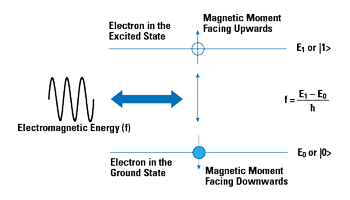
The frequency of applied electromagnetic energy causes electrons to move from one energy state to another.

For physicists to measure what is going on they have to apply certain values to each element and this is how best I can grasp what is going on by cutting and pasting from various web sites and wikipedia.
Each atomic orbital, (a 3D region around an atom's nucleus describing where an electron is most likely to be found and also represents its wave-like behaviour rather than a fixed path), is represented by an energy level measured in electron volts, with the lowest orbit called the ground state. As a particle can also be a wave, its energy level has a frequency equal to the energy level in electron volts divided by Planck’s constant (the quantisation constant). Consider the diagram above. If we want the electron to move to a higher energy state, we apply electromagnetic energy at a frequency (f) equal to the desired energy level (E1) minus the current energy level (E0), which is the energy level of the ground state, which is then divided by Planck’s constant (h). The electron will absorb the energy and jump to the next quantum energy level, its excited state. Once the energy is removed, it will fall back to its original level, emitting the energy at the frequency previously absorbed. Therefore, if we can constrain the energy levels to two, we have the fundamental building blocks for manipulating ones and zeros with a single electron.
Electrons also possess a type of angular momentum called spin.


As the electron moves from one energy level to another, the spin momentum changes. At the lower energy level, the momentum is pointing down, called the “spin-down.” When electromagnetic energy is applied, the spin changes until the momentum is pointing upwards as the electron achieves the next energy level. This is the “spin-up” state. When the electron state can be defined like this, it is said to possess an eigenstate, as both the position and momentum are known and can be quantified through measurement. However it's not quite as simple as this because as Schrödinger postulated, the probability is that an electron can at any chosen moment be in neither a spin-up or spin-down state, it is most probably somewhere between. As the electron is not at one energy state or the other and not oscillating between the two, it is in both states at the same time or a superposition of the two states. Another way to say this is: when two disturbances occupy the same space at the same time, the resulting disturbance is the sum of two disturbances. We know that each energy level is proportional to frequency, and since a particle is a wave, the state of superposition is simply the vector addition of the upper and lower states. A vector addition combines two or more vectors (quantities with magnitude and direction) to find a single resultant vector. Superposition is fundamental to the operation of a quantum computer, but it carries with it the “measurement problem.” A state of superposition only can exist if you don’t “observe” it. By applying a measurement frequency pulse to a qubit in superposition, the state of that qubit collapses or snaps back to one of the two quantised energy levels, which is how quantum bits are manipulated to have a value of one, zero or both simultaneously, which in computing are the binary digits;1 for on and 0 for off.

In order to digest this I have to turn to other forms of thinking and as I have often suspected that ancient ideas of the body's energy levels and chakras are actually deep insights into these things, I reestablished in my mind a connection to the concept of Yin Yang.

Yin Yang

The Yin Yang symbol represents opposite forces that interact to form a dynamic whole. The two magnetic moments of up and down-ness could easily be symbolised by this figure. Each side of the symbol slides into itself and it is always in a state of becoming, like the Necker Cube illusion, first one then the other shape takes precedence and if you stare at the image for a while, its optical negative will appear, reinforcing the either or or yes/no value of the sign.

At the level of quantum we cant ask what or where things are, because it is all simply relationships. Just as speed is about the relationship between distance and time, it is not a thing in itself, it only comes into existence as a concept by thinking about how distance and time might relate. The idea of relationships takes us back to the entanglement of everything and that there is no such thing as an isolated individual object; as Ingold put it, "we are an intermingling."

At which point I can perhaps begin to see what this post is all about. It's not an attempt to describe how quantum biology works, or how quantum computing operates, it is about finding supportive undercurrents that help me come to some sort of heightened awareness of my art practice and how it sits alongside my ever evolving ethical framework. It's also to do with the fact that I believe that art is also about how to communicate emotion and how at some point emotion and physical reality are deeply entwined.
I have been drawing at the same time as thinking about these issues and recently have returned to making what I see as 'post-amoeba' images.

The amoeba is a powerful signifier for life itself. The way it works within a permeable membrane and manages to maintain itself as an entity, whilst it is mainly water in a water environment, its membrane just holding it together with enough force to stop it dissolving back into the water it emerged from; provides for myself a metaphor that suggests the fragile impermanence and hard fought existence of all living creatures.

An amoeba

The drawing I made of an amoeba, above, became the first of several images that gradually like the amoeba itself developed cell extensions like pseudopodia and as each one was drawn I thought more about evolution, interconnectedness and entanglement. 

The amoeba takes on a future form

The flow of energies passing through and around an evolving form

Relationships entwined as the threads of the Norse Norns weave a destiny

The liquids of making forming the plasma of connectedness

Animal possibilities 

Monkey takes his first steps

I have recently been using the form of a monkey to enact or represent myself within various drawn situations of imaginary encounters. The image above was the equivalent of the moment of embryogenesis of that idea. My thoughts about the invisible interior landscape of the body, coupled with a need to use other narrative forms, becoming for a moment fused together. In this image the exterior does at one point penetrate the interior, an idea I have developed further in other drawings, the fold can reveal the other side of a surface, whilst a torus can be a donut, a worm or a human body, all of which have contiguous insides that eventually become exterior surfaces.

My wife is a follower of Buddhism and she will sometimes remind me that many of the issues I struggle with have been thoroughly thought through by Buddhist monks many years ago. For instance in the Bodhisattvacaryāvatāra by Shantideva, the image of the monkey is used as an analogy for the untrained and easily distracted human mind. The monkey represents a mind that is mischievous, restless and undisciplined, constantly leaping from one thought, sensation or desire to another. This undisciplined state is seen as a major obstacle on the path to enlightenment, but in my case it is a symbol that reminds me never to take what I do too seriously and that it is only in releasing and accepting my inner more intuitive animal, that I will find peace in my entangled relationships with the universe.

References

Bohm, D. (2002) Wholeness and the Implicate Order London, Routledge

Cook, L. S. (1887) Geometrical Psychology, or, The Science of Representation an Abstract of the Theories and Diagrams of B. W. Betts London: G. Redway

Deleuze, G. (2006) The Fold London: Continuum

Lipton, B. (2015) The Biology of Belief London: Hay House UK

Ruyler, R. (2019) The Genesis of Living Forms London: Rowman & Littlefield International

Yanagisawa, E (2017) The Fold. A Physical Model of Abstract Reversibility and Envelopment in 'The Dark Precursor, Deleuze and Artistic Research'. Edited by Paulo de Assis and Paolo Giudici. Orpheus Institute, Ghent. Leuven University Press  

See also:

Drawing as entanglements of life

What is embodiment?

Dream photography

Geometrical psychology and the fold

The weaving of grids

Paper, folding and the songs of trees

The split

Body auras

A linear enjambement 

Between art geometry and emotion

Tuesday, 15 October 2024

What is embodiment?

 'Our bodies are not mere vessels for the containment of our personalities, our agencies or our disembodied souls. Our embodiment is the very manner of our co-activity with, emplacement in and experience of the world. ... We are entangled, we are processes of becoming, we are products of resistance to the conditions in which we find ourselves.' (Noë, 2023, p.139)

In his book 'The Entanglement', philosopher Alva Noë explores the inseparability of life, art, and philosophy. The book has helped me to see how I can move between one mode of visualising things and another. For instance I might spend time trying to visualise a pain, either my own or someone else's, this interoceptual or somatic experience can appear to be totally unrelated to a creature that seems to emerge from my subconscious, or an image I might have made of a cornfield on a sunny day; but they are all part of my experience of the world. At one moment I might be in conversation with someone about their state of mind, an hour later I might be walking through a rain storm and be wondering if the Gods of nature are all against me and then as I take shelter in a local museum, might find myself gazing at Egyptian artefacts from 5,000 years ago. 

Whether I am experienced by others as a soaked escapee from the storm, or a serious historical researcher, as an artist or as an old man, will also effect how I feel about my experiences. But the architecture of the museum, the layout of the streets I walk through and the geological features of the land I walk over will also be shaping and influencing both my body and the thoughts it contains. 

I am inseparable from my body and my body is inseparable from the world. As Jacob Von Uexküll pointed out in his text, 'A Stroll through the worlds of animals and men', each creature has its own 'unwelten' or phenomenal world. Living beings therefore perceive their worlds in terms of species-specific, spatio-temporal, "self-in-world" subjective reference frames. He called these framings, the 'umwelt'. The structure of the world view of each creature is therefore determined by the nature of each individual species; by its physiology, its behaviour, and its interactions with its environment. For myself as an artist, I thought the most important thing was the fact that Von Uexküll when pointing these things out, also stated that he firmly believed that these world views could only be disclosed through individual subjectivity.

This is how Jacob Von Uexküll introduced his idea;

'The place, a flower-strewn meadow, humming with insects, fluttering with butterflies. Here we may glimpse the worlds of the lowly dwellers of the meadow. To do so, we must first blow, in fancy, a soap bubble around each creature to represent its own world, filled with the perceptions which it alone knows. When we ourselves then step into one of these bubbles, the familiar meadow is transformed. Many of its colourful features disappear, others no longer belong together but appear in new relationships. A new world comes into being. Through the bubble we see the world of the burrowing worm, of the butterfly, or of the field mouse; the world as it appears to the animals themselves, not as it appears to us. This we may call the phenomenal world or the self-world of the animal.'

However the physiology of the individuals of each species, is a product of a particular type of memory. Raymond Ruyer who developed the concept of embryogenesis stated, 'Memory is not the property of bodies. Bodies, or what appear as "bodies", are the property of memory'. He also wrote that consciousness begins with a material idea. A forming principle being at work, right from the beginning that directs the actions of bodies. Every cell forms itself out of the 'memory' of the principles adhered to by the sub-atomic forces that control the behaviour of materials. Therefore both the form of each creature and even what we think of as consciousness, are the products of the movement of relationships between atomic forces. How they can move and in what possible variations being dependent on the structural principles inherited from all the previous embodied generations of electrons and protons, neutrons and / or electromagnetic or other forces that underpin everything. These rules then determine the possibilities of events coming together in different arrangements, such as a finger in a human ending up being something that can be used to help hold a pencil, but in a bat being something to help tauten a membrane so that it can fly. 

Ruyler uses diagrams to illustrate his ideas.


In 'The Genesis of Living Forms', the folding of the earth to form the Alps is compared with the folding of a flat sheet to form a tube, which is in turn compared to the folding of cells during the process of embryogenesis, in particular during cell division and differentiation. 

I'm sure Gilles Deleuze must have been reading Ruyler or had come across his ideas when he wrote 'The Fold: Leibniz and the Baroque'. Leibniz had developed a concept of the monad, which was that the universe is made up of an infinite number of basic, immaterial, and indestructible substances, that in his Fold text, Deleuze interpreted as folds of space, time and movement, going on to describe the world itself as a body of infinite folds that twist and weave through space and time.

So 'embodiment' when considering this framework, could be a sort of enfolding of things. 

From a series of images trying to visualise a moment/event in the life of a fish

A fragment of a body/emotional landscape

The body folds into its environment, at the same time the body's internal events are folding into and are the body's interior, which itself is contiguous with its exterior.  

The body as a landscape with inhabitants (fragment of an animation)

As you make an animation it is as if you 'fold' something into life. Beginning with just a few marks, gradually you add more and more material until you have enough to create movement. For the animator the background and the figures that act upon it are equally important, as the one defines the other.

Two birds attempt to blow life into the landscape (detail from far left, above)

References:

Deleuze, G. (1992) The Fold: Leibniz and the Baroque Univ Of Minnesota Press

Noë, A. (2023) The Entanglement: How Art and Philosophy Make Us What We Are. Princeton, N.J.: Princeton University Press

Ruyer, R., (2019) The Genesis of Living Forms. Rowman & Littlefield

Von Uexküll, J. (1992) A stroll through the worlds of animals and men: A picture book of invisible worlds. Semiotica, Vol. 89 (Issue 4), pp. 319-391. https://doi.org/10.1515/semi.1992.89.4.319

See also: 

Invisible worlds

Connecting the singularity

Interoceptual textures and surface flow

Drawing and quantum theory


Sunday, 13 March 2022

Drawing as portable sculpture

Do Ho Suh

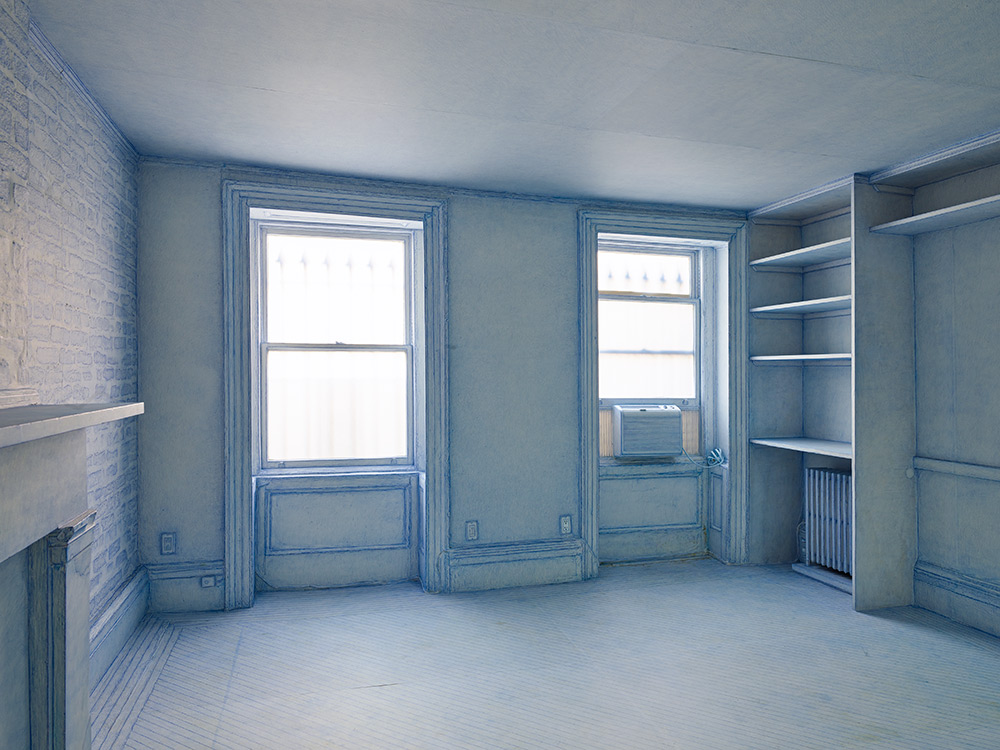
Do Ho Suh was exhibiting at the Henry Moore Centre in Leeds not that long ago. I have looked at his work before as a cross between drawing and sculpture, his material meshes working as if they were assembled from full scale technical drawings of architectural environments. However you could also think of his work as a very portable way of carrying information around, and as such to begin thinking about certain sorts of drawing as portable sculpture.  


A few years ago Do Ho Suh papered over much of the interior of a four-storey New York townhouse. He used thin paper, stuck down with a soft glue, and delicately worked the paper over fixtures such as radiators or pipes. He was sort of caressing the surface, treating it as a kind of second skin. Finally he coated his fingers in blue pastel and rubbed himself into the walls, and floor and fireplace and shelving, ‘caressing them’ as he put it. He went on to rub different colours into the surfaces of the other rooms. The rubbing got less intense the higher up the house he got and the rooms less familiar. Suh remarked on observing he rubbed away his fingerprints; ‘I gave part of my body’ 

 
Do Ho Suh: Papered and pastel coated room

I was in particular fascinated by photographs of Do Ho Suh's rubbings of fixtures and fittings, such as the one below. It operates in a very strange space that sits between photography, drawing and sculpture.

Do Ho Suh: Photograph of a paper covered sink that has been rubbed with a blue pencil crayon

Photograph of a paper covered radiator

The paper covered radiator is more sculptural and if the paper surface was carefully removed from its metal underpinning, it could become a free standing sculpture. Because the sink photograph has no visual edges to it, we become more aware of the direction of marks taken by the rubbing process, and this makes it more like a drawing. In either case the idea of drawing as portable sculpture still seems viable, so perhaps its worth opening the idea out a little further. 

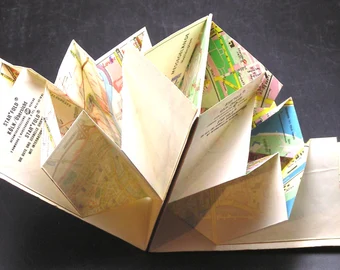
Frances Richardson remarked that she thought of some of her drawings as thin sculpture. Blueprints can be thought of as thin plans for sculpture. When we make a map we think of it as a flat drawing. However when you buy an ordnance survey map it comes as a folded object. 

Opening out a folded map

The folded paper is very sculptural and of course the art of folding flat paper into complex three dimensional forms can reach extremely high levels of complexity. Arisawa Yuga's design for an origami dragon being typical of the thinking processes that allow us to think about the relationship between a flat drawing and a sculptural form. 


Arisawa Yuga: Dragon

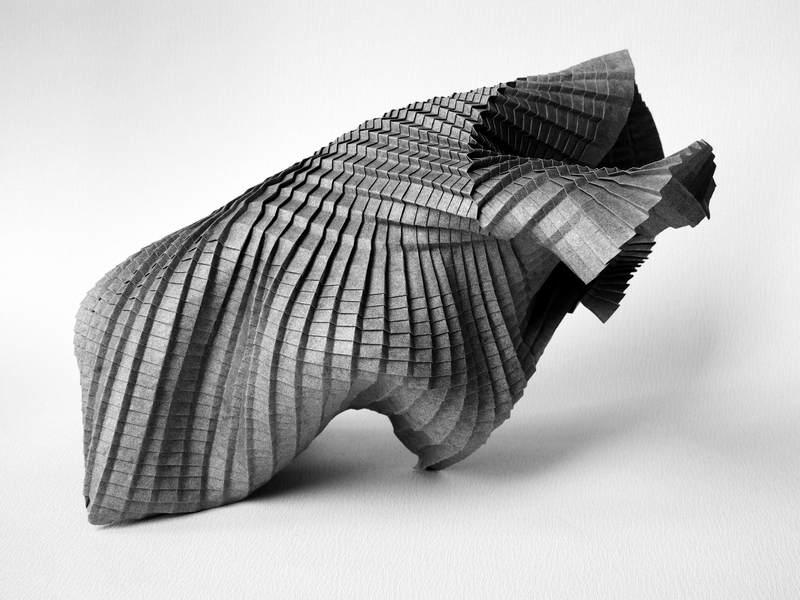
So could we think about Arisawa Yuga's design for an origami dragon as another form of portable sculpture? If we look at a very formal set of folds by Paul Jackson, such as the parallel, but unequal v-pleats below, we see a more engineering than sculptural set of concepts in action. In fact the conceptual thinking around paper folding is even more interesting than simply thinking of how two dimensions can become three. A 'No' crease is a one-dimensional point which creates a dent in the paper called a 'Break'. This generates complex curves in the paper, which can change from convex to concave and back again. So we have a one dimensional point, leading to a fold in a two dimensional surface that allows the maker to create an object with three dimensions. In this case engineering becomes art.

Paul Jackson: Parallel, but unequal v-pleats

The current more sculptural understanding of origami stems directly from Akira Yoshizawa's work. He pioneered many different origami techniques, including most importantly wet-folding which involves slightly dampening the paper before making a fold, which allows the paper to be manipulated more easily, resulting in finished origami models that have a rounder and more sculpted look.

Akira Yoshizawa: origami self portrait

Goran Konjevod: origami 

Yoshizawa's work paved the way for artists such as Goran Konjevod, who explores paper folding as a pure sculptural device, the potentiality of a flat sheet of paper being what this type of portable sculpture is all about. 

Perhaps we could think of architects' drawings as another form of portable sculpture. The drawing of an idea of a building is something that gradually coalesces and accumulates around itself plans and elevations, physical materials and associated actions that eventually make the concept become solid. I'm reminded of a north American Indian description of thinking as crystallised air. 


Frank Gehry: Drawings and final resolution of Guggenheim in Bilbao

The bringing back inside one building the elements of another building, suggests something akin to a 1 to 1 scale map. Michael Rakowitz's rubbings of architectural details as in his exhibition 'The Flesh Is Yours, The Bones Are Ours', highlighted the traces left in Istanbul of the Armenian craftsmen who shaped Istanbul’s ornamented facades, until they were massacred with the rest of Turkey’s Armenian population. The buildings in Istanbul keeping memories alive, when written historical documents don't. 

Michael Rakowitz: 'The Flesh Is Yours, The Bones Are Ours'

In the very short story 'On Exactitude in Science', Jorge Luis Borges writes; …'In that empire, the art of cartography attained such perfection that the map of a single province occupied the entirety of a city, and the map of the empire, the entirety of a province. In time, those unconscionable maps no longer satisfied, and the cartographers' guilds struck a map of the empire whose size was that of the empire, and which coincided point for point with it. The following generations, who were not so fond of the study of cartography as their forebears had been, saw that that vast map was useless, and not without some pitilessness was it, that they delivered it up to the inclemencies of sun and winters. In the deserts of the west, still today, there are tattered ruins of that map, inhabited by animals and beggars; in all the land there is no other relic of the disciplines of geography'. 

Borges' short story is a sort of inverted idea of a map, which is usually meant to operate as a portable landscape, something that allows us to conceptualise our position in the world and therefore be able to navigate it. However the most exact scale map is 1 to 1 and this is reality itself, which as Borges intimates, can suffocate us with its weight and enormity. 

We are left with ideas as portable objects. During the early Renaissance, Filippo Brunelleschi came up with a way of making images that enabled architects like himself to make flat copies of buildings built. 


Brunelleschi  (1377-1446)  painted two panels in the course of an experiment that marked an event which was to change the way we would all begin to look at the world. These two panels are probably the first pictures to correctly embody linear perspective.  This is how Antonio di Tuccio Manetti, a man who was there, explained how the images made by Brunelleschi were made to come alive: "In order to constrain the viewer to place his eye at the centre of projection, Brunelleschi had made a hole in the panel on which there was this painting; ... which hole was as small as a lentil on the painting side of the panel, and on the back it opened pyramidally, like a woman's straw hat, to the size of a ducat or a little more. And he wished the eye to be placed at the back, where it was large, by whoever had it to see, with the one hand bringing it close to the eye, and with the other holding a mirror opposite, so that there the painting came to be reflected back; ... which on being seen, ... it seemed as if the real thing was seen: I have had the painting in my hand and have seen it many times in these days, so I can give testimony."

In effect an image could now be made of something, which acted as an exact copy. This meant someone like Brunelleschi could take an image of a building he had designed and had built to another city and use it to explain what he could build for that other city. A sort of portable architecture. The great grandchild of this event was of course photography, the implication of my question finally being to ask whether or not a photograph could be considered some form of portable sculpture. 

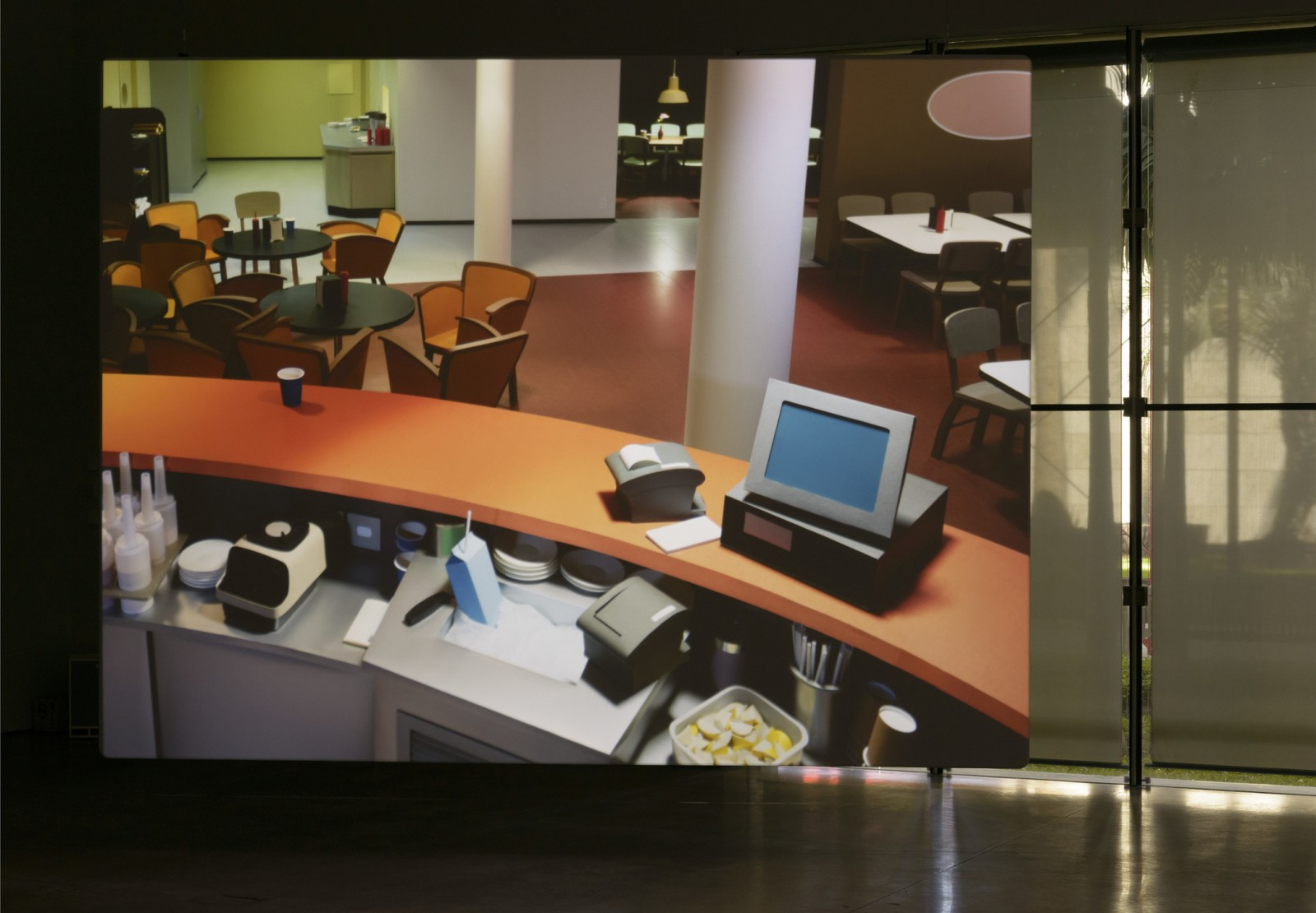
Thomas Demand uses paper to make fragile models of familiar objects that he turns into photographs. The photographs complete the work, the paper objects being thrown away once the photograph is printed. 

Thomas Demand

In the case of Thomas Demand the photograph carries all the information needed to understand the sculpture, in fact it is the only information available, the three dimensional reality of the paper environment compressed into the photographic surface. Is this then the ultimate in paper based portable sculpture?