Showing posts with label rubbings. Show all posts

Sunday, 13 March 2022

Drawing as portable sculpture

Do Ho Suh

Do Ho Suh was exhibiting at the Henry Moore Centre in Leeds not that long ago. I have looked at his work before as a cross between drawing and sculpture, his material meshes working as if they were assembled from full scale technical drawings of architectural environments. However you could also think of his work as a very portable way of carrying information around, and as such to begin thinking about certain sorts of drawing as portable sculpture.  


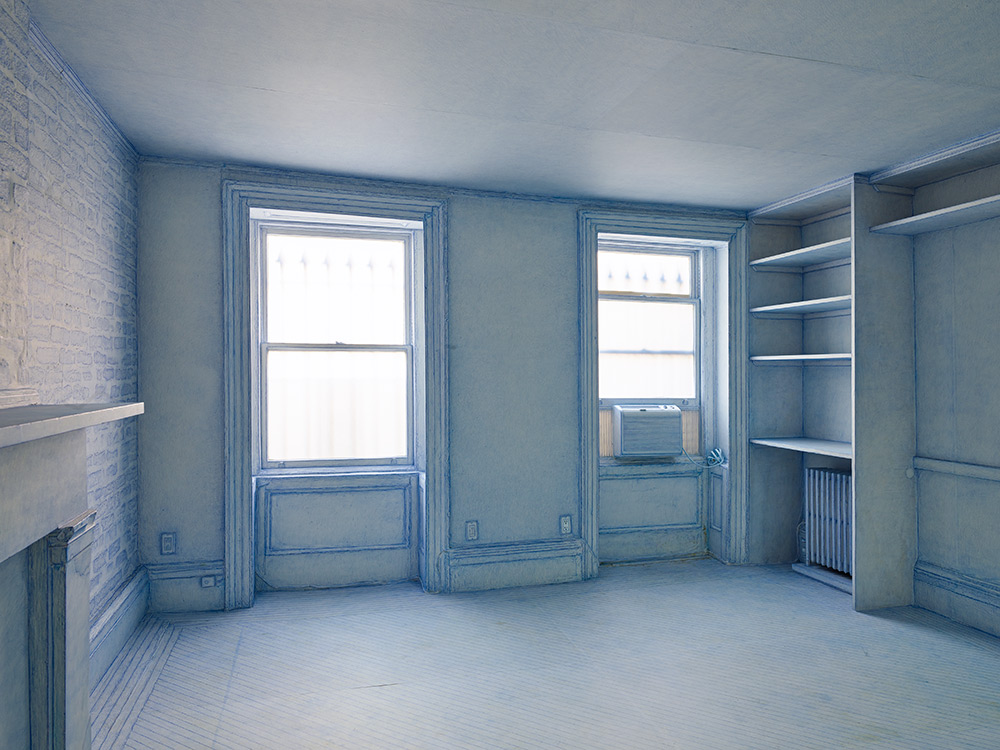
A few years ago Do Ho Suh papered over much of the interior of a four-storey New York townhouse. He used thin paper, stuck down with a soft glue, and delicately worked the paper over fixtures such as radiators or pipes. He was sort of caressing the surface, treating it as a kind of second skin. Finally he coated his fingers in blue pastel and rubbed himself into the walls, and floor and fireplace and shelving, ‘caressing them’ as he put it. He went on to rub different colours into the surfaces of the other rooms. The rubbing got less intense the higher up the house he got and the rooms less familiar. Suh remarked on observing he rubbed away his fingerprints; ‘I gave part of my body’ 

 
Do Ho Suh: Papered and pastel coated room

I was in particular fascinated by photographs of Do Ho Suh's rubbings of fixtures and fittings, such as the one below. It operates in a very strange space that sits between photography, drawing and sculpture.

Do Ho Suh: Photograph of a paper covered sink that has been rubbed with a blue pencil crayon

Photograph of a paper covered radiator

The paper covered radiator is more sculptural and if the paper surface was carefully removed from its metal underpinning, it could become a free standing sculpture. Because the sink photograph has no visual edges to it, we become more aware of the direction of marks taken by the rubbing process, and this makes it more like a drawing. In either case the idea of drawing as portable sculpture still seems viable, so perhaps its worth opening the idea out a little further. 

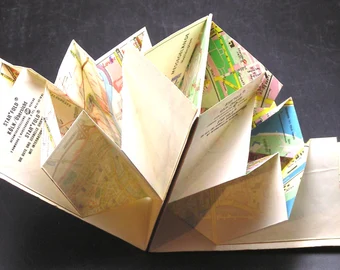
Frances Richardson remarked that she thought of some of her drawings as thin sculpture. Blueprints can be thought of as thin plans for sculpture. When we make a map we think of it as a flat drawing. However when you buy an ordnance survey map it comes as a folded object. 

Opening out a folded map

The folded paper is very sculptural and of course the art of folding flat paper into complex three dimensional forms can reach extremely high levels of complexity. Arisawa Yuga's design for an origami dragon being typical of the thinking processes that allow us to think about the relationship between a flat drawing and a sculptural form. 


Arisawa Yuga: Dragon

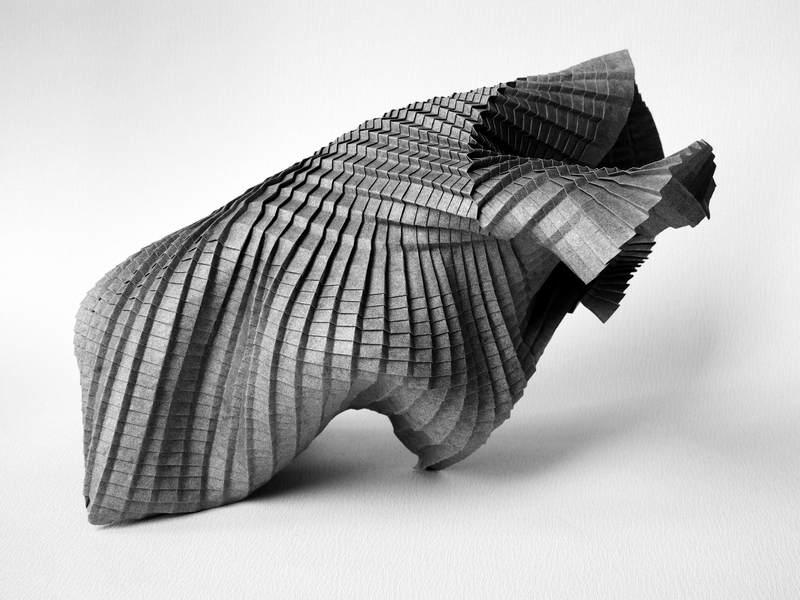
So could we think about Arisawa Yuga's design for an origami dragon as another form of portable sculpture? If we look at a very formal set of folds by Paul Jackson, such as the parallel, but unequal v-pleats below, we see a more engineering than sculptural set of concepts in action. In fact the conceptual thinking around paper folding is even more interesting than simply thinking of how two dimensions can become three. A 'No' crease is a one-dimensional point which creates a dent in the paper called a 'Break'. This generates complex curves in the paper, which can change from convex to concave and back again. So we have a one dimensional point, leading to a fold in a two dimensional surface that allows the maker to create an object with three dimensions. In this case engineering becomes art.

Paul Jackson: Parallel, but unequal v-pleats

The current more sculptural understanding of origami stems directly from Akira Yoshizawa's work. He pioneered many different origami techniques, including most importantly wet-folding which involves slightly dampening the paper before making a fold, which allows the paper to be manipulated more easily, resulting in finished origami models that have a rounder and more sculpted look.

Akira Yoshizawa: origami self portrait

Goran Konjevod: origami 

Yoshizawa's work paved the way for artists such as Goran Konjevod, who explores paper folding as a pure sculptural device, the potentiality of a flat sheet of paper being what this type of portable sculpture is all about. 

Perhaps we could think of architects' drawings as another form of portable sculpture. The drawing of an idea of a building is something that gradually coalesces and accumulates around itself plans and elevations, physical materials and associated actions that eventually make the concept become solid. I'm reminded of a north American Indian description of thinking as crystallised air. 


Frank Gehry: Drawings and final resolution of Guggenheim in Bilbao

The bringing back inside one building the elements of another building, suggests something akin to a 1 to 1 scale map. Michael Rakowitz's rubbings of architectural details as in his exhibition 'The Flesh Is Yours, The Bones Are Ours', highlighted the traces left in Istanbul of the Armenian craftsmen who shaped Istanbul’s ornamented facades, until they were massacred with the rest of Turkey’s Armenian population. The buildings in Istanbul keeping memories alive, when written historical documents don't. 

Michael Rakowitz: 'The Flesh Is Yours, The Bones Are Ours'

In the very short story 'On Exactitude in Science', Jorge Luis Borges writes; …'In that empire, the art of cartography attained such perfection that the map of a single province occupied the entirety of a city, and the map of the empire, the entirety of a province. In time, those unconscionable maps no longer satisfied, and the cartographers' guilds struck a map of the empire whose size was that of the empire, and which coincided point for point with it. The following generations, who were not so fond of the study of cartography as their forebears had been, saw that that vast map was useless, and not without some pitilessness was it, that they delivered it up to the inclemencies of sun and winters. In the deserts of the west, still today, there are tattered ruins of that map, inhabited by animals and beggars; in all the land there is no other relic of the disciplines of geography'. 

Borges' short story is a sort of inverted idea of a map, which is usually meant to operate as a portable landscape, something that allows us to conceptualise our position in the world and therefore be able to navigate it. However the most exact scale map is 1 to 1 and this is reality itself, which as Borges intimates, can suffocate us with its weight and enormity. 

We are left with ideas as portable objects. During the early Renaissance, Filippo Brunelleschi came up with a way of making images that enabled architects like himself to make flat copies of buildings built. 


Brunelleschi  (1377-1446)  painted two panels in the course of an experiment that marked an event which was to change the way we would all begin to look at the world. These two panels are probably the first pictures to correctly embody linear perspective.  This is how Antonio di Tuccio Manetti, a man who was there, explained how the images made by Brunelleschi were made to come alive: "In order to constrain the viewer to place his eye at the centre of projection, Brunelleschi had made a hole in the panel on which there was this painting; ... which hole was as small as a lentil on the painting side of the panel, and on the back it opened pyramidally, like a woman's straw hat, to the size of a ducat or a little more. And he wished the eye to be placed at the back, where it was large, by whoever had it to see, with the one hand bringing it close to the eye, and with the other holding a mirror opposite, so that there the painting came to be reflected back; ... which on being seen, ... it seemed as if the real thing was seen: I have had the painting in my hand and have seen it many times in these days, so I can give testimony."

In effect an image could now be made of something, which acted as an exact copy. This meant someone like Brunelleschi could take an image of a building he had designed and had built to another city and use it to explain what he could build for that other city. A sort of portable architecture. The great grandchild of this event was of course photography, the implication of my question finally being to ask whether or not a photograph could be considered some form of portable sculpture. 

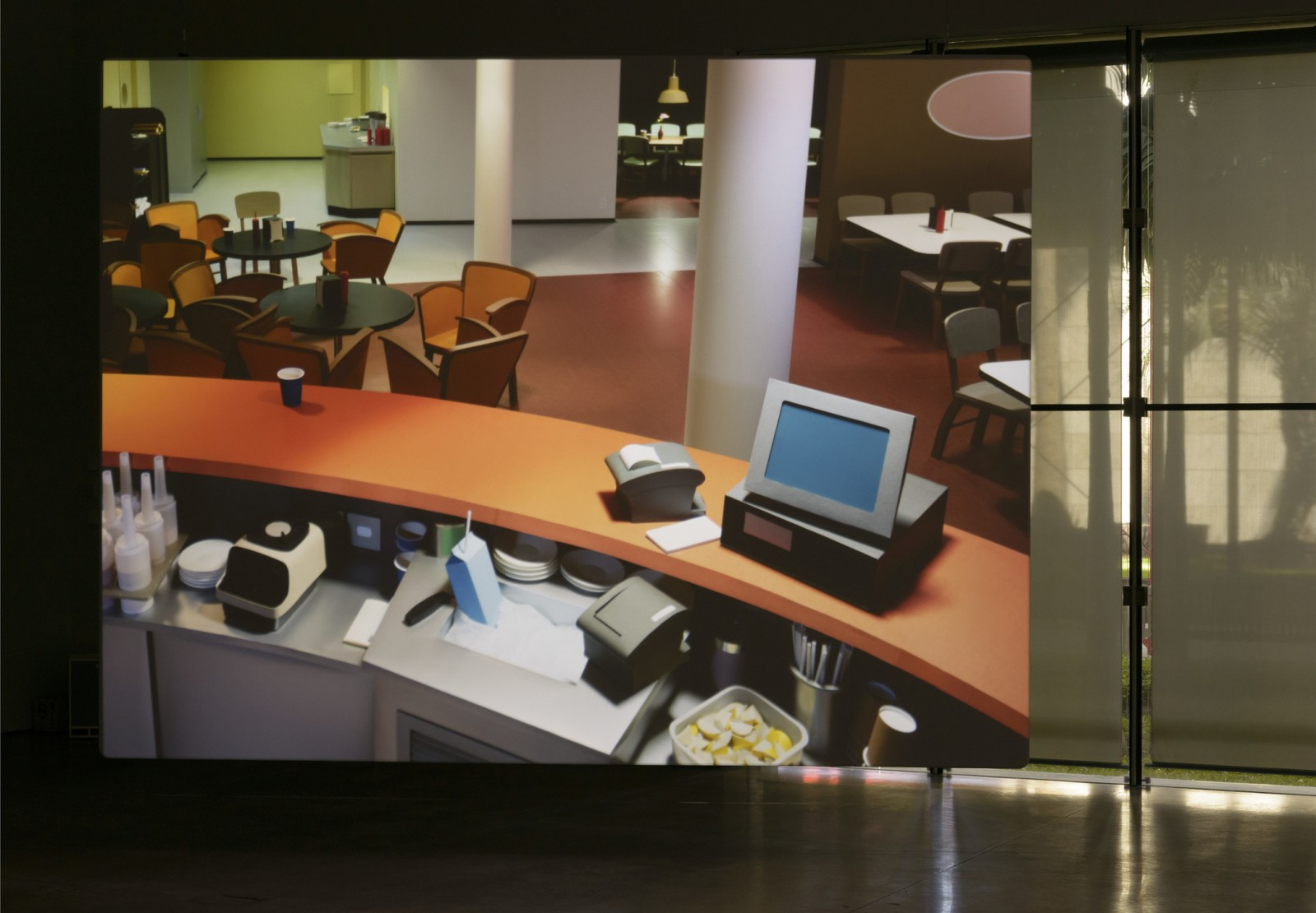
Thomas Demand uses paper to make fragile models of familiar objects that he turns into photographs. The photographs complete the work, the paper objects being thrown away once the photograph is printed. 

Thomas Demand

In the case of Thomas Demand the photograph carries all the information needed to understand the sculpture, in fact it is the only information available, the three dimensional reality of the paper environment compressed into the photographic surface. Is this then the ultimate in paper based portable sculpture? 


Monday, 28 October 2019

Rubbings and frottage emerge from the graveyard

Michael Rakowitz: Rubbings of architectural details

It used to be that the only rubbings taken seriously outside of those made by children were brass rubbings made of tombstones. I well remember the activity in the 1960s, several people I came across in those days spending their weekends travelling round looking for the perfect tombstone to take rubbings from. They also had specific tools for the work, certain types of papers and special wax blocks. But with the recent exhibition of Michael Rakowitz at the Whitechapel and Simon Woolham's exploration of the Kennet & Avon Canal at the drawing centre  in Trowbridge, you can see that there is a growing awareness that a direct touch with a surface has far more possibilities than might at first be apparent. Rakowitz has used rubbings in more than one exhibition to transfer information from one context to another. The decorative details that exist across many threatened architectural monuments, can be re-presented by a rubbing far more intimately than by a photograph. For one thing you know they are size for size and you also realise that someone had to climb up onto the architecture, place the paper over the surface details and make the rubbing. This much more physical record is emotionally much more highly charged than a photograph which by its very nature implies a distancing from the subject. 


Michael Rakowitz: Casts of architectural details

Rubbings can be thought of as very shallow casts. Rakowitz using both processes to capture his experiences of the way conflict is destroying the architectural heritage of the Middle East. 

Simon Woolham's exploration of the Kennet & Avon Canal uses the process of making rubbings differently, he recreates the various experiences of surface that he comes across on his walks, by building complex reconstructions or compositions out of the huge number of collected surfaces that he brings back with him. Not only composing the rubbings by finding new juxtapositions for them, he will cut out sections so that he can use geometry to give order to what could be a chaotic mess and work into the compositions other types of drawings that are more observational. As these constructions are built they can also take on an environmental aspect, especially as they reach floors and ceilings and spill out into the spaces of a room. Because Woolham is also a performer, these adjusted spaces can then also become settings for other things to take place such as musical or spoken performance. 

Simon Woolham

An animation made by school children working with Simon Woolham

The great thing about working with rubbings is that people don't get worried about their drawing ability. Simon Woolham's work with school children proving that very sophisticated results can emerge from collaborative ventures.

Do Ho Suh uses rubbing to capture the essence of a lived in space. He can then transport that space elsewhere and exhibit it. Sometimes using sewn fabric to do the same thing, he presents ghost like recreations of spaces he has known. 


Do Ho Suh

The use of rubbings as an art form is often regarded as something originating in the work of Max Ernst. Using the wooden floor in his room, he began to take pencil rubbings and as he did so realised that these rubbings suggested ideas to him. This was an ideal Surrealist technique, which he first called grattage and subsequently frottage. It was of course a very old idea, Shakespeare had this to say about it;

Sometime we see a Cloud that's dragonish,
A Vapour sometime like a Bear, or Lion,
A tower'd citadel, a pendant Rock,
A forked Mountain, or Promontory,
With Trees upon't, that nod unto the World
And mock our Eyes with Air.--Anthony and Cleopatra (Act IV Scene II)


Max Ernst: Le Start du Châtaignier

What was also interesting about these Surrealist inventions was the use of titles to further reinforce the feeling of unreality. In this case 'Le Start du Châtaignier', in English, 'the Chestnut tree start', continuing to not provide an answer as to what the image is all about. I do think we could spend more time thinking about how to use titles. From Turner writing long poems for his titles, to abstract artists giving their work titles reflecting those of musical terms, such as 'composition 23', there have been many attempts to include the title itself into the meaning of the work. If you visit an exhibition, it is interesting to see how much time visitors will spend reading titles and other associated information, so for an art form that prides itself on not having to use words and a 'what you see is what you get' attitude, this suggests that audiences are not so sure and they want a belt and braces approach to finding meaning. 

Not that the old traditional skills of brass rubbing should be discounted. Some brass rubbings I have seen were very powerful images in their own right. The dense black of a wax 'heelball' pushed into the surface of 'butcher's paper' (a 22–30-inch-wide roll of white paper) can be used to produce a beautiful negative. 


Brass rubbing from a church in Otley, West Yorkshire

Astral wax used to be the wax of choice for making brass rubbings. 


I have been unable to find any lately except on E Bay and people want astronomical prices for it. The nearest substitute I have found are some shoe polishes, (which of course was what Astral Wax was originally made for), especially if you take the wax polish block out of the tin and leave it out in the air for a few weeks, this seems to harden it up and make it more suitable for making a rubbing. Butcher's paper was used for wrapping meat and there are still butcher's papers being made. Some are wax coated but you can also get them uncoated. Rolls of butcher's paper can come in beautiful colours as well as white, one colour that is specific to butcher's paper being a pink peach. It is of course a very interesting paper to draw on and because it comes in rolls can be an ideal paper to use when trying to develop a different 'feel' to large images. 
I'm drifting off tack again. The important issue about rubbings is that they bring the sense of touch back into the way we think about collecting information about the world and communicating this to others. Touch in many ways comes before sight, as a baby, you need to touch the world to decide it is there, your eyesight is yet to be trusted. Therefore rubbing could be seen as a more essential or authentic record of a certain type of encounter with the world. But it is hard to get away from the fact that frottage is also “the act of rubbing against the body of another person, as in a crowd, to attain sexual gratification.” Which reminds us that rubbing is when you think about it, quite sexual as well.

Jane Eaton follows the logic of two dimensions moving back into three dimensions in her frottage work. If we think of a rubbing as shallow sculpture, or a type of low relief, then it is no surprise to find frottage as an entry into more sculptural thinking. 


Jane Eaton: Frottages

The transfer of texture onto a flat surface from a three dimensional experience is after simply being rolled into a cylinder, a new object, column like, its texture suggestive of marble. Treating one surface as a dense black and the other much more lightly creates a basic dark/light opposition, which is very effective as a structural device. 

A Banalinga stone

As I let these various thoughts spill out, for one reason or another I am reminded of Banalinga stones. These are used for Hindu worship in India. Found on the beds of rivers they are smooth ellipsoid stones that feel as if they were made to be held in the hand. Also called the Svayambhu Linga: a Sanskrit term for a “Self-existent mark or sign of God”, because they are discovered in nature and not carved or crafted by human hands. Their forms are often a simple roller shape that is roughly cylindrical. These forms are also about touch. In their case it is the action of water on stones being rolled along the river bed that makes their unique forms, the touch of water on stone, coupled with some abrasive grit, making something of beauty. Another case of non human action resulting in objects that can appear at first sight to be manufactured by hand. This 'sign of God' perhaps now read as a 'sign of nature' a reminder that we are no different to animals and minerals and other things, simply events linked to other events as we process our way through a mass of interconnected entanglements. 

Hanna Barriball

Hanna Barriball

Hanna Barriball has long been interested in the indexical; i. e. the one to one relationship a rubbing has with the thing that is rubbed. By pushing hard on the materials she makes her rubbings with she also engages with the sculptural qualities of the various papers she uses. She makes her images by rubbing so hard she pushes her paper into the indentations that are part of the surfaces being rubbed, thus making in effect shallow casts of the surfaces she is exploring. 

Paper casts sit in that space between relief sculpture and drawing on paper, made from one sheet of paper, they carry an impression of the surface they were moulded over, but they are still a single sheet of paper thick. Paper moulds can be used to make a negative impression of a building or object, from which a positive could be cast. Paper moulds were used by archaeologists in the mid-nineteenth century to copy the façades of monuments such as Angkor Wat in Cambodia, Palenque in Mexico or the Alhambra in Spain. Described as ‘facsimiles’ by the inventor of the technique, Lottin de Laval (1810-1903), paper moulds allowed explorers to transport a version of a building or sculpture with all its details back to the museum. As a cheap and extremely light method of reproduction, they allowed the explorer to travel further, into previously uncopied territories, into the Mexican and Cambodian jungles for example, where the huge weight and fragile nature of plaster would have proved prohibitive. For instance Alfred Maudsley made paper moulds of Mayan Temples.

Rachel Whiteread

In 2017 Rachel Whiteread shredded a plan chest of drawings to make paper mâché, which she cast on sheets of corrugated iron. In effect she was repeating the Lottin de Laval process, and like Michael Rakowitz casting off architectural fragments. The dialogue between people and objects being linked in this case by touch. 

See also these other posts that reflect on touch


Coda:

I'm reminded by Patrick Ford of a project he was engaged with back in 2017. He was already engaged with a dialogue with rubbings, rocks and the implications of object orientated ontology. See his blog where he explores work in process. 

Patrick Ford at work

Monday, 19 May 2014

The imprint and the trace

A few people have asked me to put up some information about the idea of ‘the trace’, this is my first post on this issue. Do remember that if you want me to open out an idea you have to let me know by commenting in the comments box.

In Nicolas Bourriaud’s introduction to Foucault’s ‘Manet and the Object of Painting’, he points out that like other philosophers of the time Derrida was a writer that explored the interval between the sign and the trace, the space between things rather than things in terms of singular objects, the event rather than the moment.

 Traces are usually traces of moments of surface contact. For example the imprint of feet as someone walks across a sandy beach, wet soles of shoes marking a hallway, a hand-print left on a steamy bathroom mirror. However traces can become more permanent, a tyre track left in mud can become ‘cast’ in hard baked clay as the mud dries out during a hot summer. A dead body sinks into a tar pit, becoming slowly materialized until revealed millions of years later as a fossil. A car runs through a pool of spilled paint, its tyres now leave a permanent print on the road.

 Traces are incomplete records of events, but ones that can often be read as signs. Traces of crumbs left on a table, can be signs of a recently eaten meal.  A deer leaves ‘traces’ of its passage, hoof-prints left in soft ground, velvet from its antlers, brushed off and held by low lying tree branches.  These traces can be read as signs, as a language that can be used to understand the deer’s life. A complex understanding will evolve as we learn to read the traces of its passage more accurately. We can work out which direction the deer was going in by close examination of its hoof-print, we can ascertain its height by measuring how far from the ground a twig holds a scrap of antler velvet, we can guess its weight from the depth of the hoof-track etc. We may even try to ascertain from the traces of its passage its mental state; was it rushing away from an enemy or calmly wondering through the woods?

The trace can be seen as at the root of the sign. The possibility of language embedded within our ability to interpret traces. Interpretation lays at the inception of the sign, it could mean this or that, but once interpreted as one thing, this can stick. Through inductive reasoning we shift the trace towards becoming a sign, i.e. we decide that something is probable based on the evidence before us, the probability leaking eventually into a generalization.

Traces are often imprints and therefore we can open the dialogue of meaning out into associated words, such as prints and touch. We might also include the idea of the cast, which could be seen as a three dimensional print. However some of the most compelling issues surround the fact that a trace or print taken from a three dimensional body is flat or two dimensional. 

At the core of much painting and drawing theory lies the paradox of trying to reproduce images of a three-dimensional world on a flat surface or two dimensional plane. (See Greenberg) However most three dimensional objects can be thought of  topographically as types of continuous surfaces, and if so, these surfaces can be flattened out as ‘diagrammatic’ ideas. For instance a cube can be visualized as six squares laid out in the form of a cross.  However the cross-like plan or net of a cube implies a ‘time of unfolding’, it suggests that it could be returned to three-dimensionality by refolding.

The interesting issue, and one that was highlighted by Abbot’s book ‘Flatland’ is that a two dimensional understanding of a three dimensional world is always lacking. A pyramid slowly passing through a flat plane initially appears as a dot, then as a triangle that is slowly increasing in size, but never as a fully realised three-dimensional object. One way therefore of thinking about a ‘trace’ is as a two dimensional piece of evidence of a three dimensional object. If so, we can develop an account of how the incomplete nature of this trace, in relation to the totality of the object, leads to an ambiguity of read. For instance the ‘imprint’ of a box left on the sand, doesn’t tell us anything about its height or whether or not the top of the box is at right-angles to the bottom.

Traces are dependent on events happening between objects or things. For instance a bird flies into a window and leaves a trace or imprint of its collision. 

A trace of a bird that has left its imprint on a glass window

A trace or imprint in a drawing or painting reinforces our awareness of the paper or canvas as a flat material plane. It highlights the idea that a drawing can be an object, a thing in the world that acts upon it and can be acted upon, rather than being an illusion or window on the world. In this way a drawing can be seen as a record of facts after the event.  However an imprint can also be a representation, for instance a handprint not only captures a moment of touch between the paper and the hand, it operates as a representation of a hand. Drawing has this ability to operate in two ways at once. It can be simultaneously a copy or illusion of reality and reality itself. It can be both image and information, arena for action and/or window on the world. Every drawing could be seen as a collection of traces, marks left over from the hand’s passage, but as we step back from the image, some of these markings might look like landscapes, or portraits.

As has already been mentioned, traces are often imprints of three-dimensional solid bodies left on flat planes. Therefore another word we can use is ‘touch’. These traces are memories of what happened when one object ‘touched’ another. One of the oldest images we have is that of a human hand ‘printed’ onto a cave wall, the artist literally touching the surface in order to make an image.

The Oxford English Dictionary defines touch as “That sense by which a material object is perceived by means of the contact with it of some part of the body.” We can by analogy ‘touch’ one object with another. When my coffee cup is put down on the table it can be seen as ‘touching’ the table and a record of this touching might be the ring stains of spilt coffee that have run down the sides of the cup.

One of the key issues about touch is that it is both immediate and unmediated. There is no time-delay, no medium between the subject and the object, the sensing organ is in direct contact with the sensed object. Similarly a print from the surface of an object is a record of a direct contact, a one to one relationship.  Touch is also identified with the real. If you can’t believe your eyes or ears, and believe that taste is subjective, you can still argue that to touch is to prove.  In this way we come to another area of meaning surrounding traces, that of the direct imprint, a print off an original that suggests that what we have is a more authentic record than a drawn or painted copy because this trace or print maintains some form of original surface contact with an original.

Associated with touch is the idea of a ‘print’, defined as “to press upon a substance or surface, so as to leave an indentation or imprint” We conjoin the two terms touch and print of course when finger-prints are taken. Our most sensitive organs of touch are also our most unique attribute, the ends of our fingers having swirls that are always singular to ourselves. The most common parts of our body to be used to print with being those we associate with intimate close contact with others, the lipstick prints on millions of cups and mugs, perhaps in sheer numbers being higher than the millions of fingertip prints taken throughout the world’s police offices. 


Susan Collis

Artists working in this area include Anna Barriball, her graphite rubbings are intense enough to eventually become as perceptually dense and solid as the originals; Dan Shaw-Town uses rubbing, erasing and sanding as well as folding techniques, Alice Channer has developed a body of work around skin, prints and stained surfaces, Susan Collis makes crafted versions of traces such as paint spills, Sian Bowen has worked with archaeological sites and is interested in touch, Dieter Roth’s ‘worktables’ were drawings that are actual traces left over from his working process, local Leeds artist Hondartza Fraga has done some interesting rubbings of old maritime books as part of a residency in Hull, the Ian Kiaer recent exhibition at the Henry Moore Institute displayed some of his traces of practice pieces, Max Ernst explored ‘frottage’ techniques to stimulate his imagination, these techniques nearly always consisted of taking rubbings from textured surfaces, Jasper Johns’ image ‘Study for Skin, 1. 1962’ is a direct imprint/trace of himself and Gyotaku or ‘fish rubbing’ printing is an established tradition in Japan. In popular culture the legend of the Turin Shroud highlights the emotional impact of the body as an imprint and one aspect of archeological practice was to take Lottin de Laval type rubbings of inscriptions, a response to these saw a terrific exhibition at the Henry Moore Centre in Leeds. As these were two dimensional casts from the surfaces of three dimensional buildings, they could be re-presented as both two and three dimensional representations.

A Lottin de Lavel rubbing taken from an Angkor Wat temple

Anna Barriball 'Door' Graphite rubbing on paper

Dieter Roth 'Worktable' 1979 Worktable top with stains

                             Ian Kiaer Black tulip, offset, stain, 2012: Tape, cardboard, aluminium, coffee and tea stains, glitter

Finally an accidental image, that is definitely a trace and is made by human beings but is it a drawing? Whatever it is it is a powerful image.
The imprint of a crashed Zero fighter plane on the side of a destroyer.

Books mentioned
Abbott, E (1992) Flatland: A Romance of Many Dimensions New York: Dover
Foucault (2011) Manet and the Object of Painting London: Tate
The debate surrounding Derrida and his understanding of how the trace becomes the sign is fleshed out in:
Critchley, S (2005) The Ethics of Deconstruction London: Motilal Banarsidass
In particular see page 37
‘The present is constituted by a differential network of traces.’ (Critchley, 2005, p.37)
‘The sign is what Derrida calls a trace, a past that has never been present.’ (Ibid)
‘The sign represents the present in its absence. It takes the place of the present.’ (Ibid)

See also:

The Chicago School of media theory has a wonderful blog which can be used to open out more theory behind these things, see for example:
Artists