Showing posts with label political art. Show all posts

Sunday, 16 October 2022

Drawing and The Diggers

Diggers getting nowhere

Sometimes ideas come full circle and when they do you either have to celebrate that their time has come, or despair that there will never be a right time for them and that human nature is such that we are doomed to make the same mistakes over and over again. The animated gif above was one of my responses to that feeling of 'stuckness' I had when thinking about the promise of The Diggers. It seems that for every shovelful of earth they removed, someone would have a spadeful of dirt to throw right back onto the pile. 

To dig the earth is a powerful idea, one that is celebrated by the name 'The Diggers'. They were a group of people who way back in the middle of the 17th century envisioned the tight ecological interrelationship between humans and the rest of the world. They had the idea that connections between people and the land were deep and inseparable and they advocated for social and agrarian reforms including the common ownership of land. The Diggers was a name given to 'The True Levellers' because of their insistence on digging as a way of signalling that any plot of earth could be made into a productive garden. One of their leaders was Gerrard Winstanley, who declared that "true freedom lies where a man receives his nourishment and preservation, and that is in the use of the earth". They were one of the first political groups to write down ideas that we now associate with socialism or communism but more importantly they understood that humans were in an interrelationship with the land and that it should not be owned by anyone. As they started to cultivate common land, they began to be called the Diggers, but their aims were much wider than that, they were developing their manifesto at the same time as the English Civil War. King Charles the First had been executed and therefore the unquestioned concept that the country and its land had to be owned and ruled by an elite class of people had been broken. For the first time the idea was mooted that no one individual should own land; as Winstanley stated, "The Earth was made a common treasury for all." These words now ring truer than ever; but when we look at the statistics of present day land ownership what do we see? 


In the book 'Who Owns England?' by Guy Shrubsole, we find that around 25,000 people, most of them still members of the aristocracy or owners of large companies, own approximately 48% of the nation’s land. The aristocracy and gentry accounting for around 30%, with the next 18% coming from corporations. However even the land technically owned by corporations, after looking at that in more detail, and exploring the labyrinthine legal ownership bureaucracy that covers up real ownership, he finds that much of the land that corporations hold is also essentially in the hands of the gentry. As Shrubsole puts it, “Land ownership in England is astonishingly unequal, heavily concentrated in the hands of a tiny elite.”

Almost a hundred years after The Diggers made their mark, in 1755 Jean-Jacques Rousseau in his 'Discourse on the Origin of Equality' had this to say, “The first man who, having enclosed a piece of ground, bethought himself of saying "This is mine", and found people simple enough to believe him, was the real founder of civil society. From how many crimes, wars and murders, from how many horrors and misfortunes might not any one have saved mankind, by pulling up the stakes, or filling up the ditch, and crying to his fellows, "Beware of listening to this impostor; you are undone if you once forget that the fruits of the earth belong to us all, and the earth itself to nobody.” If only someone had pulled up those stakes or filled up that ditch.

Perhaps now you can see what I mean by my concern that we are doomed to make the same mistakes over and over again.

But if we don't continue trying to raise the flag of alternative possibilities, we become ethically compromised and we easily forget those artists who have for many years nailed their socialist credentials to their left leaning ship's mast, because by virtue of the questions they ask and the causes they celebrate, it is unlikely that their work will become widely known in the mainly right wing media or bought and sold within the capitalist dominated current art market.
Gerrard Winstanley by Clifford Harper

As I write about Gerrard Winstanley I am reminded of the work of Clifford Harper. I first came across his work when visiting the anarchist bookshop just behind the Whitechapel Gallery in London. As an artist he is firmly embedded into a tradition that stretches back to expressionist woodcuts, a style he echoes with his mainly pen and ink drawings. Clifford Harper is described as an anarchist underground artist, and of course is regarded by many people more as an illustrator than fine artist. As he puts it very clearly in his own words, “I don’t regard myself as an artist. I am a craftsman. Fuck art.” For myself he fits into a tradition of socialist protest art, which other artists such as Sue Coe also inhabit, a tradition that is a world wide one and that continues to have relevance as a visual voice of dissent. 

What is unique about this visual 'voice', is that it is designed to be a communal voice rather than the voice of an individual, you can see this very clearly by comparing a few artists from this tradition. 

Sue Coe: We are many they are few 2020

Clifford Harper: Anarchy Now 2019

Charles Nkosi: Submission to Death 1976

John Muafangejo: Rorke's Drift 1981

Maurice Merlin: Black Legion Widow 1936

Zheng Yefu: Fight 1933 

Đorđe Andrejević-Kun

Käthe Kollwitz: The People 1922

Frans Masereel: The City 1925

Safo Marko, untitled linocut

Ken Sprague: Happiness 

Neil Doloricon: Tribute to frontliners 2020

Black and white is of course a powerful visual idea. The world is full of colour and therefore not only does a black and white image stand out because of its internal high contrast, it stands out because it is so different to the coloured world that surrounds it. Simple print making methods such as woodcut, lend themselves to stark imagery, and community groups who want to promote their ideas are often strapped for cash, therefore basic print technology is vital to their ability to communicate. However not all these artists use wood or linocut, Clifford Harper mainly uses black ink on white paper, the reality now being that reproduction methods are so cheap that in contrast large woodblocks or rolls of linoleum are prohibitively expensive. It is though the visual language that is most important, the long association of socialist left wing ideas with clear high contrast black and white imagery, means that an audience 'gets it' very quickly. The emotional language of socialist expression has become universal, whether we are in China, Belgium, the USA, Albania, the Philippines or England, and  because of this it is a language that all of us can use.

Clifford Harper like most artists that use the visual language of socialist expression, also has a personal language of visual expression, one that I find at its best when he makes images such as the one below of the humble dandelion. Using pen and ink to simplify what is often regarded as a weed, together with a symmetrical composition and a reframing of the seed head as a halo, he reminds us that this so called weed, used to be part of our staple diet in England and that far from being a weed, it is a plant that has saved many of society's poor from starvation. Dandelions are a rich source of vitamins, minerals and antioxidants. They have powerful healing properties as they can be eaten to improve the immune system, detoxify the liver or gallbladder, as well as help kidney function. Its long taproot brings up nutrients so that nearby shallow-rooting plants can benefit from the minerals and nitrogen it extracts as well as its beautiful yellow flowers attracting pollinating insects such as bees.  

Dandelion: Clifford Harper

It is interesting to compare Harper's image with the much more well known and celebrated artist Michael Landy's weed drawings. Landy was lauded for etchings that critics said celebrated what was often overlooked and thought of as weeds. Yes they are sensitive drawings of the dandelion and that is a good thing. However Harper goes further and constructs the image of the dandelion in relation to his own socialist agenda and he gives it an almost religious conviction. Landy is properly humble in front of the dandelion, its pale grey image forcing us to peer into the image to discover its beauty, but Harper is sensitive to the wider ecological issues involved, ones that just as the Diggers intimated, we need to heed and to act upon, to respond as if all nature is sacred. In this case the weed is portrayed as if it is a saint with a halo. The concept of a surrounding aura, glow or irradiation was used in Christian and other religions to single out figures that had God like status and Harper uses this idea to give honorific value to a common plant, in a similar way that he might try to give value to the often overlooked 'common man or woman'. 

Michael Landy: Common dandelion , 2002

In San Francisco in the 1960s another Digger community action group emerged. This was a group of activists and street theatre actors operating out of San Francisco's Haight-Ashbury district. Contributors included Peter Berg, Neal Cassady, Richard Brautigan, Allen Ginsberg, Emmett Grogan, Paul Krassner, and Gary Snyder. The group put out a magazine between 1965-8 and printed leaflets known as 'Digger Papers'. 


Digger Dollar 

The Digger Dollar was a vital image as it highlighted the central role that money now had in society and in particular the dollar was now the value system that all the rest of the world's currencies measured themselves against. 
The issues brought to the fore by the Diggers continue. A continuing ownership of the land by a few powerful individuals and corporations as well as their wasteful use of the resources they own, has brought about a climate crisis and a growing awareness of the consequences of global warming. Ecological art forms are therefore proliferating; in particular this means an art that could involve functional ecological systems-restoration, as well as socially engaged, activist and community-based interventions. Ecological art addresses politics, culture, economics, ethics and aesthetics as they impact on our collective awareness of the threats to ecosystems that the dominant capitalist system perpetrates. Its practitioners are often found working cooperatively and as well as artists, may include scientists, philosophers and other activists all working together to restore or heal what has been broken by unthinking economic growth and also raising public awareness by developing very visible projects. You will find many links to artists working in this way if you use the sustainability resources link below, but my point for today's post is that at various times in the past groups have collected together to raise the public's awareness of what happens if we lose sight of our responsibility to the planet. My fear is that the power of the existing Earth's owners will once again win out and that those who many years ago conquered the various lands by force of might, will hold on to that power forever. The new King Charles inherits what the old King Charles bequeathed to the royal family, and I realise how so many of us feel safer if traditions are maintained, however it was a salutary reminder that when a conservative chancellor wrecked the economy, that the people that it really affected were as always the working poor. When tackled as to how they would support poor people through this crisis the government's safeguarding minister Rachel Maclean, stated that people could 'take on more hours' at work or move to a 'better paid job' to protect themselves from this new cost of living surge. This is not just about conservative ministers being disconnected from the realities of people's lives, as the Labour party put it, it is a reflection of the deep divisions between those that own the land and those that work on it. Until we have true equality not just between people, but between humans and the rest of the world, we will be getting nowhere again. 

In the meantime perhaps it is worth looking at how one artist in Ireland is responding to the situation:

'The Distant is Imminent' is a work by Camille Seaman, depicting her still and moving images from Antarctica and the Arctic. 

Meant to be projected on the walls of cities most threatened by rising sea waters, a line in Seaman's video depicts where the water level would be in that particular location in 2050, if no action is taken to curb climate change – viscerally showing that while icebergs melting away might feel distant and abstract, climate change is indeed imminent and personal. 

A living artwork, the piece initially covers four locations (more to be added in the coming months) – New York City, Tokyo, Amsterdam and Limerick, where the artist resides.

You can download the video files from here, and project the video on the walls of your city, to raise awareness about the climate crisis.


See also:


Wikipedia links 


NB
Wikipedia is a free online encyclopaedia, created and edited by volunteers around the world and hosted by the Wikimedia Foundation. It is another example of how human beings can collectively work together for mutual benefit.  


Tuesday, 8 June 2021

Graffiti and the Colston statue

The Statue Of Edward Colston

The statue as displayed in the current exhibition

On the 7th of June 2020 John Cassidy's statue of Edward Colston, a 17th century slave trader, was pulled down by an angry crowd and thrown into the river. The statue had already been graffitied in earlier attempts to respond to its implications, and when it was fished out of the water the damaged statue became a problem for the city. Should it be put back or not? The statue has just been put on display, but this time as part of an exhibition designed to ask questions as to its role and whether or not it should ever be re-erected. The exhibition however has come in for criticism from the right-wing media for the way the statue is presented, lying down on its back and still covered in the graffiti that had been daubed on it. 

I have looked at graffiti as a street language in an earlier post and we could have no better illustration of the division between low and high class values as in the relationship between the visual language of the statue; cast bronze and an idealised three dimensional realism, and the visual language of the graffiti; spray paint, pooling colour that collects in indentations and the traces of hand gestures rather than any attempt at representation. Colston was initially celebrated in bronze and set up on a plinth above his fellow citizens because of his philanthropy. The received narrative is that he was elevated to this position because he devoted his later life to good deeds within the city of Bristol. Elevated is a good word to use in relation to a statue like this, the bronze itself is 8ft 8 inches high and the plinth is 10ft 6 inches high, the head of Colston therefore looks down from a commanding height of over 18 feet above the ground. Around the sides of the plinth are two scenes from Colston's life and a third image of a maritime fantasy. A plaque on the south face bears the words "Erected by citizens of Bristol as a memorial of one of the most virtuous and wise sons of their city AD 1895" 

Most of the spray paint was applied to the statue before it was toppled, therefore someone must have climbed up to it in order to do this. This physical act is itself a sign of challenge, the plinth is meant to keep people at a distance, a distance that was overcome by the act of climbing. The toppling signifies the taking of resistance to what the statue represents one step further. The graffiti preparing the crowd for action, the statue already defaced, its presence reduced by the act of marking it, therefore its power was compromised and it was in effect already brought down to earth by being touched by the language of the streets. 

Colston's prestige in Bristol was not what we think it was, or have been encouraged to believe. The notion that the erection of the statue in 1895 was undertaken because of popular support for his philanthropy is hard to sustain. The £1,000 that was needed to pay for it was very hard to come by, the final amount only reached after the statue had been unveiled. The original proponent of the statue J. Arrowsmith, eventually covered the cost. Arrowsmith belonged to a group of Bristol businessmen for whom Colston represented an idea of respectability and self-made wealth.  He also represented an idea of rich paternalism which could be looked to as a bastion against the rise of socialism and private charities. The slavery on which his fortune was built was obscured for the purposes of creating a certain heroic narrative of Bristol's history and as a smokescreen behind which could be hidden the inequality that meant that Bristol, like so many cities in England at that time, was sharply divided between the haves and the have nots. 

I have been looking at the continuing importance of ritual recently and the ritual commemoration, celebration and memorialisation of Edward Colston was crucial in the communication of a 19th century concept of Colston that legitimised capitalist individualism, both morally and economically, as a political system. Colston was also used as a symbol for the right of limited but sustained private relief organised and distributed by those considered the city’s moral and economic leaders, thus cementing the authority of the rich to not only determine who had money and who didn't but that the rich were in some way given almost divine status as 'benefactors' of their poor brethren. It was around this constructed symbol that the rich merchants at the time then constructed rituals similar to those we see in the masonic tradition, rituals designed to re-affirm their powerful position within the city. The ability to depict Colston as both ‘merchant prince’ and ‘moral saint’ was thus central to the perpetuation of 19th century capitalist ideals. If you want to read the details research the work of the Bristol Radical History Group.

So we have agendas within agendas. Many of the people protesting against the toppling of the statue stated that Bristol needs to retain its history and that times and therefore values change, but no one as far as I can remember, stated that the statue was erected to serve a particular purpose, in that it was designed to become the centre piece around which certain rituals could be developed and enacted, rituals that gave 'divine' authority to a group of rich white merchants and that the statue was a political construct erected long after the actual events of Colston's life and not a celebration of Colston's philanthropy by the common people of Bristol. The problem is that history is something we can all mine in order to support our own agendas. 

It has also been quickly forgotten that soon after the toppling the artist Marc Quinn had erected a sculpture of activist Jen Reid to take the place of the slave trader's statue. Quinn had his statue secretly installed overnight on the plinth, an action that quite rightly drew the ire of virtually every political spectrum out there. Quinn had forgotten that the issue was all about power and who has the right to exercise it. By taking it upon himself to make a decision as to what sort of representation should stand on the plinth, he was exercising his own power as a well known artist, and as he is white, middle class and male, he was seen as providing yet another example of those with power, taking their power for granted. Quinn's action was paradoxically in many ways reminiscent of Arrowsmith's. Both men wanting to have statues erected that celebrated their own status, both men looking for a subject that could be read in terms that would by association celebrate themselves and their own agendas. 

The exhibition of the rescued statue can only be attended if you book a timed visit with the museum. These sessions have it appears been block booked by those that want Colston's stature resurrected where it was before. They don't like the idea of the re-presentation and intend to stop anyone else experiencing it; so much for letting the people of Bristol access their own history. Instead of standing over 18 feet high, Colston is made to lie horizontally in such a way that people can get up close and examine the statue and its graffiti. The most powerful visual signifier being the red paint that covers the statue's face, which felt to myself as if the blood of the dead had come back to haunt him. So who's history are we to celebrate? Colston's, Arrowsmith's, the unknown graffiti artist's, the people of Bristol? The conservators have reported that the statue is structurally damaged, so it would require extensive repairs if it was to be returned to its plinth. 

There is though another issue for us to consider, and that is how powerful body metaphors are. By simply taking something that was standing up and not just standing up but standing proud and re-presenting it in a lying or horizontal position the meaning has changed completely. At various times this blog has asked its readers to rethink how work is presented and it has also argued that a re-presentation can be more meaningful than the work itself. The arguments surrounding the Colston statue illustrate the point really well, we feel as if the fall of the statue and its post-fall recumbent position embodies a deep truth, that of an active youth being overtaken by old age and then death. That is the deep metaphor behind it all. One set of values are now becoming redundant and different values are taking their place. This is of course unsettling, especially if you see yourself as belonging to a group of people that still cling on to those old values. 

Read from left to right a horizontal line rises and becomes a vertical line. This basic element of visual language is related directly to our own experience. We lie down horizontally when tired or ill, we rise and stand up straight when awake and feeling confident and healthy. If we are lying down for a long time without ever attempting to raise ourselves up, it may well be that we are dead. 

Communication theory suggests that we examine who communicates what to whom, in what channel and with what effect? When undertaking any form of analysis it is also suggested that you compare and contrast a similar situation that is different enough to allow you to illustrate salient points. So I have decided to look at how John Cassidy's Colston's statue of 1895 and Duchamp's 'Fountain' from 1917 have both been used to communicate ideas. 

These objects were put on display only 22 years apart, but one was in Bristol and the other in New York. Both objects were cast, one in ceramic and the other in bronze, both objects were intended to make a point and both objects have been subjected to considerable changes in their perception over the years since their making. 

John Cassidy's work was commissioned by a group of the great and the good of Bristol, this commission was part of a long term falsification of Colston's life, which included spiritual transformations and miracles such as rumours that samples of Colston’s hair and nails had been secretly conserved and were worshipped by the Society of Merchant Venturers in the Merchant's Hall, like medieval religious relics, and the ‘miracle’ of the Dolphin that saved one of Colston’s ships in a storm by plugging a hole in the hull with it’s body. The unpalatable aspects of Colston’s history, such as his leading role as an organiser and profiteer in the slave trade and his religious and political bigotry, were ignored and whitewashed away. 

Duchamp's work is similarly surrounded by stories of falsification and begins its journey at the behest of a committee. The Society of Independent Artists was based on the Parisian Salon des Indépendants and Duchamp was a founding member. All submitted work to the society's exhibition was to be accepted and Duchamp tells a story that he submitted 'Fountain', a urinal signed R. Mutt as a test to see whether or not the rules were being adhered to. However there is another story. Glynn Thompson argues that all the evidence suggests that the urinal was the work of Baroness Elsa von Freytag-Loringhoven. The urinal it is argued by Thompson and Spalding is in fact the world’s first great feminist, anti-war work of art. The art world has persistently refused to acknowledge this, especially because so many ideas and concepts that are central to the idea of contemporary art practice are focused on a post-Duchampian narrative. 

Duchamp 'Fountain'

Both works are externalised ideas, examples of the extended mind concept. Their physicality allows us to think about ideas in ways that allow for their appropriation through ritualisation. The statue of Colstan was used by Arrowsmith and other members of Bristol's civic and business elite as a symbol of civic pride, in particular a pride in business and individual achievement and in paying for the erection of a sculpture, it also demonstrated their good taste and the passing of that taste onto the people of Bristol. The fact that it is Andre Breton that begins to develop a new narrative for 'Fountain' in the 1930s shouldn't be forgotten. Breton was a member of another elite, the European art intelligencia and his idea that 'Fountain' was one of the earliest examples of a found object, fitted in neatly to his other ideas about mundane, mass-produced objects developing new resonances when arranged in unprecedented configurations. The surreal object is a very close relative to the found object. Both suggest that meaning is something that is very tenuous and that what was once an object anchored to a particular use value, such as being something to urinate into, can by changing its context become a nightmarish vision emerging from the subconscious mind or a piece of sculpture. The object in this case representing the clever ideas of a certain group of intellectuals who were seeking to validate their own positions within a newly developed art world. 

In the same way that Colstan's role as a slave trader was forgotten, Baroness Elsa von Freytag-Loringhoven's role was forgotten too, women were not yet ready to be taken seriously as artists by the art world.

Baroness Elsa von Freytag-Loringhoven

The effect of both works was to establish a myth. One myth was the benevolence of a businessman who was a great benefactor to his city, the other a myth about art and its ideas and that the artist's 'choice' was central to art practice. Both in their own ways celebrate myths of male individuality, the idea of the lone genius entrepreneur being as applicable to businessmen as to artists.  

So once again we come back to power. People trying to maintain it, people trying to deny others the right to have it and people trying to establish their credentials as holders of power and their rights to then take actions dependent on the power they have. 

The pulling down and dunking of Colstan's statue is perhaps not that dissimilar to the 'outing' of the provenance of 'Fountain', both acts signifying a shift in dominant discourses. 

I have tried to write this entire post without mentioning 'Black Lives Matter'. Of course this is central to the argument that there needs to be a shift in dominant discourses. It is difficult to accept that a man who made his money by being a slave trader is put on a pedestal in a city that also hosts a large population of Afro-Caribbean people for whom slavery and its bleak and terrible history is central to their personal history and identity. However I have tried to work around the edges of the issue, not as if it is the elephant in the room, but in order to explore how ritualised activities can embed themselves into all our lives and especially how these rituals need objects around which to focus and develop stories. Sometimes we need to focus on the mechanisms of communication, and as we do, we find that the content of the communication begins to reassert itself. It is finally up to us as artists to make decisions as to how we use this awareness. 

A new ritual begins

Sunday, 28 March 2021

Using sketchbooks to think with

Tala Madani: Cell Men March: 2011: Silkscreen, digital print, marker, acrylic, ink on paper

I've been looking at the work of Tala Madani and in particular at the way she uses sketchbooks to help her think through ideas. As I use sketchbooks myself, both to think with and to record the things I see, I totally emphasise with her idea that sketchbooks not only allow you to work through an idea, they 'record' it, as well as preserving certain aspects of your ideas' gestation. I rarely paint from my own sketchbook images, being more a printmaker and sculptor, but there were moments of recognition for me as I looked at the relationship between her evolving ideas and their final realisation in paint. It's not good enough just to have the idea, you have to find the right format for it. In her case she has literally squeezed paint into a shape that carries her ideas. We all need to think more about our own ability to resolve ideas and how the various forms they might take manifest themselves out in the world. I wish I could simply accept that painting is what it is, but for me it also comes with a lot of other 'baggage' that unfortunately nearly always prevents me from taking the painterly route. However, whatever my own tangled up thoughts, I still think we can learn a lot from Madini's process. 

An Iranian-American artist Tala Madani uses her awareness of the complex relationship between men and women that occur in a society that is still dominated by ideas of the superior male and the 'domesticated' female. She is by virtue of her residence in the USA, able to stand aside from the reality of day-to-day life in Iran and see male/female relationships as partly funny, partly about inadequacy and partly about a real frustration on her part with attitudes that mean she cant express herself in the ways that she wants to in her own country. Her portraits of Middle Eastern men are used to play out possibilities that arise from a feminist imagination reflecting on the phallic centred Iranian culture. However by reacting in the way that she does and using oil painting as her communication medium, she is also engaged with a secondary debate in relation to the visual arts culture of the country she finds herself working and living in. Are women fully emancipated in the USA? Is she free to make her own way in the world as a woman? The line between how one society thinks of the roles men and women should take and another is sometimes not as clear as we would like to think. The USA has a strong tradition of Christian ideals including those associated with determining the roles that women should be allowed to play in society; the right to life campaign for instance seeks to abolish a woman's right to choose to have an abortion. 

Oil painting as a medium can also signify a particular history of art that saw women as unacknowledged background figures, whilst men played out heroic roles as genius artists.

Madani's work touches upon all of these issues, however making art doesn't solve real world problems, but even so, it does help us to think about the issues that surround them. Perhaps its real value is that we can begin to think about political and ethical problems without necessarily having to take up any one fixed position on them, and it is fixed positions that often lead us into conflict.

However, back in the world of sketchbooks, we are looking at a way of working that is traditionally seen as being about creativity and invention and Madani's use of them is very contemporary in that she is using those drawing tools we all have at hand now, such as felt tips and biros.


Pages from Madani's sketchbooks 

I like the fact you can see an idea evolving such as the thoughts about 'no nose', you don't need to know what this actually means for Madani, but you can see that she is thinking it through, emoticons have no noses and they are happy, so.....


Paintings that emerged from Madani's sketchbook ideas

I also like the fact that she uses little cardboard cut out figures to work out how her audiences might relate to her large paintings in gallery spaces. It's the sort of thing we might all do, it's easy and useful. 


Trying to work out how an exhibition might look

Tala Madani looks at the male gaze

Art21 has a very good video of her talking about her work, a resource that is live as of the date of this post: Find it HERE.

See also:

My own use of a sketchbook The evolution of an idea


Sunday, 7 March 2021

The art of the banner

A John Midgley made banner

The artist John Midgley died recently, an artist who devoted much of his working life to designing and painting banners for the trade union movement and in particular for the various miners' unions. His death has reminded me of a long and powerful relationship between artists and working class political organisation. 


John Midgley banners made for the Durham Miners

John Midgley set up Chippenham Designs in 1970 and his company still continues to design and paint banners. His influence on the making of political statements remains and in many ways his approach to his work was I feel very similar to the way artists used to work for the church. We are so accustomed to the idea that artists work for gallery exhibitions, that sometimes it's useful to see an alternative tradition. The banner is often used to proclaim what is right; by walking the streets and carrying a sign, or putting a sign up over your place of work, (this could be a church or an art gallery, as well as a factory), you are making a powerful statement about your belief system. 

The baton of political protest was picked up by various feminist movements in the 1970s and perhaps the most well known of the artists who came to prominence at that time, who also used banners, was Judy Chicago. 

Judy Chicago: Drawing for a banner


Judy Chicago banners and woven banner making

Judy Chicago is very aware of the religious background out of which socialist banner making emerged and uses biblical text to make her own pronouncements. She also has some of her banners woven, an aspect of her overarching project of feminist awareness raising; in this case of society's association of women's work with craft and craft's difficult relationship with 'fine art'. A relationship that had seen a divide open up between two very different value systems; on the one hand 'men' being regarded as being 'genius' artists who belong to the avant-garde, while women being regarded as the craftspeople, who carry on traditional values. 

Both John Midgley and Judy Chicago were making their statements in the 1970s, Midgley in many ways working in a tradition that was fast disappearing, and Chicago being in the vanguard of a movement that was becoming more and more powerful. 


The banner continues to be an important communication vehicle,  it still fulfils its historic function, church parades continuing to take place with banners carried aloft. However banners can also be still be used to raise the profile of those who find themselves marginalised or dismissed by society as being unproductive or a problem. The Harris Galley's recent exhibition, 'The Unfurlings: Banners for Hope and Change', saw a collaboration between groups of people from across the UK working with artist Ian Beesley and poet Ian McMillan to create banners that were designed to be centre pieces around which a campaign for a better understanding of dementia could be built.

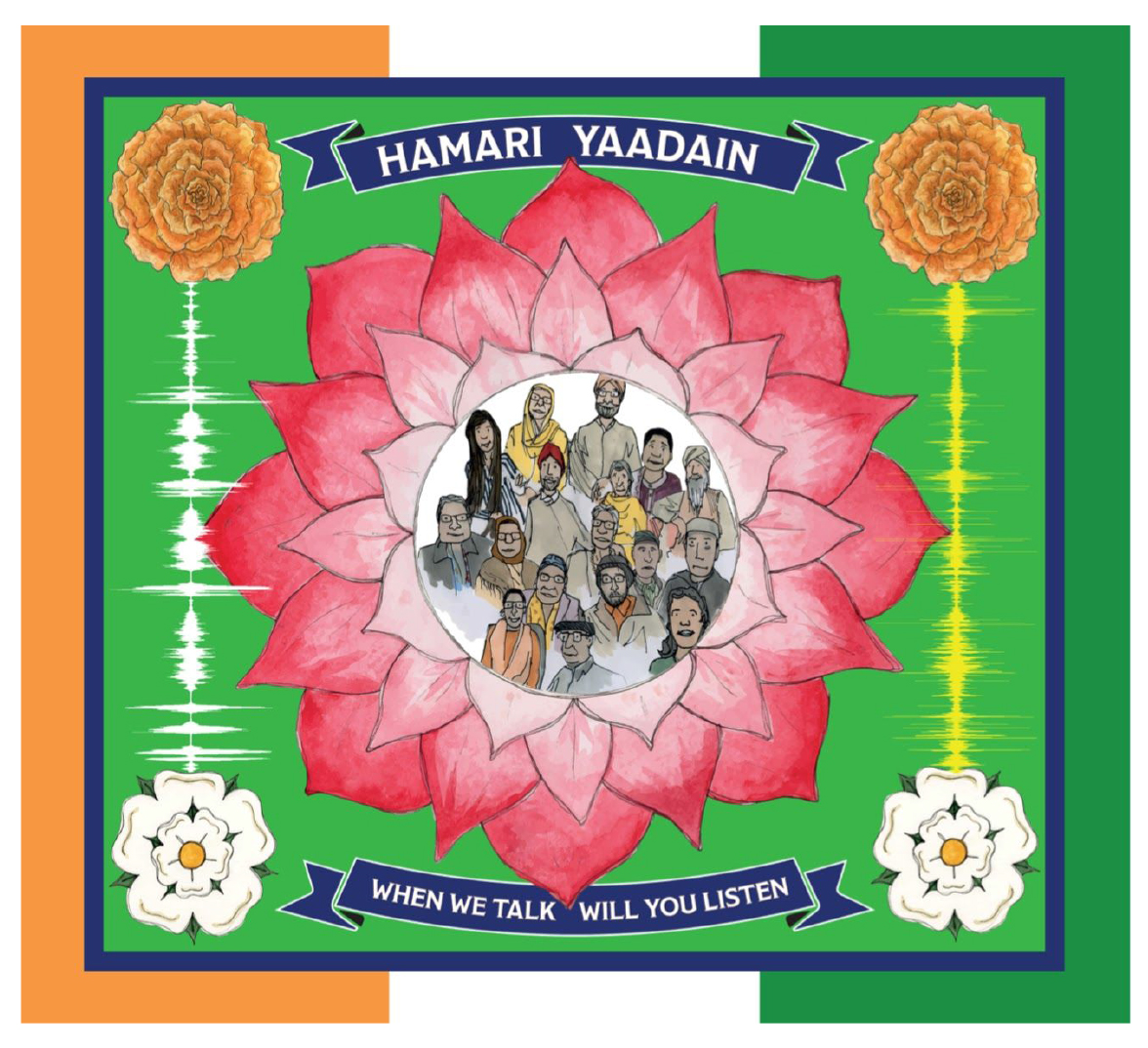
Hamari Yaadain: Banner

‘When we talk will you listen’ is an 'Unfurlings' banner created by ‘Hamari Yaadain’, a South Asian group based in Leeds. The banner asks us to listen, and to try and understand the concerns of people living with dementia. One of the symptoms of certain kinds of dementia can be the disturbance of speech, and the ability to speak a second language, something that has obviously had an effect on certain immigrant communities. The design is a collaborative venture, between the artist and the Hamari Yaadain group, which is typical of community art practice, the artist having to operate more as a facilitator than as an individual creator. This role is often undervalued, but as someone who has worked for many years supporting community art and community art education, I am very aware that the artistic skills involved in facilitating this type of work are just as powerful and involve perhaps a wider set of competences than what we might call traditional gallery art practices. 

Ian McMillan wrote a poem to accompany every banner, this poem was the one he wrote to support the Hamari Yaadain banner.  This collaborative venture giving the project a rich complexity in its realisation. I have not posted on community art practices before, but it should not be forgotten how drawing is still central to person to person communication and ideas development. Ian Beesley as the lead artist will have had to make a variety of drawings in order to both help design the banners and to show all the other collaborators how their various ideas could be made to fit in or in some cases he would have had to make drawings to show how one idea would work better than another. Drawing is for the community artist a key tool, often being used as the glue to hold everything together. 

'The Unfurlings: Banners for Hope and Change'

The banner still continues to be used to carry political messages, Cauleen Smith's 'I Cannot Be Fixed', or 'Leave me for the crows', are banners that have emerged from a practice that encompasses moving image, installation, textile, drawing, and performances that double as community gatherings. 

Cauleen Smith

It is perhaps in Smith's work that we see a more contemporary approach, the banner being one aspect of a multi faceted practice that attempts to embrace the viewer within an immersive environment designed to work across a wide range of sensibilities. This is not new, think of the banners hung in a church, they would be set alongside stained glass, sculpture, incense burning, candles and music. 

Cauleen Smith, Epistrophy, 2018, multichannel video, four CCTV cameras, four monitors, projection, custom wood table, stuffed raven, wood figures, bronze figures, plastic figures, books, seashells, minerals, jar of starfish, Magic 8-Ball, maneki-neko, mirror, metal trays, plaster objects, wood objects, wire object, fabric, glass vase and plants

If you want to see a banner being used as part of a multi-media environment you could look at Mel Brimfield's exhibition that is on at the Tetley in Leeds at the moment. 'From this world, to that which is to come', which is named after a quote from Pilgrim's Progress. The banner in this case being about collectivity and the need to unite in collective protection in times of stress and need. 

Mel Brimfield: Installation shot: The Tetley 2021

Coda

Leeds Spinners: Banners

Since putting up this post, I have come across Leeds Spinners and the recent banner work of Emma Dolan. It was wonderful to find that this tradition was being taken on by someone local. 

See also:

The frame and the banner

Drawing and politics

Drawing for site specific proposals