Showing posts with label climate change. Show all posts

Sunday, 16 October 2022

Drawing and The Diggers

Diggers getting nowhere

Sometimes ideas come full circle and when they do you either have to celebrate that their time has come, or despair that there will never be a right time for them and that human nature is such that we are doomed to make the same mistakes over and over again. The animated gif above was one of my responses to that feeling of 'stuckness' I had when thinking about the promise of The Diggers. It seems that for every shovelful of earth they removed, someone would have a spadeful of dirt to throw right back onto the pile. 

To dig the earth is a powerful idea, one that is celebrated by the name 'The Diggers'. They were a group of people who way back in the middle of the 17th century envisioned the tight ecological interrelationship between humans and the rest of the world. They had the idea that connections between people and the land were deep and inseparable and they advocated for social and agrarian reforms including the common ownership of land. The Diggers was a name given to 'The True Levellers' because of their insistence on digging as a way of signalling that any plot of earth could be made into a productive garden. One of their leaders was Gerrard Winstanley, who declared that "true freedom lies where a man receives his nourishment and preservation, and that is in the use of the earth". They were one of the first political groups to write down ideas that we now associate with socialism or communism but more importantly they understood that humans were in an interrelationship with the land and that it should not be owned by anyone. As they started to cultivate common land, they began to be called the Diggers, but their aims were much wider than that, they were developing their manifesto at the same time as the English Civil War. King Charles the First had been executed and therefore the unquestioned concept that the country and its land had to be owned and ruled by an elite class of people had been broken. For the first time the idea was mooted that no one individual should own land; as Winstanley stated, "The Earth was made a common treasury for all." These words now ring truer than ever; but when we look at the statistics of present day land ownership what do we see? 


In the book 'Who Owns England?' by Guy Shrubsole, we find that around 25,000 people, most of them still members of the aristocracy or owners of large companies, own approximately 48% of the nation’s land. The aristocracy and gentry accounting for around 30%, with the next 18% coming from corporations. However even the land technically owned by corporations, after looking at that in more detail, and exploring the labyrinthine legal ownership bureaucracy that covers up real ownership, he finds that much of the land that corporations hold is also essentially in the hands of the gentry. As Shrubsole puts it, “Land ownership in England is astonishingly unequal, heavily concentrated in the hands of a tiny elite.”

Almost a hundred years after The Diggers made their mark, in 1755 Jean-Jacques Rousseau in his 'Discourse on the Origin of Equality' had this to say, “The first man who, having enclosed a piece of ground, bethought himself of saying "This is mine", and found people simple enough to believe him, was the real founder of civil society. From how many crimes, wars and murders, from how many horrors and misfortunes might not any one have saved mankind, by pulling up the stakes, or filling up the ditch, and crying to his fellows, "Beware of listening to this impostor; you are undone if you once forget that the fruits of the earth belong to us all, and the earth itself to nobody.” If only someone had pulled up those stakes or filled up that ditch.

Perhaps now you can see what I mean by my concern that we are doomed to make the same mistakes over and over again.

But if we don't continue trying to raise the flag of alternative possibilities, we become ethically compromised and we easily forget those artists who have for many years nailed their socialist credentials to their left leaning ship's mast, because by virtue of the questions they ask and the causes they celebrate, it is unlikely that their work will become widely known in the mainly right wing media or bought and sold within the capitalist dominated current art market.
Gerrard Winstanley by Clifford Harper

As I write about Gerrard Winstanley I am reminded of the work of Clifford Harper. I first came across his work when visiting the anarchist bookshop just behind the Whitechapel Gallery in London. As an artist he is firmly embedded into a tradition that stretches back to expressionist woodcuts, a style he echoes with his mainly pen and ink drawings. Clifford Harper is described as an anarchist underground artist, and of course is regarded by many people more as an illustrator than fine artist. As he puts it very clearly in his own words, “I don’t regard myself as an artist. I am a craftsman. Fuck art.” For myself he fits into a tradition of socialist protest art, which other artists such as Sue Coe also inhabit, a tradition that is a world wide one and that continues to have relevance as a visual voice of dissent. 

What is unique about this visual 'voice', is that it is designed to be a communal voice rather than the voice of an individual, you can see this very clearly by comparing a few artists from this tradition. 

Sue Coe: We are many they are few 2020

Clifford Harper: Anarchy Now 2019

Charles Nkosi: Submission to Death 1976

John Muafangejo: Rorke's Drift 1981

Maurice Merlin: Black Legion Widow 1936

Zheng Yefu: Fight 1933 

Đorđe Andrejević-Kun

Käthe Kollwitz: The People 1922

Frans Masereel: The City 1925

Safo Marko, untitled linocut

Ken Sprague: Happiness 

Neil Doloricon: Tribute to frontliners 2020

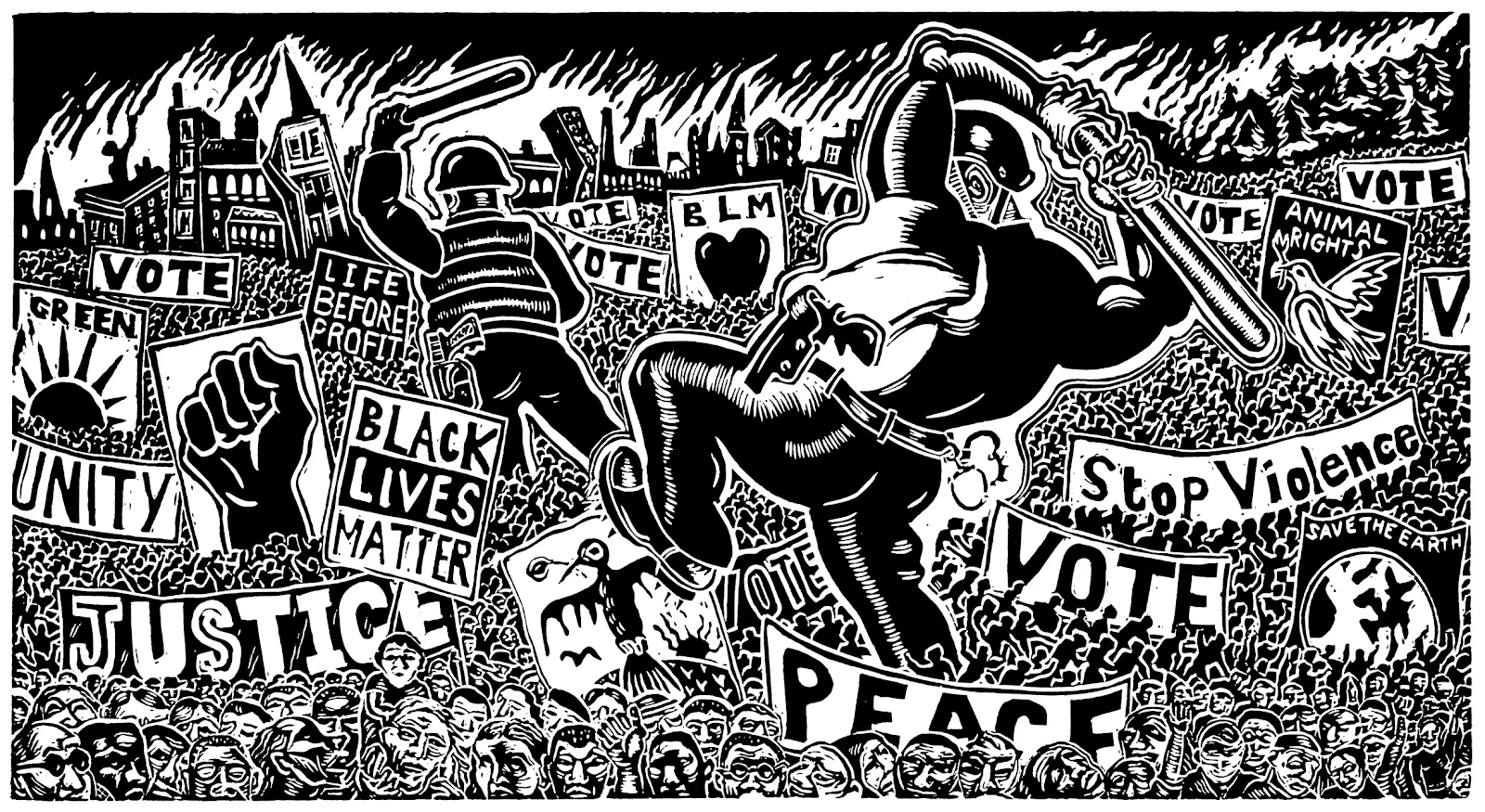
Black and white is of course a powerful visual idea. The world is full of colour and therefore not only does a black and white image stand out because of its internal high contrast, it stands out because it is so different to the coloured world that surrounds it. Simple print making methods such as woodcut, lend themselves to stark imagery, and community groups who want to promote their ideas are often strapped for cash, therefore basic print technology is vital to their ability to communicate. However not all these artists use wood or linocut, Clifford Harper mainly uses black ink on white paper, the reality now being that reproduction methods are so cheap that in contrast large woodblocks or rolls of linoleum are prohibitively expensive. It is though the visual language that is most important, the long association of socialist left wing ideas with clear high contrast black and white imagery, means that an audience 'gets it' very quickly. The emotional language of socialist expression has become universal, whether we are in China, Belgium, the USA, Albania, the Philippines or England, and  because of this it is a language that all of us can use.

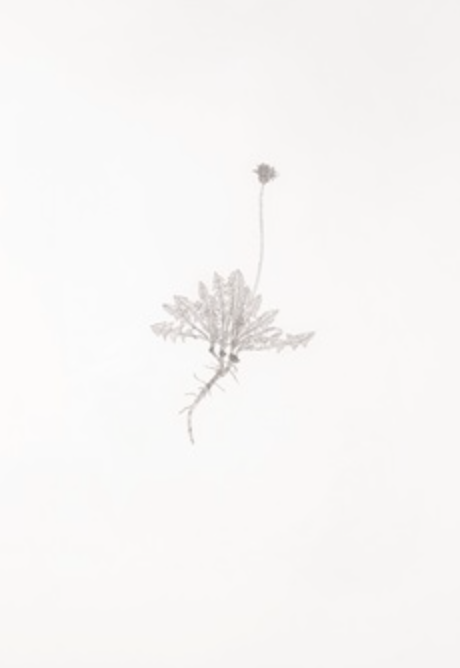
Clifford Harper like most artists that use the visual language of socialist expression, also has a personal language of visual expression, one that I find at its best when he makes images such as the one below of the humble dandelion. Using pen and ink to simplify what is often regarded as a weed, together with a symmetrical composition and a reframing of the seed head as a halo, he reminds us that this so called weed, used to be part of our staple diet in England and that far from being a weed, it is a plant that has saved many of society's poor from starvation. Dandelions are a rich source of vitamins, minerals and antioxidants. They have powerful healing properties as they can be eaten to improve the immune system, detoxify the liver or gallbladder, as well as help kidney function. Its long taproot brings up nutrients so that nearby shallow-rooting plants can benefit from the minerals and nitrogen it extracts as well as its beautiful yellow flowers attracting pollinating insects such as bees.  

Dandelion: Clifford Harper

It is interesting to compare Harper's image with the much more well known and celebrated artist Michael Landy's weed drawings. Landy was lauded for etchings that critics said celebrated what was often overlooked and thought of as weeds. Yes they are sensitive drawings of the dandelion and that is a good thing. However Harper goes further and constructs the image of the dandelion in relation to his own socialist agenda and he gives it an almost religious conviction. Landy is properly humble in front of the dandelion, its pale grey image forcing us to peer into the image to discover its beauty, but Harper is sensitive to the wider ecological issues involved, ones that just as the Diggers intimated, we need to heed and to act upon, to respond as if all nature is sacred. In this case the weed is portrayed as if it is a saint with a halo. The concept of a surrounding aura, glow or irradiation was used in Christian and other religions to single out figures that had God like status and Harper uses this idea to give honorific value to a common plant, in a similar way that he might try to give value to the often overlooked 'common man or woman'. 

Michael Landy: Common dandelion , 2002

In San Francisco in the 1960s another Digger community action group emerged. This was a group of activists and street theatre actors operating out of San Francisco's Haight-Ashbury district. Contributors included Peter Berg, Neal Cassady, Richard Brautigan, Allen Ginsberg, Emmett Grogan, Paul Krassner, and Gary Snyder. The group put out a magazine between 1965-8 and printed leaflets known as 'Digger Papers'. 


Digger Dollar 

The Digger Dollar was a vital image as it highlighted the central role that money now had in society and in particular the dollar was now the value system that all the rest of the world's currencies measured themselves against. 
The issues brought to the fore by the Diggers continue. A continuing ownership of the land by a few powerful individuals and corporations as well as their wasteful use of the resources they own, has brought about a climate crisis and a growing awareness of the consequences of global warming. Ecological art forms are therefore proliferating; in particular this means an art that could involve functional ecological systems-restoration, as well as socially engaged, activist and community-based interventions. Ecological art addresses politics, culture, economics, ethics and aesthetics as they impact on our collective awareness of the threats to ecosystems that the dominant capitalist system perpetrates. Its practitioners are often found working cooperatively and as well as artists, may include scientists, philosophers and other activists all working together to restore or heal what has been broken by unthinking economic growth and also raising public awareness by developing very visible projects. You will find many links to artists working in this way if you use the sustainability resources link below, but my point for today's post is that at various times in the past groups have collected together to raise the public's awareness of what happens if we lose sight of our responsibility to the planet. My fear is that the power of the existing Earth's owners will once again win out and that those who many years ago conquered the various lands by force of might, will hold on to that power forever. The new King Charles inherits what the old King Charles bequeathed to the royal family, and I realise how so many of us feel safer if traditions are maintained, however it was a salutary reminder that when a conservative chancellor wrecked the economy, that the people that it really affected were as always the working poor. When tackled as to how they would support poor people through this crisis the government's safeguarding minister Rachel Maclean, stated that people could 'take on more hours' at work or move to a 'better paid job' to protect themselves from this new cost of living surge. This is not just about conservative ministers being disconnected from the realities of people's lives, as the Labour party put it, it is a reflection of the deep divisions between those that own the land and those that work on it. Until we have true equality not just between people, but between humans and the rest of the world, we will be getting nowhere again. 

In the meantime perhaps it is worth looking at how one artist in Ireland is responding to the situation:

'The Distant is Imminent' is a work by Camille Seaman, depicting her still and moving images from Antarctica and the Arctic. 

Meant to be projected on the walls of cities most threatened by rising sea waters, a line in Seaman's video depicts where the water level would be in that particular location in 2050, if no action is taken to curb climate change – viscerally showing that while icebergs melting away might feel distant and abstract, climate change is indeed imminent and personal. 

A living artwork, the piece initially covers four locations (more to be added in the coming months) – New York City, Tokyo, Amsterdam and Limerick, where the artist resides.

You can download the video files from here, and project the video on the walls of your city, to raise awareness about the climate crisis.


See also:


Wikipedia links 


NB
Wikipedia is a free online encyclopaedia, created and edited by volunteers around the world and hosted by the Wikimedia Foundation. It is another example of how human beings can collectively work together for mutual benefit.  


Thursday, 1 November 2018

Sustainability

Dear Climate: General Assembly, 2018

On a recent Tuesday evening we went to see a music, sculpture and performance work at the Howard Assembly Rooms in Leeds. The Matter of the Soul' by Kat Austen was something I had been looking forward to because it was a complex piece that was bringing together a range of practices in order to make a statement about climate change and global warming, issues that I'm very aware haven't been dealt with as much as they ought to have been by the arts community. However I was very disappointed in the final production, the various elements failed to fit together and I found the sound languages used incomprehensible and supporting visual imagery badly done. This was a real shame, and as far as I was concerned a wasted opportunity. At least the ambition was there and perhaps that was more important than anything else.
We only have a few years left to prevent global warming becoming an unstoppable planetary disaster. As artists we cannot escape this, we have responsibilities not just to each other but to ourselves. Recent posts have suggested that we should be reframing our approach to everything we do when faced with this situation, but I have not yet really addressed something that is rather like the elephant in the room. It's so big we don't talk about it, it is the biggest thing in the room by far, but we are so scared of what it represents that we will busy ourselves with all sorts of distractions, rather than look at it directly.

There are of course artists dealing with these issues, but due to the complexity of the issues involved these are more often than not artists working in collaboration.  For instance, Livin Studio, an Austrian artist duo composed of Katharina Unger and Julia Kasinger, developed Fungi Mutarium. Fungi Mutarium is a prototype that grows edible fungal biomass, mainly the mycelium, as a novel food product.  Agar, a seaweed based gelatin substitute acts, mixed with starch and sugar, as a nutrient base for the fungi. The fungi digests the plastic and gradually overgrows the whole substrate. 


Livin Studio use drawing to highlight communication issues.

The Canadian duo FICTILIS, composed of Timothy Furstnau and Andrea Steves, have developed 'True cost market' a shop that confronts and tells its customers the real cost of its products and 'Wastewater Walk' which is a series of walks following the paths of human waste from toilet to treatment facilities in various locations. The walks are a playful way to promote awareness of the hidden infrastructure, environmental inefficiencies, social inequities, and psychological repercussions of modern sanitation systems, and to tie this awareness to shared, lived experience in the physical landscape. Different versions of the walk have included mapping exercises, water tables staffed by local water organisations, performances at stops along the route, and audio tours. 


A map of nuclear sites from a FICTILIS research file looking at protest

Both these art groups are non traditional in approach, and they see problem solving as a thing they are happy to undertake, which is normally the province of designers; they are not involved with making art objects as such, they are more interested in an awareness raising process. You could argue therefore that this is bad art, but when there is the need for something to be done, I believe this doesn't matter that much and that gradually as more and more artists begin to work in this area, ways to make powerful, emotive statements will become more and more possible, because an audience will have been developed that can understand and respond to the types of work possible in this area.

A wide range of approaches are being taken by artists to these issues and an exhibition such as 'Indicators: Artists on Climate Change' at the Storm King Art Centre, is a useful place to start if you are wondering what sort of approaches have already been made to this issue. 


Adam Lowe and Jerry Brotton

I've looked in the past at how useful both model making and maps can be when trying to visualise things, but of course these technologies can be brought together. Adam Lowe and Jerry Brotton of Factum Arte, in their work Terra Forming: Engineering the Sublime, make relief models of maps of Earth and flood them. These models are designed to provoke discussions about climate change, the artwork encompassing the associated debates and symposiums that Factum Arte are developing. This way of working, whereby the physical artwork is just a small part of an overarching series of events, talks, marches, internet campaigns etc. etc. is becoming more the norm, as artists realise that the situation is urgent. 


A strength that comes from involving art in this context is that it is not constrained by standard scientific methods and can more easily involve not just artists and scientists, but also citizens and many different types of change agents. As such, the arts can also challenge things that tend to be taken for granted, in an engaging and creative way. This can lead to new ways of perceiving, understanding and acting upon climate change.


The diagram above represents the number of art projects that have been recorded as dealing in some way with raising awareness around sustainability and climate change. As you can see these have now peaked but together they help others gain momentum in their various approaches. Each and every action, no matter how small, helps.

References

Sacha Kagan: Art and Sustainability: Connecting Patterns for a Culture of Complexity

Soil City A good place to start if like me you think soil is vitally important to a sustainable future.

Invisible Dust Lots of links to both artists and scientists   

Creative Carbon Scotland Lots of supportive information on what you can do

Centre for contemporary art and the natural world Exploring new understandings of our place within nature.

Deveron Projects A place to see how a single town has embraced art and climate change awareness

Arts Catalyst A commissioning body that specialises in arts and the environment

Green Art Lab Alliance A place to see what's going on.


Related posts:

The 12 principles of permaculture as an art manifesto

The pencil and sustainability 

Wednesday, 13 July 2016

Material thinking

Richard Long: A Line made by Walking


Continuing thoughts on material thinking.
As I was walking home the other day I took a well-trodden route over Button Hill in order to save time. The path is well worn by countless other feet taking the same short cut and it reminds me of Richard Long’s walking pieces. But in this case the line of walking is simply made in order to get from one place to another, there is no art intended. However it can be understood in several ways. It tells a story of its own making, it is evidence of how humans shape the world, but perhaps a shaping that is no different to any other encounters between things. For instance there are paths just off my route frequented by animals, these animal runs connect to places where they find food, water or cover. These runs are much narrower than the tracks made by humans, but are they any different? I can read them as signs of passage just as well as I can read the fact that humans walked this way. There are secondary signs too. In muddy places along my route I can spot both human boot prints and animal tracks. These allow me to be more specific in my interpretations. Big boot prints implying a heavy man passing, toe and heel prints implying someone running rather than walking, paw prints suggesting that a dog passed this way. However there are other material encounters with this landscape. As I work my way down the hill I pass a shallow dip which acts as a funnel for rain water. Each time it rains earth is washed down a slowly forming gulley and over the years I have walked this way the gulley has gradually widened, making a clear drainage path. People, animals and material forces are all testing themselves out against the world and each leaves traces of actions taken. These events are about material flow, the shape of the environment changing through elemental confrontations, wind and rain pushing elements against each other, a basic testing ground that includes the humans walking in curved lines to avoid large trees or too steep inclines, animals making runs through areas that give them good cover from predators, and water running down the easiest route towards the stream below. These things are just what happens.


I’m getting older and as I make these notes with a pencil I’m aware that my fingers are thickening with arthritis, the cartilage that used to cushion my finger joints has worn away, my joints no longer move smoothly and I’m slowing down. This physical change is inevitable and my body is responding to years of wear and tear, continuously reshaping itself in response to its interaction with the world. I am slowing down, until eventually I will reach the same speed as a stone.
From the stone’s point of view I’m moving at a very accelerated pace. The pebble that emerges from the path in front of me was shaped millions of years ago on some far distant sea shore only now to emerge back into daylight as the latest rain storm washes out the earth from around it. Before it was a stone it was part of a rock face, itself composed of billions of tiny compressed sea creatures, which themselves had processed other water dissolved rocks in their making.
The stone is like myself composed of a constantly changing material history. Over time the elements are rearranged into new configurations, these configurations being responsive to the environmental conditions that happen to be there during any particular time period. Whether these elements are combined into organic or inorganic relationships doesn’t matter, the line between the two being from the stone’s point of view very blurred.
So what happens when the human being picks up the stone and begins to draw with it? Looking at this from the stone’s point of view it has simply entered into another abrasive encounter with the world. It deposits some of its outer molecules onto the surface of another complex material composite. However the human may consider these traces as being of special significance, the traces may form the shape of an arrow for other humans to follow or may be combined into some form of complex drawing. But it could be argued that this is no different to the path made by walking. Some people might look at the path and interpret it as a place where people run and walk, some people might look at the marks and interpret them as an artistic drawing and others as just marks. Consciousness allows the human to think about the actions performed, but rarely about the whole situation, usually a human’s awareness is focused on how the action will benefit humans. 
Awareness is you could argue something that exists on a sliding scale. Last week I heard a sharp crying noise outside and thought it was a cat in some sort of confrontation with another feline. However when I went outside to see, the noise was being emitted from a screaming frog that a cat had trapped in a corner of the porch. The frog was obviously in distress and I rescued it and put it back in the pond, but it was a salutary reminder that we are not the only life-form that has a high level of vital awareness.
We are descended from amphibians, which are the descendants of fish, which are descended from...etc. all the way back to the moment when abiogenesis occurred. (The moment when life itself began) Every change in species was the result of an environmental shift, but so too were the changes in material formation. The atomic environment of suns shaping and creating elements by first of all fusing hydrogen atoms into helium that then fuse to create beryllium, a process that eventually will create every element up to and including iron.
This material awareness it should be hoped helps us rethink our belief in the special nature of ourselves. It should help us think about our localised experiences as being about direct physical contact with other elements, be these organic or inorganic and to by conceptual projection begin to think of the global nature of existence as being something that goes far beyond the human. Hopefully it allows us to find universal truths in everyday experiences and to become more aware that new possibilities of material formulations should not be the result of our forceful control of nature but should be the result of finding a more autopoietic* relationship with our environment. (*Autopoietic systems are "structurally coupled" with their medium and embedded in a dynamic of changes)

One way to think about drawing is as the trace of an action. This definition allows us to see drawing as an expanded field and gets us away from having to describe drawings as marks on paper. However it does raise some issues as to how drawing is also art, especially if expression is seen as a fundamental element. 

Individual expression has been a central issue for many artists, the idea of the signature work or identifiable personal style is key to the way the art market works. The 20th century saw an increasing focus on the inner life of humans. Psycho-analytical theory was an important lens through which we were led to believe we could look at our subconscious motivations and art appeared to be a way of articulating this inner world. Surrealism and Expressionism in particular were rooted in these beliefs and their offshoots including Abstract Expressionism relied on sets of values that elevated the idea of the unique individual. We have been sold the idea that we need to satisfy our inner needs and advertising has developed a whole set of tools to ensure that we are constantly craving for things that we feel will satisfy these desires. We are rarely encouraged to just be, to see ourselves simply as part of the material flow of life; we are instead treated as consumers. But as we consume the world we eat it up and if you eat more than you need you also produce waste. Our waste has now reached the point that it pollutes the whole earth, so perhaps it’s time to rethink the hubris of personal expression.
There have been artists in many cultures that didn’t sign their name to what they did, they operated more like facilitators or people with making skills that helped that particular society articulate certain ideas.
So how can a definition of drawing as the leaving of material traces help anyone to do anything? Perhaps the scratched mark that signalled the fact that someone went in a certain direction gives us a clue. A tracker moving through unknown territory may make marks on stones or trees so that others can follow, and the tracker has also provided a way of finding a way back without getting lost. These marks are both useful and can be used to communicate to others.  We can though explore unknown territory conceptually as well as physically, the things we do and make leaving traces that can both guide others towards these concepts and make ourselves aware of where we have been. It seems odd to argue that traces of our own actions allow ourselves to become more aware of what we have done, but for many of us whilst we are engaged with the flow of materials play, forms seem to emerge without any conscious control.
Others as well as ourselves can look back at the walk we have taken and see where we went, tracing our steps back by looking at the flattened grass or muddy footprints. Because that walk allowed us to get from A to B it will also allow others to do the same. The first person to ever walk the route I took over Button Hill blazed a trail that is still used every day by other people.  So was that first walk across unknown territory art? Not in the sense that we now understand it, but it would seem to me that it could be useful to bring this idea back into the way we think about what art is.
Various posts on this blog have looked at approaches to communicating information through drawing; mapping, tracing, technical drawing processes, drawing as performance, as political statement,  as document, as materials investigation or as perceptual record, the best of the drawings used as illustrations to these approaches I believe set out first of all to solve a problem or to articulate an idea, and as the drawing attempts to do this, it evolves in close relationship with the materials at hand and the ability of the maker to sympathetically control these materials.  
I am therefore suggesting that self-expression should not be the central concern of the artist. By having something to investigate that has purpose you can get lost both in the investigation and in the making. The focus should be in the ‘now’ of discovery and choosing appropriate methods and materials that can carry the ideas that arrive from your investigations, as well as developing a feel for your chosen materials or technologies, so that you can use them well.
Look at what is going on around you and examine it closely, why are the things you see and experience like they are? Try to develop a particular interest and research it in depth, and make more and more trials and tests when trying out ways to articulate your ideas, both to build up your skills and to put yourself into the situation whereby you can discover what it is that you are doing. In the initial stages of the research use as many approaches to drawing as possible.
Perhaps the most important issue is to not worry about making art; that is something that can come much later.
Joseph Beuys trained as a scientist, so was very aware of the physical properties of the world around him, later as an artist in both his teaching and in his actions he suggested that "art" might not ultimately constitute a specialised profession but, rather a heightened humanitarian attitude or way of conducting your life. The blurred territory between art and life, and the material nature of art thinking both suggest that we need to take more responsibility for a continuing re-evaluation of what it is to be an artist and perhaps in doing this will be able to embrace a much wider field of thinking. Today perhaps you need to draw and think like a geologist and tomorrow as a biologist but next week as an architectural technician. 


Joseph Beuys

See also: 

The imprint and the trace
Drawing as the trace of a touch
Drawing as material thinking

Wednesday, 11 March 2015

Anthony Gormley drawings used to highlight climate change crisis

The Guardian is making climate change its main story for the next week. The editor is leaving and he is trying to make sure that before he goes the paper has done its upmost to tell everyone how important climate change is. It does look as if governments are taking no notice but as Naomi Klein states we can all try and make a difference. 
The following is from the Guardian article on Anthony Gormley's contribution.
I'm also trying to make my own response, if anything is a vital subject matter today, raising awareness of climate change is.

Full text on Gormley from 'The Guardian'
Connection: Anthony Gormley

A work by the artist Antony Gormley has been shown for the first time in the Guardian as the newspaper published an extract on Friday from Naomi Klein’s book on climate change.
The piece, called Connection, shows a disturbing silhouette of a giant body against a deep glow which could be manmade or natural. Both the body and the landscape appear to be equally toxic, raising questions of how humanity is impacting the planet through climate change.
“It’s very important that the image is not a didactic one,” said Gormley of the work, made with aniline dye on paper.
“Hopefully it gives you an opportunity to put yourself in the place offered by this silhouette and to think about your connection to and dependence on the context in which we find ourselves... the most important being the elemental world that we have managed for the first time ever, for any species, to have destabilised.”
The image will wrap around Saturday’s printed copy of the Guardian and be handed out at a climate change protest march through central London.
Gormley was minded to share the image because of the concerns he shares with the marchers about the irreparable damage we are doing to the planet. “We are sleepwalking into a massive human disaster.”
He said he despaired of politicians who thought no further forward than the next five years – “they are just not capable of long-term thinking.” Gormley has also shared an art work with the Guardian not seen in public before, called Evening IV, made with carbon, casein and Indian ink on paper. It accompanies the extract from Klein’s book, This Changes Everything – Capitalism vs Climate. 
Evening IV by Antony Gormley

Naomi Klein’s book argues that capitalism is ill-suited to handle the challenge that global warming presents – and that tackling climate change can also address inequality in society.
Gormley agrees. “If the division between rich and poor is already chronic and very consciously in people’s minds now, then the division between those who are banished from their homes because of rising sea levels and temperatures will be a hell of a lot more painful.
“As Naomi Klein has ceaselessly pointed out, we have to make politicians take notice.
“Short termism is the way capitalism works and the way politicians work and capitalism is not going to solve this. We have to find another form of defining value that is not market value.
“Nobody wants to face the truth that actually air, water, sunlight are resources that are certainly not free.”
Gormley has made previous work which explores questions around climate change, not least Another Place which consists of 100 cast iron sculptures of Gormley’s own body on Crosby beach, looking out at the water from the mouth of the Mersey to the River Alt.
The figures ask questions around humanity’s relationship with nature, whether we are a toxic body and whether we can live sustainably.

 “Can we change what looks like Armageddon into a real go to find global governance that will allow human beings to work with the forces of nature in a sustainable way?”