There is a previous detailed post on charcoal and how it can be made. However issues of sustainability in relation to charcoal production were not picked out and as sustainability is so important, I have decided to re-visit my posts on various art materials and to develop eco-narratives around them.
First of all there are considerations in manufacture if you are not making your own charcoal. Watch this video on how a specialist charcoal supplier makes charcoal ready for art supply shops and similar outlets. On the one hand it's very good to hear that they source their willow locally and that they work in relation to a specific location so don't have to have raw material shipped in and that they have managed to keep their workers in employment over a long period of time, which suggests that they are good employers. On the negative side they have to transport their charcoal to all the various art shop outlets, so their carbon footprint is probably going to be at its worst in relation to distribution rather than manufacture. Some charcoal producers state that that their artist quality charcoal is made from Natural Willow cut offs that would usually be discarded, and some like the Dorset Charcoal Company, set out in detail how they manage their charcoal production ecologically. In their case a mobile charcoal burner system allows the company to respond to the changing needs of their local woodland and they are seeking to be beneficial to local woodlands and wildlife. Visit their site to find out more about how to spot charcoal made from unsustainable tropical wood sources. However, no matter how good their carbon footprint, there will always be distribution costs, which is why you might consider making your own at home.
Most charcoal is actually made as fuel for fires. This is still a vital source of heat for cooking in Africa and there are both good and bad practices going on. Sustainable charcoal production requires owners of natural woodland to maintain forest cover over time, rather than converting it to other land uses, such as large scale agriculture. However sustainable production is more likely to be achieved in woodlands with secure tenure with formalised management and harvesting plans designed to maintain the broad ecosystem functions of the forest or woodland. For instance in Niger and Senegal the adoption of formalised, community-based wood fuel production has resulted in an increase in the diversity and health of the forest stock (de Miranda et al., 2010). However in other areas of Africa unsustainable harvesting, has contributed to widespread forest degradation and deforestation, particularly in the vicinity of concentrated markets, such as large urban areas (Chidumayo and Gumbo, 2013). A very brief look at charcoal production in its wider context quickly raises issues about localised and global production and the maintenance of interconnected forest or woodland ecosystems. These issues are of course related to the production of charcoal for burning, but the maintenance of healthy woodlands and forests is of significance to everyone, and whether charcoal production is for fire or for drawing, it can either be done sensitively and in co-operation with an understanding of the local eco-system, or not.
If you are to use charcoal and want to make a point about why you are making it yourself, you could indicate how you are thinking about sustainable resources in a wider context. You might consider issues such where willow is grown in relation to where you are? How should you harvest it if you want to ensure it is not depleted? Perhaps you might research what other wood is available to you locally and in what form does it come, (old bits of furniture, wood picked out of skips, branches and twigs from local trees etc.). Test local trees for types of charcoal, some will make for a reddish brown mark, others darker browns or light blacks and some will be scratchy and break into tiny pieces and others very soft. If you are making a charcoal oven, could this be part of the idea? Could you set up a sustainable charcoal production facility? Perhaps making charcoal of various sorts for the local arts community. In doing so you could help others become more self-reliant and make them more aware of how charcoal is made. Could you oversee your charcoal production as part of a local interconnected woodland ecosystem? It is important to think about this, because over 90% of all charcoal consumed in this country comes from overseas, predominantly the endangered tropical rainforest and mangrove habitats of South America, West Africa and South East Asia. In addition to the damage caused by unsustainable forestry practices in these regions, is the negative environmental impact arising from the consumption of fossil fuels transporting charcoal so far around the world.
David Nash
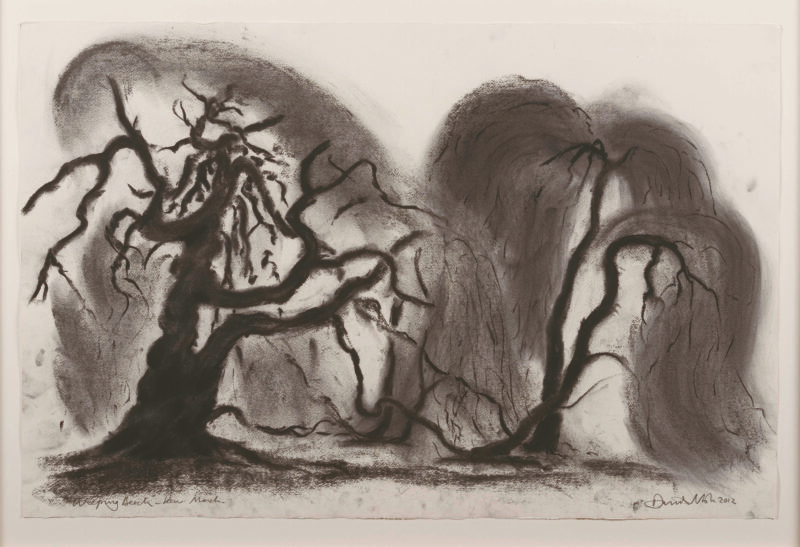
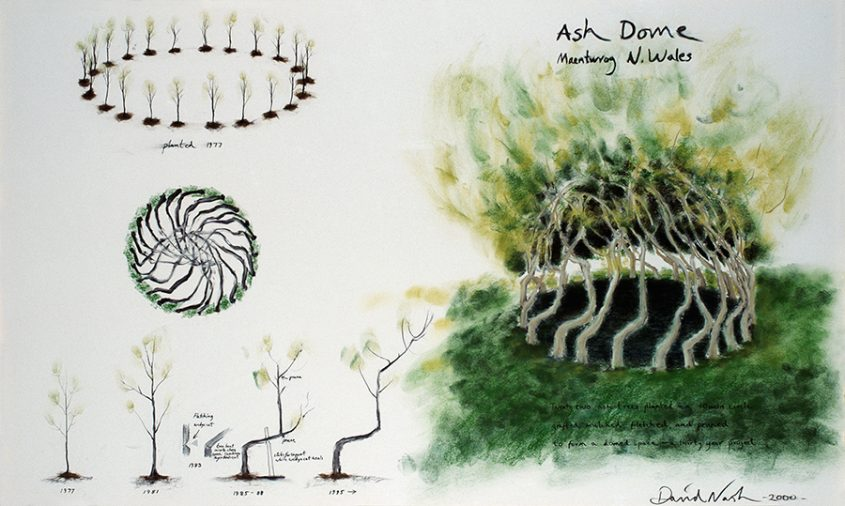
One artist in particular has deeply explored the relationship between ecology and charcoal, and that is David Nash, who is also exhibiting at the Yorkshire Sculpture Park at the moment. Using fallen trees, Nash has made sculptures and charcoal drawings that explore environments and ecosystems as points of intersection between nature and art. As he says, “trees take just enough and give back more”. Drawing is central and constant in Nash’s practice. It is an alternative way of learning about and understanding his subject, of finding form for ideas and recording and responding to perceptions of his environment. He uses hand made smoky willow charcoal to create intense blacks, these he will soften or accompany with softer warmer colours made from ash or oak; bold swathes of colour are achieved by using pure pigment dug out from the ground, mixed with burnt wood and ashes and wiped onto his drawings with bare hands. He uses local streams in which to dissolve ground down homemade charcoal alongside various natural pigments, which then become his inks, his ideas are often driven by the particular qualities of certain trees and their environments. His drawing Ash Dome (2007) was created using ash charcoal and earth taken from the surrounding ground, and he uses diagrammatic drawing to demonstrate the aesthetic associations and familial links between various aspects of his ecologically tuned ideas.
Ash Dome: david Nash
Working directly with fallen twigs and other 'pick-up' elements of a natural habitat might be even more ecologically friendly. For instance every stick can be a drawing implement. When you make marks with sticks you will find them expressive and they will help you achieve a much wider range of line quality. If you have no ink to dip the sticks into, just collect local soil, add water and draw using dirt. You can if you have more time extract colour from leaves. This video will show you how. Then when you draw both applicator and pigment will have a conceptual relationship.
How to extract colour from leaves
The German artist Nils-Udo works directly with fallen leaves and branches to create site-specific works. From delicately arranged petals scattered on the surface of a pond, to huge nests formed from twigs, leaves, and wildflowers, like Nash he tries to use what he finds in an environment such as a woodland or park, heightening our awareness by making interventions designed to make us wonder. His artist statement reads: “By installing plantings or by integrating them into more complex installations, the work is literally implanted into nature. As a part of nature, the work lives and passes away in the rhythm of the seasons.”
Nils-Udo
A charcoal burner's mound
The form of the nest like work above is heavily influenced both by birds' building activities and by the size of charcoal burner's mounds.
Nils-Udo: Project proposal for a motorway service area
Nils-Udo's drawings are proposals for interventions often in urban spaces, whereby planting is used to soften the impact of the harsh edges of places like motorway services stations. The question though is of course is he just hiding or making more acceptable something that we should be confronting, such as the still too high levels of car use and associated carbon emissions?
Once you have made a charcoal drawing or a drawing using soil, it may need to be fixed. Van Gogh used to use a skimmed milk spray to fix his charcoal drawings and Spectrafix Degas Pastel Fixative, also uses milk-protein. I try not to advertise brands, but in this case it is ecologically far more sustainable than toxic fixatives that operate like hair sprays. Most of us at one time or another will have used hair spray to fix a charcoal drawing, but remember the clear liquid spray is made of polymers that cause it to create a film over what you spray it on, be that hair or your charcoal drawing or an insect. Don't forget, hairspray was originally created to kill insects back in the 1940s, it was one of many chemicals developed after World War Two, that relied on advances in toxic chemical production because during that war there had been research into chemical warfare, just in case the other side decided to use poisonous chemicals to attack unprotected populations. Instead of people it was then decided to use these chemicals on the natural world; Rachel Carson's book 'Silent Spring' highlighted the issues surrounding the following unrestricted developments in using chemicals like DDT to control insects, pointing out that in the end those chemicals did indeed and still do, poison humans too. Spectrafix, not only avoids toxic chemicals it also facilitates layering, as it can be used to both fix and restore the friction you need to rework or refresh markmaking on an overworked surface, so that additional layers of charcoal can be applied.
When considering sustainability there are always more questions than answers, but if we don't consider these, we might at some point wake up to a dying planet.
Of course paper is also a material that is often made in unsustainable ways. I will be putting up a post on the issues specifically related to paper and sustainability in the near future, but in the meantime there are several other issues to think about in relation to paper, and you can read about those at some of the links set out below.
References
Chidumayo, E. N., and Gumbo, D. J. (2013). The environmental impacts of charcoal production in tropical ecosystems of the world: a synthesis. Energy Sustain. Dev. 17, 86–94. doi: 10.1016/j.esd.2012.07.004
De Miranda, R. C., Sepp, C., Ceccon, E., Mann, S., and Singh, B. (2010). Sustainable Production of Commercial Woodfuel: Lessons and Guidance from Two Strategies. Washington, DC: The World Bank.
If as artists we are to embrace sustainability we will have to re-examine the practices that we call art. This isn't something new and I have looked in the past at how the word 'art' has changed its meaning over time. The stem 'rt' from the old Indo-European language root meant, 'the dynamic process by which the whole cosmos is being created.' A powerful idea that suggests 'rt' and its successor 'art' are much more to do with being involved with unfolding events than making objects, a concept that celebrates the interconnectedness of everything, rather than something just about painting and drawing. Perhaps our society needs to think again about the way art is used or perhaps we need to revisit a much older tradition. Art under capitalism has become about the exchange value of objects, unfortunately the news media now concentrates on the amount of money that an art work achieves at auction and rarely on how art might be used to add value to society. In 2017 the Wall Street Journal reported that the painting 'Salvator Mundi' by De Vinci had been bought for $450 million by Saudi Culture Minister Prince Badr bin Abdullah. A figure so huge that it is almost impossible to begin thinking about what this means. In a time of war, migration of displaced peoples, global warming and planetary wide instability, somehow the putting of so much money into an art investment seems not just futile but criminal, a sign that something has gone wrong with our idea of value.
So it is perhaps time to look at alternatives, of ways of approaching art in such a way that its relevance to our collective understanding or feeling about the world goes beyond whether or not a drawing or painting is suitable to be shown on a gallery wall.
In connection with my earlier posts on sustainability and the linking in of artists associated with eco-awareness, I'd therefore like to add another strand of practice, and in doing so perhaps open out alternative models that some of you might find useful or at least thought provoking.
The term ARTocracy, a sort of 'how to do it' brand name, was first used by Nuno Sacramento and Claudia Zeiske in their 2010 book of the same title. The book systematically shows how creativity could be applied through a sensitive interconnecting of people, context, processes and outputs, all of which it is argued will need to work together if we are to develop more sustainable communities.
The book is about the organisation of collaborative projects and it is designed to raise awareness as to how projects get off the ground. It provides practical guidance about funding, communication strategies, education and the making of art in community contexts, and in particular it looks at the balance between artistic quality and social consequence. I thought this was interesting because these issues go deep. For instance I remember being told very early on in my career that I was to avoid being didactic. I.e. that I should not intend to teach or give moral instruction through my artwork, if I did my art teacher told me, it would not just be detrimental to its aesthetic value, it could actually stop it being considered as art. Years later I was to meet Joseph Beuys and the first thing he said to me was that he was a teacher and that his artwork was designed to educate and provide a moral framework for others. Beuys used the term 'Social Sculpture' for his work, a term he used to describe an expanded concept of art, in particular to advocate art's potential to transform society. The fact that Beuys was co-founder of the German Green Party, illustrates how deeply he wanted to integrate politics and social awareness into his practice. In 1982, which was the year he was in Leeds; for documenta 7 he proposed to plant 7000 oaks, each one paired with a basalt stone. The 7000 stones were piled up on the lawn in front of the Museum Fridericianum in Kassel with the idea that the pile would shrink every time a tree was planted. The project, seen locally as a gesture towards green urban renewal, took five years to complete and it eventually spread to other cities around the world. If you stand outside the Henry Moore Centre in Leeds and look slightly to your left for an oak tree, you will see one of those Beuys oaks still standing next to its basalt stone.
I thought it useful to begin with ARTocracy simply because it is subtitled; 'Art, Informal Space and Social consequence: A Handbook for socially engaged practice', and we all need to start somewhere and this is a handbook. The first premise it establishes is that the town is the venue. I.e. the place you live is going to be where you develop an audience, find participants, seek content and be a place to both make and present or exhibit work. Your art practice is in effect embedded into the society and particular locality in which you find yourself. This is a very different approach to the idea of the artist as outsider, or cool observer of reality. It also questions the role of the artist as individualist or 'genius', looking at the artist's role as cultural activist, rather than artistic producer, exploring how an artist can energise people and local communities, rather than provide images for contemplation. Art processes it is suggested can be employed to untangle and overcome real-life challenges, defuse conflict, solve problems and open up new possibilities. Sometimes though its good enough just to help people see what's there.
Socially engaged art practice is collaborative and participatory and how you involve people in the work is central to the process. You can involve people and communities in debate, collective action and social interaction. The term 'new genre public art' is another way of thinking about it, a description that was coined by Suzanne Lacy, who wanted to find a way of making public sculpture that wasn't putting up statues of high achievers onto pedestals, as she wanted to show how 'ordinary people' could participate in collective decision making.
City conversations: Suzanne Lacy
What Kind of City? is the title of many of Suzanne Lacy's conversations, she has visited Leeds in the past, and this question was the title of her presentation at the art gallery. Lacy has also engaged directly with drawing in her work. She undertook a collaborative project with the artist Andrea Bowers called appropriately enough; 'Drawing Lessons'. This was a nine-day installation at The Drawing Centre, New York, during which artist Andrea Bowers attempted to teach Lacy to draw. Each day for nine days, Bowers offered Lacy lessons, which were also open to the public. Working together under the scrutiny of the audience, Bowers and Lacy explored the questions, in work and conversation, that they engage with in their individual practices. This really interested me, because I am convinced of the power of conversations as being central to social integration and sensitive action. The project served as a platform for extended conversations with curators, union organisers, people who attended from the area and other artists who draw or do performances. The conversations reflected on feminism, performance art, drawing, and socio-political issues of concern to the artists. For example: what are the roles and problems of representation in public art practice? How do artists reconcile activist and field-based practices with the necessities of production for the gallery and museum? What is the relationship between first and second generation Feminism? What is the role of venue, object, and style in the identification and evaluation of art?
Suzanne Lacy and Andrea Bowers 'Drawing Lessons'
The pulling down of the Colston Statue in Bristol last year, raised many issues about the role of both artists and public statues. If the making of statues is problematic, then what can artists do when they work in public? One project I remember in particular that helped me to think about the possibilities for making art-work in this area was, 'Where The Heart Is' by Graham Fagan. As part of his work with the community of Royston in Glasgow, he discovered that the one thing most people enjoyed or could appreciate was gardening and in particular many people liked roses. Fagan purchased a new rose that had no name, originally known only by a code, JC30518/A. It was named through a consultative process across the entire area of Royston. A pupil from St Roch's Primary School eventually selecting the winning name. Cuttings of the rose were then given to any local people that wanted one and its lovely pink blossom and fragrant scent was the following year to be seen throughout the area.
Graham Fagan: 'Where The Heart Is'
Graham Fagan: Local children's images of the rose
Fagan's work was part of a much larger project. It is interesting to look at how it all fitted together and at how many approaches to community development were used. Check the overall project out at the link below.
So what's this got to do with drawing you may be asking? I have written about how drawing can be used to facilitate conversations in several ways. For instance as a way of developing stories around and for a community. See:
Barker, Garry (2017) Drawing as a tool for shaping community experience into collective allegory. In: Collective and Collaborative Drawing in Contemporary Practice. Cambridge Scholars Publishing, pp. 192-215. lau.repository.guildhe.ac.uk/17315. My contribution to the book on Collaborative Drawing in Contemporary Practice, is mainly centred on how drawing can be used as a focus for conversation and how different types of drawing facilitate different types of conversations. For instance, I'm currently drawing ideas for a permaculture garden, but the real issue is that this activity will facilitate conversations and these will explore whether or not permaculture ideas can be used within wider contexts of sustainability, in particular whether or not perception and interoception can themselves be shaped or inflected by a permaculture awareness. I'm also developing a paper for an architectural magazine that brings together permaculture with perception and looks at how permaculture principles such as 'Observe and Interact' or 'Integrate Don’t Segregate' can be applied to the way we think about architecture.
Marjan van Aubel
But of course there are other approaches to thinking about how to operate sustainably as an artist. I'm always interested in how ideas can be visualised and made real. This is what so much of drawing has always been about. The problem is that we categorise things in such a way that some ideas are seen as design and others as art. If we take away the distinction, we simply have people visualising ideas. Marjan van Aubel is a wonderful example of how to do just that, in this case her ideas use light fittings in a not dissimilar way to how nature itself harvests the energy of the sun via photosynthesis. She demonstrates that there are alternatives to existing paradigms and exciting new ways of thinking about solar energy that reflect how energy is collected and used by biological entities other than ourselves.
Olafur Eliasson: Sketch for 'Beauty'
A lot of eco ideas seem to emerge from Scandinavia, perhaps this is because the winters are so cold, and you therefore need to think carefully about how you will survive them. 'Beauty' is a typical work of Olafur Eliasson. You walk into a dark room and a fine mist is falling illuminated by a single light bulb. As you walk around the room from some angles you can see a rainbow. You also see a hose pipe that the water falls from, you see the things creating the rainbow at the same time as the rainbow. You are having an experience, and are conscious of having the experience. As you are made self-aware you go out into the world with that awareness and will hopefully make future decisions more thoughtfully.
Beauty
Eliasson is interested in the connection between an experience that might take place in a gallery and the way it might affect your behaviour when you leave that gallery. Olafur Eliasson is an artist who also uses design skills to solve projects, which again highlights the artificial divide between the two disciplines. His team at Studio Olafur Eliasson consists of craftsmen and specialised technicians, architects, archivists, art historians, web and graphic designers, film-makers, cooks, and administrators. Eliasson and the studio also work with structural engineers and other specialists and collaborate worldwide with cultural practitioners, policymakers, and scientists. His climate change activism has inspired many and his approach suggests that as an artist you can both make things and be engaged in community activism. He is able to make art from the poetics of a situation, as well as from an understanding of the ecological condition of it, as well as from the constraints of physical materials and the possibilities that they offer.
Thomas Hirschhorn: Too Too - Much Much
Thomas Hirschhorn is another artist that has responded to the problem of how to avoid the 'statue' issue, he uses everyday and found materials such as plastic sheeting, cardboard, aluminium, packing tape and magazine images to create environments for change. The process of making remains clearly visible and becomes a metaphor for the individual and collective struggle to establish local democracy or to build a space within which people could debate ideas. People are implicated in Hirschhorn's work, viewers are obliged to reflect upon that which they may have hitherto been able to ignore in their daily lives, by having to take part in conversations, often with others who they would not normally meet or engage with. Hirschhorn's practice facilitating conversations, as much as making metaphors for change.
If I was going to cite one example of social sculpture that sparked my imagination it would be the work of Pedro Reyes, who for the artwork 'Palas por Pistolas' (2008) collected 1,527 weapons from residents of Cuiliacán in Western Mexico, which were exchanged for electronics. The artist then melted the weapons down into shovels, which were then used to plant 1,527 trees. This is real alchemy, the transformation of guns into shovels a beautiful metaphor as well as a real intervention. Reyes is also interested in drawing as a way to communicate ideas, the work 'Collective Hat' is a very funny as well as conceptually interesting work.
Pedro Reyes: Collective Hat: pleated palm collective activity
Reyes puts it like this:
Wittengstein stated that if we were to imagine a book which contained only the truth it would have to be entirely composed with jokes. I think in jokes you are led to the truth so quickly that the only way to handle the shock is laughing. Not all jokes produce laughing, there are also slow-smiling jokes, visual puzzles and graphic puns, some jokes are diagrams.
You may remember this one...
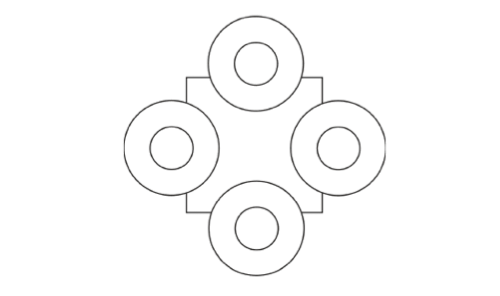
...a Mexican riding a bicycle. They are often a child's game but in fact very abstract and concrete depictions of social or spatial situations, like this one...four Mexicans sharing a table:
The design process in architecture is concerned with drawing the object, but we often lack tools to draw the social interplay. How do you map individual actors? How do you represent collective entities? This figure below for instance...
I drew this diagram of a collective sombrero and it became the blueprint for a sculpture. It was one of my early participatory sculptures. I took it to different plazas in Mexico city and asked people to wear it. What happens is very curious, for me it represents a paradox of democracy, the huddle has to deliberate endlessly where to go, and they have to walk very slowly not to stumble.
Pedro Reyes
'Collective Hat' reminded me of Lucy Orta's work. In the piece below for COP 26 Orta states, 'the ripple and the chain of solidarity clearly manifested our interdependence', and I can see clearly what she is trying to visualise, the fact that we are as in Reyes work all connected in some way. I do though personally respond more to Reyes because he realises that it is also funny, our situation so stupid, that we need to collectively laugh at ourselves before perhaps we decide to make some changes.
Seeing a plant, seeing a garden: Agnes Waruguru: 2020
Dreams of more and more and yesterday: Agnes Waruguru: 2020
The Kenyan artist Agnes Waruguru has reminded me that you don't have to go far to find subject matter, sometimes you just need to look out of the window or step out of the back door into the garden. We make gardens because we are in love with that feeling of wellbeing we have when we are immersed in them. We feel so much more at home in even a small patch of greenery; window boxes and tiny yards with a few plant pots will sometimes have to do or we might have to go to our local park, but whatever we do, we find the natural world of vegetation sits kindly on our eyes and we breathe a deep sigh of contentment as we immerse ourselves into the soft greens of leaf filtered sunlight. We existed as mammals for millions of years amongst trees and other vegetation, forging lives that were entangled into innumerable seasons of growth and decay, in doing so in conjunction with our environment we created a state of autopoiesis. This allowed us as creatures to maintain and renew ourselves by regulating our embodied selves and conserving but interlacing boundaries between our bodies and the environments we inhabited. It is important to remember that our internal state of homeostasis can only be kept up if we are an integral part of a living system and gardens remind us of this. Richard Deverell, the director of Kew Gardens was forced to close the botanical gardens during the covid pandemic and as he did so he stated that it really hurt him to do this because, "There is no salve quite like nature for an anxious mind." The further we are taken away from our natural environment, the more anxious we become, this perhaps being one of the key meanings of the Garden of Eden.
Waruguru's delicate images are partly sewn, partly drawn and partly painted. She touches her surfaces delicately as if almost frightened to make a mark, she is an artist that is dealing with an uncertain certainty that feels to me a right and proper way to go about our relationship with the world. For too long we have valued those that seem to command respect because of their certainty and clear vision, but I'm afraid too many of those visions have now been seen as self-aggrandised flag waving. "Look how wonderful I am", says the artist, while the world burns and the forests die.
Durer: Columbine (Aquilegia vulgaris)
Right outside my back door has grown a columbine, its flowers suggestive, as its common name of 'granny's nightcap' implies, of an old fashioned type of headgear, a pixy's hat.
Columbine (An illustration from the 1950s)
The flowers of the columbine outside my door are now dropping and being replaced by seed-heads, and every time I pass this plant I'm reminded that Durer made a beautiful image of the same plant way back in 1526, and that the name Aquilegia, is derived fromaquila meaning eagle because of a similarity between the shape of the petals and eagles' wings. In medieval times, columbine was thought to be eaten by lions and because of this connection, rubbing the flower between your hands therefore gave you the courage of a lion. But for the Romans it was a flower beloved of the Goddess Venus, so you could wear it as a love token. The more you delve into a plant's history, the more connections you will find, it eventually becoming something mystical, something entwined with the ghosts of its ancestors, the columbine of today, being the columbine of 1526, just as it was the flower to clothe a pixy's head and to soothe the heart of the goddess of love.
Sketchbook drawing of a now gone to seed columbine outside my door
The function of flowers is to involve mobile animals in their reproduction processes. Pollen can be scattered by animals and thus reproduction is more efficient. 'Animals' of course also includes ourselves, as well as bees and other insects, birds and any passing mammal that can get close enough to cause stamens to get involved with pistils.
Diagrams of bee flights
These diagrams of bee flights are rather like the spiralling marks on Waruguru's images and remind us that other creatures are involved in the creation of gardens. Without insects the world will perish. In fact a plant on its own is not really viable, it is only viable as part of an event. An event that includes sunlight, soil and insects, and sometimes humans but often not. The boundaries or edges of what we call for short a plant, are permeable and blurred. All life is in fact an interpenetrating series of interacting, overlapping relationships.
David Jones
David Jones had an approach to the natural world that also feels as if it is both uncertain and certain. His vision enables him to with great delicacy,intuitively picture the atomic dance of flowers and spaces in such a way that in this image, the garden moves inside and overpowers the interior space. The vibratory buzz of a bee, is perhaps the driving force behind this approach to composition.
Apple tree: Gustav Klimt
Klimt's 'Apple tree' is an image that suggests that there is no definite edge between the tree and its environment, the one slips into the other. It is an image that any one of us could see just by stepping out into the garden. Klimt's images are though also cosmic visions, the flower garden dissolves into life energy, these could be paintings of galaxies or the interior of an atomic cloud; like Van Gogh's sunflowers and Monet's waterlilies they go beyond seeing the world as a collection of objects or things and picture it as an event, a happening rather than a record.
Flower garden: Gustav Klimt
Nathan Hawkes continues the tradition of the unfixed image, uncertain but certain, his drawings are never still. His flowing vegetation escapes being bound by lines and his surfaces pulse with energy.
Nathan Hawkes: The double dream of spring: 2019
These images remind me of Markov blankets. It has recently been argued that any living system is a Markov blanketed system and the boundaries of such systems need not be co-extensive with the biophysical boundaries of a living organism. In other words, autonomous systems are hierarchically composed of Markov blankets of Markov blankets, all the way down to individual cells, all the way up to you and me, and all the way out to include the local environment. For instance, in the drawing below, a human being and a tree both dissolve into their surroundings, whilst at the same time still maintain enough of an internal integrity to still be seen as a human and a tree.
Human, tree, air and ground
It is the permeable boundaries between one thing and another that allow systems to operate. If we look at the image by Seurat below, we get the sense that the edges or boundary of the figures slip into the surrounding air, a way of image making that helps us think about that permeable boundary that all self organising things need to have in order to maintain their existence. If we were cut off from everything else we couldn't exist, we need to breathe the air, stand on the earth, ingest food and exhale. In order to regulate our body temperature we sweat back out into the world around us; if we are to function, we have to ensure our permeable boundaries are in place. I particularly like the way that Seurat suggests that the tree and the human being both dissolve their edges into the same light fused space, it feels as if the tree is ingesting the carbon dioxide exhaled by the human, just as the human is inhaling the tree's output of oxygen.
Seurat
Minjeong An has looked at how her father grows sprouts. Her diagrams set out to visualise both visible and invisible relationships, in the case of the sprouts, she is as concerned to show that her father has to lavish love and care on his sprouts, just as much as he has to water and feed them. I.e. the feeling tone of a human being is as important as the nuts and bolts of a system, such as a need for water and food. Care it should never be forgotten is essential to all the best gardens.
Minjeong An
Minjeong An's work includes drawing using sharp lines, she uses Illustrator as a drawing tool in order to give her diagrams precision and coherence. However because she concentrates on relationships, she overcomes the tendency of line to isolate things.
What I'm getting at, is the reason that we can work powerfully with the garden as a subject matter, just as we can work powerfully with any other subject, is that as long as we can see a series of interconnections, understand or intuit the consequences of any thing's being, we can develop images that in their very making try to communicate things about the situation we have begun to explore. If on top of that we have a view on how we feel about or think about the connections we find, we can shape the process of making images to reflect this view. It's not easy and very few of us have a clear point of view that is easily translated into imagery, but by every now and again trying to feel our way towards an answer, we can have something that keeps us going, some kernel around which we can build a construction that at least feels as if it is meaningful. Hopefully this approach stops us thinking we have the answers, but allows us to continue searching and in that search perhaps we become more attuned to the things that surround us and become better gardeners.
There is as always another story. The Aboriginal peoples of Australia used to draw sacred designs on themselves and in the soil, these designs often using dots and zig-zags, were outlined in circles and encircled with dots and were deeply interconnected to sacred rituals. Their garden was the landscape they existed in and it was something that inhabited them as much as they inhabited it. These designs were for the tribe and the initiated, for people who would understand how the dots and patterns reflected the stories told; stories woven into folk tales of the people, intertwined dreamtime encounters with animals, plants and the landscape. Those who were uninitiated should never get to see these sacred designs, because they would be able to enter the secret places, steal the knowledge of thousands of years and upset the delicate balance of the eco-system. These designs would often be drawn directly into the earth with sticks, and the soil would be smoothed over on the appearance of an outsider.
In the early 1970s Australian school teacher Geoffrey Bardon asked the young aboriginal school children he was teaching to paint their world in their own way. But the youngsters struggled and their parents couldn't understand why they had been set such a task; they wanted to know why he was asking the young people to picture things that it was the job of the old people to know. I thought this was very interesting, because in the west we associate children with creativity and celebrate their fresh if often clumsy approaches to depicting the world, but we rarely look at older people as the custodians of image making.
Karun Warun: Meeting Place
Michelle Possum Nungurrayi
Because of the private nature of certain ritual links to image making the initial group of men who Bardon worked with decided to work out which aspects of the stories could be told and which ones had to be withheld from public view. Men from at least half a dozen different language groups worked on this together. They worked out jointly how they could express very significant aboriginal stories without upsetting the requirement for non-initiated people not to have access to the meanings. Once this was resolved it meant that the elders could paint their stories. At that time there was little interest in Aboriginal culture, most of the government directives in Australia were directed at trying to make aboriginal peoples let go of their traditional beliefs and to embrace Western culture. Bardon supplied art materials to the group of elders and with help from him, they began to paint their stories by transferring their depictions from desert sand to paint on canvas. Because of the concern that the more sacred and therefore secret aspects of the things they they painted were being seen not only by Westerners, but Aboriginal people from different regions, these early translations therefore had their special secret elements abstracted into dots to conceal their sacred meanings. These first paintings to come from what became known as the Papunya Tula School of Painters were never intended to be sold. They were created by the Aboriginal people who had often been displaced, and living a long way from their original home country, as reminders of landscapes that they still inhabited in their minds, landscapes that they still felt they needed to protect, even as they represented them in paint, by changing some of the more significant features. These paintings were in effect visual reminders of their own being. They painted the lands that they belonged to and the stories that were embedded into them. These paintings were visual assertions of their identity and their origins. The original colours were restricted to variations of red, yellow, black and white produced from ochre, charcoal, sand and pipe clay, however when these paintings became popular and saleable, acrylic paints were introduced and much more vivid colourful paintings ensued. The fact that the original colours were also representations of the various earths of the landscapes they lived in, was quickly forgotten.
Even though the original patterns were changed in order to remove secret meanings, the basic structures and ideas about how to depict the world remained intact and the work produced had a resonance and a visual power that broke through the difficulties associated with the conditions of the people that began producing work of this sort. For instance the artist Michelle Possum Nungurrayi is the daughter of one of the group of men brought together by Geoffrey Bardon in the 1970s, her paintings even more abstracted from the initial forms as were developed by her father, but the rhythms and visual pulses emanating from her work are still effective and some of the forms she paints still echo the symbolism that was came from original sand drawings.
Some basic symbols
The world of the dreamtime is one that is unique to the Australian aboriginal peoples. It resonates with us because it reminds us of a much earlier time when we were all living interconnected with the landscapes we lived in. Perhaps this is the garden of Eden we feel we have lost. This is a harsh landscape however, most of us couldn't survive more than a day or so in the wild, our contemporary skills would be useless to us as survival tools. The plight of many aboriginal people is plain to see, as they lose the skills to negotiate their own landscape, they are not being given the skills to negotiate the world of modern Australia, the disjunction of western and aboriginal cultures is such that they are almost incomprehensible to each other and life set between the two is difficult, people being prone to mental instability because many of the old landmarks and associated meanings no longer make the sense they used to. The garden that was Australia is now facing global warming, and fires are becoming more and more a threat to life, the impact of western technology now forcing itself on the indigenous peoples as never before.
It is to be hoped that the nations of the world will see sense and get together to control climate change, but that will mean looking at the world as an integrated system, whereby everything is interconnected, something that the indigenous peoples of Australia understood many thousands of years ago. As we step out into our garden, hopefully we are also reminded that one of the most wonderful things you can do as an artist is to show how the stories that emerge from the world are special and how they are woven into the very fabric of living, and in their entanglement with other people, animals, plants and things, they help us to care about the places we inhabit. Even as they disappear, the ancient peoples of Australia have much to teach us about how to inhabit our own gardens.
Coda
Every now and again I'm asked whether it is worthwhile putting work into competitions. These always cost money and you very rarely get through to the exhibition itself. I tend to be ambivalent about the process, sometimes I think its a total rip off but at other times I decide that its one of the only ways that an artist can get his or her work noticed. For instance Andrew Barrowman has just won The Bowyer Drawing Prize. He received £500 for his pencil and charcoal drawing, 'Tree Study'. Little recompense you will I'm sure all agree for a tremendous drawing that will have taken hours to make and years of art making experience to allow him to control markmaking within such a complex space. A short video was made of his response to winning and he was obviously delighted. A very traditional artist, he shows that you can still make a wonderful image out of the things you see on your local walk. His drawing process of working into charcoal on a gesso ground has allowed him to give a vibrant energy and life to this image of a tree that he encountered in his sketchbook recently. If he hadn't won the prize I would have probably never seen the drawing, so perhaps it is a good thing to apply for these competitions sometimes.