Showing posts with label Joseph Beuys. Show all posts

Sunday, 21 January 2018

Notes on the conference: Joseph Beuys and Europe: Crossing Borders, Bridging Histories


Yesterday I was at a conference on Joseph Beuys at the Leeds City Art Gallery. The gallery has an artist's room exhibition of Beuys' work on at the moment and his drawings form an important aspect of his practice, so I was interested to see what Beuys scholars were saying about him. 
I wont pick out the presentations by individual presenters who were all professors, or PhDs or people working towards PhDs, because I was selfishly only really there to listen to Richard de Marco give his presentation. I had met him years ago and together with Patrick Oliver and Penny Cooper (who was an old friend of de Marco's), when he visited Leeds back in the 1980s we went up onto the art college roof in Vernon Street and after looking at all the architectural domes we could see, decided that Leeds was essentially a female city. He was an engaging speaker and full of energy and enthusiasm for life, so I was expecting something special from him. I sat through everyone else’s presentations and took notes and had ideas in relation to their papers, but, and this is something I’m becoming worried about, every speaker, except Richard de Marco, read from a pre-written paper. Over the years this has become more and more the accepted conference standard and perhaps it’s my age, but I can’t see the point of it. If I want to read a paper, I can just read it, so why not give out copies. Because most of the speakers are not trained actors, their voices trail off, they don’t use microphones properly or they just mutter. This means that large chunks of what they are reading out are lost, one presenter in particular was totally inaudible. Richard de Marco in contrast performed. He has a strong voice, didn’t need to refer to notes and spoke to us about what was on his mind, asserting that Beuys was for him still alive. He spoke powerfully about his belief in art and memories and experiences of Beuys. It was a fascinating and memorable talk, one that was constructed live for a live audience and it was so different from all the academic speakers who I felt operated as if they were more like vultures picking the last flesh from the dry bones of a long dead artist, and I wanted them to be translators channeling his ideas to a new audience.

However before I turn to what Richard de Marco had to say, there were some issues I picked out from all that dry academic talk, so perhaps it wasn’t quite as bad as I’ve painted. Someone mentioned the principle of resurrection as a driver behind certain art forms. Someone else, it was an audience member if I remember rightly also highlighted the importance of Christianity to Beuys’ ideas and there was mention of the wound and how Beuys set out to heal the world. The Judeo/Christian heritage was referred to several times and I was reminded that concepts like democracy, socialism and a caring society are rooted in this heritage, one that Beuys would have been keenly aware of.  This background was linked to Beuys’ interest in other cultures, such as the cultures on the far edges of Europe, from the Celtic fringes, to the frozen edges of Nordic Scandinavia, Lapland and Inuit territories via the Russian steppes. The European fringe cultures were in Beuys’ mind also in conversation with Eastern cultures, the wisdom of the other, either from the past, such as the Wyrd or from religions such as Zen Buddhism or Tao, all entangled in Beuys’ mind. I began thinking again of the journeys taken by many migrants, often beginning on the borders of Europe, then working their way through the European heartland and finally to the edges of that old kingdom that once was Angleland and which is now a Brexit fixated island of little Englanders. Beuys would have hated the idea of Brexit, he thought in long historical lines, worked across national boundaries and was aware of geology being more important than history. When you think of his work with dead hares, you also think of Durer and his famous painted image of a hare and the fact that Durer’s self portrait included a hare fur collar; when you think of Beuys' use of reindeer images, you know he is also thinking of the pre-historic drinking reindeer of Les Combarelles in the Dordogne


Beuys: Reindeer

Drinking reindeer: Les Combarelles Dordogne

Beuys set out to heal the wounds of the world, he wanted to bring people together, he wanted to teach people about the interconnectedness of things, he also wanted an art that would highlight the connections and similarities between cultures. His was not an art of aesthetic formal invention; it was an art of shamanic transformation. Material languages were central to his ideas, fat, felt and rich brown paint, each applied as a mark or register of a Beuysien sensibility.  I was reminded as Demarco spoke of how wonderful the idea of Beuys was at the time. Of how exciting the possibilities seemed. Art could change things, art could have some sort of relevance and it was a way of educating people about alternative truths.

I have been thinking about material languages again and Beuys had a very personal set of these, his invented stories of being saved by Siberian Tartar tribesmen, helping him to construct an authentic language of fat and felt. He was concerned to communicate in mythic terms, how the damage done by politics might be transfigured. The Nazi party had engineered its own myths and appropriated older ones, poisoning what should have been a nourishing set of beliefs and threatening to make all mankind lose touch with proper nourishing myths of life and its entanglements.  
I do worry about things though, and something was niggling away at me, something about the idea of the art star. Beuys’ screen-print by Warhol perhaps being the image that was unsettling me, it suggested that like Warhol himself, Beuys was now something to be commoditised, his piles of fat no longer working as psychic energy batteries but as securities and hedge funds for the super rich. Beuys’ association with de Marco was already compromised when I met Beuys, who came along to the college with Anthony D’Offay, a man who collected up everything that Beuys did when he was with us, who wouldn’t let any of Beuys’s scribbled diagrams of possibilities get out into the public domain because they were too precious, too full of cultural capital to be allowed out.

Warhol: Joseph Beuys

But back to Richard de Marco, he was still at the age of 87 positive and excited by the legacy of Beuys and his enthusiasm was a necessary cure for my cynicism.
De Marco still sees the work of Joseph Beuys as a legacy that creates hope for the future of art and its role in society. The language of politicians and politics is too poor and impoverished to be of any real use, and only the language of great artists like Shakespeare, T S Elliot and of course Beuys can open out for us the true possibilities of what it is to be human. These languages of art go beyond logic, their creators live on in our languages; artists in reshaping the material of words and physical forms leave us a continuing legacy of possibilities.

Two weeks before Beuys died he gave a lecture, he began, “I would like to thank my teacher Wilhelm Lehmbruck…” A timely reminder that Beuys was a sculptor and that artists are also concerned with the art of their predecessors, but perhaps even more importantly that Beuys regarded teaching as being the most important thing. De Marco stated that all of Beuys’ work could be regarded as teaching tools; his lectures in particular and writings and drawings on blackboards produced as illustrations to his thinking, clearly point to these pedagogic issues in his practice. “Every single manifestation of his work was as a teacher”.

Wilhelm Lehmbruck

De Marco went on to remind us of the dangers of ‘tourism’ making a joke about George Bush’s pronunciation of “terrorism” which he first misheard as “tourism”. He reminded us of the importance of small magazines like ‘Pages’ that existed simply to promote and deepen an awareness of art’s possibilities. He railed against of the rise of art as ‘entertainment’, of art as an adjunct of the tourist industry, pointing to Damien Hirst’s latest Venice exhibition 'Treasures from the Wreck of the Unbelievable’ as a sad reminder that Hirst was once seen as a possible inheritor of Beuys’ mantle.

De Marco sees universities as now being simply machines for making money and reminded us that there should be no separation between art and science as ways of understanding the world.  He wanted us to think about what is the proper use of art colleges and asserted that if we could get that right they would be central to the future of civilization. Art colleges should be looking at how to face the reality of global warming, Beuys’ ‘The Pack’ produced in the 1960s being a reminder that he was already thinking about these issues even then.

The Pack

Beuys saw other artists of the past as belonging to a ‘communion of souls’ that you as an artist should aspire to belong to, this communion being essential to the way that artists think and that this world is far too important to be sucked into the world of entertainment.

The Museum Sztuki in Łódź (pronounced like ‘watch’ with an ‘o’) has one of the most important collections of Beuys’ work. Beuys was drawn to Poland because he wanted to heal the wounds left over from the 2nd World War. I was reminded as de Marco spoke of a wonderful performance by the Slovenian Sister Scipion Theatre that he put on in Edinburgh, in 1986; holes had been cut into the floor so that heads could pop up randomly and begin speaking as you walked through the space. The whole ‘feel’ of performances like this or the Kantor productions that de Marco also put on was gripping, they had a gritty reality and somehow otherworldliness that moved you into totally new spaces for thinking.

Kantor theatre production

For de Marco both Kantor and Beuys are still alive. 
At the end of his exhilarating presentation he suggested that a good book to read that would be a useful salve if feeling crushed under the weight of Capitalism and the fact that the art world appears to simply exist as a playground for the super rich would be ‘Reclaiming art in the age of artifice’ by J F Martel and finally that he has an archive that is accessible to everyone. 
Joseph Beuys: Felt action:1963

See also:

Saturday, 14 October 2017

Beuys and Cotman at Leeds City Art Gallery

Leeds City Art Gallery has finally opened after refurbishing and the new rooms are superb. In particular the central upstairs space is bathed in natural light and is a wonderful space for showing sculpture. 
Two of the opening exhibitions are of particular interest for the drawing community, the staging of a large show of the gallery's Cotman holdings and the Joseph Beuys 'Artist's Rooms' display. 
If you have never looked at Cotman before you will be surprised at how modern he can seem. He breaks the landscape down into abstracted chunks and eliminates details and in doing so prefigures the way artist's of the 20th century would begin to select out forms from nature. However what really interested me was the display of his pencil drawings.


Cotman

The drawings were located on shelves, simply leaning against the wall, 4 or 5 to a row, still attached to their supporting card backing. A glass sheet was then fixed over the lengths of wood shelving in order to protect the drawings from the public. A very neat method of presenting a diverse range of small shapes and sizes. 


By displaying the drawings in this way it meant that I could get up really close and look at how the images were made. 


Cotman

I was immediately taken with a drawing of some weeds. I suppose it was because drawings like this are ones I have done many times, usually thinking "this will come in handy at some point", made when wandering the streets collecting visual information for some future foreground detail. Because I have drawn this type of situation myself I can also empathise with the selection of the composition. Cotman is keen to locate the plants selected in a space, a few marks indicating other grasses and plants are enough to ground his image. Looking back on the sketchbook drawing (1) below, taken from one of my old sketchbooks, my effort looks very isolated and because the sense of space is poor, the drawing lacks life. I can remember at the time not wanting to get down on my knees to sort out the visual entanglement of other plants around the base and this is probably why the drawing is lacking in attention to a specific experience. 

Sketchbook drawing 1

Sketchbook drawing 2

My sketchbook drawing (2) in retrospect seems a much better record of an experience, the few brushed in indications of other plants create a sense of space that (1) doesn't have.  
As I stood looking at these small drawings of Cotman's, I was becoming more and more aware of the embodied nature of their understanding. Because these are things I have drawn, I begin to re-enact their making in my body. Each stroke Cotman makes is meaningful to me intellectually and physically. The hand is still holding the pencil, the arm is still moving, the elbow tracing a smooth curve as it pushes and pulls the lower arm across the paper, the shoulder now aware of a change of pressure as the hand is pulled off the paper and dropped down again as a leaf is found in space next to a rising plant stalk. I'm in Cotman's body, I inhabit his mind, his hand and his eyes. I'm affected by the plants he drew, their presence still echoing through time, their effect still potent after all these years. I know this, I know I am both Cotman and the small weeds he once perceived on a day when he had his paper and drawing implements with him. We are drawn together as I re-animate the artist and the stimulus for his perceptions, the old drawing's agency is powerful, taking a strong hold of me. 
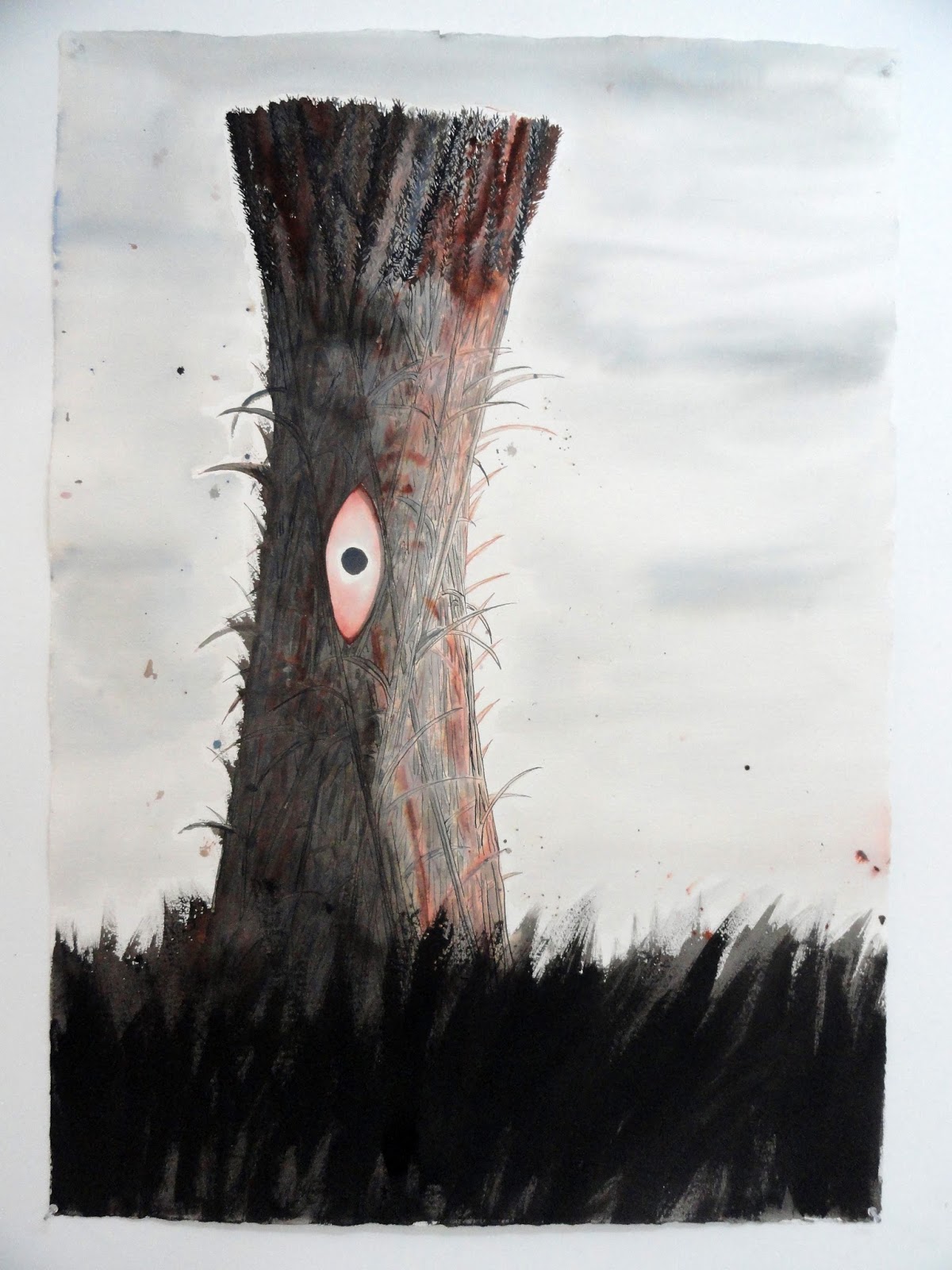
Most of the drawings in this display are in pencil. Like many artists I draw with pencil to capture ideas and images as they either come to me perceptually or via the inner workings of my imagination. In the morning before going to the art gallery I had been working on another image of an eye in the corn. 

Eye in the corn

The image above would not have come to me without in the past standing next to a wheat field and drawing it. (Sketchbook drawing 3). 

Sketchbook drawing 3

The Cotman drawings are collected together in an area adjacent to a much larger gallery in which a comprehensive display of his finished watercolours is on exhibition. That connection between what you are aiming for as an artist and what you need to collect from your experiences is very important. In this case it was for myself interesting to see how he had at times been on a very similar journey. Tiny drawings of horizon lines were of particular interest for me as they made me very aware of the importance of linear rhythm, especially on that line that separates the land from the sky. 


Cotman: studies of the horizon

Again I'm both reminded of my own drawing experiences and taken over by these little scraps of information. The way that you look across a landscape is determined by how the experience is punctuated by events. Once again I am engrossed by these indications and quickly aware of how Cotman would have been engaged in the experience. For him a windmill stands out, for myself a mosque. But for both of us the edge between sky and land is a linear experience, an experience that reflects the material presence of the world and the way that it shapes us. 


Detail of Leeds horizon from a large drawing


In the main gallery devoted to Cotman's watercolours is a drawing on which he had spent a much longer time. Titled, "An effect of Parhelion seen from Hunstanton Lighthouse on July 6 1816", Cotman had obviously been deeply impressed by a powerful natural phenomenon. 


Cotman: An effect of Parhelion...

Cotman both writes about and draws an image of the event, a rare occurrence and one which is centred on light and our perception of it. Here we see his response to the 'effect' of the world, his being acted upon by world events, shaped and in turn shaping the experience. 
An effect of Parhelion... is an image we might well place as one of those belonging to the tradition of the sublime. Cotman is also an artist that uses his drawing materials in a much more expressive manner, the drawing of a road disappearing into the mist below, demonstrating that he isn't always about sharply defined areas and flat shapes.  

Cotman

On the ground floor of the art gallery there are also three rooms devoted to the work of Joseph Beuys. It may at first appear as if Beuys and Cotman are worlds apart in both sensibility and effect, but as I wondered through the galleries I began to feel that they were in fact very similar. 
Beuys: Pregnant woman with swan

Drawing is for both these artists central to their practice. Both are happy to work ideas out on scraps of paper or card and they both have an instinct for abstraction. The profile of a pregnant woman above being as much as a simplification as any of Cotman's abstracted landscapes. 

Beuys: Energy Field

Beuys' drawings are also records of performances and he often uses a particular brown coloured floor paint for his later drawings. These images feel as if they are about traces of events and so did Cotman's drawings. Both artists are offering us records of their material engagement with the world, Beuys is much more aware of this, often talking about the meaning of fat and felt and other materials, but Cotman is obviously aware himself that his ideas are being shaped by the properties of the materials he chooses to use. Both artists abstract elements out of the process of their complex entanglement with experience and the matter that shapes that experience. The consequence of these experiences is relayed to me and as an entity made of similar stuff to both artists, I am 'tuned' into the way materials are being shaped to form ideas. Beuys is though a 20th century creature, he is aware of a post quantum world, a world of relativity and the atomic bomb, so is therefore much more attuned to energy flows and the transmutation of matter. Beuys has a type of political awareness that Cotman doesn't have, but there are politics of the picturesque that Cotman would have had to deal with that we are perhaps not as aware of as we should be. 
I have on purpose spent more time writing about Cotman than Beuys, even though Beuys as an artist was much more influential on my own practice and was one of those artists that I was fortunate enough to actually meet. My point is that the act itself of drawing is such a special one in that it carries with it a material value, a physical entanglement with the world that writing never does. In those small pieces of paper I could sense the reality of experiences, in a way that the words on this screen never could. I am asking the reader to go and look at some actual 'real' drawings and to open themselves out to their own embodied world. To try and feel that invisible but palpable pencil or pen in their hand and to re-trace the time of a drawing's making. No matter how tiny and ephemeral a drawing may be it is a physical, material idea and as such is a reminder of our own and the world's material agency. 

Both these exhibitions are well worth visiting and there is of course the added bonus of being able to visit the new displays upstairs in the gallery. 

Find more information on the Leeds City art gallery here

Wednesday, 13 July 2016

Material thinking

Richard Long: A Line made by Walking


Continuing thoughts on material thinking.
As I was walking home the other day I took a well-trodden route over Button Hill in order to save time. The path is well worn by countless other feet taking the same short cut and it reminds me of Richard Long’s walking pieces. But in this case the line of walking is simply made in order to get from one place to another, there is no art intended. However it can be understood in several ways. It tells a story of its own making, it is evidence of how humans shape the world, but perhaps a shaping that is no different to any other encounters between things. For instance there are paths just off my route frequented by animals, these animal runs connect to places where they find food, water or cover. These runs are much narrower than the tracks made by humans, but are they any different? I can read them as signs of passage just as well as I can read the fact that humans walked this way. There are secondary signs too. In muddy places along my route I can spot both human boot prints and animal tracks. These allow me to be more specific in my interpretations. Big boot prints implying a heavy man passing, toe and heel prints implying someone running rather than walking, paw prints suggesting that a dog passed this way. However there are other material encounters with this landscape. As I work my way down the hill I pass a shallow dip which acts as a funnel for rain water. Each time it rains earth is washed down a slowly forming gulley and over the years I have walked this way the gulley has gradually widened, making a clear drainage path. People, animals and material forces are all testing themselves out against the world and each leaves traces of actions taken. These events are about material flow, the shape of the environment changing through elemental confrontations, wind and rain pushing elements against each other, a basic testing ground that includes the humans walking in curved lines to avoid large trees or too steep inclines, animals making runs through areas that give them good cover from predators, and water running down the easiest route towards the stream below. These things are just what happens.


I’m getting older and as I make these notes with a pencil I’m aware that my fingers are thickening with arthritis, the cartilage that used to cushion my finger joints has worn away, my joints no longer move smoothly and I’m slowing down. This physical change is inevitable and my body is responding to years of wear and tear, continuously reshaping itself in response to its interaction with the world. I am slowing down, until eventually I will reach the same speed as a stone.
From the stone’s point of view I’m moving at a very accelerated pace. The pebble that emerges from the path in front of me was shaped millions of years ago on some far distant sea shore only now to emerge back into daylight as the latest rain storm washes out the earth from around it. Before it was a stone it was part of a rock face, itself composed of billions of tiny compressed sea creatures, which themselves had processed other water dissolved rocks in their making.
The stone is like myself composed of a constantly changing material history. Over time the elements are rearranged into new configurations, these configurations being responsive to the environmental conditions that happen to be there during any particular time period. Whether these elements are combined into organic or inorganic relationships doesn’t matter, the line between the two being from the stone’s point of view very blurred.
So what happens when the human being picks up the stone and begins to draw with it? Looking at this from the stone’s point of view it has simply entered into another abrasive encounter with the world. It deposits some of its outer molecules onto the surface of another complex material composite. However the human may consider these traces as being of special significance, the traces may form the shape of an arrow for other humans to follow or may be combined into some form of complex drawing. But it could be argued that this is no different to the path made by walking. Some people might look at the path and interpret it as a place where people run and walk, some people might look at the marks and interpret them as an artistic drawing and others as just marks. Consciousness allows the human to think about the actions performed, but rarely about the whole situation, usually a human’s awareness is focused on how the action will benefit humans. 
Awareness is you could argue something that exists on a sliding scale. Last week I heard a sharp crying noise outside and thought it was a cat in some sort of confrontation with another feline. However when I went outside to see, the noise was being emitted from a screaming frog that a cat had trapped in a corner of the porch. The frog was obviously in distress and I rescued it and put it back in the pond, but it was a salutary reminder that we are not the only life-form that has a high level of vital awareness.
We are descended from amphibians, which are the descendants of fish, which are descended from...etc. all the way back to the moment when abiogenesis occurred. (The moment when life itself began) Every change in species was the result of an environmental shift, but so too were the changes in material formation. The atomic environment of suns shaping and creating elements by first of all fusing hydrogen atoms into helium that then fuse to create beryllium, a process that eventually will create every element up to and including iron.
This material awareness it should be hoped helps us rethink our belief in the special nature of ourselves. It should help us think about our localised experiences as being about direct physical contact with other elements, be these organic or inorganic and to by conceptual projection begin to think of the global nature of existence as being something that goes far beyond the human. Hopefully it allows us to find universal truths in everyday experiences and to become more aware that new possibilities of material formulations should not be the result of our forceful control of nature but should be the result of finding a more autopoietic* relationship with our environment. (*Autopoietic systems are "structurally coupled" with their medium and embedded in a dynamic of changes)

One way to think about drawing is as the trace of an action. This definition allows us to see drawing as an expanded field and gets us away from having to describe drawings as marks on paper. However it does raise some issues as to how drawing is also art, especially if expression is seen as a fundamental element. 

Individual expression has been a central issue for many artists, the idea of the signature work or identifiable personal style is key to the way the art market works. The 20th century saw an increasing focus on the inner life of humans. Psycho-analytical theory was an important lens through which we were led to believe we could look at our subconscious motivations and art appeared to be a way of articulating this inner world. Surrealism and Expressionism in particular were rooted in these beliefs and their offshoots including Abstract Expressionism relied on sets of values that elevated the idea of the unique individual. We have been sold the idea that we need to satisfy our inner needs and advertising has developed a whole set of tools to ensure that we are constantly craving for things that we feel will satisfy these desires. We are rarely encouraged to just be, to see ourselves simply as part of the material flow of life; we are instead treated as consumers. But as we consume the world we eat it up and if you eat more than you need you also produce waste. Our waste has now reached the point that it pollutes the whole earth, so perhaps it’s time to rethink the hubris of personal expression.
There have been artists in many cultures that didn’t sign their name to what they did, they operated more like facilitators or people with making skills that helped that particular society articulate certain ideas.
So how can a definition of drawing as the leaving of material traces help anyone to do anything? Perhaps the scratched mark that signalled the fact that someone went in a certain direction gives us a clue. A tracker moving through unknown territory may make marks on stones or trees so that others can follow, and the tracker has also provided a way of finding a way back without getting lost. These marks are both useful and can be used to communicate to others.  We can though explore unknown territory conceptually as well as physically, the things we do and make leaving traces that can both guide others towards these concepts and make ourselves aware of where we have been. It seems odd to argue that traces of our own actions allow ourselves to become more aware of what we have done, but for many of us whilst we are engaged with the flow of materials play, forms seem to emerge without any conscious control.
Others as well as ourselves can look back at the walk we have taken and see where we went, tracing our steps back by looking at the flattened grass or muddy footprints. Because that walk allowed us to get from A to B it will also allow others to do the same. The first person to ever walk the route I took over Button Hill blazed a trail that is still used every day by other people.  So was that first walk across unknown territory art? Not in the sense that we now understand it, but it would seem to me that it could be useful to bring this idea back into the way we think about what art is.
Various posts on this blog have looked at approaches to communicating information through drawing; mapping, tracing, technical drawing processes, drawing as performance, as political statement,  as document, as materials investigation or as perceptual record, the best of the drawings used as illustrations to these approaches I believe set out first of all to solve a problem or to articulate an idea, and as the drawing attempts to do this, it evolves in close relationship with the materials at hand and the ability of the maker to sympathetically control these materials.  
I am therefore suggesting that self-expression should not be the central concern of the artist. By having something to investigate that has purpose you can get lost both in the investigation and in the making. The focus should be in the ‘now’ of discovery and choosing appropriate methods and materials that can carry the ideas that arrive from your investigations, as well as developing a feel for your chosen materials or technologies, so that you can use them well.
Look at what is going on around you and examine it closely, why are the things you see and experience like they are? Try to develop a particular interest and research it in depth, and make more and more trials and tests when trying out ways to articulate your ideas, both to build up your skills and to put yourself into the situation whereby you can discover what it is that you are doing. In the initial stages of the research use as many approaches to drawing as possible.
Perhaps the most important issue is to not worry about making art; that is something that can come much later.
Joseph Beuys trained as a scientist, so was very aware of the physical properties of the world around him, later as an artist in both his teaching and in his actions he suggested that "art" might not ultimately constitute a specialised profession but, rather a heightened humanitarian attitude or way of conducting your life. The blurred territory between art and life, and the material nature of art thinking both suggest that we need to take more responsibility for a continuing re-evaluation of what it is to be an artist and perhaps in doing this will be able to embrace a much wider field of thinking. Today perhaps you need to draw and think like a geologist and tomorrow as a biologist but next week as an architectural technician. 


Joseph Beuys

See also: 

The imprint and the trace
Drawing as the trace of a touch
Drawing as material thinking