Showing posts with label Embodied mind. Show all posts

Wednesday, 1 May 2019

Drawing and Mindfulness: Part two: Drawing before drawing

Your stance and balance are vital and so is your ability to mime what you see

Once you have all your preparation done, before making an actual drawing you will need to think about the drawing you need to visualise before you make a drawing. 

When teaching observational drawing I have always started with the toes. These are as far away from the eyes and head as we can get, but awareness begins here, because without an awareness of our feet and toes we will easily become off balance. To be in balance is also to feel healthy and alive and a balanced point of view from which to observe and to respond, is one of the things we are aiming to achieve. 

Your stance is going to be vital. If you are standing to draw, you will need your body to be as relaxed as possible and ready to respond sensitively to any eye/brain/hand implications that your looking implies. Balance will depend on how well your feet are 'planted' on the ground. However if you are too firmly set there will not be enough response or springiness in your step and a drawing will lack the full range of rhythmic touches. Therefore begin with this exercise. 

Position yourself at an angle between your easel* and the subject that you are going to draw. If possible stand, because this will enable you to access the full range of your body’s movements, but I realise as I get older, that standing for long periods becomes harder and harder, therefore use discretion here and decide what is best for you in terms of your own fitness and physical capability. 
Begin to move your toes and start tightening and relaxing your muscles, feel for the muscles in the rest of your right foot, work along to your ankle and now do the same with your left foot. Move on to your calf muscles, tighten them and then relax. Think of your knees, upper thighs, stomach, back and ribs, slowly working up through the body and becoming aware of each set of muscles as you do this. Eventually you will get to the shoulders and then arms. Spend more time here, move your shoulders around in their sockets, then upper arms, and elbows, eventually moving to your wrists, hands and individual fingers. Make tight fists, splay out your fingers, touch each finger to each finger lightly, imagine holding something between your fingers and watch your movements as you rotate fingers and wrist together and then separately. 
Finally you need to move your neck muscles, again tighten and free them, moving your head forwards, backwards and sideways and in rotation both clockwise and anti-clockwise. Now move on to the muscles of the face, scrunching up eyes, pulling strange gurning faces, sticking your tongue out, until if you are in company, you have no inhibitions or worries about looking strange or weird, or if on your own, you simply become face lost or not bothered about what you might look like. 

Now look at your subject, take a step towards it and back from it, one step to the left and back again then one to the right and back again. Now do this again, this time between each step breathe from the diaphragm. At last you can begin to look at your paper; is it set at the right angle? Is it too high or too low? What is the angle between your subject and your paper, how far do you have to move your head and body in order to look from your subject to the paper? 

Decide on where your central drawing position is going to be. Now pull yourself up to your full height, begin with your toes again, up through your legs, body, neck and head. Imagine a string attached to the top of your head, think of its position right above your spine and allow it to pull you up. Now relax. 

This is a good time to make any adjustments needed to your paper and easel or other supports. Make sure all is firmly attached and tightened up and readdress your stance. 

This time begin to move your hand around the paper, move it to the top edge, try a long horizontal straight movement with your arm, think about shoulder control, elbow and wrist. Now move your hand to the centre of the paper. Touch it with the extended index finger of your drawing hand. Slightly rock your body from your toes, knees and hips and see if you can steady the body by simply allowing your finger to bend with the movement. Now do this with all four corners of the paper. 

Once you are aware of these corners, you can begin cross movements, going initially from bottom left to top right, then top right to bottom left. Once you feel in control of these movements, try bottom right to top left and top left to bottom right. How in control are you? Think about balance again. Are you always in balance as you make these movements? 

Now step back from the paper, look across at the subject you want to draw. Begin searching with your eyes, look left and look right, look up and look down. Can you ‘see’ your body movements in the subject before you? You have just been stretching to the left and right, crossing your hand from the bottom to the top of your paper, but can you ‘feel’ this or ‘see’ this in your mind as you look at the subject? 

Begin to look for relationships. Look for one point at for example to the right of your subject, perhaps slightly above the centre of your subject. Look horizontally across from this, what significant things can you see? Look vertically down and do the same thing. Now look across your subject at an angle of approximately 450and see what relationships you can spot along this imaginary diagonal. 

You can carry on looking for as long as you feel comfortable, but after a while you will need to begin embodying your looking. I think of this as a sort of mime. 

Go back to looking at your paper, repeat the process of becoming aware of your body and this time try and think about how breathing and moving are synchronized. Do you breathe out as you make a long horizontal movement with your arm or do you breathe in? Move and breath for a while until you feel relaxed. Beware of doing this too forcibly; you can get dizzy if you are not careful but if you do feel dizzy, simply sit down and relax. 

Now return to looking at your subject and this time transfer the looking to the space in front of your paper, begin to mime over your paper what it is you are seeing. Try and gently touch the paper with a slightly bent but still extended index finger as you do this. What sorts of curves do you need to make, where does a curve begin in your body? Does it start with a roll of the hips, or the bend of a knee? What is the smallest curve you can see and how will you make this? Is it a roll of the wrist or a twist of the fingers? What sorts of straights are there? Can you lock your shoulder/elbow/wrist/fingers in such a way that you can move these interconnected body parts together in a straight line? Do you have to rock your body backwards and forwards as you do this in order to keep an even pressure on that bent index finger as it lightly touches the surface of the paper?

Now go back to looking at your subject. However this time as you look, can you bring in those mime movements and play them out in the space between you and the subject? As your eye looks at for instance a long straight edge, can you mime the drawing of it? This is a sort of body dance. You are trying to choreograph your movements to become in tune with the rhythm of relationships that you find as your eyes move over the subject. You are in effect attuning your body to the perceived world. 

Once you begin to feel comfortable with these movements, try to remember them and now practice making these movements back over your paper surface, again lightly touching the surface with a slightly bent index finger. This is very like learning dance moves and you need to open your mind out into a physical space, so that you can orchestrate your body movements in your visual imagination. 

Do not at this stage worry about making a drawing. The wonderful thing about the ‘miming’ of a drawing is that you can do this anywhere and you don’t really need any drawing materials. You can imagine where the easel and paper are and practice transferring the mime from the imaginary space in front of the subject to the imaginary space in front of the drawing paper. 

Eventually you should be able to build up a range of movements not too dissimilar to those you might employ when undertaking Tai Chi or a choreographed dance. Go back through the movements you are making and think about how you can make smooth transitions between them. Think about how the body can move forwards and backwards between the looking positions and the drawing positions, move carefully into the angles of looking that you need to make in order to see the subject and transfer this seeing onto the paper. Try and slow these movements down in order to know them more intimately and then as you feel you have them in your mind, begin to speed them back up again. Once you have developed an idea of a rhythmic set of movements begin to think about using a range of speeds, slow large movements, perhaps interspersed by faster small movements of the body. For instance a long sweeping movement of arms coming from the hips, contrasted with tiny fast finger flicking. At this point you may well begin to become more interested in one approach over another, that's ok, this is simply your own sensitivity reasserting itself. 

At this point you might try returning to the beginning again. Stand tall, stretch out your spine and then begin moving through the dance of mime drawing, in your mind you should be able to 'see' the drawing evolve as a series of gestures overlaid one over the other, each one staying in the mind long enough for you to be able to 'see' it behind each new gesture before it fades away. 

Once you feel totally at one with your drawing mime and your body flow feels synchronised with your looking, then you are ready to move on the the next stage; Drawing and Mindfulness: Part Three: making the drawing. However, you don't have to ever make a physical drawing and if you want to, you can make these exercises part of a stand alone routine designed to attune your mind and body relationship.


*See the previous post on choosing an easel or support for your drawing.

Saturday, 1 December 2018

On horizontality, the body and other things

Trisha Brown: Performance drawing


Trisha Brown: Walking on the wall 1971

To work horizontally, flat on the floor, or make your work against a vertical, on a wall or an easel, was at one time a vital issue and one that was used to develop a narrative about the objectness of art objects and the performative nature of making marks. A decision to work horizontally as opposed to vertically, was part of a call to eliminate from painting its role as a window on the world. Wall mounted images it was argued at the time, fell into the trap of the picturesque and the horizontal seemed to offer an opportunity to escape this trap. Painting, it was argued, was a physical act, something that belonged to the axis of dance and paradoxically the book, another art form that was usually approached in relation to the horizontal. This argument was one Rosalind Krauss formulated in the text she jointly wrote with Yve Alain Bois, 'Formless, a user's guide'. In this text Jackson Pollock's decision to move from the wall to the floor as a place to work was cited as a seminal act in the ongoing process of moving away from seeing the painting as being about spatial representation, one which was itself prompted by Pollock seeing the Mexican mural artist Siqueiros working on large banners on the floor of a warehouse.

However for myself, it's something that takes me back to being a child. Back then, we never did drawings on vertical surfaces and if we did we were told off. Drawing was done, like reading in books, on flat horizontal tables or on the floor. I still feel safer and more comfortable working on the horizontal, even though today I work between both, sometimes pooling ink on the floor and at others working across a wall surface, so that I can stand back and see what I'm doing. You can move around a drawing on the floor and the idea of top and bottom can change as you revolve around the drawing, its making therefore supportive of changing spaces, rather than you having to respond to a set vertically orientated direction. Most of my best work has emerged from working on the floor, there are so many more angles to discover, each new angle opening out a fresh possibility in terms of spatial representation. 


Pollock's decision to work on the floor made his physical relationship with the act of painting much more important, it was easier to see the artist as some sort of performer. Indeed as Harold Rosenberg stated back in 1952, “Since the painter has become an actor, the spectator has to think in a vocabulary of action: its inception, duration, direction—psychic state, concentration and relaxation of the will, passivity, alert waiting. He must become a connoisseur of the gradations between the automatic, the spontaneous, the evoked.” 

There is a complicated relationship between movement and its representations. In the middle of this complication is the fact of horizontality, the surface we walk upon and of course also dance upon; the ground that has always been there to support us.

My cousin as well as my mother and father were all very serious ballroom dancers. Victor Silvester's 'Modern Ballroom Dancing' was a key text for this and the diagrams were fascinating, even for someone like myself that had two left feet.


Victor Silvester: Diagrams from 'Modern Ballroom Dancing'

When learning ballroom dancing small drawings were often made to explain particular moves, they were similar to the drawing below by Barry Gasson, which was used to get his students to understand a heel turn.


Barry Gasson: Sketched biro diagram of a heel turn


Because of this early awareness of the link between learning dance and diagrams, my thinking about horizontality was already embodied and included movement. When later I was to make technical drawings in the steelworks these drawings were either done horizontally or at various angles using an angled drawing board, they were never made in the vertical plane. The drawings themselves were often representations of how to do something. Such as in what order a particular set of bolts needed to be undone and put back in when you were undertaking a repair. So the technical drawings I was doing were also in many ways representations of possible movements, this time sequences of movements that needed to be undertaken in order to achieve a better relationship with a piece of complex machinery.


These 'how to assemble' technical drawings were what I was mainly doing before I left the steelworks, and my making of them coincided with the introduction of the Maynard operation sequence technique, so it was a good time to go, because what had been a useful skill in that it helped new workers understand how to do something, was now being used by management to develop a set of procedures that got each job done in the fastest possible time. The introduction of this began an erasure of long developed skills in 'feeling' for a machine. My drawings were initially done in consultation with old hands, who could tell you the best way to do something, but they also recognised when it wasn't possible to do something in a certain predictable way. For instance a certain bolt might be more worn than others and therefore it needed to be taken out first. A holistic approach was needed and one that recognised the knowledge in the body, one that allowed someone to just feel for a few protruding bolts and 'know' which ones to deal with first. Men (and in those days it was just men) and machines grew to know each other and over time I began to recognise the 'dance' that we were developing. One that began on the ground and moved up ladders and onto gantries, as overhead cranes came to a stop and we had to quickly get them running again. 


Image result for trisha brown
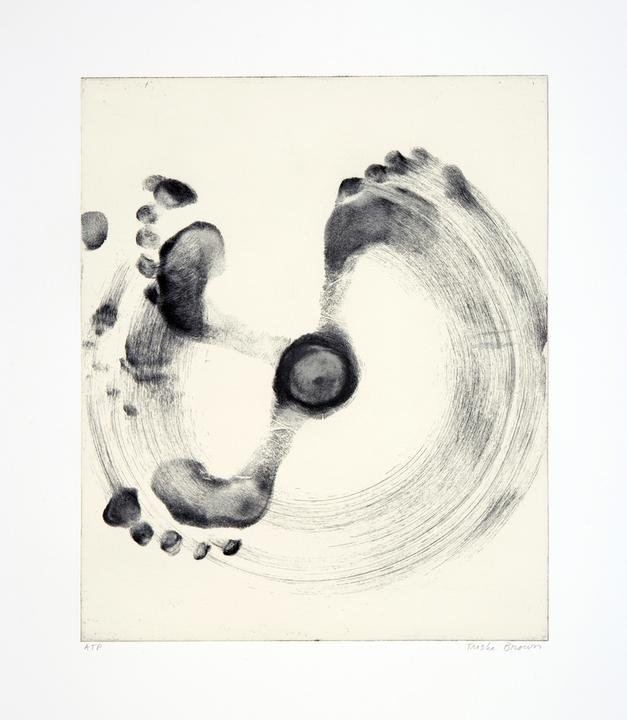
Trisha Brown: Drawing: foot rotation
Trisha Brown the dancer joined Robert Dunn's dance workshop in the early 60s and very quickly came across Dunn's use of Laban notation, not just as a way to record dance movements but as a way of generating or implying ideas for movement. Dunn had understood that graphic notation and movement invention were for Laban inseparable and had embedded these ideas into his choreography teaching. See a detailed documentation of the issues here. Brown took on the implications of this even further and saw that not only could a diagram be an instigator for particular movements in dance, but that the dance itself could lead to drawings which could themselves be seen as physical diagrams of what the body had been doing. 


Laban with an example of his notation system developed in the 1920s

Labanotation in use

How to graphically represent change in effort

As you can see from the photograph of Laban and his system above, the method of transcribing movement was paradoxically linked to the vertical, hence the introduction of a more horizontally orientated system, in the 1940s, Benesh notation.


Benesh notation of a gymnastic routine

All of these things are for me a sign of the growing importance of the body when thinking about how to approach drawing. Not just drawing but the way we think we think is being questioned here. I'm going off on one of those side tracks again but bare with me. Over the last few years we have become more and more aware of how complex our body systems are and how deeply interconnected the psychological is with the physiological. For instance there is communication between the bacteria in your gut and your brain, and this communication is linked to both psychiatric health and intestinal disease. Our host bacteria can influence how the brain is shaped for learning and memory. It has also being theorised that when new material enters the gut, our bacteria is sensitive enough to be able to communicate with it. In some way it can 'know' things about the previous life of the new food that has entered the system. This is a deeply profound idea. The thought that your gut will in some way 'know' whether your food's previous existence was a good one or a traumatic one, leads us to rethink the implications of that old aphorism, 'You are what you eat'.  

Add to this the way our language is itself linked to the body, "I hope you are able to digest this information'; 'can you grasp what I'm saying?' and the idea of embodied knowledge becomes not just a vague thought, but a real touchable and useable thing. Our assumed superiority over other animals and our celebration of our own brain power, can be put into a different context. Our over reliance on brainpower has prevented us from using or even being aware of many of our other faculties. We hardly use our noses to navigate the world any more, but thousands of years ago we would have needed our olfactory senses all the time in order to select and check out what we were eating and whether or not food was in the vicinity. Above all, we are hardly in touch with our bodies, we have forgotten to 'listen' to them, we don't know how to smell illness or feel for a cure. As we forget our own bodies, so we forget the impact of other things. We forget to speak to the wind as it passes around us, we forget to address the plants that feed us, to sing with the birds as they wake us or to commune with the rocks on which we walk. 

In order to attune ourselves to our bodies we need to be 'grounded' and this may mean that we need to develop more of an awareness of the horizontal. By working against vertical surfaces we begin to separate out the frozen mark field, from the act of movement. We separate the result from the doing. You stand back and judge what you have done, rather than immerse yourself in the doing. 


It all begins here
When you made your first drawings I suspect you were simply lost in the making and now you are 'grown up' you are supposed to put away childish things and analyse what it is you have done, but as Picasso said, “Every child is an artist. The problem is how to remain an artist on growing up.”

By withdrawing from the world we have developed a powerful set of tools that can dissect this world and extract from it the things that we want from it. However, would we do this to our children, would we dissect them in order to extract from them what we think we need? 

Some of my more recent posts have been about certain approaches to philosophy and politics and I have been muttering about whether or not politics can be made to work with certain philosophical viewpoints. I think as I keep returning to similar issues that I am gradually getting to what is perhaps the crux of the issue. Why do art? What use is it to make drawings or any other art form? 

If I think back to making those 'how to assemble' technical drawings it was pretty clear what they were being used for, and because they had a clear purpose, they were quickly taken up by the then powers that be, as a way of showing workers how to work faster. So something that began as a way of understanding a process and communicating that process to someone else, became a way of supporting the standardising of procedures as set out by management. 

The meaning is the use said Wittgenstein, so perhaps my more recent writings about how my drawings have been used need to be revisited and further unpicked. 

Garry Barker: Drawing and Allegory 


My artwork is a reflection on what I think the current feeling tone is in relation to our 'condition'. In the drawing above I was trying to visualise the paradox of our desire for constant success, of always trying to climb the ladder of achievement, but not realising that in reality there is nowhere else to go. No matter how hard we try to climb up, we always stay in the same place. We are in reality always here on an earth that we have forgotten to look at because we are so busy trying to climb away from it. How images like this are used, I'm not sure? It is an open ended question, hopefully it helps some people think about the situation we are all in, but it is unlikely that I will be given any clear feedback as was the case when I worked making 'how to assemble' drawings. 


This cocky human came from a series of drawings whereby I was wondering whether or not anthropomorphic images might help us become more sympathetic to other non-human points of view. But whether or not these images are in fact useful I don't know and have to rely on instinct or some sort of inner trust to have the confidence to keep making them, each time I make a drawing I am like most artists, looking for that image that might actually communicate something useful to another human being. The fact that most of my images are made horizontally suggests that I also need to consider the performative aspect of this in more detail, but the most important thing is that I can still after all these years get lost in the making. 


Buster Keaton making a comedy routine look like the best dance/art combination ever!


See also:


Drawing and dance
Performance drawing
Eye Music

Saturday, 14 October 2017

Beuys and Cotman at Leeds City Art Gallery

Leeds City Art Gallery has finally opened after refurbishing and the new rooms are superb. In particular the central upstairs space is bathed in natural light and is a wonderful space for showing sculpture. 
Two of the opening exhibitions are of particular interest for the drawing community, the staging of a large show of the gallery's Cotman holdings and the Joseph Beuys 'Artist's Rooms' display. 
If you have never looked at Cotman before you will be surprised at how modern he can seem. He breaks the landscape down into abstracted chunks and eliminates details and in doing so prefigures the way artist's of the 20th century would begin to select out forms from nature. However what really interested me was the display of his pencil drawings.


Cotman

The drawings were located on shelves, simply leaning against the wall, 4 or 5 to a row, still attached to their supporting card backing. A glass sheet was then fixed over the lengths of wood shelving in order to protect the drawings from the public. A very neat method of presenting a diverse range of small shapes and sizes. 


By displaying the drawings in this way it meant that I could get up really close and look at how the images were made. 


Cotman

I was immediately taken with a drawing of some weeds. I suppose it was because drawings like this are ones I have done many times, usually thinking "this will come in handy at some point", made when wandering the streets collecting visual information for some future foreground detail. Because I have drawn this type of situation myself I can also empathise with the selection of the composition. Cotman is keen to locate the plants selected in a space, a few marks indicating other grasses and plants are enough to ground his image. Looking back on the sketchbook drawing (1) below, taken from one of my old sketchbooks, my effort looks very isolated and because the sense of space is poor, the drawing lacks life. I can remember at the time not wanting to get down on my knees to sort out the visual entanglement of other plants around the base and this is probably why the drawing is lacking in attention to a specific experience. 

Sketchbook drawing 1

Sketchbook drawing 2

My sketchbook drawing (2) in retrospect seems a much better record of an experience, the few brushed in indications of other plants create a sense of space that (1) doesn't have.  
As I stood looking at these small drawings of Cotman's, I was becoming more and more aware of the embodied nature of their understanding. Because these are things I have drawn, I begin to re-enact their making in my body. Each stroke Cotman makes is meaningful to me intellectually and physically. The hand is still holding the pencil, the arm is still moving, the elbow tracing a smooth curve as it pushes and pulls the lower arm across the paper, the shoulder now aware of a change of pressure as the hand is pulled off the paper and dropped down again as a leaf is found in space next to a rising plant stalk. I'm in Cotman's body, I inhabit his mind, his hand and his eyes. I'm affected by the plants he drew, their presence still echoing through time, their effect still potent after all these years. I know this, I know I am both Cotman and the small weeds he once perceived on a day when he had his paper and drawing implements with him. We are drawn together as I re-animate the artist and the stimulus for his perceptions, the old drawing's agency is powerful, taking a strong hold of me. 
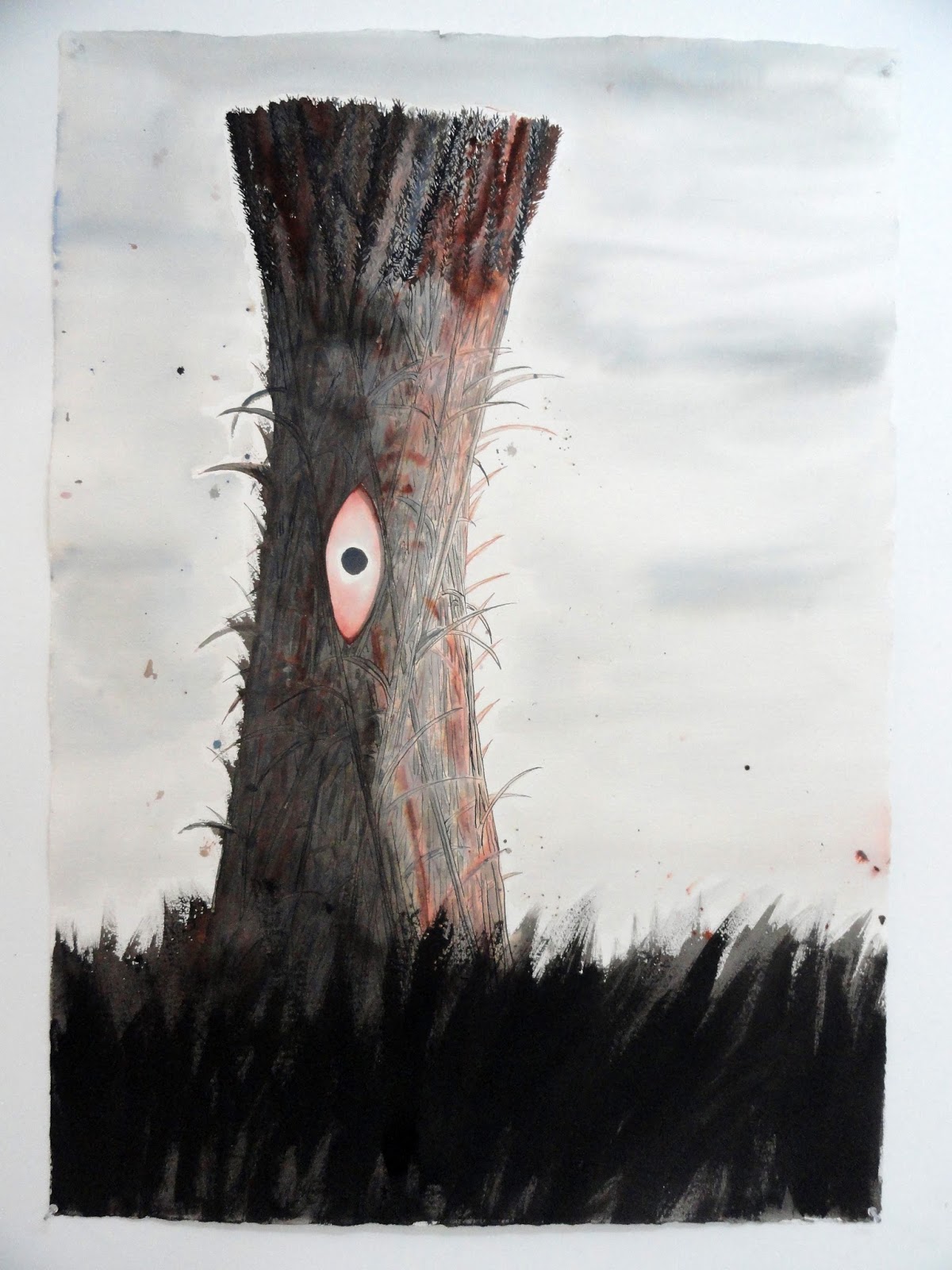
Most of the drawings in this display are in pencil. Like many artists I draw with pencil to capture ideas and images as they either come to me perceptually or via the inner workings of my imagination. In the morning before going to the art gallery I had been working on another image of an eye in the corn. 

Eye in the corn

The image above would not have come to me without in the past standing next to a wheat field and drawing it. (Sketchbook drawing 3). 

Sketchbook drawing 3

The Cotman drawings are collected together in an area adjacent to a much larger gallery in which a comprehensive display of his finished watercolours is on exhibition. That connection between what you are aiming for as an artist and what you need to collect from your experiences is very important. In this case it was for myself interesting to see how he had at times been on a very similar journey. Tiny drawings of horizon lines were of particular interest for me as they made me very aware of the importance of linear rhythm, especially on that line that separates the land from the sky. 


Cotman: studies of the horizon

Again I'm both reminded of my own drawing experiences and taken over by these little scraps of information. The way that you look across a landscape is determined by how the experience is punctuated by events. Once again I am engrossed by these indications and quickly aware of how Cotman would have been engaged in the experience. For him a windmill stands out, for myself a mosque. But for both of us the edge between sky and land is a linear experience, an experience that reflects the material presence of the world and the way that it shapes us. 


Detail of Leeds horizon from a large drawing


In the main gallery devoted to Cotman's watercolours is a drawing on which he had spent a much longer time. Titled, "An effect of Parhelion seen from Hunstanton Lighthouse on July 6 1816", Cotman had obviously been deeply impressed by a powerful natural phenomenon. 


Cotman: An effect of Parhelion...

Cotman both writes about and draws an image of the event, a rare occurrence and one which is centred on light and our perception of it. Here we see his response to the 'effect' of the world, his being acted upon by world events, shaped and in turn shaping the experience. 
An effect of Parhelion... is an image we might well place as one of those belonging to the tradition of the sublime. Cotman is also an artist that uses his drawing materials in a much more expressive manner, the drawing of a road disappearing into the mist below, demonstrating that he isn't always about sharply defined areas and flat shapes.  

Cotman

On the ground floor of the art gallery there are also three rooms devoted to the work of Joseph Beuys. It may at first appear as if Beuys and Cotman are worlds apart in both sensibility and effect, but as I wondered through the galleries I began to feel that they were in fact very similar. 
Beuys: Pregnant woman with swan

Drawing is for both these artists central to their practice. Both are happy to work ideas out on scraps of paper or card and they both have an instinct for abstraction. The profile of a pregnant woman above being as much as a simplification as any of Cotman's abstracted landscapes. 

Beuys: Energy Field

Beuys' drawings are also records of performances and he often uses a particular brown coloured floor paint for his later drawings. These images feel as if they are about traces of events and so did Cotman's drawings. Both artists are offering us records of their material engagement with the world, Beuys is much more aware of this, often talking about the meaning of fat and felt and other materials, but Cotman is obviously aware himself that his ideas are being shaped by the properties of the materials he chooses to use. Both artists abstract elements out of the process of their complex entanglement with experience and the matter that shapes that experience. The consequence of these experiences is relayed to me and as an entity made of similar stuff to both artists, I am 'tuned' into the way materials are being shaped to form ideas. Beuys is though a 20th century creature, he is aware of a post quantum world, a world of relativity and the atomic bomb, so is therefore much more attuned to energy flows and the transmutation of matter. Beuys has a type of political awareness that Cotman doesn't have, but there are politics of the picturesque that Cotman would have had to deal with that we are perhaps not as aware of as we should be. 
I have on purpose spent more time writing about Cotman than Beuys, even though Beuys as an artist was much more influential on my own practice and was one of those artists that I was fortunate enough to actually meet. My point is that the act itself of drawing is such a special one in that it carries with it a material value, a physical entanglement with the world that writing never does. In those small pieces of paper I could sense the reality of experiences, in a way that the words on this screen never could. I am asking the reader to go and look at some actual 'real' drawings and to open themselves out to their own embodied world. To try and feel that invisible but palpable pencil or pen in their hand and to re-trace the time of a drawing's making. No matter how tiny and ephemeral a drawing may be it is a physical, material idea and as such is a reminder of our own and the world's material agency. 

Both these exhibitions are well worth visiting and there is of course the added bonus of being able to visit the new displays upstairs in the gallery. 

Find more information on the Leeds City art gallery here