Showing posts with label Leeds City Art Gallery. Show all posts

Saturday, 22 June 2019

Drawing and ritual: Leeds City Art Gallery

Roger Ackling: Bird: Sunlight on wood 1974

There is an exhibition of work at the Leeds City Art Gallery as part of the Yorkshire Sculpture International, that you might easily walk past and not notice, as it concerns small discrete objects that were used as part of three artists' performative works and personal rituals. This small self contained exhibition looks at the work of artists that made their reputations during the 1970s, and therefore I was very interested in how their various sensibilities overlapped with my own, as they emerged as artists at exactly the same time as myself.

I was particularly interested in the work of Roger Ackling. For much of his career he made work using a magnifying glass to focus bright sunlight onto the surface of found wooden objects, and in the process burning lines and dots, which for him became a sort of meditative mark making. The wood he used was usually found, often on a beach, but it could be from anywhere, and his only tool was the magnifying glass. He in this way was able to re-assert the position of the sun as central to all things seen. His work reminds us of the power of the sun to transmit energy to the Earth and in doing so power vegetable, animal and mineral life. These small drawings on wood, are objects that have a sensibility that could have been arrived at thousands of years ago. I was reminded of constructions like Stonehenge and Newgrange, constructions that were also celebrations of the sun, but on a larger scale. There is a lot of hand eye co-ordination and control in his drawings. Each line positioned very carefully in relation to the others, until a perfectly formed rhythmic surface is developed. 


Roger Ackling

Ackling's friend Richard Long tells of Ackling suggesting driving to Cornwall trailing a pencil on a piece of string on the road, and returning by the same route trailing a rubber. This was back in 1968, a time when Ackling had already developed a minimalist sensibility, one that would find full expression in the use of a magnifying glass and forgotten wooden fragments. It is also worthwhile thinking about the fact that in making work of this sort he was dealing with sustainability issues well before they were seen as essential.

Keir Smith made drawings in an indirect way, as part of a method of investigating his subject matter and developing ideas. In the early 1980s Smith began to start turning process into performance, creating a series of sculptures and installations as a way of documenting his interaction with the landscape.


Keir Smith


Keir Smith

Smith at one point was making drawings by using metal stencils and then scorching or burning images through the stencils onto paper. The stencils were kept in special handmade leather pouches, which were worn by the artist as a sort of tool belt, the perfomative act and associated equipment being just as important as the drawings that emerged from the process.


Every profession has its tool kit, leather belts designed to carry as wide a range of tools as possible have always been excellent aids for performance artists as much as make-up artists.

Probably the most well known image of an artist carrying his kit out of the studio is this one of Courbet, notice the roll of canvas, folded easel and stretcher bars

Martin Rogers was known for his artist's books as well as a wide ranging idiosyncratic practice. The present exhibition presents some of his drawings for objects as well as the objects themselves. These objects are made beautifully as if by a cabinet maker and they suggest that they have emerged from a society that used them for complex rituals, rituals that in particular would involve some sort of rhythmic sound making. The drawings on display show Rogers thinking through the various possibilities and forms that these objects could possibly have, as well as visualising their making process. 


Martin Rogers 

All three artists had a performative aspect to their work and to some extent this exhibition of objects and drawings misses the point that these artists were trying to make. The boundaries between art and life were becoming blurred, artists such as Alan Kaprow were very influential at this time, his "happenings" and "environments" were the precursors to what would be called performance art, and his essays set out a series of approaches to understanding the paradoxical relationship between art and life and the nature of meaning. The putting of this type of work behind exhibition glass, if we are not careful, re-introduces the divide between how we think about life and how we experience it. 

The other artist that I remember being of vital importance at this time was Robert Smithson, the detail below of a drawing of stars from one of Keir Smith's drawings in particular reminded me of Smithson's cosmological approach. Smith's drawing of a drawing held down by stones, suggests that the artist should be making drawings out in the landscape and not in the studio, especially as in this case, if the drawing is of star patterns seen at night. 


If we take a typical work by Robert Smithson, such as his ‘St. John in the Desert’, whereby an old engraving of St John is surrounded by collages of electrical diagrams, force-fields and other technical readouts from science manuals and place it next to his essay on Robert Morris; we can think of these two visual/written texts as containing ideas that could flow between each other, intellectual energy at times being converted into electrical flow and vice versa. This perhaps gives an idea of how Smithson's influence worked at the time. 
Robert Smithson: St John in the Desert

This is a short extract from Smithson’s essay on Robert Morris.
'Descartes' cosmology is brought to a standstill. Movement in Morris's work is engulfed by many types of stillness: delayed action, inadequate energy, general slowness, an all over sluggishness. The ready-mades are, in fact, puns on the Bergsonian concept of "creative evolution" with its idea of "ready made categories." Says Bergson, "The history of philosophy is there, however, and shows us the eternal conflict of systems, the impossibility of satisfactorily getting the real into the ready-made garments of our ready-made concepts, the necessity of making to measure." But it is just such an "impossibility" that appeals to Duchamp and Morris. With this in mind, Morris's monstrous "ideal" structures are inconsequential or uncertain ready-mades, which are definitely outside of Bergson's concept of creative evolution. If anything, they are uncreative in the manner of a 16th-century alchemist-philosopher-artist. C.G. Jung's writing on "The Materia Prima" offers many clues in this direction. Alchemy, it seems, is a concrete way of dealing with sameness. In this context, Duchamp and Morris may be seen as artificers of the uncreative or decreators of the Real. They are like the 16th-century artist Parmigianino, who "gave up painting to become an alchemist." This might help us to understand both Judd's and Morris's interest in geology. It is also well to remember that Parmigianino and Duchamp both painted "Virgins," when they did paint. Sydney Freedberg observed in the work of Parmigianino, if not in fact, at least in idea'.
There was a sort of ‘hippy’ feeling to all this, and one that for many artists at this time, myself included, seemed a positive and morally uplifting direction to take. That desire for everything to be joined up, for an invisible universe that lay behind this everyday world to be revealed in all its complex glory, was I remember vitally important to the rise of conceptualism. We move in Smithson’s essay from Duchamp, through Descartes, touching on Jung and use a late Renaissance painter as a touchstone that can take us into the world of alchemy. Smithson goes on to examine the nature of thermodynamics and then reflect on the structure of time. Old myths and religious beliefs, as rethought by Joseph Campbell were for our generation as important as the more technological writings of Buckminster Fuller. Fuller invented the term 'ephemeralization' or the ability of technological advancement to do "more and more with less and less until eventually you can do everything with nothing." At the time there was a high degree of optimism that science would soon be fused with some sort of mythic understanding of universal principles and that what used to be called 'magic' was simply some sort of future science. Perhaps we need a dose of that optimism again, and seeing the work of these now all dead artists of my own generation reminded me that art and life always need to be entwined together. 

Every now and again I review an exhibition in the City Art Gallery that I think expands or deepens an idea of what drawing is concerned with, as a reminder to keep going and checking out what is being presented. There will always be a wide range of other approaches to art making represented, at the moment there is an excellent exhibition 'Woodwork' to see, that includes work from various historical periods and from non western cultures. It is easy to ignore something just because it is on your doorstep, make sure you make full use of an excellent local resource. 

Find out what's on here: Leeds Art Gallery  
What's on at the Tetley, where there is another excellent exhibition on at the moment. 

Some earlier posts reflecting on what could be seen in the city art gallery:

Beuys and Cotman
Sculptors' Drawings
Narrative Objects
A gallery presentation of large drawings


Wednesday, 15 May 2019

John Dewey: Art as Experience: Leonardo Drawings at Leeds City Art Gallery

Leonardo

The Leonardo drawings that have just been on show in Leeds City Art Gallery reminded me of the time when art and science were not such strange bedfellows. The philosopher John Dewey would often advocate their conjoining and similarities, a position that came out of his pragmatist approach to thinking and one that I have a lot of respect for.  

John Dewey was a ‘Pragmatist’ philosopher who wrote his most famous text on aesthetics in the 1930s, ‘Art as Experience’. This might seem a very long time ago but during the 1990s and early 21st century several writers on art theory began to see that Dewey’s key concepts developed out of working from concrete experience could be very useful. I was very lucky in coming across Dewey quite early on in my career, reading him as an art educator rather than as an artist. It was in art education where his influence had always been strong, but at the time, because I was also a practicing artist, I saw his relevance to the drawings I was making about my experiences of being a young father with growing children. There didn’t seem to be many other theorists around that could help me with the building of a supportive theoretical framework for a body of work that focused on making images derived from watching my children grow up. 

Dewey ‘democratised’ my thinking about art practice. If everything that I could possibly think was the result of experience, therefore anything was potential subject matter. More recently Richard Shusterman (1989, 2012) in response to Dewey’s thinking advocated treating all art as fine art, in particular in his writings on rap. He has also used Dewey to support his own thinking about the ‘embodied mind’ another area of research that I have pointed to several times in these blog posts. Crispin Sartwell (1995, 2003) and Yuriko Saito (Saito 2007) have both used Dewey to support an idea of an everyday aesthetics. However my own interest in how aesthetics and ecology need each other in order to support a new approach to thinking about Nature, such as in the writings of Tim Morton, is why I’m particularly interested in returning to Dewey. In relation to this, although I find his writing too soaked in Romanticism, Thomas Alexander has shown in ‘The Human Eros’ how Dewey’s ideas are essential to an understanding of eco-ontology and the aesthetics of existence (Alexander 2013). 

For Feminist writers Dewey is important because of his emphasis on the importance of concrete experience and his exploration of how feelings are an essential aspect of how personal experience is received and understood.  He also prioritised doing and making and he wanted to eliminate the division between practice and theory in order to achieve some form of synthesis.

Dewey argued that all experience has an aesthetic, therefore it could be argued that our aesthetic sensibility is centred on how we ‘feel’ or ‘experience’ our day-to-day situatedness. Art therefore leads out of life and this being so, for a ‘good life’ and correspondingly ‘good art’ we need to cooperate with and nurture our environment, which in turn will shape us. For artists this puts aesthetics right at the centre of philosophical debate, therefore when trying to write about the nature of art as a means towards some sort of understanding, Dewey can be vital. 

As a Pragmatist that focused on human beings learning from experience, Dewey believed that art and science are very similar; both learning by doing in response to finding out about the world that surrounds us.  Because of the relativist nature of his interpretation of “what is art?” he will sometimes ask the question  “when is art?” and in doing so he reinforces my belief that we need to be looking more at processes than things, definitions such as ‘art’ and ‘science’ often standing in the way of forming new ways of thinking and acting. (I like to use the compound word ‘thacting’) 

Any of you thinking of going into art education ought to read 'Art as Experience', I believe it is a seminal text, and will help you begin that process of shaping and modelling sessions for your own future students, especially sessions designed to enable them to see how making art can also be about making sense of the world. 


The Leonardo drawings demonstrate beautifully how art and science can be conjoined in a synthetic response to the world. At times he is looking at how things work, at others how things can be represented and as his imagination is fed by his looking he begins to make new images constructed out of what he has learnt from his experiences of examining the world. As a process this is not hard to understand, but sometimes we forget that the modelling or shaping of experience relies on long periods of intense study. You are not required to dissect a human body any more in order to develop an understanding of how it works, however there are always other things to explore. Dewey's point is that everyday is filled with experience, but we don't usually stop to examine that experience, but when we do, science or art will emerge from this activity. It doesn't really matter what we call it, however the naming tends to shape the way we continue with our exploration, so perhaps, at least for a while, we should simply stop, look and listen and then see if we can do something that makes ourselves and others aware of the implications of existence. 

Goethe would have approved of Dewey, his poem 'The Metamorphosis of Plants' perhaps sums up everything I had to say in this post. Biology and art combine in a form that like Leonardo's drawings goes beyond both. 

References

Alexander, T(2013) The Human Eros: Eco-ontology and the Aesthetics of ExistenceNew York: Fordham University Press


Dewey, J (2009) Art as Experience New York: Perigee Books

Saito, Y. (2007) Everyday Aesthetics, New York: Oxford University Press.
Sartwell, C. (1995,) The Art of Living: Aesthetics of the Ordinary in World Spiritual Traditions Albany: SUNY Press.
Sartwell, C. (2003) “Aesthetics of the Everyday,”  In The Oxford Handbook of Aesthetics, J. Levinson (ed.), Oxford: Oxford University Press, 761–770.
Shusterman, R. (1989) “Why Dewey Now?,” Journal of Aesthetic Education, 23: 60–67.
Shusterman, R  (2012) Thinking through the Body: Essays in Somaesthetics, New York: Cambridge University Press.

See also:


Saturday, 14 April 2018

Drawings on show in Leeds City Art Gallery

Anne Hardy: Installation view 'Falling and Walking'

It’s nearly always worthwhile checking out your local art gallery at least once a month. Exhibitions change and a new arrangement of their existing collection can reveal new things about often seen work that you might have become overly familiar with. So as you return to university after the Easter break why not pop in to see whats on?
Leeds City Art Gallery has two drawing themed exhibitions on at the moment. The focus on the drawings used to develop the installation ‘Falling and Walking’ by Anne Hardy is really useful to look at if you are thinking about how drawing can be used as a way of thinking about large scale ideas and how they might be realised. Anne Hardy uses a combination of model making and drawing in order to both work her ideas out and to communicate them to other people. Most of the drawings are quick sketches of ideas, you get the sense that drawings are very much ‘what ifs’ for Hardy and that the models are where she gets t grips with the nuts and bolts of how things might actually work. She often uses watercolour wash to establish a feeling for a space and what might activate it and ballpoint pen to scribble out a fast idea or to hold on to a thought before it disappears.


Ann Hardy: Thinking drawings and a model of installation ideas

Adjacent to the display of Anne Hardy’s drawings and models is a very interesting display of the gallery’s collection of two-dimensional work by artists that we usually think of as sculptors. This was very informative and once again highlighted the role that drawing plays in so many artists’ working methodologies. It was personally interesting for myself because one of the first drawings on display was ‘Crossed Beds’ by Jenny West, a fellow colleague at the Leeds Arts University and one that I worked alongside for many years when I worked on the foundation course. Jenny is well known for her very technical approach to drawing,  using tightly controlled perspective drawing projections. In the drawing on display she uses a variety of surface qualities to soften and sharpen different areas of the drawing in order to emphasise the planar movement of her spatial grids and to humanise the technical approach she uses to nail down the image. It was impossible to photograph the image through the glass it was framed behind, so all I can do is give you a ghost image of the drawing, one that has my own body standing within the centre of its crossed grids. 


Jenny West (Crossed Beds: Image behind glass)

Jenny’s drawing is positioned right next to two Claes Oldenburg images. Both of his drawings rely on a very strong sense of how scale can be manipulated in order to give drama and power to an image. The first larger drawing is of a faucet or as we would put it in England a tap. The tap is on and water pours from it in a vertical column. The image is designed to look as if the tap is huge and an architectural insert into a park or garden.  Here perspective is used very technically in order to give authenticity to Oldenburg’s vision of what an everyday item might be like if it was elevated to the scale of a huge landscape feature.


Oldenburg: Proposal for a cathedral in the form of a sink faucet for lake Union, Seattle

A small much looser drawing of cigarette ends is also in show, it is also designed to get an audience to see how these throwaway items could become monumental. These two drawings give you a snapshot into Oldenburg’s mind and you quickly realise how good a draftsman he is. The images are drawn with a consummate command of the materials he is using, whether he is making a swift sketch or a more detailed technical drawing, he is in total command of the process.

Phyllida Barlow: exhibition installation of coloured drawings

Phyllida Barlow

On the opposite wall is a collection of A1 size coloured drawings by Phyllida Barlow. Her drawings are made independently of her three dimensional work, and unlike the Oldenburg drawings are not preparatory sketches or visualisations of ideas but works in their own right. You could think of them as compositions, or freeform arrangements of colour and surface materials, as thin coloured sculpture or flat environments. This distinction between sculptors that use drawing to visualise what might be and those that use it to explore other possibilities runs throughout the display and highlights a key distinction between those using drawing in the old sense of 'disegno' and those who see drawing as a discipline that has its own autonomy, those that in effect treat drawing as an object in its own right.

Alison Wilding

Alison Wilding is an interesting case in point, she uses drawing to explore concepts that she has also realised in 3D, not to visualise more 3D versions, but to create some alternative 2D possibilities that exist as images in their own right. Rose Leverton’s ‘Dinner table beneath the floor proposal’ is of course in the other camp, the drawing is showing us a possibility.


Rose Leverton

The person that perhaps opens out the most conceptually interesting approach to drawing is Cornelia Parker. Her ‘Dead match exposed by a live one’ uses simple photographic technology (literally drawing with light) to produce a photogram of a burnt-out match, brought back to life again by the light of a newly stricken one, in the form of a glowing white silhouette. Parker is conceptually playing with us, getting us to see a beautiful connection between how an image is made and what the image is of.


Cornelia Parker: From ‘Dead match exposed by a live one’ 

The Cornelia Parker image was impossible to photograph because like most of the drawings on display it was behind glass. However it does give me a chance to show you a view of the exhibition as reflected in her photogram and it offers a timely reminder that all of the drawings shown in these blog posts are digital images rendered from photographic exposures. I am always having to write about a topic that is never actually seen, but only referred to. In many ways this demonstrates the power of photography, it is so embedded into digital technology that I often forget how it is shaping and processing everything that I refer to, so perhaps for a while I might turn my attention to 'drawing with light' and see how as a way of thinking it re-conceptualises what I have been trying to articulate in relation to drawing as an extended practice. 
In the meantime do try whenever possible to go and see original artwork, drawings are so much more like objects when you see them in the flesh, the camera lens flattens and de-textures everything, as well as resizing images to fit screen world formats. 


Saturday, 14 October 2017

Beuys and Cotman at Leeds City Art Gallery

Leeds City Art Gallery has finally opened after refurbishing and the new rooms are superb. In particular the central upstairs space is bathed in natural light and is a wonderful space for showing sculpture. 
Two of the opening exhibitions are of particular interest for the drawing community, the staging of a large show of the gallery's Cotman holdings and the Joseph Beuys 'Artist's Rooms' display. 
If you have never looked at Cotman before you will be surprised at how modern he can seem. He breaks the landscape down into abstracted chunks and eliminates details and in doing so prefigures the way artist's of the 20th century would begin to select out forms from nature. However what really interested me was the display of his pencil drawings.


Cotman

The drawings were located on shelves, simply leaning against the wall, 4 or 5 to a row, still attached to their supporting card backing. A glass sheet was then fixed over the lengths of wood shelving in order to protect the drawings from the public. A very neat method of presenting a diverse range of small shapes and sizes. 


By displaying the drawings in this way it meant that I could get up really close and look at how the images were made. 


Cotman

I was immediately taken with a drawing of some weeds. I suppose it was because drawings like this are ones I have done many times, usually thinking "this will come in handy at some point", made when wandering the streets collecting visual information for some future foreground detail. Because I have drawn this type of situation myself I can also empathise with the selection of the composition. Cotman is keen to locate the plants selected in a space, a few marks indicating other grasses and plants are enough to ground his image. Looking back on the sketchbook drawing (1) below, taken from one of my old sketchbooks, my effort looks very isolated and because the sense of space is poor, the drawing lacks life. I can remember at the time not wanting to get down on my knees to sort out the visual entanglement of other plants around the base and this is probably why the drawing is lacking in attention to a specific experience. 

Sketchbook drawing 1

Sketchbook drawing 2

My sketchbook drawing (2) in retrospect seems a much better record of an experience, the few brushed in indications of other plants create a sense of space that (1) doesn't have.  
As I stood looking at these small drawings of Cotman's, I was becoming more and more aware of the embodied nature of their understanding. Because these are things I have drawn, I begin to re-enact their making in my body. Each stroke Cotman makes is meaningful to me intellectually and physically. The hand is still holding the pencil, the arm is still moving, the elbow tracing a smooth curve as it pushes and pulls the lower arm across the paper, the shoulder now aware of a change of pressure as the hand is pulled off the paper and dropped down again as a leaf is found in space next to a rising plant stalk. I'm in Cotman's body, I inhabit his mind, his hand and his eyes. I'm affected by the plants he drew, their presence still echoing through time, their effect still potent after all these years. I know this, I know I am both Cotman and the small weeds he once perceived on a day when he had his paper and drawing implements with him. We are drawn together as I re-animate the artist and the stimulus for his perceptions, the old drawing's agency is powerful, taking a strong hold of me. 
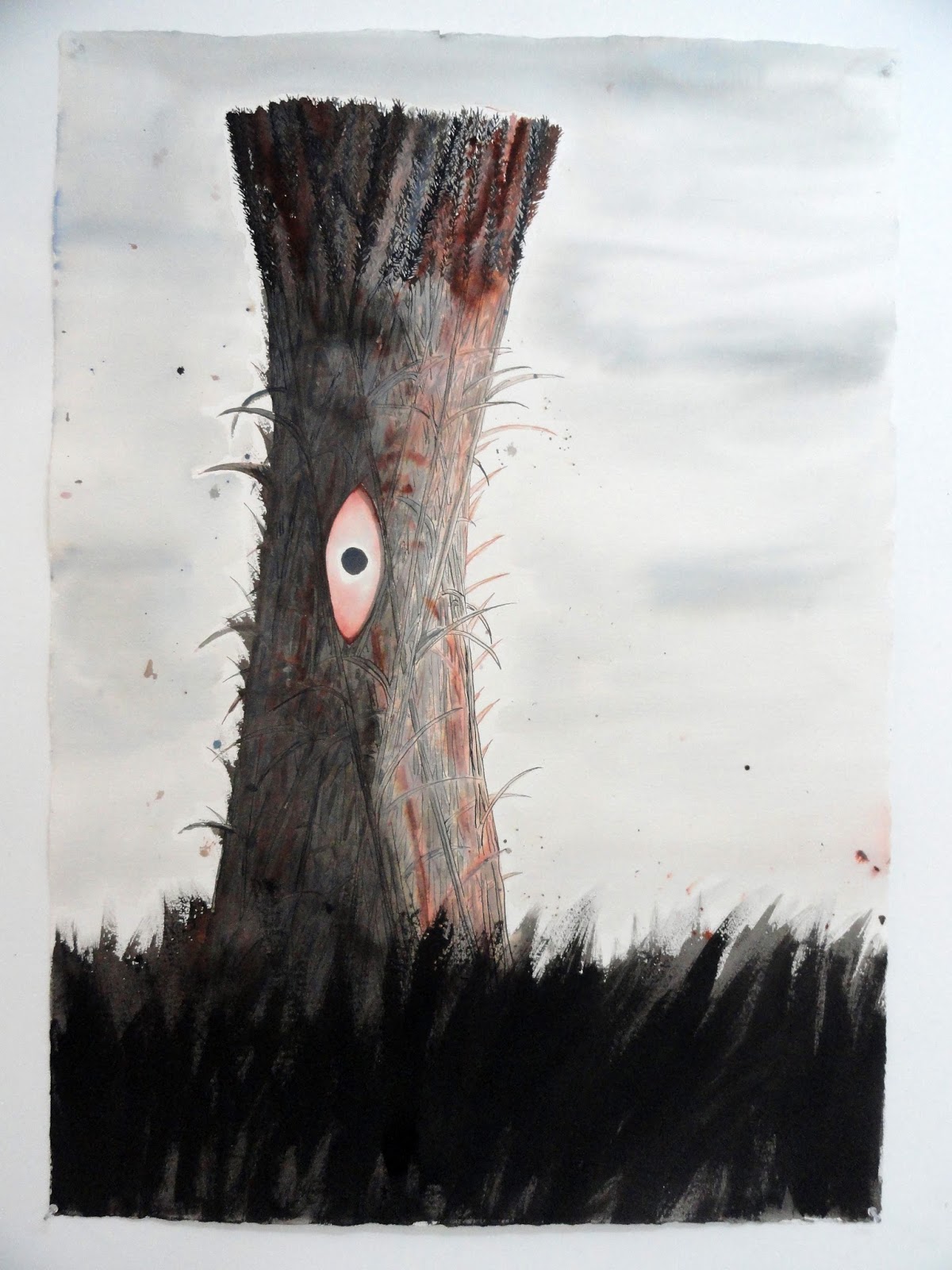
Most of the drawings in this display are in pencil. Like many artists I draw with pencil to capture ideas and images as they either come to me perceptually or via the inner workings of my imagination. In the morning before going to the art gallery I had been working on another image of an eye in the corn. 

Eye in the corn

The image above would not have come to me without in the past standing next to a wheat field and drawing it. (Sketchbook drawing 3). 

Sketchbook drawing 3

The Cotman drawings are collected together in an area adjacent to a much larger gallery in which a comprehensive display of his finished watercolours is on exhibition. That connection between what you are aiming for as an artist and what you need to collect from your experiences is very important. In this case it was for myself interesting to see how he had at times been on a very similar journey. Tiny drawings of horizon lines were of particular interest for me as they made me very aware of the importance of linear rhythm, especially on that line that separates the land from the sky. 


Cotman: studies of the horizon

Again I'm both reminded of my own drawing experiences and taken over by these little scraps of information. The way that you look across a landscape is determined by how the experience is punctuated by events. Once again I am engrossed by these indications and quickly aware of how Cotman would have been engaged in the experience. For him a windmill stands out, for myself a mosque. But for both of us the edge between sky and land is a linear experience, an experience that reflects the material presence of the world and the way that it shapes us. 


Detail of Leeds horizon from a large drawing


In the main gallery devoted to Cotman's watercolours is a drawing on which he had spent a much longer time. Titled, "An effect of Parhelion seen from Hunstanton Lighthouse on July 6 1816", Cotman had obviously been deeply impressed by a powerful natural phenomenon. 


Cotman: An effect of Parhelion...

Cotman both writes about and draws an image of the event, a rare occurrence and one which is centred on light and our perception of it. Here we see his response to the 'effect' of the world, his being acted upon by world events, shaped and in turn shaping the experience. 
An effect of Parhelion... is an image we might well place as one of those belonging to the tradition of the sublime. Cotman is also an artist that uses his drawing materials in a much more expressive manner, the drawing of a road disappearing into the mist below, demonstrating that he isn't always about sharply defined areas and flat shapes.  

Cotman

On the ground floor of the art gallery there are also three rooms devoted to the work of Joseph Beuys. It may at first appear as if Beuys and Cotman are worlds apart in both sensibility and effect, but as I wondered through the galleries I began to feel that they were in fact very similar. 
Beuys: Pregnant woman with swan

Drawing is for both these artists central to their practice. Both are happy to work ideas out on scraps of paper or card and they both have an instinct for abstraction. The profile of a pregnant woman above being as much as a simplification as any of Cotman's abstracted landscapes. 

Beuys: Energy Field

Beuys' drawings are also records of performances and he often uses a particular brown coloured floor paint for his later drawings. These images feel as if they are about traces of events and so did Cotman's drawings. Both artists are offering us records of their material engagement with the world, Beuys is much more aware of this, often talking about the meaning of fat and felt and other materials, but Cotman is obviously aware himself that his ideas are being shaped by the properties of the materials he chooses to use. Both artists abstract elements out of the process of their complex entanglement with experience and the matter that shapes that experience. The consequence of these experiences is relayed to me and as an entity made of similar stuff to both artists, I am 'tuned' into the way materials are being shaped to form ideas. Beuys is though a 20th century creature, he is aware of a post quantum world, a world of relativity and the atomic bomb, so is therefore much more attuned to energy flows and the transmutation of matter. Beuys has a type of political awareness that Cotman doesn't have, but there are politics of the picturesque that Cotman would have had to deal with that we are perhaps not as aware of as we should be. 
I have on purpose spent more time writing about Cotman than Beuys, even though Beuys as an artist was much more influential on my own practice and was one of those artists that I was fortunate enough to actually meet. My point is that the act itself of drawing is such a special one in that it carries with it a material value, a physical entanglement with the world that writing never does. In those small pieces of paper I could sense the reality of experiences, in a way that the words on this screen never could. I am asking the reader to go and look at some actual 'real' drawings and to open themselves out to their own embodied world. To try and feel that invisible but palpable pencil or pen in their hand and to re-trace the time of a drawing's making. No matter how tiny and ephemeral a drawing may be it is a physical, material idea and as such is a reminder of our own and the world's material agency. 

Both these exhibitions are well worth visiting and there is of course the added bonus of being able to visit the new displays upstairs in the gallery. 

Find more information on the Leeds City art gallery here