Showing posts with label vanitas. Show all posts

Friday, 12 July 2024

Dream photography

When trying to find out more about Louis Darget’s V-rays, (vital rays) I discovered that he was into 'dream photography', and as I have for a long time been interested in photographs of ectoplasm, decided to find out more. I usually find photographs of ectoplasm very funny, they are so obviously fakes and often use just bits of muslim stuffed up noses or into mouths, to effect their 'mystery', but they must have convinced some people and therein lies the interest for me; why and how are people 'convinced' of psychic meaning by such obvious fakery?

Ectoplasm: A séance image from Thomas and Lillian Glendenning Hamilton's archive 

Ectoplasm materialisations were according to Albert von Schrenck-Notzing, a result of 'ideoplasty', an idea that expressed a medium's ability to form images directly from the mind. Photographs of these images were used to illustrate von Schrenck-Notzing's book 'Phenomena of Materialisation' (1923). The images were obvious fakes, sometimes made of magazine cut-outs and string. In response to their obvious fakery, the magician Carlos Maria de Heredia replicated a photograph of the ectoplasm taken from von Schrenck-Notzing's book that was supposed to have been produced by the psychic medium Carrière, using just a comb, gauze and a handkerchief.

The psychic medium Carrière at work: From 'The Phenomena of Materialisation'

Examples of ectoplasm: Samples found in the Library of Congress photo archives.

The images of ectoplasm samples above reminded me of Radiolarians which are tiny protozoa that produce intricate mineral skeletons that are the result of cells dividing into inner and outer forms of endoplasm and ectoplasm. This other more prosaic 'ectoplasm' is perhaps in terms of microscopic imagery even more unworldly, for myself though it also offered a connection between fact and fantasy and further fuelled my interest in hybridity and permeability. In fact if you look up 'ideoplasty' in Webster's dictionary it has two meanings, the first being 'modified by mental activity' such as ideoplastic factors in digestion'; the second being 'of an art form': rendered symbolic or conventional through the mental remodelling of natural subjects. 'Ideoplasty', in terms of von Schrenck-Notzing's concept of a medium's ability to form images directly from the mind, no longer being even written up as an old defunct dictionary definition. 

Radiolarians

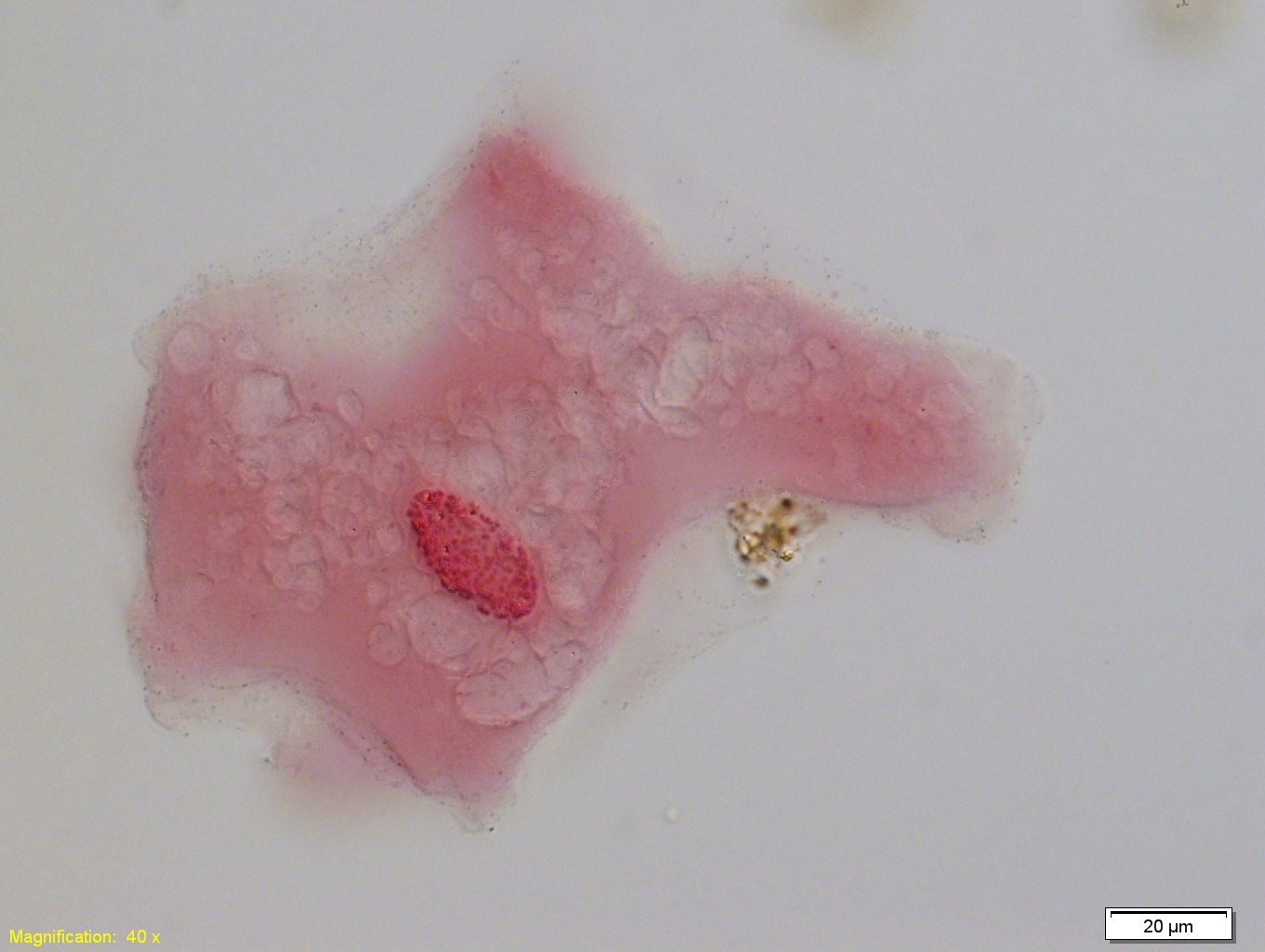
An amoeba

In the image above of an amoeba the darker pink blob is the nucleus and the rest of the cell's body is the cytoplasm. There are lots of plasm words used to describe a cell. For instance the whole thing is made up of protoplasm. If you exclude the nucleus the remaining protoplasm is called the cytoplasm. The cytoplasm is itself composed of the endoplasm, which is the stuff you see and though not visible, the ectoplasm lies just inside the plasma membrane and is the outer, more viscous region of the cytoplasm. A sort of invisible skin that sits below the membrane. Ectoplasm provides structural support to the cell and helps maintain its shape and is involved in processes such as cell movement and the formation of cell extensions like pseudopodia in amoeboid cells. The cell membrane is the outer boundary of the cell responsible for regulating the passage of substances in and out of it, whilst the ectoplasm provides structural support and facilitates cell movement in the amoeba. 


An amoeba hybrid: Taken from drawings made some time ago

The word ectoplasm is another hybrid, as it unites the ancient Greek words ἐκτός ektos, "outside" and πλάσμα plasma, "anything formed." The imagination of a scientist and the imagination of a psychic, seeming to travel along similar lines. The blobbyness, or unformed plasma appearance of the amoeba suggests that it is always between one state and another, always moving towards something that might be food or away from something that repels it, such as toxic chemicals in the water. It is always for myself a delight to find forms implied by examining of a lump of clay that I am manipulating or within the granularity of pooling liquids, as a brush is moved through them. Just as the amoeba flows between one shape and another, possibilities constantly emerge from materials in flow as you draw.

Landscape emerging from paper: Inks and watercolours

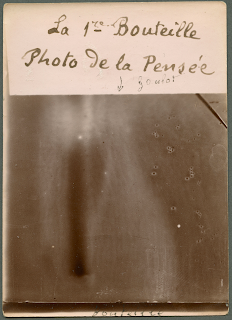
I like to think of 'dream photography' as a form of drawing, as it really is 'drawing with light' and is concerned very much with the way we give meaning to the things we cant see very well, or are usually unseen. I particularly like the crazy way that Louis Darget set about making his dream photographs. For instance in order to make the image below, Mme. Darget was told to hold a photographic plate about an inch in front of her face in darkness. Eventually she would fall asleep. She would awaken as the cool, smooth plate pressed against her face because it had been dropped as she dozed off. Louis Darget would then take the plate away and develop it. In the case of the image below, he decided that his wife must have been dreaming of an eagle as she fell asleep. 

Commandant Louis Darget: Mme. Darget's “Eagle Dream”

A photograph of thoughts being projected from the human brain


All of these images above developed by Louis Darget, could be anchored by titles. For instance the one directly above could have been entitled 'Frogs in a dream' or 'An insect dream', in fact anything you want to see in the image could be reinforced simply by writing down what you imagined to be there and these images are so ambiguous that they are open to interpretation in a wonderful variety of ways, especially if you stated that they were images from dreams.

In the early days of photography, many believed and hoped that the camera would prove more efficient than the human eye in capturing the unseen. Spiritualists and animists of the nineteenth century seized on the new technology as a method of substantiating the existence of supernatural beings and happenings as well being a tool that could visualise those things that only we can see in the mind, such as thought dreams or memories. 

A thought photograph" by Tomokichi Fukurai

Thoughtography or psychic photography, (nensha in Japan) is the claimed ability to 'burn' images from the mind onto photographic film by parapsychic means. In the film 'The Ring', which was a remake of the Japanese film of the same name, a similar idea was introduced, which was called 'projected thermography'. However when we draw from our imagination, surely this is what we do. We 'burn' the images that are emerging from our minds into the materials of their making. However as we make an image, part of the process is a dialogue with the materials of the image's making, therefore what was in the mind, as it is embodied into a new material presence, is also 'in the material' or 'of the material' of its making. This is a symbiotic emergence. A fact that for myself is wonderful, as it is a sort of dance with the world and yourself. 


Images from the mind as it thinks about the body and its interior

However the ability of people to effect changes in photographic substrates still captures people's imaginations, more recently a former bellhop Ted Serios convinced people that he was able to manipulate Polaroid photographs. In the 1960s, Dr. Jule Eisenbud a psychiatrist, staged a series of experiments with Polaroid instant film, using Ted Serios as his subject for research, in order to prove that a psychic projections could manifest on film.
“Parthenon” (1965), an image in the Jule Eisenbud Collection on Ted Serios and Thoughtographic Photography 

I love this image supposed to be of the 
Parthenon, all you need is lots of fogging and blurring and lo and behold you have a psychic projection. 

The Psychic Polaroid Photographs of Ted Serios

The Thoughtography of Ted Serios

There is something serious behind all this fakery though and this is our willingness to suspend our disbelief. We want to believe that there are forces beyond our understanding and that there are doorways into the unknown.

One of the first books to mention "psychic photography" was The New Photography (1896) by Arthur Brunel Chatwood, who described experiments where the "image of objects on the retina of the human eye might so affect it that a photograph could be produced by looking at a sensitive plate." The book also has a chapter on 'Spirit Photography' and the later more esoteric chapters are a seamless extension of the earlier part of the book whereby new photography seems to be exemplified by its ability to see through things, as in the image of the frog seen below.

From: The New Photography (1896) by Arthur Brunel Chatwood

In his book (p. 96) Chatwood states, 'I made experiments on the subject by staring at a sheet of grey paper in a strong light, and at the same time doing my best to concentrate my mind upon some well know object, and trying then to produce a photograph in the same way as in the case of the ordinary retinal impression.... In the Amateur Photographer of 1896, Dr. Ingles Rogers...states that he found it necessary to produce a vacuum in the space between the eye and the plate and that the problem of photographing thought is solved.'

Chatwood was more sceptical about spirit photography and he provides an image of his own whereby he shows how easy it is to fake up these ideas.

From: The New Photography (1896) by Arthur Brunel Chatwood


Dora Maar, Main Coquillage, 1934, 

Within art practice it would be Surrealism that would take up the implications of these ways of developing imagery. Photo-montage techniques now becoming more sophisticated and coupled with a much more subtle understanding of psychology, artists were able to manipulate images designed to effect us in terms of their psychic resonance. The surrealists were also interested in magic and the ritual objects used in a variety of cultures to effect people's minds and as such they form a bridge between the experimentation of the late 19th century and the contemporary advances in neuroscience, whereby the mind/body relationship is being rethought. 
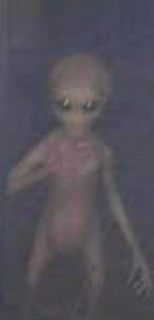
We are still willing to be fooled though by a slightly out of focus photograph. Uri Geller has for many years now played with our minds and his alien photograph, is yet another attempt to tap into our willingness to suspect disbelief. 

Uri Geller's alien photograph

Most of these ideas go back to William H Mumler, an American spirit photographer who's first spirit photograph was a self-portrait which, when developed, also revealed the "spirit" of his deceased cousin. At the time a large number of people had lost relatives due to the American Civil War. They were looking for solace and his work gave them something to hold on to, a belief that the spirits of their lost ones were still out there somewhere and that they were not 'gone forever'. 

William H Mumler: Spirit photography 

This brings me back to a familiar theme, how can we use art to reconcile ourselves with our own mortality? All this interest in invisible rays and esoteric energy flows, is perhaps driven by an inability to accept that death is just what it is. Life is such a magical thing that it is hard to believe that it just finishes. An animist would point to the fact that the life essence moves on and flows into other things and that as we rot down, we feed the vegetation that grows through us. Dream photography and its cousins being perhaps forms of vanitas or memento mori.


References: 


Arthur Brunel Chatwood. (1896). The New Photography. Downey. p. 93


Chéroux, C., Fischer, A., Apraxine, P., Canguilhem, D. and Schmit, S., (2005) The perfect medium: Photography and the occult. Yale University Press.


See also:

Monday, 31 May 2021

Responses to the fragility of being alive

The lockdown in England is beginning to ease and as we all begin to emerge blinking into the sunlight, it is going to be very interesting to see how artists have used drawing and other practices to think about the situation they have just experienced.  I know that it has been a subject many of the students I have been working with have taken on board and as a subject I suspect it is going to be with us for quite some time yet. 

Szu-Han Ho has been thinking about making devices to help people cope with the fact they are not allowed to touch anyone. By making the drawings out of little scraps of material she is able to heighten the feeling of fragility and unworthiness many of us began to have as time went on and we began to yearn for a time when you could just simply hug someone. My grandchildren live in Scotland and I've not been able to see them in the flesh for a year now, so I found these little fragile images particularly poignant.  

Device for Hugging, COVID19

Device for Bingewatching, COVID19

Device for Spooning (Big Spoon), COVID19

Szu-Han Ho has done some very interesting work and she is a good example of an artist that can respond to life as it emerges from fiction as well as real life situations. I have read far more this last year than for a while and this may be the case for many of us, if we cant go out and have real life experiences we have to get our stories from somewhere. 


In the work above she has responded to a page in Robinson Crusoe and constructed a simple series of platforms for two groups of singers to stand on. When the piece is working, the two groups sing a call and response refrain using Defoe's text. Many people have felt devoid of all hope during this past year but they have pulled through, and solace in books and the sound of choirs has often helped in that process.

Taking something from the past and reimagining it is something I suspect many of us have done this year. 

Dario Robleto | Body as Data


Dario Robleto talks about his work

We have had to look at graphs and listen to statistics about bodies every morning, evening and night this past year and we can forget that amongst masses of data for every point on a graph there is a real human being having a real traumatic reaction to something that is totally and hugely significant to that individual. Dario Robleto tries to remind us of this by returning to images made of heartbeats during the late 19th century. 

Jonathan Borofsky's 'Heartlight' 1991

Robleto's work reminded me of Jonathan Borofsky's 'Heartlights' the first of which I saw in Barcelona in 1992, these sculptures sent out an audio and visual transmission of his heartbeat and as you stood in front of one you felt your own body attune to the constant rhythmic beat and visual flickering. Borofsky's 'Heartlight' is still one of the most powerful self-portraits I have ever come across, somehow you were sucked into his actual body; levels of empathy were raised incredibly high simply by experiencing someone else's heartbeat so intensely. 


Rafael Lozano-Hemmer 'Last Breath'

Rafael Lozano-Hemmer's work is always interesting. I remember seeing a wonderful installation of his in Venice, whereby he had the ceiling of a large space covered in light bulbs, an on and off pulse was being carried from one light bulb to another. When you reached the other end of the space you had just walked through, you were directed to climb up to a dais and hold two electronic sensors that were used to calculate the rhythm of your heart beat, this rhythm was then passed on to a light bulb right above your head, gradually the rhythm was passed on to other light bulbs until you lost sight of your own pulse amongst all the others. However the work that for me holds most resonance in relation to our current situation is 'Last Breath'. This is an installation designed to store and circulate the breath of a person forever. A brown paper bag inflates and deflates automatically due to a motorised bellows similar to those found in artificial respirators in hospitals. The apparatus hangs on a wall and is activated 10,000 times a day, the typical respiratory frequency for an adult at rest, and it punctuates this relentless series of breaths with an occasional sigh, 158 of them a day. Each stroke of the machine advances a digital counter that beeps. The breath circulates between the bellows and the paper bag through a ribbed transparent plastic tube that emits a faint and hypnotic low sound, whilst the paper bag makes a rhythmic crushing sound as it inflates and deflates. The first copy of the piece stores the breath of Cuban singer Omara Portuondo; so that after she dies people will be able to still experience her "Last Breath". 
I'm sure that once the pandemic crisis is over we will find that some wonderful pieces of art have been made in response to it, but what the best work does is to transcend the particular situation and to find something of universal significance. 

See also:


Monday, 20 May 2019

Drawing Plants

Leonardo

One of the first drawings that I ever made where I realised I had been able to put something down on paper that I had actually seen, was of a flower. I can still remember the concentration it took and how I had to make its shape appear and disappear as the edges of a leaf moved behind each other. I had to move my head to 'see' what had happened and then make a decision how to show this. The realisation that by 'disappearing' the leaf plane and letting it reappear but now from beneath, would visually describe the way a leaf dipped through space was at the time magical. I suspect this is quite a common experience. 


Flowers are such beautiful things, designed to attract other living things so that pollen can be distributed, they have had millions of years of evolution to get those colours and shapes just right, no wonder we find them so fascinating. 

I'm once again having to go on about the art and science divide, so bare with me. In the last post I put a hyperlink in to a poem by Goethe. He wrote this about plants:

None resembleth another, yet all their forms have a likeness;
Therefore, a mystical law is by the chorus proclaim'd;
Yes, a sacred enigma! 

He recognised the mystical in the difference between each plant form. Each plant had a certain degree of similarity because of a set of features that are designed to do certain things, such as draw up water from the ground, photosynthesise and have sexual needs. But each plant was also very different because there are as many different niches for plants as there are possible differences in environments. Each leaf form designed to act slightly differently, roots that dig deep or hold on tight to stones in thin soils, yellow flowers that may be small, or red flowers that may be smaller or a similar size but only blossoming on late summer days. Stems are segmented or ridged, covered in hairs or smooth, tall or low lying, each designed by time and evolution to survive right here, right now. This is science, this is art, this is mystical knowledge that we all should know. So lets not dismiss those wonderful botanical artists who spend their days visualising plants. Celebrate them as creative artists of the highest order and bring them back into the fold of fine art. They should be shown alongside our Turner prize winners and not be relegated to dark dusty museum cupboards and seen as some sort of low grade artists who don't do 'real' art. For them art and science are one and in that fusion they continue to see the magic in reality. 

To draw a plant well you need to have a good grasp of its structure and to understand its structure you need to understand the plant's life. Make the plant a friend, listen to it, be with it and care about it. All simple things but once again it is about dissolving the differences between humans and other things. If we are to change our ways in order to not totally despoil the Earth, we need to begin somewhere, and this could be by simply making friends with that plant that we used to call a weed. 


Raymond Booth

Living in Leeds I have gradually became more and more aware of the work of Raymond Booth. Occasionally I would come across one of his studies of flowers, I immediately realised that they held within them a record of enormous feats of extended concentration. They were when you saw the originals very large drawings, sometimes four or five feet high, these were not schoolboy drawings, these were serious scientific studies made by someone with an artist's eye. His drawing above of a man holding flowers, is evocative of what his whole life was concerned with. The human figure in the drawing is Booth himself concentrating on the flowers he holds, his body gradually dissolving back into the field of marks that also operates as a sign for the vegetation that surrounds him. The tradition of intense close observation of nature goes back to Durer, and it could be argued that no one has ever captured a small piece of the earth with such intensity.  

Durer: Clod of earth


Raymond Booth: Iris study 

Perhaps using an over 'designed' layout, Booth's study still operates to inform us and show us what he has seen.  So much more understandable than a photograph, the drawing has a clear visual narrative that takes us under the ground as well as showing us the full glory of the plant in flower. 

Going back to John Dewey, Booth gives us a way of connecting with his own experience. An experience so common that we can overlook it. But when a well known fine artist did something similar, for instance when Michael Landy after completing his epic work of destruction in 'Break Down' made his etchings of weeds, he was praised for his bravery and refreshing take on art. The Tate Gallery buying a set of these prints and on its website tells us that "Landy collected a number of these plants and took them back to his studio where he potted and tended them, making studies of their structures including detailed renderings of roots, leaves and flowers". That's wonderful and very praiseworthy but I would argue that is what any botanical artist worth their salt would have to do on a daily basis.


Michael Landy

We forget that most of the activities that make sense are done over and over again. We discover that it is wonderful to lie back in the grass and gaze at slowly moving clouds as they shape change in the sky. We look at a clump of weeds and as we stare at it we realise that there is a whole world there to discover. Millions upon millions of human beings will have done those things, but that doesn't take away from the richness of each individual experience. Unfortunately we live in a society that wants to celebrate individuality, we focus on the fact that each one of us is different, when we ought to be looking far more closely at how we are similar. 

It was the work of Chinese artists that first of all set out the interrelationship between looking and understanding the world, not as a way of being separate from it, but as a way of commingling with it.
If you look at this brush drawing of a pine tree and chrysanthemums by Chen Shu you can see that she understands the six principles of Chinese brush drawing very well. 

Pine tree and chrysanthemums by Chen Shu 

I haven't referred to the six principles before and as they were set out as early as the year 550 it is worth looking at them in some depth. They have an almost mythic status and yet you could use them as a manifesto for the depiction of nature today. 
The Six principles of Chinese brush drawing were established by Xie He and first set out in the book ‘The Record of the Classification of Old Painters’.
The first and most important principle was ‘spirit resonance’ or vitality. The life energy of the maker should be transmitted from the artist into the work. The very heartbeat of the artist should exist in the rhythm of the marks that go to make up the work. There should be a total transmission of life force from the living being of the maker into the material structure of what is made. Xie He stated that without 'spirit resonance', there was no need to look further at a work. 
The second principle the "Bone Method" or ‘way of the brush’, establishes the method of establishing ‘spirit resonance’. The language of the brush stroke is linked to the textural qualities it can command. This is also to do with the ‘handwriting’ or personal signature of the artist, which can be read like graphology, a set of marks that can reveal the personality of the maker. It is important to remember that the art of calligraphy was inseparable from painting in Chinese art at this time. 

The third principle, "Correspondence to the Object," concerns the depiction of form, or how mark, shape and line are used in correspondence with what is being depicted. This again relates to the first principle. The chosen mark quality should be in sympathy with the qualities found in the object depicted by the maker. A link is established between the life force of the maker and the ‘spirit’ of what is to be represented. This ‘resonance’ goes both ways and can only work if the maker is ‘attuned’ to what is both seen and what is being understood in that seeing through a sensitivity to the materials of depiction. 

The forth principle, "Suitability to Type," refers to the overall colour or tone of the image. This includes the layering or the building up of textures when an image is worked on in order to refine differences or pick out qualities that refer to the particular nature of the subject. This is sometimes thought of as a type of refinement or fine tuning, but may also be to do with the overall atmosphere or feeling tone of an image. 

The fifth principle "Division and Planning," concerns both composition and the way that the image deals with space and depth. The placement of the various elements within an overall composition can either enhance or hinder an understanding of the overall spatial positioning of the pictorial elements. This together with an understanding of atmospheric perspective, size constancy, mark energy, formal relationship, such as whether or not objects overlap each other or whether they have a certain consistency of relationship, such as regular or irregular spacing between marks or shapes; will determine the overall spatial conviction of the image. 

The final principle "Transmission by Copying," concerns the amount of understanding the maker has of tradition. Every artist builds up their understanding of the principles of image construction by looking at the work of other artists and comparing the languages of art their predecessors have developed with their own experiences of the world. Therefore a good artist will reveal thoughtful study of past masters in the way they make their own work and at the same time reveal how well they study nature by the building of new visual ideas because of the need to record what they have observed that others may not have witnessed before. Thus tradition is preserved and art is refreshed again by each new generation of makers. 


Chen Shu's drawing of a pine tree and chrysanthemums echoes these principles and hopefully you can see how a simple depiction of plant life can embed within it a set of principles that could be applied to the depiction of anything. 

Dandelion Face

I have been drawing flowers a lot over the last few months, and gradually another aspect is beginning to emerge. As I draw them they begin to inhabit my subconscious, coming through that dark unknown internal space as slightly changed hybrids often with human features.

From a floral narrative

When I was a small boy the puppet programme 'Bill and Ben the Flowerpot Men' was on children's hour, I watched it avidly even though I found the fact that houses and simple garden objects could be sentient rather disturbing. I suspect the character 'little weed' went much deeper down into my psyche than I realised.

Bill and Ben the Flowerpot Men

See also: 

The evolution of an idea: how drawing plants can help evolve visual thoughts