My last post on the Venice Biennale ended with a reflection on presentation and possibly the most immediately arresting formal approach to this never ending issue was seen in the Romanian pavilion.
Șerban Savu: The Polyptych of Work and Leisure.
The wall had been extended in thickness, so that all his paintings could be inserted into shallow niches, making them sit flat, with their painted surfaces congruent with the grey painted plaster wall. 45 paintings of various sizes made between 2006 and 2024, were set out in a format that echoed those used in Christian churches and cathedrals. Indeed sometimes the images directly evoked that situation, as in the painting directly above, entitled 'Saint Christopher'. Serban Savu belongs to the Cluj school of Romanian artists, who focus on depicting the banality and uncertainty of life after the fall of Communism and whose work is characterised by a loose application of paint, often with dark, subdued palettes. This subdued tonal range reminded me of the Renaissance use of 'unione' techniques, by which you achieve emotional delicacy by tonal control. One way that controlled colour gradation can be achieved is by toning down colours by reducing their saturation, a method often used by Raphael.
Raphael: Saint Catherine of Alexandria
Raphael used this to achieve a certain monumentality of affect, suggesting that the Christian idea was a solid permanent thing and Savu by also restricting his palette suggests that work is somehow eternal. However as you get closer you become aware of the more impressionist application of paint and this begins to undermine the first impression. You then become more aware of the fact that Savu's paintings are populated by disorientated protagonists and lethargic extras, caught in the lull between work and rest and as you begin to grasp this, you realise his world is one where people are just as confused as we all are.The embedding of the canvases into the huge wall (2215 x 566 cm) and the formal layout, did though really impress me and it reminded me to spend more thought on presentation issues the next time I come to show work.
I have been aware of Madge Gill's work for many years, her drawings have a hallucinatory quality, checkerboard patterns tie her images of women into shallow spaces that suggest giddy, quasi-architectural constructions. Pale faces of nameless women, with ambiguous expressions people her images, crowds of them swirl about and push their way through a compositional thicket, which is in reality the organic shape of an energetic pen and ink drawing. When asked about her drawings she stated that she was working under the control of 'Myrninerest', her spirit guide, and that her drawings were some sort of magical outpouring similar to ghost writing.
Madge Gill
Gill's mediumistic communications from another world, proliferate in a dense web of repetitive mark making and the immense scale of the work presented at Venice, 'Crucifixion of the Soul' from 1936, is a monumental version of her characteristic approach. It reminded me of a stained glass window both in its luminous intricacy and the way it was made; she developed the composition by drawing on sections of her calico fabric as it was unrolled. I have not made any large drawings for a while, trying to focus on developing a wider range of imagery and looking for ways to open out the subject matter for my ceramic work, but this image reminded me that I need to finish the stained glass panel I have been working on and more importantly, that I have now developed sketchbooks full of imagery that needs to be activated by being brought together within both remembered and mythic landscapes as narratives. Some of my best work, (or what I regard as my most effective), has been done when I have set myself the task of creating large scale drawings that can hold within them complex narratives. They do though take a lot of mental as well as physical effort, but without that, the work can stay on a sort of 'OK' or satisfactory level, so I really do need to get back to making more ambitious images.
Outsider art, or art made outside of western art traditions, was central to this biennale's idea of 'Foreigners Everywhere'. Anna Zemánková’s images of invented plants and alien like organisms were another approach to what I think of as finding an internal affinity with an external reality. In her own words, she was “growing flowers that are not grown anywhere else”. The exhibition catalogue states that her 'forms seem to metastasise with a vital force of their own, laden with fruit-like appendages and delicate arabesques. The imagery of the pieces on display straddle both microcosmic and macroscopic orders, evoking a cartography of unknown astronomical formations as well as the reproductive structures of imagined plant life.' I couldn't put it better.
Anna Zemánková
Artists such as Madge Gill and Anna Zemánková who are considered as outsiders within a rationally focused western culture, can be seen, because of their mediumistic type communications, as being very similar to artists who in other cultures tap into the spiritual world, as a way to interpret the day to day realities of existence. Joseca Mokahesi, a Brazilian artist who lives in the Yanomami Indigenous lands. draws characters, scenes, and landscapes from his people’s universe, presenting myths and shamanistic chants, as well as moments from the everyday. Many of his characters are 'xapiri', spirits left by Omama, the Yanomami creation deity, to aid shamans in their tasks, who when summoned, descend and manifest in shamans’ bodies. The image directly below is of the spirit 'Hawahiri', drawn as a chestnut tree emerging from a mouth.
Joseca Mokahesi: A bee spirit
I could really empathise with this approach and have for a while been thinking that an animist way of thinking is essential to a reconciliation with a world that we have tended to mine for its resources, rather than find ways to communicate and commingle with it. Thinking about communication with things very different to ourselves might also mean that we need to see things differently and an artist/shaman such as Joseca Mokahesi, might help show us a way to do this.
Next to the space devoted to Joseca Mokahesi's images, was another Yanomami artist. André Taniki is a shaman who's artistic output is directly linked to his association with artist and photographer Claudia Andujar and anthropologist Bruce Albert. The drawings exhibited by Taniki were done in the late 1970s, and were made in conversation with Bruce Albert, when together they were searching for ways to depict shamanic visions. The structures of the drawings made represent the organisation of the cosmos from the point of view of the Yanomamis’ sense-universe. They are a sort of cartography which is visible only to the 'xapiri', the Yanomami shaman’s auxiliary spirits, and to the shamans themselves. The drawings, made using felt tip pens provided by Bruce Albert, made me think about the possibilities of translation and communication between different cultures and systems of knowledge.
André Taniki
This work also made me think about cultural tourism and what might be happening to these people once they had been exposed to the western art world. Nothing seems straightforward any more, but I hope both Joseca Mokahesi and André Taniki found something of benefit by taking the time to put their shamanic visions on paper and using them to explain to others some aspects of the nature of their lives.
Naminapu Maymuru-White: paintings on bark
Naminapu Maymuru-White, presented a series of bark paintings that show animal and celestial motifs, and which were based on centuries-old stories. These images are meant to invoke old wisdom, connecting the earthly sphere with heaven and linking ancestors to people living now. The paintings are of the Milŋiyawuy an indigenous name for the Milky Way. It is also the name of a river that flows into the north of Blue Mud Bay, where Maymuru-White lives, and the paintings are also about the river. Their restricted palette gave these images a certain gravitas, and the themes of landscapes, stars and other elemental forms, still seemed to ring true, even if these images had been lifted out of the Australian territories that they were meant to be set within. I do understand that many of these indigenous artists have been locked into a western art world structure and that they have begun to rely on money coming from purchases made from outside their community, but even so, it seemed to me that some of the old magic of landscape embedded storylines was still there; these images were effecting me deeply enough to want to have one of them on my own walls at home.
Archie Moore 'Kith and kin'
The First Nations people of Australia have a considerable presence in this biennale, the Australia Pavilion itself showcasing a powerful piece made by the artist Archie Moore, who’s kith and kin is both evidence and a reminder of how these first inhabitants of the continent have been treated since the British occupation.A huge chalk on blackboard mural traces Archie Moore's Kamilaroi and Bigambul relations back 65,000+ years, therefore including the common ancestors of all humans. Handwritten across the walls and ceiling, this huge family tree engulfs the audience. As the catalogue states, the central black ink made pool 'works like a void; a memorial to First Nations deaths in state custody attended by piles of coroners’ reports. Archie adds archival records referencing kin to demonstrate how colonial laws and government policies have long been imposed upon First Nations peoples. These bureaucratic papers documenting tragedies are cradled by the reflection of the family tree in the surrounding water. The artist uses his family history to make systemic issues uncomfortably tangible to audiences while providing a prescient reminder that we are all kin.'
Archie Moore 'Kith and kin'
The video gives a much better idea of how immersive Archie Moore's work was.
I began to wonder if things had actually changed at all. Primitivism as an aesthetic was often used by Europeans borrowing from non-Western cultures. The Art historian Kobena Mercer when writing about Picasso'sDemoiselles d'Avignonin his book on black diasporic art, 'Travel and See',argued that Picasso's stylistic change in response to an African inspired aesthetic was individualistic and modern, but the artists he took ideas from received little to no recognition for their work. Picasso himself said about his painting "It's not an aesthetic process; it's a form of magic that interposes itself between us and the hostile universe, a means of seizing power by imposing a form on our terrors as well as on our desires." I think he intuitively as an artist recognised the magical intent of the work he was responding to, the issue being that the culture these works emerged from had no concept of the celebrated individual artist, the work emerging from a common cultural language of magical effect that many artists had used over long periods of time. If we can get beyond the idea of Picasso as a genius and simply see his work as a celebration of the human spirit, then we might be able to accept his appropriations as an acknowledgement of the inventive power of all human beings.
I'm still very much in awe of Picasso, he has taught me so much over the years and I still return to his work as a very deep reservoir of both formal invention and simple joyful, playful fun. So I will give him the final words for today's post. On entering the museum he found it damp and dusty and nearly left, but he didn't. He stated, "But I forced myself to stay, to examine these masks, all these objects that people had created with a sacred, magical purpose, to serve as intermediaries between them and the unknown, hostile forces surrounding them, attempting in that way to overcome their fears by giving them colour and form. And then I understood what painting really meant. It's not an aesthetic process; it's a form of magic that interposes itself between us and the hostile universe, a means of seizing power by imposing a form on our terrors as well as on our desires. The day I understood that, I had found my path."
To be able to look at the work of artists from other cultures and see within that art something to inspire and change yourself, demonstrates great insight and empathy, qualities that many people have decided are not ones with which to associate Picasso. Like many Spanish men of his time he believed in the myth of the bull male, something that now seems totally unacceptable, but I don't believe he can be blamed for something his entire generation accepted as being the way things were.
This year's Venice Art Biennale is entitled 'Foreigners Everywhere' and is a response to the global refugee crisis and the fact that immigration has become a difficult topic for the western world. Many countries now seek to put up boundaries to prevent those in the global south who are facing war and the consequences of climate change, from looking for safe havens in their more 'stable' regions. The fact that many of the western nations have at one time or another used their superior military powers to conquer the areas of the globe that now face climate change at its worst, or are politically unstable as a direct result of western colonial occupation and the arbitrary establishment of boundaries, doesn't seem to matter to many people. I have been told to 'get over it', when raising the issue and that these things are all in the past. But they are still live. Our experience here in Chapeltown, is that there are still consequences linked to post-colonial situations, such as what sorts of jobs people can get, how people think about race, how culture is shaped and who's culture is regarded as the norm.
The works I have selected to ruminate upon are mainly dealing with a drawing led agenda, but due to the multi faceted nature of current art practices; video, photography, soundscapes, mixed media and installation art forms were also very strongly represented within the current biennale exhibitions, I will naturally spread my thoughts out beyond drawing's territory. In particular John Akomfrah's 'Listening all night to the rain', which is this year's British pavilion exhibition, was an extremely moving and powerful work, that used a combination of audio and video projection, to develop a complex narrative of contemporary life in Britain. To experience this, whilst hearing news about far right led riots in English cities, was particularly sobering and I would hope that his exhibition goes on to be shown in UK venues, just as Sonia Boyce's biennale presentation 'Feeling her way', eventually found its way to Leeds.
The first body of work to capture my drawing led attention was that of Evelyn Taocheng Wang, who was channelling the work of Agnus Martin.
Evelyn Taocheng Wang: I Do Not Agree with Agnes Martin All the Time (2022–2023)
Wang’s series of paintings 'I Do Not Agree with Agnes Martin All the Time', set up a dialogue that represents how culture morphs and changes over time. Martin was an abstractionist influenced by eastern philosophy and religion. Her work is part of the established canon of western non figurative painting and is often introduced to fine art students as a model of refined sensibility and the need to focus on the nuances of aesthetic difference. However as Wang copies Agnes Martin's work she is herself conflicted and her commentary reflects both the difference in aesthetic attitudes between western and eastern traditions, and her own personal feelings as she tries to reconcile these differences. The refined abstract sensibility of Martin, in now conjoined with the delicate questioning of Wang, the new synthesis echoing the fact that nothing is pure, we are all a mix of influences and hopefully by being aware of this, we can accept difference much more easily and move beyond binary oppositions in our thinking.
The need to become much more accepting of other cultures and ways of thinking is I believe going to become central to our future survival, if not we face a period of war and terrible destruction, that will eventually expand to include all those areas of the world that at the moment see themselves as safe havens.
Strangely after deciding that the work I would be most interested in would be centred on dissolving the boundaries between cultures, the next body of images to capture my attention were those made by Romany Eveleigh. These were works on paper glued to canvas, made in the 1970s and theyused the materials, and techniques of writing rather than drawing. She basically repeats the letter “o”, which fills her square support to create irregular bands of faint marks so that from a distance they appear as written texts. This is writing that does not communicate a message and I have reflected on this several times before because of my interest in aesmic writing. It is interesting to compare these images with those of Irma Blank, Eveleigh's images are though more a reminder of the gesture of the writer’s hand. Eveleigh has stated that these images are “not a sought-after end but a sought-for beginning.” Aesmic writing, it is argued, fuses text and image into a unity, thus setting them both free to an audience's subjective interpretations, but perhaps because also on exhibition in the Giardini was the work of an artist who wanted to show how drawing ability had been used in the past to discriminate and separate out foreign elements from society, I was reminded of the false claims of graphologists, who argued that they could tell a person's character and moral disposition from the shape of their handwriting.
Romany Eveleigh
Joyce Joumaa's work, 'Memory contours' reflects on the eugenics movement's influence on past immigration policy and practice in the United States of America. She has investigated the drawing led intelligence tests designed to identify mental deficiency; tests that often led to the detention and deportation of people who failed them. One test that was often given to people landing in Ellis Island New York, was to draw shapes from memory. The test demonstrates how drawing can be both gestural expression and instrumentalised as a sign of intelligence and mental health. The Nazi party in Germany were very quick to pick up on the implications of these types of tests and used examples of expressionist painting, which was itself an attempt to portray emotion, as illustrations of mental depravity.
Joyce Joumaa
Joumaa has made videos of people trying to replicate the four drawings shown in the upper image, thus heightening the tension. How well will the person drawing be able to replicate what they have seen? The installation reminds us that observational drawing ability is a product of training and is not an innate skill. Training is also culturally specific and a well trained artist in one tradition, will find their skills not valued in another. It was interesting to see that a collective of Māori artists won the Golden Lion prize for 'Takapau', a large-scale installation inspired by traditional woven mats. An intricate canopy had been woven from reflective trucking straps, echoing the shape of traditional takapau; the finely woven mats made for special events.
Māori artists collective: Takapau
Māori artists are trained in takapau mat construction, the particular abstract forms signifying various aspects of Māori culture. This training is as important to a Māori artist as life drawing was to a French academy painter from the 19th century. One society's culture will always be foreign to another's; imagine a situation whereby a Māori set test was given to Europeans, whereby they had to make designs using traditional Māori forms, after having just a quick glance of a takapau mat.
It is at this point that an idea of releasing images from their past context begin to become more and more important to me, and I presume this is what led Lina Bo Bardi to design her alternative presentation method. She is another person I have looked at before in connection with my posts looking at framing work. The clear glass system does help us to see what lies behind the images that we normally only look at the front of. The old fading stuck on notes about past exhibitions, or sales are always fascinating, as well as the various ways that the images' supports have been made. There was though an issue and that was how poorly sighted people were managing to negotiate these glass panels. perhaps the same effect could have been achieved by sinking the images into a thin wall, so that you could see both sides without having to negotiate the 'invisible' glass holding structure. The glass panel presentation systems were designed by Bo Bardi and first exhibited at the opening of the Sao Paulo museum of Art in 1968. They were designed to ‘resurface’ art objects dating from classical history up to the present by “floating” them in glass panels anchored by a concrete block. She stated, “My intention has been to destroy the aura surrounding museums.” She wanted to disrupt the contemplation of works hanging on white walls, and destroy the hierarchies set up between artists and artistic periods, undoing the sacralisation of the museum experience. Of course her glass easels were now exhibited with all the aura of the art and artists that she wanted to get past. This valorisation is something that is part and parcel of contemporary western art culture; the art gallery is used as a frame to give value to the work, even if it is meant as a statement about art not having monetary value; a paradox that I don't think will be overcome until art is returned to its function as a day to day reality, as opposed to something special and therefore metaphorically protected by the walls of the Venice Arsenale.
Lina Bo Bardi 'floating' presentation system
The exhibition as a whole did though raise questions about western aesthetic values and what role an artist has in a world that is both global and constructed from a fantastic mix of cultures; some with traditions going back thousands of years and others with newly minted traditions, that have come about as fusions between the many disparate peoples that now inhabit dense city environments. Whether or not an art exhibition, no matter how big, can have any impact on what is actually going on in our towns and cities is debatable, but it is hard to track down consequences of experience, and someone with or without power and influence, might just see something here that will trigger them to make a decision, and that decision may set off something, like that butterfly in the Amazon jungle that flaps its wings one day, and as a consequence eventually a storm blows over New York.
I shall, as I have in other years in response to earlier visits, reflect on my visit over the next few weeks, there is so much to see that it takes me time to digest it all.
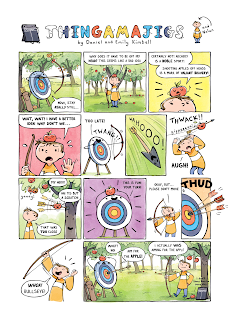
The last time I was visiting my grandchildren, I came across a comic strip they were looking at called 'Thingamajigs' by Daniel and Emily Kimbell. The strip appears in 'The Phoenix' comic and in it characters are animated versions of everyday objects.
From: 'Thingamajigs'
I was fascinated to read a comic whereby my thoughts on animist practices were being played out as children's entertainment. The use of anthropomorphism, the act of attributing human characteristics to nonhuman things, such as animals or inanimate objects, is an old one, and it has been revived for each generation in slightly different ways.
The Thingamajigs' comic strip
In my day I first encountered human attributes in non human form in Walt Disney's 'Fantasia', which was already over 10 years old by the time I first saw it in the 1950s.
From 'Fantasia'
In the scene above a flower becomes a swirling ballet dancer, spot-lit in the dark as if on stage. Also in Walt Disney's 'Fantasia', Micky Mouse, another product of anthropomorphism, is seen in action as the Sorcerer's Apprentice, a 20th century version of an 18th century tale.
From: The Sorcerer's Apprentice
In the animated cartoon, Micky is seen giving life to a cleaning brush, that he then directs to carry buckets of water for him. The film was in turn based on a poembyGoethe, written in 1797.The poem tells the tale of an old sorcerer leaving his apprentice with cleaning chores to do. Tired of fetching water in buckets, the apprentice then enchants a broomto do the work for him, using magic that he cant really control. The apprentice soon realises he cannot stop the broom because he does not know the right spell with which to stop it. The apprentice tries to stop the broom by attacking it with an axe, but each piece chopped off then becomes a whole new broom that takes up a pail and continues fetching water, but now at twice the speed. The entire room then begins to flood, but when all seems lost, the old sorcerer returns and quickly breaks the spell. This story is in turn based on one written 2,000 years earlier by Lucian. In the story, 'Philopseudḗs', literally, 'Lover of lies', the narrator, Tychiades, visits the house of a sick and elderly friend, Eucrates, where he has an argument about the reality of the supernatural. Eucrates and several other visitors tell various tales, intended to convince him that supernatural phenomena are real. Each story in turn is either rebutted or ridiculed by Tychiades. In this Greek version, the sorcerer is an Egyptian mystic and Eucrates his companion has learnt the spell for animating the inanimate by eavesdropping, but the basic structure of the story is the same.
This magic is concerned with the transfer or release of 'Élan vital', the vital life that Bergson argued was within all things not just the biologically active. The Animation Spell is in many fictional stories, a spell that enables sorcerers and sorceresses to bring any object to life.
Another story from my childhood whereby things were given human attributes was the fable of the North wind and the sun. This was one of Aesop's Fables, whereby persuasion triumphs over force. In the fable the sun and the wind argue over who can get the coat off a young man, the wind of course tries to blow it off, but the young man simply wraps it closer and closer around himself the harder and harder the wind blows. The sun and the wind cannot begin to argue with each other, unless we give them the power to do this, and I in turn would argue, as we do this, we release the mystical power of anthropomorphism.
The sun raises the temperature and the boy takes his coat off
We are social beings, and therefore we spend a lot of time building up connections between other people. This quality depends on trusting that others might in many ways act and think in a similar way to ourselves. But we do have to 'trust' in others, as we have no way of knowing what goes on inside other people's heads. This 'trust' can also lead to the anthropomorphising of non-humans. Just as we assume that other people are going to join in with us in the game of life, we can also have a belief that non humans might be able to operate in the same way. We give our pets internal voices, we talk to them as if we expect them to understand what we are saying. We also do this with inanimate objects; we implore our car to keep going, even though we know it can't hear us; we put trust in old tools and talk to them as if we were working with a dear friend. We attribute human-like qualities to inanimate objects, animals as well as our environments and the wider landscapes we inhabit. This can help us feel as if we are better able to understand and relate to the world around us. We are in effect always trying to socialise our experience, because being alone and unconnected to others is for a social animal a terrible thing. This way of understanding the world is something other social animals also possess. Young chimpanzees often carry around sticks and seem to play with them as if the sticks were other small chimps. This stick-carrying is a playful expression of cognitive abilities found in both chimps and humans, but in order for it to be meaningful there needs to be a capacity for imagination, or forming a mental image that is not real but which nevertheless represents reality. Anthropomorphising may be something that improves our wellbeing by creating a sense of connectedness.
The Pont des Arts that stretches over the Seine in Paris has long being used for lovers' pledges made in the form of locks. It was here that attaching padlocks became synonymous with everlasting affection. It is as if the locks can lock in or hold onto the love between people.
So many locks were attached to the bridge that eventually their weight brought a section down
The bridge is a testimony to the power of our ability to invest human meaning into objects and place externalised thoughts into inanimate things. It is now a very common ritual for couples from all over the world to declare their undying affection for one another by placing their initials on a padlock, fastening it to something and throwing the key away.
The practice has now entered the attentions of academia and it has been thoroughly researched and its history documented. An article in the Journal of Material Culture has traced the practice to a particular source.
'It was not until the 2000s that the structural deposition of a padlock took on widespread romantic significance. The likeliest trigger was an Italian teenage romance novel: Federico Moccia’s (2006)Ho Voglia di Te (I Want You), a sequel to Tre Metri sopra il Cielo (Three Metres above the Sky), in which characters attach a padlock to a chain on the Ponte Milvio, Rome. ‘This is “the lover’s chain”’, explains Gin, the main female character. ‘You have to put a padlock on this chain, lock it and throw the key in the Tevere.’ ‘And then?’, Step, the male protagonist, asks. ‘You never break up.’1 Step obligingly attaches a padlock and deposits the key into the Tiber. The phenomenal success of these novels and subsequent films, in Italy and Spain, led to Moccia’s (primarily teenage) fans imitating the custom, in a form of imaginative play that sparked a transition from popular culture to popular custom. By 2007, an assemblage of love-locks was fully flourishing on the Ponte Milvio, and tourists so readily adopted the practice that it became predominantly a tourist practice (Houlbrook, 2021).
From: Houlbrook, C. and Parker, A. (2020) Finding love: The materialities of love-locks and geocaches: The Journal of Material Culture: September: Volume 26 Issue 1
It is interesting therefore to find the same type of locks attached to contemporary Voodoo figures and African fetishes.
Mpungu figure. The Tervuren Museum
A contemporary ritual figure recently found being used in the Zaïre area, is locally called a mpungu, and is used by a nkanu or spirit worker to ward off evil forces. The object was collected recently from the frontier region between Lower Zaïre and Bandundu, near Angola. Padlocks accompany cloth, iron, cowries, herbs and mirrors. The figure was used to protect its owner from spells, curses or other maledictions. The padlocks and knots being symbolic barriers, barring all psychic routes to the owner and diverting or confusing the enemy.
In both cases, whether affirmations of love or ritual protection, inanimate objects are invested with psychic agency. Proof for myself that the making of art is somehow deeply interconnected to our need to use inanimate objects as intermediaries between the everyday and an invisible spiritual world.
Votive objects designed to deflect pain
From: Immaterial Disarray
The (im)Material Disarray exhibition gave me an opportunity to develop these ideas more fully and for the first time I was consciously trying to make objects that were animist in intent. These concerns were then developed further in the short story, 'Nest'.
An earlier post on why I have been making animist images focused on my use of a boyhood relationship with a Sooty puppet, but I'm now concerned to find more universal forms that can have a similar agency, so have been looking at ancient religious forms, especially those associated with 'magic'. For instance, the ancient Mesopotamians performed magical rituals to purify themselves of sins committed unknowingly.One such ritual was known as the Šurpu or "Burning", in which the caster of the spell would transfer the guilt for all their misdeeds into various objects such as a strip of dates, an onion or a tuft of wool.The person would then burn the objects and thereby purify themselves of all the sins that they might have unknowingly committed. It is the transfer of sins into inanimate objects, and the fact that once externalised they can be removed, that fascinates me and helps in the shaping of the wellbeing potential of the objects I have been making.
Ritual objects based on scorpions from pre dynastic Egypt
The objects above were used to help overcome pain. Because a scorpion had a sting in the tail, it could symbolise pain. It could also be used as part of a sympathetic magic ritual. The objects I have made allude to this, but I have also upped the intensity of the colour, making it 'more painful'.
'Thingamajigs' is a word that sits in my mind not that far away from the word 'tranculments'. Tranculments are things that we collect around us, like ornaments and the bric a brac that sort of mounts up gradually around the house, things that sit on top of furniture, that cluster around shelves and is a Black Country word from my youth, a word I got to know because we had a lot of tranculments in our house. We had horse brasses, ceramic Goss crested ware that consisted of souvenirs from seaside towns we had been to, Wade models of tiny dogs, Capodimonte figures and similar sorts of things such as framed sets of cigarette cards.
Horse brasses
Goss Crested Ware
Wade figurines
Capodimonte
Cigarette Card
I now find these things full of psychic energy and if I come across them in junk shops they talk to me with Black Country accented whispers. I now associate these things with my long dead parents, who collected them I believed at the time, as some sort of protection from the reality of life.
Perhaps my then intuition was not too far away from the truth. Perhaps these objects did have some sort of magical aura that blessed the house and protected those within it from harm. I spent many hours cleaning them, ritually laying them out on newspaper sheets on a Sunday morning and washing and polishing them so that they never became drab or dusty. Originally horse brasses had been used as charms or amulets to ward off evil and to bring good luck. In my parents' house they were hung on walls instead of on horses, but something of their original purpose somehow remained and worked to ward off evil, whatever that might consist of. When I was designing charms, I had these sorts of things in the back of my mind, the design below of a charm to ward off foot pain, is in effect similar to a horse brass.
Metal low relief foot charm used to ward off bunion pain