Tuesday, 17 September 2019

(im)Material Disarray: An exhibition

I've just de-installed my work from the (im)Material Disarray exhibition in Wakefield. This was part of 'INDEX' a fringe exhibition linked to the Yorkshire Sculpture International 2019 festival. I have recently been trying to deal with conversations I have been having with people about climate change and our need to find a new relationship with materials if we are going to survive the anthropocene* and this exhibition gave me a chance to try out some of my ideas of how to respond to those conversations in public.

*The current geological age, viewed as the period during which human activity has been the dominant influence on climate and the environment.

I was selected for the exhibition from a proposal I had put together which included drawings of what I was thinking about, but I hadn't at the time of putting in the proposal made any of the work. 


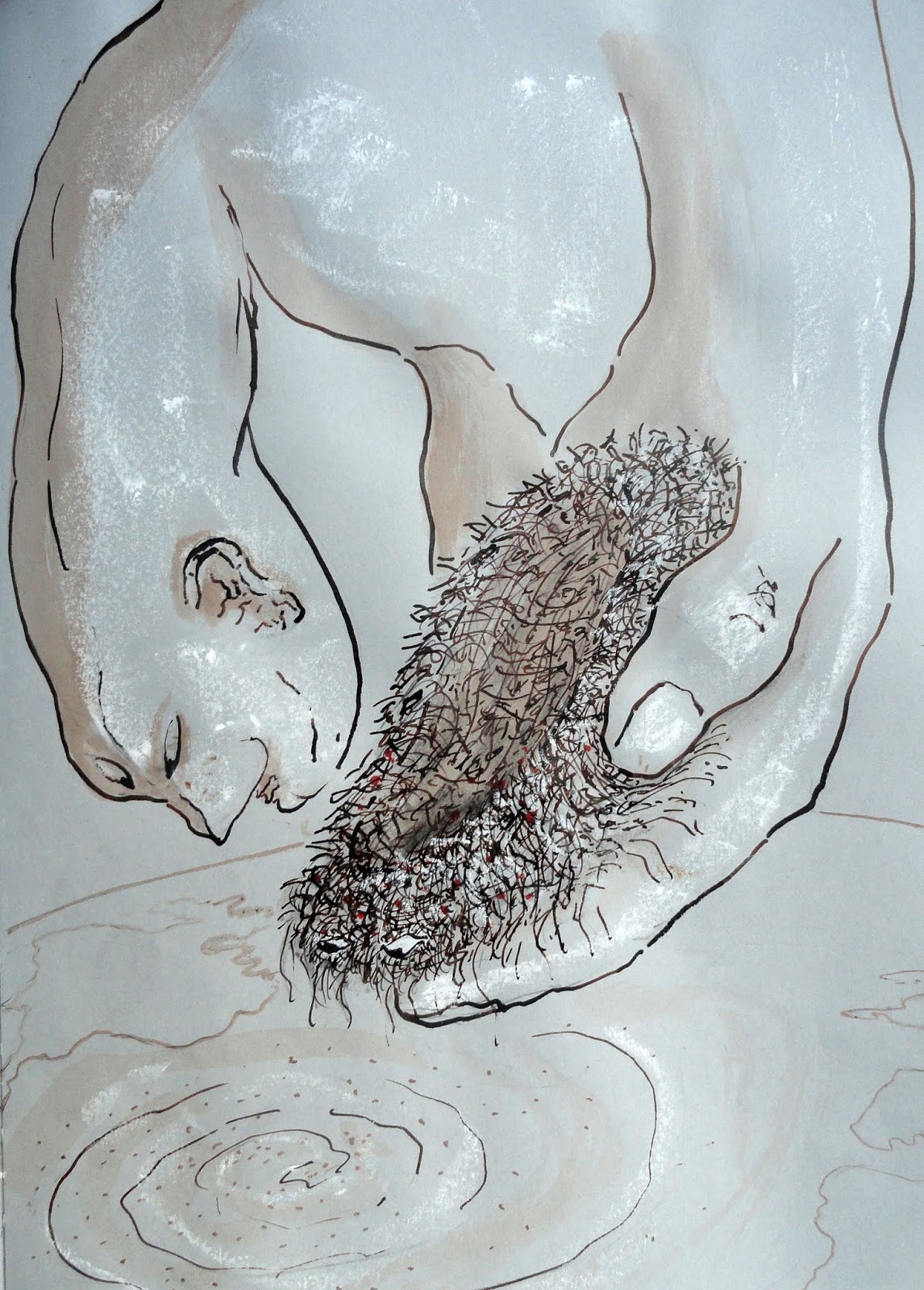
The two drawings above were done in my sketchbook whilst lying in bed in Paris recovering from a bout of sickness and diarrhoea. There was a vase of flowers in my hotel room and I began imagining what it would be like if it turned itself upside down and began to walk. I had been reading about how we don't ever think of inanimate objects as having 'agency' and these drawings were an attempt to visualise that idea but I didn't take them any further at the time. On getting back to Leeds I saw the (im)Material Disarray request for artists and as I knew the lead artist, I trusted that it would be an interesting exhibition and more importantly as the exhibition was about objects in disarray, saw it as a chance to work through some of my ideas about how to give inanimate materials agency. 
These are some drawings I did for the proposal.


I was thinking about hermit crabs as I made these drawings on grey paper and wrote this text as part of the application:


Recently almost everything made by human beings begins to feel as if it is in some way a dark, forbidding blight on the planet. What were until recently simple ‘man made’ objects, are suddenly not just manufactured things slowly becoming aware of their status as commodity fetishes, they are now ecological monsters of the anthropocene, lurking on the edges of our unconscious, reminding us of failed attempts of being kind to others, especially plants and minerals and those animals that are not human. 
Out of the corner of your eye, what was a simple domestic object may well be a growing Lovecraftian spore, something from chthonic depths that may or may not be living to two spaces at once. What was once right and wholesome is now upside down and manic, what was once a comfortable part of our home, now dark with desires that if not held in check will ruin us all, if it hasn’t done so already. 
These small creatures made from the detritus of domesticity, from cardboard, newspapers, left over rolls of tape, old toothbrushes, dead mobile phones and no longer used mugs, can clutter up the house like deformed gremlins. 

This series of objects includes ceramic elements embedded hermit crab like into domestic containers that are now more like creatures than objects, a hybrid series of forms that at times seek to be like humans but constantly fail to be so, they can shuffle into corners and lurk behind other objects, or organise themselves into a pack and when they do so, in large numbers they finally reveal themselves to be waste harbingers of doom. 

On acceptance I now I had to make the objects. 


The first ones I made were very like the drawings I had submitted, but quite quickly the making process began to take on its own momentum. I had piled into the studio as many old bits of rubbish, ends of tapes, lengths of wire, etc etc and gradually a language of objects began to take over from a language of drawing. 


I made several head type forms out of cardboard stuffed with newspapers and covered them in parcel tape. As extensions to these 'heads' began to be added, the concept became about materials trying to become human. For instance these objects needed legs to stand on and they had to find a point of balance to stop them falling over. This idea was reflected in the title for my work in the exhibition, 'Failed attempts at being human'. The work was eventually spread throughout the gallery, a series of objects placed amongst other people's work, positions chosen by the two curators, who were themselves considering how images of domesticity were being interrogated by the idea of (im)Material Disarray. In the exhibition two different conversations were woven together. The overall theme for the exhibition was a Feminist narrative centred on refusing the traditional roles of the domestic, my own contribution being more to do with waste and how it begins to have chthonic undertones and possibilities for new lifeforms to emerge. That's the interesting thing with curated exhibitions, work doesn't necessarily fit the theme exactly but in the deviation lies the fascination of other ideas seeping through and around the edges of the initial concept. Like all conversations, there is an element of unpredictability and that is partly why you engage with situations of this sort. 


A few images from the exhibition

Map of SNAPARTS gallery: each artist was given a number, I was 6

I was also working in ceramics, so the processes of drawing, building ceramics and making objects with rubbish became intertwined. One method would sometimes really challenge another and in the friction between the two I sometimes found a 'voice' for the materials.  For instance the 'face hugger' image above with three legs, was a result of using an old blue plastic bag filled with stuff I was going to throw away and noticing that a 'not working' ceramic left next to it suddenly seemed to become 'alive' in some way. The head eventually got in-between the bag and the ceramic but that just came through trial and error. 


Sometimes I would go back to drawing trying to work out an almost realised idea that was shaping itself through working with the materials I had found but was yet to quite 'get there'. The headscarf idea eventually made it as part of a very different object, (see 3rd image below) and the drawing immediately below was made when the object was not far from completion, and it was used to help me think about a few final issues which included a black slash of tape and the elimination of a stick 'antenna' from out of the top of the head. 


All sorts of objects began emerging, at one point to felt as if they had a life of their own and I didn't have to think about them anymore. 

Thinking about leaning forms


Exhibition photographs

It was at this point that I began to think about needing to deal with another aspect of what I was trying to do. These 'creatures' had emerged out of a need to find responses to conversations I had been having about how wasteful our society was and how we were despoiling the planet by using up resources and being unthoughtful. Although I thought the work in the exhibition would be interesting, I wasn't sure about how it was going to carry on the conversation, therefore when I had my proposal accepted I also agreed that I would put on something more performative on the first Sunday after the exhibition's opening. For this I had decided to tell a story. 
The story was developed around something I saw on one of my trips to Wakefield to get an idea of the layout of the gallery. I had spent time watching swans building a nest out of rubbish alongside the river Calder as it flowed past the Hepworth Gallery. The story became more and more elaborate as the time for the performance got closer and when I delivered it it had become a thing in its own right, something that was taking its own shape as a narrative. The performance went well and people seemed to be gripped by the story, but I realised it needed reshaping and writing again. 
What is interesting about the process of developing an idea is how different aspects keep coming forward and then retreating into the background. This all started with conversations and reading, the process then became about making drawings, then ideas about inanimate materials having some form of agency were opened out through writing, then drawings again, then making and letting materials speak for themselves, back into drawing and then into a spoken narrative and now it was becoming a written out story. All these things were aspects of one idea. No one element being more important than the other, it was about a series of inter connected events rather than the making of a number of art objects. 

As the story developed I started to visualise certain moments within it and so I found myself going back to drawing; drawing I suppose always being my default way of thinking. Below are some of the drawings now emerging which are directly related to the idea of a swan's nest made from rubbish mixed up with other flotsam and jetsam. The nest becomes sentient and travels from the rivers of England out into the sea, reaches the great North Atlantic gyre of plastic and eventually after meeting monsters decides to leave earth and go to the moon. It has now become a fable for children and I am working with someone else, this time someone who has worked as a writer and editor and I have decided to let the story go more and more into his mind and as I step back, I can see that it is metamorphosing into something new. This letting go is I think very important, we are a species that works collectively and the best ideas flow and shape themselves between us, at times we hold onto the baton but at other times people with different skills and ways of working need to push on and take ideas into directions you would never have thought about. 

These are some of the drawings done to help visualise scenes from the story as it develops. 


As you can see there is as yet no real coherence in the way these images are drawn, collaged or worked up as prints, all are simply ideas coming directly out of my head and onto the page, but that is always the exciting thing, not knowing what things will look like until they arrive. 
I don't use my own work very often to develop posts in this blog because it is about the wider issues of drawing. But on the other hand I have also begun to realise that it is therefore hard for any of you following these posts to get a practical idea of how drawing might work as a driver for my own ideas. This exhibition is now finished, the fable is still developing and the writer I have handed it over to is working on the final chapter, so that is coming to some sort of conclusion, it will then be decided whether or not I continue working on the images as illustrations for the book. 
In the meantime a very different exhibition opens this evening which I have been working on in print and ceramic, reflecting on conversations I have been having about the divisive nature of current politics and in the studio I am making large drawings in preparation for an exhibition opening at the end of October, again about a very different set of themes. Drawing though underpins them all and for me that is why it is so important and why I keep putting up posts encouraging the embracing of drawing in all its aspects. 


The end

As to the de-install, I separated all the objects into their various components, which were then bagged up and sent off to the recycling bin. 


See also other reflections on my work:


When the past overhauls the present Includes link to 360 degree view of exhibition
Drawing it all together
3D thinking Trying to use a 3D printer

Friday, 13 September 2019

Drawing elephants and other animals

Elephants fighting: 17th Century, Rajput: the Hada Master

If you told me I could own one drawing from all of the drawing collections in the world, I might well chose this one of fighting elephants from 17th century India. It is a wonderful drawing, has such rich content, is embedded in a real moment, uses the page in such an interesting way and above all is drawn so sensitively that the elephants are as alive and responsive now as they were 400 years ago. The dynamic writhing forms in the centre could almost be fighting squids. The straight spears of the soldiers/elephant controllers, stand on the edges of the square and take up the same visual weight as the geometrically drawn architecture. These spiky triangles of spears and architecture visually play off against the human protagonists who desperately try to keep the elephants in the frame. As a counterpoint, one of the drivers is leaping out of harms way while the other sits centrally in the composition as everything whirls around him. There is an economical use of colour too. Most of the paper is left uncoloured, but selected elements are carefully coloured in. Small patches of red and white pick out clothes and tusks and establish a secondary rhythm that riffs with the main one of swirling curves and helps us work our way to the edges of the composition and the straight edged brittle rhythm of the spears and building edges. It feels as if the elephants have knocked the buildings over; the architecture being so very insubstantial in comparison to the dynamic mass of the elephants; the construction lines of towers and walls falling away from each other, as the artist attempts to fit architectural space into the flat dynamic of elephant energy. Fine lines and dots mark out the elephant's texture, their skins are drawn lovingly as if the artist wanted to caress them, their bodies adorned in bands of red and white, as if they were dressed for a dance and not being prodded into mortal combat. The image below is another wonderful drawing from the same elephant series by the Hada master and within the Indian Rajput tradition these drawings have been very influential. 

17th Century, Rajput Drawing: the Hada Master

If you look at this drawing below from the early 18th century you can see how the influence was passed on. 

Elephants running: The Kota Master 1720

Artists like the Hada Master had a major influence on the development of painting in Kota, in both style and content, in particular the concept that that nature in many ways echoes human passion. In the drawing immediately above, the abstract shapes of the architecture are even more abstracted, but this time one elephant goes through a gateway, thus effectively being cut off at the knee. This time the elephant handlers have what appear to be burning torches on the ends of their poles rather than sharp prongs. The rhythm traverses the image from left to right and doesn't revolve around the centre as was the case in the Hada Master's more square image. Even so a life energy runs through the image and there is a sort of exhilaration in our recognition of what an animal of this size must be like when moving at speed.

An elephant combat: Black ink and charcoal with yellow highlights and white chalk on pounced paper 17th century


You can see the artist at work in the drawing above, the chalk drawing is reinforced by the ink drawing. As the image is found, it is sharped up and made ready for the next stage, which would be adding highlights and touches of colour, in a similar way to the images further above, but for whatever reason this never happened. 
Elephants would have been a common sight for Indian Rajput artists but would be a rare animal as far as western European artists were concerned.

While the Hada Master was making his drawings, it is fascinating to think about the fact that Rembrandt encountered elephants for the first time, however for him they must have been much more exotic. In my mind I like to think of these two artists working at exactly the same time, both watching their images arriving out of their hands' movements as much as out of their minds. 


Rembrandt 

The Hada Master knows what elephants look like, and is able to engage much more inventively with action and composition, but Rembrandt is still searching for form. He won't have seen elephants before and he needs to add them to his visual vocabulary. Rembrandt sensitively feels for the elephants' forms by touch. You can feel him tracing each individual elephant's mass as he mentally moves his hands over their various surfaces. These elephants feel as if they have minds of their own, there is something about the way Rembrandt has concentrated on the drawing around the elephants' eyes that makes these creatures almost human in their appeal. 

So what is it about these two different bodies of drawing that is so appealing to me? I think it's about empathy and love. These two qualities unite all these drawings, and whether the animals are part of a common cultural heritage or are new to the artist, they have been responded to with great respect, with a feeling for their 'animalness' and a sense of belonging to the same world as the artist. We feel that both the Hada Master and Rembrandt are also animals, animals that are looking at other animals and in that looking they recognise a similar sentient being. It is in these moments of recognition that philosophies are born and people decide that they are animist in belief. Because these drawings are made by hand on small sheets of paper, they are also gentle reminders of how humans create compacts with inanimate things such as inks and chalks and paper, an empathy with their materials that helps to communicate their feelings to others like myself 400 years into the future.

Joanna Bourke had this to say about the relationship that we have with animals; "In complex and sometimes contradictory ways, the ideas, values and practices used to justify the sovereignty of a particular understanding of ‘the human’ over the rest of sentient life are what create society and social life. Perhaps the very concept of ‘culture’ is an attempt to differentiate ourselves from our ‘creatureliness,’ our fleshly vulnerability". It is perhaps time to remind ourselves that we are animals, and one way of doing this is to spend more time in their company. 

Probably the most ubiquitous drawings of animals are those of cats and dogs. They are so common that we can forget how close the relationship is between ourselves and these domesticated creatures. Below are a couple of drawings by Gericault, a man who was obsessed with the problem of how to animate flesh and how to give to his drawings and paintings a living reality, something he could only accomplish by spending time in the company of animals. 


Gericault a sleeping dog and cat studies

Our observations of animals have become more and more lens based and when thinking about looking at animals we tend to turn to filmed documentary as the medium of choice. This format can however be approached in new ways and with interesting consequences. In 2004 Francis Alÿs made the video 'Nightwatch', which followed the movement of a fox through the National Portrait Gallery. By bringing the static images of dead people together with the live movements of a fox, Alÿs allows us to meditate on our relationship with nature. The fox is so alive and the art on the walls is so 'dead', nature invades culture and as it does it reminds us of how wonderful every creature is. This is perhaps the paradox of all art, in making it we struggle to recreate our experience of life, but as Pygmalion (especially in Edward Burne-Jones' vision below) discovered, art is never quite like life, always at one remove.  


Francis Alÿ: The Nightwatch

Edward Burne-Jones: Pygmalion 

The drawing by Burne-Jones above is a very poor one, it is so lifeless, the artist Pygmalion rests his chisel on a totally inert figure of the sculpture that is to become Galatea, a figure that in this drawing you don't feel could ever come to life no matter how magical the situation or how supportive the Goddess Venus was being and if it did, it could never have wit or humanity. 

See also:

Why draw animals
Indian aesthetics 
Monkey, pig, dog, rabbit and horse

References

Steve Baker (2000) The Postmodern Animal  London: Reaktion Books
Joanna Bourke (2011) What it means to be human London: Counterpoint press