Sunday, 13 June 2021

Nancy and drawing

Ernie Bushmiller: Nancy Dec: 1956

I was just 6 years old when this Nancy cartoon was published, but Nancy had already been going for 12 years as a stand alone cartoon strip. I was always fascinated by any sort of drawing as a boy and Nancy cartoons were in there with the best of them. However as I got older I began to see them as something almost akin to a type of visual philosophy. 

Then I got older still and found out that other artists had also seen Ernie Bushmiller’s Nancy as a philosophical conundrum. Bill Griffith had this to say about Nancy, Peanuts tells you what it’s like to be a child. Nancy tells you what it’s like to be a comic strip.” Paul Karasik and Mark Newgarden have written a book on Ernie Bushmiller’s work, 'How to read Nancy'. They point to the comic strip's three-panel minimalism and compare its underlying aesthetic philosophy to the “less is more” architect Mies van der Rohe. They state that every element in a “Nancy” panel adheres not to a comic strip but rather to “the blueprint of a comic strip.”  Everything in a Nancy panel is in crucial service to the gag, free of the fussiness of embellishment. The Zen-like nature of some of the Nancy panels has been commented on by Art Spiegelman, Scott McCloud and Bill Griffith, who has recently been producing a book on Bushmiller’s work.  The 'Three Rocks' issue is of particular fascination. Scott McCloud quotes Art Spiegelman in his rules for the card game “5-Card Nancy”; “Art Spiegelman explains how a drawing of three rocks in a background scene was Ernie’s way of showing us there were some rocks in the background. It was always three. Why? Because two rocks wouldn’t be ‘some rocks.’ Two rocks would be a pair of rocks. And four rocks was unacceptable because four rocks would indicate ‘some rocks’ BUT IT WOULD BE ONE ROCK MORE THAN WAS NECESSARY TO CONVEY THE IDEA OF ‘SOME ROCKS."

Three rocks in action

Scott McCloud has this to say; 


"Why Nancy? 

Ernie Bushmiller's comic strip Nancy is a landmark achievement: A comic so simply drawn it can be reduced to the size of a postage stamp and still be legible; an approach so formulaic as to become the very definition of the "gag-strip"; a sense of humour so obscure, so mute, so without malice as to allow faithful readers to march through whole decades of art and story without ever once cracking a smile. Nancy is Plato's playground. Ernie Bushmiller didn't draw A tree, A house, A car. Oh, no. Ernie Bushmiller drew THE tree, THE house, THE car."

As well as the three rocks, if you look at the cloud and the two trees in the panel above you can see why people philosophise about Bushmiller's comic strip, that cloud and those trees are sort of numb, an ontological* image of a cloud, or of a stand of trees but no more. 

It is said that invention often arrives out of boredom and perhaps that's part of the Nancy mystique, because there are no visual extras, we are left with a space for the mind to fill. 

Philip Guston: Book

I sometimes wonder whether Philip Guston was a Nancy fan. His 'Book' is pretty much to the point, although Bushmiller would have avoided the pink and the book would have had somewhat sharper edges. 

Nancy's book

This is however Nancy's book not Bushmiller's, but I think the point is made. Art doesn't imitate life, it extracts from it and simplifies it and that simplification allows us to think about the very life that has been simplified, because real life is far too complicated to think about. 

*Ontological from ontics: A branch of metaphysics dealing with the nature of being. Ontic: Greek: "Of that which is".

See also:


Tuesday, 8 June 2021

Graffiti and the Colston statue

The Statue Of Edward Colston

The statue as displayed in the current exhibition

On the 7th of June 2020 John Cassidy's statue of Edward Colston, a 17th century slave trader, was pulled down by an angry crowd and thrown into the river. The statue had already been graffitied in earlier attempts to respond to its implications, and when it was fished out of the water the damaged statue became a problem for the city. Should it be put back or not? The statue has just been put on display, but this time as part of an exhibition designed to ask questions as to its role and whether or not it should ever be re-erected. The exhibition however has come in for criticism from the right-wing media for the way the statue is presented, lying down on its back and still covered in the graffiti that had been daubed on it. 

I have looked at graffiti as a street language in an earlier post and we could have no better illustration of the division between low and high class values as in the relationship between the visual language of the statue; cast bronze and an idealised three dimensional realism, and the visual language of the graffiti; spray paint, pooling colour that collects in indentations and the traces of hand gestures rather than any attempt at representation. Colston was initially celebrated in bronze and set up on a plinth above his fellow citizens because of his philanthropy. The received narrative is that he was elevated to this position because he devoted his later life to good deeds within the city of Bristol. Elevated is a good word to use in relation to a statue like this, the bronze itself is 8ft 8 inches high and the plinth is 10ft 6 inches high, the head of Colston therefore looks down from a commanding height of over 18 feet above the ground. Around the sides of the plinth are two scenes from Colston's life and a third image of a maritime fantasy. A plaque on the south face bears the words "Erected by citizens of Bristol as a memorial of one of the most virtuous and wise sons of their city AD 1895" 

Most of the spray paint was applied to the statue before it was toppled, therefore someone must have climbed up to it in order to do this. This physical act is itself a sign of challenge, the plinth is meant to keep people at a distance, a distance that was overcome by the act of climbing. The toppling signifies the taking of resistance to what the statue represents one step further. The graffiti preparing the crowd for action, the statue already defaced, its presence reduced by the act of marking it, therefore its power was compromised and it was in effect already brought down to earth by being touched by the language of the streets. 

Colston's prestige in Bristol was not what we think it was, or have been encouraged to believe. The notion that the erection of the statue in 1895 was undertaken because of popular support for his philanthropy is hard to sustain. The £1,000 that was needed to pay for it was very hard to come by, the final amount only reached after the statue had been unveiled. The original proponent of the statue J. Arrowsmith, eventually covered the cost. Arrowsmith belonged to a group of Bristol businessmen for whom Colston represented an idea of respectability and self-made wealth.  He also represented an idea of rich paternalism which could be looked to as a bastion against the rise of socialism and private charities. The slavery on which his fortune was built was obscured for the purposes of creating a certain heroic narrative of Bristol's history and as a smokescreen behind which could be hidden the inequality that meant that Bristol, like so many cities in England at that time, was sharply divided between the haves and the have nots. 

I have been looking at the continuing importance of ritual recently and the ritual commemoration, celebration and memorialisation of Edward Colston was crucial in the communication of a 19th century concept of Colston that legitimised capitalist individualism, both morally and economically, as a political system. Colston was also used as a symbol for the right of limited but sustained private relief organised and distributed by those considered the city’s moral and economic leaders, thus cementing the authority of the rich to not only determine who had money and who didn't but that the rich were in some way given almost divine status as 'benefactors' of their poor brethren. It was around this constructed symbol that the rich merchants at the time then constructed rituals similar to those we see in the masonic tradition, rituals designed to re-affirm their powerful position within the city. The ability to depict Colston as both ‘merchant prince’ and ‘moral saint’ was thus central to the perpetuation of 19th century capitalist ideals. If you want to read the details research the work of the Bristol Radical History Group.

So we have agendas within agendas. Many of the people protesting against the toppling of the statue stated that Bristol needs to retain its history and that times and therefore values change, but no one as far as I can remember, stated that the statue was erected to serve a particular purpose, in that it was designed to become the centre piece around which certain rituals could be developed and enacted, rituals that gave 'divine' authority to a group of rich white merchants and that the statue was a political construct erected long after the actual events of Colston's life and not a celebration of Colston's philanthropy by the common people of Bristol. The problem is that history is something we can all mine in order to support our own agendas. 

It has also been quickly forgotten that soon after the toppling the artist Marc Quinn had erected a sculpture of activist Jen Reid to take the place of the slave trader's statue. Quinn had his statue secretly installed overnight on the plinth, an action that quite rightly drew the ire of virtually every political spectrum out there. Quinn had forgotten that the issue was all about power and who has the right to exercise it. By taking it upon himself to make a decision as to what sort of representation should stand on the plinth, he was exercising his own power as a well known artist, and as he is white, middle class and male, he was seen as providing yet another example of those with power, taking their power for granted. Quinn's action was paradoxically in many ways reminiscent of Arrowsmith's. Both men wanting to have statues erected that celebrated their own status, both men looking for a subject that could be read in terms that would by association celebrate themselves and their own agendas. 

The exhibition of the rescued statue can only be attended if you book a timed visit with the museum. These sessions have it appears been block booked by those that want Colston's stature resurrected where it was before. They don't like the idea of the re-presentation and intend to stop anyone else experiencing it; so much for letting the people of Bristol access their own history. Instead of standing over 18 feet high, Colston is made to lie horizontally in such a way that people can get up close and examine the statue and its graffiti. The most powerful visual signifier being the red paint that covers the statue's face, which felt to myself as if the blood of the dead had come back to haunt him. So who's history are we to celebrate? Colston's, Arrowsmith's, the unknown graffiti artist's, the people of Bristol? The conservators have reported that the statue is structurally damaged, so it would require extensive repairs if it was to be returned to its plinth. 

There is though another issue for us to consider, and that is how powerful body metaphors are. By simply taking something that was standing up and not just standing up but standing proud and re-presenting it in a lying or horizontal position the meaning has changed completely. At various times this blog has asked its readers to rethink how work is presented and it has also argued that a re-presentation can be more meaningful than the work itself. The arguments surrounding the Colston statue illustrate the point really well, we feel as if the fall of the statue and its post-fall recumbent position embodies a deep truth, that of an active youth being overtaken by old age and then death. That is the deep metaphor behind it all. One set of values are now becoming redundant and different values are taking their place. This is of course unsettling, especially if you see yourself as belonging to a group of people that still cling on to those old values. 

Read from left to right a horizontal line rises and becomes a vertical line. This basic element of visual language is related directly to our own experience. We lie down horizontally when tired or ill, we rise and stand up straight when awake and feeling confident and healthy. If we are lying down for a long time without ever attempting to raise ourselves up, it may well be that we are dead. 

Communication theory suggests that we examine who communicates what to whom, in what channel and with what effect? When undertaking any form of analysis it is also suggested that you compare and contrast a similar situation that is different enough to allow you to illustrate salient points. So I have decided to look at how John Cassidy's Colston's statue of 1895 and Duchamp's 'Fountain' from 1917 have both been used to communicate ideas. 

These objects were put on display only 22 years apart, but one was in Bristol and the other in New York. Both objects were cast, one in ceramic and the other in bronze, both objects were intended to make a point and both objects have been subjected to considerable changes in their perception over the years since their making. 

John Cassidy's work was commissioned by a group of the great and the good of Bristol, this commission was part of a long term falsification of Colston's life, which included spiritual transformations and miracles such as rumours that samples of Colston’s hair and nails had been secretly conserved and were worshipped by the Society of Merchant Venturers in the Merchant's Hall, like medieval religious relics, and the ‘miracle’ of the Dolphin that saved one of Colston’s ships in a storm by plugging a hole in the hull with it’s body. The unpalatable aspects of Colston’s history, such as his leading role as an organiser and profiteer in the slave trade and his religious and political bigotry, were ignored and whitewashed away. 

Duchamp's work is similarly surrounded by stories of falsification and begins its journey at the behest of a committee. The Society of Independent Artists was based on the Parisian Salon des Indépendants and Duchamp was a founding member. All submitted work to the society's exhibition was to be accepted and Duchamp tells a story that he submitted 'Fountain', a urinal signed R. Mutt as a test to see whether or not the rules were being adhered to. However there is another story. Glynn Thompson argues that all the evidence suggests that the urinal was the work of Baroness Elsa von Freytag-Loringhoven. The urinal it is argued by Thompson and Spalding is in fact the world’s first great feminist, anti-war work of art. The art world has persistently refused to acknowledge this, especially because so many ideas and concepts that are central to the idea of contemporary art practice are focused on a post-Duchampian narrative. 

Duchamp 'Fountain'

Both works are externalised ideas, examples of the extended mind concept. Their physicality allows us to think about ideas in ways that allow for their appropriation through ritualisation. The statue of Colstan was used by Arrowsmith and other members of Bristol's civic and business elite as a symbol of civic pride, in particular a pride in business and individual achievement and in paying for the erection of a sculpture, it also demonstrated their good taste and the passing of that taste onto the people of Bristol. The fact that it is Andre Breton that begins to develop a new narrative for 'Fountain' in the 1930s shouldn't be forgotten. Breton was a member of another elite, the European art intelligencia and his idea that 'Fountain' was one of the earliest examples of a found object, fitted in neatly to his other ideas about mundane, mass-produced objects developing new resonances when arranged in unprecedented configurations. The surreal object is a very close relative to the found object. Both suggest that meaning is something that is very tenuous and that what was once an object anchored to a particular use value, such as being something to urinate into, can by changing its context become a nightmarish vision emerging from the subconscious mind or a piece of sculpture. The object in this case representing the clever ideas of a certain group of intellectuals who were seeking to validate their own positions within a newly developed art world. 

In the same way that Colstan's role as a slave trader was forgotten, Baroness Elsa von Freytag-Loringhoven's role was forgotten too, women were not yet ready to be taken seriously as artists by the art world.

Baroness Elsa von Freytag-Loringhoven

The effect of both works was to establish a myth. One myth was the benevolence of a businessman who was a great benefactor to his city, the other a myth about art and its ideas and that the artist's 'choice' was central to art practice. Both in their own ways celebrate myths of male individuality, the idea of the lone genius entrepreneur being as applicable to businessmen as to artists.  

So once again we come back to power. People trying to maintain it, people trying to deny others the right to have it and people trying to establish their credentials as holders of power and their rights to then take actions dependent on the power they have. 

The pulling down and dunking of Colstan's statue is perhaps not that dissimilar to the 'outing' of the provenance of 'Fountain', both acts signifying a shift in dominant discourses. 

I have tried to write this entire post without mentioning 'Black Lives Matter'. Of course this is central to the argument that there needs to be a shift in dominant discourses. It is difficult to accept that a man who made his money by being a slave trader is put on a pedestal in a city that also hosts a large population of Afro-Caribbean people for whom slavery and its bleak and terrible history is central to their personal history and identity. However I have tried to work around the edges of the issue, not as if it is the elephant in the room, but in order to explore how ritualised activities can embed themselves into all our lives and especially how these rituals need objects around which to focus and develop stories. Sometimes we need to focus on the mechanisms of communication, and as we do, we find that the content of the communication begins to reassert itself. It is finally up to us as artists to make decisions as to how we use this awareness. 

A new ritual begins

Thursday, 3 June 2021

The mark of ritual

14th century carved crosses on the walls of the Chapel of St. Helena

Thousands of tiny, "medieval" crosses are carved into the walls of the Church of the Holy Sepulchre in Jerusalem. Masons or artisans carved these crosses, probably on behalf of pilgrims, who it is argued, kept the dust from each carving as a relic or sacred souvenir. What interested me in this work was the importance of the dust removal. When carving any dust is usually regarded as waste, but in this instance it is the carvings that are the remainder, the dust being central to an important ritual. This ritual gives the dust honorific value partly by it coming from a very holy place, (inside the Church of the Holy Sepulchre is the hill of Golgotha, the site of Jesus’ crucifixion, as well as the Tomb of Jesus, where he was buried and from which he arose from the dead) and partly by it being generated by the activity of carving a cross. The making of a cross was a vital sign of not just being a Christian, but of the 'truth' or 'veracity' of one's actions. In this case each pilgrim was engaging in a ritual that resulted in their being able to take away a physical memory or talisman of their experience. I'm interested in these ritual actions because I have been making small ceramic 'votive' type objects and looking at the moment of 'transaction' between myself as a maker and the individuals that have a vested interest in thinking of these objects as externalised feelings or concerns. 

Foot votives

The ceramic foot votives above were eventually turned into candles, their insides filled with wax and wicks inserted, so that a nighttime ritual could be developed around the idea of lighting someone's way. These feet were made for someone feeling 'lost', the foot candles giving that someone an excuse to punctuate their day with a moment's reflection, the feet representing both themselves and others, and being a reminder that in many ways we are all lost and seeking the 'right' path. 
A votive made for someone with bad eczema 

Sometimes votives were made in direct response to a physical pain or affliction, as in the one above. The important issue was however how an individual used their relationship with the votive to 'solve' their particular need. For instance they might bury it, smash it, give it to someone else or put it on display. Once the thought, idea or feeling is externalised, it can be 'done to' as you would any other thing out in the world. 

A kintsugi repair

Kintsugi, relates to another type of ritual action that can be embedded into life. In its original form pieces of broken ceramic are put back together and repaired using golden lacquer, these repaired ceramic bowls becoming a reminder that what might have been an accident or flaw, could now be even more meaningful, as kintsugi converts what was a weakness into a strength and like the Kula exchange, as an object is given to another or has another action embedded into its history, it becomes more and more valuable, not in monetary terms but in emotional significance. This idea is reflected in the bowls chosen for Japanese tea ceremonies; bowls with imperfections are revered for their beauty and may be chosen over and above a bowl that is aesthetically beautiful, but without a lived experience. 

Mizuko kuyo: A ritual figure 

There is a Japanese Buddhist ritual that is designed to help people mourn miscarriage or an abortion. The ceremonies begin with the making of a token, like a bib or a necklace, which you then put onto a Jizo or child saint representation. Jizo statues in Japan often look childlike and as you make an offering to the statue, you're also making an offering to the child's spirit that the statue in a way represents.  A monastery garden may be filled with hundreds of often moss-covered Jizo statues, each one wearing a bib or bonnet token. The gardens represent the enormity of loss that these events have meant to people. These rituals are not available to everyone and I'm very aware that when faced with a similar situation many years ago I wish I had had an outlet for my grief, but there wasn't any.

One of the roles of art has always been to help with a coming to terms with the bigger picture. We have however in a secular society perhaps forgotten how to embed ritual into our daily life. We all used to have to say a simple prayer, 'For what we are about to receive may the Lord make us truly thankful' before every meal, as a reminder of how lucky we were to have food on the table, but this was in a time just after the war when food had been scarce and rationing was still in place. If we don't stop and have those moments of reflection, we begin to take everything for granted, and this has led to a difficult present whereby we have many luxuries but very few reasons to feel connected to a deeper vision of the world, one whereby we feel inextricably part of the natural order of things. 

Historically the arts functioned to provide an emotionally felt and transcendent means of establishing contact with things beyond human understanding, often by creating an externalised visualisation of inner feelings or concepts, visualisations that could then be used during communal ceremonial rituals. Artists are still making externalised visualisations of inner feelings, but our very individualistic society has somehow lost its way and the communal ties of agreed communication are hard to see. But ritual does still happen, if we look at roadside temporary memorials or shrines, or the outpouring of grief that was written on the walls in relation to the Grenfell Tower fire, we see the need for ritual events and how some form of physical object needs to be used as a focus for them. 

Roadside memorial

Grenfell memorial wall

There are though small rituals that are perhaps just as important in relation to our individual engagement with life. Roger Ackling's meditative mark making, whereby he used a magnifying glass to focus sunlight and make scorch marks on found pieces of wood, celebrates the central power of the sun in all our lives, his small controlled gestures still resonate and when we look at his work, especially if you are allowed to hold them in your hands as you do so, we are reminded that small repeated gestures can be very meaningful. (Think of how we use rosary beads).

Roger Ackling: Sun histories: sunburnt wood

Mudrā

Small rituals come in many guises and perhaps the simplest and most effective are those gestures that we make with our hands. For instance the hand gestures or mudrās in tantric rituals can be used to construct a complete symbolic world. In Buddhist and Hindu traditions rosary beads are called mala. They consist of 108 beads that represent the 108 human passions or sins that must be overcome in order to reach enlightenment. Touching the beads reminds the user of each different passion and the ways you might confront that passion and go beyond it. The beads are another way to externalise an idea and you could theorise this use as an extended mind concept, the beads becoming a substitute memory organ. 

Many of us perform private rituals without realising that we are performing them. Perhaps metaphorically touching a piece of wood to ensure good luck, keeping our fingers crossed or not stepping on cracks in paving stones, these very basic ritual activities give meaning to daily activities and in their repetition these simple acts gradually acquire more forcefulness. However, what begins as a basic response, can over time become obsessive. People can find themselves silently repeating special words, repeatedly touching certain things or images, or counting and re-counting numbers. Obsessive compulsive disorders are perhaps not far away from private rituals, but all these things are part and parcel of being who we are and how we operate and as such they can be an entry into the way we think about how the making of art can have meaning. In this case I am suggesting that all art objects may work in a similar way to these objects of ritual, they are externalised ideas, ideas made concrete or materialised and as such they become extensions of our minds, extensions that allow us to see what we are doing a little more clearly or perhaps allow us to re-embody, hold on to or digest ideas by making body metaphors into realities.  

See also:


Monday, 31 May 2021

Responses to the fragility of being alive

The lockdown in England is beginning to ease and as we all begin to emerge blinking into the sunlight, it is going to be very interesting to see how artists have used drawing and other practices to think about the situation they have just experienced.  I know that it has been a subject many of the students I have been working with have taken on board and as a subject I suspect it is going to be with us for quite some time yet. 

Szu-Han Ho has been thinking about making devices to help people cope with the fact they are not allowed to touch anyone. By making the drawings out of little scraps of material she is able to heighten the feeling of fragility and unworthiness many of us began to have as time went on and we began to yearn for a time when you could just simply hug someone. My grandchildren live in Scotland and I've not been able to see them in the flesh for a year now, so I found these little fragile images particularly poignant.  

Device for Hugging, COVID19

Device for Bingewatching, COVID19

Device for Spooning (Big Spoon), COVID19

Szu-Han Ho has done some very interesting work and she is a good example of an artist that can respond to life as it emerges from fiction as well as real life situations. I have read far more this last year than for a while and this may be the case for many of us, if we cant go out and have real life experiences we have to get our stories from somewhere. 


In the work above she has responded to a page in Robinson Crusoe and constructed a simple series of platforms for two groups of singers to stand on. When the piece is working, the two groups sing a call and response refrain using Defoe's text. Many people have felt devoid of all hope during this past year but they have pulled through, and solace in books and the sound of choirs has often helped in that process.

Taking something from the past and reimagining it is something I suspect many of us have done this year. 

Dario Robleto | Body as Data


Dario Robleto talks about his work

We have had to look at graphs and listen to statistics about bodies every morning, evening and night this past year and we can forget that amongst masses of data for every point on a graph there is a real human being having a real traumatic reaction to something that is totally and hugely significant to that individual. Dario Robleto tries to remind us of this by returning to images made of heartbeats during the late 19th century. 

Jonathan Borofsky's 'Heartlight' 1991

Robleto's work reminded me of Jonathan Borofsky's 'Heartlights' the first of which I saw in Barcelona in 1992, these sculptures sent out an audio and visual transmission of his heartbeat and as you stood in front of one you felt your own body attune to the constant rhythmic beat and visual flickering. Borofsky's 'Heartlight' is still one of the most powerful self-portraits I have ever come across, somehow you were sucked into his actual body; levels of empathy were raised incredibly high simply by experiencing someone else's heartbeat so intensely. 


Rafael Lozano-Hemmer 'Last Breath'

Rafael Lozano-Hemmer's work is always interesting. I remember seeing a wonderful installation of his in Venice, whereby he had the ceiling of a large space covered in light bulbs, an on and off pulse was being carried from one light bulb to another. When you reached the other end of the space you had just walked through, you were directed to climb up to a dais and hold two electronic sensors that were used to calculate the rhythm of your heart beat, this rhythm was then passed on to a light bulb right above your head, gradually the rhythm was passed on to other light bulbs until you lost sight of your own pulse amongst all the others. However the work that for me holds most resonance in relation to our current situation is 'Last Breath'. This is an installation designed to store and circulate the breath of a person forever. A brown paper bag inflates and deflates automatically due to a motorised bellows similar to those found in artificial respirators in hospitals. The apparatus hangs on a wall and is activated 10,000 times a day, the typical respiratory frequency for an adult at rest, and it punctuates this relentless series of breaths with an occasional sigh, 158 of them a day. Each stroke of the machine advances a digital counter that beeps. The breath circulates between the bellows and the paper bag through a ribbed transparent plastic tube that emits a faint and hypnotic low sound, whilst the paper bag makes a rhythmic crushing sound as it inflates and deflates. The first copy of the piece stores the breath of Cuban singer Omara Portuondo; so that after she dies people will be able to still experience her "Last Breath". 
I'm sure that once the pandemic crisis is over we will find that some wonderful pieces of art have been made in response to it, but what the best work does is to transcend the particular situation and to find something of universal significance. 

See also:


Saturday, 22 May 2021

Unica Zurn

Unica Zurn

Unica Zurn is one of those artists often left out of the story of modern art, because they are thought to be of secondary significance or and this is often the case, left out because they were women, and the people who were controlling the construction of the canon were men.

Unica Zurn and Hans Bellmer 

Zurn was at one point Hans Bellmer's partner and she encouraged him in his erotic sado-masochistic ventures, allowing herself to be bound and photographed in poses very like those taken up by his dolls. 
Image of Unica Zurn tied up by Hans Bellmer 

These images of Bellmer's would be unthinkable without Zurn's participation and they sit very awkwardly in the history of Surrealism, because they are very real and in their reality they make us uncomfortable. In some ways they prefigure the work of Jenny 
Saville. In the mid 1990s she collaborated with photographer Glen Luchford to produce a series of photographs in which he photographed her from below lying on a sheet of clear Perspex. Her body was pushed, stretched and squashed, Saville transforming herself into a sculptural form that was constantly being moulded and re-made.

Jenny Saville: Closed Contact, 1995-6,

However Saville is in control of the presentation of her images and Zurn was often unacknowledged when Bellmer's photographs were exhibited, her name gradually disappearing from view even as Bellmer's own was being etched into the canon of modernism. 

However Zurn was also an artist in her own right and she had a convoluted relationship not just with Bellmer but with Henri Michaux with who she experimented with hallucinogenics as well as having an intense affair. She was it seemed someone who was vital to both Bellmer and Michaux's ability to function, her intensity and open nature, gradually though slipping into mental illness, especially after her drug taking period when she was first having a relationship with Michaux. In an essay he wrote in 1957 Bellmer had this to say about his relationship with Zurn. 'A man in love with a woman and himself... is in a peculiar hermaphroditic interconnection between the male and female principles in which the female structure predominates. What is always vital is that the image of a woman must have been 'lived' (experienced) by the man in his own body before it can be 'seen' by the man'. Bellmer was in effect lost in her image, an image Zurn was very aware of as being something she had been playing with and constructing for several years; her explorations into repressed desires, nightmares and the subconscious, emerging in both literary form, such as in her novel, 'The man of Jasmin and other texts: impressions from a mental illness' as well as in her visual depictions of other worldly creatures. 


Untitled 1959

Unica Zurn

We seem to have come a long way since the 1950s, the struggle to maintain a separate identity as a creative within a male dominated society must have been not just tough, but destabilising as she was used as a 'muse' and in effect a 'stage prop' for an artist who's career at the time was failing. There is something about the way her drawings of heads inside heads swirl around themselves as if swimming in their own space, that still resonate as images of a human being searching for a connection with the world around her; perhaps intuitively she was more in touch with the world than she or the male artists that surrounded her ever knew. 
I have been looking at her work as an indicator of how to tap into an more intuitive way of visualising the body and in particular I have decided that her drawing 'Untitled 1959' is a possible way for me to visualise Markov blankets, more on which I shall dwell on in a future post. 

See also:


Tuesday, 18 May 2021

Diagrams: Visualising the invisible

Diagrams are powerful things. They have a certain conviction about them that not only helps an idea become clearer, but makes it believable. I'm convinced by Descartes' 'Vortices' below as an image because I've also seen diagrams of how magnets work. Descartes' model of the universe was drawn up in 1644 and was based on his idea that there were invisible whirlpool like forces that moved the planets. These forces, he argued, were composed of some sort of ethereal liquid like matter. His diagram looked at 350 years after it was first drawn, reminded me of those wonderful images made by bubbles as they cling together.  

Vortices: René Descartes

Bubbles have often been used to think about hypercubes, which is another idea that is very difficult to think about without a diagram. 

Bubble visualisation of a hypercube


From one to two to three to four dimensions

The mathematical reality of the hypercube

An alternative view

A hypercube is though at least theoretically justified and as an idea it rests firmly in the realm of a reasonable possibility. But what about those diagrams of things that are the products of a fevered imagination? I find these just as interesting, perhaps even more so, because what they are doing is making the invisible visible. 


Grant Carlin

These diagrams above come from the artist Grant Carlin's website, he is building an imaginary universe, that has its own laws. There are people who have powerful imaginations and a diagram will always help those imaginations actualise themselves. 

Helene Adelaide Shelby: Apparatus for obtaining criminal confessions

Helene Adelaide Shelby's diagram is less fantastic than Grant Carlin's but in many ways stranger. The idea was to have criminals interrogated by a skeleton, it would have had glowing red eyes and a spectral voice, its operator hidden behind a wall. I was trying to research 'visualising the invisible' and came across her idea by chance. It reminded me of all those thousands of diagrams in patent offices all over the world, many of them never realised, like some sort of psychic energy banks, all waiting for that moment when they will be released upon the world in their full manic glory. 

I have been back making diagrams myself, trying to visualise how a particular topographic space could be envisioned, a way of thinking about the body and the spaces it occupies at the same time. It is an interesting process, how do you rethink the way the continuous surface of the body, (think of how the skin gradually flows into the mouth or into your anus or down into a nose or ear), can be understood? Could it be like a Klein bottle? If so how does it relate to more extended spaces? 


From a sequence of diagrams illustrating how interoception can morph into exteroception

These diagrams have their roots in René Descartes' Vortices, diagrams that show how to use vectors to visualise changes in a fluid, as well as Faraday's lines of force, but perhaps their real ancestor is Uccello's perspective study of a mazzocchio. Artists and scientists are always trying to re-visualise how to think about bodies in space. 
But I'm also thinking of cages and traps, which is why I think Shelby's diagram interested me. However, could a cage become a hypercube? 

Cage or trap?

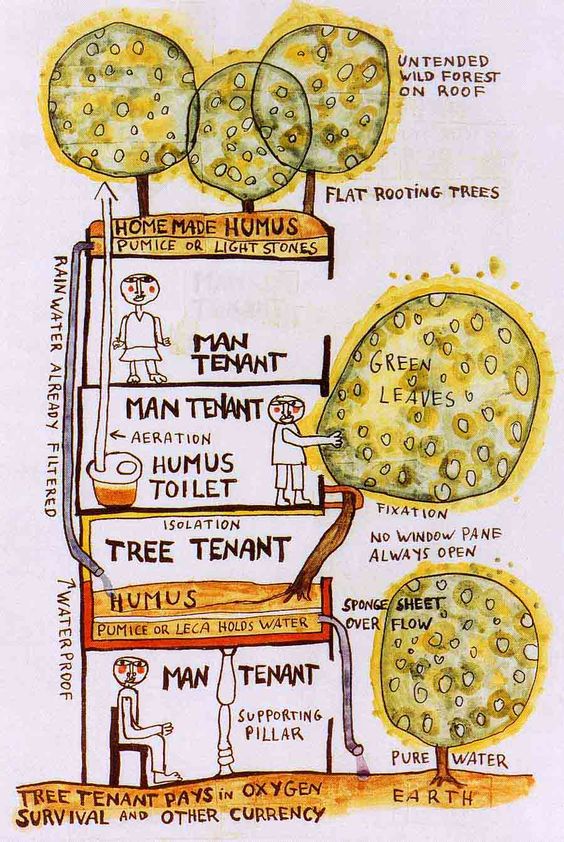
The artist Hundertwasser used diagrams to explain both his world view and how particular projects might work to support that view. 


Hundertwasser: The five skins

Hundertwasser's idea of the five skins was another reference I was aware of as I developed my diagrams. The human body and the earth are brought together as if linked by layers, which I was thinking of as topologies. Hundertwasser's diagrams are also womb like, we emerge gradually to embrace the earth and the universe. 

I'm very interested in that time around the end of the 19th century, because it was when so many things were about to change and it was as if new ways of thinking were being literally plucked out of the air, from the post-impressionist movement in art, where artists like Van Gogh, Cezanne and Seurat were emerging, to new visions in science and attempts to rethink what religion was all about. In the middle of all this were visionaries who's work didn't stand the test of time, but who's work nevertheless when revisited can offer many insights into our current times. Thomas Kuhn produced a theory about the structure of scientific revolutions, this was often set out as a diagram.

As you can see in Kuhn's diagram above progress in science is not a smooth curve of gradually built information, it is more like a series of jerky movements, whereby the models of the world science gives us begin to feel a bit shaky, and as they do new ideas as to why this is so proliferate, and the end of the nineteenth century was just such a time. Science was in need of some new ways of thinking and Einstein would provide some, but before the new world of quantum theory and spacetime could begin to have traction, a lot of other possibilities also emerged and as an artist I'm allowed to revisit them in my search for ways to visualise the invisible. For instance C. W. Leadbeater's treatise 'Man visible and invisible' details how etheric substances are seen by clairvoyants in their auratic visions.  

The astral body of the average man: from Man Visible and Invisible 

B. W. Betts work on geometrical psychology fits into a similar category and has helped me to develop a conceptual bridge between the latest work in neuropsychology and the use of diagrams of body image schemas to help demonstrate how intellectual concepts are developed out of a deep body awareness. 

B. W. Betts: Diagrams from 'Geometrical Psychology'

Rudolf Arnheim's diagrams of underlying structural skeletons and how they explain the dynamic forces at work during the act of perception, are in some way connected to Bett's ideas. For instance Arnheim suggests that a circle or disk if perceived within an image's visual field is affected by hidden structural factors. If seen at the centre of these forces there is a point of balance and rest, and as we move away from the centre, there are other points that are suggested by geometry as also being more in balance or 'right'. 

Balance schema based on Arnheim

These points of balance are only balanced in our acts of perception, Arnheim's hidden structures of 'forces' are psychological not actual unlike gravitational forces. This is where Mark Johnson steps in and demonstrates that we then use body schemas to build conceptual ideas via metaphor. 
In the case of balance, one can easily see a link between visual balance and physical balance. As a young healthy person I stand up straight, but if I am ill or get old I am more likely be become unbalanced and fall over or have to lie down. I can begin to associate certain sorts of real life experience with balance. Gradually I find that I see some things as being 'balanced' and others as 'off balance'. Balance being linked to some form of rightness and off balance as some form of wrongness. Here we begin to see the development of the idea of the scales of justice. 

The scales of justice

Two disks in balance

Mark Johnson in 'The body in the mind', again using diagrams, explains how we then build metaphorical extensions and interconnections of balance schemata. The scales of justice emerge from what he calls a 'twin-pan balance'. 

Types of balance according to Johnson

Johnson then uses these schemata to show how additional senses of balance are used by what he calls 'imaginative schemata'. Finally he explains how these basic schemata lead to concepts such as the balance of logical argument, legal / moral balance and mathematical equality, such as the = sign. It would also seem that there are various ways that schemata can be combined.
A collection

A merge

Ordering or structuring 

You can see these various approaches at work when more complex diagrams are being put together, as in the work of Marc Ngui. 


Marc Ngui: Diagram from 1000 Plateaus

Marc Ngui has made a diagrammatic version of Deleuze and Guattari's '1,000 Plateaus' and has applied his skills to other complex bodies of knowledge such as quantum mechanics. What I find interesting is that the diagrams I have looked at come from every discipline, from mathematics, to psychology, economics via philosophy to art, all these disciplines find diagrams powerful communication vehicles. I suppose what I'm also doing here is checking out my own decision to begin creating diagrams to clarify my thoughts about topographic spaces and somatic awareness, some of these issues will therefore no doubt find their way into the writing I'm now doing in relation to how I might visualise inner body perception. 

See also: