Showing posts with label Bruno Latour. Show all posts

Saturday, 18 October 2025

Speculative grace

The plane journey to Gothenburg and back to Leeds was broken by having to change planes at Amsterdam, therefore I had a lot of time to fill and so decided to re-read Adam S. Miller's 'Speculative Grace: Bruno Latour and Object-Orientated Theology'. I had read it initially some time ago and happened to spot it on my bookshelves just as I was thinking about what to take with me to read. It's a strange book, as it tries to tease out the religious concept of 'grace' from the writings of someone that developed a body of writing focused on how science makes meaning. 

Latour was though a life long Catholic and therefore as a Christian his thinking would have been coloured by his Bible readings. He was not trying to argue the importance of Christian beliefs but his arguments do suggest that certain Christian ideas, helped him shape his thoughts. For instance, Matthew 5:5; "Blessed are the meek, for they will inherit the earth," and 2 Corinthians 12:9 that states, "He said to me, 'My grace is sufficient for you, for my power is made perfect in weakness'". After looking at the way that science actually operated in real life situations, Latour had decided that you can never actually be objective, he had then developed the idea that you cannot separate opposites out from each other and that reductionism, or the focusing down on one direction or way of understanding the world was not just wrong, but that it was actually an impossibility. An idea therefore, of power residing in weakness, could have helped him to think about dissolving distinctions between culture and nature or subject and object. By stating that the world is actually an amazing network of interconnections and that everything relies on everything else, Latour suggests that if any one thing pulls itself out of the matrix and acts as if it has power over other things, it will in effect eventually undermine itself, as it would cut the very ties that enable it to be what it is.
He also argues that nothing is ever actually a thing, there are simply nodes or centres that are connected to everything else. Although at times there could be a suggestion of an object's separate identity, this could only be a constantly shifting one, one that was in itself determined by all the various connections that thing might have from moment to moment. This is a type of strength through harmony; something that could easily have emerged out of Latour's Christian beliefs, for instance many Christians believe that the unity of believers is built on humility, forgiveness and mutual respect. A unity that is achieved not through uniformity, but by valuing diversity within a common faith. I was also reminded of the Markov blanket concept, whereby, although for the sake of the way they use communication systems it might be useful for humans to be able to nominate a tree as a separate thing, in reality it is an event or aspect of a process. The boundaries of biological systems, from individual cells to trees (or indeed people) can be thought of as the supporters of free energy, or places where that energy meets other forms of energy and where interactions take place that both help to stabilise the entity and to ensure it is in constant communication with all the surrounding energy fields that it depends on for survival. If so, something called a Markov blanket can be used to define its boundaries in a statistical sense, i.e. instead of a solid wall you have a series of probabilities whereby something is and isn't at the same time, called in this instance, the active inference scheme. But Latour goes much further than this, he believes that all things operate in the same way, both organic and non organic and that some things might be processes. I was then reminded of Timothy Morton's 'hyperobjects', which could also be things such as global warming. 

Latour looked at the complexity of the everyday and in doing so, he helps us value what is going on right in front of us and Adam S. Miller opens out an argument that 'grace' can be found in Latour's writings by this very fact. 
I wrote the note below in a very shaky biro hand whilst flying between Gothenburg and Amsterdam. 

"Votives and the Pluriverse"
If we take a point of view that everything is interconnected and that everything is always becoming, in flux, never quite establishing fixed boundaries, then a votive practice that is multi faceted would seem to make sense. The need to create a flow, to establish the conditions of constant fermentation, can be met as a practice evolves out of parallel views. Grace emerges from the fermentation of the multitude. It is embedded in the bustling give and take of objects. A votive always emerges from a complexity. Ceramics allows us to make forms that are collapsing and emerging at the same time and as they do, at some point we can come to a temporary stop and see how this evolving object can now talk to the situation that it emerged from.

My votive making emerges from a complex something that comes out of a conversation. The conversation may well be far too hard to simplify or clarify what is needed, so there has to be a process of finding a line through what is being said. I push back against someone to see what will come out of the dialogue. They then push back at me, often with a statement such as, "It's not like that, its more like..." In this way forms arrive out of the flow, rather than an object being made from a pattern. 


Votive forms made of psychic animal body parts
I.e. what your organs might look like if you were inhabiting the soul of an animal

In Gothenburg I had been giving short presentations to medical professionals about the work I had been doing at Pinderfields Hospital. When not having to be doing that, I was free to follow anything else that was happening, and the other much more comprehensive presentations were being given by scientists that were very interesting. I had been reading Craig's book on interoception just before leaving, therefore I could see how important neuroplasticity was to the way our nerves operate and how our body parts are connected through our backbones. I saw two presentations in particular that looked at ways to use stem cell growth to foster the development of new neurons that could reach over divides made during traumatic injury, when a backbone is broken. It was hoped that these new discoveries would lead to a way to repair broken spinal networks and in doing so get limbs moving again.  

The patients who were involved were very similar to the group I had met in Wakefield, all had suffered traumatic spinal injuries. However the 'actants' as in Latour's use of the term, also included several non-human creatures, including mice and monkeys and machinery. The images of the injuries were made using powerful electron microscopes, giant sections of backbones were projected on several screens as presenters pointed to newly grown dendritic shaped fibres beginning to spread out into bone substrates. Craig had made me aware of an evolutionary history of the different types of nerve fibres running through the spine and therefore I was not surprised when for instance one presenter pointed to the existence of nerves carrying visual information through adjacent channels. No one mentioned that nerves carrying more emotional information would also have to pass through the backbone's super highway. I was though now beginning to see these presentations as entries into a type of micro world, one that I entered guided by science, that was re-shaping my visual spinal image bank. This caused some sort of oscillation of my being, that also included the mice and monkeys that had given their lives to the research conducted in the many medical laboratories that had been working on these issues. I was being connected via a series of networks that were previously unavailable to myself, but which had already been invisibly shaping my experiences. 

Bruno Latour's ideas level the playing field between things. He used the image of a constant fermentation that arises as a physical/chemical/quantum/emotional/psychological and economic mix that is achieved by the constant swelling and current mixing of energy seas. It's an idea that for many would be too disconcerting, people often want some form of certainty and the rise of rightwing philosophies points to this need. You need a certain confidence to ride the waves of uncertainty. An idea of time as a relative thing that operates in different ways as it interacts with small and large scale events, can for some people be very disconcerting, as people are in many ways already dead, as well as not yet born. As an artist I can see how objects effect me, they shape my mind, they penetrate me and I am worked on by them from within. I need to accept this, if not I could have no real belief in the power of the objects I make to effect other people. As you read this post, another non-organic thing enters your mind and as it does it begins to reshape your body. This may only be for a moment, you may well decide that this text is boring and stop reading, but in the short time you were reading, you were being re-shaped. Any perception of rightness is just a temporary "momentary truth", that sits within a larger, ever-changing process of constant becoming. It is a fascinating thing, one that can either be embraced or rejected, and as it is embraced there are wonderful opportunities for becoming immersed in the flow of possibilities.

Grace is normally defined as an acknowledgment that one's well-being is a result of God's undeserved kindness, benevolence, or blessing. Grace is something that reminds us that luck or good fortune is not a product of one's own actions, it is a game of chance. However in a world where there is no God, there can still, it has been speculated, be a form of 'grace'.
This is a way of thinking about the implications of a world where the idea of a deity, sits within or on the same playing field as a game of marbles or a TV set. The wonder is in the everydayness of it all and the fact that you are indeed special. No matter how insignificant you might feel you are, you have existed and still exist as a something. That existence is a complex amalgam of events and physical happenings that has during all the time it has been with us, been rubbing up against other things and in doing this it has in turn, shaped them. You might not be able to see this, you might be too close to the happening that is you to see it, but it is still happening and in that happening you are bathed in the speculative grace of now.

See also:

Friday, 4 May 2018

Touch: Photography and frottage as indexical forms of drawing

Max Ernst Frottage

Adam Fuss: Photogram


frottage
noun

1. 
the technique or process of taking a rubbing from an uneven surface to form the basis of a work of art.

2. 
the practice of touching or rubbing against the clothed body of another person in a crowd as a means of obtaining sexual gratification.

photogram
noun

1. 
the technique or process of making a photographic image without a camera by placing objects directly onto the surface of a light-sensitive material and then exposing it to light. 

2. 
archaic:  a photograph.

Both these techniques above rely on the direct contact between two surfaces, or 'things coming together'. Some of my recent posts have suggested that if we used object orientated ontology as a lens with which to explore how the materiality of drawing could lead to a less human centric way of thinking about theory, we could create a better balance between meaning as something that only applies to human lives and meaning as something that is applicable to the totality of all experiences, be these animal, vegetable or mineral. It is though very hard to avoid putting human feelings at the centre of the struggle for meaning. The fact that psychology is now such an important theoretical driver, makes it impossible for me to avoid seeing the relevance of the second definition of 'frottage', to the sexual associations we have with touch. A photograph is usually associated with theories of the gaze, the 'male gaze' being one that treats female subjects as objects and this is at its clearest perhaps within the realm of amateur photography, where I am amazed to see that photographing the female nude is still seen as an important genre, one that often comes under the heading of *'tasteful nudes'. Sight and touch in these cases become conjoined. The 'distance' that light has to travel to get from the subject via the camera lens to the light sensitive surface is in effect diminished by the need to touch the surface of the model's skin. 

Newspaper ad

The drawing above from an old newspaper ad for x ray specs sums up the psychology of the situation, "Is that really his body you "see" under his clothes", the text works as an attempt to divert attention from the reality behind the drawing. 

The feminist artist Nancy Davidson in her early works dealt with the recorded gestures of her body. In one such piece she used frottage by having her bodily weight transfer the patterns of the wooden floor underneath her to strips of paper. The resulting work was a record of touch formed by her body and the floor’s surface. These processes allowed her to touch another object without having to be touched by the 'male' other, she in effect was taking control over how touch could be conceptualised. Her images becoming both traces and signs. (Compare with the Anthropometry work of Yves Klein)

Nancy Davidson: Frottage

Alan Sonfist’s Earth Mapping of New York City is a charcoal drawing that is also both a trace and sign. A trace is something inscribed by the artist’s direct physical presence, while a mark is a sign placed with deliberate intention. The drawing is a rubbing of pine needles and dirt that suggests the composition of the New York City landscape long before it was inhabited.  The drawing as you spend time looking at it transforms into a landscape with its suggestion of depth, mountains, and even animals or figures in action.

Alan Sonfist: Earth Mapping of New York City Charcoal frottage

 Adam Fuss's photogram's are also traces and signs. However they also suggest a relationship with spirit photography. His ghost images of clothes suggest a similarity with those early photographs which were often in reality double exposures. Because of photography's newness and because unsophisticated audiences had no awareness of how these images were made, these photographs had seemed like strange magical records of the spirit world. The direct touch of the photogram as a technique being read as something from beyond the grave, a process that was supposed to be about an indexical relationship with reality, was read as a type of doorway into the fantastic. 

Spirit photography

I'm rambling again, but only to search for a series of connections about how traces and direct contacts with other surfaces can lead to a variety of readings, which can on the one hand make us more aware of the material nature of image making but on the other of how other humans will read into anything narratives of their own experiences, a direct touch being associated with being alive and by extension an awareness of sex and death.

Bruno Latour suggests that 'resistance' is the first mark of the real. In the case of a drawing the paper resists the attack of the charcoal. This is the material aspect of every situation. "Availability' is seen as the second mark of the real. 'Reality' according to Latour is itself defined by an oscillation between 'resistance' and 'availability'. 'Availability' is a tangled series of interconnections that sets out the framework within which the real comes to be. As Miller puts it each object comes to be what it is "through the difference it creates in resisting others". The trials of strength and weakness between 'availability' and 'resistance' are finally resolved by "how the multitude of links that an object has passing through it are stacked in relation to one another." (Miller, 2013, p.52) In the case of a charcoal drawing, the passivity of the charcoal allows it to be shaped into forms that can be linked into a complex series of links with metaphorical and other meanings. As things come together one will always be more resistant than another, (a sort of philosophical Mohs scale of hardness) and whatever is more malleable is then capable of taking the form of or allowing an infusion into other things, ideas or whatevers.

For a detailed discussion of Latour's ideas see: Miller, A (2013) Speculative Grace: Bruno Latour and object-orientated theology New York: Fordham University Press

For an introduction to the idea of the male gaze see:

Mulvey, L (1975) Visual Pleasure and Narrative Cinema available at http://theslideprojector.com/pdffiles/art6/visualpleasureandnarrativecinema.pdf

Charles Peirce's term 'indexicality' refers to the physical relationship between the object photographed and the resulting image. Paul Levinson emphasises the ability of photography to capture or reflect "a literal energy configuration from the real world" through a chemical process.

*If we look at the etymology of the word 'taste' we can see that it is intimately associated with 'touch'. Our present English use of the word "taste" evolved from the Old French "taster," which originally meant "to examine by touch or test". The modern sense of "flavour" didn't emerge until the 16th century. This historical connection highlights how the sense of taste was initially understood through the physical act of touching, which was also about 'testing' out experiences before committing yourself to them. 

Monday, 26 March 2018

Object Orientated Ontology and Drawing

Dog prints

If an earlier definition of drawing as traces is accepted, it could be argued that other animals are drawing too. If we take things another step onwards of course it could be further argued that any contact between things if it leaves a difference or a trace mark, is also a type of drawing. It may be that intention is overvalued, simply because what we think of as an intention may from another standpoint simply look like a trace of an action.

Snow print of a mouse being attacked by a bird

If you look at the image above it tells a complex story. A mouse, (the track left by it comes down from the top of the image), was swooped upon by a bird of prey, as the bird came down on the mouse its open wings and tail feathers were imprinted into the snow, and then is that line of marks emerging from the rear of the image the mouse escaping? It's hard to be sure, but what we can be sure of is that something dramatic happened here and the central moment to the drama was for a short time frozen in snow.

Dinosaur tracks

Fossils of tracks are quite common. We can read how fast a creature was moving and how heavy it was from the traces. In the example of the trilobite fossil below, both its track and final resting place were fossilised.


These traces are all simply records of physical interactions, but in the case of the puffer fish, we can see a much more intentional series of actions.

Sand drawing made by a puffer fish


The puffer fish must have at some point back in its evolutionary history have seen marks made in the sand by an involuntary contact with its body, but how did it move from that to be able to construct such 'sophisticated' looking images?

Bear claw marks

Bear markings on trees are long-lasting and allow for the identification of their travel corridors. Scent markings do a similar job.

The bower bird

The bower bird builds structures according to a particular identifiable aesthetic and decorates these structures with found objects. Like the puffer fish this is part of an elaborate mating ritual.

Within the strictures of Object Orientated Ontology, the reality, agency, and “private lives” of nonhuman (and nonliving) entities, (all of which are considered as "objects"), are taken very seriously. The whole point of 'OOO' as a philosophy is to rebalance the books so to speak. What Object Orientated Ontology is proposing to do is to help us to step outside of our human centred framework and to consider how things might be if everything was simply about 'objects'. For example, the 'life' of a stone is a life that inhabits its own timeframe, a timeframe that we as humans would not be able to understand or perceive, our lives in comparison to a stone's existence being as short as a mayfly. The situations that I have presented above are however still presented from a 'human' centred viewpoint, something that I would as a human find impossible to do otherwise. However by thinking about these things, perhaps we will be less inclined to just use the world as if we own it, or as if all the other things that are not me are in some way less important than me. The real lesson that the puffer fish example has to teach us is that the puffer fish will make its patterns with or without any human observations as to whether or not its world is interesting or not. 

Graham Harman, one of the key writers in relation to 'OOO' states, “The world is not the world as manifest to humans; to think a reality beyond our thinking is not nonsense, but obligatory.”

Therefore the traces of physical actions left in inanimate objects as they come into being could also be thought of in this context as drawings.

A wind weathered rock


In the case above different hardness of rock types has meant that wind weathering has eroded some surfaces more than others. The action, or coming together of wind and rock, has resulted in a change of surface, this 'trace' of the action, within an 'OOO' framework would in effect be a drawing.


As I think about these things I'm also drawing. In this case using charcoal on paper. The carbon complexity called myself, in this case engaging with the much purer carbon of charcoal in such a way that vigorous rubbing has occurred between the burnt wood and a rough Indian rag paper. This has happened over a period of human measured time (a morning) in order to produce several versions, which are now themselves entering a new timeframe of paper/charcoal, one which will itself depend on whether these drawings end up as landfill or in a national art collection.

Studio view

I doubt if these drawings will see the light of day ever again, but the thinking process that allows me to decide to draw a lump of stuff as if it could be aware is hopefully going to eventually allow me to produce much more interconnected pieces of work, perhaps less formal and more process aware. 

Maringka Tunkin, Freda Brady and Yaritji Tingila Young are artists from Alice Springs. They work in a tradition that goes back a long way. 

Maringka Tunkin, Freda Brady and Yaritji Tingila Young in front of one of their paintings

The tradition that these artists have emerged from did not treat everything as if it belonged to separate categories. In their conceptual map of the situation, animals, landscapes, people and events are all one interconnected 'hyper-object' called the 'Dreamtime'. But their existence is also one that rubs up against a very different 'hyper-object', the 'Western art world', a complex of artists, dealers, critics, buyers and value sets that are just as real as the 'Dreamtime' but far less nourishing. The concept of 'hyperobjects' is taken from Timothy Morton's book of the same name. 'Hyperobjects' as an idea is another offshoot from 'object orientated ontology' and allows us to deal with , as Morton states, "things that are massively distributed in time and space relative to humans". Maringka Tunkin, Freda Brady and Yaritji Tingila Young will also have to confront other 'hyper-objects' in their lives, such as global warming, the Australian economy and academic anthropology. Within the framework of object orientated ontology systems and processes are regarded as things, or objects, so that people, rocks, animals, star systems and mathematics are all seen as realities that bump into each other, but so are things such as Sherlock Holmes or Harry Potter. What becomes important is the resistance or actions that occur as one thing meets another. This point of resistance is often seen as the 'politics' of the situation. Therefore if you are operating as an artist within a situation that is being looked at through an 'OOO' lens, you would attempt to be more attentive to the physical objects and processes involved in your immediate environment, as well as the 'hyperobjects' that you may well find yourself part of.
This area of thinking, often associated with speculative realism, is a critique of the way philosophy has developed since Kant. Kant by developing the duality of the noumenal (the world as it is "in-itself") and the phenomenal (the world as it appears to us) set philosophy on a path that would essentially be about how human beings think about things, and therefore 'reality' sort of retreated behind a mist, it was something to think about, see at a distance, but never really experience. The rise of phenomenology began to open out the idea of 'embodied' thinking and once it began to be accepted that the physical reality of living in the world was itself constructing what it was to understand existence, then the doors were open for a way of critiquing all our mental constructions about reality. In particular ones that either reduce it to tiny bits, such as everything is really composed of atoms or wave particles, or ideas that seek to make everything fit into a bigger picture, such as God, or Nature. What we deal with is what we deal with. When I see a stone and pick it up, I can't see its atoms, I deal with its stoneness and at the same time it is dealing with my picking of it up. This is not to say atoms are not real, but that atoms are to be considered as things or objects in their own right and in their own world. A dog is a dog and the atoms that make up a tiny portion of a hair on the dog's head are just atoms, and will be experienced in a world that is commensurate with atoms, one which in human terms would include instruments such as electron microscopes.

Object orientated ontology has diagrams and as this is a drawing blog, I shall put one in. Harman presents us with 'real' objects and 'sensual' objects, as opposed to Kant's noumenon and phenomenon. The noumenon is a posited object or event that exists independently of human sense and/or perception. The term noumenon is generally used when contrasted with, or in relation to, the term phenomenon, which refers to anything that can be apprehended by or is an object of the senses . So in Harman's case real = noumenon and sensual = phenomenon. But there are essential differences. In Harman's view both real and sensual objects can interact with each other, hence the diagram below. In Kant's view the noumenon is a hypothesis and the only contact we have with reality is via sense impressions, or phenomenon, so we have no actual way of saying anything about reality itself.
I have found some aspects of 'OOO' very useful as a visualisation trigger, and some of the drawings that have resulted are I think interesting, but my personal use of 'OOO' like all theories, is I'm afraid somewhat selfish. I only use the bits I find useful and don't attempt to get to grips with the aspects of the theory that don't seem to help me visualise things. This would be a real problem if I was to turn to philosophy as a trade. However, I read 'OOO' as just another 'hyperobject' and what I'm enjoying trying to visualise are the points of resistance as 'OOO' comes up against other objects and systems such as the city of Leeds, the people that live in Chapeltown, toothache, getting older, a very cold spring, Brexit and a series of images that I have been making and thinking about over the last 5 years.

I found it interesting to use the diagram above in relation to my thoughts about Bruno Latour's observations on scientific methodology below.

There is a description of how scientists think about soil analysis by Bruno Latour in his book ‘Pandora’s Hope’ (1999, p. 56), and I have found it very useful as a way of thinking through how as an artist you can research into a subject and how as you do so you focus on various aspects of it. It allowed me to accept that I can generate thoughts about possible ideas and forms that connect or link or illustrate an individual aspect of that research, without having to prove how each aspect of my thinking links up or creates an effect on any larger entity. Each thing I do can be seen as autonomous and something I can focus on until I’m satisfied that it does what I want it to do. An idea can have its own form and material structure, as well as being related to whatever things stimulated it in the first place. Latour’s description helped me to accept that each idea can be seen as an entity in its own right, and that I didn’t have to try and deal with everything at once or prove that in some way the work bore some sort of responsibility to what was its initial reference. There is a sort of flattening out of responsibility, an idea is as much an object as an element of research, which is just as much of an object as a person, a town or a philosophy.
Latour says that the scientist will begin research with an awareness that it is soil that is being examined. Soil as a generic entity; that stuff that is more than just dirt, which has substance and is expected to be able to support plant growth. However what the scientist wants to examine is not this big entity but something else, something more focused and so work begins to focus down and as this happens, soil as a generic entity disappears from view and new forms come into the frame. An area of soil is usually gridded with string and pegs, so that the surface of the soil can be numbered and referenced, in order that any differences in soil acidity or alkalinity in terms of location of ‘hot spots’ or changes in average ph can be recorded. The scientist is now examining a grid of relationships that were not there before. It could be argued that the unruly nature of the soil has now been tamed, the ‘wildness’ has been removed and this new structure allows other things to be done. This is similar to what happens when I’m drawing from observation. My drawings can’t include everything, so I make a selection and this selection is what will allow me to develop a next stage of an idea. The grid that the scientist uses is also familiar to me, as a student I was taught to apply a grid of looking to make sure that I was able to accurately measure relationships and I still mentally apply this as I draw, checking horizontal and vertical alignments automatically as I make decisions as to what goes where in the drawing.
A scientist would now use the grid to enable a series of soil samples to be taken in such a way that each sample had a clear reference that could refer back to an exact location. A “pedocomparator” is then used to take soil samples. What is interesting here is that the generic soil could be seen as matter, but as it is gridded it then takes on a particular form, which becomes the object of attention, but now that the “pedocomparator” comes into play the material inside each gridded section is the focus of attention; form as the focus of attention is replaced by matter again. A process of reduction is taking place, but one that produces a definite something at each stage. I take my drawings from observation back into the studio, I then work from them, looking for new connections, trying to find forms that will work within a different set of relationships. Instead of drawings about spatial and formal observations, the drawings become about other narratives and connections that lie outside of the perimeters of the first experience. This is similar to the use of the “pedocomparator” (a device for arranging and comparing soil samples), as an instrument it brings to the location a set of attributes taken from the scientist’s laboratory, as opposed to the artist’s studio.
The soil samples taken from the various gridded sections are now organised into a set of gridded relationships that go to form a diagram that displays a set of interrelationships between samples. So we now have a new form, one that can be looked at and used to develop further thoughts or ideas. Just as the scientist has produced a new image that will allow decisions to be made, the artist’s images that have been developed from the initial observational drawings are now subject to contemplation and will result in further ideas and thoughts about possible formats for development.
The scientist’s diagram now becomes a medium for analysis. What is important here is that it is the diagram that is analysed, not the soil. There is of course a direct series of connections back to the soil but as the scientist concentrates on the diagram, the diagram is the thing or object of study, not the soil. Similarly in the studio, the new images that are emerging are objects in their own right, things that have emerged in a process of abstraction and which are connected in process back to the initial observations, but are now a product of the processes of art, just as the scientist’s analysis of the diagram is now a process belonging to science. The writing up of a report based on the diagram gives the process yet another new form, myself as the artist am now making a series of images for exhibition and am also creating new forms. Each of these processes can be seen as a stand alone ‘object’ and what Latour and others would argue when experienced they are types of realities not things either reducible to atomistic bits or to be described as components of some sort of overarching bigger picture. The soil is still of course soil, the landscape or situation drawn by the artist still remains as the landscape, but the diagram is just as much an object as the drawing, they are all interconnected and rich in their interconnections but each is to be experienced as a thing in itself.

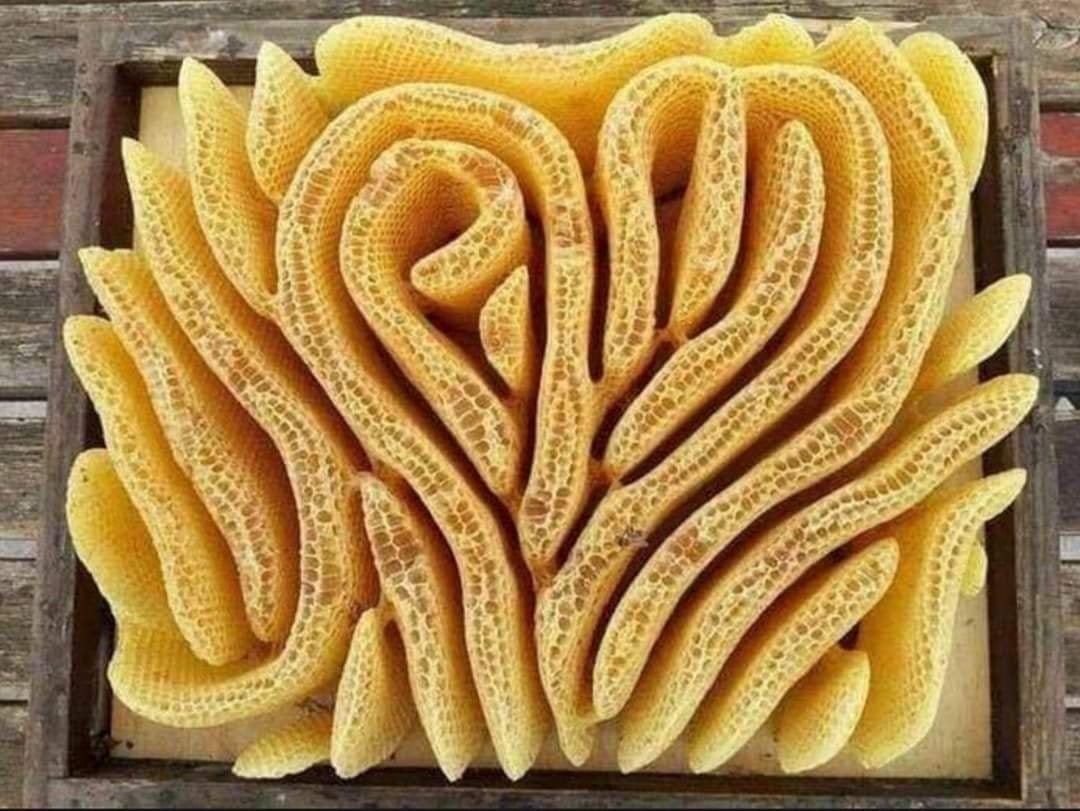
Perhaps best to leave the last word to the bees.


When a beekeeper forgot to put the frames back in a hive, bees built this amazing structure themselves. It takes into account airflow and temperature regulation.

If you are interested in finding more out about how object orientated ontology, speculative realism, actor network theory, agential realism or material thinking could help you think about your relationship with drawing and the world, the following bibliography could be a useful starting point.

Barad, K (2007) Meeting the Universe Halfway: Quantum Physics and the Entanglement of Matter and Meaning New York: Duke University Press
Bennett, J (2010) Vibrant Matter: A political ecology of things New York: Duke University Press
Bogost, I. (2012). Alien Phenomenology. Ann Arbor, MI: Open Humanities Press
Harman, G. (2011). The Quadruple Object. United Kingdom: Zero Books
Latour, B (2017) Facing Gaia London: Polity Press
Latour, B. (1999) Pandora’s Hope Cambridge, Mass: Harvard Press
Morton, T. (2013) Hyperobjects: Philosophy and Ecology after the End of the World. Minneapolis: University of Minnesota Press

There is an interesting dictionary of OOO terms available that also links to suggestions as to how to read the diagram of Ten Possible Links above.

How OOO is effecting contemporary art practice

See also

Drawing and philosophy part 4