Celia Paul: Figure approaching the British Museum
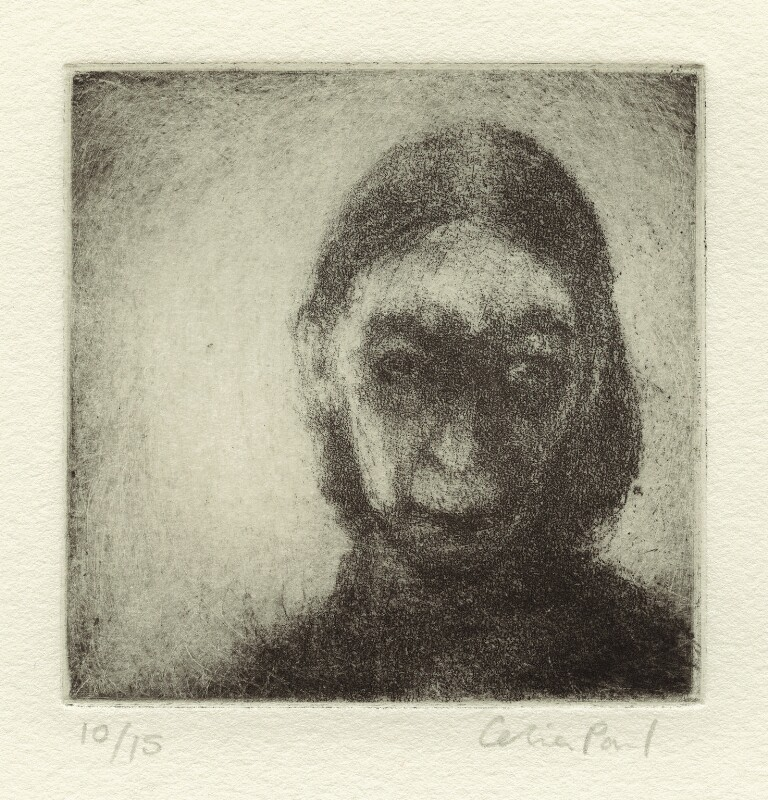
On a recent visit to London I saw two small images that have stayed with me, lodging themselves in my visual brain far more powerfully than any of the other art works out there in the commercial art world seeking attention. I had been looking around a few private galleries, in order to get a flavour of what seems to be going on in the contemporary art world and perhaps because of their relative insignificance, found myself staring long and hard at two images I had never seen before. In the Marlborough Gallery I found the first, a small etching by Celia Paul of a dark figure appearing to approach an archway in the fog and the other image that I found in the basement exhibition space of the Bernard Jacobson Gallery, was of a tiny pencil drawing by Cézanne of a sculpture of Atlas crouching.Cézanne: Study of a sculpture of Atlas crouching.
I have no idea of the dates, but Cézanne was dead by 1906 and Celia Paul is a living artist, so there will be at least a hundred years between the coming into being of these two images.
Both artists were making representations of things I don't normally associate with them and both were making images that suggested to me that they were in one way or another trying to make sense of their relationship with history.
Celia Paul has a studio flat directly opposite the British Museum, high up on the fourth floor, so her small etching could therefore have been made initially from the direct observation of a building that for myself has long been a place of pilgrimage. This hallowed repository of the world's cultural treasures, is for Celia Paul the place on her doorstep. In fact the last time I went to the British Museum I did look up at the windows above the shops opposite to see if I could guess where she might live, but there were of course no clues, no windows that were framed in artist's paint marks or any other identifying features.
Celia Paul's etching of a figure approaching the British Museum is but 12 inches high or less; an insignificant image behind glass. The museum doorway is hazily picked out in scattered ink marks, I wondered if she might have been directly scratching into the plate, as well as biting through a thin acid resist. The image might as well be a container transporter crane obscured by sea mist, as a museum doorway. All recognisable features have disappeared and it becomes something emerging out of an insubstantial cloud of unknowing that is at the centre of all the fogs and mists and vapours that have at different times acted to remind us that behind the sunlit world of clarity and intellectual knowing, is a twilit world of shifting uncertainty and unconscious dreams. It is as if the museum is hissing steam, hiding itself behind mist. Paul is perhaps reminding herself of the essentially Romantic nature of museums. She touches on the sleeping dormant power of world wide collections of stories; stories sometimes ripped out of the hearts of the peoples that handed over their many treasures to the collecting needs of a colonial power. Celia Paul's image also reminded me of the 1950s, a time before the Clean Air Act, when foggy days were frequent, when the mystery of things coming into and out of vision was an everyday occurrence. There was something exciting about trying to make your way home in a 'peasouper', things became partly imagined and partly seen, and this is perhaps what Paul's image is about. The museum is a place where we go to see things that have been imagined by others. It collects together the eternalised minds of thousands of peoples from various times and places, putting them together to create the mind of a dreaming giant. As you walk its various corridors you trace out the branching nervous system of a brain that carries ideas between things, linking myths and legends, connecting a chain of animist ideas, wrapping them around Christian, Buddhist, Muslim, Egyptian, Aztec, Confucian and Shamanistic totems. These are ancient visualisations of invisible energies, that like wires connecting empty batteries awaiting recharging, can easily be attached to a new power source. Energy is power, and Paul perhaps wants to negate the power of this old establishment; one that intimidates as much as nourishes, that appropriates as much as educates and that establishes canonical histories as much as tells tales of other times and cultures. In the long scheme of things this powerful building will one day be gone, it will like the classical Greek and Roman buildings it echoes, becoming one day a ruin; its contents scattered back out into the world, only ghosts remaining. If there is one thing this collection of objects tells us, it is that no culture lasts forever. The fact that the debate around Benin bronzes and the Parthenon frieze has reached a point where so many people believe that they ought to be returned to the places they were taken from, is indicative of a shift in attitudes, a move towards a more sensitive future and one that hopefully will see a celebration of otherness rather than a fear or destruction of it.
Paul's sensibility can't accommodate the museum's monolithic presence, her work is more like that of Gwen John's, it is about the nature of quiet withdrawal, so she reduces the building to an insubstantial doorway. A small dark figure stands looking towards where the museum would be if it ever began to solidify, the figure acting as both measure and spatial indicator; a halfway marker that sits spatially between ourselves and the museum entrance. Many people have I suspect, stood in front of this huge imposing building, feeling small and fragile, uncultured in the face of so much culture, not quite sure of who they are and what they stand for when confronted by so many captured cultures; cultures that when they were in their ascendency had a strong belief in themselves and that made art objects that reflected those beliefs. How can, suggests Paul, a private individual make anything that can stand up to the carefully selected images that have emerged from history. How can a contemporary artist make something that has the same authenticity or gravitas as the objects found in this temple to colonial history?
Cézanne also confronts Classical culture. Atlas as a punishment was condemned by Zeus to hold aloft the heavens, he is often portrayed bent down beneath the weight of his burden. Cézanne was also weighed down by a consistent doubt that was always with him when trying to represent the process of looking. You feel that he is never sure, never allowing himself to finally come to a conclusion. Cézanne makes marks that attempt to define the surfaces of the model he is drawing. He is trying to 'feel' for the solidity of the forms that he is looking at. I suspect he is drawn to a small sculpture of the human body because a life model couldn't hold a pose long enough for him to get to grips with what he was seeing. When he painted a still life, the fruit or flowers he used would often wither and die and he would have to replace reality with paper flowers or artificial fruit. The dilemma he faced was that his work was on the one hand motivated by a visual search for sculptural weight and volume, but on the other hand he wanted it to be a 'true' record of the personal act of looking. This led him to use mixed perspectives, each one linked to those small head and eye movements you make as you attempt to scan the scene in front of you. Movement and stability are difficult bed fellows and in his best work, the world is represented as something that is as tentative and perplexing as it is stable and tangible. This small pencil drawing is an excellent example of the paradox of existence. At first sight it is a small, very grey, insignificant, and even clumsy image. But then you look again and it increases in size and weight. The forms begin to have a rock like solidity and the sculpture could be hewn out of stone. But then as you begin to become involved in its mark qualities, it starts to dissolve back into the paper it has been constructed upon. There is something wrong with the darker marks in the 'V' of the gap between the arm and the leg right in the centre of the composition. It feels as if he pushed too hard on his pencil, as he tried to find shadow rather than form. In doing this the illusion of mass escaped him. Because on the flat surface of a drawing strong dark marks advance spatially, what was meant to be a receding space, or concave surface within the mass, becomes a tone broken out of the mass. The eyes find edges rather than continuous surfaces, his vision for a moment failing him. He probably stopped the drawing at this point, as this one decision had broken the gestalt of the rest of the image. He had worked hard on this drawing, as he always did. He would have spent hours finding the right directions for small clusters of pencil strokes; trying to find out how to make them sit both in space and reinforce a mass and at the same time be true to his 'petit sensations'. Cézanne would also have been very aware of what Atlas represented as a classical ideal. There had been much debate in artistic circles as to the relationship between classical art forms and present practices. Greek sculptural form being for the philosopher Hegel not just a matter of formal harmony or elegance; it was the sensuous manifestation in material form of spiritual freedom and life and this Hegel had argued was the purpose of art. Hegel was dead by 1831, but his intellectual legacy was such that artists were still in the late nineteenth century, trying to come to terms with what he had said. As Pippin (2015) has pointed out, Hegel had proposed that the soul of a society was rooted in a struggle involving conflicting notions of freedom and power. In a historical period marked by extreme uncertainty and change, understanding itself therefore became subject to questioning and most importantly, Hegel had questioned the continuing relevance of art. In this small drawing, I began to see the dilemma left by Hegel's proposition being played out in real time, without words. Cézanne's drawing and Paul's etching, although modest in scale, had together reminded me that I am right in the middle of a continuing struggle involving freedom and power. I am surrounded by contestations surrounding climate, ecology, gender, race, nationality, religion, colonialism and class; power struggles are everywhere I look and the political is inseparable from the aesthetic. I write from a position of privilege, no one is stopping me putting down these thoughts and I can use a platform of dissemination available to anyone who wants to access it. I am not subject to censorship and am still employed by a public body that trusts me to be fair and balanced in my teaching.
It is a privilege therefore to be alive at this moment and to be able to have time to think the things I am thinking and perhaps, after remembering what Hegel proposed, I ought to therefore ask myself questions as to why I continue to believe in the importance of art. Therefore I shall spend some time putting together my first post of the new year as a reflection on why I still continue as an artist and art educator. In the meantime I wish you all a good Christmas break and hope that you will continue to find art in its many and various manifestations as fascinating and as nourishing as I do.
Reference:
Pippin, R. (2015) After the Beautiful: Hegel and the Philosophy of Pictorial Modernism Chicago: University of Chicago Press
See also: