Showing posts with label history. Show all posts

Saturday, 9 August 2025

Shadow drawing

When we were children we all at one time or another tried out shadow drawing. I've reflected on several issues associated with this activity a few times already, but perhaps not quite got down to the essence as to why this way of drawing is so magical.

How to create shadow creatures

There is a wonderful moment when you put your hands together and begin making shapes in front of a direct light source, a moment when the shadow formed begins to look like the creature you had in your head. Hands become a bird flying or a dog's head or a rabbit, but at the same time, the shadow belongs to you. It is an extension of yourself that stretches out into the world, the shadow is both of you and something that you are trying to represent.
Some time ago I wrote and illustrated a short story, whereby a creature tried to cut away its shadow. It is a common story often about someone who tries to escape their dark side, or their subconscious selves, usually with disastrous consequences. Hans Christian Andersen's "The Shadow." and 'The Fisherman and His Soul' by Oscar Wilde are typical examples.


Reattaching a Shadow, Peter Pan, Disney Studios, 1953

I first came across the idea as a boy on going to see Peter Pan; Disney's animated film enchanted me and after rewatching after many years, it still does.

The shadow has always fascinated me as someone who draws, because it is mythically part of drawing's history, as well as giving us physical information, such as where light is coming from, shadows can be used to construct a psychological context. Whenever we see shadows we “read” them and their very ambiguity can add drama or existential weight to the situation.


Rembrandt: Self portrait

By casting most of his face in shadow, Rembrandt suggests that he possesses a deeply complex personality, one that is hard to read, but powerful in its very ambiguity.

William Collins "Rustic Civility"

William Collins' painting "Rustic Civility", portrays the landowner only by the shadow he casts, suggesting that land ownership, casts a shadow over all who live on lands that are owned by others.

The cast shadows of tall buildings

When walking in the street we are very aware of the shadows cast by tall buildings, and feel cold as the sun is blocked from our view. If something is large enough to cast its shadow over us we can feel dominated or dwarfed by the presence of something so much bigger than ourselves. Conversely Lin Yutang stated, "When small men begin to cast big shadows, it means that the sun is about to set"; an aphorism that seems very apt at the moment. In fact the dictionary definition of to cast a shadow over something is "to spoil a good situation with something unpleasant".

I pointed out earlier that shadows are interwoven with the mythic history of drawing itself. Image making according to Pliny, began with tracing an outline around a man’s shadow. This act was to lead eventually to the art of painting. He goes on to then describe how three dimensional modelling began and he states that modelling portraits from clay was first invented by Butades, a potter. Pliny states that Butades invented this new art so that his daughter could remember the face of her lover, who was about to set off on a long journey. He drew in outline on the wall next to him the shadow of his daughter's lover. Then he carefully pressed clay around the interior of this outline and made it into a relief.  The emotive nature of the situation is embedded in that first shadow drawing, the painful moment of a lover’s departure is located in an image that sits between love and loss. Eros and Thanatos, the life and death instincts, attached to the shadow from its very inception as an aid to drawing. 
 

Victor Stoichita in 'A Short History of the Shadow', points out the symbolic connection between “shadow, soul and a person’s double.” and goes on to state that ”this would indicate that the result of the collaboration between the potter and his daughter was the symbolic creation of a ‘living’ double, a surrogate figure difficult to understand without visualising the ritual actions we exert over it.” (The portrait was eventually taken to a temple and put on display there.)

Joseph-Benoît Suvée would make a painting of Pliny's thoughts about the invention of painting, this time though it is 
Butades' daughter tracing around the shadow of her loved one.

Joseph-Benoît Suvée, Butades or the Origin of Painting, 1791.

What this tracing around shadows is doing though is to create surrogates of real things and this creates a particular situation, whereby copies of reality start to become more substantial than reality itself. Butades' daughter's lover may be lost at sea, but his portrait could be seen for many years afterwards hanging in the temple. This situation is further complicated when we look at Plato's shadow metaphor. In his metaphor of the cave, he points out that we never actually see reality, only shadows of it. We are therefore forgetful of what reality is, and can confuse the real with the virtual, and in doing so we lead shadow lives of illusion. 

The image of how to create shadow creatures that I used to open this post, reminded me of how ancient and deep rooted is our relationship with other animals. Shamanic traditions include the harnessing of animal spirits as guides or messengers, and the shadow forms of animals, cast by humans are easily made by the light of a fire at night in a cave. Moving human shadows when seen alongside and cast over the top of some of the earliest painted images of animals, must have seemed as if they were interacting with those images, as well it seeming that forms were morphing from human to animal. I can still remember when I was a small child my grandfather making shadow creatures, and how magical the transformation of hands into animals seemed. I suspect there were artist shadow makers in neolithic times, who were very adept at casting the shadow forms of various animals and humans in iconic poses, onto the walls of caves. If only I could have been a fly on the wall and could watch, as they acted out ancient mythic scenarios in their shadow play.

As I
 weave these various threads together, it becomes clear that shadows are deeply significant and in their very insubstantiality in comparison to the things that they are cast from, they become like ghosts or spirits. Perhaps they gave to human beings their first way of visualising such things, after all, the dead can still cast a shadow and as the earth moves around the sun, that shadow will continue to move, even though the body will lie still. 


Sometimes shadows don't look like what casts them. The drawing above being a playful account of what was at one time a grudge match. 

Sometimes an image is itself meant to exist as a  shadow or ghost, the one below of my father mowing, was made in response to him dying of a stroke as he cut the lawn. He has always been able to cast a shadow in the form of a presence often felt in times of stress or difficulty, his critical gaze still falling on me as a long dark shadow, even as I type these words. 

Ghost mower

Shadows and related phenomena remind us of the uncanny and a world of 'the other', but being so 'everyday', they also remind us of the fact that these things are always with us. 

Reference:

Victor Stoichita (1997) A Short History of the Shadow London: Reaktion Books

See also:

Arvak  A short story

Saturday, 17 August 2024

Venice Biennale 2024 Part three

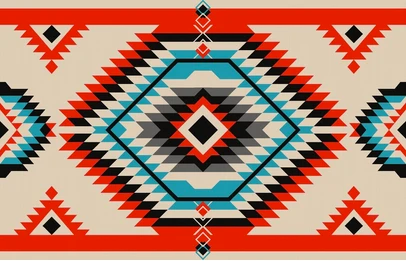
As an artist that works between 2D and 3D, I'm always fascinated by those that have managed to develop processes that allow them to do this seamlessly. In the USA pavilion Jeffrey Gibson, in his exhibition, 'The space in which to place me', demonstrated how a strong sense of formal design could be used to hold together wide ranges of materials as well as very strong colour combinations. His North American Indian heritage is mined for these formal principles, therefore both signalling his heritage and pointing to the fact that many cultures have in the past relied on abstraction and geometry as frameworks on which they have developed very specific cultural identities; Modernism was not the 'owner' or inventor of abstraction. 


Embroidered inserts were locked into compositions that used a symmetry derived from the art of the indigenous people


Navaho carpet designs


Jeffrey Gibson has developed a hybrid visual language that draws from American pop art, minimalism, the art of indigenous people and which also references particular subcultures that he taps into. He is a Choctaw Indian of Cherokee descent, and has lived in urban centres of the United States, Germany, and Korea. In his work, intertribal aesthetics, beadwork, textiles, and found objects from the past two centuries commingle with the visual languages of global modernism. His use of pattern and abstract geometries is a form of cultural critique, that engages with these complex histories rather than erasing them. Gibson develops a space in which Indigenous art, together with a broad spectrum of other cultural expressions and identities are shown to be central to the American experience.


I was particularly taken with these thread and beadwork portrait busts. They had a powerful presence, and the use of a simple symmetry, helped to give formal coherence to the masses of small coloured beads and other items that were used to construct them. The embedded badge states, "If we settle for what they're giving us we deserve what we get". A reminder that so many indigenous people lost their lands and had their ways of making a living taken away, and therefore had to rely on state handouts to survive. They were then labeled as work shy by the very culture that had stolen their livelihoods. 


I wasn't as convinced by the heavily textured 'ducks' but liked the fact that they were an attempt to make animal forms with a similar conviction to the human ones. 


When you make a ceramic pot or vessel, it is a 3D realisation of your own body's dexterity, a frozen form that captures the movements of its making. Therefore pots have often been used as substitutes for human heads or bodies. Ceramics is of course one of the oldest art forms, and by using pottery within his sculptures, Gibson reminds us again that there are other powerful visual traditions, that can still have relevance, including his own Cherokee culture. 

Cherokee artist Davy Arch, "Gumby Pot", 2005

Ceramic and textiles

Large freestanding figures using structures taken from indigenous peoples' tribal costumes

I wasn't sure Gibson had achieved a proper synthesis in these figures, but I could see the intention. Sometimes you just want to do too much; for instance the glaze of the pot/head was bright, but not quite right in terms of overall design. I didn't think the dripped glaze was right and there is such a long history of Cherokee pottery, that I'm sure some of the forms developed historically would have fitted much better. 

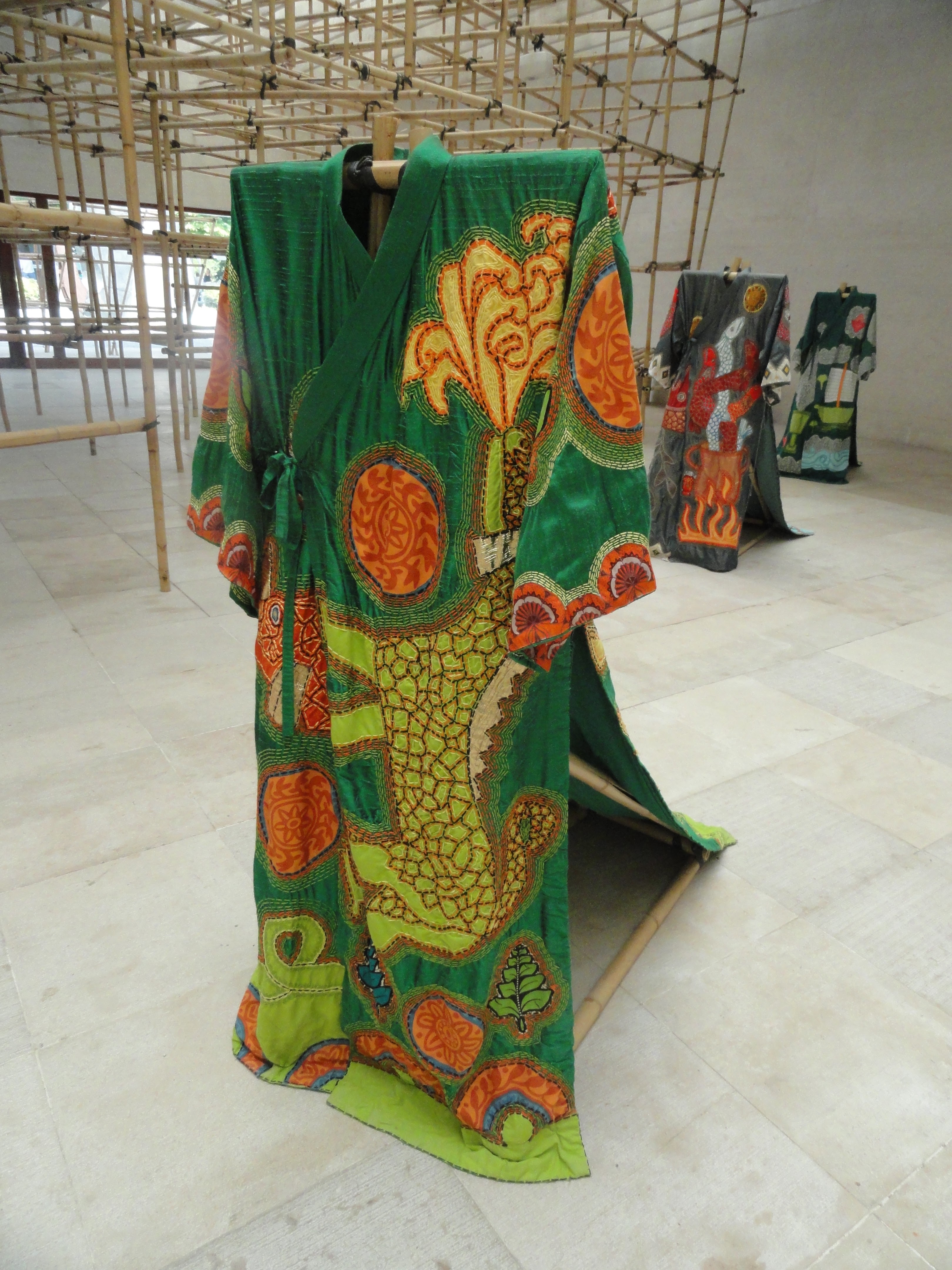
I was still thinking about how interesting peoples costumes could be as we moved on to the Nordic pavilion. This was devoted to the Altersea Opera, written as a hymn to diversity, displacement and belonging and the costumes that had been designed for the performers had all been based on Japanese kimonos and had been decorated with scenes meant to illustrate various narratives developed within the opera. 
The project was conceived and conceptualised by artist Lap-See Lam (Sweden) and realised in collaboration with experimental composer Tze Yeung Ho (Norway) and textile artist Kholod Hawash (Finland). At the centre of the story, lies the Cantonese mythological figure Lo Ting, (half fish, half man) and his longing to return to his former life in Fragrant Harbour; a narrative that is meant to suggest many of the stories told by migrant peoples, of their forced displacement and their thoughts of 'home'. Perhaps because of the fact I was already thinking about the power of clothing as symbolic form, my attention was mainly focused on Kholod Hawash’s textiles that took the form of a sculptural installation using kimonos stretched over bamboo frames. The Altersea Opera merges both real and imaginary stories all related to the diasporic experience, and it leaves us with a recognition of the need to move on and at some point leave behind but not forget previous experiences.


Kholod Hawash: embroidered kimonos

However I also felt that the operatic form was too steeped in western history and its overblown structures made it hard to express genuine emotional engagement with the story; or at least it prevented me from getting this. I wanted something more simple and direct.

Daniel Otero Torres

Because of the nature of the biennale theme there were many reminders of the dangers faced by migrants, such as Daniel Otero Torres's presentation of a simple terracotta relief of a raft with people's belongings on it; a very unobtrusive piece that could easily be overlooked. I think it may have emerged from a community project he was working on, so it may not even have been made by him, but even so, a small image picked out in clay, sometimes can mean more to me than a full opera. 

A full sized cart carrying carved wooden eels reflected how memories of home can morph and grow, becoming something strange within whatever stage becomes the new normal. 

Brett Graham, Wastelands

Brett Graham uses a distinct Māori visual language to construct a contemporary narrative. Graham’s sculpture Wastelands (2024) is a carved pātaka (storehouse) on wheels, implying mobility, transience, and separation from homeland. The pātaka was traditionally used by the Māori as a storehouse for food and treasures, often bearing particularly ornate carving across the lintel, indicative of the wealth and prestige of the community. Instead of using traditional carved patterns, Graham covers his pātaka in carved forms representing eels, a traditional Māori food source. In 1858, as part of the colonial project, the New Zealand government passed the Waste Lands Act, which shifted the designation of the large swamp lands within which the Māori used to catch eels to “waste”. The act transferred the understanding of swamps as they were now thought of as unoccupiable land, so they could be drained and turned towards western agriculture. Graham reminds us that for the Māori eels were once as valuable as gold and that you don't have to be a migrant to be displaced from your own land.

But probably the most poignant work for myself was that of Bouchra Khalili, who in 'The Mapping Journey Project' (2008–11) used a simple format of videoing a hand holding a marker pen as it followed the narrative of various people who had left their homes and had since been travelling the world looking for another one. 

Bouchra Khalili 'The Mapping Journey Project' (2008–11)

To view this work you sat on a seat directly in front of each projection, so that you could listen to a migration the story being told by the person who had experienced it, whilst at the same time watching a pen mark a map. The people recorded were very matter of fact about their experiences. "I saved up money so that I could get someone to help me get away from where I was. They took me to .... and then they disappeared with my papers. Then after working for two years in... I was able to get some false papers made and used them to go to...The police there realised my papers were false and I was deported to...." etc. etc. All were stories to break your heart and yet they were told as if these were recountings of everyday experiences; which I suppose they were for the people involved. 

I have tried as an artist to reflect on similar experiences myself, making work that attempted to visualise the stories told to me by migrants who had arrived in Leeds. The work I made at the time made me very aware that I was just one of countless artists all over the world who had been trying to make some sort of sense of an ongoing situation that art cant change. But perhaps by transforming experiences into an art form, we can make sure that the situation isn't forgotten. For myself the work was a realisation that every single person that has had to face leaving their homeland and travelling into the unknown, has had to face a trauma that those of us like myself who live settled lives in stable countries, have so far never had to experience. Hopefully this means that I will have more empathy with those people who after such traumatic journeys, finally end up in the vicinity of Leeds and try to help them with the process of settling in. Our recent experiences when trying to support someone threatened with deportation to the Gambia, have been a reminder that Kafka was indeed prescient as to the role of bureaucracy and the due process of law, when situations such as people's rights to stay in a country arise. This is undoubtedly so that people don't have to deal with people. It's so much easier to let systems make decisions as to people's fates, rather than to look across the room at someone and make a decision as to their future, then and there in front of them. Suddenly people become real and as they do, moral anxiety kicks in, because you know what is going to happen will affect real people in real ways. 

See also


Monday, 14 August 2023

Trench Art

Detail: Shellcase vase

One of my earliest memories of being interested in an art form is of my gran polishing the two brass shell cases that had been engraved and embossed with designs that stood in the fireplace of my grandparents' home in Pensnett. These things are now formally classified under the term 'Trench Art' but to my family they were 'tranculments', a Black Country word meaning 'ornaments and decorative objects typically found on mantlepieces and other places around the house'These were objects that had a special significance for my gran in particular, as they were tied into her forever grieving for her brother who had been shot through the heart in1917. If I ever asked about these shell cases, my gran would tell me all about her brother, and at the time I thought they must have been made by him, but I don't think that was actually the case. I think they were bought as memory souvenirs after the war or maybe even brought back by my grandfather who had been stationed in India, away from the horrors of trench warfare. Whatever their provenance, I was fascinated by them. You could examine the bottoms and they were clearly working devices, devices made to carry the cordite propellant for the firing of shells. They were embedded into the history of their use and as a boy I was very aware of war and what shells were used for. On the other hand they were decorated and you could see how someone had worked the metal by punching it from inside and engraving it from the outside. The craftsmanship exhibited quite a sophisticated understanding of metal, so these may well have been made by Belgian metal workers using some of the thousands of shell cases left over after the war.  

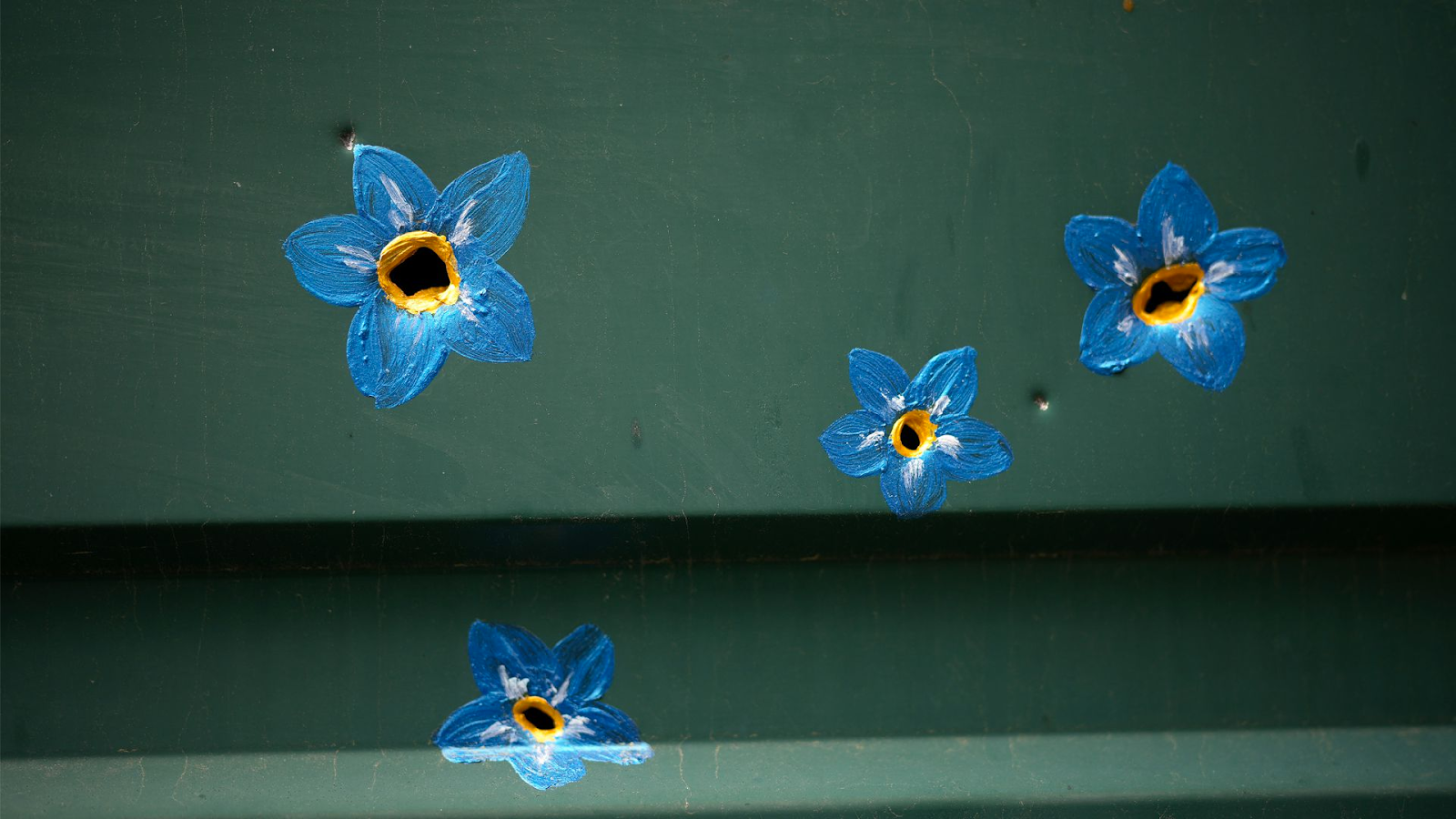
Many years ago I drew them and I have found two images of the drawings on an old hard disk file. Both images though for some reason cropped.  The shell cases were used as flower vases and perhaps I was reminded of them because of a recent visit back to Ukraine by our lodger, who has been staying with us as an escape from the war over there. She came back with some photographs she had taken of bullet holes turned into flowers. Apparently this image is now common in Ukraine, and I was able to find several online such as the one below. 


War is a horrible but very human thing, my generation being the first for a while in the UK to avoid having to go and fight. I remember wanting to draw the shell cases because of their transformation from objects of death dealing 
violence into reminders of the fact that humans can also be creative and can build intense relationships with materials that don't lead to destruction, and instead open out a potential for beauty. 

Detail: Shellcase vase

As I was making the drawings I realised that the foliage emerging from the top could also be read as marks made to represent a gun or cannon firing. 


After a long search brought upon myself because of my failure to organise files, I eventually found uncropped images of the two drawings. Seeing them again reminded me that at the time I was making drawings about looking, which means that the images read as much about the struggle to claim a relationship with a space, as about the shellcases as objects. At the time, drawing for myself was about trying to find a relationship with the space both objects and myself inhabited. I have a lot of empathy with a past self that struggled to make the white space of the paper into an extension of both mine and the brass shellcase's space. I have had a similar obsession for many years now, each time perhaps approaching it in a different way, but always associated with a puzzlement about how to engage with looking and how to re-create the energy of the experience. The conjunction of flowers and armaments, also reminded me of another image, an image from the time when I was a hippy and we were all convinced of the reality of flower power. Each of us feel the continuing effects of history, but each experience of it is unique.

October 21, 1967: March on the Pentagon by the National Mobilization Committee to End the War in Vietnam. Protester George Harris placing a carnation into the barrel of an M14 rifle held by a soldier of the 503rd Military Police Battalion


Drawings in pencil, wax crayon, watercolour and ink.

Because as a boy I was the only member of the family interested in my great uncle's fate, his diary and other personal effects were passed on to me not long after my grandparents died. He had been shot through his breast pocket, therefore the bullet went through the notebook and diary he had in it. These items had a powerful resonance and still do. 

The Human body English / French: Great Uncle Harry's soldier's notebook

It was expected that a soldier was at some point going to need to speak some French and in particular it might well be in a situation whereby some part of his body was in need of treatment. Therefore soldiers were issued with a handy reminder of what to say. 

Great uncle Harry's diary indicating the day he went on the Somme. 

The bullet that killed him went through the bottom edge of the diary, almost going through an image of an underwater mine, an image I would redraw just over 100 years later for an article 'Revealing the invisible: The virus is looking at you', whereby I looked at how the corona virus had been represented and how it could be read as a type of ‘dark star’ or anti-sun. In the article I used my own very simplified drawing of a mine to show how closely its structure echoed the way the virus was sometimes represented. I was very aware that World War I claimed an estimated 16 million lives, but in comparison the influenza epidemic that swept the world in 1918 killed an estimated 50 million people. The drawing of a mine was my private acknowledgement of how great uncle Harry still shapes some of my thoughts, his memory passed to me by his sister, and now passed on to anyone who cares to read this blog.  

The corona virus

Drawing of an undersea mine

See also:

The Blue Danube Reflections on another war and technical drawing

Monday, 26 December 2022

Celia Paul and Cézanne

Celia Paul: Figure approaching the British Museum

On a recent visit to London I saw two small images that have stayed with me, lodging themselves in my visual brain far more powerfully than any of the other art works out there in the commercial art world seeking attention. I had been looking around a few private galleries, in order to get a flavour of what seems to be going on in the contemporary art world and perhaps because of their relative insignificance, found myself staring long and hard at two images I had never seen before. In the Marlborough Gallery I found the first, a small etching by Celia Paul of a dark figure appearing to approach an archway in the fog and the other image that I found in the basement exhibition space of the Bernard Jacobson Gallery, was of a tiny pencil drawing by Cézanne of a sculpture of Atlas crouching.

Cézanne: Study of a sculpture of Atlas crouching.

I have no idea of the dates, but Cézanne was dead by 1906 and Celia Paul is a living artist, so there will be at least a hundred years between the coming into being of these two images.

Both artists were making representations of things I don't normally associate with them and both were making images that suggested to me that they were in one way or another trying to make sense of their relationship with history.

Celia Paul has a studio flat directly opposite the British Museum, high up on the fourth floor, so her small etching could therefore have been made initially from the direct observation of a building that for myself has long been a place of pilgrimage. This hallowed repository of the world's cultural treasures, is for Celia Paul the place on her doorstep. In fact the last time I went to the British Museum I did look up at the windows above the shops opposite to see if I could guess where she might live, but there were of course no clues, no windows that were framed in artist's paint marks or any other identifying features. 

Celia Paul's etching of a figure approaching the British Museum is but 12 inches high or less; an insignificant image behind glass. The museum doorway is hazily picked out in scattered ink marks, I wondered if she might have been directly scratching into the plate, as well as biting through a thin acid resist. The image might as well be a container transporter crane obscured by sea mist, as a museum doorway. All recognisable features have disappeared and it becomes something emerging out of an insubstantial cloud of unknowing that is at the centre of all the fogs and mists and vapours that have at different times acted to remind us that behind the sunlit world of clarity and intellectual knowing, is a twilit world of shifting uncertainty and unconscious dreams. It is as if the museum is hissing steam, hiding itself behind mist. Paul is perhaps reminding herself of the essentially Romantic nature of museums. She touches on the sleeping dormant power of world wide collections of stories; stories sometimes ripped out of the hearts of the peoples that handed over their many treasures to the collecting needs of a colonial power. Celia Paul's image also reminded me of the 1950s, a time before the Clean Air Act, when foggy days were frequent, when the mystery of things coming into and out of vision was an everyday occurrence. There was something exciting about trying to make your way home in a 'peasouper', things became partly imagined and partly seen, and this is perhaps what Paul's image is about. The museum is a place where we go to see things that have been imagined by others. It collects together the eternalised minds of thousands of peoples from various times and places, putting them together to create the mind of a dreaming giant. As you walk its various corridors you trace out the branching nervous system of a brain that carries ideas between things, linking myths and legends, connecting a chain of animist ideas, wrapping them around Christian, Buddhist, Muslim, Egyptian, Aztec, Confucian and Shamanistic totems. These are ancient visualisations of invisible energies, that like wires connecting empty batteries awaiting recharging, can easily be attached to a new power source. Energy is power, and Paul perhaps wants to negate the power of this old establishment; one that intimidates as much as nourishes, that appropriates as much as educates and that establishes canonical histories as much as tells tales of other times and cultures. In the long scheme of things this powerful building will one day be gone, it will like the classical Greek and Roman buildings it echoes, becoming one day a ruin; its contents scattered back out into the world, only ghosts remaining. If there is one thing this collection of objects tells us, it is that no culture lasts forever. The fact that the debate around Benin bronzes and the Parthenon frieze has reached a point where so many people believe that they ought to be returned to the places they were taken from, is indicative of a shift in attitudes, a move towards a more sensitive future and one that hopefully will see a celebration of otherness rather than a fear or destruction of it. 
Paul's sensibility can't accommodate the museum's monolithic presence, her work is more like that of Gwen John's, it is about the nature of quiet withdrawal, so she reduces the building to an insubstantial doorway. A small dark figure stands looking towards where the museum would be if it ever began to solidify, the figure acting as both measure and spatial indicator; a halfway marker that sits spatially between ourselves and the museum entrance. Many people have I suspect, stood in front of this huge imposing building, feeling small and fragile, uncultured in the face of so much culture, not quite sure of who they are and what they stand for when confronted by so many captured cultures; cultures that when they were in their ascendency had a strong belief in themselves and that made art objects that reflected those beliefs. How can, suggests Paul, a private individual make anything that can stand up to the carefully selected images that have emerged from history. How can a contemporary artist make something that has the same authenticity or gravitas as the objects found in this temple to colonial history?

Cézanne also confronts Classical culture. Atlas as a punishment was condemned by Zeus to hold aloft the heavens, he is often portrayed bent down beneath the weight of his burden. Cézanne was also weighed down by a consistent doubt that was always with him when trying to represent the process of looking. You feel that he is never sure, never allowing himself to finally come to a conclusion. Cézanne makes marks that attempt to define the surfaces of the model he is drawing. He is trying to 'feel' for the solidity of the forms that he is looking at. I suspect he is drawn to a small sculpture of the human body because a life model couldn't hold a pose long enough for him to get to grips with what he was seeing. When he painted a still life, the fruit or flowers he used would often wither and die and he would have to replace reality with paper flowers or artificial fruit. The dilemma he faced was that his work was on the one hand motivated by a visual search for sculptural weight and volume, but on the other hand he wanted it to be a 'true' record of the personal act of looking.  This led him to use mixed perspectives, each one linked to those small head and eye movements you make as you attempt to scan the scene in front of you. Movement and stability are difficult bed fellows and in his best work, the world is represented as something that is as tentative and perplexing as it is stable and tangible. This small pencil drawing is an excellent example of the paradox of existence. At first sight it is a small, very grey, insignificant, and even clumsy image. But then you look again and it increases in size and weight. The forms begin to have a rock like solidity and the sculpture could be hewn out of stone. But then as you begin to become involved in its mark qualities, it starts to dissolve back into the paper it has been constructed upon. There is something wrong with the darker marks in the 'V' of the gap between the arm and the leg right in the centre of the composition. It feels as if he pushed too hard on his pencil, as he tried to find shadow rather than form. In doing this the illusion of mass escaped him. Because on the flat surface of a drawing strong dark marks advance spatially, what was meant to be a receding space, or concave surface within the mass, becomes a tone broken out of the mass. The eyes find edges rather than continuous surfaces, his vision for a moment failing him. He probably stopped the drawing at this point, as this one decision had broken the gestalt of the rest of the image. He had worked hard on this drawing, as he always did. He would have spent hours finding the right directions for small clusters of pencil strokes; trying to find out how to make them sit both in space and reinforce a mass and at the same time be true to his 'petit sensations'. Cézanne would also have been very aware of what Atlas represented as a classical ideal. There had been much debate in artistic circles as to the relationship between classical art forms and present practices. Greek sculptural form being for the philosopher Hegel not just a matter of formal harmony or elegance; it was the sensuous manifestation in material form of spiritual freedom and life and this Hegel had argued was the purpose of art. Hegel was dead by 1831, but his intellectual legacy was such that artists were still in the late nineteenth century, trying to come to terms with what he had said. As Pippin (2015) has pointed out, Hegel had proposed that the soul of a society was rooted in a struggle involving conflicting notions of freedom and power. In a historical period marked by extreme uncertainty and change, understanding itself therefore became subject to questioning and most importantly, Hegel had questioned the continuing relevance of art. In this small drawing, I began to see the dilemma left by Hegel's proposition being played out in real time, without words. Cézanne's drawing and Paul's etching, although modest in scale, had together reminded me that I am right in the middle of a continuing struggle involving freedom and power. I am surrounded by contestations surrounding climate, ecology, gender, race, nationality, religion, colonialism and class; power struggles are everywhere I look and the political is inseparable from the aesthetic. I write from a position of privilege, no one is stopping me putting down these thoughts and I can use a platform of dissemination available to anyone who wants to access it. I am not subject to censorship and am still employed by a public body that trusts me to be fair and balanced in my teaching. 
It is a privilege therefore to be alive at this moment and to be able to have time to think the things I am thinking and perhaps, after remembering what Hegel proposed, I ought to therefore ask myself questions as to why I continue to believe in the importance of art. Therefore I shall spend some time putting together my first post of the new year as a reflection on why I still continue as an artist and art educator. In the meantime I wish you all a good Christmas break and hope that you will continue to find art in its many and various manifestations as fascinating and as nourishing as I do. 

Reference:

Pippin, R. (2015) After the Beautiful: Hegel and the Philosophy of Pictorial Modernism Chicago: University of Chicago Press

See also: