Showing posts with label corona virus. Show all posts

Friday, 19 July 2024

The pandemic and the drawing imagination

Ambika Devi

I tend to write posts in those times when I'm ruminating on stuff as opposed to making things. During the time of covid I did a lot of ruminating and this post is left over from then. I still think it is relevant and even though the epidemic now feels as if it has passed, I suspect we have not seen the last of it, or similar outbreaks of infections. The covid pandemic has been a unique phenomena and artists in every part of the world had to respond to it. This was a marvellous opportunity to look at how different societies and the art cultures within them responded and it demonstrated the ubiquity of visual art and its ability to transcend borders and cultural boundaries, as well as it reaffirming for myself its relevance as an art form. 

Ambika Devi is an artist from Rashidpur village in the northern Indian state of Bihar. She uses a folk art form called Madhubani, which takes its name from the geographical district she works in. This type of art-form is found on the walls of homes and on handmade paper. It is confined to a compact geographical area where the skills have been passed on over centuries; the style largely remaining the same. Ambika Devi's image shows people wearing face masks and maintaining social distancing at village markets. Traditionally many folk art forms in India were made on large scrolls or as murals to share information with the local community. Artists would hold up scrolls in village squares and combine these images with storytelling. Ambika Devi's images carry this tradition on, her images being used to alert villagers in the area to the continuing need to wear face masks. 

Ambika Devi

The fact that electronic media is a world wide phenomena, is clearly illustrated by the fact that the Indian artist Apindra Swain, was commissioned by the BBC to draw the image below.

Apindra Swain 

Apindra Swain: Mythological figures wearing face masks

Apindra Swain is a Pattachitra painter from Raghurajpur in the eastern state of Orissa. This art form dates back to the 5th Century and is famous for its bright hues and faces drawn in profile. The paints are hand made and still use natural colours such as ochres and iron oxides (hematite). Her paintings in response to the pandemic show mythological figures wearing face masks; age old entities demonstrate the vital need to combat an invisible threat. 

I was reminded of my earlier post on drawing the corona virus, and how different cultures over the years have attempted to respond to the need to visualising invisible threats. 

Nujuum Hashi

Nujuum Hashi

As I began looking at different parts of the world for artists responding to the corona virus, I also found individual stories of artists, some of which reflected the hard struggle they have had just to be able to have an art practice. Nujuum Hashi overcame traditional prejudice to become a respected artist in Somalia. She had been accused of being un-Islamic, as many Muslims believe that art depicting humans is forbidden. About the image of herself battling the virus, she says, "This shows me fighting the Covid virus. I was incredibly ill and was scared I would die like so many others around me. "After I painted this picture, people started calling me to ask for tips on how I managed to recover." Because Islamic artists are forbidden to make figurative images, unlike 
Apindra Swain or Ambika Devi, Nujuum Hashi has had no local tradition to draw upon, so her work reflects a wide range of visual sources, that are often experienced via electronic media or cheap print; from cartoons and information graphics to more traditional fine art imagery. Because of this some would argue that her work is superficial but I would suggest that it is as important in its context as any other artwork. The meaning is the use as Wittgenstein would say. This reflection on responses to the pandemic is deliberately not trying to set up a what is good or bad art dialogue. That would seem inappropriate in a post that is an attempt to get a feeling for a globally experienced situation, rather than a survey of the best in international art practice. 

At the same time that artists who were still carrying on the folk art traditions of India were responding to the pandemic by creating images designed to make people aware of the need to wear masks, artists in the western hemisphere were attempting to visualise the problem as one of social isolation. Daniel Laredo for example wanted to show how we were all isolated by the virus, he stated, "The buildings represent a home and a boat, and they are upside down because the pandemic situation has the entire world upside down". This image is a hand made drawing which was then edited in PhotoShop. 

"Sailing in the sea of uncertainty of a pandemic" by Daniel Laredo 

In the Philippines artists responded critically to the heavily controlled flow of information from the government in response to covid, as this had echoes of historic artistic suppression, triggering memories of the violence and oppression of the Marcos era. In particular Neil Doloricon's images were powerful reminders of his long career as a socialist artist, however he sadly died before the pandemic was over. 

Neil Doloricon, Lockdown, 2020.

Neil Doloricon, Pila

Neil Doloricon used wood cuts to create his stark images, a tradition that has a long association with socialist resistance to the sophisticated image production processes of capitalism. 

Duyi Han: 'The Saints Wear White'

A more designed approach was taken by the Chinese American artist Duyi Han, in his work 'The Saints Wear White' there is a Chapel dedicated to medical workers saving lives during the coronavirus epidemic. 

Fred Tomaselli, March 14, 2020

Back in the more traditional 'art world' of contemporary art, Fred Tomaselli a well known artist who has been at the forefront of the contemporary art scene since the 1980s, was also trying to respond to the pandemic. He has an international reputation within the contemporary art scene for meticulously crafted, richly detailed work. His hybrid images could almost be quilts or mosaics; their collaged components from printed sources, are usually suspended in layers of clear, polished, hard resin, that allow flat objects, photographic representations and paint to co-exist on the same surface. As a sort of sketchbook activity he has occasionally been reworking the front pages of the New York Times and in one of his responses to the pandemic he transformed a photograph of a medical worker taking a nasal swab, into a collage of the worker surrounded by suggestive, spiky spheres. “It’s both a refuge from, and a deep dive into, our new collective reality,” Tomaselli said of creating during the pandemic. “The refuge comes when I lose myself in the process.” He also says of these collages, “I think that maybe the Times collages are quietly political, in that I can riff on anything I want, while the horrors of the world become the background buzz. Maybe I’m saying that the world may be going to hell, but I still keep painting.” Tomaselli's reflections are those of a well established artist, who has a good steady income and who lives in a pretty stable environment and his views of what it is to be a responsive art practitioner reflect this. 

David Goodsell

A Californian based professor of computational biology and research, David Goodsell is also an artist.  An image of this painting of the cross section of the coronavirus was released on Twitter and is now also available in a colouring book version for children.
Some artists work between cultures, Dhruvi Acharya in doing this can channel the anxieties of both Eastern and Western cultures. 


Dhruvi Acharya, Painting in the time of Corona

Dhruvi Acharya works between studios based in the USA and India. She describes her work as, a visual diary of thoughts, observations, feelings and experiences and she stated that in relation to her covid focused work, “My current watercolours are in response to a world in the grips of a pandemic, when more apparent than ever are the repercussions of our misplaced priorities and our entitled attitudes towards our earth and all living things.” During lockdown, she made a series of images, designed to document her feelings as she was forced to work in isolation. 

Drawing and image making is though limited in its appeal and you have to either seek images out, as I have been doing or you need to belong to a particular locality where an artist is still working within the community or you belong to a sub-group of people, whereby you are a targeted audience for the images. If you want to affect a mass audience, immersive installations are perhaps where the public have encountered responses to the pandemic at their most powerful. 


Suzanne Brennan Firstenberg, installation view of 'In America, 2021', at the National Mall, Washington, D.C., 2021

Firstenberg and a team of associates for the installation 'In America, 2021' planted masses of small, palm-sized white flags, each representing a life lost to the COVID-19 pandemic. The flags blanketed the north lawn around the Washington Monument. The sheer numbers of victims begins to resonate when we see graphically how much of the ground these small flags cover. Each one has a name on it, each one a personal surrender to the virus.  The work was I'm sure inspired by an earlier response to the AIDS epidemic, when quilts were made to remember those who had died from AIDS complications. There is something very moving when people collectively work together to construct images designed to commemorate tragic events. See: The AIDS Memorial Quilt website, to get an idea of how this issue has been visualised on line. 

Just one of thousands

Looking at these private and collective responses to the Covid epidemic proves to myself that art is still a powerful and needed form of cathartic communication. This tiny survey of responses is of course the tip of a huge iceberg, but I hope it can operate as a reminder that art has a emotional purpose and that it can fulfil both very personal as well as very public functions. 

I also responded as an artist to the pandemic, and the emotional intensity pushed me into using colour again. Looking back at some of these images now, I see an affinity and link to all those thousands of other artists across the world who were also driven to visually externalise their feelings on being locked down.

Below are some of the images I made at the time, as well as responding to the nasty poking about of swabs on sticks that went into your mouth or up your nose, I found myself giving the virus a human head, I dreamt that it could see me and in size it became like a small planet or moon.


In my mind the virus became bigger and bigger, eventually taking over the whole city.


Once the pandemic was over, or at least it felt as it was, I made a stained glass image, a sort of memorial, whereby a mythic figure mentally attempts to bury the virus down a hole. As I made the image, I realised the virus could just as easily be emerging and floating up out of the hole, as being sent down into it. Time will tell.  

We are of course now all injected.


See also

Monday, 14 August 2023

Trench Art

Detail: Shellcase vase

One of my earliest memories of being interested in an art form is of my gran polishing the two brass shell cases that had been engraved and embossed with designs that stood in the fireplace of my grandparents' home in Pensnett. These things are now formally classified under the term 'Trench Art' but to my family they were 'tranculments', a Black Country word meaning 'ornaments and decorative objects typically found on mantlepieces and other places around the house'. These were objects that had a special significance for my gran in particular, as they were tied into her forever grieving for her brother who had been shot through the heart in1917. If I ever asked about these shell cases, my gran would tell me all about her brother, and at the time I thought they must have been made by him, but I don't think that was actually the case. I think they were bought as memory souvenirs after the war or maybe even brought back by my grandfather who had been stationed in India, away from the horrors of trench warfare. Whatever their provenance, I was fascinated by them. You could examine the bottoms and they were clearly working devices, devices made to carry the cordite propellant for the firing of shells. They were embedded into the history of their use and as a boy I was very aware of war and what shells were used for. On the other hand they were decorated and you could see how someone had worked the metal by punching it from inside and engraving it from the outside. The craftsmanship exhibited quite a sophisticated understanding of metal, so these may well have been made by Belgian metal workers using some of the thousands of shell cases left over after the war.  

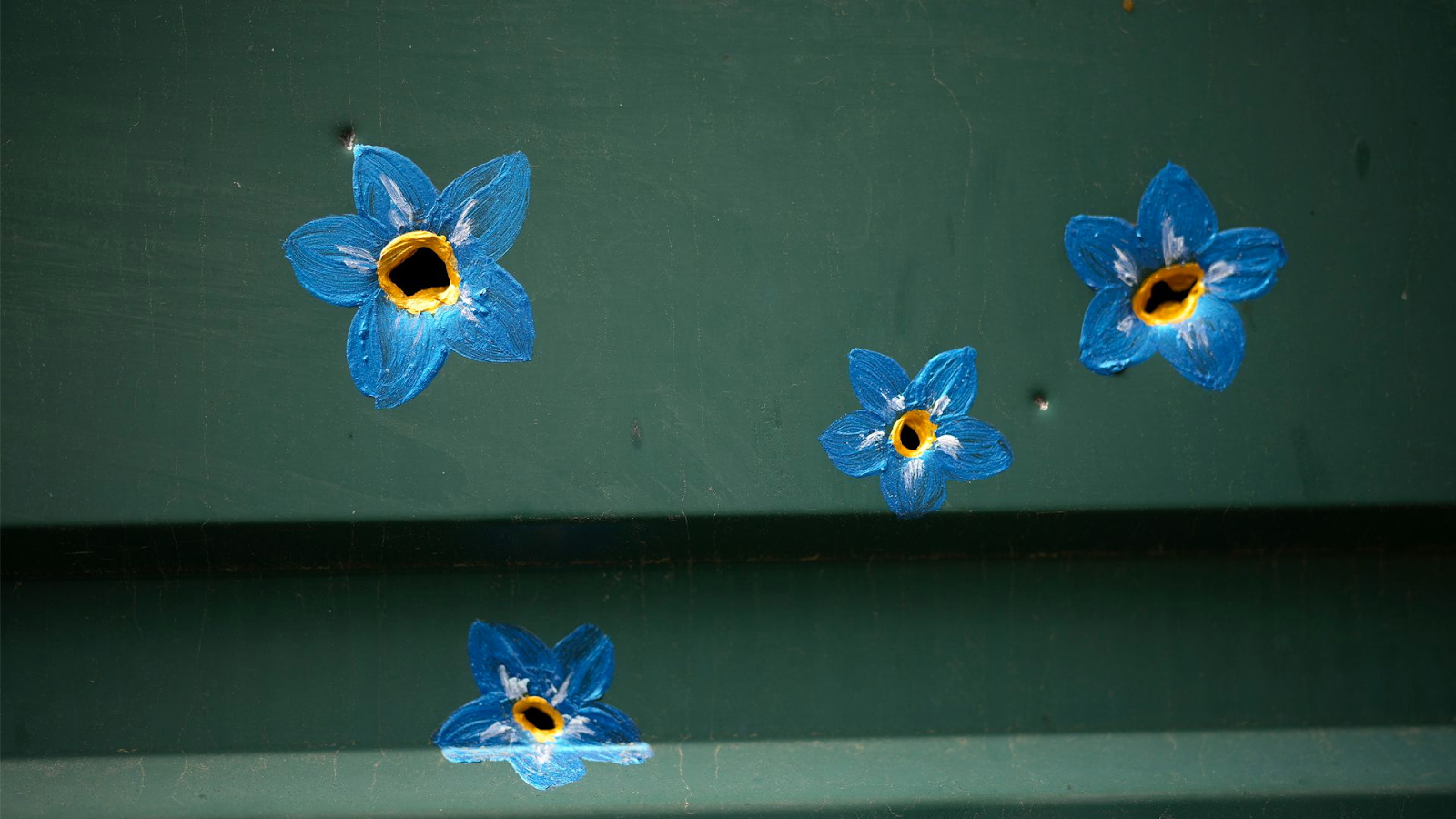
Many years ago I drew them and I have found two images of the drawings on an old hard disk file. Both images though for some reason cropped.  The shell cases were used as flower vases and perhaps I was reminded of them because of a recent visit back to Ukraine by our lodger, who has been staying with us as an escape from the war over there. She came back with some photographs she had taken of bullet holes turned into flowers. Apparently this image is now common in Ukraine, and I was able to find several online such as the one below. 


War is a horrible but very human thing, my generation being the first for a while in the UK to avoid having to go and fight. I remember wanting to draw the shell cases because of their transformation from objects of death dealing 
violence into reminders of the fact that humans can also be creative and can build intense relationships with materials that don't lead to destruction, and instead open out a potential for beauty. 

Detail: Shellcase vase

As I was making the drawings I realised that the foliage emerging from the top could also be read as marks made to represent a gun or cannon firing. 


After a long search brought upon myself because of my failure to organise files, I eventually found uncropped images of the two drawings. Seeing them again reminded me that at the time I was making drawings about looking, which means that the images read as much about the struggle to claim a relationship with a space, as about the shellcases as objects. At the time, drawing for myself was about trying to find a relationship with the space both objects and myself inhabited. I have a lot of empathy with a past self that struggled to make the white space of the paper into an extension of both mine and the brass shellcase's space. I have had a similar obsession for many years now, each time perhaps approaching it in a different way, but always associated with a puzzlement about how to engage with looking and how to re-create the energy of the experience. The conjunction of flowers and armaments, also reminded me of another image, an image from the time when I was a hippy and we were all convinced of the reality of flower power. Each of us feel the continuing effects of history, but each experience of it is unique.

October 21, 1967: March on the Pentagon by the National Mobilization Committee to End the War in Vietnam. Protester George Harris placing a carnation into the barrel of an M14 rifle held by a soldier of the 503rd Military Police Battalion


Drawings in pencil, wax crayon, watercolour and ink.

Because as a boy I was the only member of the family interested in my great uncle's fate, his diary and other personal effects were passed on to me not long after my grandparents died. He had been shot through his breast pocket, therefore the bullet went through the notebook and diary he had in it. These items had a powerful resonance and still do. 

The Human body English / French: Great Uncle Harry's soldier's notebook

It was expected that a soldier was at some point going to need to speak some French and in particular it might well be in a situation whereby some part of his body was in need of treatment. Therefore soldiers were issued with a handy reminder of what to say. 

Great uncle Harry's diary indicating the day he went on the Somme. 

The bullet that killed him went through the bottom edge of the diary, almost going through an image of an underwater mine, an image I would redraw just over 100 years later for an article 'Revealing the invisible: The virus is looking at you', whereby I looked at how the corona virus had been represented and how it could be read as a type of ‘dark star’ or anti-sun. In the article I used my own very simplified drawing of a mine to show how closely its structure echoed the way the virus was sometimes represented. I was very aware that World War I claimed an estimated 16 million lives, but in comparison the influenza epidemic that swept the world in 1918 killed an estimated 50 million people. The drawing of a mine was my private acknowledgement of how great uncle Harry still shapes some of my thoughts, his memory passed to me by his sister, and now passed on to anyone who cares to read this blog.  

The corona virus

Drawing of an undersea mine

See also:

The Blue Danube Reflections on another war and technical drawing