Showing posts with label Phenomenology. Show all posts

Wednesday, 19 March 2025

The Oceanic

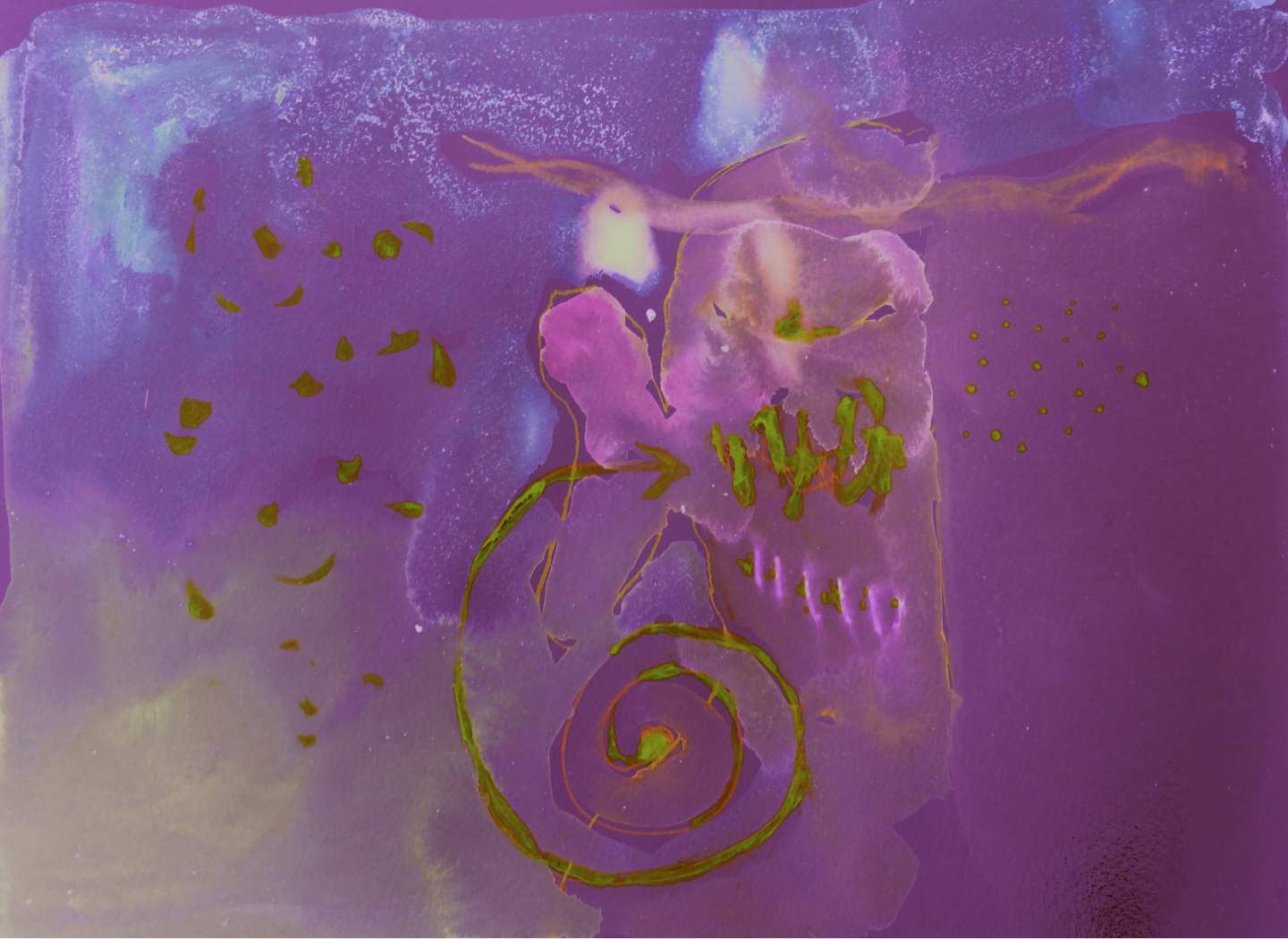
Image made in response to listening to someone's experience of tinnitus

I have for some time now been making images in response to people's interoceptual experiences. Sometimes when I do this I can find myself lost in an inner sea of the body and experience it as another universe. To be lost within people's experiences, can sometimes induce a feeling within myself not unlike that one sometimes described as 'oceanic' and when that happens the resulting images can feel cosmic. The image above was a final one made in response to a series of visits to someone trying to communicate what it feels like to hear a sound that doesn't actually exist. Sometimes this was an experience inside the body, but not always, at other times the 'sound' seemed to come from outside. The 'buzz' of sound seeming to be like the sea, a sea that existed inside as well as outside the person experiencing the noise.

I'm sure most of us have at one point or another swum out a little beyond our depths when at the seaside, or on a foreign holiday found ourselves swimming in a deep clear sea on a beautiful sunny day. These can be moments when you just close your eyes and float, letting the sea take you and as you do everything seems to be in that moment, all worries and fears for once dismissed, as you experience a oneness with the moving waters, the sea sound in your ears and the sun above. This is the feeling of the oceanic.

The 'oceanic feeling' was first used as a term by Romain Rolland. De Cruz (2022) states that Sigmund Freud in response to a letter from Rolland, attempted to explain religion as the result of certain cognitive dispositions and saw it as a 'childlike yearning for a fatherly figure'. He took Rolland's idea of “oceanic feeling” (of limitlessness and being connected with the world), as a sort of phenomenological explanation of religious experience. But what if the reality of that experience is of a deeper significance, and in being reminded of how we are totally immersed and interconnected into the world, we begin to see other moments when we are totally 'lost' in our worldly integration. Higgie, (2023, p. 73), quoting Freud, writes that he also linked oceanic states to the times 'when people fall in love and consequently feel as if they are merged with another or are in some way transfigured by the experience'. Higgie (p.74) goes on to point out how Marion Milner widens Freud's vision when she writes that an oceanic state could be experienced moments of artistic creativity, when the unconscious mind lets go of the distinction between me and not me, between seer and seen, and does things that the common sense, conscious mind cannot do.'

My occasional posts on 19th century and early 20th century mystic approaches to how to visualise invisible experiences are I'm sure linked to this feeling. The moment of creativity is something special, even if we only get lost within it momentarily, in those times we let our mind/body dissolve itself into the world via the materials of making. Higgie's book reminded me of the central importance of women to a more mystic tradition of art and it has been very useful in letting me feel connected to a range of approaches to art making that have long been there and it has also reminded me that we need, as Higgie states, 'elements of illusion to cope with reality'. (Ibid, p. 88)

Image produced in response to a conversation about tinnitus

The tinnitus image above was made directly before the one that sits at the top of this post. It is easy to see the relationship and the differences. The spiral remains a very important aspect of the feeling tone but the eye has gone, it was far too obvious and grounded the image in an exterior seeing, rather than opening it out into a more 'mystic' interior life of the invisible. The colour was too predictable and had no real sense of the un-reality of an alien sound. The notes around the edge are annotations taken from a conversation made in response to a previous drawing. I listen, I draw, I take the drawing away and then develop it further. Once satisfied that I have something worthwhile, I take it back to the person I spoke to and we begin another conversation about the relationship between the image and the experience they have had. Gradually the images are changed, a type of co-production emerging. At its best when I let go of my control, an image can arrive that seems to myself at least, literally 'wonderful'.

References.

De Cruz, H. (2022) Religion and Science The Stanford Encyclopaedia of Philosophy (Fall Edition), Edward N. Zalta & Uri Nodelman (eds.), Accessed from https://plato.stanford.edu/archives/fall2022/entries/religion-science/ 15. 1. 25

Higgie, J. (2023) The Other Side: A Journey into Women,  Art and the Spirit World London: Weidenfeld and Nicolson

Coda

It has been great to be chosen as one of the best drawing blogs out there by Feedspot: See: https://bloggers.feedspot.com/drawing_blogs/ for a link to all the ones shortlisted. 

See also:

Art therapy and perceptual research 

Drawing water

The uncertain certainty 

Freud and drawing invisible forces

Ibrahim el Salahi: Pain relief drawings

Wednesday, 12 March 2025

Sensuous aggregates

On being knocked down by a car at night

There are moments in life when time and space seem to lose their hold on you. For example when I was knocked down by a car when crossing a road and everything was happening at the same time, a sort of clumping of experience in a way very different to 'normality'. Thinking about the experience from a distance I'm reminded of other people's attempts to describe the thing I might call an accelerated intuited moment. The term ‘sensuous aggregate’ is one taken from Husserl who used it to describe a ‘unified intuition’ (Farber, 2006) and is a term used to describe the various feelings and bodily knowledge that come to us through pre-cognitive thought. This ‘sensuous aggregate’ is something that I might also call a ‘feeling tone’ when describing an experience. In both 'Logical Investigations' and 'Ideas' Husserl argues that our perceptual consciousness is based in the “animation” or interpretation of sensory data or hyle. In philosophy, 'hyle' is a noun that means matter, especially matter in its original, unorganised state. In my case a road and a car in the rain at night. It can also refer to anything that receives form from outside itself, i.e. 'that which is formed'. Hyle when brought together with some form of representation, could I think be another type of sensuous aggregate. This is the intuitive or as Williford (2013, p. 1) puts it “in-the-flesh” aspect of perception, something we discover, rather than create, another possible bridge between consciousness and the experienced world. I would argue this is another aspect of what we also call our 'feeling tone'. It's the something that lies behind statements such as, "It's all going well", or "I'm anxious about something", "this is very exciting" or "I'm going to die". The general summation of my response to stimulus, determines my flight or fight response and is the overall judgement my embodied senses are making in response to what is happening out there. That judgement depends on the form I give to the perceptions I receive. 

If so, another way to approach the images I have been making is to see them as diagrams of 'sensuous aggregates'. 

Sensuous: relating to or affecting the senses rather than the intellect.
Aggregates: a whole formed by combining several separate elements.

Often more than one sense is activated at the same time when I have a feeling. So when I'm drawing I try to bring together into one representation more than one feeling tone. Perhaps a sense of cold shiver with a knotted stomach and a vision of an empty landscape on a misty day. 

Deleuze and Guattari in response I presume to their reading of Husserl, stated that art relies on the creation of sensuous aggregates. (Rodowick in Furstenau, 2010, p. 31) So art itself could in some ways be pulled into this clump of aggregates. A clump that has now reminded me of 'the paradox of the heap', a philosophical puzzle that explores the vagueness of language and the difficulty of defining vague concepts. A heap is by definition an amorphous concept, and so is a sensuous aggregate. I know what I think I'm getting at but it might only be poetry that can save me. Heap, gravel, sand etc. out of which we build roads and buildings. But not that, something else.

I thought I saw an angel
It looked like a glowing stone

It was committed to religion 
One built on death

I picked up the stone
Put it in my pocket

In the dark it opened wings out from its back
It had had a vision of my future

When I was knocked down time seemed suspended. The car lights were frozen in my mind, but I was planted into the road, slammed flat. The image that eventually arrived is now seen by myself as a sensuous diagram, starting as a very rough drawing in a notebook, it began to morph as I began to daydream what it was like to be almost dead. It was as if I was part of a scene from a film, embedded into the scenery, but still allowed to play my part. I can see the scene now, a sensuous street, at night everything has an animist soul; the lights, the glistening road, wet from continuous rain, dark shops brooding, a stolid deep red post box, looking on, mouth open as if to say something, my shopping dispersed over the damp road, broken eggs leaking yokes in the rain, as I too dissolve into the flowing waters of the gutter. But I survived and I thanked by guardian angel.

It's now over a year since the accident, but I still see myself in that moment, as if I was outside my body, yet in it. Working with people who have had traumatic accidents has reminded me that I am making images for them to inhabit as much as myself, so images will need to be made like animist objects, so that they can be inhabited by other beings, put on like clothes or crawled into like a tent. 

Reading

Aaltonen, Minna-Ella (2011) Touch, taste & devour: phenomenology of
film and the film experiencer in the cinema of sensations.
MPhil(R) thesis. Obtained at: http://theses.gla.ac.uk/2666/01/2011aaltonenmphilr.pdf accessed on 14. 11. 11 

Farber, M (2006) The foundation of phenomenology: Edmund Husserl and the quest for a rigorous science of philosophy London: AldineTransaction

Furstenau, M (2010) The film theory reader London: Routledge

Harvey G. (2015) The Handbook of Contemporary Animism London: Routledge

Williford, K. (2013) 'Husserl’s hyletic data and phenomenal consciousness', Phenom Cogn Sci.
1​ DOI: 10.1007/s11097-013-9297-z.

See also: