Showing posts with label body. Show all posts

Tuesday, 27 October 2026

Imagined and neurobiological maps

 (c) Lee lab

I am often creating imagined maps of the body. But I'm also very aware there are other approaches to visualising the internal body and one I'm often thinking about is the mapping process that neurobiological scientists are constantly developing as they attempt to follow the complex interconnections that the body's neurological systems undertake.

Wei Chung Allen Lee of the Harvard Medical School research team that are looking at mapping the body's neurological systems has this to say, “The brain is structured so that each neuron is connected to thousands of other neurons, and so to understand what a single neuron is doing, ideally you study it within the context of the rest of the neural network. In essence, the structure of how our neurons are wired is our “self,” and connectomics is the key to understanding this structure." My lab is interested in... how those neurons are active within the functioning circuit. We do this in the context of behaviour, ranging from making decisions to executing actions."

However it is the fruit fly that is providing the material for the research and initially what we are looking at is a map of drosophila.  

The fruit fly: Drosophila

As an animist, I wondered what it must be like to be immersed into the fruit fly's umwelten or subjective reality. The project had revealed that complex behaviours and motor control were driven largely by distributed local neural circuits throughout the body rather than a single top-down brain command centre. I began to wonder how similar we might be to a fruit fly, how many of our own behaviours were the result of distributed local circuits. 

As a result of all this work the first complete synapse-level wiring diagram of the entire adult fruit fly central nervous system, uniting brain and nerve cord connectomes has been published and the images are wonderful.


The Male CNS dataset covers the fruit fly’s brain and ventral nerve cord.

Artificial deep neural networks, computer models inspired by the human brain that use multiple layers of interconnected processing units, to learn complex patterns from raw data, are used to extract information about cells and their connectivity from massive datasets. That being so, I do think there is room for some doubt on how the final pattern works, as the computer models will be looking for certain patterns and perhaps not others, but it does all seem pretty impressive.  The fruit flies, pretty impressive in themselves, are not the only animals used, mice also provide models used to help study the basic principles of how neural circuits are built and operate, thus helping to find out how neural networks are connected to each other to perform the different computations that underlie behaviour. People, flys, mice and artificial neural networks, all deeply interconnected, as they weave a new set of patterns. 
As I read about these things I was reminded of my time in Gothenburg, where I became very aware of how monkeys were used in the development of new spinal injury treatments. At the time I wrote about how Bruno Latour used the image of a constant fermentation that arises as a physical/chemical/quantum/emotional/psychological and economic mix, all being part of the currents that flow within vast energy seas of interconnected information, but the bit we think we swim in tends to be experienced as being very shallow and we easily forget its depths.  Therefore we need to be reminded that amongst many other things, we are beholden to dead animals, who have given their lives for our research. As a child in the 1950s the short prayer we had to say before meals, whereby we thanked God for there being enough food to eat went,

“For what we are about to receive,
may the Lord make us truly thankful. Amen.”

That small moment, whereby as a child I had to think about where the food came from was important. It would seem to me that we need something similar as a recognition of the role of other creatures in providing us with information that helps us to think about how we are ourselves constructed. The images below are provided curtesy of a mouse and we can think of them as visual prayers or simply that they look magical.

3D images of two neuron types in the mouse cerebellum. (c) Lee lab
An image of two granule cells (light and dark blue) connected to three mossy fibers (red, pink, and yellow) in the mouse cerebellum.

As a small token of appreciation, I have written a short poem; like the one about being grateful for the food we have, it is targeted at children, my 1950s brain, still wired in a particular child focused way and yet at the same time I'm mindful that magic practices often require a rhyming spell in order to make them effective. Even Sooty had to chant, "Izzy wizzy, let's get busy!" before his spells would work, all of which is part of the life soup, or witches brew,  that consists of the physical/chemical/quantum/emotional/psychological and economic mix that Bruno Latour was thinking about. 

All creatures of the earth and sky,
Of tiger, monkey, fish and fly.
Please listen to my humble prayer.
My endless, heavy debt of care.
For creatures of the land and sea.
Who've given up their lives for me.

So how does this mapping of 
body's neurological systems relate to what I'm doing as a creator of imagined interiors of the body? Studies have shown that within an area of the brain known as the somatosensory cortex there exists a map of the body, with different regions corresponding to different body parts. These maps are responsible for processing sensory information, such as touch, temperate and pain, as well as body position. For example, if you touch something hot with your hand, this will activate a particular region of the brain; if you stub your toe, a different region activates. For decades now, the commonly-accepted view among neuroscientists has been that following amputation of a limb, neighbouring regions rearrange and essentially take over the area previously assigned to the now missing limb. But this has presented a conundrum. Most amputees report phantom sensations, a feeling that the limb is still in place, this can also lead to sensations such as itching or pain in the missing limb. Also, brain imaging studies where amputees have been asked to ‘move’ their missing fingers have shown brain patterns resembling those of able-bodied individuals. I.e. the body itself has an imagined map, one that remains in place, even if parts of the body are no longer there. In my own imagination therefore, the imagined body map I internally possess myself, becomes merged with the imagined body that I am over the years constructing and externalising, not only of my own interoceptual feelings, but of other people's. 

Pain map made in response to a conversation 

Sclerotome pain referral patterns 

Diagram from a Hermetic practice

The mystic interior

The more I talk to people about their pain, the more I realise it is a complex issue. For instance, sclerotomal pain is typically felt as something deep down or dull and it is poorly localised; people often describe it as “achy” or “boring”. In contrast: dermatomal pain, that connected to an area of the skin linked to sensory neurons from a particular spinal nerve, can be sharp and burning and well defined, as when a spinal nerve root is compressed, irritated, or inflamed (such as from a herniated disc, spinal stenosis, or a viral infection like shingles). This is closely linked to myotomal pain, as felt by a group of skeletal muscles supplied by a single spinal nerve root; the pain symptoms occurring when a nerve root in the spine is compressed, irritated, or injured. This time a pain might feel crampy and be associated with restricted movement or fatigue. There also exist maps of acupuncture points that treat deep connective tissue pain as well as sclerotomal maps that assist clinicians in tracing the origin of pain that doesn’t follow a typical dermatome or myotome, such as pain around the shoulder blade from lower cervical irritation or deep pelvic pain from sacral sclerotome involvement. I. e. where pain seems to be in the mind map, is not necessarily, where an actual problem lies in the body.  It is as if the body can tell lies or at least stories that are hard to read or understand. These issues chiming with my own continuing struggle to visualise the sensations I have when inhabiting this old body of mine. These other maps all operating as parallel forms of awareness, that lie in that area of associated attempts to visualise the internal body from the point of view of other disciplines. My imagined interoceptual maps acknowledge their existence and participate in diagrammatic dialogues with the observer but the area of overlap is one of intuitive feeling and never one of scientific verisimilitude, as much about diagrams taken from magic rituals as maps of Yorkshire's underlying geology.

Interoceptual body map
Ref.
Caruso, C (2023) A New Field of Neuroscience Aims to Map Connections in the Brain: Scientists working in connectomics are creating comprehensive maps of how neurons connect to one another Harvard Medical School Reseach News January 19, Accessed from https://hms.harvard.edu/news/new-field-neuroscience-aims-map-connections-brain 17 Oct 26. 

Wednesday, 6 May 2026

The flying carpet, art and craft

I sometimes get textiles made in order to communicate certain types of ideas; in the past I have had headscarves, shirt material and hangings made. I'm now thinking about how the carpet and prayer mat carry associations. As crafted forms they can also be used to posit questions as to where the art/craft divide now lies and whether or not that divide still exists. I recently saw that there had been an exhibition of what have been called Afghan war rugs. It was advertised with the for myself worrying byline, "War and conflict have long had a role in the production of art." The associated text went on to say that, "This survey is steeped in the tension between aesthetic beauty and violent subject matter." I wasn't sure about this either but it did remind me of something that has long haunted my imagination, the flying or magic carpet, a form I have been fascinated by since when as a boy I saw the 1940 film, 'The Thief of Bagdad'.

From: 'The Thief of Bagdad'. Abu on the magic carpet. 1940 Dir. Korda

Much of the action in the film takes place in Basra and at one point the young thief Abu is turned into a dog, an attribute as a 'Barker' I could easily empathise with, my then late 1950s school nickname being 'woofwoof'. 

Abu as a dog

My understandings and feelings about the city of Basra are therefore conflicted and confused, it is woven together in my head as both a place of magic and of war, a place inhabiting my 1950s memories as much as my more recent awareness of tragic events brought to me by the various news outlets.

My inner head mash up continues; our lodger is from Iraq and he has tales and stories of conflict from the time of Saddam Hussein, many people in his family having been put to death because of their political views. I still clearly remember going to London to march and protest against Tony Blair's Labour Government wanting to take us into war with Iraq over weapons of mass destruction; which we found out later never existed. We now see night after night of images of a gradually being destroyed Iran, so soon after it seems like a thousand and one nights of a slowly being destroyed Gaza, these events being our contemporary bedtime stories. The Middle East or more accurately West Asia, feels like a media myth, a story played out like some form of fantasy tale that no one in the West seems to have any real understanding of. The 'Middle East' might as well be another story from a 1001 Nights. In Islam, a prayer mat is placed between the ground and the worshipper. It also operates as a magical flying carpet, one that helps to separate the devout follower of Mohamed from the filth of the world when they pray. The prayer mat in effect operating as a temporary vessel for a spiritual journey.


 Prayer mats

Within Islam, the prayer mat is a powerful symbol and it is disrespectful to put one down for prayer in a dirty place. They are traditionally woven with a rectangular design, typically asymmetrical so that it is easy to see where the head goes when in prayer. The designs may also represent the promise of paradise and eternity, the mat in many ways operating like a doorway into paradise. No wonder the myth of a flying carpet arose out of this tradition. 

Unknown maker West Afghanistan, “War Rug with Peacocks,” date unknown


Detail from a prayer mat I had made and which was installed as part of an exhibition

Ten years ago I had a prayer mat made for an exhibition about the migrant crisis and I had a Qibla compass inserted into it, so that it was always set out on the gallery floor pointing towards the Kaaba in Mecca. I thought and still do, that the idea of a direction for prayer being more powerful than an idea such as North-ness, was an amazing thing, giving a physical shape to the idea of belief. Ten years on, the work feels naïve, so much has happened since then and AI has thrown image making into a tumble dryer, what might have been seen as an interesting conjunction back then, is now simply lost under an avalanche of everybody's personal AI image generated snow. Which is sort of why I'm getting more interested in craft. The handmade object is coming back into its own. The more AI is used to make decisions, the more we will need to be reminded that humans can still make things and we will look more and more for the fingerprints of a maker and perhaps value the sleek engineering of the manufactured object less. 

When I used to teach on the Foundation Course in Art and Design, there were fierce debates about the relative value of art and craft. Craft was often denigrated as being just about hand skills and fine art it was argued was more to do with concepts and was therefore of a higher value. Since then we have had the material turn, a theoretical shift across the humanities and social sciences that now focuses on the agency, role and importance of physical objects, technologies and bodies. "Things", such as a crafted object or a skill such as an ability to weave, are seen as active ingredients, enmeshed into life's meaning, rather than them being passive or inconsequential. Artists such as Grayson Perry have shown how articulate craft can be and have helped to break down the art/craft divide. 

But there is still that need to create meaning. It is wonderful to think that the hand is being appreciated as a thinking tool and that the mind is now understood as something embodied, rather than being something that sits outside of our bodies, sort of gazing out of a fog of unreality. But ideas are still needed, they just change with the readjustment of focus and the application of a new lens. Craft or an understanding of making, becomes an idea in its own right, therefore it can be added into a theoretical toolbox and then it rubs up alongside all those other ideas, such as critical theory, spirituality, evolution, game theory, scientific method, human rights or communism. 

I've just been working on two related pieces that are now showing in Yorkshire Sculptors Group exhibitions. One 'Monkey Mind' has gone on show in Barnsley Civic, the plan for its installation being directly below and the other 'The Cosmic Body' is on exhibition on the third floor of Salt's Mill in Saltaire. 

Monkey Mind

The Cosmic Body

Both installations are made of textiles and ceramic pieces, but I had the textiles made by a company that usually makes objects for domestic use, so they are seen as 'throws' or 'blankets' and I'm repurposing them as magic carpets. I have been trying to fuse several ideas together. One is to do with the fact that ancient burial sites have objects buried in with the bodies. These objects were often to help the dead navigate the afterlife and this navigation might be a protection from evil spirits or perhaps spiritual food for the now dead. 'Monkey Mind' is for the now alive, but to give them things to contemplate, in a similar way to how Japanese kusiizu images work, which are graphic depictions of corpses in the process of decay, images that Buddhists could meditate upon as reminders of the fragility of life and the reality of death. 'Monkey mind' being what we need to escape from, the never ending internal mind chatter of what to do and what to think being something that at some point we will have to cease. It's interesting that the only feedback I've had from anyone visiting is that someone thought my work looked like roadkill. 
In contrast 'The Cosmic Body' is more a reflection on traditional Chinese medicine (TCM) and its view of the body as a cosmic entity. In TCM the human body is visualised as a microcosm, a miniature universe or "cosmic entity". It is intricately linked to the natural world and governed by the same forces, therefore health is maintained by balancing our internal energies to ensure harmony between body, mind and the world. I continued to put '
The Cosmic Body' together in different ways as I was trying to follow various narrative shifts, but I had to stop as the work needed to be installed in Salts Mill in readiness for the exhibition opening. 


Details: The Cosmic Body

I like the mix of a cheap reproduction, (the textiles) and the hand made, (the ceramics). In many ways the ceramics are 'cheap', as I am using bright earthenware glazes and have avoided the subtlety of stoneware. I'm still trying to work out what things mean, rather than simply letting go but I seem to be in a mental trap of my own making. Both these pieces are presented on 'magic carpets'. The textiles being frames that allow the idea to float, as if in another world, the fringes defining the edges of an idea as much as an object. However I now need to refocus on the work for Graz, as I go over tomorrow to install work and host workshops. After all the hassle trying to get the work over there, (I was using a carnet system as organised by the Bradford Chamber of Commerce), I shall also go over with a tube of glue, in case when I open the shipping crate, the ceramics are broken. The getting of an exhibition into Europe is now a post Brexit nightmare, but I shall reserve the details for a later post, as the procedures took a while to sort out. If someone else reading this blog is foolish enough to also be thinking of shipping an exhibition across the Channel, all I can say is, beware the bureaucracy of the carnet system. 

See also: 

Tuesday, 2 September 2025

Drawing out from within

In 1945 farmers digging in the Upper Egyptian town of Nag Hammadi, discovered some long lost texts, that were found in unearthed ceramic jars. Amongst these texts were 114 supposedly secret sayings, that were attributed to Jesus. These short texts were about spiritual knowledge and they were understood to be from the Gospel of Thomas, a non-canonical text that is not in the Bible, but which scholars were aware of because of the existence of previously discovered fragments. However, this was a complete manuscript written in Coptic. Of these sayings perhaps the most well known is; "If you bring forth what is within you, what you bring forth will save you; if you do not bring forth what is within you, what you do not bring forth will destroy you".
For someone trying to visualise interoception, this phrase has often come to haunt me. Interoception is defined as the sense that allows us to perceive internal bodily sensations, such as emotional change, heart rate, respiration, hunger, and pain. It's often described as the body's "eighth sense," playing a crucial role in our moment-to-moment awareness of our physical state and influencing our emotions, self-regulation, and decision-making. 
Chen et al (2021) point out that definitions of interoception change and that they were initially to do with a creature's 'internal state', then by the mid 20th century it had become a way of referring to the dynamics of a body's homeostasis and only recently has it been seen as a communication process by which the nervous system both senses and integrates information about the inner state of the body.  They highlight 'the complex interplay between the brain and other organs necessary to monitor and regulate internal states'. (Ibid p. 4) 

The anatomical boundary that separates interoceptive from exteroceptive experiences has historically used the skin as a dividing border. Chen et al (2021) point out that interoception was focused on signals generated from within the body, sensations occurring below the skin, but as I have already become aware, it's not quite as simple as this, there being no clear division between internal and external realities. Even so, I like to feel that the images I make can 'get under your skin'.

Perhaps this is why that old Coptic text of St Thomas still strikes a chord in me. 

Although most of the current texts on introception rely on discoveries in neurology, as an artist, I'm still fascinated by psychology and its early acceptance of a subconscious/conscious dialogue. In fact the inner/outer duality of interoception/exteroception, stirs within me Surrealist yearnings and I'm prone to make responses to what I think I might be feeling, by relying more on instinct and chance than any sort of rational process.

The psychology of interoception works with body awareness and an ability or inability to use this awareness, can affect psychological issues related to mood and other emotional factors. The work I do in trying to help raise awareness of somatic feelings will hopefully help others enhance their ability to control emotional regulation and well-being, but I don't expect my art as such to change anything. The process of being involved and listening is probably the most important issue in relation to the fostering of wellbeing, the artworks themselves are stand alone entities, that emerge from a fusion of the process of listening and the process of image development. Part of the process therefore of an image's development, may well be therapeutic, but the final images are creatures in their own right, things that can carry whatever meanings they can, but they are not in themselves therapeutic images. 

I have been working with other artists to try and resolve some of these issues, as well as people who are not at all connected with the art world. Sometimes because of the close affinity I can feel with fellow practitioners, especially those that see drawing as fundamental to their practice, I can begin to see an almost epic dimension to the work. In conjunction with two artists that I have known for several years, I have recently been making much larger drawings, these are attempts to capture some of the essence of another person's life experience. We have spent some time preparing for the sessions, each artist making objects or drawings that can be shown alongside themselves, things that are used to animate the situation that we each draw from. The difficulty is we are all isolated from each other and we use the medium of the computer screen to communicate. We have though been doing this for a while now and we have tried a variety of ways to break through the barrier of the screen and try to 'touch' each other with our 'inner' as much as our 'outer' appearances. Above all we talk when it is our turn to be the subject. Conversation is such a wonderful thing, our sometimes awkward and at other times poetic attempt to put into words the things we are thinking and feeling, is right at the centre of what it is to be human. This alongside an eternal hope and expectation, that others will get some sort of awareness about our inner thoughts from a dialogic process. When you do this with people who are also practiced at another form of conversation, that of direct drawing from experience, the conversation is deepened. You are in the company of those that can feel the limitations of verbal conversation; as artists they of course value the poetry of communication, but they also, like myself, sense that so many things are unsaid, mainly because they can't be 'said' using words. We look at ourselves in the mirror and see a something that is as much the person inside as outside, our outward appearance a cypher that has to be decoded in order to engage with inner thought. A stance may indicate illness, mental state or environmental threat, the speed of a body's movement tells us so much about the physical and mental state that it encloses, the smoothness or erratic track of someone's hand gestures speaks silent volumes. 

Portrait of an Italian artist by an English artist: The inner and outer of an interoceputual experience

The three of us have recently been working on a particular project, focused on trying to extend previous ways of making portraits of each other and on my part, I have also been trying to re-define for myself what it is to make a portrait of another human being. This overlaps with the work I have been doing in the hospital, but in the protective bubble of artists communicating with other artists, I feel that I can begin to let go of my normal reserve and reveal aspects of myself that don't normally emerge in everyday life. I sense that that is also the case with my fellow artists. Perhaps this is art as a form of counselling, I don't know, but I do know that emotionally this is a very hard body of work to be engaged in and that it really stretches my ability to make emotionally resonant images.
 
Portrait of an English artist by an English artist: The inner and outer of an interoceputual experience

As I make the drawings, which are 5 feet (h) x 8 feet (w), I also photograph them and then make prints from the drawings, which are what I'm putting up for you to see on this blog. The prints are more screen friendly, I don't think the translation of large drawings into screen images works at all. The scale of the originals is such that you need to step up to them and then pull away, in order to get a sense of how they work. I'm also making all of the work done from the hospital available in digital print form, so that it is available to everyone concerned, patients and medical staff, and therefore I am becoming more attuned to the relative values of digital versus analogue imagery, seeing them both as capable of carrying feelings and emotional registers, but in very different ways.

An important issue is surface. The hand drawn initial images clearly show the traces of material changes and human interactions. There will be now dry water diluted coloured liquids, pen marks cut into the paper, areas of wiped away colour still holding a memory of the wiping in their stain, frozen brush strokes and fingerprints from when I have had to support myself as I have leaned over the drawing in order to make marks. The hand is remembered because the scale is one to one with the body, the paper size forming a flat theatre of possible re-enactment of every gesture made in the image's making. The digital version is very different, but as a print it carries a set of values compressed into a form that is equally powerful as a communicating surface. Paper and ink are fused together in a different way and if the right paper is chosen, (in this case Hahnemühle German Etching mould made paper and the inks all at maximum intensity, i.e. the printer is properly working and laying down colour as dictated by the digital colour files), the surface can be rich and seductive. Differences in handling in the original are now translated as changes in granular texture. The thickening and thinning of paint or ink as it moves across a surface can be captured by photography and tonal differences enhanced by using a digital filter that operates in the same way as now long discontinued lith film*. As this filter has only has black or white options it will produce a black and white granular texture as a translation of a smooth movement between light and dark. Therefore a brushstroke may now have a more three dimensional appearance or a new texture, due to the 'pushing' of the contrast. 

This way of working is a hangover from my time as a print technician. When I used to make silkscreen prints, I would often use what we called at that time, black and white 'lith' film', which came in rolls, so that it was large enough to make A1 size photographic exposures. Once made these positives of developed film were in effect 'burnt' by light into an emulsion that had been applied to the surface of the nylon screen, thus making a negative, through which ink would be squeegeed to make the positive on the paper that was to be printed on. 
High-contrast lithographic film was a specialised type of orthochromatic film designed for graphic arts to produce stark black-and-white images with maximum density and stark separation between tones, using a process that required careful control of developer strength. The film was specially produced for silkscreen printing, as any stencils; photographic, painted on or hand cut, had to allow for the printing of flat colours by pushing ink through a fine nylon screen. As technology moves on, it often carries memories of a previous technology embedded within it. For instance the first cars were at one point known as horseless carriages and their box like shape was a reflection of this. In a similar way the early filters designed for Photoshop, tended to reflect the types of photographic film and associated processes that existed before digital processing. 

I'll try and explain how I use this in the development of a digital print. In the detail taken from a hand made original below you can see the thickening and thinning of paint and inks, as well as tonal diversity. 

Detail of a large drawing

In the black and white image made from the detail above, a stark separation between tones has been achieved by using a 'stamp' filter on Photoshop. I have to decide the percentage of white to black, so I ask myself, do I need more black or more white in order to achieve the emotional effect I need? The most interesting textures are always those that evolve in the between areas, not clearly white or black and just as the old lith film did, this filter breaks down in-between areas in quite unpredictable ways. 

Image converted to black and white and using the 'stamp' filter in Photoshop

I can selectively highlight any area and make each selected component of the image darker or lighter, so may make four or five different black and white exposures and then collage them together to make a final textural layer. 

Once I have a surface similar to the one above, I can use this as a layer that can then be placed on top of coloured layers, often as in silkscreen printing, making the layers transparent, so that colours can both intensify each other and create often unexpected new colours as they overlay. I can then build the image up, layer on layer and as I do I can push some elements into the background, heighten others and remove anything that doesn't support the overall emotional tone. 

Detail of print

As you can see the final image made for print, is very different in surface feel to the original drawing. All the layers are compressed down before printing, their colour intensity when translated into ink, giving the image an impact that for myself, can be as powerful as the one made by the size and textual surface of the original drawing. Deciding dpi and output size is also of vital importance to the look of the final image. When printing these images, they are in effect squeezed out onto the paper surface and as they emerge back into daylight, this very compaction gives them a certain traction that allows them to stand up alongside images made in more traditional ways.

I have digressed I know into technical matters, but they are all a necessary part of the process of drawing out the interoceptual aspects of an experience. Technology is a vital aspect of drawing, a word that has ancient connections with the word 'drag', in the sense that you can drag a plow through the ground, thus scoring it, leaving a line of exposure as the earth is turned over to reveal the colour of the soil below. I am in effect trying to use drawing to drag out of myself and others, some sort of response to the feeling tone of interpersonal communication and whether this requires analogue or digital processes to do this, doesn't I feel matter, what does matter is whether or not some form of communication is made. 

Finally some thoughts about the drawing out from within that touch more upon the poetry of that inner/outer flow. In Philip K Dick's science fiction novel 'The Divine Invasion' he develops a wonderful description of what space and time is like for God like beings and I transcribed his description of a particular journey taken by one of God's prophets into my own words, in order to get some sort of traction on the poetic possibilities of a mind seeing both inside its own body and at the same time being able to escape the confines of a body and move out into the cosmos. This is what I wrote at the time when I attempted to imagine myself as one of Dick's characters:

My mind began to travel in an outside mode, my consciousness ceasing to be something, instead becoming a process, evolving into accretional layers, inhabiting a timescale of the outer world. From there or when, they are now both of one indivisible form, I could at last see the inside forms of my somatic body from another reality and as I rose above myself, I became a process of Hermetic transformation. I saw my body not as a mass but as transparent pictures permutating at an immense velocity, images made of forms outside of space, being fed into the body to become reality. As this image froze, time ceased. Slowly, by degrees a transformation began to take place, I saw outside of myself a pattern, the print of my own brain, I was within a world made up of my brain, with living information carried here and there like little rivers of shining red that were alive. I could reach out and touch my own thoughts in their original nature, before they became thoughts. Space filled with their fire, it stretched out, the volume of my own brain becoming external to myself. 
I now began to introject the outer world, so that it became contained within myself. Now having the universe inside me and my brain outside everywhere. My brain extended into vast spaces, far larger than the universe and I knew the extent of all things that were myself and because I had now incorporated this world I knew it and controlled it. 

What is within you, is also outside you; what you bring forth will both make you and disguise you.

References

Chen, W. G., Schloesser, D., Arensdorf, A. M., Simmons, J. M., Cui, C., Valentino, R., Gnadt, J. W., Nielsen, L., Hillaire-Clarke, C. S., Spruance, V., Horowitz, T. S., Vallejo, Y. F., & Langevin, H. M. (2021). The Emerging Science of Interoception: Sensing, Integrating, Interpreting, and Regulating Signals within the Self. Trends in neurosciences, 44(1), 3–16. https://doi.org/10.1016/j.tins.2020.10.007

Dick, P. K. (1981, 2008) The Divine Invasion London: HarperCollins

Tuesday, 15 July 2025

Pilates and Interoception

The inner body as a psychic form

I have for the past few months been undertaking pilates exercises. These have helped me to get more in touch with my body and to teach myself about myself. Each week as I go through a set of controlled exercise routines, I am gradually, very slowly, increasing my ability to control my body. In Pilates, students, like myself, are taught to employ the repetition of specific movement skills, and gradually through repetition, hopefully the brain will also rewire itself, as a more body aware organ. This hopefully will develop my neuromuscular synapses, and lead to a heightened body awareness and therefore more precise body/joint/muscle control, something that I am testing out by playing more and more table tennis.

One example is the fact I often experience lower back pain. I have realised that I have trouble sensing the position of my pelvis in its body space and find it hard to differentiate the movement of my pelvis from my spine or distinguish the movement of my hip joint from my spine. I am slowly becoming aware that I can more precisely activate my core and I am sensing the fact that gradually I can take control of an inner set of relationships, that previously I wasn't even aware of.

My trainer/teacher gets me to make certain movements over and over again, their repetition has helped me to internalise certain movement skills, an ability that I am beginning to see as being essential for my lower back health. I see this development as fostering improved communication between my brain and my body, which should also eventually result in more resilient muscles and an increased capacity to sustain effort over an extended period; again I am trying to test these things out by playing table tennis. For instance how quickly I react to changes in incoming stimulus or how long I can sustain a certain level of bodily concentration.

All of which I am of course then trying to bring into my visualisation of interoception research. I am trying to approach the issue from several angles at once, putting myself and my feeling tone, at the centre of the process, as well as looking at other cultures and their various ways of depicting inner body understandings, such as old Chinese Edo period medical illustrations. I cant really ask others to believe in what I'm doing, if I am not prepared to undertake an investment in the full possibilities that begin to open up, as I continue to explore the relationship between my inner body and my outer psyche in relation to the way that my outer body hosts my inner psyche. The folding that I feel takes place, seems rather like a Klein Bottle, my insides becoming my outsides, my facial signalling reflecting my stomach feelings and my mind reflecting my body. 


Studies for body mind awareness

The animation I'm working on tries to deal with these issues and at times it represents feelings trapped inside the body, at other times the body becomes a landscape and then we slip between the body and its interior organs and the feeling tones or sensations that make up the emotive landscape that emerges from the physical release of hormones into the bloodstream. 

The images above eventually become embedded into ideas for a body moving within a body. The 'trunk' being a totally separate organ, seen as an idea rather than as some sort of anatomically accurate image. 

Four versions of a trunk, ready to be animated

Body parts to be attached to a trunk

As I begin to put the animation together, the process will like all my other drawing activities, eventually begin to tell me what it is becoming about. This finding clarity in the muddle of doing, is I'm afraid my most valued methodology, but it is not one that sits very well within the established research list of approaches to attaining new knowledge.

However here is a first indication of what the interior somatic feelings are looking like.

The growing awareness of a pain emerging

In the image above, I'm trying to fuse a shape of a pain with an emotive reading of a response to it. The landscape itself is a fusion of two sets of drawings, one of local woods and another of mountains of slag drawn from memory. It is movement that tells us something is alive and active, a throbbing pain, being as alive as a flying bird, all inhabiting the biological ecosphere. 
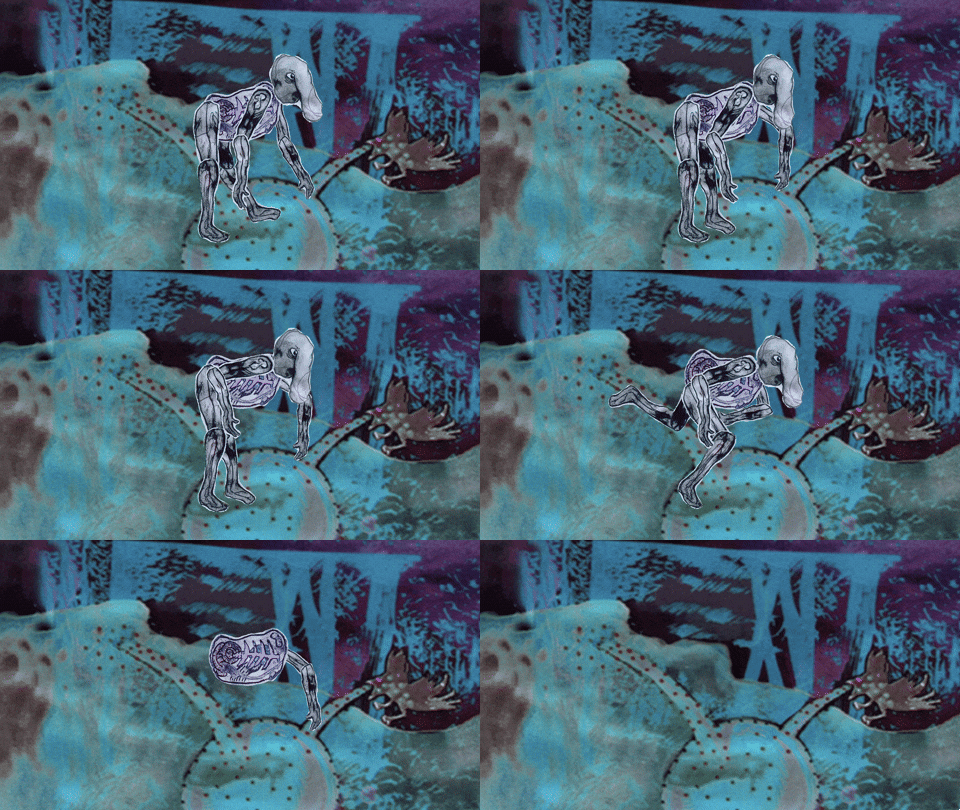
The animated gif image below is an indication of how the trunk and body parts will come together. I was initially going to hand make all the parts of the animation and had already made a few cutout puppets, jointed with paper fasteners, but Doctor Simpo, an old friend and animator as well as comic maker and many other things, suggested that he could digitally animate the figure for me. This is his test, to see how the figure sits against the background. 


As the figure moves through the body/landscape it talks to itself, using a language that has been constructed from sounds made as people respond to different feelings, see Sound sample

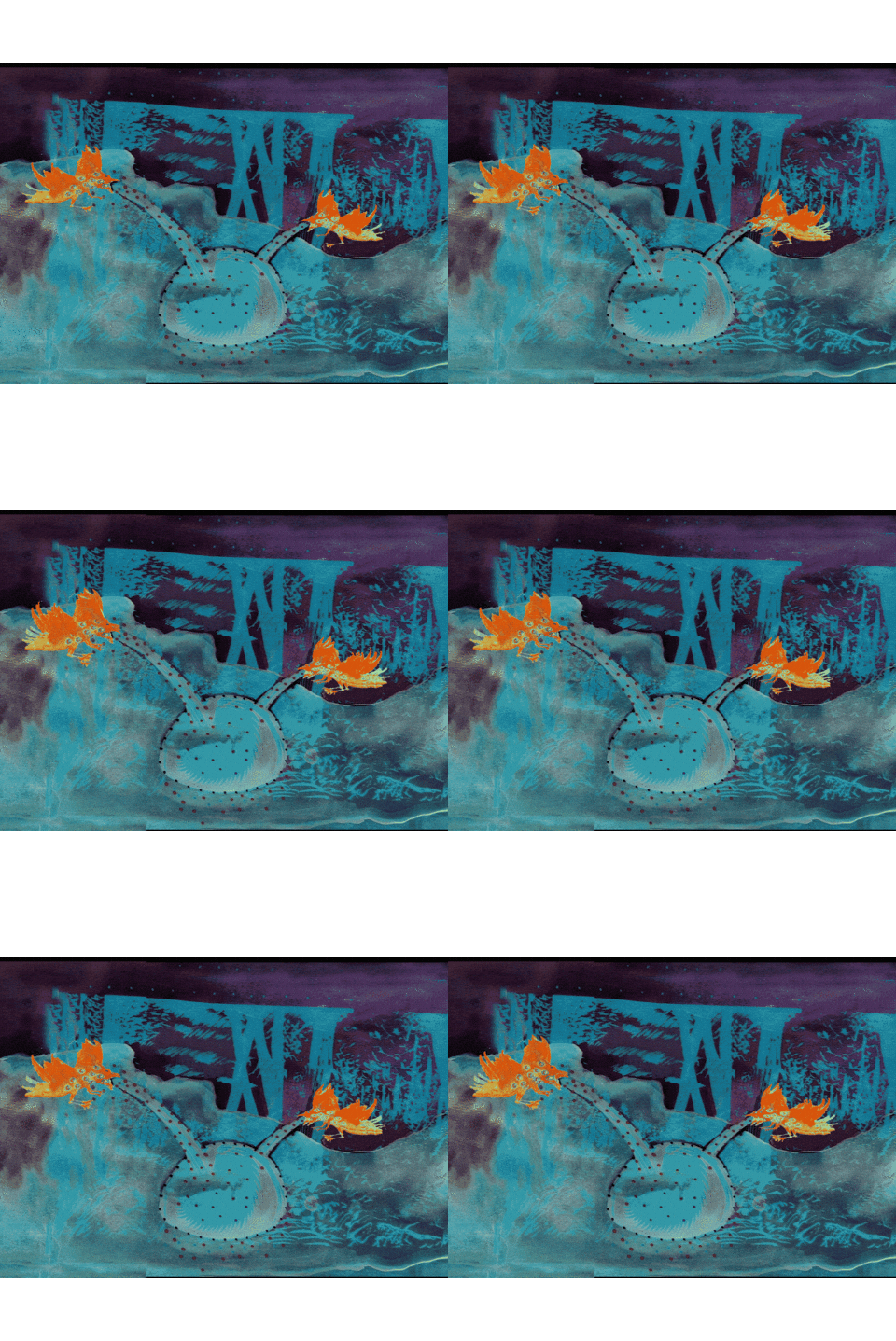
The object in the frame that looks a bit like a helmet with two horns, is what I termed a psychic infuser, it is where life energies can be piped into the ground from living creatures, in this case birds attempt to breath life into the landscape. You can get a better idea of how that works from the image below, which is a colour test, to see how orange would sit against the blues. I'm yet to animate the birds properly, as they need to be redrawn. 
As I return to pilates, I will continue to use the experience to visualise a somatic awareness of the body in motion, alongside trying to represent the feeling tone that I have as I emotionally think about my ageing abilities to move. Therefore the visualisation of emotional feelings has to be coupled with 'invented' body forms, something that is also being developed by another related project that has emerged from the meetings I occasionally have with artists that worked with myself on 'The Body I am in' online project. I am in the middle of a new project directed by myself, but with growing interventions and ideas from the other participants, whereby three of us are working to develop body costumes to help externalise internal feelings but there is so much going on there that it will need a post to itself to communicate what is happening. Hopefully, this work will begin to fuse with all my other projects, such as the work at Pinderfields Hospital, and I will begin to see what it is I'm actually doing. 
References:

K. Caldwell, M. Adams, R. Quin, M. Harrison, J. Greeson. 2013. Pilates, mindfulness and somatic education, J. Dance Somat. Pract. 5 (2):141.


See also:


Thursday, 24 April 2025

The poetry of the body

Gaston Bachelard's 'The Poetry of Space' was at one time an essential text to read. It gave artists a rationale that they could use to value the poetic (i.e. non scientific) way that they shaped lived experiences and his text demonstrated how emotional responses to spaces like attics, cellars or even drawers, could be communicated through a more poetic understanding.  

What I'm looking for is a companion volume, 'The Poetry of the Body'. Something that like a dérive, eventually finds purpose in wondering about. My unsettled mind, as it flitters around and alights on stuff and then dips into things, never quite settles. I cant seem to drill down and deeply focus on one thing or another, each of my posts skips around an idea, but never quite settles down and I'm looking for some sort of confirmation that this is ok, this is normal.

I was watching a butterfly in the garden yesterday. It seemed to be randomly drifting around, following the shifting air currents as a light breeze passed through the hedge. Then it settled on an old stuffed textile. The cloth was now a pale yellow, a ghost of its former self, but it  offered a moment of warmth to the butterfly, that then spread out its brown spotted wings as a gift to the world. As it bathed in the sun, the surface it had happened upon became something else, a spot for sunbathing. It was a sunbathing spot that hosted a sunbathing moment, like all the billions of moments that butterflies of this sort had had in their pasts and futures. A moment that I now thought was what that old thrown out stuffed cloth had been made for. It was already degrading, it had the grime of nature already woven into its texture, touches of green were now growing through its tight matrix of fibres and this moment, was perhaps the moment of its transformation, woven back into the matrix it had emerged from. 

The speckled wood

 A moment of inconsequence, but it felt more real to me than the many systems of thinking and categories of connections that I had been wrestling with over the last few years. 

I sitt in a plastic red chair, writing about something I felt yesterday. As I lean forward to write, I'm aware my shirt lifts away from my lower back and I feel the cold air that this lets move across my skin. The chair exerts pressure to my upper thighs and I can rock slightly from one side to the other to make myself more aware of this. I cough occasionally, I am getting over a nasty viral infection that I have had to struggle against over the last two weeks. I wonder how many more I will succumb to in the future, before one takes a hold that I cant shift. I have an itch that I cant really get at as it sits between my shoulder blades, but I don't mind, it helps make me aware of that part of my body and it guides me to an ache that sits across the top of my shoulders. My attention, like that of the butterfly's, flits around and then I forget these body sensations because something else takes my attention. The flow of awareness, the impact of constantly occurring qualia on my perceptual screen, is like a mist that I walk through and as things appear to solidify themselves as they emerge out of this mist, I tend to mostly let them fade back again, unless it feels as if they hold some sort of importance. 

For a brief moment this morning I saw something come into focus as I was looking at the work of Flora Joan, who is an acupuncturist and artist. She is part of 'The Nature of the Points' a group based in Amsterdam who have been thinking and acting within a territory that straddles visualisation and healing.

Tongue and diagnostics: Flora Joan

Tongue reflexology

The tongue can be used as a diagnostic tool and it can be used to assess the flow of Qi (energy) in the body. I was interested in Flora Joan's illustration because she was bringing together elements from both inside and outside traditional Chinese medicine, in particular her own focus on a return to nature. Looking at the range of activities that take place under the umbrella of 'The Nature of the Points', also helped me develop my own thoughts on how useful my work on the visualisation of interoception was and I could see a clear link between the work they do and what I'm attempting. 


Visualisations of subjective models of the body's interior

I have cardiac arrhythmia and certain medical and music scholars have speculated that Beethoven may also have had the same condition. In his musical scores he sometime uses asymmetrical rhythmical patterns and changes in tempo, that could possibly mirror the effects of an irregular heartbeat. This aspect of his work has also been linked to a correlation between the known times when it is argued he would have experienced stress or a very high emotional connection with what he was engaging with. It is impossible to prove this of course, but it is another of those possibilities or what ifs, that help me frame up what I'm thinking about in relation to emotion and its communication. 

An invisible hand about to close on the chest

Sometimes I dream about my inner body being squeezed and then realise its my heart trying to tell me something. Out of dreams, sometimes emerge images that sit between the conscious and the unconscious mind, they can be an alternative poetry of the body. 

I think of Beethoven is a giant of poetry, particularly in the way his music's expressive power and ability to evoke emotions, goes right down to my body's core. I 'feel' his emotional intensity, as a type of 'sound poetry', something that I intuitively feel ought to be possible as 'visual poetry' as well. 

The externalisation of an idea of a headache

I have attempted to visualise inner sensations in a variety of ways and after running several workshops with people looking at how others can visualise interoceptual experiences, am now very aware of the necessary time it takes for people to confront the difficulties that face them when attempting to learn a new or developing language. Often you need to show a 
cliché in order to open a pathway towards an alternative.

Headache

Sometimes I have to rely on existing conventions and deal with clichés, as in the image of a headache I came up with above. This was an image arrived at by consensus but which I now feel could go on the side of a packet of Anadin. Which in itself might be a good thing, but I have never thought of my work as graphic design for pharmaceutical companies. 


An image of sinusitis intuitively feels to me that it is much more interesting.

Headache: Sinusitis

This is a more personalised image, one made as a consequence of a conversation, so it is an actual 'portrait' of two people's interoceptual experience, rather than a generic visual idea. Perhaps this is where the value of the work lies and that by tapping into individual experiences and trying to make them visible; am I finally making some sort of embodied visual poetry?

See also: