Showing posts with label cosmos. Show all posts

Monday, 14 September 2026

We are an expression of the universe

The embodied cosmos

I have recently been writing an article that explores relationships between my ideas of the body and how we think about landscape. In particular I was looking at how our understanding of the features of landscape begins in a knowledge of our own bodies and that at the same time, our imaginative awareness of our internal interoceptual world, is fuelled by our experiences of the environments we inhabit. They are interconnected; one becoming informed or shaped by the other. This type of idea is not new and in my article perhaps I should have pointed out that it is a concept deeply indebted to a personal reading of Spinoza. I admit here that all my thinking on his influence is a very subjective interpretation by myself and others. As always I take from my various readings what I feel is useful and believe that Spinoza's ideas of God (even if misinterpreted by myself) remain relevant today and I'm not the only one. Albert Einstein stated when asked if he believed in God, "I believe in Spinoza's God who reveals himself in the orderly harmony of what exists, not in a God who concerns himself with the fates and actions of human beings." Spinoza in my understanding, argues that we are not separate from nature and that we are all interconnected. He points out that if God is in everything then our reality is God, therefore Nature is God and God is Nature. I. e. Spinoza in my mind, is saying that it is nature itself, which is self forming and in self forming one of the things it self forms is consciousness, which suggests that you are the universe experiencing itself. Another way to look at this in a more materialist sense, is that at one point in time I was star stuff, my physical make-up being related intimately to those stars I see at night in the sky. So is everything around me, the landscape is as much a star born idea as I am. This approach reminds us that our logical minds tend to draw boundaries between things, especially when we use words to name them, but in reality we are enfolded into everything. Mind and matter are two different expressions of the same reality. Every living and non-living thing is interdependent, woven together into a fabric that becomes for Spinoza, proof that reality is holy.

This type of thinking is I believe becoming more and more relevant to those of us living in a society whereby belief in a 'big Other' is often questioned or old rigid religious systems and beliefs blindly adhered to. I use the term 'big Other' in relation to Jacques Lacan's definition, who used it to refer to people's assumption that an invisible, overarching authority or symbolic system exists to guarantee meaning and truth and that this belief system should be used as a basis on which the rules of society are built. The big Other is not one actual God or pantheon of gods, it is a belief framework that encompasses language, law, culture and the social norms that structure our human reality. We psychologically need a big Other, it reassures us that there is in the end some sort of meaning to life. Part of my work as an artist is I believe to provide evidence that some sort of big Other exists, or at least to create a doorway one can step into as a way towards accepting that everything is meaningful. In my case I strongly believe in certain animist principles, a belief system that in the way I personally understand it, gives an equal value to all the things in my universe, be these people or animals, or plants or landscapes or forces such as energy or the flow of waves or the wind. However to make the doorway memorable, an artist's job is perhaps to find that meaning in the most surprising things. Trying to scratch an itch, being perhaps just as important in the grand scheme of things as a star exploding; in our minds both exist at the same time as qualia. As information hits our brains it is in effect qualia what we are experiencing, whether this information comes from actual external perception such as a sound or internal feeling such as a stomach ache or a powerful idea. 

As an artist I can make images that try to reflect this view. Like the image at the top of this post, which is one of several whereby I was trying to suggest that our lineage is spread out amongst the stars. But also in the image below which is simply a drawing of a broken concrete part of an old sea defence system. As I drew this broken landscape I also felt it in my body, the forms of wire, concrete and wood, talking directly to my flesh, bones and sinews. At the same time I was thinking of those old myths of ancient Albion, such as of Gogmagog, being defeated by Corineus and thrown off the cliffs of Cornwall. In old British myths it was believed that his broken bones for many years afterwards were to be found protruding from the sea.
 
Broken sea defences West Wittering

My latest project whereby I have installed large ceramic ears into a newly uncovered graveyard, being another attempt to raise people's awareness of animist possibilities; the ears being portals that allow people to begin a conversation with both nature and the ancestral population that still lies beneath the ground of the graveyard. 


Details from an installation: St Michael's and All saints Church: Headingley: Leeds

In this sense my work is no different to other religious artists, whether these be Hindu, Christian, Buddhist or shamanistic, images are used as portals into ways of thinking about mythology. Indeed Joseph Campbell, the mythologist, stated that mythology begins in the body, believing that myth was a function of biology, where physical bodily energies and organic impulses inspired the imagination, which is itself he believed, a biological function.

Vishvarupa 

Vishvarupa is considered the supreme form of Vishnu, where the whole universe is described as contained within him. This is just one of the Hindu cosmic forms. Perhaps the most well known is Om or AUM as a cosmic form that is regarded as the first vibration, the primordial cosmic sound that represents ultimate reality. Campbell believed that just as dreams bubble up from a subconscious that resides within a physical state, mythological symbols also originate from deep within our biological impulses. He referred to mythology as "the song" and the "flight of the imagination, inspired by the energies of the body". This song is how mythology reflects the needs of the physical body to harmonise its experiences of basic organic impulses, hungers, and fears, such as birth, growth, and death; and in doing so it attempts to align life with reality; myths being ways to put our human mind into an accord with our body and create a way of life, in accord with the dictates of nature. Campbell also believed that mythology was a way for the deeper biological self to control the conscious ego; for instance in Buddhism the conscious ego is seen not as a powerful controlling thing for us to be proud of, but as a fluid, illusory mental construct built on attachment and ignorance that causes human suffering.

Cosmic Buddha

The term "Cosmic Buddha" refers to Vairocana, a primordial and universal Buddha who embodies the entire universe and the ultimate truth of existence. This particular personification of Buddha is to be found in Mahayana and Esoteric Buddhism. I also think it is vitally important to reflect upon how Mahayana teaches that all things lack an independent self or permanent core essence and exist only through interdependent relationships. Within such a concept, it is then possible to see how emptiness' or 'Sunyata' can also be an expression of the universe. As nothing exists completely on its own or in isolation, very object, person and thought is temporary and changes constantly. Everything arises and exists only because of a web of causes, conditions and relationships. For example, a tree depends on soil, water and sunlight to exist. This 'void' or 'emptiness', does not mean life is meaningless or that nothing exists. Things still function and appear, but they lack a fixed, permanent core or essence; meaning emerging from the contemplation of the wonderful interconnectedness of everything. 

The "Cosmic Buddha" is not a variant of a monotheistic God, as in Christianity, Vairocana is not the creator of the universe, nor a personal deity who takes action in this world from a transcendent location behind it. Nor does the Buddha communicate with humans through revelation. This aspect of the Buddha is the universe, which in itself is a set of interdependent actions or processes, not an independently existing agent that can do things. This concept also reflects the fact that human beings are also no more than, and yet wonderfully operating, as sets of intrinsically interlinked processes, rather than independent agents. Therefore each of us can be thought of as a subset of the universe’s function; our awareness of this being part of reality’s self-knowing. We eventually within a deep contemplation of this state, find that I, we, you are all terms that describe the universe experiencing itself. 

Several aspects of this issue are unpicked in Chopra and Kafatos (2018). In their book 'You are the universe' they explore these types of concepts and attempt to align them with contemporary physics. Eventually however they look to Walt Whitman, who I was thinking about recently in my post on 'Drawing the multitudes within us' quoting him thus;

I celebrate myself and I sing myself.
And what I assume you shall assume,
For every atom belonging to me as good belongs to you.

As they quote Whitman I'm minded to feel he communicated these ideas far more succinctly. Poetry, rather than the prose of academic text, seeming far more suited to these revelations. 

The writer on mythology Joseph Campbell, was the first person I came across who initiated me into a way of thinking about religion and mythology as ways to get to grips with reality and I still find him one of the clearest and deepest interrogators of these things, so perhaps he is worth a post to himself. 

Reference
Chopra, D. and Kafatos, M.C.(2018.)You are the universe: Discovering your cosmic self and why it matters. Harmony.
See also:

Some thoughts on Hegel An essay I wrote some time ago, but which still has relevance in terms of my thoughts about how art might still matter. 

Wednesday, 6 May 2026

The flying carpet, art and craft

I sometimes get textiles made in order to communicate certain types of ideas; in the past I have had headscarves, shirt material and hangings made. I'm now thinking about how the carpet and prayer mat carry associations. As crafted forms they can also be used to posit questions as to where the art/craft divide now lies and whether or not that divide still exists. I recently saw that there had been an exhibition of what have been called Afghan war rugs. It was advertised with the for myself worrying byline, "War and conflict have long had a role in the production of art." The associated text went on to say that, "This survey is steeped in the tension between aesthetic beauty and violent subject matter." I wasn't sure about this either but it did remind me of something that has long haunted my imagination, the flying or magic carpet, a form I have been fascinated by since when as a boy I saw the 1940 film, 'The Thief of Bagdad'.

From: 'The Thief of Bagdad'. Abu on the magic carpet. 1940 Dir. Korda

Much of the action in the film takes place in Basra and at one point the young thief Abu is turned into a dog, an attribute as a 'Barker' I could easily empathise with, my then late 1950s school nickname being 'woofwoof'. 

Abu as a dog

My understandings and feelings about the city of Basra are therefore conflicted and confused, it is woven together in my head as both a place of magic and of war, a place inhabiting my 1950s memories as much as my more recent awareness of tragic events brought to me by the various news outlets.

My inner head mash up continues; our lodger is from Iraq and he has tales and stories of conflict from the time of Saddam Hussein, many people in his family having been put to death because of their political views. I still clearly remember going to London to march and protest against Tony Blair's Labour Government wanting to take us into war with Iraq over weapons of mass destruction; which we found out later never existed. We now see night after night of images of a gradually being destroyed Iran, so soon after it seems like a thousand and one nights of a slowly being destroyed Gaza, these events being our contemporary bedtime stories. The Middle East or more accurately West Asia, feels like a media myth, a story played out like some form of fantasy tale that no one in the West seems to have any real understanding of. The 'Middle East' might as well be another story from a 1001 Nights. In Islam, a prayer mat is placed between the ground and the worshipper. It also operates as a magical flying carpet, one that helps to separate the devout follower of Mohamed from the filth of the world when they pray. The prayer mat in effect operating as a temporary vessel for a spiritual journey.


 Prayer mats

Within Islam, the prayer mat is a powerful symbol and it is disrespectful to put one down for prayer in a dirty place. They are traditionally woven with a rectangular design, typically asymmetrical so that it is easy to see where the head goes when in prayer. The designs may also represent the promise of paradise and eternity, the mat in many ways operating like a doorway into paradise. No wonder the myth of a flying carpet arose out of this tradition. 

Unknown maker West Afghanistan, “War Rug with Peacocks,” date unknown


Detail from a prayer mat I had made and which was installed as part of an exhibition

Ten years ago I had a prayer mat made for an exhibition about the migrant crisis and I had a Qibla compass inserted into it, so that it was always set out on the gallery floor pointing towards the Kaaba in Mecca. I thought and still do, that the idea of a direction for prayer being more powerful than an idea such as North-ness, was an amazing thing, giving a physical shape to the idea of belief. Ten years on, the work feels naïve, so much has happened since then and AI has thrown image making into a tumble dryer, what might have been seen as an interesting conjunction back then, is now simply lost under an avalanche of everybody's personal AI image generated snow. Which is sort of why I'm getting more interested in craft. The handmade object is coming back into its own. The more AI is used to make decisions, the more we will need to be reminded that humans can still make things and we will look more and more for the fingerprints of a maker and perhaps value the sleek engineering of the manufactured object less. 

When I used to teach on the Foundation Course in Art and Design, there were fierce debates about the relative value of art and craft. Craft was often denigrated as being just about hand skills and fine art it was argued was more to do with concepts and was therefore of a higher value. Since then we have had the material turn, a theoretical shift across the humanities and social sciences that now focuses on the agency, role and importance of physical objects, technologies and bodies. "Things", such as a crafted object or a skill such as an ability to weave, are seen as active ingredients, enmeshed into life's meaning, rather than them being passive or inconsequential. Artists such as Grayson Perry have shown how articulate craft can be and have helped to break down the art/craft divide. 

But there is still that need to create meaning. It is wonderful to think that the hand is being appreciated as a thinking tool and that the mind is now understood as something embodied, rather than being something that sits outside of our bodies, sort of gazing out of a fog of unreality. But ideas are still needed, they just change with the readjustment of focus and the application of a new lens. Craft or an understanding of making, becomes an idea in its own right, therefore it can be added into a theoretical toolbox and then it rubs up alongside all those other ideas, such as critical theory, spirituality, evolution, game theory, scientific method, human rights or communism. 

I've just been working on two related pieces that are now showing in Yorkshire Sculptors Group exhibitions. One 'Monkey Mind' has gone on show in Barnsley Civic, the plan for its installation being directly below and the other 'The Cosmic Body' is on exhibition on the third floor of Salt's Mill in Saltaire. 

Monkey Mind

The Cosmic Body

Both installations are made of textiles and ceramic pieces, but I had the textiles made by a company that usually makes objects for domestic use, so they are seen as 'throws' or 'blankets' and I'm repurposing them as magic carpets. I have been trying to fuse several ideas together. One is to do with the fact that ancient burial sites have objects buried in with the bodies. These objects were often to help the dead navigate the afterlife and this navigation might be a protection from evil spirits or perhaps spiritual food for the now dead. 'Monkey Mind' is for the now alive, but to give them things to contemplate, in a similar way to how Japanese kusiizu images work, which are graphic depictions of corpses in the process of decay, images that Buddhists could meditate upon as reminders of the fragility of life and the reality of death. 'Monkey mind' being what we need to escape from, the never ending internal mind chatter of what to do and what to think being something that at some point we will have to cease. It's interesting that the only feedback I've had from anyone visiting is that someone thought my work looked like roadkill. 
In contrast 'The Cosmic Body' is more a reflection on traditional Chinese medicine (TCM) and its view of the body as a cosmic entity. In TCM the human body is visualised as a microcosm, a miniature universe or "cosmic entity". It is intricately linked to the natural world and governed by the same forces, therefore health is maintained by balancing our internal energies to ensure harmony between body, mind and the world. I continued to put '
The Cosmic Body' together in different ways as I was trying to follow various narrative shifts, but I had to stop as the work needed to be installed in Salts Mill in readiness for the exhibition opening. 


Details: The Cosmic Body

I like the mix of a cheap reproduction, (the textiles) and the hand made, (the ceramics). In many ways the ceramics are 'cheap', as I am using bright earthenware glazes and have avoided the subtlety of stoneware. I'm still trying to work out what things mean, rather than simply letting go but I seem to be in a mental trap of my own making. Both these pieces are presented on 'magic carpets'. The textiles being frames that allow the idea to float, as if in another world, the fringes defining the edges of an idea as much as an object. However I now need to refocus on the work for Graz, as I go over tomorrow to install work and host workshops. After all the hassle trying to get the work over there, (I was using a carnet system as organised by the Bradford Chamber of Commerce), I shall also go over with a tube of glue, in case when I open the shipping crate, the ceramics are broken. The getting of an exhibition into Europe is now a post Brexit nightmare, but I shall reserve the details for a later post, as the procedures took a while to sort out. If someone else reading this blog is foolish enough to also be thinking of shipping an exhibition across the Channel, all I can say is, beware the bureaucracy of the carnet system. 

See also: 

Sunday, 30 June 2024

Macro and micro embodied networks

Typus Sympathicus Microcosmi cum Megacosmo: Oedipus Aegyptiacus: Athanasius Kircher

In the image above, the body's organs are shown, along with zodiacal and planetary symbols. The dotted lines are labelled in Latin with the name of the body parts they point towards. The outer ring names various plants, diseases and foods. The image reflects a desire to link everything together and it suggests that various correspondences exist between humans and the environment they exist within. This reminded me of the fact that when we begin to look at other species beside ourselves, they nearly always exist within a niche, for instance insects that feed on the various plant species, tend to have a very specific relationship with the plants they feed on. They have evolved to fit perfectly in the world they inhabit, but outside of that environment they would soon die. If an insect were therefore to be able to show us the relationship between itself and its world, it too would probably produce a diagram showing how its own form reflects the make up of the world it inhabits. 

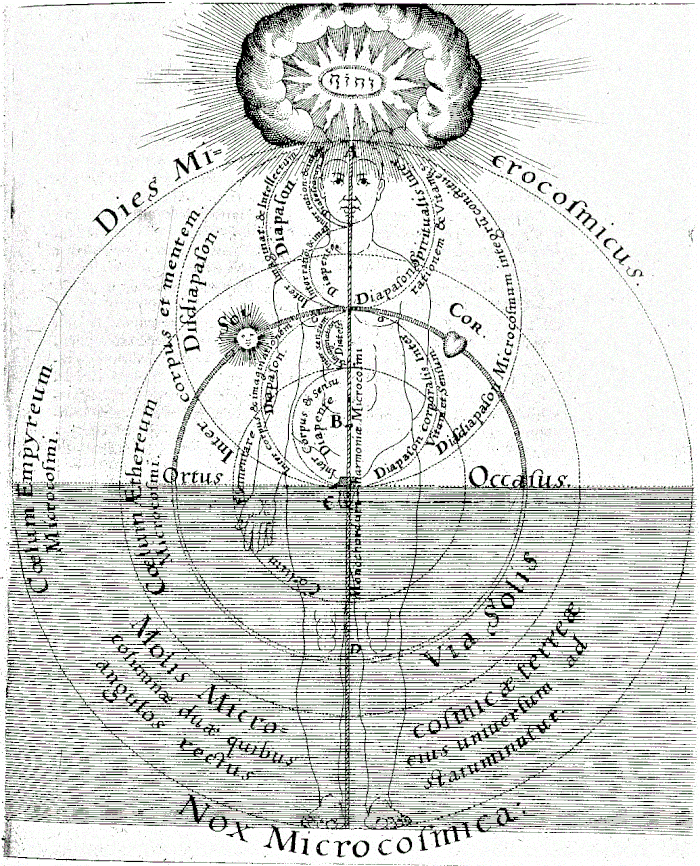
Robert Fludd: The cosmic macrocosm within the body microcosm 

Several cultures at different times in history have come to a conclusion, that there is an analogy between the human body and the structure of the cosmos. In European traditions the head is analogous to the coelum empyreum or highest heaven which was supposed to be occupied by the element of fire. The chest to the coelum aethereum which is occupied by the planets and wherein the heart is analogous to the sun and the abdomen to the coelum elementare; the legs to the dark earthy mass (molis terreæ) which supports this universe. The nice thing about drawings is that they can at the same time be illustrations and diagrams, therefore they can hold two positions at once. You can focus for example on the shape and form of the human body and think about how it stands in relation to the surface it is depicted upon. On the other hand you can switch your attention to a diagram of the cosmos. The scale of one being totally at odds with the scale of the other, and yet even so, in your minds eye you can reconcile the two ideas and hold them together, because analogy stems from finding a likeness and this likeness forms a powerful and meaningful connection. 
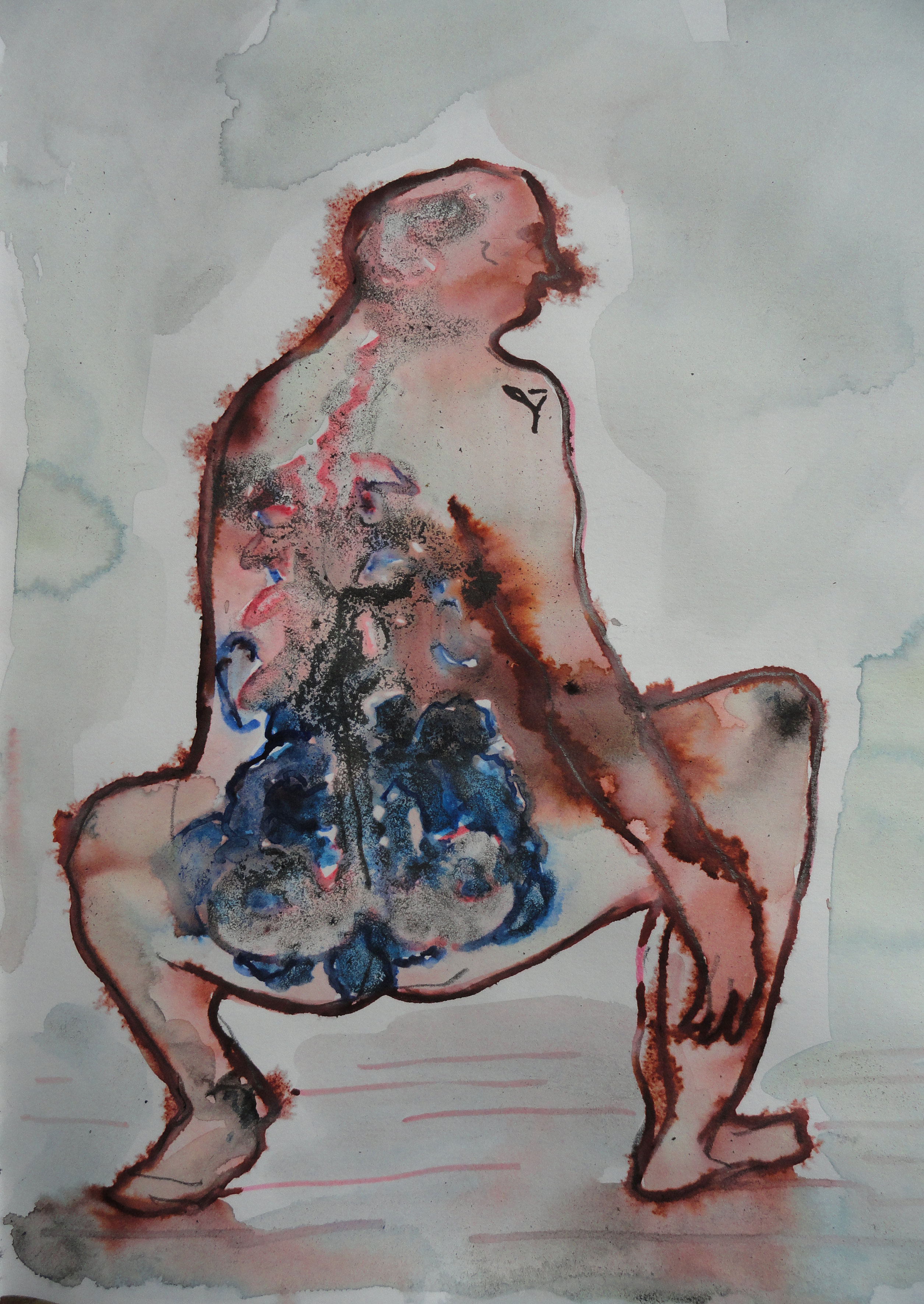
I have been trying to combine some of my images based on interoceptual experiences, with those made from observation, so have returned to life drawing, but with a different intent, trying to imagine feelings of interiors at the same time as seeing an exterior form. 


Perceiving insides and outsides at the same time.

I've also been reading two texts at the same time, as an attempt to support a more holistic understanding of what I'm trying to get at. One is exploring the 'molecules of emotion', an examination of how for instance neuropeptides are secreted by immune system cells, demonstrating therefore that communication with the brain and stomach is via a network and is not one way. The peptides integrate the immune system, (spleen, bone marrow, lymph nodes and white blood cells), with for example areas of the skin, in order for the body to react when we are wounded. In the defence of the realm, (the body) good communications are therefore maintained, and as with all communication networks, you can use communication theory to help think about what is going on. 

Internal and external flows of information

An act of communication is the transferring of information from one thing to another thing. Every communication involves (at least) a sender, a message and a recipient, or a starting point, a movement between and an end point.  Communication includes the medium used to communicate and the location of the communication. There are several communication theories that are available to help us understand how and why a system might work, and each theoretical lens allows us to think about the effects of the communication in slightly different ways. See this Handout that describes the main communication theories, the cybernetic transmission theory being the one that most clearly fits this situation, but other theories that stress the very human nature of communication can also be used. 


Chinese representations of the trunk and its organs (c.13th century)

The other text is a history of Chinese medicine and it explores the mythic relationship between the human body and the cosmos, and it focuses on ways of thinking that were developed over 2,000 years ago. I am revisiting this text because it allows me to think visually about the body as an image that can hold an inner and outer reality together and at the same time conjoin two vastly different scales, the size of a body and the size of the universe. The images above are entitled  'neijing tu' a term that translates as 'internal view, inner landscape, inscape' and as images they were intended for people who practised the inward visualisation of the internal organs. The images in their original form, were accompanied by a text about inward contemplation. 

The Neijing Tu

The Neijing tu depicts a human body as a microcosm of nature; an "inner landscape" with mountains, rivers, paths, forests, and stars. 

An interoceptual landscape

Exploring how various scales as well as interior and external narratives can be conjoined

In my visual research, I've been looking at how some things that we think of as beginning with perceptual external experiences, eventually become physical, inner body realities, such as an experience that becomes embodied as a chemically induced feeling. For instance I was knocked down by a car before Christmas and since then, every time I need to cross a road, I have a heightened sense of anxiety and I feel this within my stomach. 

The body scan

I was taken to hospital and had to have a full body scan and the whole experience left me with an embodied set of feelings that are now part of me. I have had a steep learning experience and as I therefore approach a road to cross it, my body issues a chemical warning and in order to do this, my body is secreting extra neurotransmitters such as epinephrine and norepinephrine. This has led me to develop a series of drawings centred on images of whirlpools, in particular tales of the Moskstraumen or Moske-stroom that sits adjacent to the Lofoten Islands off the Norwegian coast. As a teenager I had read 'A Descent Into The Maelstrom' by Edgar Allan Poe and this illustrated imaginary experience, even though 60 years ago, is also an embodied memory, something that still causes me to have a slight anxiety, especially when I bring to mind Poe's written description, alongside Harry Clarke's illustration. Going into the scanner, felt as if it was something akin to entering a whirlpool. My body scan print above, structurally echoing the idea of being sucked into a vortex. 

Harry Clarke: Illustration to 'A Descent Into The Maelstrom' 1919

I was also reminded of an idea I had some time ago of a decent into the gut, where I drew the slide down a throat and the journey into the intestines; a place where bits of old food floated about; visualised as a sort of Jonah and the Whale or Geppetto and Pinocchio inside the whale story. The nearest I had come to actually using this idea though in the past was as an illustration for the Nest story. 

Kay Nielsen: Inside Monstro the Whale: Pinocchio (1940)

From: Nest

This is how Edgar Allen Poe described the situation; 'Our first slide into the abyss itself, from the belt of foam above, had carried us a great distance down the slope; but our farther descent was by no means proportionate. Round and round we swept—not with any uniform movement—but in dizzying swings and jerks, that sent us sometimes only a few hundred yards—sometimes nearly the complete circuit of the whirl. Our progress downward, at each revolution, was slow, but very perceptible. Looking about me upon the wide waste of liquid ebony on which we were thus borne, I perceived that our boat was not the only object in the embrace of the whirl. Both above and below us were visible fragments of vessels, large masses of building timber and trunks of trees, with many smaller articles, such as pieces of house furniture, broken boxes, barrels and staves.' E A Poe

This for myself is proof of art's ability of affect us deeply and that various threads of experience (both of external realities and the imagination) can be woven together in ways, that even though they don't seem logical, can still be effective. 


Pages from sketchbooks

So perhaps I need to further integrate a narrative that has been floating around this new body of work. It began several years ago when I was making images in response to a story told to me while I was drawing blocks of flats in Leeds. At the time I made an animation of a boat at sea, the boat hit troubled waters and eventually sank, re-emerging in calmer waters only to fall prey to the same storm, over and over again. Other static drawings also included tiny boats, filled with tiny people, always engaged in some sort of tragic event. This boat has returned to my image bank, very much in response to the government cry of 'Stop the Boats'. I inwardly shudder as I think of the harsh trials that people have had to survive to get as far as the English Channel, only to find at the last hurdle, one more virtually insurmountable hurdle, the toxic myth of migration and immigration. The boats are now being sucked down by maelstroms, but these maelstroms are also digestive tracts, as if by setting out to legislate against these people, we in effect try to swallow them whole, we are now the monsters that swallow the boats. 

This is also a sign of our collective health. We treat immigration as if it is some sort of infection. However if we are to collectively heal ourselves, we will need to be far more in tune with the environment and focus on issues such as pollution and global warming, two of the very things that cause populations to destabilise. The Earth warms and fishing grounds become sterile, crops die because of drought and it becomes just too hot to live where you are. When it gets too hot to live, you need to move and as you do you come across artificial boundaries, invisible lines that were drawn across maps at some time, often in the 19th century by Europeans; lines that never took into account the invisible reality of the industrial revolution and its dire consequences for the planet.

The Chinese system saw the human body as a model of the cosmos and the cosmos as a model for the human body. A new cosmic model would include all of our recent tragedies, and would embrace polluted rivers as models of the body's blood flow, but now including micro plastics and chemicals found in our food, due to over investment in pesticides. Gut bacteria would be faced with strange foods that are blighted with antibiotics, preservatives and high levels of artificial sugars, the gut in turn becoming an embodied model for the Earth itself. 

The body's cells have long memories, these memories determine strange things, such as the fact that during the early development of the spinal chord, the heart is at one point above the head. Cells are programmed to divide and undertake various types of metamorphosis as they evolve into the forms that will be needed to maintain the particular life type they have an encoded DNA for. But tiny changes in the environment can affect their programming. 

So what am I getting at here? Can communication theory deal with how a cell communicates with other cells? Is noise or interference an issue? What would this be in the life of a body cell? Does the body inhabit a form of rhetoric? Is it all just about energy flow? Is the relationship between the scale of a cell and the human body, similar to the scale of a human body shown in relation to the scale of the solar system?

There is a story here, a tale of two selves, one a body and another of a mind, fused together and in the flux of fusion something else is glimpsed; a spirit, a vital charge, soul or just life itself. 

The glimpse

Always new images to find, and as the search goes on, a trail of not quite there ones are left, which when put together perhaps reveal something else, how the visual embodied mind seeks stories that speak differently to the verbal one. The Greek poet Nikos Kazantzakis once stated, "The universe is warm, beloved, familiar and it smells like my own body". 

The human universe

See also:

Drawing using analogue and digital processes: A reflection on the visualisation of interoception