Showing posts with label craft. Show all posts

Wednesday, 6 May 2026

The flying carpet, art and craft

I sometimes get textiles made in order to communicate certain types of ideas; in the past I have had headscarves, shirt material and hangings made. I'm now thinking about how the carpet and prayer mat carry associations. As crafted forms they can also be used to posit questions as to where the art/craft divide now lies and whether or not that divide still exists. I recently saw that there had been an exhibition of what have been called Afghan war rugs. It was advertised with the for myself worrying byline, "War and conflict have long had a role in the production of art." The associated text went on to say that, "This survey is steeped in the tension between aesthetic beauty and violent subject matter." I wasn't sure about this either but it did remind me of something that has long haunted my imagination, the flying or magic carpet, a form I have been fascinated by since when as a boy I saw the 1940 film, 'The Thief of Bagdad'.

From: 'The Thief of Bagdad'. Abu on the magic carpet. 1940 Dir. Korda

Much of the action in the film takes place in Basra and at one point the young thief Abu is turned into a dog, an attribute as a 'Barker' I could easily empathise with, my then late 1950s school nickname being 'woofwoof'. 

Abu as a dog

My understandings and feelings about the city of Basra are therefore conflicted and confused, it is woven together in my head as both a place of magic and of war, a place inhabiting my 1950s memories as much as my more recent awareness of tragic events brought to me by the various news outlets.

My inner head mash up continues; our lodger is from Iraq and he has tales and stories of conflict from the time of Saddam Hussein, many people in his family having been put to death because of their political views. I still clearly remember going to London to march and protest against Tony Blair's Labour Government wanting to take us into war with Iraq over weapons of mass destruction; which we found out later never existed. We now see night after night of images of a gradually being destroyed Iran, so soon after it seems like a thousand and one nights of a slowly being destroyed Gaza, these events being our contemporary bedtime stories. The Middle East or more accurately West Asia, feels like a media myth, a story played out like some form of fantasy tale that no one in the West seems to have any real understanding of. The 'Middle East' might as well be another story from a 1001 Nights. In Islam, a prayer mat is placed between the ground and the worshipper. It also operates as a magical flying carpet, one that helps to separate the devout follower of Mohamed from the filth of the world when they pray. The prayer mat in effect operating as a temporary vessel for a spiritual journey.


 Prayer mats

Within Islam, the prayer mat is a powerful symbol and it is disrespectful to put one down for prayer in a dirty place. They are traditionally woven with a rectangular design, typically asymmetrical so that it is easy to see where the head goes when in prayer. The designs may also represent the promise of paradise and eternity, the mat in many ways operating like a doorway into paradise. No wonder the myth of a flying carpet arose out of this tradition. 

Unknown maker West Afghanistan, “War Rug with Peacocks,” date unknown


Detail from a prayer mat I had made and which was installed as part of an exhibition

Ten years ago I had a prayer mat made for an exhibition about the migrant crisis and I had a Qibla compass inserted into it, so that it was always set out on the gallery floor pointing towards the Kaaba in Mecca. I thought and still do, that the idea of a direction for prayer being more powerful than an idea such as North-ness, was an amazing thing, giving a physical shape to the idea of belief. Ten years on, the work feels naïve, so much has happened since then and AI has thrown image making into a tumble dryer, what might have been seen as an interesting conjunction back then, is now simply lost under an avalanche of everybody's personal AI image generated snow. Which is sort of why I'm getting more interested in craft. The handmade object is coming back into its own. The more AI is used to make decisions, the more we will need to be reminded that humans can still make things and we will look more and more for the fingerprints of a maker and perhaps value the sleek engineering of the manufactured object less. 

When I used to teach on the Foundation Course in Art and Design, there were fierce debates about the relative value of art and craft. Craft was often denigrated as being just about hand skills and fine art it was argued was more to do with concepts and was therefore of a higher value. Since then we have had the material turn, a theoretical shift across the humanities and social sciences that now focuses on the agency, role and importance of physical objects, technologies and bodies. "Things", such as a crafted object or a skill such as an ability to weave, are seen as active ingredients, enmeshed into life's meaning, rather than them being passive or inconsequential. Artists such as Grayson Perry have shown how articulate craft can be and have helped to break down the art/craft divide. 

But there is still that need to create meaning. It is wonderful to think that the hand is being appreciated as a thinking tool and that the mind is now understood as something embodied, rather than being something that sits outside of our bodies, sort of gazing out of a fog of unreality. But ideas are still needed, they just change with the readjustment of focus and the application of a new lens. Craft or an understanding of making, becomes an idea in its own right, therefore it can be added into a theoretical toolbox and then it rubs up alongside all those other ideas, such as critical theory, spirituality, evolution, game theory, scientific method, human rights or communism. 

I've just been working on two related pieces that are now showing in Yorkshire Sculptors Group exhibitions. One 'Monkey Mind' has gone on show in Barnsley Civic, the plan for its installation being directly below and the other 'The Cosmic Body' is on exhibition on the third floor of Salt's Mill in Saltaire. 

Monkey Mind

The Cosmic Body

Both installations are made of textiles and ceramic pieces, but I had the textiles made by a company that usually makes objects for domestic use, so they are seen as 'throws' or 'blankets' and I'm repurposing them as magic carpets. I have been trying to fuse several ideas together. One is to do with the fact that ancient burial sites have objects buried in with the bodies. These objects were often to help the dead navigate the afterlife and this navigation might be a protection from evil spirits or perhaps spiritual food for the now dead. 'Monkey Mind' is for the now alive, but to give them things to contemplate, in a similar way to how Japanese kusiizu images work, which are graphic depictions of corpses in the process of decay, images that Buddhists could meditate upon as reminders of the fragility of life and the reality of death. 'Monkey mind' being what we need to escape from, the never ending internal mind chatter of what to do and what to think being something that at some point we will have to cease. It's interesting that the only feedback I've had from anyone visiting is that someone thought my work looked like roadkill. 
In contrast 'The Cosmic Body' is more a reflection on traditional Chinese medicine (TCM) and its view of the body as a cosmic entity. In TCM the human body is visualised as a microcosm, a miniature universe or "cosmic entity". It is intricately linked to the natural world and governed by the same forces, therefore health is maintained by balancing our internal energies to ensure harmony between body, mind and the world. I continued to put '
The Cosmic Body' together in different ways as I was trying to follow various narrative shifts, but I had to stop as the work needed to be installed in Salts Mill in readiness for the exhibition opening. 


Details: The Cosmic Body

I like the mix of a cheap reproduction, (the textiles) and the hand made, (the ceramics). In many ways the ceramics are 'cheap', as I am using bright earthenware glazes and have avoided the subtlety of stoneware. I'm still trying to work out what things mean, rather than simply letting go but I seem to be in a mental trap of my own making. Both these pieces are presented on 'magic carpets'. The textiles being frames that allow the idea to float, as if in another world, the fringes defining the edges of an idea as much as an object. However I now need to refocus on the work for Graz, as I go over tomorrow to install work and host workshops. After all the hassle trying to get the work over there, (I was using a carnet system as organised by the Bradford Chamber of Commerce), I shall also go over with a tube of glue, in case when I open the shipping crate, the ceramics are broken. The getting of an exhibition into Europe is now a post Brexit nightmare, but I shall reserve the details for a later post, as the procedures took a while to sort out. If someone else reading this blog is foolish enough to also be thinking of shipping an exhibition across the Channel, all I can say is, beware the bureaucracy of the carnet system. 

See also: 

Monday, 24 March 2025

Stained glass: Finishing

The finished panel

As you can see from the image above the stained glass panel I have been working on for over a year has finally been finished. It's approximately A1 size and it was designed as a response to the fact that when I started the project I had plantar fasciitis, which meant I couldn't put my foot down without extreme heel pain. As I had been making votives, I decided to use the idea of Sooty as a type of voodoo fetish, interceding to bless the pain and therefore release it. It did eventually go away but not I suspect due to the intersession of Sooty. Even so it was an interesting experience and I have learnt a lot technically and have set up my workshop to be able to undertake quite a few of the glass skills used during the past year. The painting I started out with is this one below, and as always its fascinating to look at how a change in technique totally changes the meaning of what can be almost exactly the same image. 

The original painting 

My last post was about the soldering process, which left me with lots of cleaning to do, most of it due to the deposits of tallow still left on the lead. Once the tallow had been cleaned off the next step was to stabilise the panel with black putty, which  ensures that every section is held securely in place. If the panel was to be used as a window, it would also need to be made weather proof and this stage would ensure rain water would not be able to penetrate it. 

Black putty being applied to all the gaps between the lead and the glass

I had bought myself a tub of stained glass putty a while ago, so had it ready. It's much more expensive than the putty you use to secure the glass in a window and I suspect you could mix your own by staining ordinary putty black but I was in a rush to get everything finished, so had bought a ready mixed tub. There is nearly always a reason for the materials being what they are and when I have tried to go my own way, such as using ordinary soldering flux, things haven't worked. 

Stained Glass Lead Cement Putty Black 1/2 PINT (Approx: £26)


I used an old toothbrush to push the putty into the gaps between the leading and the glass. I was amazed at how much putty would be needed to go into these gaps, and it takes quite a while to work it into each section. A circular movement of the toothbrush seemed best, and as the putty began to settle into the spaces, it lifted off the glass surface. (I was initially worried that it might stick to the glass and be hard to clean off). 

The toothbrush: The black putty is very sticky, like thick runny hunny.

As the gaps become filled, the putty pulls away from the glass surface. 

I then, once all the gaps were filled on one side, with help, I turned the panel over and repeated the process. I had some whiting power left over from when I was printmaking and once the putty was in place on both sides, dusted one side with it. This is to help dry the putty and clean off the panel. Using an old scrubbing brush, I then worked my way across the panel, again using a circular motion and this removed bits of excess putty and at the same time cleaned the glass. This was then repeated on the other side.

Using an old scrubbing brush to remove whiting powder and excess putty.

The window was at last beginning to look how I wanted it to. The too shiny look of the solder had gone, the black of the putty now filling every crevice of the surface, which makes the whole panel look as if it is an old thing; something made back when stained glass was a process embedded into a deeply spiritual way of understanding the world. I was beginning to think that all the effort was at last going to pay off. 

The final part was to get the 'look' of the leading right and to do this I used black stove and grate polish. (£7)
'Stove black'

I used to help my nan polish her black iron stove and this was very like the Zebo polish that we used then. When buffed up with a soft duster or rag, you get a rich dull black, which is what I wanted. These final touches were vital as they gave the panel a very personal feel. The surface looks very hand done, the final finish looking like something that has resulted from several hours of intense one to one application. The Sooty window was meant to be a type of fetish or votive and by virtue of the many hours of work invested into its making, it has human spirit built into it.  


Developing the final patina by polishing

This final part of the process felt intuitively right, perhaps because of the link back to the time helping my nan polish that old black iron stove. 

In order to have a good flat light source behind the panel, I ordered an A1 size, LED lightbox from Amazon, and it fits very neatly, I used it to light the window in order to take the photograph at the top of this post. 

It has been a long and expensive process, I have learnt a huge amount and made a piece of work I am very satisfied with, as it extends the conceptual as well as the emotional and spiritual range that I am trying to communicate with. I have also set up my old studio in such a way that I can now cut glass and grind it into shape, I can cut lead and fit panels together, but what I cant do is paint the glass without access to a specialist kiln. My objective was to see if I could become self sustaining in relation to a craft that I really feel does enhance spiritual 'feeling'. But the reality is that it will have to be a 'supportive' skill, one I use occasionally to enhance my work, rather than as a main focus. 

See also:


Thursday, 29 June 2023

Tauba Auerbach: Craft and Drawing

Tauba Auerbach: Extended Object (detail), 2018: Acrylic

Tauba Auerbach (pronoun 'they') reminds us of how important craft is to an understanding of how the world works. At one point, when they were younger, they worked as a sign writer and this experience highlighted for them the importance of hand skills and how the body builds up knowledge about how materials work and how to be sensitive to them. Auerbach also has a long commitment to unravelling a parallel scientific understanding of the world and questions how we really understand the world we live in. Is it through an activity such as science, or is it through the way we encounter the world through the materials we use? Auerbach suggests that in shaping materials as craftspeople, we understand the world in a deeply embodied way, they then use this embodied understanding of craft, to revisit certain scientific principles and to rethink them as material structures. The craft of drawing is central to this process and they remind us of how vital an awareness of body control is to the making of any image. 

Tauba Auerbach: Org: Glass, nylon coated steel cord

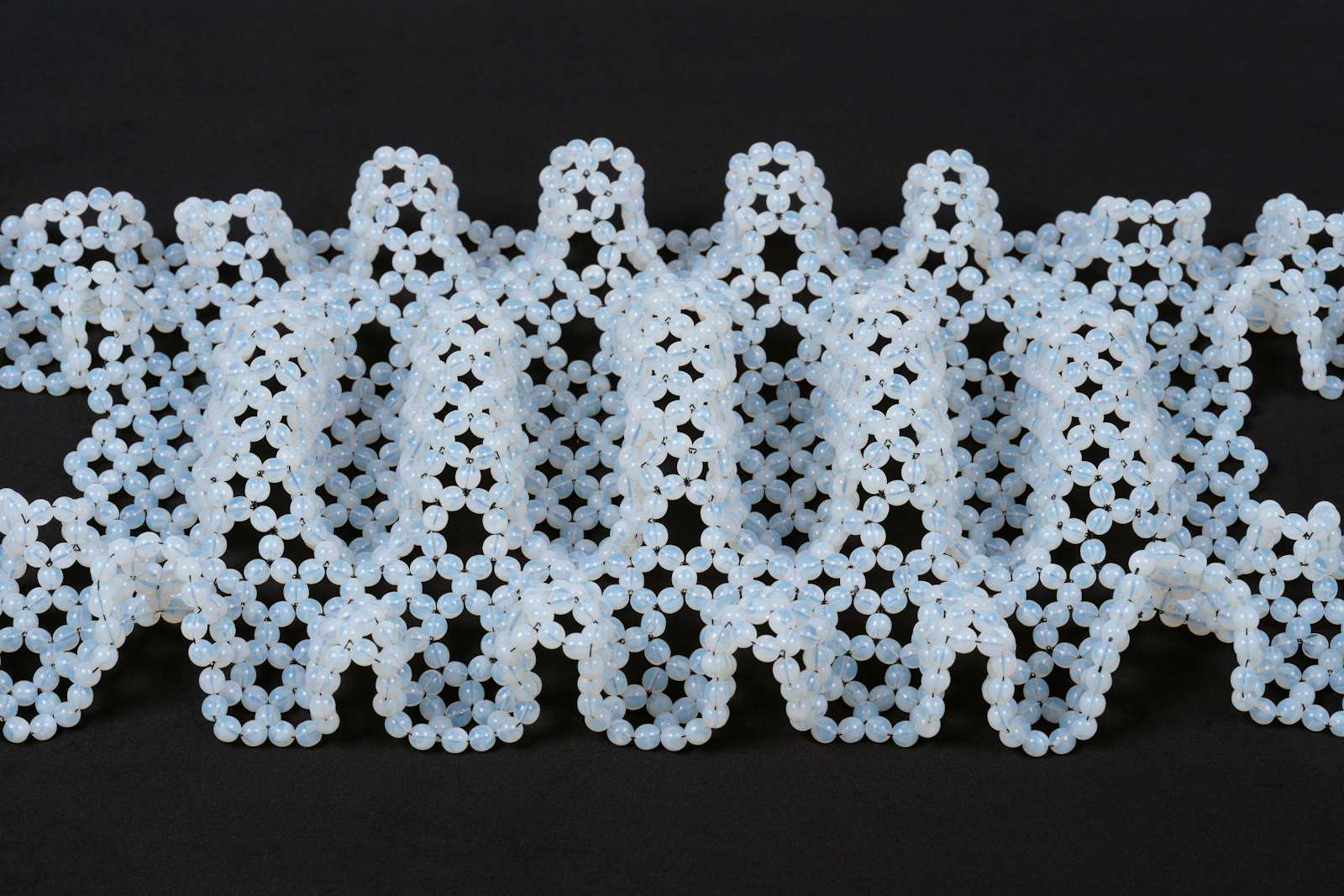
There is a particular set of crafts associated with bead construction and this is associated with religious objects, such as prayer beads and also, the visualisation of atomic forms, whereby atoms are grouped into certain configurations which can be modelled by using beads. Auerbach has learnt the skills of bead construction from someone who had been making these scientific models for some time and has then gone on to create her own models using the skills learnt. We have looked at these issues before; Daina Taimina for instance used crochet as a way of modelling hyperbolic space. She taught herself crochet and in doing so her levels of understanding geometry were raised, as it was much easier to see how a line, generated by a fold, could operate in hyperbolic space; especially when you saw these structures develop as a result of a series of hand movements. 

Tauba Auerbach: Ligature: 2019

Ligature is a drawing done with a large chisel tip felt pen. It is a type of meditative drawing controlled by an underlying grid. This is something anyone can try. Simply use some graph paper or draw out a grid and then after practicing hand movements and how to hold the felt tip pen, you should be able to eventually control your hand / arm movement to make an image not unlike the one Auerbach has produced. This is about smooth, continuous movement and keeping the same pressure and consistent angle as you move the pen. It relates to the sort of hand movements you need when undertaking the writing out of calligraphic script. This is another craft and one usually associated with the Islamic religion, but on a more quotidian level, signwriters have to be able to achieve a similar consistency of application in their everyday work. The grid helps a pattern form and patterns are often found in nature to underpin the way that forms are structured. These images remind me of the work of Marian Zazeela an artist who worked in the 1960s and onwards, but who was always in the shadow of the composer La Monte Young, a link that reminds me of the entangled interconnections between musical notation and the representation of vibration and other rhythmic constructions such as lines of force. 

Marian Zazeela

Lines of force illustrating electromagnetic action

Auerbach's revisiting craft techniques includes marbling. You might have done this yourself because people often do this to make endpapers for books. A very basic way to do this is to float oily inks onto water and to develop patterns by touching the ink drops with a stick or a broken comb. Auerbach makes marbled surfaces on a much larger scale than the normal amateur would, (see this video link) and makes a connection back to scientific principles in relation to the material interactions involved.  


What is interesting here is that some of the crafts Auerbach is using have a history of association with amateur crafts and outsider art making. They remind us that everything is up for grabs when it comes to developing ideas, especially areas of endeavour that are usually dismissed as being naff or not very creative. Perhaps browse through the crafts section of your local bookstore and look at that wide range of activities that includes everything from crochet to knitting, via marbling to mosaic, and p
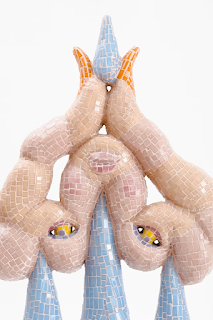
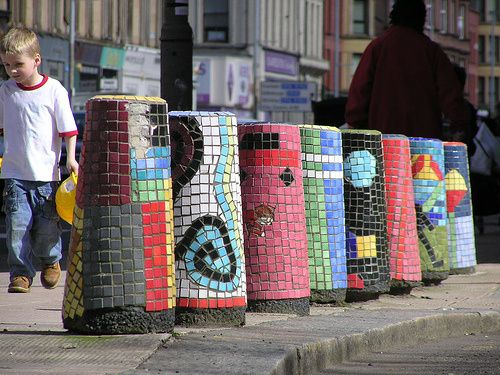
apier-mâche to decoupage. Look at how Zsófia Keresztes takes the idea of using mosaic to cover an object and elevates it from a craft into art. Keresztes had an impressive exhibition of her sculptures at the last Venice Biennale, all of which had a surface finish using the same type of mosaic techniques that we might find forming some sort of street decoration. 

Zsófia Keresztes

Mosaic bollards Glasgow

Kathy Prescott Parker

Finally perhaps relook at those objects we have ignored in the past as being non-art or kitsch and then after reconsidering, might they actually be much more interesting than we initially thought. I have been making some hybrid objects myself lately and now when I look at them they don't seem that far away aesthetically from the work of artist's such as Kathy Prescott Parker, who on her online profile says she deals with, 'All things colorful, smile-inducing and inspirational'.

Kathy Prescott Parker

Hybrid object

See also:

Wednesday, 6 September 2017

Paper: Folding and the songs of trees

Papermaking in Echizen

David Haskell in his wonderful book ‘The Songs of Trees’ has a chapter on Japanese paper making in Echizen. He points out that in Japanese the word for deity ‘kami’ is the same sound as the word for paper ‘kami’ , of course the Japanese character for each is different. When Haskell arrived in Echizen, because of the similarity his taxi driver wasn’t sure whether he wanted to be dropped off at a shrine or a papermaking facility. This caused Haskell to reflect that both shrines and papermaking are centred around water and the fact that a spiritual understanding of both paper and its manufacture was essential to the continuation of papermaking as a craft.

Echizen paper's stamp of authenticity, the goddess Kawakami Gozen

The Okamoto Otaki Shrine in Echizen is home to the goddess of paper, Kawakami Gozen, which translates as “The Goddess who lives above the stream”. The village of Echizen has around 40 studios that make Washi or Japanese handmade paper. The manufacturing process is a long and intricate one that is undertaken in the cold weather of winter in order to ensure that the pure, cold running water can inhibit the production of bacteria and prevent the decomposition of fibres.  The cold also makes the fibres contract, producing a much crisper feel to the paper.
Haskell writes beautifully about his experience and rather than try and paraphrase his writing I will quote one section in full;
“In a bath of mashed inner bark of kozo or mitsumata trees, water floats the plant cells’ dissociated strands, buoying them as they drift. Each molecule of cellulose is a strand of sugars, up to fifteen thousand links in the chain. Suspended in a haze of water and hibiscus mucilage, they crosshatch and weave. Coldwater forestalls fermentation and makes a viscous suspension, yielding the finest papers. The foothills of Echizen might not be able to grow much food, but Kawakami Gozen brought a craft suited to the mountains. Even the trees here grow longer fibres than those of the warmer valleys, giving paper strength and luster. Echizen became the hub of papermaking in Japan. The town was the exclusive supplier for aristocrats, shogunates, and governments. From these vats of water and fibre, Japan crafted its written culture. Later as trade with the west commenced, the paper travelled to Europe, where papermaking methods were one thousand years behind those from Asia. Rembrandt preferred Japanese paper, likely from Echizen for his etchings.
A scoop into the bath with a fine screen captures the maze of cellulose, locking the tangle as the sheet flattens. Repeated dips laminate the paper’s surface. Water’s capillary bonds, the same bonds that hold water within living plant cells, suck and mat the plant strands. Crushed by a press, water seeps out of the paper. The sodden sheet tightens as it oozes and drips. Finally the departing water draws the cellulose close enough that plant atoms find one another and bind, atom to atom.”
Near the end of Haskell’s article he begins to remark on the importance of sound as an indicator of a paper’s quality. Again I quote from him;
“Forged banknotes have a different timbre from real money. Criminals seldom find the right mix of plant species and water. The banker and printer hear the age and provenance of money in crack or slur, their fingers massaging sound from paper. A connoisseur of cash hears paper’s origin.” (Haskell, 2017, p. 102)
Japanese paper money is printed on a paper made from pulped mitsumata bark and abaca leaf fibre, American dollars are printed on paper made from rough cotton and linen rags; the new British paper money is printed on synthetic polymer instead of paper. When you fold money and put it in your pocket you will feel it and hear it, technological change and cultural association coming together in a moment of audio and tactile meaning. This could be one of those starting points from which a body of work could grow.
Why not spend a day listening to your finger tracing its way over different papers? If you have access to a contact microphone why not record the sounds different papers make when you draw on them, or when you fold them? How would you compose these sound stories? Has anyone written the tragic opera of the folded banknote?
As with all my posts on materials, what is important is that by focusing for a while on anything, by stopping to research what lies beneath appearances, new avenues for practice should become apparent. Paper's story is biological, chemical, socio-cultural, phenomenological, historical, geographical, technological and personal. Usually thought of as a support for drawing, paper is much more than that, it has wonderful physical and metaphorical possibilities and a rich set of associated stories that cross many cultures. For instance the Glasgow based artist Karla Black uses a very particular sub-set of papers, cellophanes and tissues, touching upon a certain series of associations we have with bathroom textures, scents and colours; by owning this particular 'territory' she is able to construct a distinct body of work, this year showing in the Venice Biennale as Scotland's representative. 

Karla Black

Sipho Mabona works using origami techniques, techniques that begin to become interesting when you push them to an extreme. The fold is an important aspect of paper, you could argue that folding is in effect paper's own internal drawing method, folding reveals a paper's geometry, the lines of folds made reveal the internal dynamics of possibilities. We fold a banknote as we put it into our pocket, or carefully fold that note on a slip of paper given to us by a secret friend and slip it into a wallet, both activities of the everyday. As artists we can look at those things we do everyday and in them find the wonder and magic of life. 

Sipho Mabona at work

T. Sundara Row's Geometric exercises in paper folding is the classic text on paper folding and is itself a wonderful example of how by focusing on one idea a whole field of possibilities open out. In this case the relationship between folding and photographic documentation is also really interesting*. 


T. Sundara Row exploring the equilateral triangle 

*The issue of how documentation can shape drawing practices is going to be something that I will be looking at in much more detail in a future post.