Showing posts with label geometry. Show all posts

Sunday, 30 March 2025

Dancing and Occult Chemistry

I'm very aware that as I make a drawing my body performs a series of movements that could be thought of as a type of dance routine. Back in the 1960s when I worked at the steelworks, we had a time and motion expert come in to analyse the various jobs that we did and in that analysis I for the first time saw the possibilities of some sort of 'work dance', one that however had military overtones.

Motion efficiency study by Frank Gilbreth, c. 1914.

Frank Gilbreth was a pioneering management consultant, who invented the use of cyclegraphs as a way to improve the efficiency of repetitive tasks. The image above could both be used as an example of how a relentlessly monitored production line could dehumanise people and as an idea for a type of choreography and its documentation. As I sit at my drawing desk, I'm sure a time-lapse image of my movements would not be that dissimilar, except for the matter of my taking a break whenever I want to.

Movement and its understanding can be both a form of control, (think army marching displays as in the Edinburgh military tattoo) and an expression of freedom.

Military geometry 

At a sub-atomic level all is movement and one of the earliest twentieth century attempts to describe the invisible structures that lie beneath perceived reality was Besant’s and Leadbeater’s 'Occult Chemistry', published in London by the Theosophical Publishing Society in 1908. I have mentioned Besant and Leadbeater in previous posts, mainly because of their interest in visualising thought forms and their book 'Occult Chemistry' subtitled, 'Clairvoyant observations on the chemical elements', is a fascinating example of how an awareness of eastern religious practices was at that time beginning to influence western approaches to visualising the unknown. 

From: Occult Chemistry

This is how they describe visualising a hydrogen atom in chapter two:

'Turning to the force side of the atom and its combinations, we observe that force pours in the heart-shaped depression at the top of the atom, and issues from the point, and is changed in character by its passage; further, force rushes through every spiral and every spirilla, and the changing shades of colour that flash out from the rapidly revolving and vibrating atom depend on the several activities of the spirals; sometimes one, sometimes another, is thrown into more energetic action, and with the change of activity from one spiral to another the colour changes.'

From Occult Chemistry: The complexities of a hydrogen atom

I was fascinated by the relationship between atomic structure and the organs of the body and tried to develop their atom image as a beating heart. Edwin Babbitt had also proposed an atom of this form in his text "Principles of Light and Colour," His model of the atom was a globular structure composed of spirals and spirillae, with three movements: rotation, orbital motion, and pulsation and I think it would have been Babbitt's idea that was used as a model for Besant and Leadbeater’s diagrams. 

Atom heart dynamo

The visualisations of Besant and Leadbeater, as well as Babbitt, in some ways resemble those eventually developed in relation to Niels Bohr’s theory of atomic structure and the related laws of quantum mechanics; initially these structures were visualised as electrons in orbit, then they became cloud-like and illustrated as fuzzy-edged three-dimensional geometries, such as vibrating spheres, misty toruses or out of focus dumbbells. I suspect that our ideas of the sub-atomic world will look like something very different in another hundred years time. 

A radium atom visualised using Bohr’s theory of atomic structure

Besant and Leadbeater stated, “The atom can scarcely be said to be a ‘thing’, though it is the material out of which all things physical are composed”. “It is" they further stated, "formed by the flow of the life-force and vanishes with its ebb.” This reflects some of our earliest human ideas of religion; ideas that arose out of the contemplation of what happens when someone or something 'stops', when movement comes to an end and things die. 

We now tend to think of the sub-atomic world as being composed of wave energies, energy and movement being conjoined. As living beings, in order to respond to experiences, we rely on the constant movement of our sensors in relation to what is out there; we experience this movement as 'life' and its expression is at its most heightened as dance. 

The passepied an old French court dance

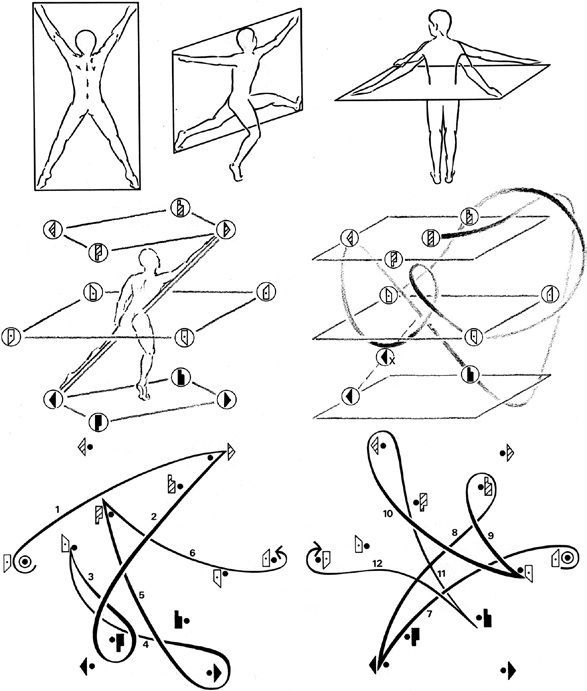
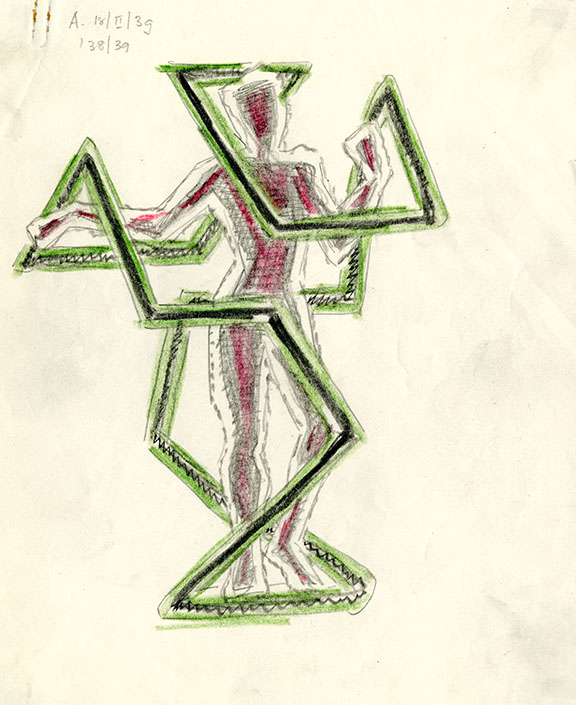
The structure of the passepied is not unlike the spiral structures that thread through the atoms as envisioned by Besant and Leadbeater. As the body moves through three dimensional spaces, it forms interlocking wave structures, that if for a moment are realised as diagrams they can be seen as similar to the visualisations produced for Occult Chemistry.


Choreography: Laban diagrams and William Forsythe's Space Trace Notation

A visualisation of the sodium atom from Occult Chemistry


Figure in a dodecahedron

I am always looking for ways to link the various threads that arrive within my weekly musings on drawing, searching for how I can come to some sort of personal understanding about what I'm thinking about. I have recently found an article by David A. Becker which has helped me to see how certain strands could be linked together. Music, brain structure, chemistry and geometry are all fused together in his article, 'A Peculiary Cerebroid Convex Zygo-Dodecahedron is an Axiomatically Balanced "House of Blues": The Circle of Fifths to the Circle of Willis to Cadherin Cadenzas'.  He wrote this abstract for his article in the journal 'Symmetry'.

'A bilaterally symmetrical convex dodecahedron consisting of twelve quadrilateral faces is derived from the icosahedron via a process akin to Fuller’s Jitterbug Transformation. The unusual zygomorphic dodecahedron so obtained is shown to harbor a bilaterally symmetrical jazz/blues harmonic code on its twelve faces that is related to such fundamental music theoretical constructs as the Circle of Fifths and Euler’s tonnetz. Curiously, the patterning within the aforementioned zygo-dodecahedron is discernibly similar to that observed in a ventral view of the human brain. Moreover, this same pattern is arguably evident during development of the embryonic pharynx. A possible role for the featured zygo-dodecahedron in cephalogenesis is considered. Recent studies concerning type II cadherins, an important class of proteins that promote cell adhesion, have generated data that is demonstrated to conform to this zygo-dodecahedral brain model in a substantially congruous manner.' 

(Becker 2012)


I have previously commented on the way that bi-lateral symmetry has affected our relationship with the world and how we think about it, especially as someone that spends many hours drawing on bilaterally symmetrical sheets of paper. This symmetry is of course reflected in the layout of our nervous systems and in the context of brain connectivity van den Heuvel and Sporns have posited that the human brain contains a bilaterally symmetrical group of twelve major interconnected neuronal hubs that Becker (2012) has linked to our propensity to respond to particular musical rhythms. A relationship illustrated beautifully by John Coltrane's drawing of a circle of fifths that I used in a previous post, as an illustration of the relationship between rhythm and our spatial understanding.

John Coltrane. Untitled (circle of fifths), 1967

Many years ago I used to tap dance, and I recently found an old pair of my tap shoes in the basement, perhaps its time to revisit my inner body rhythms and to see if my feet have more awareness of these issues than my hands. When I began teaching I noticed some of the older staff wore brogue shoes with solid heels and when they strode out into the studio, they used the sound of their clip-clop rhythm, to both get immediate attention and in Patrick Oliver's case to teach students about the relationship between rhythm and space. What I do feel is that it is the bilaterally symmetrical body that 'knows' these things and that the head follows slowly behind. In the head's embryonic development its pharyngeal arches, pouches, and clefts, are derived from the implications of formal possibilities of the icosahedron and its cells will remember that, especially when the head twists around as the body is dancing. 

UV Map* of my bilaterally symmetrical body made using Maya

*A UV Map is a type of vertex map that stores vertical and horizontal positions on a 2D texture. The letters U (Horizontal) and V (Vertical) denote the axes of the 2D texture because X, Y and Z are used to denote the axes of the 3D space. (Vertex = graph)

I look at the map of myself above and see the possibilities of laying it over a star chart. This week I'm designing cosmic tableware and am thinking about what the tablecloth should look like and am getting close to an idea that welds together drawings of the curved time/space that is gravity and the body map. 

Space time curvature

The cheese platter has already been made in the form of a moon sitting on a sun. 


Soup bowls

Design for batik tablecloth

This is another one of my tranculment ideas. The point being that the things which we surround ourselves with in 'ordinary life' can become entries into a more mythic everyday.

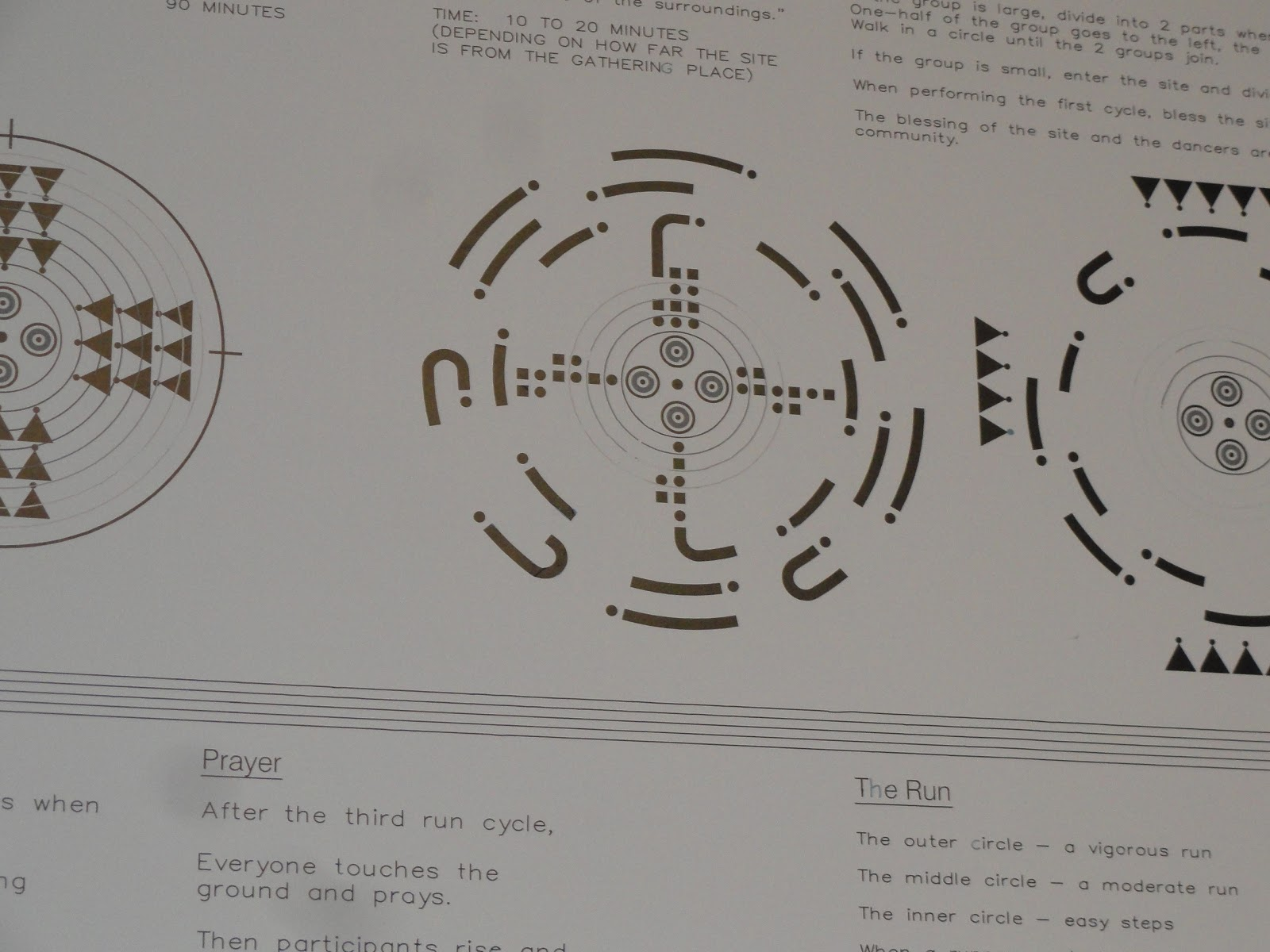
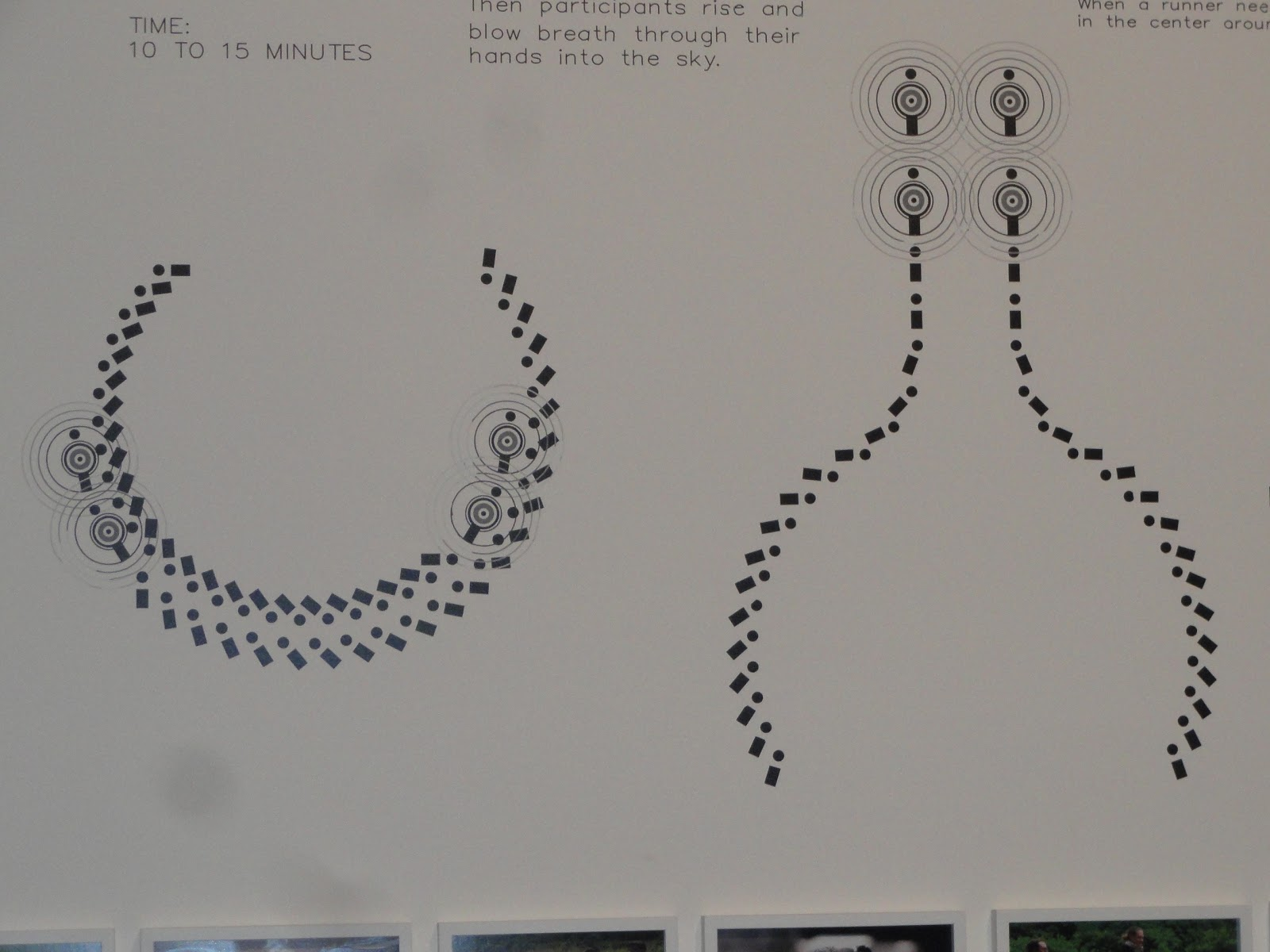
From the micro to the macro is another theme that seems to run through my ideas and as I work through this stuff in my head I remember something else. In the large wall drawing 'Planetary Dance' by Anna Halprin, she presented rituals consisting of explanatory diagrams with accompanying text. Back in 2017 at the Venice Biennale Halprin was offering us a chance to help heal the world by joining its peoples together in a healing set of dances. I took a couple of photographs of the diagrams she drew and they sort of close the circle of my thoughts today on these things and help me link up my various ramblings.


Anna Halprin

At one point in their dancing, participants had to blow breath through their hands into the sky and when they do this we are linked back to the chemistry of breath, the exchange of gases, oxygen and carbon dioxide, that takes place between the body and its environment during respiration, but that's another story.

References

Becker, D.A., (2012) A Peculiarly Cerebroid Convex Zygo-Dodecahedron is an Axiomatically Balanced “House of Blues”: The Circle of Fifths to the Circle of Willis to Cadherin CadenzasSymmetry4(4), pp.644-666.

Morrisson, M. S. (2009) Occult Chemistry and the Theosophical Aesthetics of the Subatomic World RACAR: Revue d'art canadienne34(1), pp.86-97.

van den Heuvel, M.P.; Sporns, O. (2011) Rich-Club organization of the human connectome. Journal of Neuroscience 31, 15775–15786. 

See also:

Maps made by our nervous systems

Horizontality and the body

Body cartography

The micro and the macro

Jorinde Voigt: Drawing as abstraction and notation

Saturday, 22 February 2025

The geometry of consciousness

The geometry of consciousness 

I have been fascinated for some time with attempts to use diagrams to visualise invisible forces and the projective consciousness diagram (below), which uses projective geometry to describe consciousness, has inspired me to have my own attempt to visualise consciousness in diagrammatic form. The image directly above, 'The geometry of consciousness' being a first attempt to make a diagram of what is surely the most important invisible force to affect us. When I attempted to visualise a field of perceptual experience earlier, I had to include the idea that there was never a static moment that could be picked out of that experience. Therefore I used an idea of oscillating eyes to explain this in a static diagram, which I have included top left, in the image above. This was I felt missing from the diagram below of projective consciousness, as developed by Rudrauf et al.(2023). 

Projective Consciousness: Rudrauf, et al. 2023

This is how the Projective Consciousness Model is explained by Rudrauf, et al: 

'Modelling approach: from metaphors to computation. (Left Tier) Two principles to be combined: A Global Workspace (GW), integrating and processing multiple sources and types of information and priors, and a Subjective Perspective (SP). (Right Tier) Field of Consciousness (FoC), projective geometry and active inference, as a GW through a SP. The FoC is structured by a 3D projective space, undergoing transformations through the action of the projective group (𝑃𝐺𝐿) for perspective taking (PT). Each possible perspective is associated with affective and epistemic values depending on the distribution of information in the space, with the values themselves yielding a value of FE. The projective transformation associated with the lowest expected FE is selected, providing the agent with a model for its actions (moving so as to adopt the perspective minimising the FE). The approach is based on the duality between PT and actual or imagined actions in ambient space. At the lowest level of processing, the FoC is calibrated (FC) to select the specific projective framing of information in the projective space (which modulates the precise representation and perception of information in space). This process underlies conscious access to information and is the basis for multiple perceptual illusions'.

Rudrauf, et al. 2023

The complex text above does not really help me to understand the diagrams that Rudrauf, et al. came up with, but I could sort of see what they were getting at. 

I think the diagrams of B. W. Betts and his use of them to explain geometrical psychology might be of more use in the visualisation of both a three dimensional model of consciousness and the many possible intersections and overlaps between emotions, perception (interoception and exteroception), drives and social constructions that underpin that strange thing we call consciousness. Strangely, by leaving out Betts explanations and simply looking at his images, I get a better intuitive grasp of the diagrammatic possibility of a projective consciousness.


From: Louisa S. Cook (1887) Geometrical Psychology or The Science of Representation: An abstract of the theories and diagrams of B. W. Betts London: Redway

Betts believed that consciousness was the only thing that we could actually experience and therefore it was the only thing that we could in effect ever explore or research, because everything else, all our interoceptual or perceptual experiences, had to be received via consciousness. Mathematical forms, such as geometry, are products of pure consciousness, and they don't need any external verification, therefore they will produce, according to Betts, the most pure images of our inner subjective activity. Geometry and mathematics underpin his “Science of Representation,” a system of symbolisation that was regarded as the mediator between the corporeal and the incorporeal. An idea that had its antecedents in the writings of Philo of Alexandria who 
believed that the Logos or mathematical world was in fact the shadow of God, and that mathematical thought was used as an instrument and a pattern of all creation. 

Betts seems to make more sense in terms of visualising consciousness to me, than Rudrauf. et al. However I thought what was needed was a dose of poetry, because if we have actual and/or imagined actions occurring in a space so complicated that in reality we cant understand it, we might have more success by resorting to instinct and feeling tone. In particular I was interested in how to visualise the overlapping awareness of two people who were in conversation; a situation that happens in my workshops, when we collectively try and visualise and communicate interoceptual experiences. 

An overlapping conversation gradually comes to an agreement

I also have also had to more rigorously theoretically support the recent work I have been doing on visualising interoception. In order to do this I have decided to look at the work of Catherine Tallon-Baudry a neuroscientist at the Ecole Normale Supérieure in Paris. She heads a research team that has been looking at the reverse hierarchical nature of conscious perception. I.e. it is believed that visual information is passed through a cortical hierarchy in a bottom-up fashion, with cells in the early visual cortex responding to simple visual information such as the direction of lines or edges, and the next or following set of cortical areas having increasingly complex response to edges or profiles in that they are read as faces or particular scenes. The reverse hierarchical theory states that; 'conscious perception of that visual information does not arise with the processing of local details, but rather emerges in higher cortical areas where global information about the outside world is represented.' Campana et al: 2016. This research used specially designed images containing local information (oriented lines) and global orientation (shapes defined by clusters of similarly oriented lines). Importantly, local and global information in those images could be manipulated separately.

Tallon-Baudry has stated that the brain on its own isn’t enough to generate subjective experience, and that without the body, the self simply wouldn’t exist. Interoception plays a major role she believes in not just creating emotions, but in how our thoughts as a whole come into being. Interoception it is argued, is in fact a fundamental feature of consciousness. She has stated that our internal organs, particularly the heart and gut, are vital in the creation of our conscious experience, both having their own self-generated rhythms, separate from the brain, on which the brain can hang its sense of self.

In her paper, 'The topological space of subjective experience', she asks, 'How many dimensions do we need to account for subjective experience, and how do those dimensions differ between individuals? What are the properties of the space defined by those dimensions, are they homogeneously distributed, or are there some regions with specific properties?' (Tallon-Baudry, 2022) All of these questions are ones that I feel overlap with my own far less scientific investigations, but which help me to push forward with some sort of intuitive fumbling, in a territory I realise many scientists would think of as foolish.

However, Williams (2023) points out that Antonio Damasio has stated that internal body signals aren’t just involved in consciousness, they are consciousness. He states, “People continue talking about consciousness as the great mystery that will be revealed by understanding the brain, and that’s wrong", he says. “It’s not about the brain, it’s about what the brain achieves with the interoceptive system in the body.” (p.43)

Gradually as I read around and at the same time make drawings based on how people talk about their interoceptual experiences, I begin to feel as if I'm getting at least a tenuous grasp on what I might be dealing with. I many ways it is best as an artist not to know too much, but by sniffing around the edges of science, I do feel that it gives me the confidence to keep trying things out. I like to feel that the early Cubists were in a similar position. They didn't really understand the mathematics of relativity but they did grasp some of its implications intuitively and that intuition led to some of the most powerful images to emerge from the early 20th century.

The merging of two subjective worlds

References: 

Rudrauf, D., Sergeant-Perthuis, G., Tisserand, Y., Poloudenny, G., Williford, K., & Amorim, M. A. (2023). The Projective Consciousness Model: Projective Geometry at the Core of Consciousness and the Integration of Perception, Imagination, Motivation, Emotion, Social Cognition and ActionBrain sciences13(10), 1435. Accessed from: https://doi.org/10.3390/brainsci13101435 22.01.25

Tallon-Baudry, C. (2022) The topological space of subjective experience Trends in Cognitive Sciences, Volume 26, Issue 12, 1068 - 1069 December Accessed from: https://www.cell.com/trends/cognitive-sciences/fulltext/S1364-6613(22)00219-4?_returnURL=https%3A%2F%2Flinkinghub.elsevier.com%2Fretrieve%2Fpii%2FS1364661322002194%3Fshowall%3Dtrue

Tallon-Baudry, C. (2021) From global to local in conscious vision: behavior & MEG Journal of Vision September, Vol.21, 63

Campana, F., Rebollo, I., Urai, A., Wyart, V., & Tallon-Baudry, C. (2016) Conscious Vision Proceeds from Global to Local Content in Goal-Directed Tasks and Spontaneous Vision. Journal of Neuroscience, 36(20), 5200-5214. DOI:10.1523/JNEUROSCI.3619-15.2016

Williams, C (2023) Why the mind-body connection is vital to understanding consciousness New Scientist 10th May 


See also:

Drawing as research

Drawings as aesthetic transducers

Diagrams: visualising the invisible

Drawing: Analogue and digital processes

The topology of dreams

Observer-Patch Holography 


Tuesday, 29 August 2023

The Square and the rectangle


The QR (Quick Response) Code

The square and the rectangle are probably the most powerful shapers of contemporary visual thought, but they were never seen on cave walls, never seen as accompaniments to lives embedded into nature. Squares and rectangles signify a non-organic world, one where humans have devised grids that they place over nature and use to own it. Rectangles form doors that allow us to think that we can step outside of the interconnectivity that we live within. These Platonic forms rely on straight lines for their construction and the earliest straight edge drawing devices would have probably been lines made by tautening strings of some sort, drawings would then be made in a similar way to how we now use chalk snap lines. We need a straight edge of some sort to construct a square or rectangle. We also need a way of ensuring that the edges of rectangular forms are at right angles to each other. This now usually means using a ruler and compass construction, a method that would have been preceded I'm sure by a taut string process. These complex constructional issues meant that the square and the rectangle were relative late comers to the arsenal of forms that human beings developed as ways to think about concepts using things that formed extended minds, objects that existed outside of their own bodies, such as drawings and other constructions. 

How to draw a right angle

The stringing of areas of land allows you to divide the land up. The land along the edges of the Nile was very fertile and the extent of the annual flood of the river was measured by stringing, the results of which were recorded in some of the earliest records of land registry.  Thousands of years later, when archeologists begin an Egyptian dig they too string the area to be dug beforehand, so that it and everything found within it, can be located and fixed into position. Once you get used to the techniques of measuring areas by using pegs and taut string it is a very simple step to begin string geometry. A taut line between two pegs is a straight edge and a taut line attached by a loop, stretched between a fixed peg and a rotating drawing tool (in the case below a lump of chalk) held firmly in a hand, becomes a compass. 

Drawing a circle with chalk, string and a fixed point

String defining the edges of an archeologist's dig

From these basic processes was derived 
Euclidean geometry, 'geometry' being itself a word that is derived from the Greek words 'geo' = earth and 'metrein' = 'to measure'. Geometry developed at the same time that cities evolved, and they came into being alongside the development of agriculture; all three concepts associated with measuring out the land. Early cities were often laid out on grid systems and architecture which had previously been very organic, became concerned with structural principles based on right angled forms. The plumb line being another taut string device, this time using the action of gravity to find a vertical.  By 2600 BC, 
Mohenjo-daro and Harappa, major cities of the Indus Valley civilization, were organised using blocks of buildings divided by a grid of straight streets. 
By the time of the writing down of the Epic of Gilgamesh (2,100 BC), the square was understood as being central to the formal idea of a city.

"Go up on to the wall of Uruk and walk around. Inspect the foundation platform and scrutinise the brickwork. Testify that its bricks are baked bricks, And that the Seven Counsellors must have laid its foundations. One square mile is city, one square mile is orchards, one square mile is claypits, as well as the open ground of Ishtar's temple.Three square miles and the open ground comprise Uruk. Look for the copper tablet-box, Undo its bronze lock, Open the door to its secret, Lift out the lapis lazuli tablet and read."

From: Dalley Stephanie ed. (1989). Myths from Mesopotamia: Creation, the Flood, Gilgamesh, and Others. Oxford University Press p.120

The right angled square is a key formal device in the development of the modern world, and we still live in architecture dominated by it and now embed our lives into screen based technology that is also shaped by the rectangular form. 

I was reminded to put up a post about the square by recently seeing a film, which in many ways carried ideas within it that were not very square like. 'The Square' was released in 2017 and without going into detail it is basically a dark comedy and satire on the hypocrisy of the art world. The film is about the publicity surrounding an art installation, and was partly inspired by an installation the writer and directer Ruben Östlund and the producer Kalle Boman had made a few years earlier for the Vandalorum Museum in Värnamo. In their artists' statement for the exhibition they wrote. "The Square is a sanctuary of trust and caring. Within it we all share equal rights and obligations." They had at that time obviously looked at the myths surrounding the square and used what they had found to determine their artists' statement, and then as they reflected upon their exhibition experience decided that the reality of the situation was nothing like what they had written. Out of such reflections ideas emerge and in this case a film was engendered. 

My first contact with the mythology of the square, was via Bruno Munari's small book 'The Discovery of the Square', which was written in 1960. It came in a neat square format and by the time I began teaching on the foundation course in art and design at Leeds, was a standard text recommended to all students. 

Bruno Munari: The Discovery of the Square


The Square Munari stated, symbolises stability, the fixed nature of matter, strong foundations and order. In the physical world the Square is meant to represent the static configuration of matter, and is responsible for solidity, reliability and sturdiness. 

The Discovery of the Square is a delightful book and was accompanied on the library shelves by his other books which came in the same format, 'The Discovery of the Circle' and 'The Discovery of the Triangle'.
The square is associated with the number four and therefore is often linked to other things that come in fours. Such as the four ancient elements of the physical world, (earth, air, water, and fire), the four states of matter, (hot, dry, wet, cold) or the four seasons (winter, spring, summer, and autumn), the four Directions (north, south, east, west) and other more debatable fours such as the four stages of life (birth, childhood, maturity, and death).

It is in the construction of a square that you can effectively watch symbolism arise, because the process of a square's construction is a physical thing, you have to make it and in making it somehow you are much more deeply embedded into its life than simply 'understanding' it, or intellectually referencing it. 


When constructing the square you can begin with a circle drawn using your compass or taut string centred with a peg in the ground. Fig 1. 

Draw a straight line through the centre point of the circle and you have a diameter and at the same time a fixed length determined as that diameter. Fig 2. 

Create another diameter length that goes through the centre of your circle at right angles to the first. (using the how to construct a right angle method already referenced) Fig 3.

The circle is now divided by four equal points that form a cross. By connecting the points of the cross in contact with the circumference, we obtain a type of square that is symbolically 'active', i.e. balanced on one corner. Fig 4.

By rotating the active square by 45°, we get a passive or more grounded square that sits solidly on its base. Fig 5. 

This process is the method on which is then built further divisions of the geometry of a square, most importantly beginning with the square in its active position. 

Polygons of space and matter


The polygons that can be built out of the square correspond to emerging ideas of space and matter. Which is for myself an important issue, as it begins the process of linking space and matter together, and eventually what flows from this enfolding of space into matter is the concept of energy fields lying beneath both. For instance, the tetragon represents the four cardinal points of Space, the four directions that we normally think of as north, south, east and west and in cartesian geometry the four quadrants. 

The four quadrants of Cartesian Geometry 

The octagon represents the four Elements and the four States of Matter as a combined idea. 


In the octagon, direction (space) is embedded into the elements (matter), the diagram helping us to think about how the two could be combined. The only problem being that there is a contradiction between this need for order and the fact that everything is in reality in a state of entropy. 
Rudolf Arnheim wrote a classic essay on these issues; 'Entropy and Art: An essay on Disorder and Order', which was an attempt to reconcile this contradiction and as I extend my thoughts on squares and rectangles I shall attempt to keep Arnheim's observations in mind. 

Going from a circle to a square is not quite as easy as deriving a square from a circle. It demands more esoteric knowledge. The squaring of the circle was seen as much as a geometric problem as a spiritual exercise, that symbolised the passage from the earthly (the square) to the celestial (the circle), from the imperfect to the perfect, it is a metaphysical problem. Going from square to circle could also diagrammatically locate a move towards the invisible from the visible, and make transcendent the passage from the sensible to the divine.


The symbol π is obtained on my computer by pressing the option key while I type 'p'. The value of Pi (π) is the ratio of the circumference of a circle to its diameter and is approximately equal to 3.14159. In a circle, if you divide the circumference by the diameter, you will get exactly the same number. But π is a mathematical idea, and although mathematical ideas can seem like universal truths, life isn't like that. 
It was Plato who thought there were universal forms that underpinned all reality and similar ideas have continued to pop up whenever human beings have sat around and reflected on what it might be all about. An idea such as an omniscience God is similar, as it depends on a sort of fixed entity, an unchanging something against which all transient life can be measured. But the reality I live with is that everything changes, everything is in flux and you cant really find a point outside of existence to look at it. We are entwined into existence with everything else and myself and everything else will become what becomes as moments unfold out of the nowness of now, there being no pre-known future, only possibilities. 
I have looked before at the Necker Cube, a shape that visually oscillates between viewpoints, therefore it is a more flexible diagrammatic form.  The Bronshtein hypercube uses this format and can help to visualise the idea that even emotions are quantum processes and that they are as tied into the physical world just as securely as mountains. 

The Bronshtein cube

The Bronshtein cube attempts to show that the energy field motions we find within the depths of matter, link chemistry, colour perception, the working of nerves, volcano eruptions, the structure of DNA, everyday life and basically everything that there is, together. It also suggests that there is a sort of sliding scale between different ways of thinking about this, from a sort of Newtonian or Galilean perspective, via an Einsteinian one, to quantum field theory. However it too, like all the diagrams in this post, seems to me to be problematic, as it also strays into Plato's territory of belief in a universal idea that can be fixed. If we are embedded into a web of interconnected processes, everything I do and am, is connected in such as way that these things cause consequences. A diagram therefore needs lines radiating out from it to represent these consequences. A vibrating spider web being perhaps a better analogy. A spider web is a extension of its body out into the world. It both lives within it, and uses it as a sensor.  Each strand of the web emits a different frequency when disturbed and can as well as send signals back to the spider about the state of external reality, be used to communicate with other spiders. When the spider taps on the strands, its web works as a form of percussion instrument, one that operates like a cross between a message drum and a piano. 

From: Studio Tomás Saraceno: A Hybrid web

So my squares and rectangles have dissolved into a network of connections. Which is perhaps all for the best, the various histories of squares and their symbolic function are just that, 'histories', thoughts about past ideas and if I am to maintain my belief in process and relational forms as being what life is all about, tightly composed structural forms such as squares or circles, are far too static to be useful. I need visualisation tools that help with entanglements and interconnections, with flux and hybridity; unfortunately the grid of measurement brings with it ideas of territorial boundaries just as much as ideas of scientific exactitude, both of which have been used by capitalists to facilitate ownership rather than partnership. 

The symbol for the Jacob Kramer College Leeds 1968 to 1993

Hybrid forms such as the old Jacob Kramer red spot are perhaps more useful. It could also well be that the QR (Quick Response) Code squares will become a symbol of interconnectedness rather than ownership, as we use them to link site specific experiences with associated information, they operate as a type of invisible link back to whatever context the QR code instigator wants to direct you to. This could be to direct you to buy more, but it doesn't have to be. However I would like to think that it's the spiders that have it right, and that they might be able to devise a new organic geometry for us, one that consists of a fine web of connections that radiates out and takes energy in, that rhythmically responds to the patterns developing around it and that is flexible enough to be constantly re-shaped in the ever happening moment of the present. 

A visual conversation with a spider about hypercubes. (Homage to Tomás Saraceno)

A hyper-topology of energy fields
See also: