I have for the past few months been undertaking pilates exercises. These have helped me to get more in touch with my body and to teach myself about myself. Each week as I go through a set of controlled exercise routines, I am gradually, very slowly, increasing my ability to control my body. In Pilates, students, like myself, are taught to employ the repetition of specific movement skills, and gradually through repetition, hopefully the brain will also rewire itself, as a more body aware organ. This hopefully will develop my neuromuscular synapses, and lead to a heightened body awareness and therefore more precise body/joint/muscle control, something that I am testing out by playing more and more table tennis.
One example is the fact I often experience lower back pain. I have realised that I have trouble sensing the position of my pelvis in its body space and find it hard to differentiate the movement of my pelvis from my spine or distinguish the movement of my hip joint from my spine. I am slowly becoming aware that I can more precisely activate my core and I am sensing the fact that gradually I can take control of an inner set of relationships, that previously I wasn't even aware of.
My trainer/teacher gets me to make certain movements over and over again, their repetition has helped me to internalise certain movement skills, an ability that I am beginning to see as being essential for my lower back health. I see this development as fostering improved communication between my brain and my body, which should also eventually result in more resilient muscles and an increased capacity to sustain effort over an extended period; again I am trying to test these things out by playing table tennis. For instance how quickly I react to changes in incoming stimulus or how long I can sustain a certain level of bodily concentration.
All of which I am of course then trying to bring into my visualisation of interoception research. I am trying to approach the issue from several angles at once, putting myself and my feeling tone, at the centre of the process, as well as looking at other cultures and their various ways of depicting inner body understandings, such as old Chinese Edo period medical illustrations. I cant really ask others to believe in what I'm doing, if I am not prepared to undertake an investment in the full possibilities that begin to open up, as I continue to explore the relationship between my inner body and my outer psyche in relation to the way that my outer body hosts my inner psyche. The folding that I feel takes place, seems rather like a Klein Bottle, my insides becoming my outsides, my facial signalling reflecting my stomach feelings and my mind reflecting my body.
Studies for body mind awareness
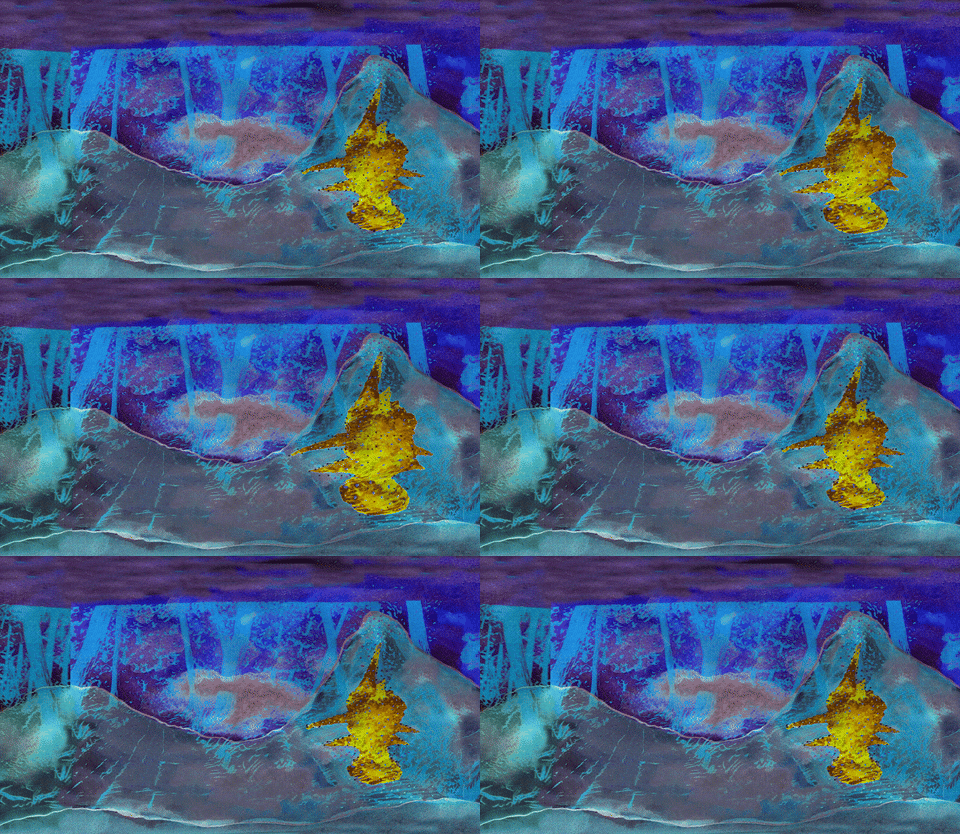
The animation I'm working on tries to deal with these issues and at times it represents feelings trapped inside the body, at other times the body becomes a landscape and then we slip between the body and its interior organs and the feeling tones or sensations that make up the emotive landscape that emerges from the physical release of hormones into the bloodstream.
The images above eventually become embedded into ideas for a body moving within a body. The 'trunk' being a totally separate organ, seen as an idea rather than as some sort of anatomically accurate image.
Four versions of a trunk, ready to be animated
Body parts to be attached to a trunk
As I begin to put the animation together, the process will like all my other drawing activities, eventually begin to tell me what it is becoming about. This finding clarity in the muddle of doing, is I'm afraid my most valued methodology, but it is not one that sits very well within the established research list of approaches to attaining new knowledge.
However here is a first indication of what the interior somatic feelings are looking like.
The growing awareness of a pain emerging
In the image above, I'm trying to fuse a shape of a pain with an emotive reading of a response to it. The landscape itself is a fusion of two sets of drawings, one of local woods and another of mountains of slag drawn from memory. It is movement that tells us something is alive and active, a throbbing pain, being as alive as a flying bird, all inhabiting the biological ecosphere.
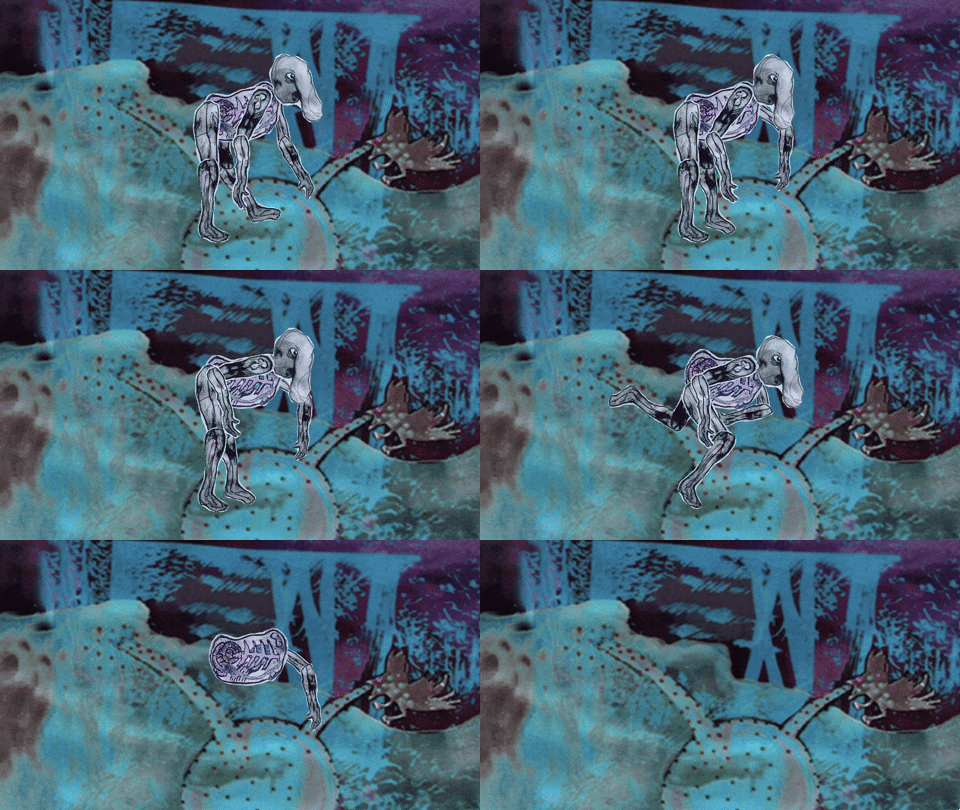
The animated gif image below is an indication of how the trunk and body parts will come together. I was initially going to hand make all the parts of the animation and had already made a few cutout puppets, jointed with paper fasteners, but Doctor Simpo, an old friend and animator as well as comic maker and many other things, suggested that he could digitally animate the figure for me. This is his test, to see how the figure sits against the background.
As the figure moves through the body/landscape it talks to itself, using a language that has been constructed from sounds made as people respond to different feelings, see Sound sample
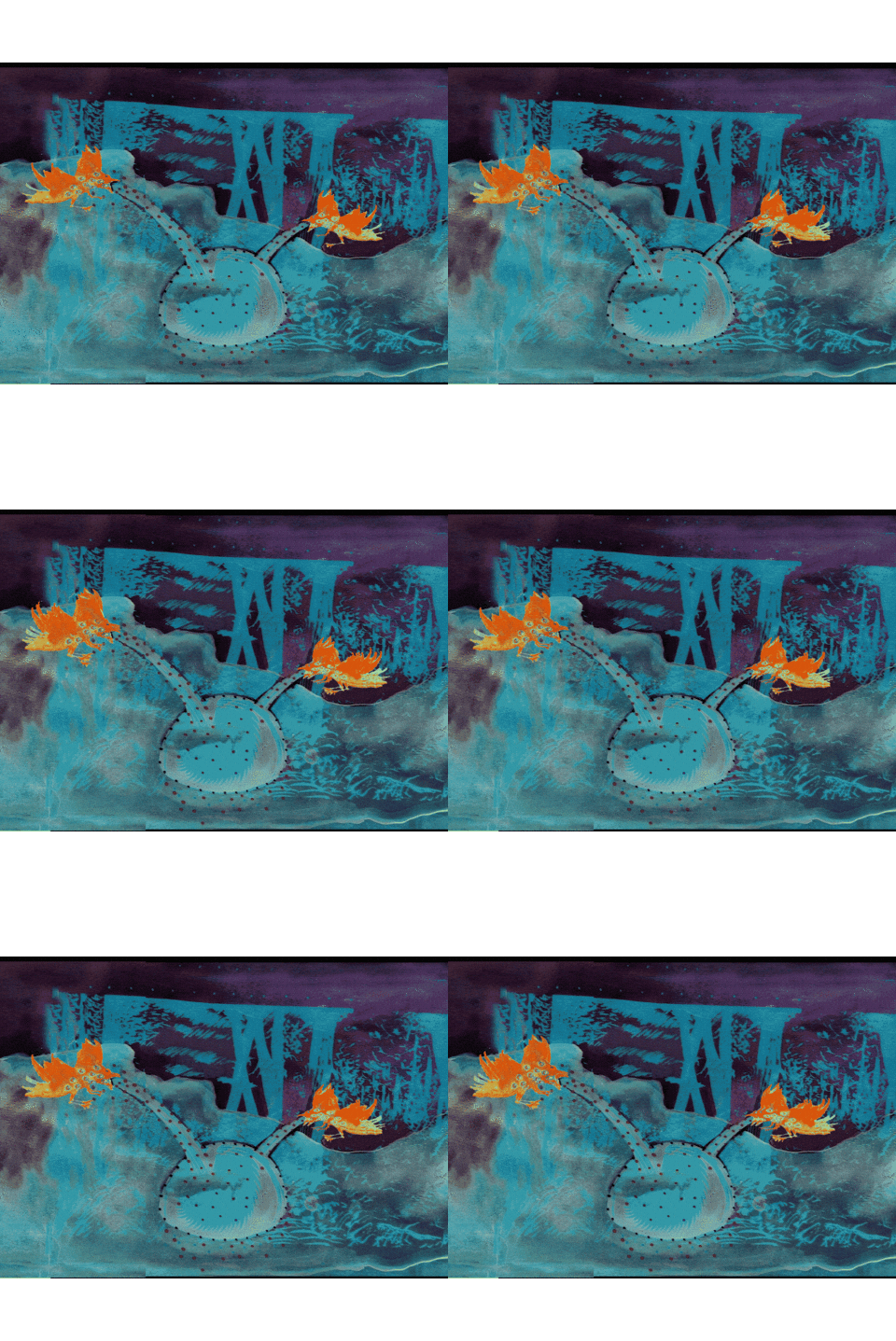
The object in the frame that looks a bit like a helmet with two horns, is what I termed a psychic infuser, it is where life energies can be piped into the ground from living creatures, in this case birds attempt to breath life into the landscape. You can get a better idea of how that works from the image below, which is a colour test, to see how orange would sit against the blues. I'm yet to animate the birds properly, as they need to be redrawn.
As I return to pilates, I will continue to use the experience to visualise a somatic awareness of the body in motion, alongside trying to represent the feeling tone that I have as I emotionally think about my ageing abilities to move. Therefore the visualisation of emotional feelings has to be coupled with 'invented' body forms, something that is also being developed by another related project that has emerged from the meetings I occasionally have with artists that worked with myself on 'The Body I am in' online project. I am in the middle of a new project directed by myself, but with growing interventions and ideas from the other participants, whereby three of us are working to develop body costumes to help externalise internal feelings but there is so much going on there that it will need a post to itself to communicate what is happening. Hopefully, this work will begin to fuse with all my other projects, such as the work at Pinderfields Hospital, and I will begin to see what it is I'm actually doing.
References: K. Caldwell, M. Adams, R. Quin, M. Harrison, J. Greeson. 2013. Pilates, mindfulness and somatic education, J. Dance Somat. Pract. 5 (2):141.
I was recently asked to hold a one to one on stage conversation with the animator Caroline Leaf. This was one of my last formal tasks as a staff member of the Leeds Arts University before I retire and even after all my years of teaching and hosting similar events, I was really terrified of meeting her, as she is one of my heroines of drawing.
Her animated film, 'The Street' was named the 2nd best film of all time in the world at the Olympiad of Animation in Los Angles in 1984 and how Ben Simpson managed to persuade her to come to Leeds and why he chose me to interview her I'm not sure, but I took the opportunity on gratefully and hopefully didn't come over as too much of a clod. She had even taken the trouble to look at one of my animations, 'Boat at Sea' and was gracious enough to write to me that... 'I’ve seen your migration animation with the little boat of people and the beautiful drawings. I like seeing the paper of each drawing flicker so I know how you made it, I like the variety of the kinds of waves and how they feel real and threatening and at the same time I see they are drawings.'
From someone of her status that was for myself high praise.
She talked about her time as a student at Harvard and how at that time the way animation was taught was to give students the time and space to find out what could be done, with whatever means they could get their hands on. This led to a focus on the basics, how one frame could lead to another, and that led to some very personal approaches to the process of animating, in Caroline Leaf's case, it led to her discovery of sand animation. The drawing in all her animations is sensitive and very well observed, she could have been a painter rather than an animator and during the evening she showed us her recent work, which is no longer animation and is both abstract and made directly from observation. Her drawing observation skills are clearly evident in both sets of new work and she is a wonderful example of how the skills learnt in drawing can be applied in so many ways.
So if you haven't seen her work before, below are links to some examples. Her animations embrace reality by dealing with film as if it is sculpture. Each frame feels as if it is travelling around an object, just as much as it is some sort of low relief sculpture. The physical nature of the material, whether it is paint or sand is always central to her vision, which is why these films are so 'human', they seem extruded from her hands and her fingers.
The Owl who married a Goose
The Metamorphosis of Mr. Samsa
The Street
So thank you Ben Simpson for giving me the opportunity to meet a drawing heroine of mine and thank you Caroline Leaf for agreeing to come to Leeds and to give both a masterclass and to take time to be in conversation with myself in the university lecture theatre. For those of you who follow this blog and who have never come across her work before, if the links still work, you are in for a treat.
I haven’t put up many posts on graffiti and yet as an art form it is probably the closest to pure drawing. I wonder if its my age or a certain unconscious bias that has kept me away from reflecting on an area of art making that surrounds me and where I can walk out and see good examples of it within seconds of emerging from the house. I did a few years ago put a book together about the streets texts of Chapeltown where I live, ‘Wits Breath Edion’, https://www.blurb.co.uk/books/2308745-wits-breath-edion and its still available on-line but I have not been alert to the latest developments of a movement that continues to be very powerful globally. However I need to remind myself of the issues involved because I have just been given an MA level graffiti artist to supervise, and so as I go through the process of preparation by reacquainting myself with some of the key background issues thought it would also be an opportunity to develop a blog post outlining what I think are the key issues surrounding graffiti art form practices.
You could define graffiti as an art form of the proletariat, being an old left wing socialist I have always thought of it as a way of making marks on a property canvas; by this I mean that walls or the surfaces on which graffiti is made, are usually owned by someone and yet the images made on them are usually produced by those who own little or nothing. This I do understand is an old trope or stereotype and as I pointed out just the other week, stereotypes are dangerous so perhaps I’d better broaden my definition.
A Marxist reading of graffiti would highlight how it works in terms of stages in the redistribution of property. In this case the use-value of a wall or other surface is becoming appropriated by the graffitist and the surface’s owner is losing control over one of the meanings of his or her property. However many current graffiti artists are using their style for commercial gain, the spray paints they use are expensive and the culture from within which they operate is much more complex than that attacked by certain urban revolutionaries. For instance a Banksy image stencilled on a wall can increase its value considerably and yet at the same time he is very critical of certain capitalist values and his work is often considered a left-wing critique of the establishment.
In 2001 IBM employed graffiti advertising by spray-painting images on pavements.
Ogilvy and Mather: IBM Linux ad
The ad agency Ogilvy and Mather were using graffiti images to bring attention to IBM’s launch of a new Linux based e-server by linking in the idea of graffiti to the counter-cultural roots of Linux as open-source, community-driven software. This awareness of commercial possibilities was a product of capitalist appropriation and for some time before this there had been a gradual drift of street art into gallery spaces, the most notorious perhaps been the parallel careers of Jean Michel Basquiat and Keith Haring.
Bansky comments on Basquiat
Basquiat's work was highly political, it questioned everyday racism and the fluid nature of identity and Haring supported rallies against apartheid and the campaign for nuclear disarmament as well as being an early AIDS awareness advocate. Both artists emerged from the New York graffiti scene, hence their left wing credentials and were taken on board by fine art galleries. It has been argued therefore that their early left wing stances were appropriated and neutered by being turned into commercial products. It is this argument that now lies central to the ambiguous nature of more recent writing about graffiti, is it truly a style of the streets or is it yet another platform for wannabe gallery artists? I don't have an opinion on this and think it's too complicated an issue to unpick as I don't know enough about the current situation, however anyone thinking of developing a graffiti practice does I think have to at least be aware of the issues.
Advertising directed at your counter culture
When Sony decided to use graffiti type images on the streets of American cities, of urban kids playing with the PSP handheld device as if it were a street culture icon, there was an immediate backlash from the graffiti community. However the line had now been blurred and a number of graffiti artists, including Mike Giant, Pursue, Rime, and Noah have used their street credentials to support new careers in the design of skateboards, T shirts and other urban wear including shoe design.
'Become a walking art installation with the Dr. Martens X Jean-Michel Basquiat collection. Iconic silhouettes are adorned with Basquiat illustrations to take your look to new levels' Text pasted from Doc Martin's website.
Doctor Martin's in the case above suggesting that by buying their boots decorated in imagery derived from Basquiat's paintings, the wearer can become a walking art installation. What this image also suggests is how much humans need imagery in order to brand themselves as belonging to certain 'urban tribes'. In this case the wearer can suggest an interest in creativity, urban style, black street culture as well as suggesting an edginess due to the fact that everyone knows that Basquiat was a drug addict and that he died young like so many teen icons.
Haring seemed to understand the very ancient roots of graffiti, and as soon as you see his imagery painted directly onto his body, you get a sense of how 'tribal' some graffiti is.
Keith Haring
A performer at the Ayres rock Tjungu Festival
Body decoration in many cultures including our own is usually part of a 'total art' or gesamtkunstwerk, which is an approach to using imagery, music, dance etc., all together, as a way of communicating what it is to be a human embedded into a particular culture at a particular time. Think of someone today going to the tattoo studio, hanging out on the street, wearing certain clothes, then moving on to a music scene to listen to a certain type of structured sound. It should all hang together for them and be part of the way they develop an identity.
High Viz street culture festival Birmingham
The idea of 'street culture' is now so embedded into contemporary consciousness that cities like Birmingham are now bringing together comic book, dance, skateboarding and graffiti as annual festivals celebrating the contribution of street life and culture to the city.
Of course when this happens some will decry the artists as selling out, whilst others will bemoan the fact that the city is allowing graffiti and urban culture to become acceptable. All of these ideas are also mixed in with issues surrounding the fact that cities are multicultural and that they are melting pots of culture clashes, high art coming up against hip-hop, poetry against tagging, oil paint against the spray can. You are either excited by the potential of new hybrid art forms emerging from this chaotic mix or are worried that what you have always understood as culture is being eroded by something that you never even considered as art. What you cant do if you live in a city is ignore it.
From a personal point of view I think that people will always want to celebrate their identity and that if you begin to elevate one way of doing this over another you begin the process of selecting out the culture of the elite or powerful. A healthy culture is not a fixed culture, it is one that is open to change and is confident enough to reflect that the only things that are constants in life are growth, death and energy transfer.
Basquiat and Haring were followed into the gallery by many other graffiti artists, and as they transfer across and become more acceptable their work becomes appropriated by academia. In my own institution Sweet Toof has been a visiting lecturer and his work it has now being argued is a modern continuation of the 'vanitas' tradition, his teeth standing in for the full skull image that was used to remind us of the fact that death is always with us.
Sweet Toof
I opened this post with an image of Blu's work, one that if you click on it becomes an animation. I have been following Blu's practice for a few years now and his work attracts me for a number of reasons. First of all he reminds me that all drawing is in some ways a performance. He will be acting out the drama of these animations in such a way that they extend over several days, as he makes drawings, paints them out and remakes, over and over again as they make their way over buildings and along streets, each drawing being a clearly thought through follow on from the one before. Of course he needs a supportive team of people filming his drawings as they unfold, and the team becomes part of the street performance. He is also very inventive, and the invention begins with the environment within which he is working, as William Kentridge said about his own animation drawing, "there is always discovery in the making". In this case the drawing begins with outlining a single brick in a wall. Once the work is done we are left with a cleaned off surface, each drawing being wiped out as a new one replaces it. This means that the work is ephemeral, something that is enacted as street drama, but not left so that it becomes dated or inappropriate because the moment or issues it reflects upon has now gone.
PHLEGM
More locally to Yorkshire PHLEGM, who is based in Sheffield, has been making images that I think work very well in an urban setting. He uses images drawn in black over a white silhouette. This is a very canny way of making his drawings stand out against a variety of different backgrounds.
If you want to get an idea of how the New York graffiti scene changed over a period of time when some of its members became art stars, perhaps the film KENNY SCHARF: WHEN WORLDS COLLIDE, is the best introduction. It was made over 11 years and features interviews and rare archival footage with Kenny Scharf, Andy Warhol, Jean-Michel Basquiat, Keith Haring, Ed Ruscha, Dennis Hopper, Yoko Ono, Kaws, Marilyn Minter, and Jeffrey Deitch.
I have posted before on D' Arcy Thompson's 'On Growth and Form'. But perhaps his real legacy is that he has provided a platform for digital artists to explore the possibilities of form implied by mathematical formulae.
Daniel Brown is known for his inventive and playful interactive animations. His series 'On Growth and Form' (2000–ongoing) uses mathematical formulas to generate various possibilities for the creation of blossoms that are inventions relying on mathematical ideas, rather than being abstractions from natural forms. These digital blossoms extend an idea of beauty into virtual reality. Brown is paralysed from the upper chest down and uses adaptive technologies to continue working, now in lines of code rather than with his hands. This animation uses real-time 3D (OpenGL / DirectX) flowers engine. If you go to Dundee you can see a D'Arcy Thompson museum and Brown's work is also shown there.
Geometry was usually an artist's entry into the world of mathematics, Uccello and Piero Della Francesca, being the early Renaissance artists normally referred to as being fascinated by geometric as much as by observed form and of course Leonardo had plenty to say on the subject.
Uccello: Perspective Study of Mazzocchio
Leonardo: Study of Mazzocchio
So as a student where would you begin? There are several entry level 3D programs, especially now that 3D printing is becoming more available. A good starting point is to see what's recommended as being the best option. This link won't work for long but there will always be some company wanting to get you started so just search for what's out there.
The problem comes when you want to move on and enter the world of animation. If you look at a CGI film you quickly realise how many different people have been involved. The ‘animation pipeline’, whereby concept, designs, storyboard, layouts, music, poses, and outline etc. have all been looked at as to how they fit together, is vital. Think of a factory, with various steps, often employing different people along the way, all having to be integrated if you are to make a product. Remember just one piece of software, such as Maya, has a huge learning curve and this is why so much animation is done in teams.
If you look at the screen for 3dsMax, its pretty obvious that 3D computer programmes still use the basic wire frame structures as drawn all those years ago by Leonardo and Uccello.
An earlier post did mention other starting points and covered a brief history of this area of drawing, but as the technology moves on so quickly that earlier post looks totally antiquated now. As an introduction, here are a few artists that I think are worth looking at, but do remember I am rather like a dinosaur when it comes to exploring this area of drawing and as you discover exciting people or approaches, it would be useful to get some feedback on what is happening out there.
Escape Pod: Jonathan Monaghan Video 20 min loop
I saw Jonathan Monaghan's 'Disco Beast' a couple of years ago and realised that he is very astute at playing with our boundaries as we travel between fantasy worlds and reality. My granddaughters are into unicorns, so he was obviously on the button there.
Still from 'Disco Beast'
The use of contemporary myths, like the commodification of the unicorn, allows him to deal with the absurd situations that are encountered when something that originates in ancient Greek natural history writing, becomes central to recent fantasy film making and finds itself as a brand that can be on anything from on line gaming to soap. A unicorn is also about purity and desire, and in some ways the early disco experience was about those things too, old ideas re-emerge within new technologies.
Katie Torn
'Breath Deep' by Katie Torn is a video that is well worth looking at because of the way it combines so many of the tropes of our present over cooked world. Katie Torn's work reminds me of Rachael Maclean's, colour soaked animations are embedded into integrated video footage, as virtual environments are built from the detritus of consumer culture.
Natural Plastic: Faiyaz Jafri
Faiyaz Jafri's 'Natural plastic' creates an environment in which nature and culture are fused into one. Plastic has obtained the ability to grow just like natural life and as it does it mimics the shapes and forms of the natural world. Whether it is people or vegetation, all have been overcome by digital processing, the boundaries between organic and inorganic dissolve and categories previously seen as distinct, such an animate and inanimate life now collapse into each other. The implications of AI are such that artificial intelligence is probably going to become recognised as a life form in the very near future.
It is interesting to compare Jafri's 'Natural plastic' with Daniel Brown's 'On Growth and Form', Jafri's work is still in many ways tied to traditional ideas of artist's narrative visualisation skills, even though it uses a lot of contemporary 3D animation software, while Brown's is more reliant on his computer coding skills, he is seeking to build an implication of a formal idea rather than make a narrative point. These differences though will I'm sure soon disappear. Coding will become more available to everyday users, probably as a mix and match selection procedure, whereby you will plug together bits of coding to get done what you want. Which is to a large extent what is already happening but without the ease of use.
David McLeod
David McLeod, is in many ways a much more traditional user of 3D animation software. He uses it to explore permutations of form, his carefully orchestrated animations demonstrating how one form can become another, or how what looks like one surface can gradually become something that belongs to something else. His work sitting somewhere conceptually between the work of Brown and Jafri.
I'm always happy to see artists in the flesh, they can hide behind their video animation projections and Archangel Constantini as well as dealing with computer animations, moves between computer hacking, performance and soundscape generation. He flits between the world of computers and an analogue presence very fluidly. For me he helps humanise the sometimes 'geekish' association we can have with computer generated artwork, his awkward presence sometimes appearing funny and at other times tragic.
Archangel Constantini
Archangel Constantini first came to our attention in the late 90s with his Karaoke style songs that accompanied animated gifs of what he called ìBarbasî (Ken) dancing. 'Barba' was a socio-critical project, dealing with identity issues, but it was also very funny and the computer generated aspects were just as important as the Karaoke. Probably most well known for his 'Atari Noise' work, he has more recently been getting involved with Magnetoplankton, another artificial construct, a speculate future that as always with Constantini, was already flawed with humanity.
I went to see the William Kentridge exhibition, 'Thick Time' over at the Whitworth Gallery in Manchester last week. Every time I go to see a Kentridge exhibition I find something new to think about and something else for me as an artist to aspire to. There are very few artists that I can revisit over and over again and still find myself engaged and thinking about how my awareness of the world changes as I look at it through his lens. This is not to say that his work is great or profound, just that the way he struggles to put together narratives about his own experiences of the world seems to chime in some way with my own. I'm older than he is, but only by five years, so my upbringing, although far away in the English Black Country, was in some ways similar. He was though from a very intellectual and well connected family; Clement Greenberg came to tea at Kentridge's family home when William was a young man, and I think it probably took some courage to not be directly influenced by Greenberg's powerful modernist doctrine. I had to reject Greenberg's ideas as anti-working class via a different route, but both of us needed to find a way of saying things about the world by using metaphor. Art for a long time seemed to reject narrative and analogy. These were things I always wanted art to include, but I spent many years having to fight for some sort of acceptance that what I was doing was ok, that it could be seen as legitimate fine art practice. Even now, I sometimes get accused of being too illustrational, but it doesn't worry me any more, I just get on with what I do.
From 'Thick Time'
Kentridge uses metaphor in a layered way and this time I made sure I sat in with his animated installations long enough to see them through and to get an idea of what they were like if you moved into different positions to listen to them as well as watch them unfold. In doing this you get a better idea of the correspondence between the processes of his making and processes we find in the world itself. He has said himself that drawing is analogous to thought, and that for him, "the activity of drawing is a way of trying to understand who we are and how we operate in the world". More recently his drawing concerns have moved on from being a type of thinking, (epistemological research) to becoming much more about a state of being, about worlds that are places to inhabit, as well as a process out of which worlds arrive. (Ontological investigations). He has also commented that we "actively construct our world as we go through it", something that is also what we do when we draw.
Thick time
The processes that Kentridge uses such as animation or printmaking are also metaphoric; animation moves through time and therefore appears to Kentridge as a medium ideally suited to dealing with history. Printmaking pushes information from loaded plates onto paper proofs, the press squeezing the ink into the papers operating as some sort of 'proving' process as well as 'proofing' process. The texts about his practice, all state that Kentridge is working through his South African trauma. I'm not sure what I'm working through, perhaps it's the British post industrial and post colonial loss of identity and the realisation of what it is to live in a multicultural society in a time of global warming. Or perhaps it's just that I have dreams and need to get them out of my head. When I make animations I'm not using them like Kentridge as metaphors for historical change, I'm trying to deal with change as a process that simply unfolds as part of the everyday, as well as realising that so much of what we do is repetition, this is why I try and make my animations looped.
A dog with eyes on its body
This dog was the first animation I ever made, I know it's really basic, but the fact that the dog keeps running, keeps trying to get to the edge of the frame, but never quite gets there, was what fascinated me and this was what I decided was the deeper metaphor for myself, not an ever changing history but a sense of Sisyphean activity endlessly repeated.
Neither man nor bird
In this case I tried to draw an animated image whereby man's aspirations, in this case to be able to fly, prevents the bird from taking its natural course. By one trying to catch or control the other, neither is able to do what they need to. The man endlessly stuck trying to hold on to the bird, hoping it will lift him off the ground, the bird struggling to fly, but being held down by the weight of the man. It's very crude, and I learnt this crudity from Kentridge, it seemed to me to be the only way to avoid having my work being compared to the sophistication of modern CGI animation techniques. This image is simply an animation made of a very quickly put down set of drawings, executed on several sheets of A4 tracing paper, with a dip in pen and a little ink wash. As the washes were added the paper crinkled up, and it is this crinkling that makes the background tonal changes. The drawings were not even laid on top of each other to ensure a smooth transition from one frame to the next, I just drew them in a line, one after the other. At the time of drawing this image I felt that the rough stupidity of human actions could not be over estimated and I haven't changed my mind. Kentridge's images are less pessimistic than my own and he has a sense of history leading towards a better life, something I'm not so sure about. Showing alongside the Kentridge at the Whitworth was another wonderful exhibition of Goya and Hogarth prints. Both artists were grim chroniclers of human folly and I see no reason to disagree with their take on things, we still repeat the same mistakes and I'm sure both Goya and Hogarth would recognise the base elements of greed, xenophobia and hatred that continue to exist, even when economic conditions are such that so many more of us now exist above the poverty line.
Goya
Hogarth
If you can, do go to the Whitworth to see this. Kentridge has used several different ways of installing video projections as well as using sound to add emphasis to his narratives. He also has large textiles and cabinets of drawings on display, so there are various ways of dealing with presentation for those of you interested in moving image and sound art, as well as excellent work using more traditional formats.