I have for the past few months been undertaking pilates exercises. These have helped me to get more in touch with my body and to teach myself about myself. Each week as I go through a set of controlled exercise routines, I am gradually, very slowly, increasing my ability to control my body. In Pilates, students, like myself, are taught to employ the repetition of specific movement skills, and gradually through repetition, hopefully the brain will also rewire itself, as a more body aware organ. This hopefully will develop my neuromuscular synapses, and lead to a heightened body awareness and therefore more precise body/joint/muscle control, something that I am testing out by playing more and more table tennis.
One example is the fact I often experience lower back pain. I have realised that I have trouble sensing the position of my pelvis in its body space and find it hard to differentiate the movement of my pelvis from my spine or distinguish the movement of my hip joint from my spine. I am slowly becoming aware that I can more precisely activate my core and I am sensing the fact that gradually I can take control of an inner set of relationships, that previously I wasn't even aware of.
My trainer/teacher gets me to make certain movements over and over again, their repetition has helped me to internalise certain movement skills, an ability that I am beginning to see as being essential for my lower back health. I see this development as fostering improved communication between my brain and my body, which should also eventually result in more resilient muscles and an increased capacity to sustain effort over an extended period; again I am trying to test these things out by playing table tennis. For instance how quickly I react to changes in incoming stimulus or how long I can sustain a certain level of bodily concentration.
All of which I am of course then trying to bring into my visualisation of interoception research. I am trying to approach the issue from several angles at once, putting myself and my feeling tone, at the centre of the process, as well as looking at other cultures and their various ways of depicting inner body understandings, such as old Chinese Edo period medical illustrations. I cant really ask others to believe in what I'm doing, if I am not prepared to undertake an investment in the full possibilities that begin to open up, as I continue to explore the relationship between my inner body and my outer psyche in relation to the way that my outer body hosts my inner psyche. The folding that I feel takes place, seems rather like a Klein Bottle, my insides becoming my outsides, my facial signalling reflecting my stomach feelings and my mind reflecting my body.
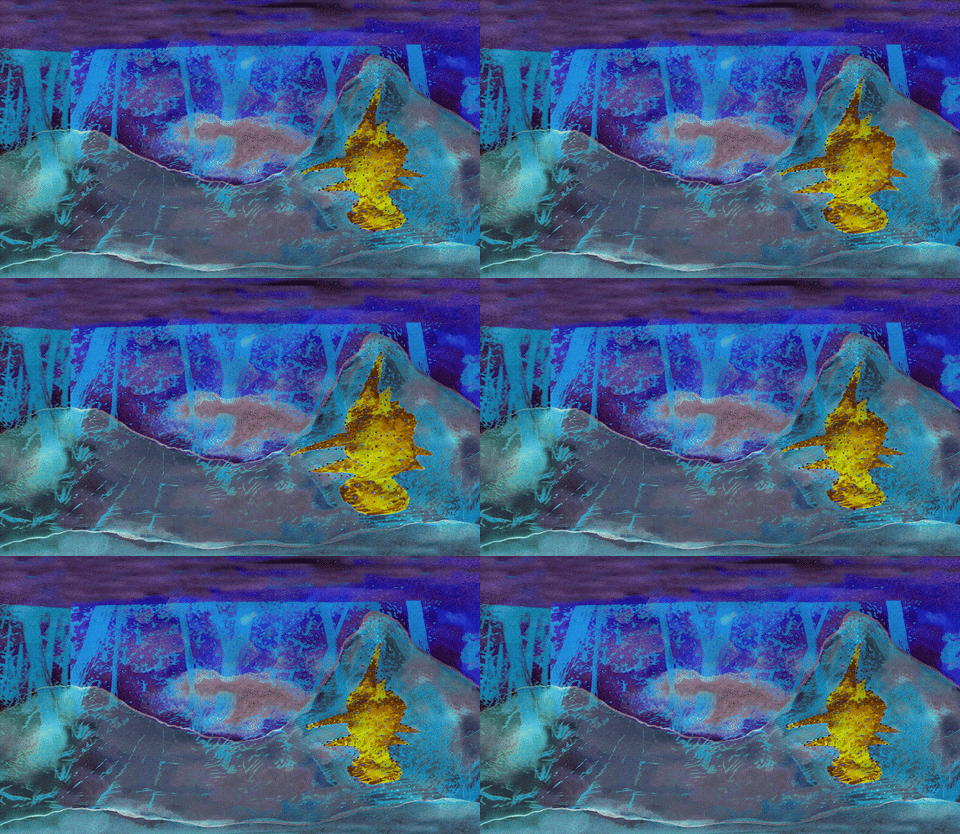
Studies for body mind awareness
The animation I'm working on tries to deal with these issues and at times it represents feelings trapped inside the body, at other times the body becomes a landscape and then we slip between the body and its interior organs and the feeling tones or sensations that make up the emotive landscape that emerges from the physical release of hormones into the bloodstream.
The images above eventually become embedded into ideas for a body moving within a body. The 'trunk' being a totally separate organ, seen as an idea rather than as some sort of anatomically accurate image.
Four versions of a trunk, ready to be animated
Body parts to be attached to a trunk
As I begin to put the animation together, the process will like all my other drawing activities, eventually begin to tell me what it is becoming about. This finding clarity in the muddle of doing, is I'm afraid my most valued methodology, but it is not one that sits very well within the established research list of approaches to attaining new knowledge.
However here is a first indication of what the interior somatic feelings are looking like.
The growing awareness of a pain emerging
In the image above, I'm trying to fuse a shape of a pain with an emotive reading of a response to it. The landscape itself is a fusion of two sets of drawings, one of local woods and another of mountains of slag drawn from memory. It is movement that tells us something is alive and active, a throbbing pain, being as alive as a flying bird, all inhabiting the biological ecosphere.
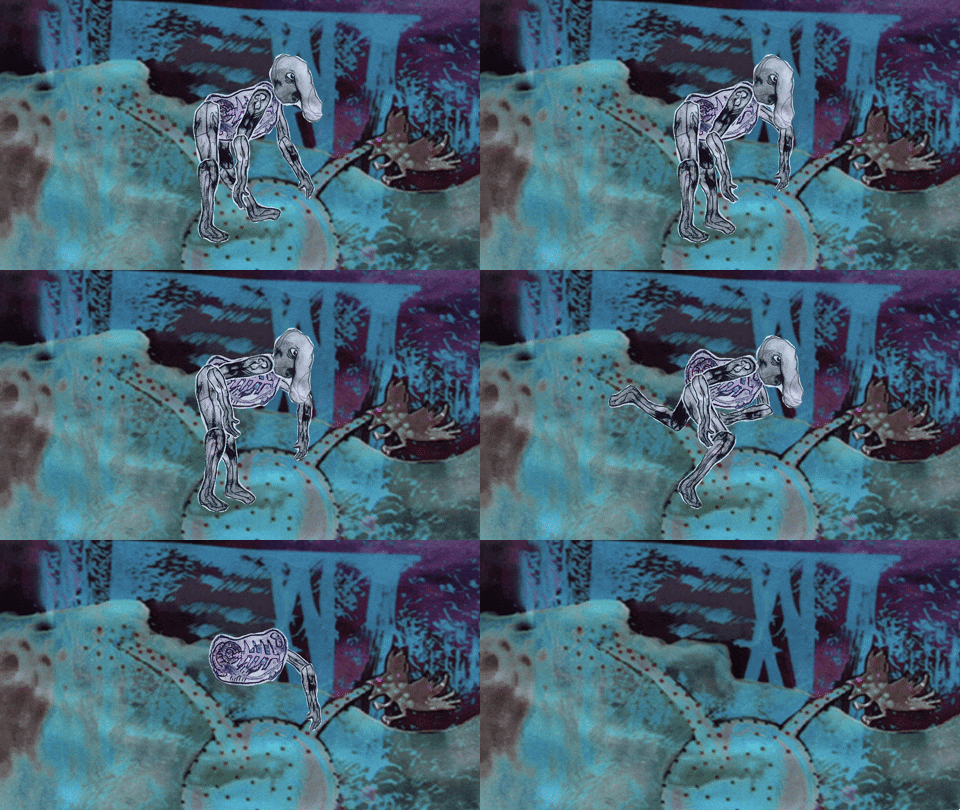
The animated gif image below is an indication of how the trunk and body parts will come together. I was initially going to hand make all the parts of the animation and had already made a few cutout puppets, jointed with paper fasteners, but Doctor Simpo, an old friend and animator as well as comic maker and many other things, suggested that he could digitally animate the figure for me. This is his test, to see how the figure sits against the background.
As the figure moves through the body/landscape it talks to itself, using a language that has been constructed from sounds made as people respond to different feelings, see Sound sample
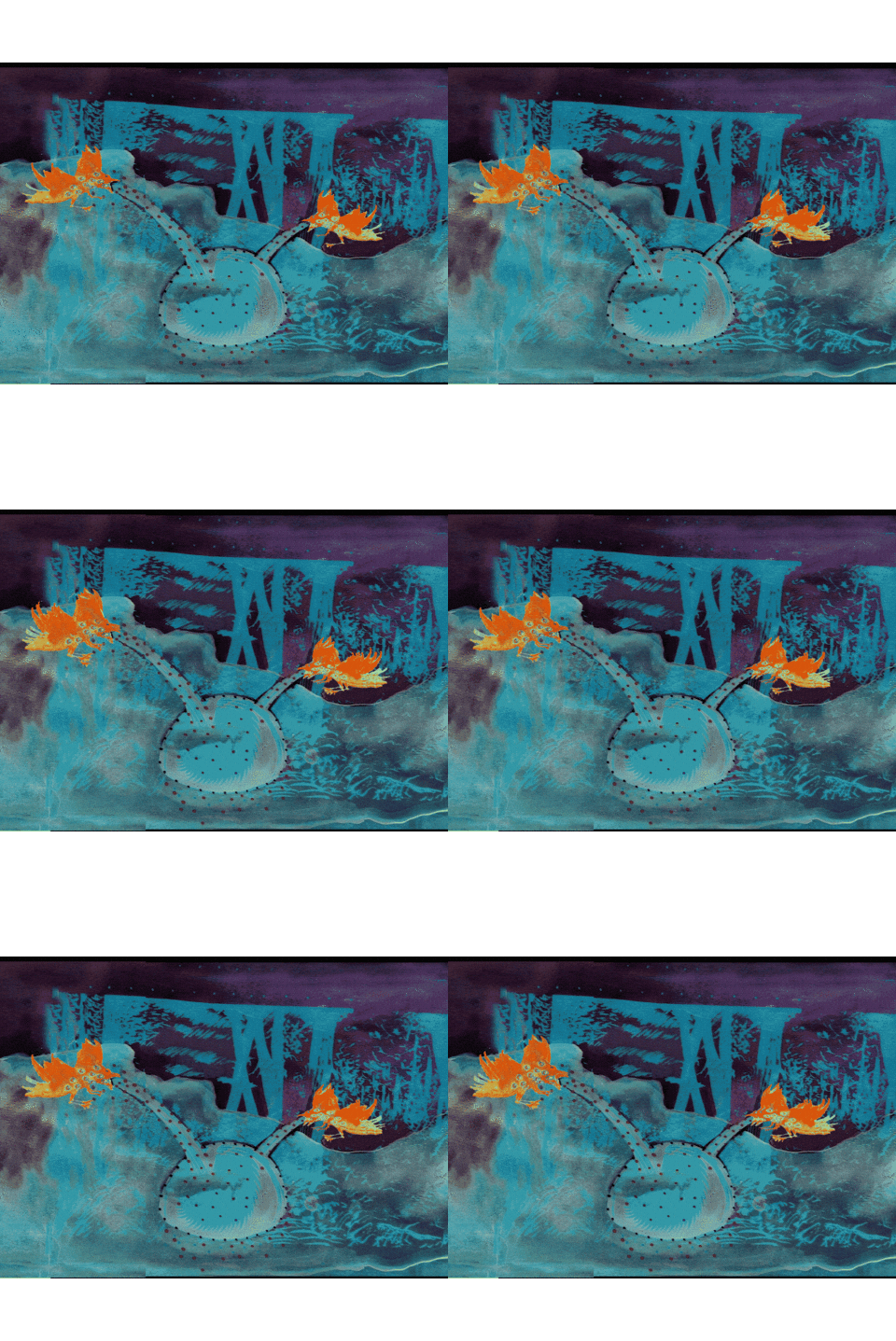
The object in the frame that looks a bit like a helmet with two horns, is what I termed a psychic infuser, it is where life energies can be piped into the ground from living creatures, in this case birds attempt to breath life into the landscape. You can get a better idea of how that works from the image below, which is a colour test, to see how orange would sit against the blues. I'm yet to animate the birds properly, as they need to be redrawn.
As I return to pilates, I will continue to use the experience to visualise a somatic awareness of the body in motion, alongside trying to represent the feeling tone that I have as I emotionally think about my ageing abilities to move. Therefore the visualisation of emotional feelings has to be coupled with 'invented' body forms, something that is also being developed by another related project that has emerged from the meetings I occasionally have with artists that worked with myself on 'The Body I am in' online project. I am in the middle of a new project directed by myself, but with growing interventions and ideas from the other participants, whereby three of us are working to develop body costumes to help externalise internal feelings but there is so much going on there that it will need a post to itself to communicate what is happening. Hopefully, this work will begin to fuse with all my other projects, such as the work at Pinderfields Hospital, and I will begin to see what it is I'm actually doing.
References: K. Caldwell, M. Adams, R. Quin, M. Harrison, J. Greeson. 2013. Pilates, mindfulness and somatic education, J. Dance Somat. Pract. 5 (2):141.
Thinking about my body while walking through landscape
I’m still thinking about how to justify the fact that when I’m working to visualise invisible sensations such as pain or certain emotions or feelings such as being worried, angry, thirsty or too full, that I rely on intuitive responses more than any form of logical analysis. This is the case in both my responses to visualising my somatic awareness of my own body and in my work done in conversation with others, whereby we jointly try to work towards the making of images that are meant to communicate interoceptual experiences. One problem is, as I have pointed out before, that my conscious awareness of the sensations I have is an interpretation, sometimes the interpretation might seem like a visual image but at other times the same information, could be received through my skin as heat. (The infrared issue) This feeling of consciousness seems to be something science can’t help me understand, or at least not the science we are used to using. Which is why I have in these blog posts occasionally reverted to the exploration of pseudo-science or outdated beliefs, in an effort to feel for a way of understanding something, that has I have come to believe, only to be understood intuitively and not logically. This is another attempt to approach the issue, this time though using some of the theoretical work produced by Regis Dutheil and his daughter Brigitte in France and first published in French in the 1990s.
Regis and Brigitte Dutheil (2024, p. 55) stated that there was an ‘incontestable correlation between physical parameters (e.g. wavelength, intensity) and the quality of the sensation (e.g. 700nm wavelengths evoke red as a sensation, while those of 450nm are bluer).’ However as I have pointed out before this 'correlation' is suspect, because the same wavelength received via the eyes, can evoke an infrared colour for a snake or human wearing infrared goggles or contact lenses, yet also evoke a feeling of warmth if detected via the skin's thermoreceptors. However, Regis and Brigitte Dutheil go on to question whether or not sensations can be quantified. They state that it is not possible to map sensations back onto the physical effects that stimulated them into existence. They also believe that there is no functional representation of the real world mapped onto the senses; there being a discontinuity between cerebral activity and its registration in conscious awareness. (p. 56). They go on to argue that this phenomenon therefore lies outside of the ability of science to understand it; which does suggest that like myself they agree that the mind creates the sensations we become aware of.
As they advance their argument they point out that the mind can hallucinate and as it does an individual’s conscious awareness may well tell them that what they are experiencing is true, even though those around them can clearly see that the experience is not coming from any outside the body stimulus. I. e. that the mind shapes our reality, not any outside experience. They then go on to propose that this ability of the conscious mind to shape reality is very similar to quantum mechanics, whereby an observer also shapes reality, via what is known as a superposition collapse. (p.57). In quantum mechanics, superposition is the ability of a quantum system to be in multiple states at once until a measurement is made. Its collapse is the process where it is reduced down into a single, definite state upon measurement or observation; i. e. the potential outcomes described by the superposition are reduced to a single, actual outcome. In the same way our minds when stimulated by sensations decide what these sensations are going to be represented as. For instance, that scarf on the chair which is being activated by a gust of air blowing through the window, was first seen out of the corner of my eye as a cat, however when I look again, it is redefined in my consciousness as a scarf.
I found all this very interesting, as it for myself allows art back into the frame and their descriptions of altered states by particular drugs or meditation practices, reflected my interest in how a shaman might operate as a conduit between the everyday and the spirit world. A role that Joseph Beuys argued was something that artists could appropriate. My work to find an intuitive visual language to represent interoceptual experiences, was I felt not so strange after all and that what I was doing was also illustrating something about how consciousness itself works.
However this last week I have been out in the landscape walking and drawing. I often need to do this as it charges my batteries and feeds both my perceptual and my interoceptual imagination. When I'm drawing from the perceptions that flood in as I engage with landscape, I use my artistic interests as a filter and this last week I have been trying to see the landscape as a body, finding organs in its embedded forms, my internal somatic awareness operating as a compass to help me navigate the external world. The more I work to visualise internal worlds, the more I see the internal in the external. What I invent in drawing to capture my perceptual experiences, is I realise limited to the extents of my personal visual language and this language has been shaped by all the other drawings I have done up until the moment of making a new one, including therefore my recent attempts to visualise pain and associated emotions, which are in the background of my visual thinking as I begin to record the landscape.
I began drawing on the first day in West Wittering by looking at the coastline as something constantly being reshaped by the sea's waves, a shifting boundary that is permeable. Then once I had attuned myself to its ebb and flow, I began see the landscape as a body that flows around me as I walk through it; its fine grain the equivalent of blood platelets or the fibles I see within a split bone when looking through a magnifying glass. Sound, ground, air, vegetation all flowing past as I walk and draw, whilst bird noises talk to me and I begin to sense that they also need to tell stories of the land and what passes through it. Perhaps their songs are like drawings, I learnt recently that birds have a particular chemical high as they learn their songs, being rewarded by successful tuning and vocalising when babies, with dopamine releases. I also feel better when I get a drawing right, could this be a similar effect?
As I invent my way through drawing, I invent my way into how I might in future draw myself. I see the space of landscape as an opening for my emotions to enter and a place to give form to the body's feeling tone. Gradually my mind begins to quiet itself and accept the situation, the drawings become more focused and I feel that I am becoming entwined with my surroundings. I feel my body becoming fully immersed back into landscape and as it is, it is something to quietly and gratefully accept.
Sketchbook drawings
Reference
Dutheil, R and Dutheil, B. (2024) The Superluminal Universe London: Watkins
Ian McKeever has been working with images of landscape for a long time. However his work as a painter gradually grew out of a conceptual interest in landscape that used drawing as a vehicle to reveal time and place as moments of photographic capture. Back in the 1970s conceptualism was a powerful driver of art practice and there was a focus on the methodologies that lay behind representation. In particular photography was often used as a measure of time. For instance; focusing on a snow-laden bush of spiky branches, Douglas Huebler photographed it twelve times from a fixed position at fifteen minute intervals. He was also interested in the idea of a photograph also undergoing a material transformation, the silver gelatin printing process allowing for a very beautifully controlled set of tonal variations that reveal the role of light in relation to the underling negative-positive process of the medium in which he is working. He regarded this type of work as sculpture and had this to say about that; "The existence of each sculpture is documented by its documentation".
Douglas Huebler: Duration Piece #11: 1969
This type of gridded documentation was very influential when I was studying sculpture in the early 1970s and you can see how McKeever was using it to present his own take on the documentation of the coastline.
Ian McKeever: 1972: 'Tree painting' for grassy lowland-scape: Photography and drawing
As you can see in the image above, McKeever had been bringing together photography and drawing for a while and in the painting and construction below, he was trying to show several elements of his landscape experience. He wants to show us the sky, the beach and the rocks all at once, but some experiences are more tactile than others so he has made textured ceramic balls to present us with the more tactile experience.
Ian McKeever: 1971: Withernsea, Yorkshire Painting with extensions: Oil on canvases in 2 wooden boxes, with textured ceramic balls
However as McKeever progressed he became more and more interested in the relationship between photographic documentation and drawn or painted realisation. Often a photographic element was juxtaposed with a drawing or overpainted.
Ian McKeever: Studio set up
As you can see from the studio shot above, he began bringing the landscape back into the studio. Painting, drawing and photography are enmeshed together.
Ian McKeever: Seascape with photograph
Gradually the painterly recreation begins to escape the photographic documentation.
Ian McKeever: Assumption
In painting such as Assumption, it is the quality of light that interests McKeever, rather than a documentation of the landscape. The manipulation of paint on canvas makes a landscape in its own right. As the paint is moved around, it is as if he is re-creating the forces of light, wind and rain and how they interact with a geologic substrata.
Ian McKeever: Waterfall 3 1979
You can see the split between photographic documentation and painterly recreation beginning to come about if you look at McKeever's 'Waterfall' series of images from the late 1970s. He juxtaposes the photographic document with a drawn recreation of the same place. The drawings begin to 'escape' the dictates of the photograph, they make their own reality, just as the landscape does.
Lucas Arruda
Lucas Arruda is a Brazilian painter known for the atmospheric luminosity of his landscapes. It is interesting to compare his work to McKeever's, as in a way they have both left representation behind and both are far more concerned with re-creation. Arruda states, “It’s the idea of landscape as a structure, rather than a real place.” He paints from memory, and avoids specific reference points, recalling atmospheric conditions, different types of weather or times of the day.
These paintings are a type of abstraction, the use of a horizon line gives a sense of a landscape of distance and atmospheric space. When seen in the flesh, the materiality of the paint, combines with the brain's tendency to see landscapes, and the art historical references point to the romantic sublime. I like them because they waver between things, sitting on an edge between genres, whilst being very enjoyable paintings, that are very much about paint.
Lucas Arruda
Lucas Arruda
Christopher Prout is an artist working with the English landscape that I have often looked at as someone operating in a very interesting space between an abstract expressionist sensibility, one of making paintings that achieve their impact and expression through the way they are painted, and an observational practice, that attempts to capture the images of particular places and atmospheric conditions. While looking at his work your mind can switch between an awareness of the painting as object and the painting as a window.
Christopher Prout
Christopher Prout
However when it comes to the drawn image, a current favourite of mine are the drawings of Sue Bryan. She works in charcoal on either handmade paper or primed wooden panel.
Sue Bryan
Sue Bryan's drawings are always about dry materials such as charcoal and graphite, but also about certain atmospheric conditions. You feel that she really does have a deep empathy with the trees that she is depicting, these images are suffused with love. Her process of image making is one of building up tones and textures using a combination of charcoal, carbon and graphite combined, in order to achieve a beautiful range of blacks and greys, that as she puts it "vary in density and transparency as much as in tonality".
In a time of global warming and an awareness of how we as a species have made such an impact on the landscape of the planet, how art can be used to raise awareness of the wonderful landscapes that we still have left, is becoming a more and more vital question.
Nils-Udo: Beech and Rowen Berries
Artists such as Nils-Udo and Andy Goldsworthy have used the materials of nature to make their drawings and site specific installations, whilst collaborative ventures such as Red Earth have undertaken performances and have become much more directly involved in the preservation of landscapes.
Red Earth
Whether you are trying to make people aware of the beauty and wonder of landscape by making images of it or are being much more environmentally politically active, (as in the work of Agnes Denes), doesn't matter, what is important is that you become more aware of how our future is inextricably linked to the fate of the landscapes that surround us; not just the ones we can see out of the window, or as we travel through the countryside, but also the landscapes that we cant see, but which are still effecting us everyday, such as the Amazon and the Antarctic, huge areas of land that have both been severely effected by climate change and human intervention.
Guest drawing blogger: Patrick S. Ford A Dialogue with the Landscape.
I Grew up in England, with its long tradition of landscape art, and studied at Jacob Kramer College (as Leeds Arts University was known at the time). I first studied there from 1977-78 and then again from 1980-81.
Among the many wonderful and unforgettable experiences I had at Jacob Kramer, the week-long drawing trip to Wharfedale was arguably the high-point for me. I could never forget sitting up on the hills in the cold for hours on end making marks, erasing marks, making new marks, struggling to capture the particular character or personality of a specific section of the valley. The search for the appropriate marks that could express weight and convey distance and form in the landscape were the goals of those drawings. I quickly became aware that the resulting drawings were not simply an objective recording of the chosen landscape, nor were they merely an attempt to depict the landscape as a two dimensional image. The final images were more than that, they seemed to be a struggle to find a way of conveying a physical experience by recording that experience as a specific collection of marks, in a similar way to how binary code stores complex sets of information about the world.
‘Wharfedale’, 1981
As I made these drawings I first had to ignore the temperature and the fact that I had not dressed appropriately for a day on the hills. I sat on a plastic sheet, with snow lying all around me. As I drew a stick of compressed charcoal across the sheet of paper, I followed the lines of the drystone walls I could see on the opposite side of the valley. I imagined myself walking there, hugging the walls for protection against the wind, climbing the hill towards the crest. As my imagination walked across the hillside, the piece of charcoal in my hand scraped correspondingly across the paper surface.
The resulting drawn image may not have been an exact visual copy of that part of Wharfedale but that would only be apparent if the drawing were held at arm’s length to the valley beyond. Once a drawing has left the location that triggered its creation it must work as an independent, resolved image able to exist on its own merit and not reliant on any comparison with a particular place and in my case a particular part of Yorkshire.
Fast forward now around 40 years and I found myself living on Cheung Chau Island, part of the territory or Hong Kong. During the 6 years I had been living on the island I had developed a regular late afternoon walk which I undertook every Saturday and Sunday unless it was raining heavily. Along the route of the walk I had noticed numerous boulders that lay in various parts of the island. Some of them lay very close to the path I traced and as I walked quite slowly I had time to look at them closely. On many of them the surface had been eroded by the wind and water into a texture that resembled miniature vermiculation reminiscent of the type to be seen on the lower stories of renaissance buildings. One in particular attracted me due to a large crack that ran vertically down the rock. The combination of the fissure in the rock and the surface texture I thought was quite striking. It could almost have been sculpted deliberately.
At the time, in my notebooks, I had been testing various drawing materials, such as willow and compressed charcoal, pastels, soft pencils and so on by laying thin sheets of paper onto the floor on my balcony to see which materials picked up the details of the floor surface in a more effective way. I was investigating different methods of mark making although at the time I did not have a particular application in mind. When I saw the fissured rock on my weekend walk I put the two together and decided to trace the wonderful texture of the rock with the most effective materials I had determined from my tests.
The next weekend I took out a few sheets of thin, Chinese ink painting paper, some willow charcoal and located a few rocks that could serve as experimental subjects.
I spent a few minutes deciding which part of the rock to lay the paper on and then laid out my materials to be at arms-length while I worked. I would be holding the paper with one hand and pressing the charcoal onto the paper with the other. I carefully picked up the texture of the rock by utilising the frottage technique, the kind often used to record brass memorials in old churches. Care was needed and some practice required as I found that a certain amount of pressure was needed to pick up sufficient texture from the rock, but not too much pressure as that would tear the thin Chinese ink paper. I worked on 3 different rocks before moving on to the one with a distinctive crack running through it. This I felt to be the best of the group as it had an individual, distinct character. Although I was picking up the natural texture of the rock by rubbing the charcoal across the paper, I found that I could intensify certain parts of the emerging image in order to create emphasis. I therefore realised that I could exert some control over the marks being made and it was not simply a matter of recording the rock texture mechanically. The hand that held the paper in place while I drew was forced to move as I concentrated the drawing on different parts of the paper and through that hand I could sense the texture and temperature of the rock beneath.
In this way, as I used my hands to sense the form of the rocks, I gained an understanding of their make-up and which allowed me to respond later in an empathetic way. I had already expected that I may then have to work further on these initial images in order to clarify the visual imprint the rocks had left.
The drawings were the end result of a direct tactile interaction between the natural landscape and my hands. The experience was quite sculptural in a way, almost as though I was physically shaping the rocks in clay or a similar malleable material.It was as if the activity I was engaged in would somehow record the residue of the rocks’ presence onto the paper. Paul Klee would suggest that this residue would be generated by the naturally occurring energy of the rocks. Although the scale was different, I now realise that this ‘presence’ was what I was attempting to record onto paper back in Warfedale.
Reviewing my first round of drawings on Cheung Chau, I sensed that some drawings seemed to be almost fully resolved while others required some further work in order to resolve them. This further work was completed back in my studio and it was important for me to reflect on the experience I gained out in the landscape, so that my responses in the studio would be sympathetic with the marks made out in the field.
My overall aim was to combine the natural marks and textures created by the technique of ‘frottage’ and the sympathetic application of marks and tones added later in the studio.
Relief Drawing A – 33(h) x 22cm(w)
Relief Drawing B – 29.5(h) x 34.5cm(w)
Relief Drawing C – 32.5(h) x 35cm(w)
Relief Drawing D – 31.5(h) x 34.5cm(w)
Following this initial experimentation, I decided to move on to the next stage.
For this second round of experiments I chose a spot on a local beach. Here I found horizontal rocks emerging from the sand, full of character and ideal for my project. As these rocks formed the ground I walked upon it was therefore easier to lay out larger sheets of paper and use rocks as weights, rather than relying on my left hand to hold them in place while I worked.
On the day I chose to make my drawings it was very hot. I wore a straw hat from Okinawa that gave me shelter from the sun and allowed air to circulate through the weave. During the session that day I aimed to make two drawings. I took the roll of Chinese paper and a large square of paper that was not as sensitive as the Chinese ink paper, but being much larger it allowed me to experiment on a larger scale. It made sense to document the process and Nina, Yiu Lai Lei made the video recording for me.
Video: the making of relief drawing1
Working on the beach: Relief Drawing 1
Video: the making of relief drawing2
Working on the beach: Relief Drawing 2
Back in the studio I laid out the two drawings and reviewed them. The one I had made using the roll of Chinese ink paper seemed to me to be fully resolved. It had recorded quite a lot of the surface texture and the overall image had a strong personality. It seemed there was nothing missing and therefore nothing for me to add that could have improved it.
The larger, square sheet seemed a little unresolved so I felt I had to work more on it. Perhaps as this sheet of paper was not as sensitive it had not picked up as much of the surface texture. The contrast in the marks was greater (fewer half-tones had been created) and the marks seemed quite linear when compared to the other drawing. At first I was disappointed. I had been so pleased with the first drawing I assumed the larger drawing to be similar but more extensive. However, as I began work on it I realised my assumption was wrong. The paper surface was different, it was thicker and smoother and had not picked up as much of the delicate texture, only recording the main lumps and bumps beneath. I was mistaken to think that this paper could result in an image similar to the other paper that had such different qualities. Instead of being disappointed I embraced the larger drawing and as I continued to work I began to sense this drawing’s own personality. The image that began to emerge was not as three dimensional, the marks were almost calligraphic in nature and did not merge together so much in places as had happened in the previous drawing. Once I had found the new direction for this work I found the work much more enjoyable.
I tried to find equilibrium between the marks that were directed by the textures and fractures in the rocks and my own, considered response to them. The rocks led the way by setting out a basic structure, the scope of the drawing, and I then later followed their lead by responding to their clues and hints.
In order to make these drawings I had to adapt my usual method of working that would eventually allow me to make an honest and direct response to the form of the rocks. It is so easy to impose preconditions on a drawing and then attempt to push it in that direction rather than allowing the work’s specificity to dictate one’s working methods.
I have always found experimentation exciting and I enjoy the thrill I receive when I am not in control and don’t fully understand where a particular project is headed. In future I now plan to explore this topic more and test the specificity of this method through the use of different surfaces and different types of drawing support. The fact that the results of such a project would be unpredictable is what drives me on.
Relief Drawing 1: Chinese ink paper drawing – 138(h) x 35cm(w)
Relief Drawing 2: Layout paper drawing – 119(h) x 88cm(w)
Landscape drawing is often thought of as recordings of the picturesque, drawn scenes of beautiful views in the distance. However much contemporary landscape drawing tries to engage us in the physicality of the experience and in order to do this is often made large scale and designed to carry an element of the experience of encountering a landscape back into the gallery. Instead of holding the image at a distance so that the viewer can contemplate it, there is sometimes an attempt to thrust the experience directly into the audience's space. At other times artists cross fertilise their images with information coming from a variety of sources, actual elements of the landscape may be brought back and incorporated into a drawing, or photographs, maps, diagrams and writings added into the mix.
Often working directly in urban landscapes, Kate Downie is as much interested in the non spaces that are overlooked and the edgelands of our townscapes, as the iconic architecture that can appear to dominate a city. Working at a variety of scales, she is often to be found drawing directly in front of her subject; mud, rust and grass stains can therefore become just as important as her charcoal marks. Rolling up, flattening out, dragging along the ground, pinning up, falling down, being trod on and dropped are all actions that are recorded in her drawings. They bear witnesses to the act of ‘being there’. She also brings her studies back into the gallery and works directly from them, often merging different views together in order to create a 'poetic' meditation on her collective experience.
Kate Downie
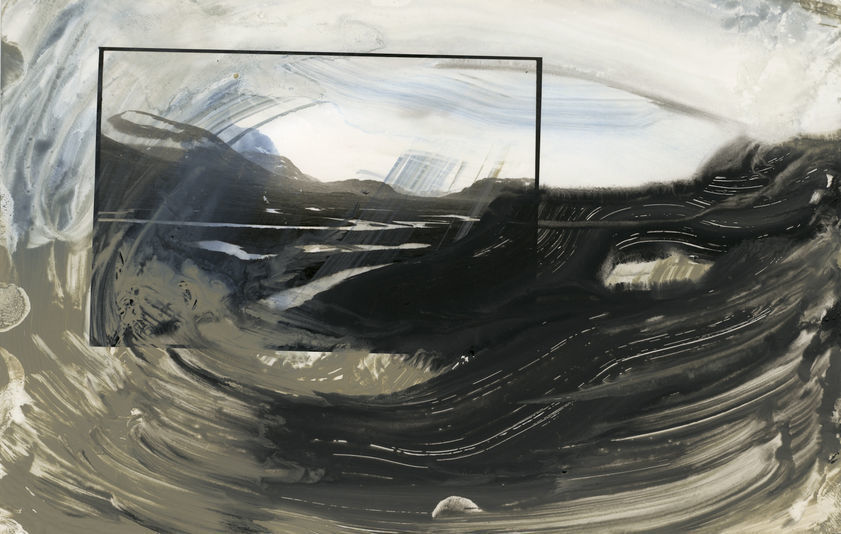
This video of Downie making the drawing above will give you an idea of her working methods when she is drawing in a gallery or exhibition space. It is useful to compare how Downie works with what John Virtue has to say. He has worked for years in black ink, often mixed into shellac. Virtue will work into the raw canvas, stating he wants to 'bleed the image in', he goes on to say that he likes 'the idea of the image impressing itself into the canvas'. He uses rags, hands and all kinds of brushes, all in an attempt to get the right effect.
The drawing above by Virtue is one of his early drawings, done whilst he was working as a postman, small views are gradually pieced together to create a much larger image that is a meditation on walking through the same landscape over and over again.
John Virtue
Virtue uses his materials to create an edge between the becoming of the paint, (often oil mixed with shellac) and the becoming of the landscape. You feel a tug between the two states and if at one moment he finds the image of what he is looking at too powerful, he reasserts the act of painting. Pushing and pulling image against paint until a sort of stasis is arrived at that oscillates between the two. In the flicker of betweenness be lets us back in to the moment of the landscape's perception, a window into his own experience of both looking at the landscape and painting a response to it.
Artist Matthew Rangel hikes cross-country and through the mountains, exploring and drawing along the way. He then constructs drawings that combine the various ways that he has experienced his journey. This can mean that he has to combine maps, with diagrams, photographs and observed drawings. He is another artist that relies on a grid to give structure and coherence to his images. The vertical ruled lines are also perfect structural scaffolding for his annotations.
Matthew Rangel
Rangel also uses concertina sketchbooks, which allow him to travel through the landscape making annotations in a sequence that reflects the passage of experience. He may well have looked at Chinese and Japanese scrolling landscape drawings, which can have a very similar feel to his images.
John Wolseley, an Australian artist, makes large works on paper that represent an inventory or document about the state of the earth. He usually works out in the landscape and sees himself a a hybrid between an artist and a scientist. He has made markings by rubbing his paper against burnt branches after bush fires have burnt themselves out, by burying his paper or by letting insects make their tracks across it. His drawings are as much as a record of the physical experience of being in the landscape, as an observed visual document. The drawings also include written notes and diagrammatic reflections on what is happening to the flora and fauna that he encounters.
John Wolseley: Murray-Sunset refugia with 14 ventifacts (2008–10)
carbonized wood, watercolour and graphite on 15 sheets of paper, 120 x 232 cm
History of the Whipstick Forest with ephemeral swamps and gold bearing reefs 2011
watercolour, charcoal and graphite on paper 234 x 287cm
Nicholas Herbert is much more conventional in his approach, but nevertheless just as interesting. If you are ever thinking of mixing pastel into your drawings he is a good artist to look at. Like most artists he is really interested in where his materials come from, and in his case he keeps a blog where he can reflect on these things.
Nicholas Herbert
Herbert in the tradition of Turner, inserts himself into the landscape and in particular responds to those misty days when valleys come in and out of focus. Masses of trees can loom dark against soft white mist in the early morning, or clouds shadowing the sun can cast alternative dark and light patches onto the gradually emerging forms of hills and valleys. These drawings are almost paintings, I like the way he keeps the surface of untreated paper coming through, it's as if the support is the ground of the landscape. He is very sensitive to his materials and you feel as if the materials of ink, chalk, pastel and wash are directly in tune with his observations of earth, atmosphere, rain and wind blown vegetation.
Emily Nelligan now well into her 80s has been drawing charcoal landscapes for well over 50 years. She is interested above all in light and her drawings of clouds, the light reflecting off water and similar subjects, point to how delicately a material like charcoal can be handled.
Emily Nelligan
When you look at Nelligan's drawings, the thing that impresses you is her use of the paper grain. Something that is often mistreated, or simply ignored, but in her case she glides her charcoal across the surface, never smudging it into that amorphous blob that it is so easy to do with charcoal, but keeping it crisp and yet atmospheric. It's so easy to overwork drawings like this, but you can tell they come from observation and experience and not from trying to copy photographs.
Marie Lorenz, Untitled (Corpse), 2007; charcoal on vellum
A series of charcoal on vellum drawings and rubbings acts as a chronicle of Lorenz’s navigation of urban waterways. Lorenz uses a journey down a river to create a series of interconnecting works that emerge from the process of making a journey. Her landscapes are also stories. Sometimes rubbings are taken from both the landscape and the boat that she travels in, forming an indexical relationship with the experience, literally bringing part of the experience back into the studio. What is interesting about contemporary landscape drawing is both the continuing influence of the past and the reshaping of that by more contemporary concerns such as performance or documentation. Contact with other disciplines also helps keep renewing ideas about the role of drawing in relation to landscape, for instance when art and geology or geography combine in mapmaking, or when art meets data analysis as in the work of Matt Willey whose work has tried to show the impact of the economy and human activities on the environment.
Mat Willey
Contemporary landscape drawing often combines fieldwork with material and philosophical research. Many site-specific drawings are ephemeral, drawing installations may blend into way markers, set into a landscape to help you read it in a particular way, or recording might be made of a passage through a particular territory.
Landscape badge
In my own work I have been looking at the interrelationship between humans and landscapes. The inner body being thought of as being very similar to what lies beneath our feet. Cross sections and slices through both, reveal similarities and I at times attempt to merge them.
However it's Easter and I'm sure you are all taking a well earned break. Some of you may however well find yourselves out in the landscape and if so think about its potential for being a source for your work. I'm off for a break myself and will be making my own contributions to this old and venerable tradition, so I will not be posting any thoughts about drawing until I return. I will however leave you with an artist that geologists still look upon with awe, one that for the first time spotted the layering of the Earth's crust.