Showing posts with label feeling. Show all posts

Thursday, 9 July 2026

Qualia and Visualising consciousness


An embodied thought

If structuralists are right, our perceptions of experience depend on how we have perceived all other previous experiences. When we encounter red, in order to define it or hold it in our heads as a distinct category,  we contrast it with other colours, as well as compare it to entirely different perceptual categories. For instance, red is sort of like orange, but distant from blue, and nothing at all like pain or joy. Contemporary neuroscience has used this contrast and compare qualia situation to develop classification schemes of experience, often couched as abstract geometric shapes. “Our approach is to categorise all possible relationships between qualia,” says psychologist Nao Tsuchiya at Monash University and ATR Computational Neuroscience Laboratories in Kyoto, Japan, who leads the Qualia Structure Project.

The Qualia Structure Project is regarded as being fundamental to an understanding of consciousness and it has at its core a mathematical approach that uses a geometric analysis enabling researchers to boil data down to shapes.  For instance, based on his experiments, Tsuchiya estimates that we experience at least seven dimensions of colour. A report on the project states that it "has turned some of the classic philosophical thought experiments into actual empirical experiments. For instance, "is my red the same as your red?" ...The project invited participants into the lab for intensive testing. Four were flagged as colour-blind on a standard screening test, four weren’t flagged but volunteered that their colour vision seemed different and three had typical colour vision. Within each group, people made the same judgements about the resemblance of colours, but between groups, these assessments diverged. By doing a geometric analysis, the researchers boiled the data down to a shape. That of the second group – the self-reported colour-blind people – had features of the shapes of the other groups. “It’s an intermediate shape,” says Tsuchiya. In the structural way of thinking, what we take to be red is defined by its position within this shape. So, people within a group were entitled to say, “My red is the same as your red.” But what was red for people in one group might effectively be green for those in another. Tsuchiya describes the intermediate, second group as a “bridge” between atypical and typical colour experience, able to grasp the colour experiences of both." (Togashi, 2026)

Recently the project has been studying emotion. They have been showing participants pairs of videos that are supposed to elicit emotional responses. The early results are that both highly sensitive people and far less emotionally literate people experience emotion interoceptually in similar ways, but some people are more able to communicate this experience than others. I thought this chimed with my own work. Most people seem to have some awareness of their interoceptual experiences but they differ in their ability to articulate this. My work is mainly to help people become aware of these experiences, whilst this scientific project seeks to measure them; a typical art/science divide. 

From a series of images trying to visualise heartache

Tsuchiya says, “Experience is all about relationships,” He has used category theory to develop a descriptive language for these relationships, hoping that science will then be able to explain experience. If he is successful, he would like to build something similar to the periodic table to show how qualia work. However Loorits, in the paper 'Explanatory Relevance of Ineffable Qualia', states that the unanalysability of qualia is an important feature of human psychology. He brings in our experience of art to support this, stating that we often perceive experiences of art as unanalysable from the first-person perspective, until at a later stage we begin to adopt critical distance. I think this varies from person to person. I know some people that launch into analysis from the moment they experience art. I find that very difficult and am usually too overwhelmed by the experience to be able to break it down and analyse it, its only later, perhaps three or four days later, that I begin to think about what it might mean. 

This debate goes on whilst at the same time I continue with my own visual research. I still talk to people and ask them what feelings might look like and I still draw shapes and colours and textures that are attempts to connect a feeling with a visual form and run workshops to see how people can develop their own visual language to represent internal feelings. If it is true that experiences are all relative to one another, then even one viewed by an individual differently will effect how all the others are seen by that individual. Professor Dr. Holger Lyre states that 'people with synaesthesia, taste words or smell colours and therefore perceive these connections directly, but all of us, he states make them, therefore he proposes that, “To a certain extent, we are all synaesthetes.' (In Musser, 2026) This statement by Professor Lyre reinforces my decision to use the kiki / bouba sound shape connection example as a starting point for visualising interoception workshops. I also think that it is fascinating to watch what type of geometric analysis the Qualia Structure Project will come up with, but my feeling is that it will still not be able to solve the conundrum of consciousness. I am though as an artist happy to use my conscious awareness to develop visual responses to unseen events. There is enough mystery in the processes involved in communicating the un-communicable to keep me interested for some time yet and hopefully at some point my work will be used as a sort of instinctual counterbalance to the work being conducted by the Qualia Structure Project.   

A slide from one of my presentations on interoceptual awareness

Anger mask

Many years ago when I was at art college we had to look at the work of J. L. Austin, his book 'How to do things with words', was seen as seminal by my then tutor Keith Arnatt. We looked at illocutionary acts and in particular I remember being very interested in Austin's thoughts on the nature of pretence. Austin broke communication down into three parts, Locutionary Acts: The literal, physical act of communicating something, producing the sounds and constructing the words or making in our case, the art; the welding, drawing, painting processes. Illocutionary Acts: The performance of a communicative function in saying those words (e.g., using the words within the context of a warning or a promise), or presenting the artwork (framed perhaps by the gallery blurb as a warning, as an aesthetic experience or as an investment) and finally the Perlocutionary Act: The actual effect or consequence the utterance or exhibition has on the audience (e.g., persuading, comforting, alarming, or annoying them). Consciousness in Austin's terms was more to do with how we used language, but what if we were pretending? Pretending in relation to art seemed to myself to be to do with mimesis and mimesis was one of the art raft's central planks. Austin made a distinction between pretending to do and pretending to be. Pretending to be something, such as an angry person requires carrying out a string of related behaviours associated with that identity and eventually the pretence behaviour will become assimilated. I. e. you will eventually become what you pretend to be. This was the point of the anger mask. In order to think about how it feels to be angry, sometimes we need to assimilate the 
related behaviours associated with anger. As we do this, we can be more aware of what we are feeling. But what if you are pretending to see a colour?  “Colour blindness” was not scientifically recognised until John Dalton’s seminal report in the late 18th century. (Taniguchi, et al, 2025) This delay implies that atypical colour vision may have long gone unnoticed because people communicated without difficulty using a shared colour vocabulary, grounded in largely overlapping phenomenology. An alternative possibility is that a shared linguistic system itself shapes colour experience in a way that renders their qualia similar. The act of using language to cover up the fact that you were pretending to see, being gradually assimilated, so that in effect people can see, even though they cant see what others do see. This belief that you can see what you cant see, was something I came across several times during my career teaching foundation students. I encountered several students who were colour blind but they had never realised it and had had no problems communicating colour experiences before. It was only when we were exploring colour mixing that this became evident. Once it was evident and we gave them a colour blindness test, most of these students then admitted that they had felt something was wrong, but had purposefully behaved as if their perception was the same as other people.  

Perhaps all masks are like that, in wearing them we reshape our consciousness. If so an awareness of consciousness is perhaps another form of pretence behaviour, something that we hide behind, because without it we might lose our sense of self, which may itself be yet another mask. 

References

Austin, J. L. (1975) How to do things with words Cambridge, Massachusetts: Harvard University Press

Musser, G (2026) The simple questions cracking the hard problem of consciousness New Scientist https://www.newscientist.com/article/2519288-the-simple-questions-cracking-the-hard-problem-of-consciousness/

Loorits, K. Explanatory Relevance of Ineffable Qualia. Acta Anal (2026). https://doi.org/10.1007/s12136-026-00682-6

In press: Robust individual alignment of color qualia structures: toward a structure-based taxonomy of divergent color experiences. Yu Togashi, Yuko Yotsumoto, Chihiro Hiramatsu, Naotsugu Tsuchiya, Masafumi Oizumi
bioRxiv 2026.02.13.705699; doi: https://doi.org/10.64898/2026.02.13.705699

See also:

Surface and inner body perception in the age of CGI
Drawing textures

Wednesday, 19 March 2025

The Oceanic

Image made in response to listening to someone's experience of tinnitus

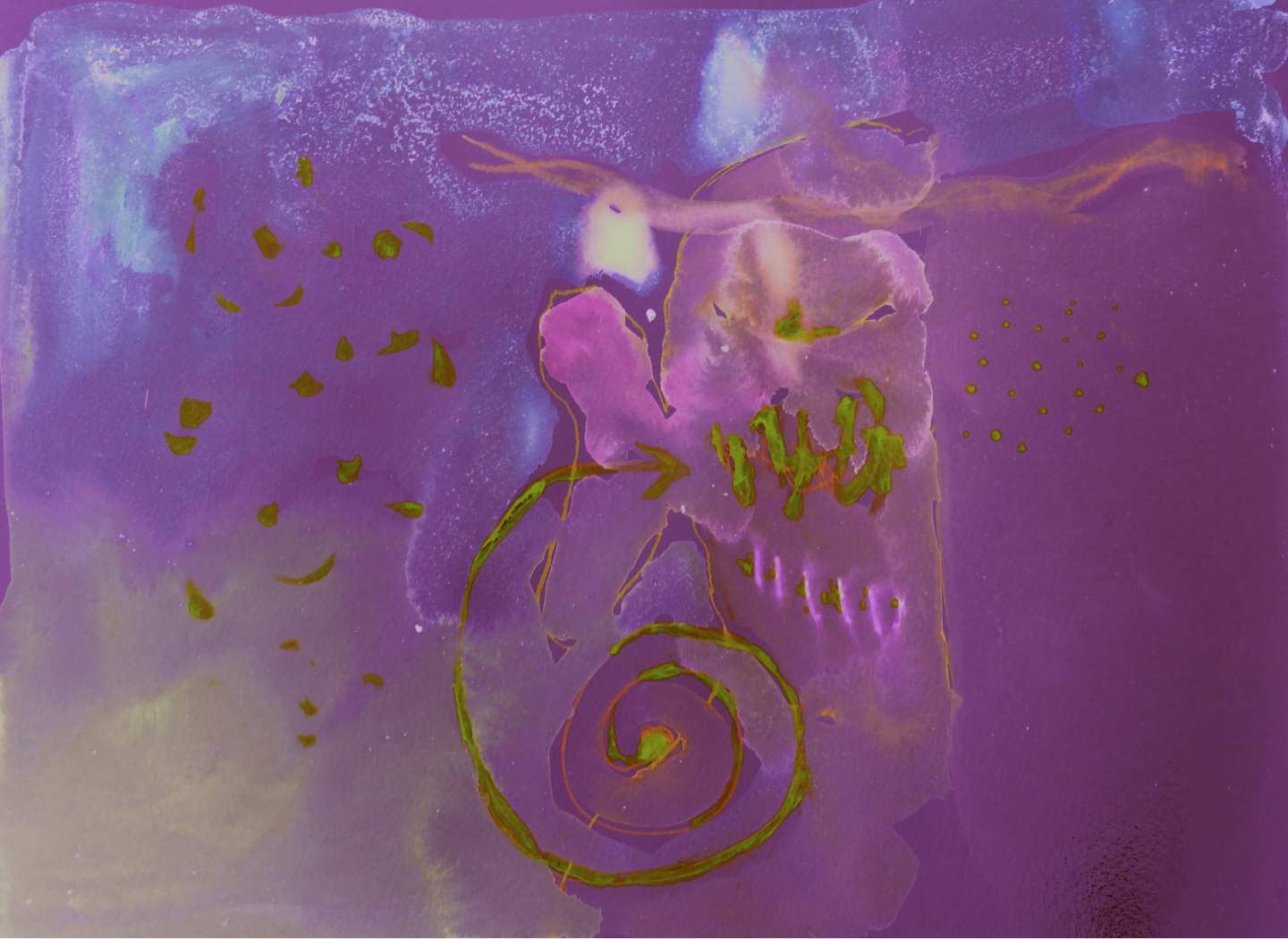
I have for some time now been making images in response to people's interoceptual experiences. Sometimes when I do this I can find myself lost in an inner sea of the body and experience it as another universe. To be lost within people's experiences, can sometimes induce a feeling within myself not unlike that one sometimes described as 'oceanic' and when that happens the resulting images can feel cosmic. The image above was a final one made in response to a series of visits to someone trying to communicate what it feels like to hear a sound that doesn't actually exist. Sometimes this was an experience inside the body, but not always, at other times the 'sound' seemed to come from outside. The 'buzz' of sound seeming to be like the sea, a sea that existed inside as well as outside the person experiencing the noise.

I'm sure most of us have at one point or another swum out a little beyond our depths when at the seaside, or on a foreign holiday found ourselves swimming in a deep clear sea on a beautiful sunny day. These can be moments when you just close your eyes and float, letting the sea take you and as you do everything seems to be in that moment, all worries and fears for once dismissed, as you experience a oneness with the moving waters, the sea sound in your ears and the sun above. This is the feeling of the oceanic.

The 'oceanic feeling' was first used as a term by Romain Rolland. De Cruz (2022) states that Sigmund Freud in response to a letter from Rolland, attempted to explain religion as the result of certain cognitive dispositions and saw it as a 'childlike yearning for a fatherly figure'. He took Rolland's idea of “oceanic feeling” (of limitlessness and being connected with the world), as a sort of phenomenological explanation of religious experience. But what if the reality of that experience is of a deeper significance, and in being reminded of how we are totally immersed and interconnected into the world, we begin to see other moments when we are totally 'lost' in our worldly integration. Higgie, (2023, p. 73), quoting Freud, writes that he also linked oceanic states to the times 'when people fall in love and consequently feel as if they are merged with another or are in some way transfigured by the experience'. Higgie (p.74) goes on to point out how Marion Milner widens Freud's vision when she writes that an oceanic state could be experienced moments of artistic creativity, when the unconscious mind lets go of the distinction between me and not me, between seer and seen, and does things that the common sense, conscious mind cannot do.'

My occasional posts on 19th century and early 20th century mystic approaches to how to visualise invisible experiences are I'm sure linked to this feeling. The moment of creativity is something special, even if we only get lost within it momentarily, in those times we let our mind/body dissolve itself into the world via the materials of making. Higgie's book reminded me of the central importance of women to a more mystic tradition of art and it has been very useful in letting me feel connected to a range of approaches to art making that have long been there and it has also reminded me that we need, as Higgie states, 'elements of illusion to cope with reality'. (Ibid, p. 88)

Image produced in response to a conversation about tinnitus

The tinnitus image above was made directly before the one that sits at the top of this post. It is easy to see the relationship and the differences. The spiral remains a very important aspect of the feeling tone but the eye has gone, it was far too obvious and grounded the image in an exterior seeing, rather than opening it out into a more 'mystic' interior life of the invisible. The colour was too predictable and had no real sense of the un-reality of an alien sound. The notes around the edge are annotations taken from a conversation made in response to a previous drawing. I listen, I draw, I take the drawing away and then develop it further. Once satisfied that I have something worthwhile, I take it back to the person I spoke to and we begin another conversation about the relationship between the image and the experience they have had. Gradually the images are changed, a type of co-production emerging. At its best when I let go of my control, an image can arrive that seems to myself at least, literally 'wonderful'.

References.

De Cruz, H. (2022) Religion and Science The Stanford Encyclopaedia of Philosophy (Fall Edition), Edward N. Zalta & Uri Nodelman (eds.), Accessed from https://plato.stanford.edu/archives/fall2022/entries/religion-science/ 15. 1. 25

Higgie, J. (2023) The Other Side: A Journey into Women,  Art and the Spirit World London: Weidenfeld and Nicolson

Coda

It has been great to be chosen as one of the best drawing blogs out there by Feedspot: See: https://bloggers.feedspot.com/drawing_blogs/ for a link to all the ones shortlisted. 

See also:

Art therapy and perceptual research 

Drawing water

The uncertain certainty 

Freud and drawing invisible forces

Ibrahim el Salahi: Pain relief drawings

Sunday, 19 November 2023

Drawing on Experience

John Dewey wrote ‘Art as Experience’ in the 1930s and set out the centrality of the communication of experience to the practice of art. I have been involved for a while with a research group associated with the university of Porto entitled 'The Observation of Perception, considered through Drawing' and my own research in relation to this has been to explore how we might visualise experiences of interoception. I have posted fairly regularly on the different aspects that I have confronted as the work around this has developed, from a consideration of 'qualia' as the phenomenal quality of experiences, how we now think about inner body perception in an age of CGI, the relative benefits of hand drawn and computer refined imagery when making representations of inner body experiences, how the body and its nervous system construct inner maps of experience, how we might use this process of visualisation for the development of a contemporary type of votive and other issues that are all related to why interoception is an important aspect of perception, especially if we want to reflect the full complexity of perceived information, that comes from both outside and inside of our bodies at the same time. However I'm also very aware that as well as making images about this, which I regard as my primary research, I'm also writing about the process and sometimes forgetting that I'm writing in English and the English language is itself a somewhat limited communication medium. This post is therefore a reminder to check out how other languages deal with issues that are similar, but in their very difference, open out conceptual alternatives. 

The word 'experience' in German can be translated as either 'erfahrung' or 'erlebnis'. 'Erfahrung' represents deep, full blooded experiences that lead to knowledge, whilst 'erlebnis' is a word that stands for more superficial experiences that are perhaps enjoyable but not necessarily profound. In English 'experience' is a thing, but in German it is a quality of perceiving. There is a diagram that might help illustrate this difference. 


In the diagram we have two very different German words for something that is another single one in English. Körper refers to the body as an object, something to which physical qualities can be attributed. Leib, by contrast, implies the body as a subject. 'Körper' represents the physical/material, objective body and 'Leib' the lived/animated, subjective body. In English of course we have the word 'corpse' to define a 'dead' body, but this is not what the German word implies. These distinctions are vital to our reading of phenomenology because the main early thinkers are German. According to Husserl and, then later, Merleau-Ponty who takes his reading from Husserl, 'Körper' is the body-object, while 'Leib' is the lived-living body. In German what it is to be a body (Leibsein) can be contrasted with what it is to have a body (Körperhaben).  Körper stems from the Latin corpus and refers to bodies as physical entities, including celestial bodies, geometrical entities, and dead bodies or corpses. Leib, by contrast, is related to the verbs leben (to live) and erleben (to experience, to go through) and the adjectives lebendig (animated, lively) and leibhaft (in person, in the flesh). As such, Leib refers to the body as it is experienced or lived, instead of the body as it can be measured or quantified. Therefore for my purposes I'm dealing with subjective experiences of the lived body, (Leib) not a set of measured physical bits of objective information that are records of the physical nature of the body, (Körper). 

A representation of stomach cramps (A subjective experience of the lived body)

If we go back to 'erfahrung' or 'erlebnis' we can then open out the two differences in meaning even further. In this October issue of Art Monthly, Matthew Bowman looks to Walter Benjamin and his understanding of the distinctions between 'erfahrung' or 'erlebnis' to open out a reflection on why we are no longer able to sustain 'erfahrung' or deeply felt experiences, and how we use 'erlebnis' as a way to protect ourselves from the constant bombardment of information that is our contemporary state of being. We in effect can only deal with shallow or superficial responses to experience because if we tried to deeply experience the constant flow of stimulus that we are now subjected to, we would seize up and be crippled by information overload. My reading of this is to keep making slow things by hand, things that you can take your time with, rather than trying to make another incursion into the world of mass media. Instead of trying to avoid confronting profound, deep feelings; to cultivate them. To use a sense of 'erfahrung' as something to strive for in your work. Colour, surface texture, tonal variation and other basic elements of image making can be deeply emotional, and we can have profound relationships with both objects and other people. Events still move us. Yes we are subjected to a constant bombardment of information, but we can still recognise the qualitative emotional differences between life changing events, such as experiences of birth, death, and of those special times of unexpected spiritual awareness that can become moments of epiphany. If not, we will become empty, emotionless husks, incapable of deep feelings. In slowing things down, we help ourselves and others to feel more, to attune ourselves to the wider cosmic wonder that we live within. 

A chest pain visualised

A meditation on the body

Sometimes thoughts can be carried in materials in ways that you don't expect. In the image above, I found myself talking in a language of pigment diluted in water. As the image emerged out of swirling liquids, it seemed to develop some sort of harmonic with my own body. This is something that can happen both within and without; can be both portrait and landscape. Finding the right material to work with can be vital, for instance, Sue Bryan's drawings of trees, mainly using charcoal, sometimes achieve a close harmony between the dry crumble of the charcoal, the texture of 'treeness' and the atmospheric emergence of the tree; the 'crumble' and soft smudge of the chosen material representing both object and the space it grows into. 

Sue Bryan

Just looking at a tree or listening to your own body can be antidotes to the constant flow of digital information. So perhaps leave off reading this blog and go outside and look at stuff. With a pencil in your hand, examine a tree and when you are ready, begin to draw it or if you are stuck inside think about what it feels like to hold a pencil, and draw that. 

See also: 

The magazine PSIAX issue 7  This link is to a PDF download of the magazine which includes my recent article on visualising interoceptual experience

Qualia

Surface and inner body perception in an age of CGI

John Dewey

Considering analogue and digital drawing processes in relation to the visualisation of inner body experience

Maps made by our nervous systems 

Drawing and healing traditions

Why interoception