Showing posts with label Trinity Buoy Wharf Drawing Prize. Show all posts

Wednesday, 27 January 2021

The Trinity Buoy Wharf Drawing Prize winners announced.

M. Lohrum: You are It.

It is always fascinating to see the final selection and winners that are picked out in the annual Trinity Buoy Wharf Drawing Prize. It works as a sort of litmus test as to the current state of drawing led practices and especially this year in a time of lockdown. My own added personal interest was that I had submitted a collaborative piece this year, that made it through the first round but no further; so I was of course fascinated to see what did win. 

Trinity Buoy Wharf Drawing Prize 2020, Installation view(s) Cooper Gallery 2020. Courtesy Cooper Gallery. Photography by Eoin Carey.

M. Lohrum’s 'You are It' was the overall prize winner and for the first time a performative drawing has won. It reminded me of Sol Lewitt drawings that were also made from written rules, his impermanent wall drawings consisting of sets of the artist's instructions, so that their actual execution could be carried out by someone else. There is though a difference. In M. Lohrum’s case the audience is engaged directly in the drawing's execution, in Lewitt's case it was usually student volunteers or gallery staff who made the drawings and when you did get to see the work it was usually already completed. 

Sol Lewitt: Wall Drawing instructions

M. Lohrum is less 'authorial' in the control of the work, and there is more an emphasis on collaboration and participation, which I think reflects a shift in attitudes that has taken place since Lewitt began producing his work in the late 60s. Lewitt came from a time when the status of the artist was more or less unquestioned, artists were the avant-garde, the romantic initiators of new ideas and as such their name was very important, as it was used to in effect 'brand' their practice. We are living in different times, the status of the artist has been questioned and in particular the role of the artist as maker of 'honorific objects' that are to be collected by rich individuals and displayed as cultural capital in museums and art galleries is perhaps coming to an end. Of course the art market still exists, but it seems to have less and less relevance to many an artist's everyday life. My own recent experience is that as an artist I have become more embroiled in interdisciplinary activities, especially those related to health and wellbeing. The artist still has a role in society, but perhaps it is one shifting away from a capitalist idea of the producer of a particularly rare cultural commodity and is moving gradually towards an idea of the artist as catalyst or instigator of alternative ways of approaching life. Artists have always been associated with raising awareness, seeing something more in the everyday than the everyday, and it would seem that in times of a lockdown we need this quality more than ever. As the selector Frances Morris stated “The invitation to members of the public to participate as anonymous makers and the work’s dependency on collaboration between strangers, felt timely and necessary, speaking to the power of art to bring people together”. It is not of course just that a work like this brings people together, it also reminds us of the central position of our bodies in the making of meaning. Every drawing that has ever been made is in one way or another a seismographic record of the person that made it. Each one of us has a different ratio of arm length to height and to hand size; we are all unique in relation to the type of heart beat we build our life's rhythm to and in the way that our nervous systems are wired up. Each person participating in this drawing, as they are instructed to draw from their shoulder will immediately be aware of the weight of their own arm and of how well it operates as it moves around in its shoulder socket. Body awareness is of course vital if we are to maintain a sense of our own well being, an awareness not just of our selves but of other people's bodies is essential to the building of empathy with others and the development of our collective sense of community care. 
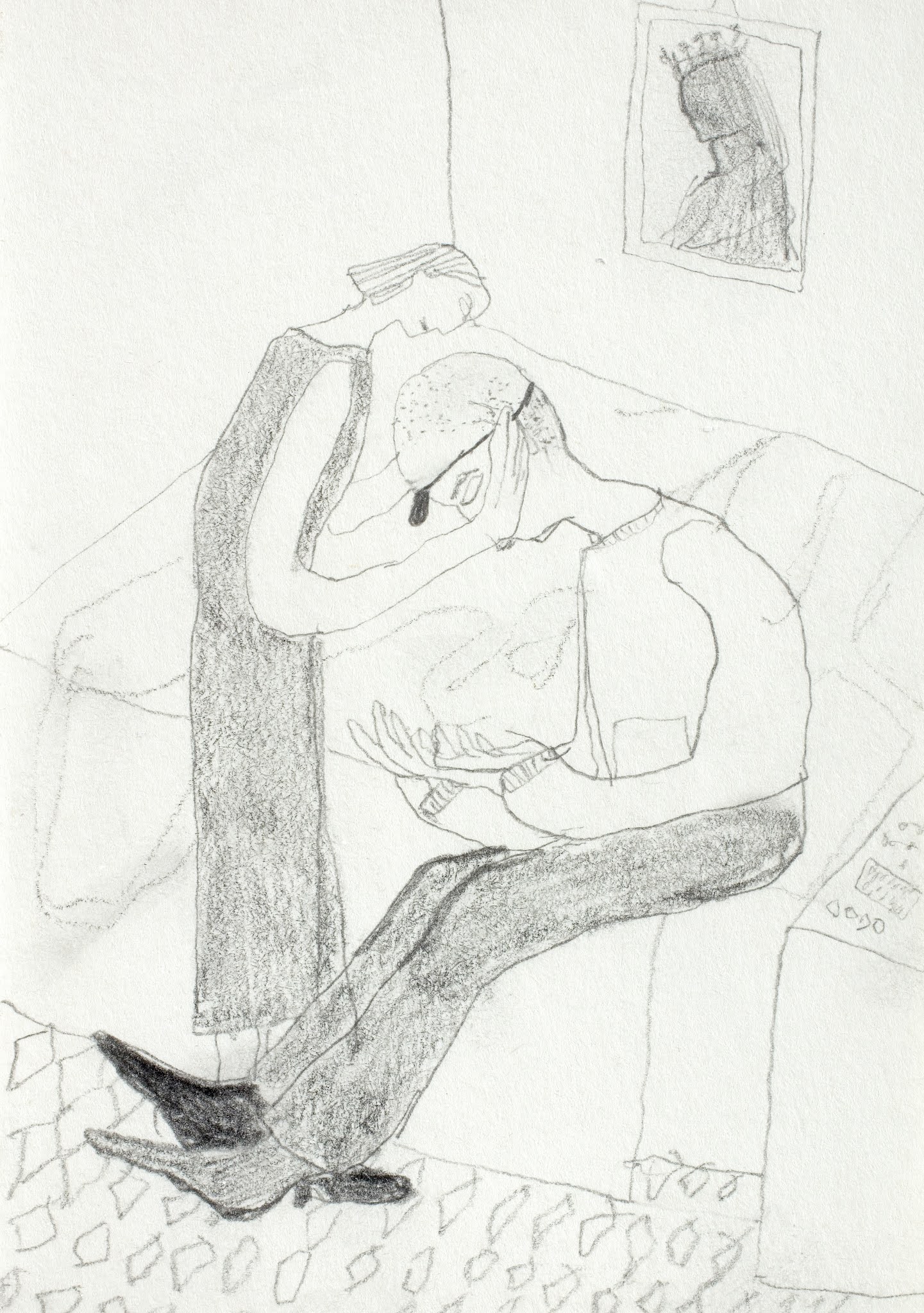

Nancy Haslam-Chance: 'Caring Drawings'

It was very interesting therefore to see that the second prize had been awarded to Nancy Haslam-Chance for her 'Caring Drawings'. These pencil drawings are a long way from the fine artist's 'signature' drawings that forefront a special touch or individuality of approach and instead these drawings document her role as a carer and support worker. These drawings are more like those we might find in a visual diary, and they focus on the physical and emotional relationships she has formed with her clients.  The daily details and practicalities of her job are drawn from memory between shifts, an important reminder that artists need to ground their practice in reality if it is to communicate to others. This type of reality has of course in a time of COVID become much more visible, but carers have always been there working to support other human beings who have fallen on hard times, we just needed a reminder and Haslam-Chance has given it to us. 

Nancy Haslam-Chance: 'Caring Drawing'

Both these artists have produced work that has emerged out of a crisis, one that will hopefully have been overcome by the time the next Trinity Buoy Wharf Drawing competition is run. I would hope though that what their work intimates is that there is a move towards a rethinking of the role of the artist in society. A role that is less to do with individualism and one much more to do with self awareness, community cohesion and spiritual well being. 

Art as an idea is always changing

Reference

LeWitt, S 1967, “Paragraphs on conceptual art”. Artforum, vol.5, no.10, p.79

See also:

More on the TBW exhibition 

Etymological root of 'art' 

Thursday, 24 September 2020

The Trinity Buoy Wharf Drawing Prize is on tour

The Trinity Buoy Wharf drawing prize is on tour again, and interestingly as it does so, first year fine art students at the University of the Arts Leeds begin their first module with a drawing brief. Even in this time of media soaked information and constant Zoom meetings, drawing can still hold its own, and the fact that it can be done with very low and cheap forms of technology, ensures that it continues to be relevant. This year in particular the short listed artists demonstrate the continuing power of visual observation and how drawing can operate as a focus and a selector, picking out from the chaos of reality those moments that ensure that art can still reflect thoughtfully on the human condition. As well as all those other subjects and approaches, such as landscapes, buildings, abstracts, three dimensional drawings, performance drawing and gestural mark making, this year a strand of portrait drawing has emerged as one of the show's most powerful aspects, and its worth a closer look. 

Akash Bhatt

Akash Bhatt has interwoven text and image in his portrait, something that many of us aspire to do but rarely with the sensitivity that Bhatt demonstrates. All human beings have personal narratives and sometimes we can see these in their faces or in the way they sit, stand or move, and at other times it is in the stories they tell or the ones told about them by others. In this case tiny forehead worry lines, echo the horizontal lines of a sailor striped top, whilst foregrounded are hands used to hard work, all integrated and set into a field of reflective text. He has obviously honed his observational skills through the constant use of sketchbooks, something I've always warmed to as a way of keeping your eyes tuned to the many and various forms that make up our world. You can see him at work in this video. 

Akash Bhatt

Anna Barratt has a more surrealistic and emotional take on what it is to be human. Skin hangs 'flayed' away from the solidity of body mass and yet it still holds on to bodily functions. We are helpless sometimes in our emotional engagement with our bodies and its a useful reminder that you don't need a head in an image to make a portrait and that we have bottoms as well as tops. 

Anna Barratt

Barratt's work springs from unconscious tensions that come from the fact that the everyday is weird. Well sometimes it is and then its not, the toilet is boring, its function to support an everyday need, but our thoughts about this are often twisted and strange, such as why is that towel hung in that way and why is it so close to the cistern and who left that stain? 

Helena McGrath

Helena McGrath has an ideal technique for the locked in portrait. Her washes suggestive of a time marked out with the filling in of liquid tones, drips forming cage verticals that trap the image as it arrives. The figure in the background, (could it be the artist?) presenting to us the subject of the drawing, the home becomes the stage, which becomes the world within which the artist makes. This is a sort of self portrait as world maker, but the world is a domestic one, and who is to say that it is a smaller world than any of the others that we think exist? 

James Robert Morrison

James Robert Morrison

James Robert Morrison has pushed the fag joke to its limits. Rolling papers are waver thin, almost like Bible paper, with that tasty strip of glue, waiting to be licked and stuck to the other unglued paper edge. These are close ups, or as he puts it, 'there is never more than a fag paper between them', or in this case it takes about 60 fag papers to support this figure/ground relationship, all neatly stuck, licked dirty into the slick of graphite, touched carefully onto the surface of a Rizla dream. 

Lucy Anderson

Lucy Anderson makes large scale charcoal drawings. It's the light and surprising shadows that tell these stories, perhaps even more than what we think we see. Something is happening here, but we don't know what it is; a grey ghost shadow floats across the back wall, emerging from the old woman's head, perhaps an intimation of what's to come, whilst a strong young hand commands the foreground, alongside a half full glass of water. A question has been asked, of both the old woman and ourselves, but who will answer it?

Nancy Haslam

Nancy Haslam

Nancy Haslam gives us an insight into interwoven lives, lives of harsh reality, the ones that you know about, that you see statistics about, but don't really want to know about. Her line meanders, her touch is one of knowing unknowing, as she opens windows but in some ways closes them at the same time. There is no perspective, well not one we understand as such, this isn't one point or two point or three point, it's all points North, its being stuck in one place, one that you cant get far away enough from to see it in perspective. 

Sally Wood

Sally Wood

Sally Wood

Sally Wood shows us a new generation emerging. These are the portraits of those who will inhabit our future, as yet unframed, their futures still emerging, not yet boxed in by convention and society's will to power. Fresh, open and direct, these portraits are a healthy reminder of a future time when the virus is gone and we return to being able to see each other in the flesh and meet ourselves on our own terms and not those imposed upon us by a government that has forgotten what people look like. 

The Trinity Buoy Wharf Drawing Prize 2020 exhibition will tour to the following venues:

Drawing Projects UK in Trowbridge, Wiltshire: 2 to 31 October 2020 
Cooper Gallery at the University of Dundee: 13 November to 19 December 2020 
Trinity Buoy Wharf in London: from 9 January to 22 January 2021  
The Gallery at Arts University Bournemouth: from February 2021

See also:


Sunday, 19 July 2020

Drawing as writing: Ali Smith and the drawing eye

Alison Carlier performing an audio drawing

A few years ago the Jerwood Drawing Prize was won by a verbal description. In 2014 Alison Carlier's sound piece 'Adjectives, lines and marks' described at the time as an 'open-ended audio drawing', a 75 seconds long spoken description of an object, was chosen as being a worthy winner, because as the artist put it, "It exists in your head, rather than in a made or finished way. This open-endedness puts it in a similar place to some drawing conventions." The text's source was a reference book on Roman excavations in south London held by the Museum of London. The extract that Carlier had had recorded was her reading aloud a section describing a "hard, red, brown" Roman pot found in the London borough of Southwark. The exhibition was toured to Leeds and I was able to listen to the work and make my own mind up as to its value. 
I listened to it several times. It was an interesting idea, but one I felt had little poetry in it, more a concept about the relationship between the languages of art forms than a new observation about the world. The fact that a description in words of something can be seen as a type of drawing, is fascinating and opens out the territory between the two disciplines as fertile soil within which to plant ideas and when Carlier reads her work aloud, it becomes part of the expanded field of drawing which now includes performance.
I was reminded of this recently because I have just been reading Ali Smith's 'How to be Both', another work from 2014. 
Smith is someone as a writer I have referred to before, her book on writing 'Artful' had helped me think through how someone could mix different languages together and yet still maintain an overall ‘voice’. 
The extract below from pages 203 to 205 of Ali Smith's 'How to be Both' is one I would propose myself as a drawing as written text, indeed, if read out loud it is an even better drawing. The Ali Smith text has for myself a poetical core that transforms the descriptive text into something much more memorable than Carlier's. As an educator, I am on the one hand trying to maintain a position that keeps the door open for the widest range of approaches to the making of drawings, but on the other hand I am proposing that whichever approach is taken, that there are always some works that will be more resonant than others and as the maker and/or audience of these works, you will need something to measure one thing against another. Therefore try and think about Smith's text as a ruler against which to measure other text pieces. 

Extract from Ali Smith's 'How to be Both'


A boy has just watched a horse pee so much urine that a small pool has formed, as he gazes in fascination at this pool something falls into it creating a small ring like disturbance.

Ali Smith describes the following scene thus:


The thing that fell caused a circle to happen, a ring to appear in the piss: the ring widened and widened until it got to the edges and vanished.

It was a small black ball like the head of an infidel: it had a single wing, a hard and feathery-looking thing stuck straight out of it.

The ring that it made in the pool when it fell, though, was gone.

Where’d it go?

I shouted the words, but she was trampling cloth in the big half barrel: she was making the cloth turn white with the soap, she was singing, didn’t hear me, my mother.

I called again.

Where’d it go?

Still she didn’t hear me: I picked up a stone: I aimed at the side of the barrel, I missed, hit a chicken in its sidefeathers instead: the chicken made a chicken noise, jumped and nearly flew: it ran about in a dance that made me laugh, it panicked all the geese and the ducks and the other chickens: but my mother has seen the stone hit the chicken and she leapt out of the barrel and ran towards me with her hand in the air cause she was a despiser of cruel things.

I wasn’t I said. I didn’t. I was calling you. But you were preoccupied so I threw it to get your attention. I didn’t mean to hit the chicken. The chicken got in the way.

She dropped her hand to her side.

Where did you learn that word? She said.

Which word I said?

Preoccupied, she said. Attention.

From you, I said.

Oh, she said.

She stood in the dust with her wet feet: her ankles were beaded with light.

Where’d it go? I said.

Where’d what go? she said.

The ring, I said.

What ring? She said.

She got straight down and looked in the pool: she saw the winged thing.

That’s not a ring, she said. That’s a seed.

I told her what happened: she laughed.

Oh she said. That sort of ring. I thought you meant a ring for a finger, like a wedding ring or a gold ring.

My eyes filled with tears and she saw.

Why are you crying? She said. Don’t cry. Your sort of ring is much better than those.

It went, I said. It’s gone.

Ah, she said. Is that why you are crying? But it hasn’t gone at all. And that’s why it’s better than gold. It hasn’t gone, it’s just that we can’t see it any more. In fact, it’s still going, still growing. It’ll never stop going, or growing wider and wider, the ring you saw. You were lucky to see it at all. Cause when it got to the edge of the puddle it left the puddle and entered the air instead, it went invisible. A marvel. Didn’t you feel it go through you? No? But it did, you’re inside it now. I am too. We both are. And the yard. And the brickpiles. And the sandpiles. And the firing shed. And the houses. And the horses, and your father, your uncle, and your brothers, and the workmen, and the street. And the other houses. And the walls, and the gardens and houses, the churches, the palace tower, the top of the cathedral, the river, the fields behind us, the fields way over there, see? See how far your eye can go. See the tower and the houses in the distance? It’s passing through them and nothing and nobody will feel a thing but there it is doing it nonetheless. And imagine it circling the fields and the farms we can’t see from here. And the towns beyond those fields and farms all the way down to the sea. And across the sea. The ring you saw in the water’ll never stop travelling till the edge of the world and then when it reaches the edge it’ll go on beyond that too. Nothing can stop it.

Smith's writing can be seen in the mind as an image. As an image it can belong to the same idea category as a certain sort of drawing. This relationship between drawing and text is something that continues to fascinate, and I have just been informed that the Trinity Buoy Wharf selection panel for this year's drawing prize has provisionally accepted an e mail exchange by Charlie Eden and myself as a drawing. This exchange is presented as a series of three printouts of e mails of an ongoing conversation about drawing.  These printouts are what have been selected to go into the second stage of the competition, to be looked at by the judges as actual rather than virtual images. I would argue that because it is a conceptual idea rather than an image based piece, the fact that it has passed the first stage of the selection process means it was successful, whether or not it then makes it to the final exhibition. As to how good the piece is, I go back to the Ali Smith extract. If it makes it through to the exhibition, read both and decide which is the most memorable. 
See also:

Thursday, 25 June 2020

The Trinity Buoy Wharf Drawing Prize 2020


I have posted before about the importance of what was formally the Jerwood and which is now the Trinity Buoy Wharf drawing prize. 2020 is the 25th consecutive annual holding of this prize and accompanying exhibition and to celebrate this, the call for entries is going international, and is now open for artists from the UK and around the world. There is another new addition: the Working Drawing Award, which focuses on the role of working drawings in art, architecture, design, engineering, manufacturing, science and if you are a regular reader of this blog you will be very aware of how I have attempted to open out the conceptual framework around which we can think about why drawing matters to include the work done in other disciplines. In particular it would be interesting to look at how even more disciplines could be included, such as police crime scene drawings or those done for archeological digs or circuit diagrams. 

The Trinity Buoy Wharf drawing prize has been led by its Director, Professor Anita Taylor, since its inception, and she is passionate about drawing in all its guises. She has helped raise the profile of what has sometimes been a forgotten art form, and she continues to work hard to communicate and support an understanding of drawing as a medium that is central to the way that humans communicate with each other. 

The entry date has been extended and it is now going to be the 9th of July. All the details for entry are on the Trinity Buoy Wharf Drawing prize website  and there are regional as well as London drop off and collection points. 

See also:

Thursday, 2 August 2018

The Trinity Buoy Wharf Drawing Prize

Last years's Jerwood Drawing Prize Exhibition

I have posted on the Jerwood Drawing prize before, but things have changed and the prize has new sponsors, it is now called the Trinity Buoy Wharf Drawing Prize. It is however still led by founding Director Professor Anita Taylor from Bath Spa University who is a long time supporter and champion of excellence in contemporary drawing practice. This competition is an essential part of the UK drawing calendar and because it is a touring exhibition there will usually be a venue not too far away from where you are. This year's Jerwood exhibition is however still touring, so if you are in the South West you will be able to see the exhibition at the Drawing Projects space in Trowbridge. 
The project was founded in 1994 as the Rexel Derwent Open Drawing Exhibition. It was known from 1996 until 2000 as the Cheltenham Open Drawing exhibition and was supported by a private benefactor, Westland Nurseries, The Summerfield Trust, CHK Charities and Rootstein Hopkins Foundation. Most recently, the exhibition has been known as Jerwood Drawing Prize with 17 years of significant support from Jerwood Charitable Foundation from 2001 until 2017. Trinity Buoy Wharf Trust became the principal benefactor in 2018.
I’ve just been informed that I am a shortlisted exhibitor this year, so those of you that take an interest in the drawing matters that I try to put forward in this blog and who are UK based have a chance to see what I actually do.
The Trinity Buoy Wharf Drawing Prize winners will be announced in September 2018 which is when the exhibition will open. 

My entry for this competition was the looped animation below. It was drawn using the most basic animation technology, using a dip in pen and ink, I drew directly on sheets of A4 tracing paper bought from a stationers. I photographed each frame in daylight and because it took so long to do the light conditions changed during the day, so that as the animation moves on the lighting varies according to what time of the day I was working. The sound was processed using Garage Band, I used feedback generated by trying to record and play at the same time from the same computer, once again a very basic way of generating a discordant soundtrack. As the animation ends it goes back to horizontal lines representing a calmer sea, these lines are echoed by the ones that begin the first few frames of the animation, the looping of the MP4 then results in an idea of the endless nature of the issue. Not just as something related to what is going on now as refugees attempt to cross the sea, but as something that has always been the case, every war, every famine, every natural disaster, will result in displaced people and as an island nation if these people are to find safety here at some point on their journey they will have to cross a sea. 

Garry Barker: 'Boat at Sea' Pen and ink animation
Check out these earlier posts on the Jerwood Drawing Prize