Showing posts with label anti-art market. Show all posts

Wednesday, 27 January 2021

The Trinity Buoy Wharf Drawing Prize winners announced.

M. Lohrum: You are It.

It is always fascinating to see the final selection and winners that are picked out in the annual Trinity Buoy Wharf Drawing Prize. It works as a sort of litmus test as to the current state of drawing led practices and especially this year in a time of lockdown. My own added personal interest was that I had submitted a collaborative piece this year, that made it through the first round but no further; so I was of course fascinated to see what did win. 

Trinity Buoy Wharf Drawing Prize 2020, Installation view(s) Cooper Gallery 2020. Courtesy Cooper Gallery. Photography by Eoin Carey.

M. Lohrum’s 'You are It' was the overall prize winner and for the first time a performative drawing has won. It reminded me of Sol Lewitt drawings that were also made from written rules, his impermanent wall drawings consisting of sets of the artist's instructions, so that their actual execution could be carried out by someone else. There is though a difference. In M. Lohrum’s case the audience is engaged directly in the drawing's execution, in Lewitt's case it was usually student volunteers or gallery staff who made the drawings and when you did get to see the work it was usually already completed. 

Sol Lewitt: Wall Drawing instructions

M. Lohrum is less 'authorial' in the control of the work, and there is more an emphasis on collaboration and participation, which I think reflects a shift in attitudes that has taken place since Lewitt began producing his work in the late 60s. Lewitt came from a time when the status of the artist was more or less unquestioned, artists were the avant-garde, the romantic initiators of new ideas and as such their name was very important, as it was used to in effect 'brand' their practice. We are living in different times, the status of the artist has been questioned and in particular the role of the artist as maker of 'honorific objects' that are to be collected by rich individuals and displayed as cultural capital in museums and art galleries is perhaps coming to an end. Of course the art market still exists, but it seems to have less and less relevance to many an artist's everyday life. My own recent experience is that as an artist I have become more embroiled in interdisciplinary activities, especially those related to health and wellbeing. The artist still has a role in society, but perhaps it is one shifting away from a capitalist idea of the producer of a particularly rare cultural commodity and is moving gradually towards an idea of the artist as catalyst or instigator of alternative ways of approaching life. Artists have always been associated with raising awareness, seeing something more in the everyday than the everyday, and it would seem that in times of a lockdown we need this quality more than ever. As the selector Frances Morris stated “The invitation to members of the public to participate as anonymous makers and the work’s dependency on collaboration between strangers, felt timely and necessary, speaking to the power of art to bring people together”. It is not of course just that a work like this brings people together, it also reminds us of the central position of our bodies in the making of meaning. Every drawing that has ever been made is in one way or another a seismographic record of the person that made it. Each one of us has a different ratio of arm length to height and to hand size; we are all unique in relation to the type of heart beat we build our life's rhythm to and in the way that our nervous systems are wired up. Each person participating in this drawing, as they are instructed to draw from their shoulder will immediately be aware of the weight of their own arm and of how well it operates as it moves around in its shoulder socket. Body awareness is of course vital if we are to maintain a sense of our own well being, an awareness not just of our selves but of other people's bodies is essential to the building of empathy with others and the development of our collective sense of community care. 
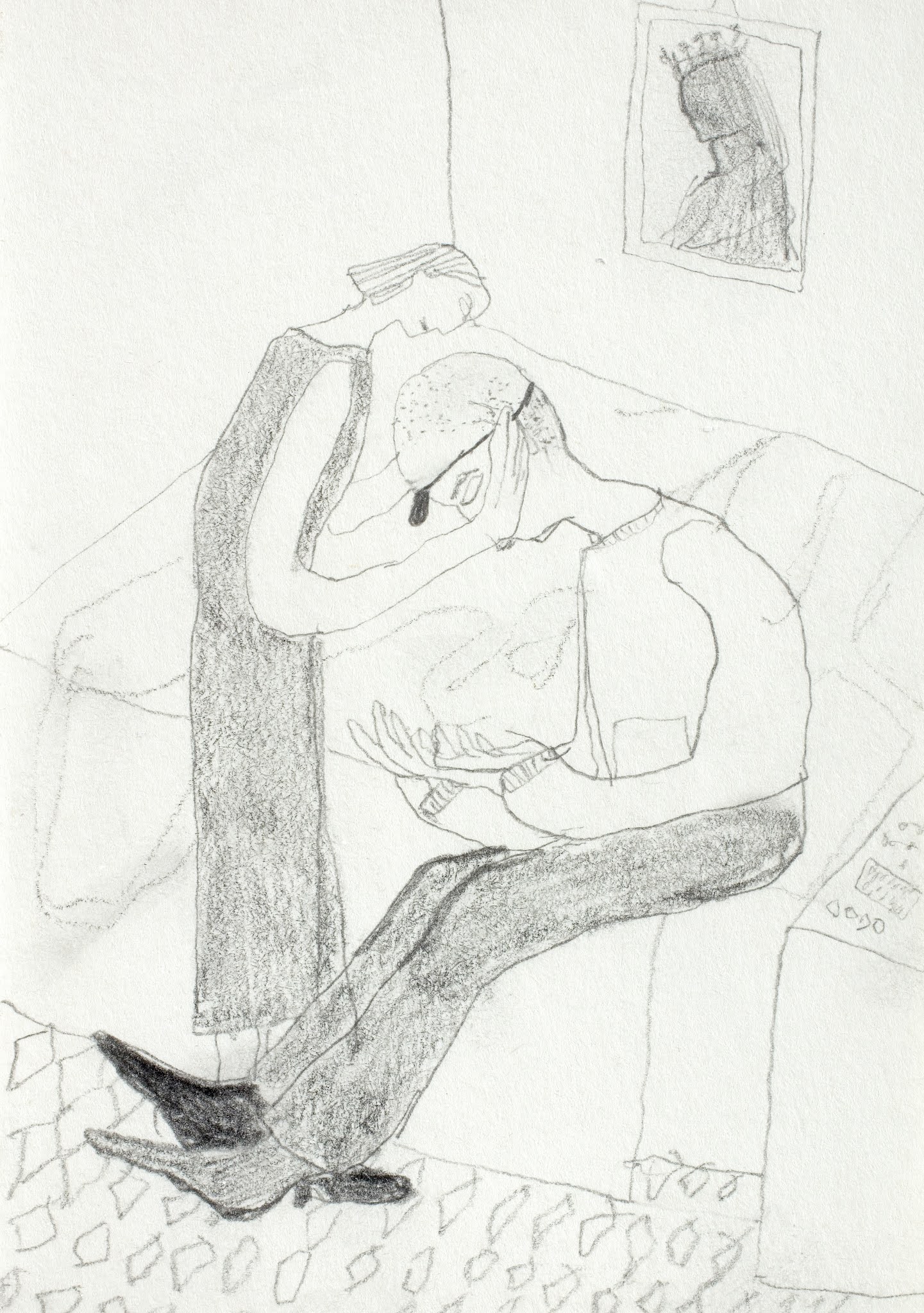

Nancy Haslam-Chance: 'Caring Drawings'

It was very interesting therefore to see that the second prize had been awarded to Nancy Haslam-Chance for her 'Caring Drawings'. These pencil drawings are a long way from the fine artist's 'signature' drawings that forefront a special touch or individuality of approach and instead these drawings document her role as a carer and support worker. These drawings are more like those we might find in a visual diary, and they focus on the physical and emotional relationships she has formed with her clients.  The daily details and practicalities of her job are drawn from memory between shifts, an important reminder that artists need to ground their practice in reality if it is to communicate to others. This type of reality has of course in a time of COVID become much more visible, but carers have always been there working to support other human beings who have fallen on hard times, we just needed a reminder and Haslam-Chance has given it to us. 

Nancy Haslam-Chance: 'Caring Drawing'

Both these artists have produced work that has emerged out of a crisis, one that will hopefully have been overcome by the time the next Trinity Buoy Wharf Drawing competition is run. I would hope though that what their work intimates is that there is a move towards a rethinking of the role of the artist in society. A role that is less to do with individualism and one much more to do with self awareness, community cohesion and spiritual well being. 

Art as an idea is always changing

Reference

LeWitt, S 1967, “Paragraphs on conceptual art”. Artforum, vol.5, no.10, p.79

See also:

More on the TBW exhibition 

Etymological root of 'art' 

Monday, 2 December 2019

Collaborative drawing


Marcel Dzama and Raymond Pettibon

Sometimes working with someone else can help trigger new and unpredictable responses to the process of image generation. We all get stuck at one time or another and our own working processes can become too well known, so when that happens it can be really rewarding to work with someone else. Working with other people is also a really useful way to try and minimalise the dreadful 'I'. Being a unique individual is such a hard ask and is perhaps the worst capitalist idea of all, because in many ways it forces us to become our own product. "I am unique therefore I can be sold." One way to try and get out of this trap is through collaborative drawing. For instance Marcel Dzama and Raymond Pettibon have been combining their work, their individual narratives coming together to make compulsive almost convulsive imagery, that brings the implications of each artist's language to the fore.


Marcel Dzama and Raymond Pettibon have also collaborated with Amy Sedaris, sometimes a three way collaboration can throw up even more unexpected results.


Once you get the idea of collaboration it can be something wonderful. Marcel Dzama in collaboration with Bryce Dessner has produced a ballet called 'The Most Incredible Thing', which is an adaptation of a Hans Christian Andersen story. It has a score by Dessner and costumes and sets by Dzama. The collaboration then goes further; Amy Sedaris made a film of the event, at times playing Dzama and also acting out the part of the choreographer, Justin Peck. Roles become blurred and each participant could be a producer, a maker or an actor, Sedaris is also a comedian and the anarchic nature of her comedy, stirs up Dzama's existing visual language of people and things, so that it becomes more unexpected and new hybrids of both shape and purpose are formed. As more people become involved we focus less on the individuals and more on what has been produced.


The Most Incredible Thing

I have tried working with other artists myself and over the last few years have collaborated with a range of different artists in the 'Drawing Dialogue' project. Because this project involves working with artists at a distance, the collaboration has been facilitated by the postal service, a drawing being made and then sent on to the next artist. When working via post you can't return to the imagery, and you can't protect it either, so you have to let it go, which is another good thing. I have recently been working on some new images that have been sent to me, you can see the before and after from some of these below, the drawings have now gone on to a third artist and we both await to see what will have happened to them.


The first image I was faced with was texturally very rich. The base layer looked as if it was a blue cyanotype, which had then been worked on with a layer of watercolour. I used white oil pastel to carve out a space for a drawing of a running bird/human, I had to find an inhabitant that somehow felt right. No real logic, all done by intuition, but that is fine and takes the idea right back to the original 'exquisite corpse' drawings. 


The second image (all three are from the same artist), was I think, made as if the brushstroke surface was a sky, but I turned it through 180 degrees to make it a sea. 


I painted a white gesso rectangular insert and then worked in pen and ink into that, with an image suggestive of some sort of sea monster. The insert was an idea about how to deal with more than one time in an image that I nicked from Richard McGuire’s ‘Here’.


I found the image above really hard to respond to. Mainly because I liked it a lot and didn't want to deface it.  Eventually I found a way to bring in an image of my own that suggested it was a secondary addition to the first image, like a child coming into the room and standing alongside its parent. 

I shall be very interested in how the third artist responds to these images, (there are 12 drawings I'm working on at the moment, 4 images from each artist), because I think they are particularly rich and will require very sensitive or conversely quite dramatic interventions by the next person who works on them. 

I'm also working with another artist on some ideas where we are collaborating using ceramics and textiles. Early days yet but again useful ideas are emerging and they are ones that I would never have arrived at on my own. 


If you were making a film it would require all sorts of collaborations, from actors, via sound and video technicians, to the people that sort out catering, and out of that complexity very sophisticated pieces of communication can emerge. Working in collaboration is something that can be very hard to do as you have to let go of some of your controlling instincts but on the other hand you can find things out about yourself and your work that may surprise you and may really help you reinvent yourself when you go back into the studio. 
My own awareness of these issues has been growing rapidly because of my work with the Leeds Creative TimeBank. The LCT consists of creative people from all types of sectors, including actors, dancers, musicians, designers and artists. By working alongside these other creative practitioners I have become much more aware of how my own working methods and ideas are a product of my fine art training and that I can learn a lot from how others approach their own disciplines. Dancers and musicians are always having to consider how to respond or improvise within a team of collaborators and their total acceptance of this is something that has caused me to question my own view of how the studio operates as a place for solitary contemplation and reflection. 
I'm working through the fact that the shadow of Romanticism is still cast over me and it is something that still seems to be there in the back of peoples' minds when I talk to them about why they want to be artists. Romanticism in many ways celebrated the personality of the entrepreneur, a role whereby individual liberty, coupled with a creative mind, is rewarded with material power. We don't normally place the artist alongside the business entrepreneur, but when you look at their essential characteristics they are in fact the same. A typical example of this in fiction would be Ayn Rand's novel 'The Fountainhead', her character Howard Roark, the architect who totally believes in his own unique vision, being a classic portrayal of the modern artist.  

So why is this? There are some essential tropes associated with romanticism, such as; individual imagination, intuition, individual rights, liberty, creativity, the importance of subjectivity, originality, inspiration, the artist as a brilliant creator, humans at one with and a part of nature, a celebration of nature's power, pride in national identity and spiritual renewal. When you look at these tropes there are several conflicting and perhaps difficult entanglements with what 'Romanticism' represents, some of which, such as 'a pride in national identity', now feel hard to reconcile with 'a celebration of nature's power', but if you look at the Nazi German narrative of native German soil (Heimat) and love of nature, and the use of traditional folk tales to both heighten an awareness of landscape as 'home' and of an ideal, you can easily see how a concept can be constructed that subverts and overturns ideas of individual rights and replaces them with a notion of 'certain individual's rights', or as George Orwell put it, "All animals are equal. But some animals are more equal than others".  The idea of genius can be easily added into other narratives such as eugenics whereby one race is seen as inferior to another. Add to that Ayn Rand's concept of the philosophy of objectivism, as Darryl Cunningham pointed out in his wonderful graphic novel 'The Age of Selfishness: Ayn Rand, Morality, and the Financial Crisis', you can see that both the economic policies that led to the destruction of the planet and the current idea of artists and the art world stem from the same root. 


Collaboration doesn't mean that there is an escape from commodification, Larry Gagosian knows a good deal when he sees one. Both Warhol and Basquiat are sold by him and putting the two together multiplies their uniqueness by two. At one point when Basquiat was going through a really bad time in relation to his drug addiction, Gagosian paid to fly Basquiat and several of his friends from New York, first class to LA for an opening of Basquiet's work. "I've never seen anything like it on a plane," Gagosian later joked. "It was like these four kind of rough-looking black kids hunched over a big pile of coke, and then they just switched over to these huge joints, and sat up there and smoked them. It was wild. They had their big, hooded ski-glasses on, and big overcoats..." Basquiet's early death brought on by excessive drug use, in many ways ratcheting up the prices for his work. It is easy to forget that Basquiet, as Katharine Arnold, the director and senior specialist in charge of post-war and contemporary art at Christie’s states, "was given space by the gallerist Annina Nosei and was able to create fully realised canvases with the same intensity and vitality as his street art.” The process of transferring his 'street-art' onto canvas, being one that effectively transformed worthless non art world stuff into art world gold. The tricks of the trade of marketing are now so sophisticated that we don't even realise how we are manipulated to 'like' these ideas of uniqueness and difference. Capitalism feeds off the idea of the unique thing that everyone needs because no one else has got it, its like a drug and I have been subject to its effect, like so many other artists
However there are other models, most of the anonymous artists that have existed in other times and cultures have operated to make objects that work as a type of invisible glue between people, ideas and things.

Here are a few:

Woman carrying a fertility doll

Backpack with strawberry doll

Someone has found a nail artist who can help them express their nationalist leanings

Henna artist

All of these anonymous artists will have had to work in collaboration with others, its just that we don't tend to think of them as artists, and if we do, society doesn't at the moment value their contributions, but what if the art market didn't exist?  Is there space for a rethinking of what folk art might be and what the purpose of art is?

See also: